
Бесплатный фрагмент - Science, Culture and Youth: Сборник трудов по материалам X Международной студенческой научно-практической конференции (25 марта 2025 г.)
Секция 1. Актуальные проблемы современности
Акопян Н. Ж.
Current Environmental Issues: Challenges and Solutions
Akopyan N. Zh. 3rd year bachelor degree student «State and municipal administration»
Scientifc adviser: Massalskaya Y.V., PhD in Philology, Associate Professor of the Department of Foreign Languages
Federal State Budgetary Educational Institution of Higher Education «Technological University named after twice Hero of the Soviet Union, Pilot-cosmonaut A.A. Leonov», Korolev, Russia
In today’s world, environmental issues are among the most pressing concerns we face. The impact of human activities on the natural world has reached unprecedented levels, leading to significant changes in the Earth’s ecosystems.
The subject matter being: Addressing these issues is crucial for the sustainability of our planet and the well-being of future generations. This article explores some of the most critical environmental problems we face today and the potential solutions to mitigate their effects.
Keywords: climate change, ecosystems, habitat destruction, the loss of biodiversity, the loss of forests, pollution.
1. Climate Change
Climate change is arguably the most significant environmental issue of our time. The increase in greenhouse gas emissions, primarily from burning fossil fuels such as coal, oil, and natural gas, has led to global warming. This rise in temperatures is causing glaciers to melt, sea levels to rise, and extreme weather events to become more frequent and severe. For example, the increase in the frequency and intensity of hurricanes, droughts, and heatwaves can be directly linked to climate change. These changes not only threaten natural ecosystems but also have severe implications for human health, agriculture, and infrastructure. To combat climate change, it is essential to reduce carbon emissions by transitioning to renewable energy sources such as solar, wind, and hydroelectric power. Governments and industries worldwide are investing in renewable energy projects, but more aggressive policies and investments are needed to accelerate this transition. Improving energy efficiency in buildings, transportation, and industry can also significantly reduce emissions. Innovations such as electric vehicles, energy-efficient appliances, and smart grids are contributing to this effort. Carbon capture and storage (CCS) technologies are another critical component of the solution. CCS involves capturing carbon dioxide emissions from sources like power plants and industrial processes and storing them underground to prevent them from entering the atmosphere. Additionally, reforestation and afforestation projects can help absorb carbon dioxide from the atmosphere, acting as natural carbon sinks. Another important aspect is the role of international cooperation. Agreements like the Paris Agreement aim to unite countries in their efforts to limit global warming to below 2 degrees Celsius above pre-industrial levels. Through such international collaborations, countries can share technology, provide financial support, and create a unified approach to combating climate change.
2. Loss of Biodiversity
The loss of biodiversity is another critical issue that threatens the stability of ecosystems worldwide. Habitat destruction, pollution, overexploitation of resources,
and climate change are driving many species to extinction at an alarming rate. The loss of biodiversity can lead to the collapse of ecosystems, reducing their ability to provide essential services such as pollination, water purification, and climate regulation. Protecting natural habitats is vital for preserving biodiversity. This can be achieved through the creation of protected areas, wildlife corridors, and national parks. For instance, the Amazon Rainforest, often referred to as the «lungs of the Earth,» is a critical habitat for countless species. Efforts to halt deforestation in this region are crucial for global biodiversity conservation. Promoting sustainable practices in agriculture, forestry, and fisheries is also essential. Sustainable agriculture involves techniques that minimize environmental impact, such as crop rotation, organic farming, and the use of natural pest controls. Sustainable forestry practices include selective logging, reduced-impact logging, and certification schemes like the Forest Stewardship Council (FSC). In fisheries, practices such as quotas, no-catch zones, and sustainable aquaculture can help protect marine biodiversity. Additionally, raising awareness about the importance of biodiversity can help garner public support for conservation efforts.
Education and outreach programs can inform people about the value of biodiversity and the steps they can take to protect it. Collaborative efforts between governments, NGOs, and local communities can enhance conservation initiatives, ensuring that they are inclusive and effective.
3. Pollution
Pollution, in its various forms, continues to be a major environmental problem. Air pollution from industrial activities and vehicle emissions contributes to respiratory diseases and global warming. Major cities worldwide, such as Beijing and Delhi, frequently experience hazardous air quality levels, impacting millions of residents’ health. Water pollution from agricultural runoff, industrial discharges, and plastic waste harms aquatic ecosystems and affects human health. For instance, the presence of microplastics in oceans is a growing concern, as these tiny plastic particles are ingested by marine organisms and can enter the food chain, ultimately affecting human health. Soil pollution, often caused by the use of pesticides and improper disposal of waste, reduces the fertility of land and can lead to food contamination. To address pollution, stricter regulations and enforcement are needed. Governments must implement and enforce laws that limit emissions and discharges from industries and vehicles. The development of cleaner technologies, such as electric cars and renewable energy sources, can also reduce pollution. Effective waste management practices are crucial in reducing pollution. This includes recycling, composting, and the proper disposal of hazardous waste. Public awareness campaigns can educate individuals on reducing their waste and recycling correctly. For example, the European Union’s circular economy model aims to minimize waste and make the most of resources by promoting recycling and reuse. Innovations in technology can also play a role in reducing pollution. For instance, advances in filtration systems for industrial plants can significantly reduce harmful emissions. In agriculture, precision farming techniques can minimize the use of fertilizers and pesticides, reducing runoff into water bodies.
4. Deforestation
Deforestation, driven by logging, agricultural expansion, and urban development, has significant environmental consequences. Forests play a crucial role in carbon sequestration, water cycle regulation, and providing habitats for countless species. The loss of forests not only exacerbates climate change but also threatens biodiversity and disrupts the livelihoods of indigenous communities. Efforts to combat deforestation include promoting sustainable forestry practices. Selective logging, where only certain trees are harvested, can minimize environmental impact. Certification schemes like the Forest Stewardship Council (FSC) ensure that timber products come from responsibly managed forests. Additionally, reforestation projects, such as the Great Green Wall initiative in Africa, aim to restore degraded landscapes and create new forests. Supporting policies that protect forested areas is essential. Governments can designate protected areas and enforce anti-deforestation laws. International cooperation and funding can also support forest conservation efforts in developing countries. For instance, the United Nations’ REDD+ program provides financial incentives for developing countries to reduce emissions from deforestation and forest degradation. Community-based approaches to forest management can also be effective. Involving local communities in the management and conservation of forests ensures that they benefit from sustainable practices and have a vested interest in protecting these areas. Programs that provide alternative livelihoods, such as ecotourism or sustainable agriculture, can reduce the pressure on forests.
5. Ocean Acidification
Ocean acidification, caused by the absorption of excess carbon dioxide from the atmosphere, poses a serious threat to marine life.
The increase in ocean acidity affects the ability of organisms like coral and shellfish to build their skeletons and shells, leading to weakened marine ecosystems. Coral reefs, often referred to as the «rainforests of the sea,» are particularly vulnerable. These ecosystems support a vast array of marine life and provide benefits such as coastal protection and tourism revenue. Reducing carbon emissions is critical to slowing ocean acidification. International agreements like the Paris Agreement aim to limit global temperature rise and reduce carbon emissions. Additionally, protecting marine areas through the establishment of marine protected areas (MPAs) can help safeguard vulnerable ecosystems. MPAs restrict activities like fishing and drilling, allowing ecosystems to recover and thrive. Reducing other stressors, such as overfishing and pollution, can also help marine ecosystems adapt to changing conditions. Sustainable fishing practices, such as catch limits and the use of selective gear, can prevent overfishing and protect marine biodiversity. Efforts to reduce plastic pollution, such as bans on single-use plastics and initiatives to clean up ocean debris, can also benefit marine life. Scientific research is essential in understanding and addressing ocean acidification. Continued monitoring of ocean chemistry and its effects on marine life can inform policy decisions and conservation strategies. Collaboration between scientists, policymakers, and industry stakeholders is crucial for developing effective responses to this global challenge.
6. Overpopulation
Overpopulation exacerbates many environmental problems, as the growing human population increases demand for resources and generates more waste. This leads to greater deforestation, pollution, and habitat destruction. Urban areas are expanding rapidly, often at the expense of natural habitats, leading to the loss of biodiversity and increased carbon emissions. Addressing overpopulation involves promoting family planning and improving access to education, particularly for women and girls. Education is a key factor in reducing birth rates, as educated women are more likely to have fewer children and invest more in their health and well-being. Programs that provide access to reproductive health services and contraception can also help control population growth. Developing sustainable living practices that minimize environmental impact is essential. This includes promoting energy-efficient buildings, sustainable transportation, and reducing waste through recycling and composting. Urban planning that prioritizes green spaces, public transportation, and sustainable infrastructure can help create more sustainable cities. Innovative solutions are also needed to address the challenges of overpopulation. For example, vertical farming can increase food production while using less land and water. Smart city technologies can improve resource efficiency and reduce environmental impacts in urban areas. Conclusion The environmental issues we face today are complex and interrelated, requiring coordinated efforts at local, national, and global levels. By transitioning to sustainable practices, investing in clean technologies, and raising awareness about the importance of environmental protection, we can work towards mitigating these challenges. It is imperative that we act now to ensure a healthy and sustainable future for our planet and all its inhabitants. Through collective action and a commitment to sustainability, we can protect our environment for future generations.
References:
1. European Environment Agency (EEA). (2021). «Air quality in Europe — 2021 report.» Available at: https://www.eea.europa.eu/publications/air-quality-in-europe-2021
2. Food and Agriculture Organization of the United Nations (FAO). (2020). «The State of World Fisheries and Aquaculture 2020.» Available at: http://www.fao.org/publications/sofia/2020/en/
3. IPCC. (2018). «Global Warming of 1.5° C. An IPCC Special Report.» Available at: https://www.ipcc.ch/sr15/
4. Intergovernmental Science-Policy Platform on Biodiversity and Ecosystem Services (IPBES). (2019). «Global Assessment Report on Biodiversity and Ecosystem Services.» Available at: https://ipbes.net/global-assessment
5. The Ocean Foundation. (2021). «Ocean Acidification.» Available at: https://oceanfdn.org/projects/ocean-acidification/
6. United Nations Environment Programme (UNEP). (2021). «Making Peace with Nature: A scientific blueprint to tackle the climate, biodiversity and pollution emergencies.» Available at: https://www.unep.org/resources/making-peace-nature
7. World Wildlife Fund (WWF). (2020). «Living Planet Report 2020.» Available at: https://www.worldwildlife.org/pages/living-planet-report-2020
Анохина В. С., Маркович К. Б.
The Pushkin card as a tool popularizing culture: advantages, disadvantages, and ways to improve
Anokhina V.S., Markovich K.B. 2nd year bachelor degree students «Business Informatics»
Scientifc adviser: Kyuregyan M.P., PhD in Sociology, Associate Professor of the Department of Foreign Languages
Federal State Budgetary Educational Institution of Higher Education «Technological University named after twice Hero of the Soviet Union, Pilot-cosmonaut A.A. Leonov», Korolev, Russia
The article presents an analysis of the program «Pushkin card’ as a mechanism popularizing culture among young people. The article considers the advantages of the initiative, the existing disadvantages and proposes ways of improvement, taking into account the federal status of the project, registration characteristics of cultural institutions, the possibility of expanding the users’ age range.
Keywords: Pushkin card, popularizing of culture, young people, government support.
Russia’s modern cultural policy is aimed at actively involving young people in the country’s cultural life. The program «Pushkin card’, started in 2021, became a very important instrument to support cultural institutions and stimulate young people’s interest to art. The initiative arose amid a decline in attendance at cultural events during the Covid-19 pandemic and the increasing digitalization of leisure.
One of the key advantages of the program is the opportunity to go to theatres, museums, concert halls and other cultural institutions free of charge or on a subsidized basis. As part of the program for 2024, the user was provided with a certain amount (5000 roubles a year) divided between various cultural events — 2000 roubles for cinemas, and 3000 roubles for theatres, museums and concerts [7]. This reduces barriers to attending cultural events, contributing to the formation of cultural habits among young people.
The Pushkin card program contributed to a significant increase in attendance at cultural institutions. According to reports for 2024, more than 5,000 cultural institutions across Russia became participants in the project, which increased the number of visitors. This growth not only contributes to the financial stability of the institutions, but also stimulates the expansion of the repertoire and the holding of additional cultural events.
Government support through the Pushkin Card allows cultural institutions to receive additional budgetary funds, which is important for their development. Due to the increased demand from young people, theaters, museums and concert halls can invest in updating exhibitions and improving infrastructure. According to analytical materials, the use of additional funds made it possible to increase the number of exhibitions and theatrical productions by 15—20% in 2023. Thus, the program has a positive impact on the development of the cultural sector as a whole.
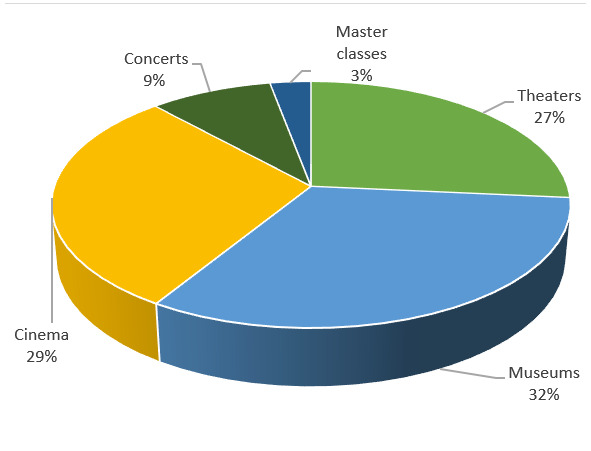
The Pushkin Card usage analysis revealed that most of the funds are spent on cinema visits, while theatrical productions, lectures and museum exhibitions remain on the sidelines. In 2023, about 60% of the allocated budget was spent on film screenings, while museums and exhibition halls received only 15%. This imbalance leads to an uneven distribution of cultural space, limiting access to diverse art forms.
The most popular events in the history of the program:
1. «Cheburashka» film screening
2. The exposition of the main museum complex of the Hermitage
3. «The Serf 2» film screening
4. Exhibition «Masterpieces of Russian art of the XI — early XX century» at the Tretyakov Gallery
5. " The Ice 3» film screening
6. The exposition «Colonnade of St. Isaac’s Cathedral» [1].
The registration process of cultural institutions in the program is accompanied by a significant administrative burden. To participate, an organization must meet a number of requirements: registration as a legal entity, the availability of a material and technical base and the absence of information in the register of foreign agents. In addition, institutions are required to register on a specialized platform http://PRO.Культура.РФ, where the responsible employee opens a personal account, creates a profile with detailed information about the organization, and then posts event announcements. After that, the profile is reviewed by an expert council, which can take several months [5], [4]. Such procedures complicate the connection of small cultural centers that do not have sufficient resources to process an application promptly.
To increase the efficiency of the process, it is proposed to automate some of the procedures, shorten the verification time and develop training materials for employees of cultural institutions. Regional differences in the cultural infrastructure development lead to the fact that in large cities young people have the opportunity to choose from dozens of events, and in small towns — from several. This leads to the fact that the benefits of the program are not felt equally in all regions of the country. In addition, the existing age limit for participation (14—22 years) limits the audience, as many citizens over the age of 22 also need support to attend cultural events [2].
Since 2025, the program has received the status of a federal project and has been integrated into the national project «Family» within the framework of the direction «Family values and cultural infrastructure» [3]. This provides additional funding, centralized management, and increased government attention. The federal status may allow us to build a unified strategy for the development of the program throughout Russia, which is especially important for eliminating regional disparities.
The existing age limit for participation (14—22 years) restricts access to the program for many young people who have already entered professional activity or are continuing their studies at universities. Increasing the maximum age to 30 years will allow reaching young professionals, graduate students and creative professionals for whom cultural development is also a priority [6]. Such an expansion of the audience can increase cultural engagement and provide more sustained support for cultural initiatives.
To study the perception of the Pushkin Card program among young people, a survey was conducted, which was attended by respondents aged 14 years and older. The sample is dominated by the age group of 14—22 years, which is explained by the target audience of the program.
All respondents (100%) are aware of the existence of the «Pushkin Card».
Among young people aged 14—22, the majority (about 80%) are cardholders.
Most often the card is used several times a year (this category accounts for approximately 57% of owners). About 28% of respondents use the card less than once a year. Near 7% of owners do not use the card at all (Fig. 1).
Theaters, museums, and cinemas are the most popular. Concerts and workshops were less frequent (Fig. 2).
About 75% of owners noted that the card increased the frequency of visits to cultural events. The rest of the respondents stated that having a card did not affect their behavior.
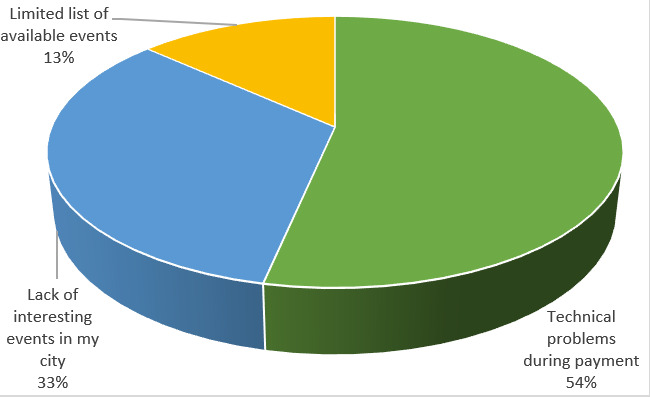
Approximately 40% of users faced difficulties (Fig.3).
The majority of respondents (about 70%) believe that the amount on the card is insufficient for active participation in cultural life.
Almost all respondents (about 90%) are in favor of increasing the age threshold, for example, to 30 years.
Also, the majority of respondents (about 85%) would like the card to cover more commercial events (for example, private theaters and concerts by famous performers).
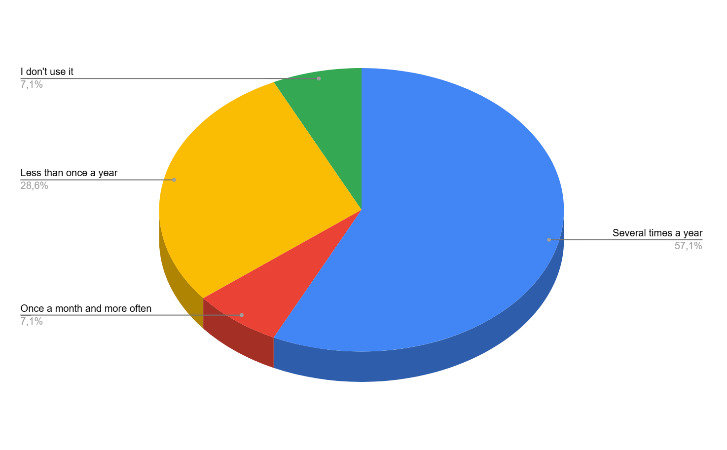
The Pushkin Card program has proven to be an effective tool for promoting culture and supporting youth. Despite the successes achieved, the problems of limited choice of activities, bureaucratic procedures and uneven distribution of opportunities between regions remain unsolved. Making changes, such as integration into the national project, simplifying the registration of cultural institutions and expanding the age range of users, will make the program even more effective and accessible to a wide audience.
References:
1. Digital Government of Russia. Пушкинской картой пользуются уже более 10 млн человек [Электронный ресурс]. — Режим доступа: https://digital.gov.ru/news-projects/pushkinskoj-kartoj-polzuyutsya-uzhe-bolee-10-mln-chelovek (дата обращения: 22.03.2025).
2. Интерфакс. Пушкинская карта: новые данные использования [Электронный ресурс]. — Режим доступа: https://www.interfax.ru/russia/922542 (дата обращения: 22.03.2025).
3. Министерство культуры Российской Федерации. С 2025 года реализация программы «Пушкинская карта» осуществляется в рамках национального проекта «Семья» [Электронный ресурс]. — Режим доступа: https://culture.gov.ru/actual/s_2025_goda_realizatsiya_programmy_
pushkinskaya_karta_budet_osushchestvlyatsya_v_ramkakh_natsionaln
o/ (дата обращения: 22.03.2025).
4. Описание процесса регистрации учреждений культуры через платформу PRO.Культура.РФ [Электронный ресурс]. — Режим доступа: https://bashnl.ru/upload/Полное%20руководство%20по%20работе%20в%20PROкультуре.
pdf (дата обращения: 22.03.2025).
5. Постановление Правительства РФ от 17.02.2024 N 181 «О внесении изменений в Постановление Правительства Российской Федерации от 8 сентября 2021 г. N 1521» [Электронный ресурс]. — Режим доступа: https://www.consultant.ru/document/cons_doc_LAW_470494/ (дата обращения: 22.03.2025).
6. РБК. Власти расширили требования к организаторам по «Пушкинской карте» [Электронный ресурс]. — Режим доступа: https://www.rbc.ru/society/23/02/2024/65d7b9899a7947c860d4f146 (дата обращения: 22.03.2025).
7. ЮРИСТ. Программа популяризации культурных мероприятий среди молодежи «Пушкинская карта»: проблемы и перспективы развития [Электронный ресурс]. — Режим доступа: https://lawinfo.ru/articles/7711/programma-populyarizacii-kulturnyx-meropriyatii-sredi-molodezi-puskinskaya-karta-problemy-i-perspektivy-razvitiya (дата обращения: 22.03.2025).
Антонова Д. В., Дроздова В. Ю.
Financial literacy of student youth
Antonova D.V., Drozdova V.Y. 2nd year bachelor degree students «Sociology»
Scientifc adviser: Kyuregyan M.P., PhD in Sociology, Associate Professor of the Department of Foreign Languages
Federal State Budgetary Educational Institution of Higher Education «Technological University named after twice Hero of the Soviet Union, Pilot-cosmonaut A.A. Leonov», Korolev, Russia
This article examines the problem of financial literacy among student youth, which plays a key role in young people achieving financial and social well-being. The study includes consideration of students’ ideas about financial literacy, its role in human life. The article presents the results of a sociological survey devoted to issues of financial literacy of student youth.
Keywords: financial literacy, student youth, knowledge.
In the modern world, financial literacy is an important part of life, however, there is no single definition of this concept. According to the Organization for Economic Cooperation and Development, financial literacy should be understood as a set of elements such as awareness, knowledge, skills, attitudes (life guidelines) and behavior that allow making informed financial decisions to achieve personal financial well-being.
Thus, the concept of «financial literacy» can be interpreted as the ability to understand and effectively manage available financial resources. It includes such competencies as budgeting, creating an economic «safety cushion», planning large purchases, the ability to properly manage available finances, knowledge of credit products, pension planning and the ability to correctly assess financial risks.
International studies have shown that the level of financial literacy of the population in many developed and developing countries does not correspond to the dynamically changing financial market. The level of financial literacy of the Russian population is currently extremely low, and its improvement is an urgent need for all market participants. Thus, according to the results of testing on financial literacy issues as part of the PISA-2012 study, Russia took 10th place out of 18 participating countries. Financial literacy is a key factor in the development of macroeconomics, as people with a low level of financial knowledge can be easily misled about the profitability and risk of financial instruments, which will ultimately lead to the emergence of assets whose prices differ significantly from their fair values. When such «financial bubbles» burst, they leave behind destroyed companies and people who have lost their jobs. Financial literacy, however, is important not only for society and the state, but also for an individual. It allows an individual to see new advantages and interesting opportunities, and achieve financial well-being. Economic erudition affects the well-being of the population, allows one to effectively manage finances, draw up a household budget, make informed economic decisions, and work correctly with investments. Students with high financial literacy can effectively manage their resources, minimize risks and maximize opportunities to achieve their goals, and effectively contribute to society, supporting economic development and social stability. Introducing young people to economic culture helps to improve the standard of living among young people.
As part of this topic, we conducted a sociological study on the issues of student youth’s perception of financial literacy in the form of an online survey, in which 83 people took part. The share of male respondents was 43.3 percent, and the share of female respondents was 56.6 percent. It was found that:
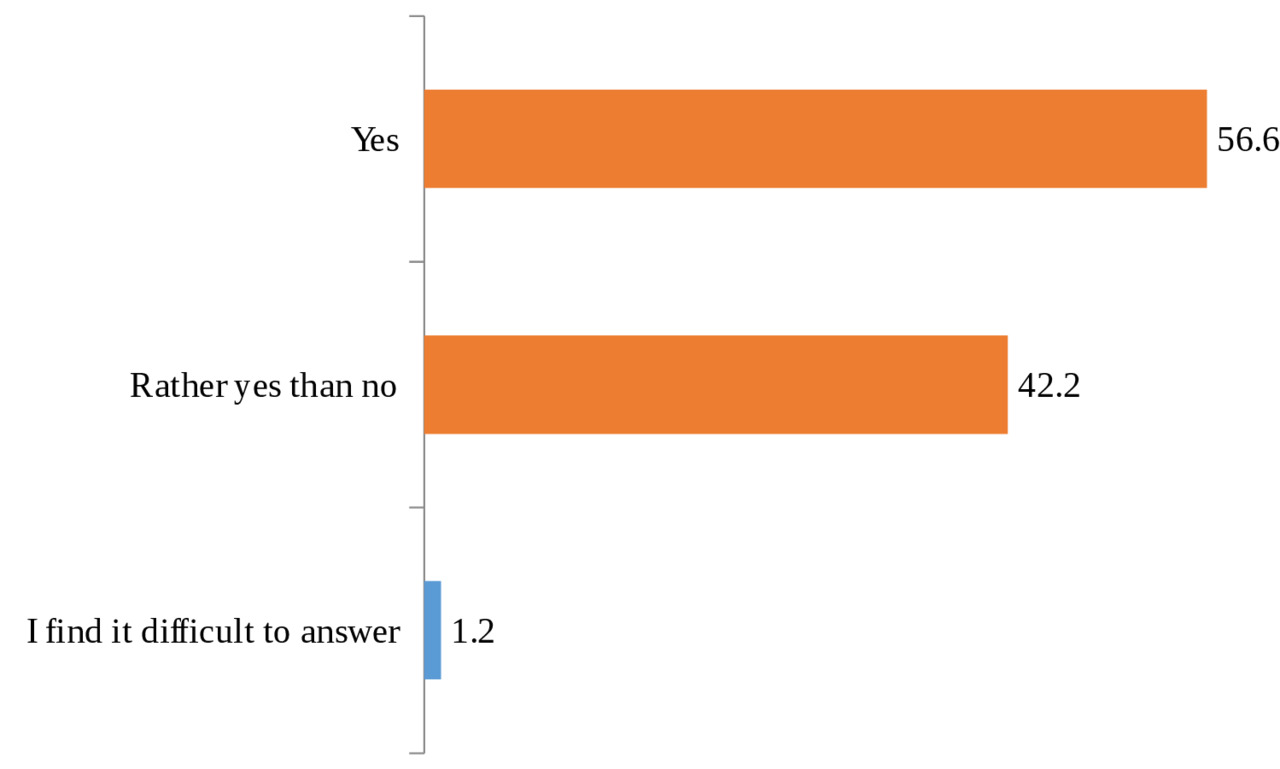
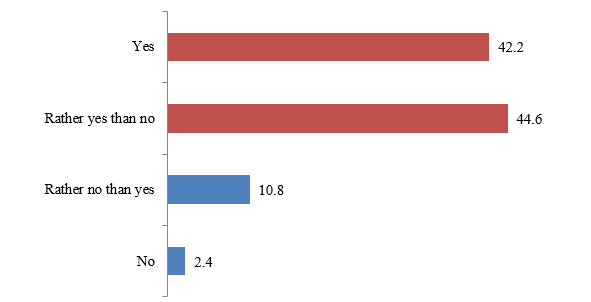
Half of the respondents (54.2%) (the sum of the answers «Yes» and «Rather yes than no» when answering the question «Do you consider yourself a financially literate person?») indicated that they consider themselves financially erudite. Less than half of the respondents (44.6%) (the sum of the answers «No» and «Rather no than yes» when answering the question «Do you consider yourself a financially literate person?») do not consider their level of knowledge in the field of finance to be sufficient. (Figure 1)
The overwhelming majority of respondents (85.5%) (the sum of the answers «Yes» and «Rather yes than no» when answering the question «Do you think you need to improve your financial literacy?») noted that they need to improve their level of financial literacy. More than a tenth of respondents (13.2%) (the sum of the answers «No» and «Rather no than yes» when answering the question «Do you think you need to improve your financial literacy?») believe that they do not need to improve their level of financial literacy. (Figure 2)
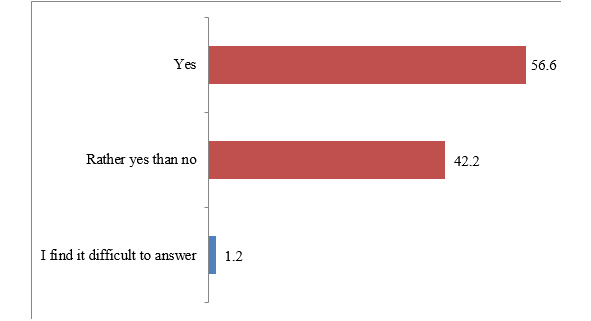
According to the results of our study, it turned out that the absolute majority of respondents (98.8%) (the sum of the answers «Yes» and «Rather yes than no» when answering the question «Do you think that financial literacy is a component of success?») believe that financial literacy is a factor in achieving economic well-being. (Figure 3)
The vast majority of respondents (86.8%) (the sum of the answers «Yes» and «Rather yes than no» when answering the question «Do you know how to protect yourself from financial fraud?») know how to protect yourself from financial fraud. Every thirteenth respondent (13.2%) (the sum of the answers «No» and «Rather no than yes» when answering the question «Do you know how to protect yourself from financial fraud?») does not know how to protect themselves from financial fraud. (Figure 4)
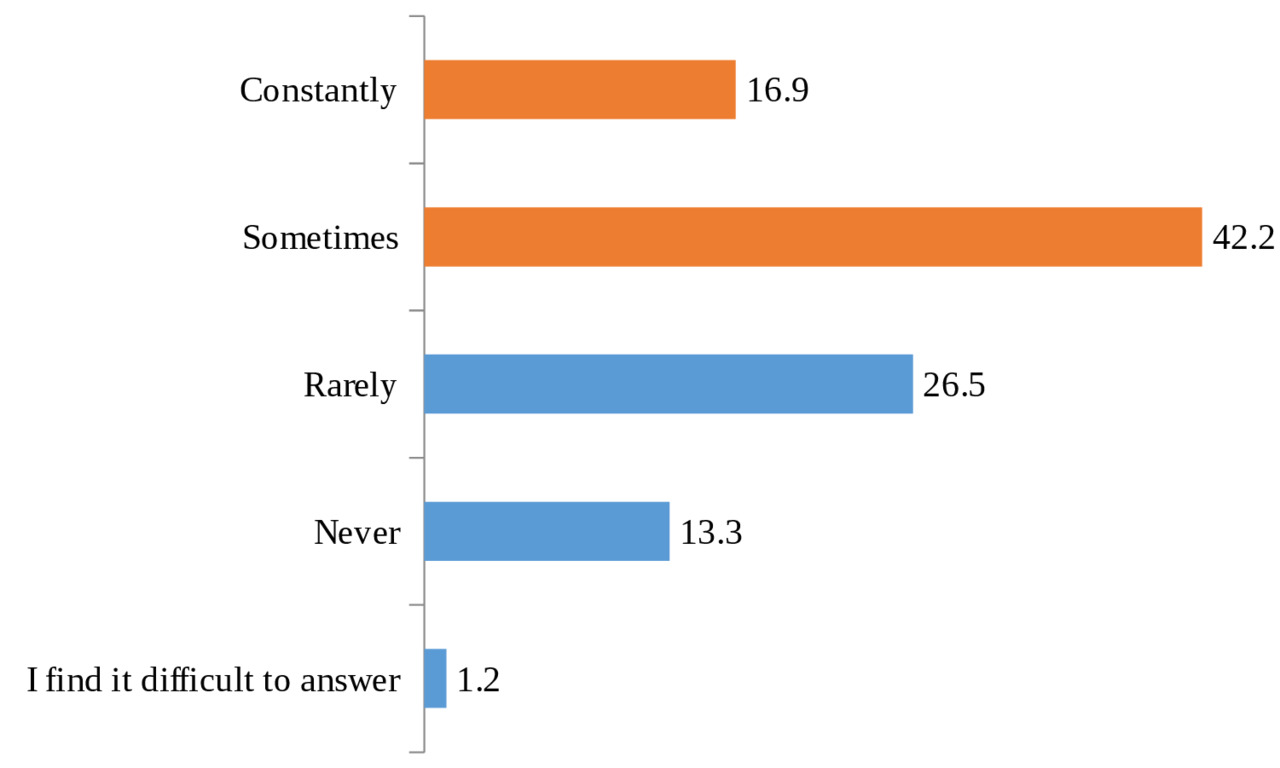
Less than a fifth of students (16.9%), when answering the question, noted that they are constantly interested in the financial situation in the country and the world, less than half of respondents (42.2%) are interested sometimes. Less than a third of respondents (26.5%) study news related to the financial situation rarely. Every thirteenth respondent (13.3%) is not interested in financial news at all. (Figure 5)
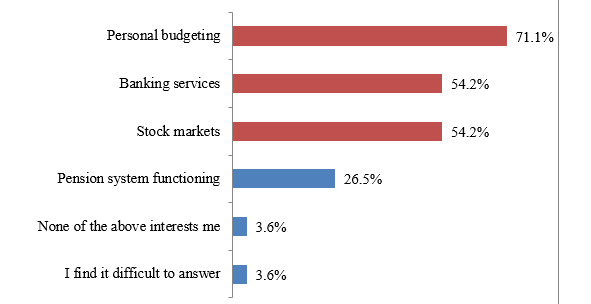
The most interesting issues in the area of financial literacy for respondents are personal budgeting (71.1%), banking services (54.2%) and stock markets (54.2%). (Figure 6)
Conclusions
In the modern world, financial literacy is the most important factor in achieving economic well-being. It allows young people to ensure a comfortable life, control income and expenses, avoid debt obligations and unplanned expenses. According to the survey results, the vast majority of young people who participated in our study believe that a high level of financial literacy is one of the components of achieving success in life.
More than half of the respondents believe that they have a sufficient level of financial culture, however, the vast majority of survey participants noted that they need to improve their level of financial literacy. Less than a fifth of students claim that they are constantly interested in issues of the financial situation in the country and the world. Also, the vast majority of respondents know how to protect themselves from financial fraud.
Young people pay attention to various areas of financial literacy. The issues that most interest respondents are personal budgeting, banking services and stock markets. Thus, studying the financial literacy of student youth not only allows us to identify current trends in this area and issues of interest to young people, but also contributes to the development of training and support programs aimed at improving financial culture among the younger generation.
References:
1. PISA 2012 Results: Students and Money: Financial Literacy Skills for the 21st Century / PISA, OECD Publishing, 2014, vol. VI. 202 p.
2. Семеко Г. В. Финансовая грамотность в России: проблемы и пути их решения // ЭСПР. 2019. №1. — URL: https://cyberleninka.ru/article/n/finansovaya-gramotnost-v-rossii-problemy-i-puti-ih-resheniya (дата обращения: 15.03.2025)
Ануфриева П. И.
Wohlbefindenprogramme als Instrument des Motivationsmanagements in Krisensituationen: theoretische Aspekte und praktische Empfehlungen
Anufrijewa P.I., Ökonomie, 1. Studienjahr des Masterstudiums
Doktorvater: Sagaydatschnaya E. N., Kandidat der Philologie, Deutschlehrerin
Rostower Staatliche Universität für Wirtschaft, Rostow am Don, Russland
Der Artikel befasst sich mit der Analyse eines neuen Konzepts der immateriellen Mitarbeitermotivation — der Wohlfühlprogramme. Die Arbeit betrachtet die wichtigsten Möglichkeiten der Umsetzung dieser Methode der Mitarbeitermotivation und ihre gesellschaftliche Bedeutung für die soziale und finanzielle Attraktivität für Arbeitgeber. Die praktischen Erfahrungen der Anwendung des Wohlfühlprogramms in dem amerikanischen multinationalen Unternehmen Facebook und in dem russischen Maklerunternehmen Vsegda. Da werden verglichen. Der Artikel konzentriert sich auf die steigende Nachfrage nach Wohlbefindens initiativen in den Jahren 2020 und 2021 aufgrund der Auswirkungen der COVID-19-Pandemie auf das Wohlbefinden der Mitarbeiter. Außerdem werden die Merkmale der Einführung des Wohlbefindens in die Aktivitäten des Unternehmens und die Phasen seiner Umsetzung identifiziert und häufige Fehler hervorgehoben, die Unternehmen bei der Umsetzung von Wohlbefindensveranstaltungen machen.
Schlüsselwörter: Arbeitgeber, Arbeitnehmer, Motivation, Personal, Unternehmen, Wohlfühlprogramme.
In den letzten 20 Jahren hat der Wettbewerb auf dem Arbeitsmarkt sowohl unter den potenziellen Arbeitnehmer als auch unter den tatsächlichen Arbeitgeber enorm zugenommen. Dieser Trend ist von der Digitalisierung des Arbeitsmarktes und den sich ändernden Lebensgewohnheiten verursacht. Fachkräfte suchen nach den günstigsten und geeignetsten Arbeitsbedingungen, während Unternehmen hochqualifizierte Mitarbeiter mit hoher Leistungsfähigkeit benötigen, die häufig mit dem inneren Zustand der Mitarbeiter verbunden ist.
Heutzutage sind die üblichen materiellen Motivationsfaktoren — Versicherungen, Rabatte für Fitnessstudios, Essenslieferungen, Taxis für den Weg ins Büro und nach Hause — zwar immer noch wichtig für die Beschäftigten, aber schon ungenügend, um Mitarbeiter an das Unternehmen zu binden, und funktionieren auch nicht ohne die Unterstützung durch immaterielle Anreize. Die Menschen werden von den finanziellen Privilegien, die sie erhalten, übersättigt und fühlen sich nicht mehr mit ihrer eigenen Arbeit zufrieden. Dieses Phänomen wird als hedonische Anpassung bezeichnet.
Die Millennials und Zoomers müssen sich nicht nur bei der Arbeit wohlfühlen, sondern sich auch weiterentwickeln. Laut einer Studie der Saïd Business School erzielen glückliche Mitarbeiter 13% mehr Umsatz als ihre «traurigen» Kollegen, sie lassen sich zehnmal weniger krankschreiben und erledigen ihre Aufgaben 19% genauer [3].
Die Pandemiejahre 2020 und 2021 haben viele Unternehmen dazu veranlasst, ihre eigene Herangehensweise an Personalanreize zu überdenken und neue Motivationsmethoden zu finden, die für die Mitarbeiter attraktiver sind. Eine der Möglichkeiten, das «Glück» der Mitarbeiter zu managen und ihren physischen, emotionalen und psychologischen Zustand zu kontrollieren, sind Wohlfühlprogramme.
Das Konzept des «Wohlbefindens», d. h. des Wohlergehens, beinhaltet fünf Kriterien des menschlichen Wohlbefindens (Tabelle 1).
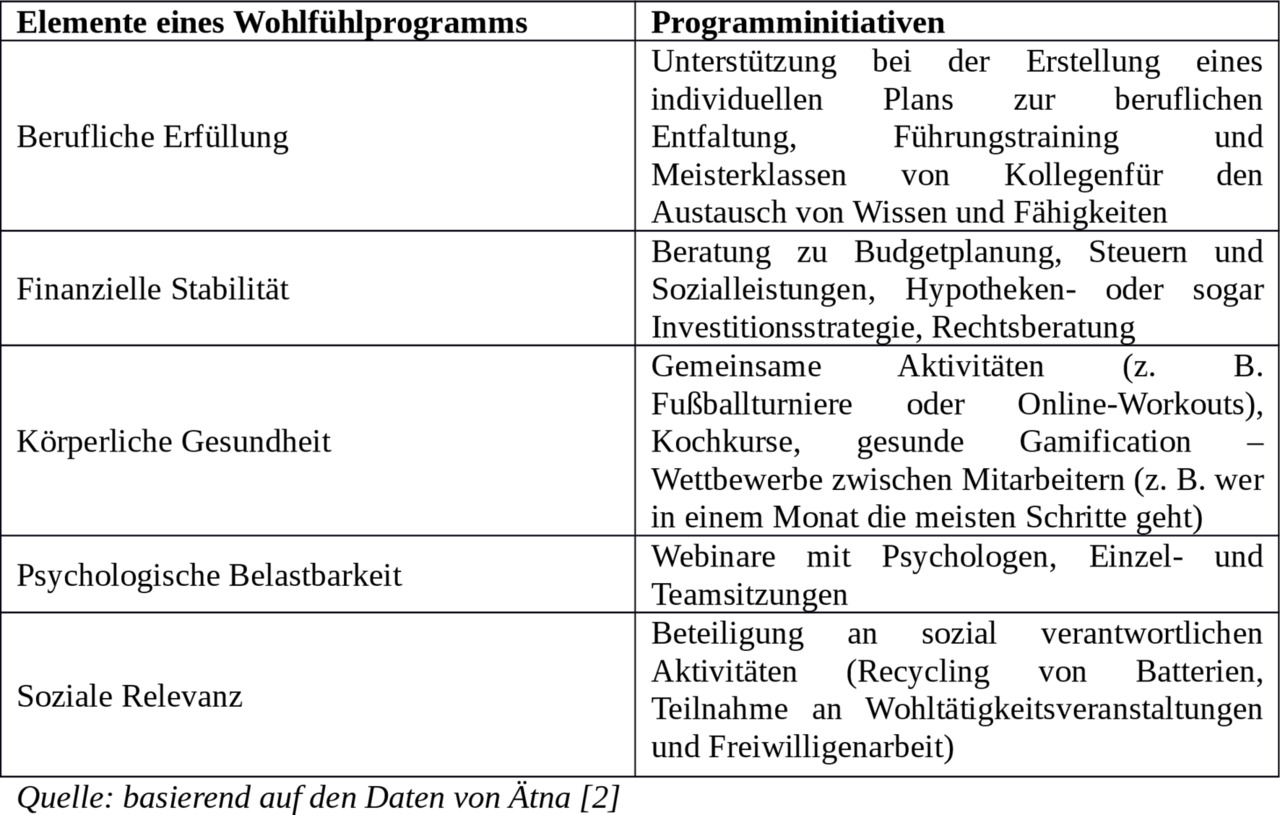
Die ständige Befriedigung dieser fünf Bedürfnisse auf hohem Niveau trägt dazu bei, dass sich die Mitarbeiter in ihrem Unternehmen sicherer und geschätzter fühlen, was wiederum zu einer höheren Leistung führt. Nach Angaben des Magazins Forbes berichten die Mitarbeiter von Unternehmen, die Programme zum Wohlbefinden eingeführt haben, in 70% der Fälle über eine höhere Arbeitszufriedenheit und eine bessere körperliche (56%) und geistige (54%) Gesundheit [7].
Heutzutage ergreifen Manager zunehmend Initiativen zum Wohlbefinden, um sich um die körperliche und geistige Gesundheit ihrer Mitarbeiter zu kümmern — dies hilft, die Produktivität zu steigern und finanzielle Verluste zu vermeiden.
Eine im Januar 2020 von der Universität von Südkalifornien und dem internationalen Beratungsnetzwerk PwC durchgeführte Studie hat gezeigt, dass Wohlfühlpraktiken dazu beitragen, Teams zu schaffen, in denen Mitarbeiter miteinander interagieren. PwC-Vertreter sind der Ansicht, dass die Beachtung des Wohlbefindens eine wichtige unternehmerische Fähigkeit ist, die zu einer hohen Arbeitsproduktivität führen kann [6].
Programme zum Wohlbefinden sind der Schlüssel zur Verringerung der finanziellen Verluste des Unternehmens, die durch Krankheit und Fehlzeiten der Mitarbeiter entstehen. Nach Angaben der American Heart Assoziation erhöhen beispielsweise ständige Überarbeitung und unregelmäßige Arbeitszeiten das Risiko von Bluthochdruck, was die US-Wirtschaft jährlich 48,6 Milliarden Dollar kostet –das sindAusgaben für medizinische Leistungen und Medikamente [1, S. 23—25].
Depressionen bei Arbeitnehmern kosten die Arbeitgeber jährlich 210 Milliarden Dollar (nach Angaben der Made of Millions Foundation), da der instabile psychische Zustand der Mitarbeiter deren Produktivität und Arbeitsqualität beeinträchtigt und die Wahrscheinlichkeit einer plötzlichen Entlassung erhöht [4].
Mit Programmen zum Wohlbefinden, die auf die Erhaltung und Verbesserung der körperlichen und geistigen Gesundheit der Mitarbeiter abzielen, können Unternehmen pro Mitarbeiter 136 Dollar einsparen. Zu diesem Schluss kommt die Weltgesundheitsorganisation [5].
Heute erfreuen sich Wellness-Initiativen weltweit immer größerer Beliebtheit: kleine Unternehmen nehmen die Dienste freiberuflicher Spezialisten in Anspruch, und multinationale Konzerne entwickeln ihre eigenen Wellness-Programme für ihre Mitarbeiter (Tabelle 2).
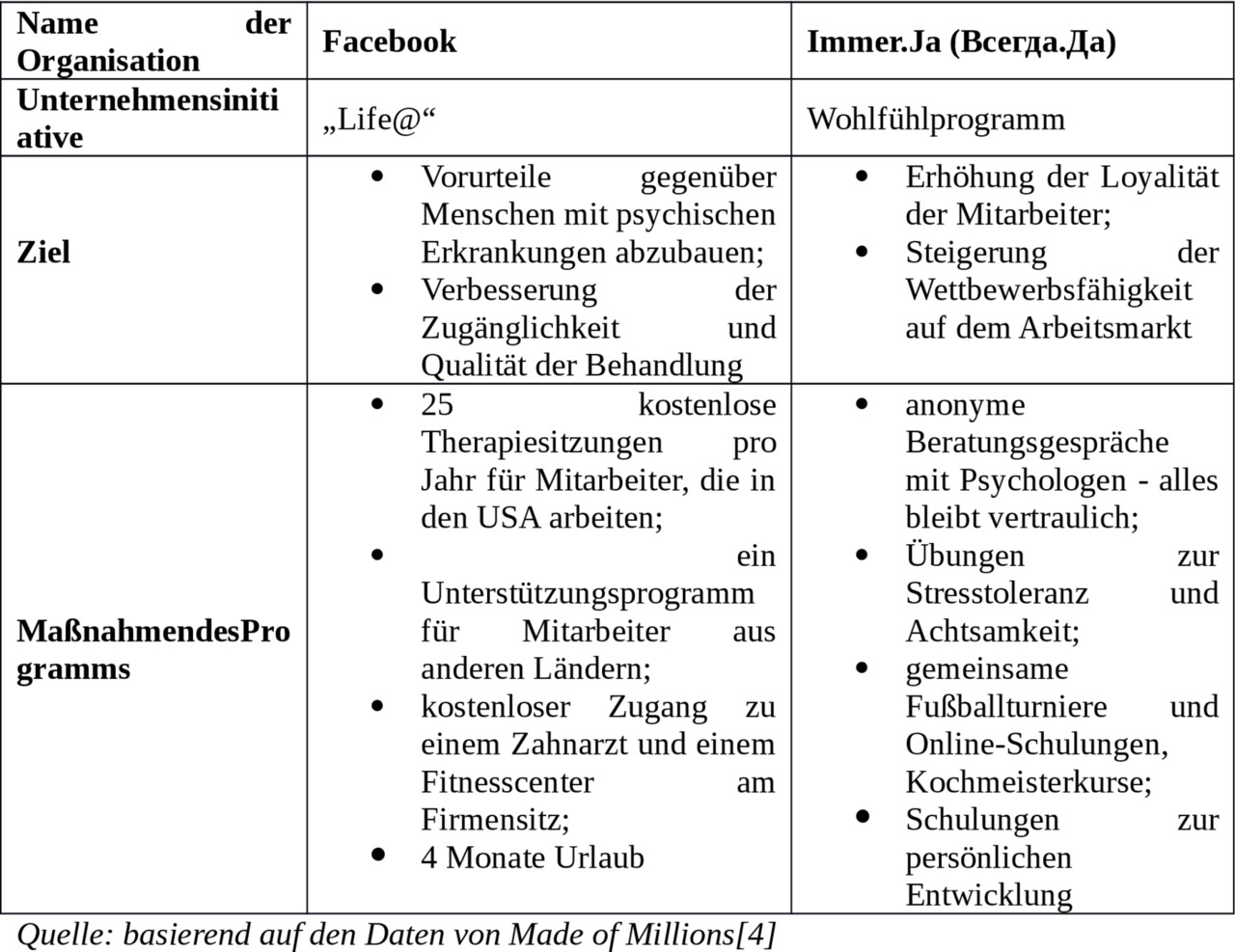
Laut einer Studie des Krankenversicherers Ätna machen sich die Mitarbeiter im Jahr 2021 mehr Sorgen um ihre eigene Gesundheit, und die Nachfrage nach Programmen zum Wohlbefinden ist deutlich gestiegen, insbesondere im Bereich der psychischen Gesundheit. 91% der Befragten waren wirklich besorgt über die Pandemie: 65% der Befragten wollten sich vom Unternehmen psychologisch unterstützt fühlen und 55% wollten Zugang zu Online-Ressourcen für psychische Gesundheit haben, die von der Organisation bereitgestellt werden [2] (Tabelle 3).
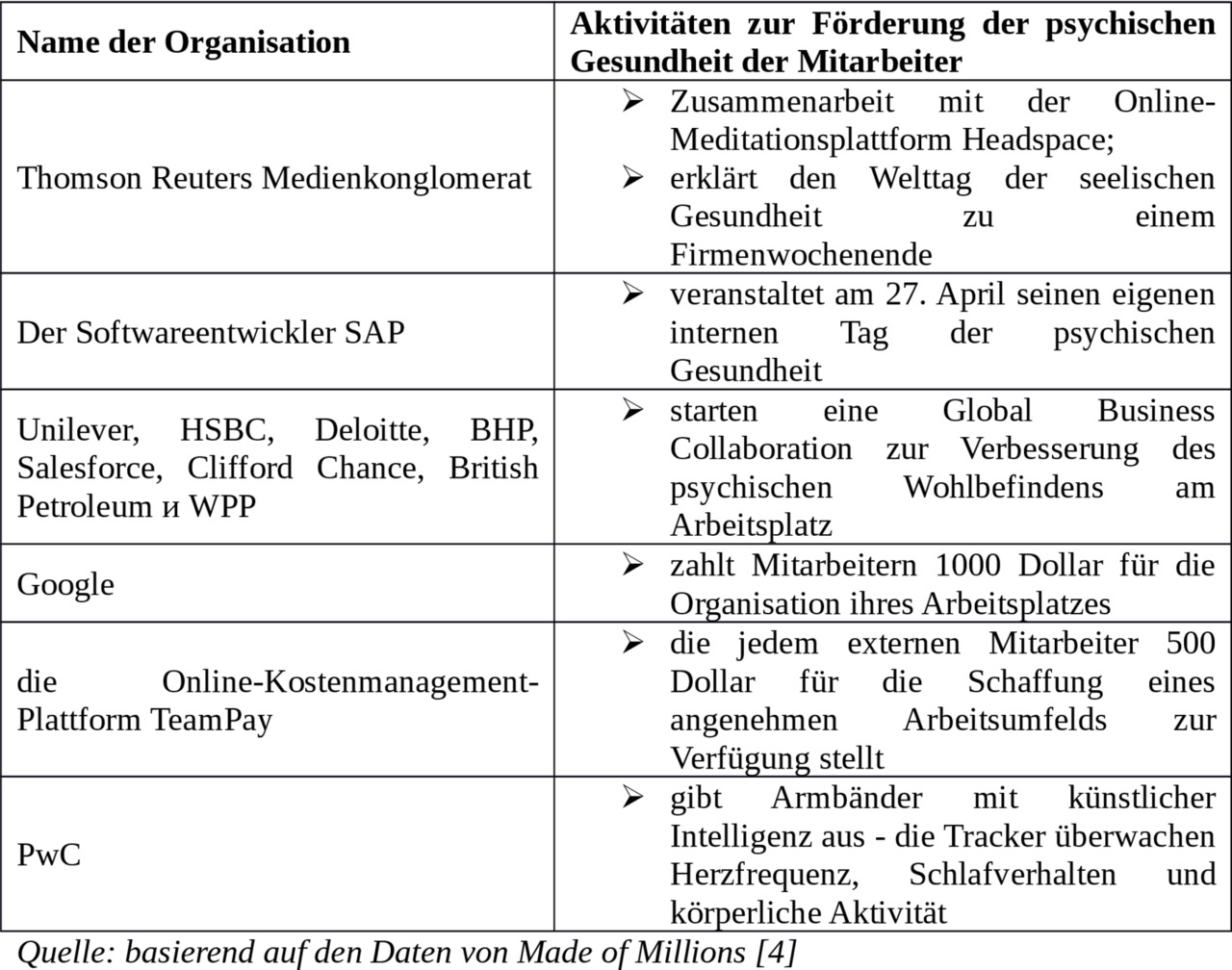
So wirkt sich die Einführung von Initiativen zum Wohlbefinden positiv auf die Leistung der Mitarbeiter aus: 70% der Mitarbeiter berichten über eine höhere Arbeitszufriedenheit und eine bessere körperliche und geistige Gesundheit [2].
Viele Unternehmen setzen heute bereits Wohlbefindensprogramme in ihren Betrieben ein, aber noch mehr Organisationen sind gerade dabei, einen Plan zur Umsetzung dieser Praxis zu entwickeln. Und hier müssen wir einen Faktor berücksichtigen, der für den Erfolg dieser Innovation ausschlaggebend ist, — das Niveau der Unternehmenskultur.
Nur bei einem Unternehmen mit einer hohen Unternehmenskultur wird die Einführung von Wohlbefinden wahrscheinlich erfolgreich sein, da diese Aktivitäten nicht im Widerspruch zu den ethischen Regeln des Unternehmens stehen werden. Bei einem niedrigen Niveau der Unternehmenskultur besteht ein hohes Risiko der Missbilligung solcher Praktiken durch die Geschäftsleitung, da in dieser Art von Organisation ein autoritärer Führungsstil vorherrscht, der keine Partnerschaft mit den Untergebenen impliziert.
Der gesamte Prozess der Einführung eines Wohlfühlprogramms in die Arbeit des Unternehmens durchläuft mehrere Phasen:
1. Vorbereitung — Analyse der Mitarbeiterzufriedenheit und Befragung der Mitarbeiter zu den Bereichen, in denen sie Unterstützung benötigen;
2. Umsetzung — Suche nach einem Anbieter, der auf die Bedürfnisse der einzelnen Mitarbeiter eingehen kann;
3. Kontrolle und Feedback — Verfolgung der Veränderungen im Team unter Berücksichtigung des Feedbacks der Untergebenen.
Dennoch ist kein Unternehmen vor Fehlern bei der Umsetzung von Wohlfühlmaßnahmen gefeit:
— Maßnahmen zum Wohlbefinden werden von der Unternehmensleitung organisiert, ohne die Meinung der Mitarbeiter zu berücksichtigen und sie in die Entwicklung des Programms einzubeziehen;
— die Unternehmensleitung setzt nur einmalige materielle Anreize für die Mitarbeiter ein, ohne die psychologischen und emotionalen Komponenten der Personalmotivation zu berücksichtigen;
— Wohlbefinden wird als kurzfristiges Projekt betrachtet (2—3 Monate), aber die tatsächlichen Ergebnisse werden erst in 1—2 Jahren erreicht;
— Wohlbefinden wird als Freizeitbeschäftigung und nicht als psychologische Hilfe für den Mitarbeiter betrachtet;
— Praktiken des Wohlbefindens erfordern systemische Veränderungen im Unternehmen, vorausgesetzt, die Organisation verfügt über ein hohes Maß an Geschäftsethik.
Bei der Umsetzung des Wohlbefindens geht es also darum, langfristige Veränderungen zu schaffen, die dem Unternehmen einen Wettbewerbsvorteil verschaffen. Dies bestätigt den Gedanken des Personalberaters Steve Simpson: «Kultur sollte in Unternehmen als eine Lebensweise betrachtet werden, nicht als ein abzuschließendes Projekt. Kultur sollte sich immer weiterentwickeln» [2].
Literaturverzeichnis:
1. Trudel, X., Gilbert-Ouimet, M., Vézina, M., Talbot, D.,Milot, A. (2019). Long Working Hours and the Prevalence of Masked and Sustained Hypertension. Hypertension, 75 (2), 23—25. https://doi.org/10.1161/HYPERTENSIONAHA.119.12926.
2. Corporate wellness and workplace wellness trends 2021 // Ätna, verfügbarunter: https://www.aetnainternational.com/en/about-us/explore/fit-for-duty-corporate-wellness/corporate-wellness-workplace-wellness-trends-2021-health.html (abrufbar am 8. März 2025).
3. Happy employees are more productive // World Economic Forum 2019, verfügbarunter: https://www.weforum.org/focus/davos-2019 (abrufbar am 8. März 2025).
4. How Depression Impacts the Workplace // Made of Millions, verfügbarunter: https://www.madeofmillions.com/articles/how-depression-impacts-the-workplace (abrufbar am 8. März 2025).
5. Mental health in the workplace // World Health Organization, verfügbarunter: https://www.who.int/teams/mental-health-and-substance-use/promotion-prevention/mental-health-in-the-workplace (abrufbar am 8. März 2025).
6. PwC’s Well-Being Learning Project. Revealing definitive links between well-being and performance // PwC, verfügbarunter: https://www.pwc.com/us/en/about-us/purpose-and-values/well-being-learning-project.htm (abrufbar am 8. März 2025).
7. Well-being for all: how companies care about the health of employees// Forbes, verfügbarunter: https://www.forbes.ru/ forbeslife/429691-blagopoluchie-dlya-vseh-kak-kompanii-zabotyatsya-o-zdorove-sotrudnikov (abrufbar am 8. März 2025).
Бергманн Д. Р.
Frieden bewahren und Kriege verhindern: Aktuelle Herausforderungen unsere Zeit
Bergmann D.R., Installation, Wartung und Reparatur elektronischer Geräte und Instrumente, Student im dritten Jahr
Wissenschaftlicher Leiteren: Jurenskaja S.A., Oswald A.
Fakultät für Raumfahrttechnik und Technologie der Technischen Universität, benannt nach dem zweifachen Helden der Sowjetunion, Pilot und Kosmonauten A.A.Leonow, Korolev, Russland
Der Artikel befasst sich mit dem Problem der Friedenssicherung und der Vermeidung von Kriegen unter den heutigen globalen Bedrohungen wie Cyberangriffen, Klimawandel und der Ausbreitung von Massenvernichtungswaffen. Es werden historische Ursprünge und gegenwärtige Trends analysiert, die die internationale Sicherheit beeinflussen, einschließlich wachsenden Nationalismus und religiöse Konflikte. Der Einfluss des Klimawandels auf die internationalen Beziehungen und innere Konflikte wird ebenfalls untersucht. Der Autor betont die Notwendigkeit eines ganzheitlichen Ansatzes zur Bewältigung dieser Probleme durch verstärkte multinationale Zusammenarbeit, Entwicklung des Völkerrechts, Rüstungskontrolle, nachhaltige Entwicklung und Bildung. Ziel des Artikels ist es, aussichtsreiche Richtungen für die Errichtung einer dauerhaften globalen Friedensordnung zu identifizieren.
Schlüsselwörter: Friedensschutz, Waffenstillstand, globale Sicherheit, Völkerrecht, Abrüstung.
Die Welt befindet sich am Rand eines neuen globalen Konflikts. Die Sicherheitsbedrohungen werden immer vielfältiger und komplexer; sie reichen von Klimawandel bis hin zu Cyberangriffen und der Ausbreitung nuklearer Waffen. Diese Situation wird zusätzlich verschärft durch steigendes Misstrauen zwischen den Nationen, wirtschaftliche Krisen und technologische Fortschritte, die neue Möglichkeiten für Aggressionen bieten [1]. Im Folgenden wollen wir uns mit dem Problem der Friedenssicherung und der Waffenstillstand beschäftigen, seine historischen Wurzeln, aktuelle Tendenzen und mögliche Lösungen analysieren.
Die moderne Welt steht vor zahlreichen Herausforderungen, die die globale Stabilität bedrohen. Nach Angaben des Stockholmer Instituts für Friedensforschung (SIPRI) erreichten die globalen Militärausgaben im Jahr 2020 Rekordhöhe von 1,9 Billionen Dollar, was etwa 2,4% des weltweiten Bruttoinlandsprodukts entspricht. Das internationale Sicherheitssystem, das auf dem Kräftegleichgewicht und Organisationen wie den Vereinten Nationen beruht, leidet erheblich unter diesen Belastungen [6]. Steigender Nationalismus, territoriale Streitigkeiten, religiöse Konflikte und wirtschaftliche Sanktionen erhöhen die Spannungen zwischen den Staaten. Cyberkriege, Terrorismus und die Ausbreitung von Massenvernichtungswaffen tragen ebenfalls zum Destabilisieren der globalen Lage bei.
Darüber hinaus hat der Klimawandel bereits Auswirkungen auf die internationalen Beziehungen. Knappheiten an Ressourcen wie Wasser und Nahrungsmittel führen zu Migration und Verschärfung von Konflikten. Wirtschaftliche Ungleichheiten und sozialer Unmut innerhalb der Länder schaffen Grundlagen für innere Unruhen, die in interstaatliche Konflikte münden könnten [4].
All diese Faktoren machen die Frage der Wahrung des Friedens und der Verhinderung von Kriegen äußerst dringlich. Es ist entscheidend zu verstehen, dass fehlende Maßnahmen zur Bewältigung der bestehenden Probleme katastrophale Folgen für die gesamte Menschheit haben könnten [5].
Krieg und Frieden waren seit jeher zentrale Themen der menschlichen Geschichte. Nach dem Ersten Weltkrieg begann man, ein modernes System des Völkerrechts und kollektiver Sicherheit zu entwickeln. 1919 wurde der Volkerbund gegründet, um solch einen weiteren derartigen Konflikt zu vermeiden, aber sie erwies sich als wirkungslos gegenüber der wachsenden Aggression Nazideutschlands und Japans. Eines der erfolgreicheren Beispiele für internationale Kooperation ist der Atomwaffensperrvertrag (NPT) aus dem Jahre 1968, der half, die Ausbreitung von Nuklearwaffen einzudämmen und die internationale Lage zu stabilisieren.
Der Zweite Weltkrieg führte schließlich zur Gründung der Vereinten Nationen (UNO) im Jahr 1945. Ihr Charta legte das Ziel fest, den internationalen Frieden und die Sicherheit durch die Zusammenarbeit ihrer Mitgliedstaaten zu erhalten. Doch der Kalte Krieg zwischen den USA und der UdSSR zeigte die Grenzen der UNO in einem bipolaren Weltsystem auf. Dieser Zeitraum war ein Beispiel für eine Konfrontation zwischen zwei Supermächten, die leicht zu einem globalen Atomkrieg hätte eskalieren können. Nur diplomatische Bemühungen und Verträge wie SALT-I und SALT-II konnten die Eskalation eindämmen [2].
Mit dem Ende des Kalten Krieges kamen Hoffnungen auf ein multipolares Weltsystem auf, in dem die UNO wiederum eine Schlüsselrolle spielen könnte. Allerdings stellen neue Bedrohungen wie internationaler Terrorismus, regionale Konflikte und die Ausbreitung von Nuklearwaffen die Wirksamkeit des bestehenden internationalen Sicherheitssystems infrage.
So zeigt die Geschichte, dass das Problem der Friedenssicherung und der Waffenstillstand eine fortdauernde Herausforderung für die Menschheit bleibt. Obwohl viele Versuche unternommen wurden, Mechanismen zur Konfliktbewältigung zu etablieren, konnte keine Lösung gefunden werden, die dieses Problem vollständig löst. Daher sind neue Ansätze notwendig.
Heutige Forscher und Politiker schlagen verschiedene Wege vor, um diesem Problem entgegenzuwirken. Eine der zentralen Strategien ist die Stärkung multilateraler Institutionen wie der UNO und regionaler Organisationen. Diese Institutionen spielen eine wichtige Rolle dabei, Konflikte zu regeln, friedliche Gespräche zu führen und die Einhaltung internationaler Vereinbarungen sicherzustellen. Ein weiterer wichtiger Aspekt ist die Förderung des Dialogs und der Zusammenarbeit zwischen den Ländern. Durch die Festigung wirtschaftlicher Bindungen, kulturellen Austauschs und wissenschaftlicher Zusammenarbeit kann die Feindseligkeit verringert und Vertrauen gestärkt werden — besonders relevant in Zeiten der Globalisierung, wo die Länder immer mehr verbunden sind.
Einen besonderen Schwerpunkt bilden auch die Rüstungskontrollmaßnahmen und Abrüstung. Die Einschränkung der Produktion und Ausbreitung von Massenvernichtungswaffen sowie konventionelle Beschränkungen an Waffen helfen, das Risiko von Konflikten zu senken. Dennoch halten Experten fest, dass die bestehenden Maßnahmen nicht ausreichend sind [7]. Radikale Reformen im Völkerrecht und die Schaffung neuer Mechanismen zur Streitschlichtung, die alle Seiten fair behandeln und faire Ressourcenaufteilung gewährleisten, sind erforderlich.
Es ist zu beachten, dass die Lösung des Problems der Friedenssicherung und der Waffenstillstand einen umfassenden Ansatz benötigt, der politische, ökonomische, soziale und kulturelle Dimensionen umfasst. Unter den vielversprechenden Richtlinien sind folgende zu nennen:
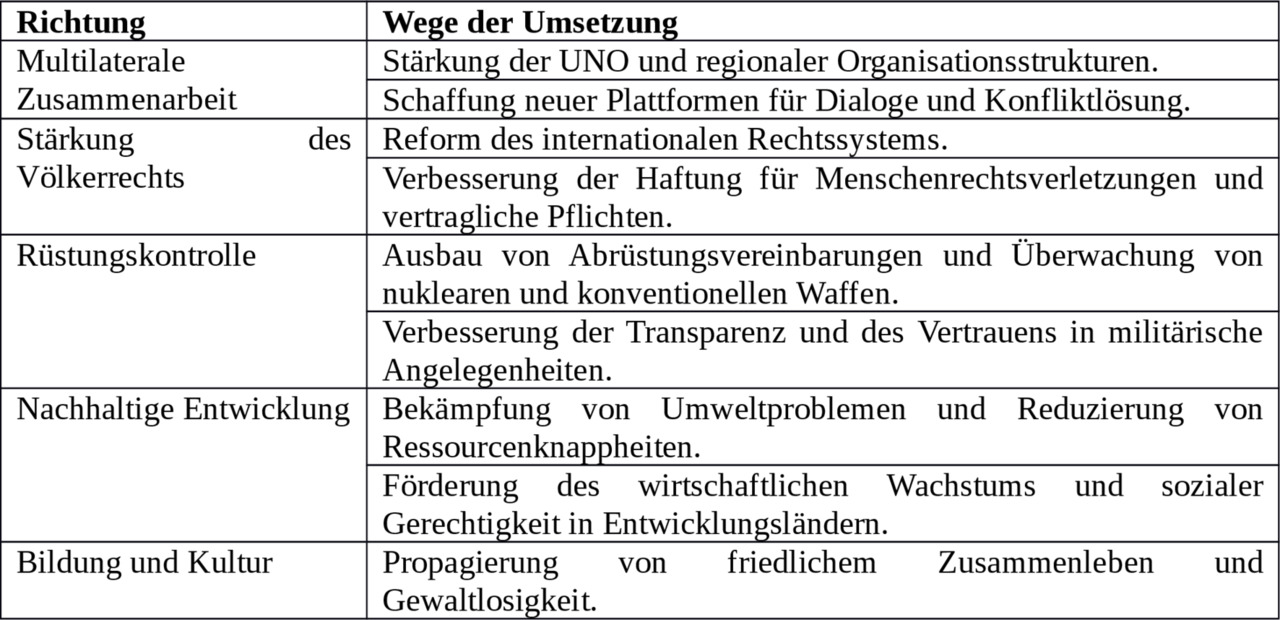
Diese Bereiche erfordern gemeinsame Anstrengungen aller Länder und Völker. Nur durch internationale Zusammenarbeit und gegenseitigen Respekt kann dauerhafter Frieden erreicht und die katastrophalen Folgen neuer Kriege vermieden werden [3].
Zusammenfassend lässt sich sagen, dass die Wahrung des Friedens und die Verhinderung von Kriegen nach wie vor eine der dringendsten und komplexesten Aufgaben unserer Zeit ist. Die Erfahrung aus der Vergangenheit zeigt, dass selbst die wirksamsten Mechanismen keine vollständige Beseitigung der Risiken garantieren. Das Streben nach Frieden und Zusammenarbeit muss jedoch für alle Staaten und Völker weiterhin Priorität haben. Die Zukunft der Menschheit hängt von unserer Fähigkeit ab, Kompromisse zu finden, Vielfalt und die Interessen anderer zu respektieren und eine Welt aufzubauen, die auf Gerechtigkeit und Solidarität basiert.
Literaturverzeichnis:
1. Виндельбанд В. История новой философии. — Т. 2. — М., 2000. — С. 485.
2. Герасимовский С. В., Хаяли Р. И. Крымская (Ялтинская) конференция 4–11 февраля 1945 г. и контуры нового миропорядка: вызовы и возможности для Российской Федерации // Вестник Университета прокуратуры Российской Федерации. — 2025. — №. 1. — С. 25—31.
3. Ницше Ф. Воля к власти. — Москва: Издательство АСТ, 2024. — 704 с.
4. Камю А. Бунтующий человек. — М.: Политиздат, 1990. — С. 177.
5. Маркс К., Энгельс Ф. Сочинения. — 2-е изд. — Т. 1. — М.: Госполитиздат, 1955. — С. 416.
6. Панкратов С. А., Морозов С. И., Панкратова Л. С. Обеспечение безопасности России как государства-цивилизации: диалектика войны и мира в XXI веке // Вестник Волгоградского государственного университета. Серия 4: История. Регионоведение. Международные отношения. — 2024. — Т. 29. — №. 3. — С. 231—244.
7. Упоров А. Г., Горовой В. В. Проблемы войны и мира, предотвращения новой мировой войны // Право и государство: теория и практика. — 2023. — №. 1 (217). — С. 220—225.
Бирюкова В. В.
Gender stereotypes in advertising. The impact on consumer society
Biryukova V.V. 1st year bachelor degree student «Sociology»
Scientifc adviser: Kyuregyan M.P., PhD in Sociology, Associate Professor of the Department of Foreign Languages
Federal State Budgetary Educational Institution of Higher Education «Technological University named after twice Hero of the Soviet Union, Pilot-cosmonaut A.A. Leonov», Korolev, Russia
The article explores gender stereotypes in advertising and their impact on consumer behavior. It analyzes how stereotypical portrayals of men and women shape audience perception, influence purchasing decisions, and reinforce traditional gender roles in modern media.
Keywords: advertising, gender, stereotype, behavior, manipulation.
Introduction
Gender stereotypes in advertising are well-established and often simplified images that reflect traditional ideas about the roles of men and women in society. These stereotypes are actively used in marketing strategies, which allows brands to form certain associations and expectations among consumers. As a result, such images not only influence how consumers perceive advertised goods and services, but also have a profound effect on their behavior, preferences, and self-identification. The problem is that gender stereotypes can limit individual opportunities and form preconceived ideas about what is considered «acceptable» or «normal» for each gender. For example, ads may portray men as strong and dominant, and women as caring and subordinate.
These images contribute to strengthening traditional gender roles and can have a negative impact on people’s self-esteem and ambitions, especially for young people who are at the stage of forming their identity.
In this article, we intend to consider the goals and objectives of our research, as well as emphasize the relevance of the topic of gender stereotypes in advertising. We will analyze various examples from the history of advertising campaigns in order to better understand how such stereotypes affect public perception and consumer behavior.
Relevance
The study of gender stereotypes in advertising is becoming particularly significant for several reasons. First, advertising plays a key role in shaping public opinion and establishing cultural norms, highlighting its influence on the perception of gender roles in society. Second, with the rise of feminist movements and increased awareness of gender equality issues, society has become more critical of traditional stereotypes, creating a need to rethink approaches to advertising. Third, modern technologies and social media provide unique opportunities for discussing and analyzing advertising campaigns, making it essential to study their impact on consumer behavior and perception. These factors underscore the importance of understanding how advertising can both reinforce and dismantle outdated stereotypes, as well as shape a more inclusive society.
Gender Stereotypes: Concept and Manifestations
Gender stereotypes are stable generalized perceptions of how men and women should behave and what roles they should fulfill in society. These perceptions are shaped by cultural, social, and historical factors and can vary depending on the context. Gender stereotypes not only reflect existing social norms but also actively contribute to their maintenance by shaping expectations and standards of behavior for both genders.
Definition and Nature of Gender Stereotypes
Stereotypes can be defined as cognitive frameworks that simplify the perception and interpretation of information about other people. In the context of gender, these frameworks include sets of characteristics attributed to men and women.
For instance, it is traditionally believed that men should be strong, independent, ambitious, and successful, which is often reinforced by images of «male success» in business and careers. In contrast, women are often portrayed as caring, emotional, family-oriented, and focused on home comfort, creating the image of the «ideal mother» or «housewife.»
The Influence of Advertising on Society
Advertising that employs gender stereotypes can influence social norms and expectations. For example, advertisements for household appliances may emphasize the role of women as homemakers, reinforcing the notion that caring for the home is exclusively a woman’s responsibility. On the other hand, car advertisements often focus on men as the primary drivers and owners, which can create a sense of exclusion for women in this domain.
Research shows that such stereotypes can negatively impact individuals’ self- esteem. Women may feel pressured to conform to ideals of beauty and the role of the perfect housewife, while men may experience stress due to expectations to be successful and strong.
Examples of Gender Stereotypes in Advertising: Case Studies
— Procter Gamble Advertisement (1950s)
Procter Gamble, a manufacturer of household cleaning products and personal care items, actively utilized stereotypes about women’s roles in the household in its advertising campaigns. For example, an advertisement for Tide detergent showcased women who happily washed clothes and rejoiced at how bright and white their laundry became. Slogans like «Tide makes laundry easier» created the impression that caring for cleanliness was a natural duty of women. These commercials not only promoted the product but also reinforced the notion that women should be responsible for household chores.
— American Tobacco Company Advertisement — «Lucky Strike» (1920s)
The advertising for Lucky Strike cigarettes often portrayed women as sexual objects who smoked cigarettes to attract men’s attention. Slogans like «Your cigarette is your calling card» emphasized that smoking cigarettes was associated with female attractiveness and the desire to please men. Women in the advertisements frequently appeared provocative and confident, creating an image of the ideal woman of that era.
— Axe Deodorant Advertisement and «The Axe Effect» (2000s)
The advertising for Axe deodorant, especially in the 2000s, became famous for the concept of «The Axe Effect.» In these commercials, men who use Axe deodorant become irresistibly attractive to women, leading to comedic and exaggerated situations where women literally «go crazy» with desire. The advertisements often portray the man as confident and sexually appealing, while women are depicted as objects of desire seeking his attention.
Man as Hunter:
The advertisement creates an image of a man who actively hunts for women’s attention. He is portrayed as aggressive and dominant, reinforcing the stereotype that men should be proactive and persistent in their attempts to win over women.
Woman as Object of Desire:
While men are shown as active participants, women are often represented as passive objects who react to men’s «attractiveness.» This reinforces traditional gender roles, where women are perceived as those who wait for a man to show interest.
Positive Changes and the Future of Advertising
In recent years, advertising has undergone significant changes aimed at dismantling outdated gender stereotypes and promoting inclusivity. Brands are beginning to realize that the modern consumer values honesty, diversity, and social responsibility. This leads to the creation of a more positive image and strengthens loyalty among customers.
Examples of Brands Breaking Gender Stereotypes
— Dove: «Real Beauty»
The «Real Beauty» campaign by Dove, launched in 2004, became a landmark example of how a brand can challenge traditional beauty standards. Dove uses real women of various shapes, sizes, and ages to demonstrate that beauty does not have a single standard. This campaign not only shattered stereotypes about what an «ideal» woman should look like but also sparked discussions about self- esteem and self-acceptance.
— Always: «#LikeAGirl»
The Always «#LikeAGirl» campaign, launched in 2014, focuses on rethinking the phrase «like a girl.» The advertisement shows how this expression is often used in a derogatory context and encourages a change in perception. As a result, the campaign inspired girls around the world to take pride in their identity and challenged stereotypes related to weakness and insecurity associated with femininity.
— Nike: «Dream Crazier»
In 2019, Nike launched the «Dream Crazier» campaign featuring outstanding female athletes such as Serena Williams. The advertisement highlights women’s achievements in sports and encourages them to dream without limits. It challenges stereotypes that women cannot be as successful and ambitious as men, while also raising questions about gender equality in the sports industry.
— Gillette: «The Best Men Can Be»
In 2019, Gillette released the advertisement «The Best Men Can Be,» which addresses themes of toxic masculinity and gender violence. The ad calls on men to behave more responsibly and supports the idea that true masculinity involves respect and support for women. This campaign sparked much discussion and demonstrated that brands can play an active role in social change.
— Heineken: «Open Your World»
The Heineken «Open Your World» campaign showcases the importance of openly discussing differences and overcoming biases. In one of the ads, two people with opposing views on life work together to create beer, emphasizing the significance of dialogue and understanding. The brand actively uses its platform to promote inclusivity and mutual understanding.
The Importance of Changing Stereotypes and Gender Roles in Advertising
— Shaping Public Opinion
Advertising is a powerful tool for shaping public opinion. Traditional gender stereotypes are often represented in advertising, which can reinforce biased perceptions of the roles of men and women. When brands begin to break down these stereotypes, they contribute to changing perceptions and norms in society. For example, advertisements that portray men as caring fathers or women in leadership positions help soften traditional views on gender roles.
— Strengthening Identity and Self-Esteem
Changes in gender stereotypes in advertising can help people better perceive themselves and their identities. Showcasing real people who are diverse in age, race, size, and sexual orientation allows viewers to see themselves represented in advertisements. This fosters increased self-esteem and self-acceptance, especially among young people who are in the process of forming their identities.
— Supporting Inclusivity and Diversity
Modern consumers increasingly value inclusivity and diversity. Brands that actively work to dismantle gender stereotypes demonstrate their commitment to these values. This not only attracts attention to the brand but also creates loyalty among customers who want to support companies that share their views.
Inclusive advertising also helps various groups of people feel represented and heard.
— Brand Social Responsibility
Contemporary brands are becoming more aware of their social responsibility. They understand that their advertising can influence societal norms and standards. Brands that actively work to change gender stereotypes show their willingness to participate in social change and support equality. This can lead to positive changes not only in marketing but also in society as a whole.
Conclusion
In this article, we explored the significance of changing gender stereotypes in advertising and their impact on society, consumers, and businesses. We analyzed how advertising, as a powerful tool for shaping public opinion, can contribute to dismantling outdated perceptions of the roles of men and women. Showcasing diversity and inclusivity in advertising campaigns not only enhances self-esteem and identity among consumers but also reinforces brand social responsibility.
Furthermore, changes in approaches to gender stereotypes can lead to economic benefits for companies by expanding their customer base and increasing consumer loyalty. Ultimately, such changes foster a more equitable society where future generations will be less susceptible to traditional stereotypes and can freely choose their life paths.
Thus, advertising becomes not just a means of promoting goods and services but also an important instrument for social change, contributing to the creation of a more just and inclusive world. It is essential for brands to continue developing this trend by considering the diversity and uniqueness of each individual, which will ultimately lead to positive changes in society.
References:
1. Babosov, E.M. Gender Sociology: A Textbook. Minsk: Belarusian State University, 2005. — 284 p.
2. Berger, A. Sociology of Advertising. Moscow: Refl-book, 2003. — 288 p.
3. Gofman, E. Gender Representations in Advertising. St. Petersburg: University Book, 2001. — 176 p.
4. Kon, I.S. Introduction to Gender Studies. Moscow: Logos, 2004. — 312 p.
5. Kotler, P., Armstrong, G. Principles of Marketing. Moscow: Williams, 2016. — 656 p.
6. Lazutina, G.V. Journalism and Advertising: A Textbook. Moscow: Aspect Press, 2001. — 319 p.
7. Lipovetsky, M. Gender Images in Advertising: Analysis and Critique // Voprosy Filosofii (Philosophy Issues). — 2009. — No. 4. — Pp. 83–95.
Будякова Р. И.
Psychology of advertising perception: how emotions affect user decision-making
Budyakova R.I. 1st year bachelor degree student «Sociology»
Scientifc adviser: Kyuregyan M.P., PhD in Sociology, Associate Professor of the Department of Foreign Languages
Federal State Budgetary Educational Institution of Higher Education «Technological University named after twice Hero of the Soviet Union, Pilot-cosmonaut A.A. Leonov», Korolev, Russia
Advertising is not just a way to convey information about a product or service. It is an art based on a deep understanding of human psychology and emotions. In today’s world, where information surrounds us, advertising remains an important tool for attracting attention and changing consumer behavior. In this article, we will look at how emotions affect the perception of advertising and, ultimately, consumer decision making.
Keywords: Psychology, Advertisement, Emotions.
Influence of emotions on the perception of advertising
The emotional element of advertising plays an important role in shaping consumer attitudes towards a product. Research shows that advertising that evokes strong positive emotions significantly increases the chances of purchase. This is because emotions affect the memorization of information and create a strong emotional connection with the brand.
On the other hand, using negative emotions can also be effective, but requires a more subtle approach. For example, fear-inducing ads (such as anti-smoking campaigns) can encourage consumers to change their behavior. But it is important that such advertising is balanced and presents a solution to the problem. Otherwise, failure may occur. It is important to find a balance between creating emotions and providing constructive information.
Thus, the emotional side of advertising has great potential to increase its effectiveness. Creating advertising messages that evoke strong and positive emotions can significantly increase brand awareness and consumer loyalty. However, keeping the target audience and cultural context in mind is very important to avoid unwanted negative reactions.
— Examples of emotional impact:
— Nostalgic advertising: you can attract consumers with pleasant memories and positive emotions using images or pop culture events familiar from childhood. Such advertising campaigns often become popular, and you have a desire to buy a product or service.
— Fear and anxiety: in some advertising messages, fear is used as a means of influence. For example, advertising safe products or medical devices can encourage people to take action and highlight potential health or safety hazards.
— Empathy: empathy-based advertising is often used by charities. Showing the victim person or animal can cause a strong emotional reaction and a desire to help.
— The main functions of advertising psychology:
— Perception test-the study of how various advertising elements (text, visual, audio) attract attention and are remembered;
— Formation of emotional reactions-identification of methods that will help develop positive emotions and associations between the target audience;
— Analysis of consumer behavior-to understand the motives, constraints and factors affecting user choice;
— Social Impact-Study of how advertising shape’s public opinion and influences public choice
These studies help companies not only sell products, but also build long-term relationships with customers, increasing the effectiveness of their marketing strategies.
Psychological triggers to encourage purchases.
The use of psychological triggers in advertising is a powerful tool to increase customer interest. They directly affect the consciousness of consumers and make them want to buy goods or services. It is important to understand which triggers are most effective in different situations. The following is a list of the most effective psychological factors:
— Limited supply-creates a sense of urgency and stimulates quick purchase decisions.
— Social proof-use ratings and recommendations based on other people’s experiences to convince consumers of the correctness of their choices.
— Trust-the presence of a celebrity or professional brand representative increases the credibility of the product.
— Reciprocity-offering something valuable (for example, a free trial period or a reward for purchases) often encourages consumers to make purchases, i.e. to make purchases.
Empathy-creating a positive brand image through association with pleasant emotions or memories increases the desire to associate yourself with the product. These triggers can be used individually to increase your ad campaign’s effectiveness.
Impact on brand awareness
The emotional perception of advertising affects not only individual purchases, but also forms a general attitude towards the brand. Brands that can evoke positive emotions in consumers will remain in memory and become a priority when choosing. Research shows that an emotional connection with brands can promote loyalty and replicate purchases.
Ethical aspects of advertising psychology
Advertising and psychology are interconnected, as advertisers use mechanisms of psychological influence on consumers. However, it is important to understand that the use of psychological methods and techniques in advertising should follow the moral principles listed below, so that people’s minds are not manipulated and their rights are not violated.
Emotional manipulation
One of the ethical aspects of advertising is the manipulation of emotions. Advertising campaigns often use psychological mechanisms such as anxiety, fear, or, conversely, happiness and satisfaction. This can be effective for achieving advertising goals, but not abusing human weaknesses is important. For example, advertisements using health issues to sell products may be morally questionable.
Principles of transparency
Ethical standards require advertisers to present information honestly and transparently. The implicit effect of advertising on potential buyers (for example, use of subtext or manipulation of product perception) can be considered a violation of ethical standards. For example, ads that do not disclose complete information about a product or service may confuse users.
Protection of vulnerable groups
Special attention should be paid to advertising campaigns targeting vulnerable groups such as children, the elderly and the disabled. These groups may be particularly vulnerable to psychological manipulation, an important protection from an advertising ethics perspective. For example, advertising aimed at manipulating children to sell products with high sugar content may contradict ethical principles.
Respect for privacy
Modern technologies allow advertisers to collect large amounts of information about users, opening up new opportunities for personalization of advertising. However, these methods must be applied within the framework of ethical standards to ensure that they do not violate people’s privacy rights. Collecting data without the explicit consent of users or improper interference in personal space is a serious violation of ethical standards.
Responsibility for results
Advertisers are responsible for the consequences of the psychological impact of advertising on consumer behavior. This is especially true for unhealthy foods such as alcohol, tobacco or junk food. Ethical principles require that advertisements for these products take into account potential harmful effects rather than simply presenting them as positive alternatives.
Conclusion
The psychology of perception is a complex process in which emotions play a central role. Effective advertising can not only provide information about a product, but also trigger an emotional response that affects consumer decision making. Understanding how emotions affect people’s behavior can help advertisers create more targeted and successful campaigns. Consequently, advertising is not only a means of promoting goods and services, but also a powerful tool for creating emotional connections between brands and consumers.
References:
1. Doctorov B. Z. Modern Russian Sociology: Historical and Biographical Searches. In 3 vols. — Moscow: TsSPiM, 2012. — Т. 1—3.
2. Zborovsky G. E. History of Sociology: Modern Stage: textbook for universities. 2nd ed., revised and expanded — Surgut: RIO Surgut State Pedagogical University, 2015. — 320 p.
3. Novikova S. S. History of the development of sociology in Russia: textbook. — Moscow: Moscow Psychological and Social Institute; Voronezh: MODEK, 1996. — 248 p.
4. Yadov V.A. Sociology in Russia. — Moscow: Publishing house of the Institute of Sociology of the Russian Academy of Sciences, 1998. — 256 p.
Васильева Е. С.
Cryptocurrencies: economic risks and perspectives
Vasilyeva E.S. 2nd year bachelor degree student «Economics»
Scientifc adviser: Massalskaya Y.V., PhD in Philology, Associate Professor of the Department of Foreign Languages
Federal State Budgetary Educational Institution of Higher Education «Technological University named after twice Hero of the Soviet Union, Pilot-cosmonaut A.A. Leonov», Korolev, Russia
Cryptocurrencies have stormed onto the financial stage like a disruptive force of nature, promising to revolutionize how we think about money, technology, and even societal structures. Imagine a world where currency isn’t controlled by central banks but instead operates on decentralized networks powered by cutting-edge blockchain technology. Sounds futuristic, right? Well, that future is already here — and it’s messy, exciting, and full of contradictions.
Keywords: cryptocurrencies, Bitcoin, economics, technology.
At their core, cryptocurrencies offer tantalizing possibilities: decentralization, technological innovation, and greater financial inclusion. But as with any revolutionary concept, they come bundled with significant risks — risks that could undermine their potential if left unaddressed. This article dives into the double-edged sword of cryptocurrencies, exploring their economic risks while also shining a light on their transformative opportunities.
Since Bitcoin’s debut in 2009, the crypto market has exploded in size and complexity. Today, there are thousands of digital assets, each vying for attention in this rapidly evolving ecosystem. These currencies aren’t just digital versions of cash; they’re built on blockchain technology, which ensures transparency, security, and immutability. Think of blockchain as a digital ledger that no one can tamper with — a kind of incorruptible record-keeper.
Unlike traditional fiat currencies, which are issued and regulated by governments, cryptocurrencies operate independently of central authorities. This independence is both their greatest strength and their Achilles’ heel. On the one hand, it makes them an appealing alternative for storing value, facilitating transactions, and serving as investment vehicles. On the other hand, it opens the door to a host of challenges.
One of the most glaring issues with cryptocurrencies is their extreme price volatility. Imagine waking up one day to find your investment has doubled in value — and then losing half of it the next week. That’s the reality of crypto markets. Unlike traditional currencies, which are backed by stable institutions like central banks, cryptocurrencies derive their value from speculative demand. This makes their prices notoriously unpredictable.
Take Bitcoin, for example. Its journey from mere cents in 2009 to over $80,000 in recent years is nothing short of astonishing. But this meteoric rise has been punctuated by dramatic crashes, leaving investors clutching their portfolios in panic. Such instability raises serious questions about whether cryptocurrencies can ever function as reliable mediums of exchange or stores of value. After all, who wants to use a currency that might lose half its worth overnight?
Another major hurdle is the lack of clear regulation. Governments around the world are grappling with how to handle this new asset class. Some, like the United States, are slowly crafting regulatory frameworks, while others, like China, have outright banned cryptocurrencies. This patchwork of approaches creates uncertainty for businesses and investors, hindering widespread adoption.
Regulatory ambiguity isn’t just a headache for users — it’s a barrier to integrating cryptocurrencies into the global financial system. Without consistent rules, it’s hard to build trust or encourage mainstream participation. And let’s face it: trust is the lifeblood of any financial system.
While blockchain technology itself is incredibly secure, the broader crypto ecosystem is far from immune to threats. High-profile hacks, like the collapse of the FTX exchange in 2022, have exposed vulnerabilities in centralized platforms. These incidents serve as stark reminders that not all parts of the crypto world are created equal.
Moreover, the anonymity of cryptocurrencies makes them attractive tools for illegal activities, such as money laundering and scams. This darker side of crypto has drawn scrutiny from regulators and law enforcement agencies worldwide. Balancing privacy with accountability remains one of the biggest challenges facing the industry.
Mining cryptocurrencies like Bitcoin requires vast amounts of energy. Picture warehouses filled with powerful computers solving complex mathematical puzzles around the clock. While this process ensures the integrity of the blockchain, it also contributes to significant carbon emissions. In an era of growing environmental awareness, this is a major concern.
Some newer cryptocurrencies are adopting more energy-efficient methods, but the problem persists. For cryptocurrencies to gain broader acceptance, they’ll need to address their environmental footprint head-on. Otherwise, they risk alienating environmentally conscious users and policymakers alike.
As cryptocurrencies grow in popularity, they pose potential risks to the stability of the global financial system. A sudden crash in the crypto market could send shockwaves through traditional markets, especially as more institutional investors jump on the bandwagon. Unlike traditional financial systems, which have central authorities to step in during crises, cryptocurrencies operate without a safety net. This lack of oversight adds another layer of complexity — and potential chaos — to the mix.
Despite these challenges, the potential of cryptocurrencies is undeniable. Major corporations like Tesla and PayPal are embracing crypto payments, signaling a shift toward mainstream acceptance. Institutional investors are also entering the space, which could help stabilize markets over time.
Perhaps most intriguing is the rise of central bank digital currencies (CBDCs). These government-backed digital currencies aim to combine the benefits of cryptocurrencies — such as fast, efficient, and borderless transactions — with the stability of traditional money. If successful, CBDCs could reshape the financial landscape in profound ways.
Meanwhile, innovations like decentralized finance (DeFi) and non-fungible tokens (NFTs) are pushing the boundaries of what’s possible. DeFi platforms allow users to lend, borrow, and trade without intermediaries, while NFTs are redefining concepts of ownership in the digital age. Together, these advancements hint at a future where money and technology are deeply intertwined.
Governments are beginning to take a more active role in regulating cryptocurrencies. As they develop clearer frameworks, we can expect reduced fraud, better consumer protection, and improved market stability. Initiatives like Bitcoin ETFs (exchange-traded funds) are already making cryptocurrencies more accessible to everyday investors.
In conclusion, cryptocurrencies are a paradoxical blend of promise and peril. They challenge our assumptions about money, power, and technology — but they also demand careful consideration of their risks. By addressing these challenges head-on, we can unlock their transformative potential and pave the way for a more inclusive, innovative, and resilient financial future. The question isn’t whether cryptocurrencies will shape the world — it’s how we choose to guide that transformation.
References:
1. Волошина К. А. Влияние криптовалюты на развитие российской экономики: угрозы и экономические возможности // Государственное и муниципальное управление. Ученые записки. — 2024. — №1. — С. 97–103.
2. Накова М. Р., Козлова Н. С. КРИПТОВАЛЮТЫ: ПЕРСПЕКТИВА ДЛЯ ЭКОНОМИКИ ИЛИ УГРОЗА ЭКОНОМИЧЕСКОЙ БЕЗОПАСНОСТИ // Вестник Московского университета МВД России. — 2020. — №5. С. 271—274.
3. Tirole J. Cryptocurrencies: an economist’s view // Toulouse School of Economics: [website]. — URL: https://clck.ru/3HYQYv (date of application: 13.05.2025).
Воскобойник Н. А.
A Comparative Analysis of Electric and Internal Combustion Engine Vehicles in Terms of Their Environmental Impact
Voskoboynik N.A., 2nd year student «Ensuring Information Security of Telecommunications Systems»
Scientific adviser: Yurenskaya S.A., lecturer
Space Engineering and Technology College, Federal State Budgetary Educational Institution of Higher Education «Technological University named after twice Hero of the Soviet Union, Pilot-cosmonaut A.A. Leonov», Korolev, Russia
This article presents a comparative analysis of electric vehicles and internal combustion engine (ICE) cars concerning their environmental impact. The author examines factors such as the increased mass of vehicles, energy consumption, and the characteristics of electricity production. Additionally, the analysis includes the volume of emissions of harmful substances and greenhouse gases under various operational scenarios. The statistical data provided indicates that, under current conditions, the transition to electric vehicles could potentially worsen the global ecological situation.
Keywords: electric vehicle, internal combustion engine car, emissions of harmful substances.
In the modern era, internal combustion engine vehicles are among the primary means of transporting goods and passengers, and the fuel they use (oil) is considered a non-renewable natural resource. Consequently, recent years have seen a trend toward shifting from ICE vehicles to electric vehicles (EVs) and hybrid-powered cars. In support of this, the European Union has developed several programs aimed at reducing harmful emissions. One such initiative involves the transition to electric transport. According to the European community, such transport is regarded as a promising solution for decreasing air pollution levels and reducing greenhouse gas emissions.
Therefore, electric vehicles are often viewed as the main alternative to traditional ICE cars — vehicles powered by one or multiple electric motors, supplied by independent energy sources such as batteries, fuel cells, capacitors, etc. Many scientists argue that their primary advantage lies in the absence of exhaust emissions, which contribute to air pollution.
However, from the perspective of the greenhouse effect, electric vehicles are not necessarily more environmentally friendly. Scientific studies conducted by the Munich Institute of Economic Research (IFO) have shown that the carbon footprint, including CO₂ emissions during the extraction of lithium, manganese, cobalt, and the manufacture of batteries, is 1.5 times higher for the Tesla electric vehicle than for the Mercedes-Benz gasoline car [3], [4].
Moreover, an emerging trend in the modern world is the pursuit of ecological sustainability, which stimulates the development of EV infrastructure and the adoption of alternative technologies. However, a more in-depth analysis reveals questions regarding the actual environmental benefits of electric vehicles, given that both their operation and manufacturing entail certain ecological costs. This article will examine three arguments that support the conclusion of a low level of ecological efficiency of electric vehicles.
High Energy Consumption. According to data from the analytical agency «Autostat,» the average annual mileage of a passenger car in Russia is 16,700 kilometers. The data used for the environmental analysis are provided in Table 1. It should be noted that, according to statistical estimates, the amount of electricity required at power plants for charging an electric vehicle was calculated taking into account a 24.6% loss during charging and transmission [1; 61].

Air pollution from harmful substances. Vehicles are one of the main sources of air pollution in urban areas, resulting not only from exhaust emissions but also from the release of solid particles caused by the wear of brake components, tires, and road surfaces. It has been proven that an increase in vehicle mass leads to a corresponding rise in the intensity of solid particle emissions [2; 137]. Additionally, the emissions of solid particles caused by tire wear from passenger cars exceed Euro-6 standards by approximately 26 times, while for freight vehicles, this figure is about 150 times higher. The wear intensity of tires for different types of transport is presented in Table 2.

Moreover, it is necessary to consider that the curb weight of an electric vehicle is 23% higher than that of a comparable internal combustion engine (ICE) vehicle of the same class (see Table 3).
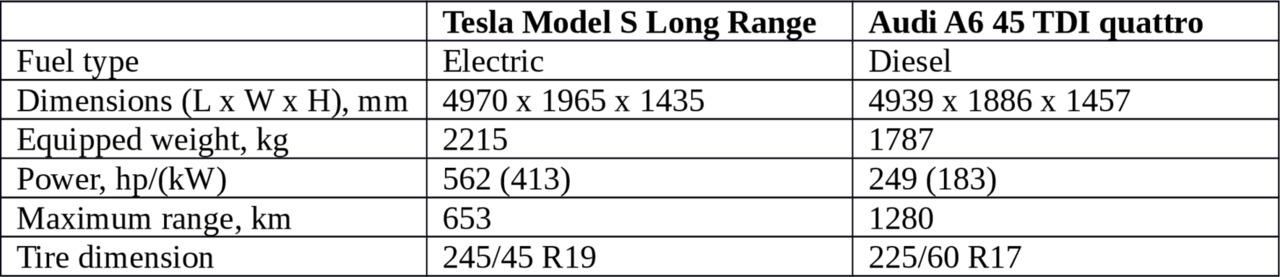
Furthermore, to reduce pressure on the road surface, electric vehicles often use wider tires, which contributes to increased tire wear emissions. It is also important to account for the significantly shorter range associated with these wider tires.
Greenhouse gas emissions. Tables 4 and 5 present the annual greenhouse gas emissions for electric vehicles and vehicles with internal combustion engines (ICE), respectively.


A comparative analysis of these data indicates that electric vehicles emit approximately 15% more harmful substances into the atmosphere than comparable vehicles with internal combustion engines within the same class. This increase is primarily due to the higher mass of electric vehicles, their technical characteristics, and the specifics of electricity production at power plants, all of which contribute to greater emissions of harmful substances and greenhouse gases. Furthermore, these emissions exceed permissible limits established by Euro-6 and Euro-5 standards. Additionally, tire wear in electric vehicles — especially those equipped with wider tires — intensifies the release of solid particles. Consequently, it can be concluded that, despite their popularity and potential advantages, the shift to electric vehicles, under current conditions, is more likely to exacerbate the global environmental situation rather than alleviate it.
References:
1. Гашо, Е. Приоритеты энергоперехода на транспорте: электротяга или повышение экологического класса углеводородного топлива? / Е. Гашо, С. Белобородов, А. Ненашев // Энергетическая политика. — 2024. — №1 (192). — С. 58—69.
2. Маслеева, О. В. Экологическое сравнение автомобиля с ДВС и электромобиля / О. В. Маслеева, Е. В. Крюков, Ю. Д. Голицын // Электроэнергетика глазами молодежи: материалы XII Международной научно-технической конференции, Нижний Новгород, 16–19 сентября 2022 года. Том Часть II. — Нижний Новгород: Нижегородский государственный технический университет им. Р. Е. Алексеева, 2022. — С. 137—140.
3. Audi A6 3.0 45 TDI quattro Tiptronic (07.2020 — 12.2022) — technical specifications. [E-resource]. URL: https://www.drom.ru/catalog/audi/a6/295995/ (Date accessed 11.03.2025)
4. Tesla Model S 100D kWh Long Range (06.2021 — н.в.) — technical specifications. [E-resource]. URL: https://www.drom.ru/catalog/tesla/model_s/459622/ (Date accessed 11.03.2025)
Гибелева М. И.
Pollution control in the Seychelles
Gibeleva M.I., 3rd year student «Applied mathematics and computer science»
Scientific adviser: Ozhereleva V.S., Senior Lecturer of the Department of Foreign Languages
Federal State Budgetary Educational Institution of Higher Education «Technological University named after twice Hero of the Soviet Union, Pilot-cosmonaut A.A. Leonov», Korolev, Russia
The article considers a problem of pollution in the Seychelles. Despite its flourishing environment and small amount of manufactories Seychelles faces problems with chemicals, waste management and air pollution. The Ministry of Agriculture, Climate Change and Environment together with non-government organizations and citizens go to great lengths to take care about ecology and maintain the environment.
Keywords: Seychelles, environment, pollution
With the rapid socio-economic development of the country, more chemicals are being used in the environment. These include petroleum and allied products, pesticides, cleaning agents, heavy industry related chemicals and food processing related industry. Some of these are released in the environment and if not done correctly, these could threaten wildlife.
Good Chemical Management involves:
1. Labelling and safety information.
2. Hazards and Personal Safety Equipment (PSE).
3. Emergency Management and Spills.
4. Disposal.
5. Public Education [1].
Seychelles generate an average amount of 90,000 tons of waste per year. Wastes are disposed in Communal bins sites around the islands and the waste are collected and transported in refused compactor trucks which then are transferred to a controlled landfill at Providence. Solid Waste Management (SWM) poses a significant challenge to Seychelles that suffers from many of the usual issues associated with managing waste within a Small Island Developing State (SIDS), such as lack of funding & capacity, high costs of transportation, absence of engineered landfills and scarcity of land.
The EAP section conducts monitoring visit, to ensure that the development is as per approval. Monitoring is also done to ensure that mitigating measuring are taken by the developer; such as:
1. Adequate mitigate measures should be taken on site to prevent sediments wash down so as not to affect neighboring properties.
2. All plastics, rubber, glass, synthetic and other inorganic waste, construction and demolition waste should not be dumped into the nearby properties but should be sorted out at source and appropriately disposed at the designated waste disposal site.
3. Onus is on the developer to minimize nuisance by reasons of noise, smell/dirt/dust and fumes to any adjoining properties.
4. No open fire should be lit on site without a valid burning permit being sought from the Forestry Section of the Environment Department.
5. Normal working hours is to be strictly maintained, i.e. 800hours to 1600hours during weekdays, 800hours to 1300hours on Saturdays and strictly no work on Sundays and public holidays [2].
Sustainability for Seychelles (S4S), a non-governmental organization, intends to expand on the air quality monitoring project and gain a clearer picture of how good the island nation’s air quality is and determine where action should be taken. The project’s manager, Laurent Sam, said that S4S «together with the Seychelles Meteorological Authority (SMA) S4S has installed 13 air quality sensors on Mahe, Praslin and La Digue. The data is uploaded to a website in real time and is freely available to the public» [3].
There is a Real-time Air Quality Index Visual Map in the Seychelles [4]. Air pollution on Mahe on March 10 is shown in the Picture 1.
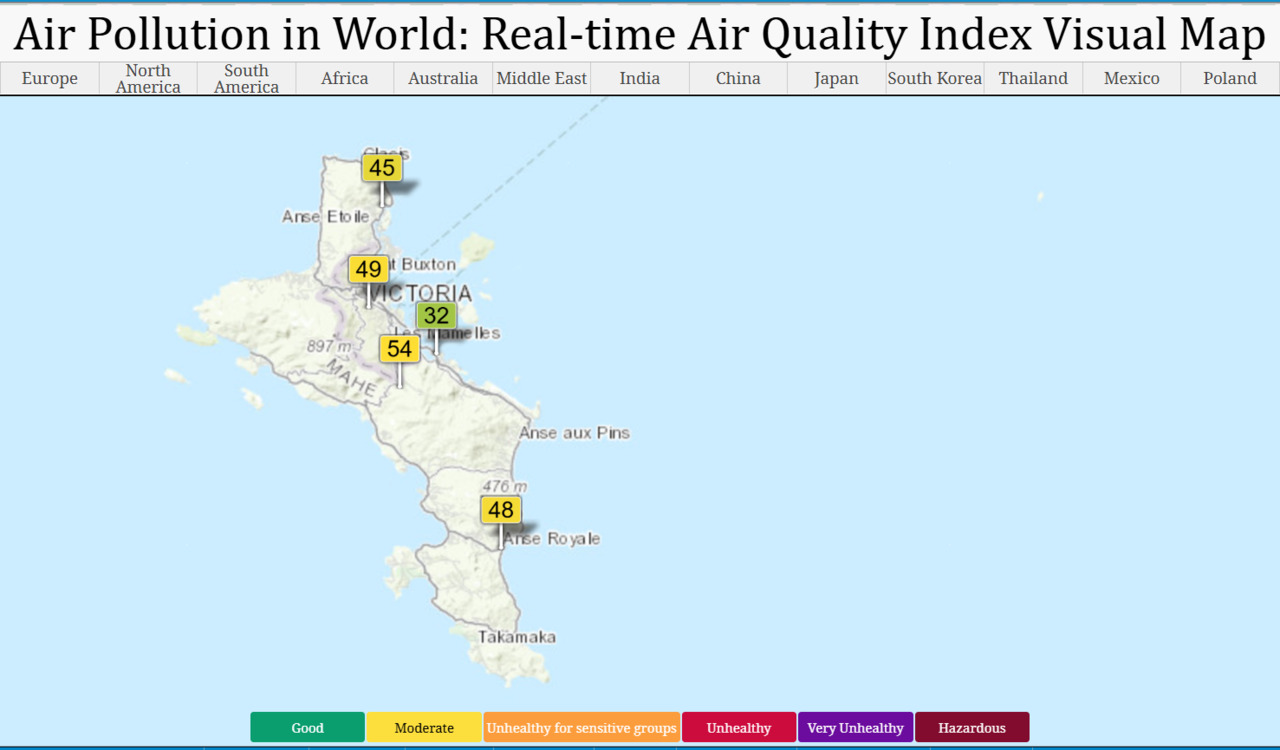
According to the Picture 1 good Air Quality was recorded by Seychelles Maritime Academy on the eastern side of Mahe (Les Mamelles District) — 32 AQI (Air Quality Index. In the rest part of the island air pollution level is moderate. A table of AQI is presented in the Picture 2.
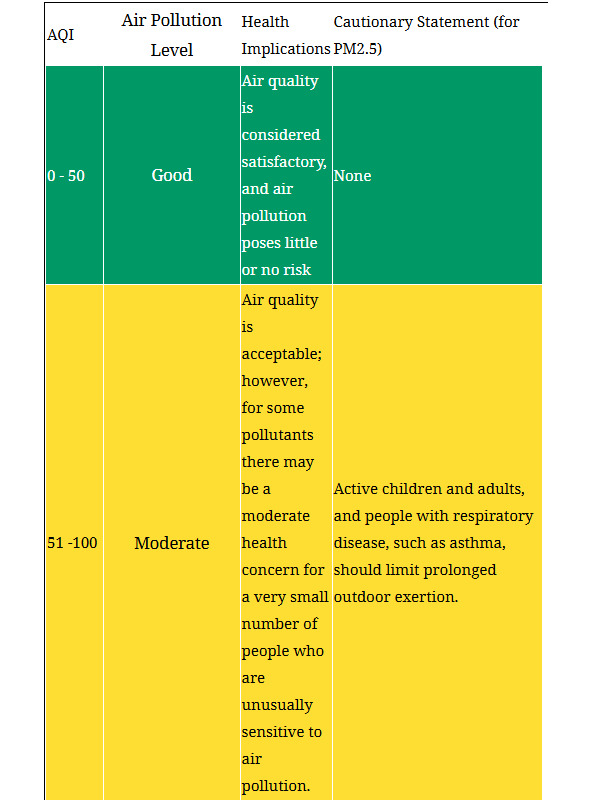
Air pollution on Praslin and La Digue on March 10 is shown in the Picture 3.

According to the Picture 3 good Air Quality is pointed on both islands — 36 AQI. Air pollution on Mahe on March 23 is shown in the Picture 4.
In comparison with AQI on March 10 AQI on Mahe 23 is lower — 20 AQI. The better Air Quality is still recorded in the Les Mamelles District. Air poluttion on Praslin and La Digue on March 23 is shown in the Picture 5.
In comparison with AQI on March 10 AQI on Praslin and La Digue on March 23 is still at the good level. But AQI on Praslin on March 23 is higher than on March 17, and AQI on la Digue on March 23 is lower than on March 17.
Seychelles’ main industries include tourism, fishing, farming, oil drilling and manufacturing. Most manufacturers are small-scale and consist largely of food processing plants. The manufacture of beer, cigarettes, chemicals and furniture, among other items, also plays a significant role within the sector.
The pollution generated outside Seychelles and is more noticeable when the humidity is high which is in the period from January to March. The rain can wash some of pollution, but it is not enough to clear the air [5]. This situation can affect people already with medical conditions or those vulnerable which include children, elderly and pregnant women. Medical center gives people advice to remain indoors during the times that the haze a bit more in the atmosphere, so this is in the afternoon going towards late evenings [6].
There are also external methods implemented by government and non-government organizations for purifying the air:
1. Precipitation. Extraneous particles are eliminated from the bulk of the gas due to the action of a certain force: gravity, inertial forces or electrostatic forces.
2. Filtering. Foreign particles are eliminated using special filters that allow the bulk of the air to pass through but retain suspended particles.
3. Adsorption. The method is based on the physical properties of several porous materials capable of extracting individual components from a gas-air mixture. Active carbons of various grades, zeolites, silica gel and other substances are used as adsorbents.
4. Absorption. The method is based on the process of dissolving gas components in a liquid (physical adsorption) or on dissolution together with a chemical reaction (chemical adsorption).
5. The catalytic method. It uses a special substance, a catalyst, upon interaction with which the toxic components of the gas — air mixture become harmless substances.
In conclusion Seychelles government should monitor the pollution situation, provide information to citizens and take action to protect environment and people’s health. Local people should also take care about themselves and follow recommendations giving by government.
References:
1. https://macce.gov.sc/pollution-control/
2. https://macce.gov.sc/environment-department/waste-management/
3. Sustainability for Seychelles to expand air quality monitoring — Inside Seychelles
4. https://aqicn.org/map/world/
5. https://youtu.be/r4cVw2xK55k?feature=shared
6. https://youtu.be/fULbURy2kd4?feature=shared
Година Е. А.
Design as a Tool for Social Impact: The Use of Language and Visual Elements to Promote Positive Change
Ghodina E.A. 2nd year bachelor degree student «Design»
Scientifc adviser: Kyuregyan M.P., PhD in Sociology, Associate Professor of the Department of Foreign Languages
Federal State Budgetary Educational Institution of Higher Education «Technological University named after twice Hero of the Soviet Union, Pilot-cosmonaut A.A. Leonov», Korolev, Russia
The article is devoted to the development of the field of design and the role of English language usage in it for influencing society. To understand the necessity of promoting this specific direction, methods facilitating the dissemination of necessary ideas and successful examples of such usage were analyzed.
Keywords: design, social impact, foreign language and design, culture in design.
We live in remarkable times when globalization and the instant spread of information are changing conventional notions of design, transforming it from mere aesthetic enhancements of products into powerful tools capable of reflecting public opinion and influencing behaviors, promoting positive changes within our society. It functions particularly effectively when combined with an international language — English, and appealing visual elements that help connect people from different corners of the world in their pursuit of solving common problems. In this article, we explore the key aspects of applying design, relying on successful examples while highlighting promising paths for its development.
Let’s begin by examining how design can influence social change. Social design is an approach that addresses real societal problems through creative thinking. Its goal is not profit, but rather the enhancement of people’s lives, the promotion of social justice, and environmental protection. To understand how to achieve these goals, it’s important to highlight several key principles of social design:
User-Centered Approach: It is crucial to understand who your audience is, what their needs and motivations are. This requires consideration of cultural particularities, educational levels, and many other factors influencing how people perceive information.
— Transparency and Credibility: Your messages should be clear and fact-based. Do not succumb to the temptation to manipulate or distort information, as this can undermine trust in you.
— Engagement and Interactivity: Design should encourage people to participate, allowing them to interact with the presented information and contribute to solving emerging issues.
— Collaboration and Co-Creation: Effective social design is achieved through partnerships between designers, social experts, and representatives of the target audience.
Thus, not only is the idea and the right intentions significant, but also the proper execution from the perspective of the design profession.
The English language is becoming a powerful tool for conveying social messages to a broad audience. Using English helps overcome language barriers and connect people from different cultures. However, it’s important to remember about clarity and simplicity of language, avoiding complex expressions and cultural references that may be unclear to non-native speakers. Research and consultation with the target audience can help ensure the correctness of statements.
Successful campaign examples underscore the role of the English language. The hashtag #MeToo, for instance, became a global symbol of the fight against sexual harassment, while the Black Lives Matter movement drew attention to racial discrimination and mobilized millions around the world.
Visual elements play a key role in design because they can convey complex ideas and emotions. Photographs, illustrations, and videos can capture attention and motivate people to act. To be successful, visual elements should be:
— Relevant: Connected to the campaign’s topic.
— Emotionally Appealing: Evoke feelings in the audience that drive them to action.
— Authentic: Use real images, avoiding staged scenes.
— Accessible: Consider the needs of people with disabilities.
Aesthetically Pleasing: Beautiful design is memorable and attracts attention.
In today’s rapidly evolving world, characterized by quick technological advances and changing social norms, design for social impact faces new challenges and opens up new opportunities.
— Virtual and Augmented Reality: VR/AR technologies allow for immersive experiences that enable users to feel empathy and better understand others’ problems. For example, VR can be used to simulate life in a refugee camp or to demonstrate the consequences of climate change.
— Artificial Intelligence: AI can be used for data analysis, content personalization, and process automation in social campaigns. For instance, AI can analyze social media posts to identify individuals in need or create personalized messages for different target groups.
— Blockchain: This can be used to enhance transparency and accountability in social projects. For example, blockchain can track donations and ensure that they are directed to their intended purposes.
— Combating Misinformation: The spread of misinformation online is a serious issue that can undermine trust in social campaigns and lead to negative consequences. Designers must develop strategies to combat misinformation, such as creating visual elements that debunk false information and spread the truth.
— Ethics and Responsibility: Designers should recognize their responsibility for the consequences of their decisions and avoid using design to manipulate people or promote harmful ideas. Ethical principles must be maintained, placing societal interests above personal gain.
Having understood the significance and techniques of the discussed topic, it is necessary to analyze the theory in real practice. As a case study example, let’s take a look at a popular company.
«The Ocean Cleanup» is a Dutch non-profit organization developing technologies to clean up the oceans of plastic waste. Their campaign is an excellent example of effective design usage for social impact, particularly in combining visual elements and the English language. The organization employs a minimalist and modern design, evident in their logo which consists of a stylized wave, making it easily recognizable and symbolizing their mission. The use of blue and white colors in their visual communication is associated with cleanliness and the ocean. «The Ocean Cleanup» actively utilizes infographics and data visualization to explain the complex issue of ocean plastic pollution. They demonstrate the scale, sources of pollution, and potential impact of their cleanup technology. These visualizations are understandable and compelling for a wide audience.
The organization produces high-quality videos showcasing their technology in action. These videos illustrate not only the technical aspects but also human stories related to the issue of ocean pollution. They evoke an emotional response and motivate support for their mission. They also use their website and social media to disseminate information about their activities, engaging donors and volunteers. They post articles, photographs, and videos detailing the progress made in ocean cleanup efforts. All content from «The Ocean Cleanup» is available in English, allowing them to reach a global audience. They use straightforward and clear language, avoiding complex technical jargon.
It is worth noting their collaboration with well-known personalities and organizations to raise awareness of their mission. This helps them attract public attention and increase their supporter base. Overall, «The Ocean Cleanup» is a vivid example of how effective design, combined with the use of the English language and persuasive visual communication, can address global social issues and inspire people to learn about different cultures and lexicons.
In conclusion, social impact design is a powerful tool that can lead to real change in society. By utilizing English and appealing visual elements, designers can bring people together, inspiring them to take action. It is crucial to adapt to innovations and use modern technologies to create effective and sustainable social campaigns. It is important to remember that design is not only about aesthetics but also an opportunity to change the world for the better.
Finally, it should be noted that we are on the brink of a new era of social design, where attention is paid to personalization, interactivity, and sustainability. By applying innovative technologies and a creative approach, designers can create inspiring campaigns that contribute to addressing pressing issues and improving our lives. A critical question remains: how to use this powerful tool wisely and responsibly to benefit society.
References:
1. Влияние графического дизайна на массовое сознание/Чжан Цзюйсинь — студент Хэнаньского университета КНР, г. Кайфэн/ Научно издательский центр Аспект — 2023. — №1. — С. 1—10.
2. Как графический дизайн повлиял на жизнь людей — роль графического дизайнера в современном обществе/Радиолоцман/Пресс-релиз
3. Роль английского языка в сфере дизайна: анализ влияния на коммуникацию и творческий процесс/М. Абдуахит, А. Жолдасова/Центрально-Азиатский инновационный университет, г. Шымкент/ In Library 16.05.2024 (1), с. 50–51
Голубева Ю. И., Лешенко А. Н.
The Superiority of Graphic Designers Compared to Modern AI
Golubeva Yu. I., Leshenko A.N. 2nd year bachelor degree students «Design»
Scientifc adviser: Kyuregyan M.P., PhD in Sociology, Associate Professor of the Department of Foreign Languages
Federal State Budgetary Educational Institution of Higher Education «Technological University named after twice Hero of the Soviet Union, Pilot-cosmonaut A.A. Leonov», Korolev, Russia
Artificial intelligence is becoming increasingly prevalent every day, transforming our way of life, communication, and even creative processes. Today, AI is capable of many things: creating works of art, writing texts, composing music, and solving complex tasks that were once exclusive to humans. Can artificial intelligence completely replace creative professions, substituting cold machines for humans? This is an important question that we will explore in this study.
The goal of this report is to demonstrate that graphic designers possess skills that artificial intelligence cannot replicate, ensuring their relevance even in the era of new and progressive technologies. We will examine what AI can and cannot do and highlight the areas where humans surpass machines.
Keywords: graphic design, artificial intelligence, difference, advantages.
Goal
To prove that graphic designers possess skills that artificial intelligence cannot replace.
Objectives
• Compare the capabilities of artificial intelligence and humans in design.
• Identify key areas where humans outperform artificial intelligence.
What is Artificial Intelligence?
First, it is essential to understand what artificial intelligence is and how it functions before delving deeper into the research.
Artificial intelligence is a way to teach computers or robots to think like humans. It uses algorithms that enable computers to analyze vast amounts of data and identify patterns. Simplifying this explanation, one could say that AI is a very diligent student. It analyzes millions of examples (photos, texts, dialogues), identifies patterns, and attempts to replicate them.
Artificial intelligence systems learn from large volumes of preprocessed and labeled data. AI analyzes this data, finds connections and patterns, and then draws conclusions or makes decisions. For example:
• A chatbot can learn to interact with humans if shown numerous dialogue examples.
• An image recognition system can identify what is depicted in a picture if shown millions of labeled examples.
Artificial intelligence is built on three core abilities:
1. Learning — identifying patterns in data.
2. Thinking — using these patterns to make decisions.
3. Error correction — improving based on feedback.
In other words, artificial intelligence learns from examples, draws conclusions, and gradually becomes more refined.
Does your phone recognize faces in photos? That’s AI. Does your voice assistant joke in response to your question? That’s also AI. Do self-driving cars operate without a driver? AI is behind that too!
Now that we’ve covered this, let’s move on to comparing the capabilities of artificial intelligence and humans in graphic design.
What AI Can Do in Graphic Design
1. AI is much faster and more efficient than humans at performing boring, repetitive tasks.
AI can handle numerous tasks, such as creating templates, selecting color schemes, editing images, generating illustrations based on text, working with typography, and adapting designs for different platforms. Additionally, AI can analyze vast amounts of data with high precision and process it according to predefined parameters, such as identifying trends or structuring information.
While humans can do the same, it requires significantly more time and effort.
2. AI lacks the human factor, which is why companies love using it.
Creative professions don’t always align well with business principles. Artists and designers often become part of corporate systems where their working conditions, pay, and final outcomes are dictated. Creativity involves experimentation and risk, but companies prioritize stable profits and avoid uncertainty and delays. As a result, creators lose freedom as their work is tailored to commercial interests. Graphic designers have a critical task: to create entirely unique solutions for clients. Yet, constrained by rigid frameworks, designers cannot fully fulfill this role.
This is where AI steps in, offering companies what they’ve long desired. Using AI is cheaper, faster, and safer: it doesn’t argue or deviate from set parameters, always delivering the expected result on time without demanding raises or breaks.
3. AI reduces costs but ignores copyright.
AI learns by analyzing vast amounts of data, including artists’ works, and can replicate their styles without permission. Imagine a publisher wanting to illustrate a book. They review various artists’ works but, to cut costs, turn to AI to create illustrations mimicking a specific artist’s style.
This example shows how companies use AI to minimize expenses while disregarding artists’ rights to their unique styles and intellectual property. This undermines the credibility of creative professions and threatens legal norms protecting copyright.
What AI Cannot Do in Graphic Design
1. AI’s work lacks individuality and genuine creativity.
AI can create many things, but not soul. It doesn’t understand why red evokes anxiety while blue calms. It can’t infuse a logo with a brand’s history or audience emotions. Its works are like beautiful but empty frames without photos.
One of AI’s main limitations in graphic design is the absence of true creativity. While AI can generate images, pick colors, compose layouts, and even mimic famous artists’ styles, it does so based on existing data and templates. AI cannot think abstractly, understand deep emotions, cultural contexts, or create entirely new ideas beyond its training data. Even if companies abandon human designers and designers stop sharing their work publicly, neural networks won’t last long. They’ll only learn from their own outputs, and over time, their results will deteriorate.
2. AI makes mistakes and depends on input data quality.
Many design tasks require flexibility and handling ambiguity. For example, a client may lack a clear vision, and the designer must ask probing questions, suggest options, and refine the concept gradually. AI doesn’t ask questions — it just acts, even if the result is nonsensical. Images and visuals created by machines often lack logic: anatomical inaccuracies, meaningless text, unnatural facial expressions. Working with a professional designer is far more effective due to their client-oriented approach, experience, and expertise. They can clarify and understand the client’s exact desires instead of repeatedly delivering mismatched results, as AI does.
3. AI lacks critical thinking and reflection.
Critical thinking requires a deep understanding of the design’s context. For instance, a designer can assess whether a layout aligns with the project’s goals, target audience expectations, and overall branding. AI, operating on data, cannot grasp context or evaluate whether its work meets real needs.
Critical thinking helps designers create work that is not only visually appealing but also functional, meaningful, and aligned with the project’s objectives. AI, devoid of this ability, may produce attractive but nonsensical or impractical solutions.
Designers actively use feedback from clients and colleagues to improve their work. They can interpret both direct comments and nonverbal cues (e.g., audience reactions during presentations). AI cannot interpret such signals and can only process explicit data like text comments or numerical ratings.
Designers must justify their decisions and techniques, ensuring clients understand that their work isn’t based on the principle of «I’m the artist — I see it this way.» A professional graphic designer always embeds meaning into their work. AI lacks self-awareness and cannot independently assess or correct its mistakes.
Unique Advantages of Graphic Designers Over AI
1. Creativity and intuition.
Graphic design sits at the intersection of art, technology, and communication, requiring not only technical skills but also advanced cognitive abilities. Creativity and intuition are particularly vital, enabling designers to create unique, aesthetically significant, and functional products.
In graphic design, creativity manifests through:
• Concept generation — crafting unique visual solutions that align with project goals.
• Experimentation — using unconventional techniques like collage, digital painting, or animation.
• Adaptation — reinterpreting existing trends and tailoring them to specific tasks.
Creativity and intuition, key traits of designers, allow them to create distinctive products that help clients stand out. Unlike machines, which require precise instructions, designers explore multiple angles and devise unconventional approaches.
2. Ethical responsibility.
Ethical responsibility is a key advantage of human designers over AI. Designers don’t just create visuals — they consider the social, cultural, and moral implications of their work. They respect copyright, avoid plagiarism, and use only licensed or original materials. Designers account for cultural contexts, recognizing that colors, symbols, and gestures may carry different meanings across countries, and avoid solutions that could be deemed offensive.
They also prevent the spread of harmful content, such as materials promoting violence, hatred, or misinformation.
Unlike AI, which may inadvertently reproduce biases in its training data or generate unethical content, designers can critically evaluate their work, incorporate feedback, and make improvements.
3. Handling ambiguous tasks.
As mentioned earlier, design often involves situations where clients cannot clearly articulate their expectations or requirements. Designers must be flexible, asking probing questions, proposing options, and refining concepts iteratively.
AI, in contrast, requires clearly defined parameters and cannot intuitively understand client needs. It cannot ask clarifying questions, suggest alternatives, or adapt to changing requirements, making it unsuitable for ambiguity. Designers, with their experience, creativity, and empathy, can help clients define their needs and propose solutions beyond initial expectations, making the process more efficient and effective.
Conclusion
In summary, despite AI’s impressive capabilities in graphic design, it cannot fully replace human designers. AI is becoming an integral part of our lives, transforming workflows, but it should remain a tool that helps preserve the freshness of ideas. Instead of fighting AI, we should learn to collaborate with it, leveraging its strengths to achieve better results, save time, and reduce stress for workers — far better than expecting AI to do everything on its own.
References:
1. https://artdesignbytc.com/2024/04/25/the-limits-of-ai-in-graphic-design/
2. https://www.behance.net/gallery/155004233/AI-vs-Human
3. https://www.toolify.ai/ai-news/the-future-of-creativity-can-ai-replace-artists-25124
4. https://expatinternet.es/human-creativity-vs-artificial-intelligence-ia/
Гончарик В. В.
Взаимосвязь сексуальных установок с показателями маскулинности-феминности у молодёжи
Гончарик В. В., обучающаяся 2 курса направления подготовки магистров «Психология (практическая социальная психология)»
Научный руководитель: Семёнова Е. М., доцент, кандидат психологических наук
Филиал ФГБОУ ВО «Российский государственный социальный университет» в г. Минске Республики Беларусь
В статье рассматривается взаимосвязь сексуальных установок с маскулинностью и феминностью у молодёжи. По результатам исследования делаются выводы об особенностях корреляции определённых сексуальных установок у молодёжи с выраженным у них уровнем маскулинности/феминности. Исследование позволит лучше понять какие гендерные особенности могут оказывать влияние на сексуальное поведение молодёжи и разработать рекомендации по формированию здоровых сексуальных установок с учётом преобладающего гендерного типа.
Ключевые слова: сексуальные установки, гендерная идентичность, маскулинность, феминность, молодёжь.
Сексуальность является врождённой человеческой потребностью и пронизывает все сферы жизни человека.
В основе сексуальных установок лежат психосоциальные факторы, так они являются одним из механизмов регуляции человеческого поведения. По Д. Г. Майерсу, социальная установка — «это благоприятная или неблагоприятная оценочная реакция на что-либо или на кого-либо, которая выражается в мнениях и целенаправленном поведении» [2, с.161]. Значит, сексуальные установки — это предрасположенность, отношение и поведение по отношению к сексу, сексуальным действиям, сексуальности.
На формирование сексуальности влияют культурные образцы сексуального поведения, а также пример данного поведения в семье. В данном случае все объясняется тем, какие социальные роли принимает на себя личность (женские или мужские).
В 1971–1974 гг. С. Бем разработала опросник «Bem Sex Role Inventory» [3], где описала гендер как когнитивный конструкт, являющийся результатом интериоризации гендерных категорий культуры, и выделила 4 гендерных типа [1, с. 149]:
• Феминный тип — это гендерный тип, характеризующийся традиционно женскими чертами и поведением, такими как эмоциональность, заботливость, интуиция и эмпатия.
• Маскулинный тип — представляет собой гендерный тип, основанный на традиционно мужских чертах и поведении, таких как силы, уверенность, решительность и амбициозность.
• Андрогинный тип — это гендерный тип, сочетающий в себе как женские, так и мужские черты и поведение. Люди этого типа могут быть одновременно эмоциональными и агрессивными, уравновешивая в себе как женские, так и мужские качества.
• Недифференцированный тип — это гендерный тип, который не подпадает ни под феминный, ни под маскулинный тип. Люди этого типа могут испытывать затруднения в определении своей гендерной идентичности или являться гендерно нейтральными.
Нами было проведено эмпирическое исследование на выявление взаимосвязи сексуальных установок (Методика «Сексуальные установки» (Ганс Айзенк, Гленн Вильсон)) с выраженностью маскулинности-феминности (Методика «Маскулинность, феминность и гендерный тип» (О. Г. Лопухова, Сандра Бем)) у молодёжи. В исследовании приняли участие 60 студентов в возрасте от 18 до 35 лет проживающих в студенческая деревне, общежитии №11 БГУ (36 человек (60%) — женщины; 24 человека (40%) — мужчины).
Для определения взаимосвязи между рассматриваемыми переменными был использован коэффициента ранговой корреляции Спирмена и получены следующие данные (см. Таблица 1):
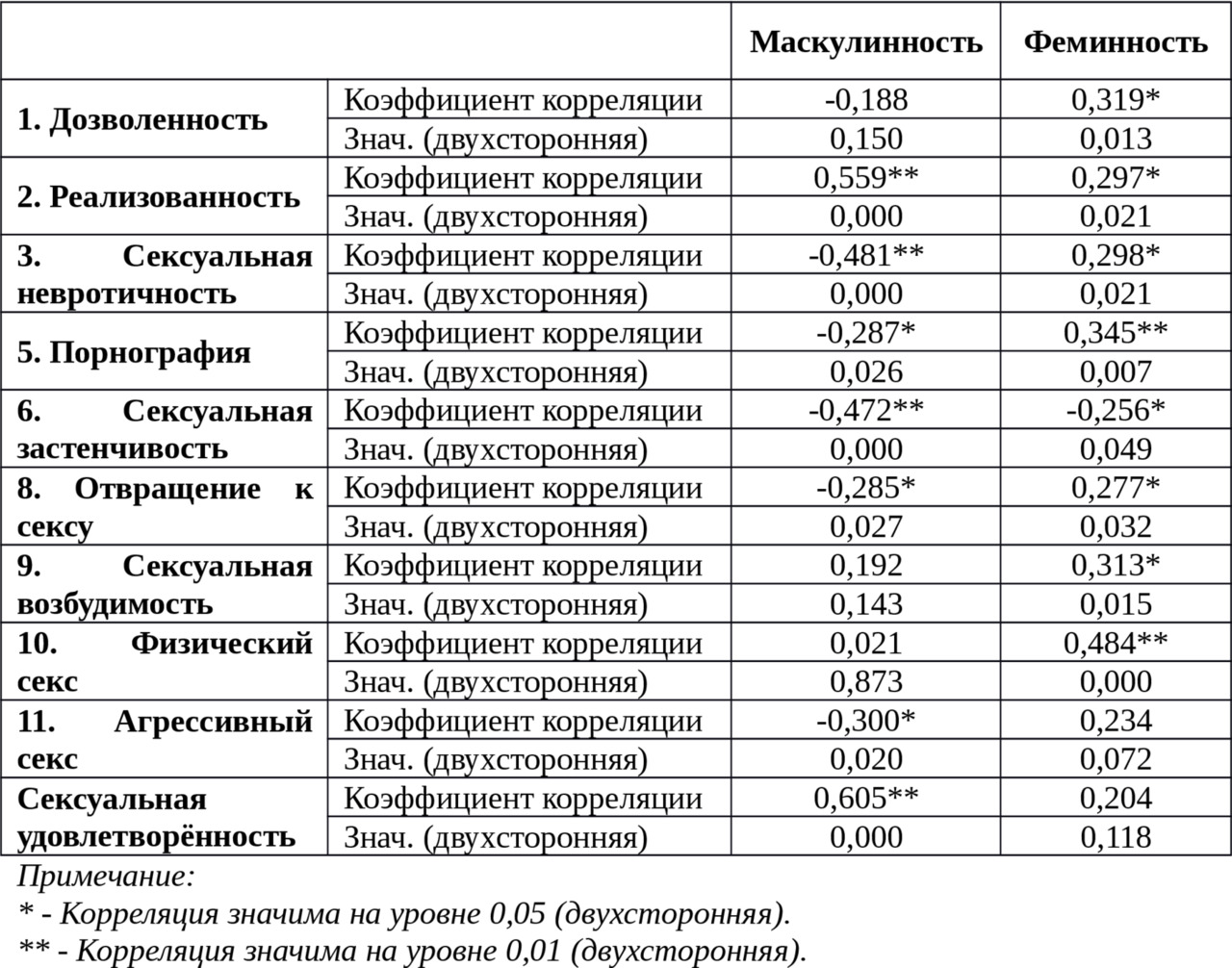
В ходе статистического анализа, выявлены следующие значимые корреляционные связи:
• Умеренная прямая взаимосвязь r=0,319 между феминностью и сексуальной дозволенностью с достаточным уровнем значимости p <0,01 — чем больше у человека преобладают феминные черты, тем выше у него будет уровень сексуальной дозволенности.
Общество и культура могут быть более благосклонны к людям с феминными чертами, считая их более привлекательными и желанными сексуальными партнёрами, а также они могут быть более эмоциональными, открытыми и коммуникабельными, что позволяет им более свободно проявлять свою сексуальность. Также возможно, что уровень сексуальной дозволенности у людей с феминными чертами может быть выше из-за их способности к более гармоничным отношениям и искусству соблазнения.
• Заметная прямая взаимосвязь r=0,559 между маскулинностью и сексуальной реализованностью с высоким уровнем значимости p <0,001 и слабая прямая взаимосвязь r=0,297 между феминностью и сексуальной дозволенностью с низким уровнем значимости p <0,05 — чем больше у человека преобладают андрогинные черты, тем выше у него будет уровень сексуальной реализованности и чем меньше у человека преобладают недифференцированные черты, тем меньше у него будет уровень сексуальной реализованности.
У людей с андрогинными чертами обычно более гибкое и разнообразное понимание своей собственной сексуальности, а также более открытый и экспериментальный подход к сексуальным отношениям. Такие люди могут быть более комфортными с собой и своими желаниями, что способствует более успешной сексуальной реализации. С другой стороны, люди с недифференцированными чертами могут испытывать большие трудности в понимании и принятии своей сексуальности из-за недостаточной ясности и уверенности в своих сексуальных предпочтениях. Это может привести к более ограниченной и неудовлетворительной сексуальной жизни.
• Умеренная обратная взаимосвязь r=-0,481 между маскулинностью и сексуальной невротичностью с высоким уровнем значимости p <0,001 — чем больше у человека преобладают маскулинные черты, тем ниже у него будет уровень сексуальной невротичности.
Маскулинные черты часто ассоциируются с более уверенным и контролирующим поведением, что может уменьшать уровень тревожности и невротичности у человека. Кроме того, маскулинные черты часто сочетаются с более высоким уровнем самооценки и уверенности в себе, что также может снижать уровень сексуальной невротичности. В целом, наличие маскулинных черт может способствовать более спокойному и уравновешенному отношению к сексу и сексуальным инициативам.
• Слабая прямая взаимосвязь r=0,298 между феминностью и сексуальной невротичностью с низким уровнем значимости p <0,05 — чем больше у человека преобладают феминные черты, тем выше у него будет уровень сексуальной невротичности.
Стереотипы и ожидания общества относительно мужественности и женственности могут оказывать влияние на чувство собственной стоимости и самопринятия у человека. Люди, у которых преобладают феминные черты, могут сталкиваться с давлением со стороны окружающих и непринятием своей сексуальности, что может вызывать у них чувство невротичности и неуверенности в себе.
• Слабая обратная взаимосвязь r=-0,287 между маскулинностью и одобрением порнографии с низким уровнем значимости p <0,05 — чем больше у человека преобладают маскулинные черты, тем ниже у него будет уровень одобрения порнографии.
Люди с более выраженными маскулинными чертами могут иметь более высокий уровень самоконтроля и эмоциональной уравновешенности, что делает их менее склонными к зависимостям, включая порнографию. Также мужественные люди могут иметь более ясное понимание своего сексуального поведения и предпочтений, что может снижать интерес к порнографии.
• Умеренная прямая взаимосвязь r=0,345 между феминностью и одобрением порнографии с достаточным уровнем значимости p <0,01 — чем больше у человека преобладают феминные черты, тем выше у него будет уровень одобрение порнографии.
Это может быть связано с тем, что люди с феминными чертами чаще проявляют открытость к новым и непривычным идеям, включая сексуальные. Они могут быть более толерантны к различным формам сексуальности и осознавать, что порнография может быть выражением сексуальной свободы и самовыражения.
• Умеренная обратная взаимосвязь r=-0,472 между маскулинностью и сексуальной застенчивостью с высоким уровнем значимости p <0,001 и слабая обратная взаимосвязь r=-0,256 между феминностью и сексуальной застенчивостью с низким уровнем значимости p <0,05 — чем больше у человека преобладают андрогинные черты, тем ниже у него будет уровень сексуальной застенчивости и чем меньше у человека преобладают недифференцированные черты, тем выше у него будет уровень сексуальной застенчивости.
Это может быть связано с тем, что андрогинные черты характеризуются более гибким и сбалансированным подходом к половым ролям. Люди с такими чертами могут быть более открытыми и уверенными в себе, что может снизить уровень сексуальной застенчивости. С другой стороны, люди с неопределённой гендерной идентичностью могут испытывать более жёсткие ожидания от себя и окружающих в отношении половой роли. Это может приводить к большей неуверенности и застенчивости в области сексуальности.
• Слабая обратная взаимосвязь r=-0,285 между маскулинностью и отвращением к сексу с низким уровнем значимости p <0,05 — чем больше у человека преобладают маскулинные черты, тем ниже у него будет уровень отвращения к сексу.
Преобладание у человека маскулинных черт, рационализирует его восприятие секса. В современном обществе секс перестал быть табуированной темой, соответственно без травматического сексуального опыта, отвращение к сексу в современном мире редкий феномен. Так же отметим, увеличенный уровень тестостерона, у людей с маскулинным гендерным типом, что может увеличивать их интерес к сексу.
• Слабая прямая взаимосвязь r=0,277 между феминностью и одобрением порнографии с низким уровнем значимости p <0,05 — чем больше у человека преобладают феминные черты, тем выше у него будет уровень отвращения к сексу.
Феминные черты предполагают под собой стереотипную ценность целомудрия, а также больший риск для появления травматического сексуального опыта, т.к. он в основном исходит от людей маскулинного типа. Феминные люди могут в большей степени чувствовать свою уязвимость, в частности при половом акте.
• Умеренная прямая взаимосвязь r=0,313 между феминностью и сексуальной возбудимостью с низким уровнем значимости p <0,05 — чем больше у человека преобладают феминные черты, тем выше у него будет уровень сексуальной возбудимости.
Феминные черты у человека предполагают более высокий уровень эстрогенов, что влияет на его сексуальное влечение. Также возможно, что люди с более выраженными феминными чертами могут быть более открытыми к разнообразным сексуальным опытам и экспериментам.
• Умеренная прямая взаимосвязь r=0,484 между феминностью и стремлением к физическому сексу с высоким уровнем значимости p <0,001 — чем больше у человека преобладают феминные черты, тем выше у него будет уровень стремления к физическому сексу.
Для феминных людей важен тактильный эмоциональный контакт, при котором они будут чувствовать себя защищёнными. Так же с трансформацией современного общества, феминность перестала подразумевать под собой целомудрие, открытое выражение своей сексуальности становиться более распространённым.
• Слабая обратная взаимосвязь r=-0,300 между маскулинностью и агрессивным сексом с низким уровнем значимости p <0,05 — чем больше у человека преобладают маскулинные черты, тем ниже у него будет уровень агрессивного секса.
Люди с более выраженными маскулинными чертами могут быть более уверенными в себе и иметь более зрелый, эмоционально богатый подход к сексу. Они могут предпочитать более интимные и эмоциональные формы сексуальной активности, чем агрессивный секс. Также стереотипы и социальные ожидания могут играть роль — люди с выраженными маскулинными чертами могут чувствовать давление со стороны общества и не проявлять агрессивное поведение в сексе.
• Заметная прямая взаимосвязь r=0,605 между маскулинностью и сексуальной удовлетворённостью с высоким уровнем значимости p <0,001 — чем больше у человека преобладают маскулинные черты, тем выше у него будет уровень сексуальной удовлетворённости.
Маскулинные черты ассоциируются с более высоким уровнем тестостерона, что в свою очередь может повышать сексуальное влечение и удовлетворение. Также маскулинные черты могут способствовать более ясной постановке сексуальных желаний и в соответствии с этим, их воплощения.
Таким образом, сексуальные установки молодежи взаимосвязаны с их маскулинностью-феминностью, и дальнейшие исследования в этой области могут помочь лучше понять роль гендерной идентичности в формировании сексуальности и помочь развивать более открытые представления о сексуальности.
В рамках сексуального просвещения молодёжи в соответствии с их гендерным типом мы можем предложить следующие рекомендации:
1. Для молодых людей с маскулинным гендерным типом:
— Обращайте внимание на свои эмоции и чувства, не бойтесь демонстрировать уязвимость.
— Уважайте собеседника и его согласие на близость, не настаивайте на интимных отношениях.
— Обсуждайте с партнером свои желания и предпочтения в сексе, обучайтесь уважать его сексуальную идентичность.
— Изучайте тему сексуального образования и консультируйтесь с профессионалами.
2. Для молодых людей с феминным гендерным типом:
— Повышайте самоуважение и уверенность в себе, не позволяйте другим навязывать свое мнение.
— Учите партнера уважать ваше желание на интимные отношения и соблюдение границ.
— Исследуйте свою сексуальность и выражайте свои желания открыто, не стесняйтесь общаться на эту тему.
— Обращайтесь за помощью к специалистам, если возникают трудности или вопросы.
Сексуальное просвещение молодежи должно основываться на уважении к личности каждого индивида и поддержке его права на собственные выборы в сфере сексуальности. Важно обучать молодежь навыкам коммуникации и взаимоуважения, чтобы они могли строить здоровые и гармоничные отношения.
Список литературы:
1. Лопухова, О. Г. Опросник «маскулинность, феминность и гендерный тип личности» (российский аналог «bem sex role inventory») / О. Г. Лопухова — Текст: непосредственный // Вопросы психологии. — 2013. — №1. — С. 147—154.
2. Майерс, Д. Социальная психология / Д. Майерс. — Санкт-Петербург: Питер, 2010. — 800 с.
3. Bem, S.L. The measurement of psychological androgyny / S.L. Bem, J. Consult — Text: direct // Journal of Consulting and Clinical Psychology. — 1974. — Vol. 42. — №2. — Р. 155—162.
Дегтярев А. Д.
The Problem of the «Demographic Hole» in Contemporary Russia
Degtyarev A.D. 3rd year bachelor degree student «State and municipal administration»
Scientifc adviser: Massalskaya Y.V., PhD in Philology, Associate Professor of the Department of Foreign Languages
Federal State Budgetary Educational Institution of Higher Education «Technological University named after twice Hero of the Soviet Union, Pilot-cosmonaut A.A. Leonov», Korolev, Russia
The article discusses the ongoing demographic challenges in Russia, particularly the sharp decline in birth rates. In 2024, Russia’s birth rate reached its lowest level in 18 years, with only 599.6 thousand babies born in the first half of the year, contributing to a natural population decrease. The article highlights various socio-economic and cultural factors, such as economic instability, the housing crisis, and societal perceptions of family life, which discourage many young Russians from having children. Despite state support measures like maternity capital and childbirth benefits, the article argues that these efforts are insufficient to address the broader demographic crisis, with many middle-class families still struggling to secure the necessary conditions for raising children.
Keywords: birth rate, natural population growth, economic instability, social changes, cultural and religious norms, sociocultural factor, contraception, housing issue, discrimination against women, maternity capital, maternity and childbirth benefits, initiatives to increase birth rate, social tension, middle class, support measures for young families.
Against the backdrop of economic and social changes in Russia, the demographic situation continues to be one of the country’s most pressing issues. In early September 2024, Rosstat reported an extremely low birth rate in the country. In the first half of 2024, only 599,600 babies were born in Russia, which is 16,600 fewer than in the same period the previous year. These figures reflect not only a decline in birth rates but also a decrease in the natural population growth, which in turn has long-term consequences for the country’s economy and social structure.
As noted by Dmitry Peskov, the press secretary of the President of Russia, the birth rate in the country has fallen to 1.4 children per woman — the lowest level in the last 18 years. For simple population reproduction, a rate of 2.1 children per woman is required, which is significantly higher than the current level. In 2023, Russia’s population decreased by 244,000 people, further exacerbating the demographic situation.
Many experts point out that global practice shows that a high standard of living and material welfare are not always the key factors in increasing birth rates. Member of Parliament Irina Filonova emphasizes that upbringing, moral and ethical values, and the perception of children by society as an integral part of life play a much more significant role. However, amid instability and economic difficulties, many Russians are postponing having children, waiting for a more stable future.
Moreover, sales of contraceptives reached record levels in 2023, the highest in the past six years, indicating a desire among people to avoid or delay childbirth in times of uncertainty. However, it is worth noting that even in «prosperous» years, such as 2006, birth rates remained low, which points to the multifaceted and complex factors influencing the demographic situation.
Interestingly, in third-world countries and ultra-religious societies, birth rates are significantly influenced not by the standard of living, but by traditional cultural and religious norms. For example, in the poorest countries like Sudan, Nigeria, and Congo, a woman has between 4.6 and 6.9 births on average. In these countries, the role of a woman as a mother is fundamental to the social context, in contrast to developed countries, where a high standard of living allows young people to build careers and engage in self-development. In such environments, a child becomes a burden, bringing numerous restrictions.
In Russia, the sociocultural factor also plays a significant role. According to research, 46% of Russians are not willing to lower their standard of living to have children or abandon their careers. This highlights that many Russians, especially younger generations, are not ready to sacrifice personal ambitions for childbearing, despite the available support measures. Years of economic instability, including during the 1990s, have led to the current generations born in that period being unable to ensure the necessary demographic balance.
A key barrier for many young people ready to become parents is the housing issue. Only 15% of Russians can afford to buy a home, which complicates the creation of a family and the birth of children. Young people are often unwilling to live with their parents, and buying their own apartment remains an unattainable goal for many.
In addition to housing issues, women with children face discrimination in the labor market. Employers fear that a young mother will frequently take sick leave or quit to care for a child. This forces many women to delay having children until they have saved enough financial resources to ensure stability.
The Russian government is making efforts to address the demographic problem: maternity capital, pregnancy and childbirth allowances, one-time payments, and other measures are aimed at supporting young families. However, as political scientist Ilya Graschenkov notes, these measures cover only a limited category of the population, mostly low-income families. The middle class, which also requires support, often remains overlooked.
In recent years, various initiatives aimed at increasing birth rates have been actively discussed in Russia. For example, a bill was introduced to ban abortions in private clinics, and other measures to strengthen family values were proposed. However, such initiatives often provoke negative reactions in society, as many believe that coercing people into motherhood and fatherhood will only lead to protests and increased social tension.
Russia is grappling with a critical demographic crisis marked by a record low birth rate of 1.4 children per woman, far below the replacement rate of 2.1, which poses long-term challenges for the economy and society. The birth rate declined further in the first half of 2024, coinciding with rising sales of contraceptives, indicating a trend of delaying parenthood amid economic uncertainty. Cultural attitudes also play a significant role, as many Russians, especially the younger generation, prioritize career and personal ambitions over having children, with 46% unwilling to sacrifice their standard of living for parenthood. Housing affordability remains a significant barrier, as only 15% of Russians can buy homes, complicating family formation. Despite government initiatives to support young families, many middle-class citizens feel overlooked, and proposed measures aimed at increasing birth rates often generate public backlash due to concerns over coercion into parenthood.
References:
1. Grigorenko Ya. A., Demographic crisis in the Russian Federation URL: [https://elar.urfu.ru/bitstream/10995/86161/1/978-5-7996-3053-9_2020_058.pdf?ysclid=lskev0y5k3248242266] (accessed 03/09/2025).
2. Natalia Kozelskaya, The demographic pit of 2024: what prevents Russia from increasing its birth rate URL: [https://riamo.ru/articles/aktsenty/demograficheskaja-jama-2024-chto-meshaet-povysit-rozhdaemost-v-rossii/?from=inf_cards] (accessed 02/09/2025).
3. Social protection / Demographic policy URL: [http://www.rosmintrud.ru/social/demography/90] (accessed 03/09/2025).
Деркач А. А.
Societal degradation and its implications in education and technology
Derkach A.A., 1st year bachelor student «Applied mathematics»
Scientific advisers: Dudka A.A., lecturer; Moyseyonok N.S., senior lecturer
Belarusian State University, Minsk, Belarus.
The article explores the phenomenon of societal degradation, emphasizing its multifaceted nature and its implications for education and technology. It examines the dynamics of societal decline, discussing factors such as moral erosion, economic disparity, and cultural challenges. Special attention is given to the role of artificial intelligence (AI) in education, highlighting its benefits — personalized learning, increased engagement — and its drawbacks, including dependence on technology and reduced critical thinking. The digital divide is also addressed as a critical aspect of societal degradation, showcasing generational inequalities in technology access and use. The article advocates for balanced approaches to education and technology, emphasizing the importance of maintaining interpersonal connections, fostering critical thinking, and addressing social inequalities.
Keywords: societal degradation, artificial intelligence in education, digital divide, educational standards, personalized learning.
Nowadays, various changes in society are drawing researchers’ attention to the phenomenon known as the degradation of society. Understanding this concept requires a closer examination of what society is, what degradation entails, and how societal degradation manifests.
Society, as a sociocultural phenomenon, is a complex system of interactions between individuals, groups, and institutions. It encompasses a wide range of relationships and influences almost every aspect of life. Engaged in the dynamics of change, society can either develop or deteriorate. A society is a collection of people united by various social ties, interacting to form a complex system. The degradation of society refers to the process of deterioration in social, cultural, and economic characteristics, often manifested through decreased living standards, moral decline, and other negative phenomena.
Degradation is typically not an instantaneous event but rather a prolonged process influenced by multiple factors. These issues are particularly relevant in the context of education, such as the debate over canceling exams for admission to gymnasiums. One manifestation of degradation can be observed in the education system, where stress and pressure from exams lead to a decline in students’ health and motivation. Proponents of abolishing exams argue that such a measure would reduce tension and create a more conducive learning environment. However, there is a concern that canceling exams could lower educational standards and diminish the drive for high academic achievement [2].
Artificial intelligence (AI) is actively being introduced into the educational sphere, providing new opportunities for personalized learning. Using data on students’ behavior, interests, and preferences, adaptive learning systems can create customized curricula, which significantly improves the effectiveness of the learning process.
At first glance, there are many advantages, for example:
— Individual approach: it allows students to take into account their individual needs and the rhythm of learning.
— Time Saving: Adaptive platforms help students focus on areas that require attention, making learning more effective.
— Engagement: The content corresponds to the student’s level of knowledge. This promotes greater engagement and increased motivation. Adaptive learning systems based on AI open up new horizons for the educational process. They not only make learning more effective, but also help create a more inclusive educational environment where each student can achieve their goals and develop their potential abilities at a comfortable pace.
Despite the obvious advantages of technology and artificial intelligence in education, it is necessary to realize and take into account their negative consequences. One of the main disadvantages is the excessive dependence of students on technology. We are witnessing how students are becoming more «trapped» in the world of digital devices, which sometimes leads to a superficial assimilation of information. In fact, many students use online resources as «short guides» without paying due attention to a deep understanding of the material. This negatively affects critical thinking and analytical abilities, contributing to the formation of a generation unable to solve complex problems on their own.
Artificial intelligence, in essence, creates the illusion of personalized learning, but such a system may not always adequately take into account the individual characteristics of each student. The conscious use of technology in education involves treating artificial intelligence as a tool that enhances, rather than replaces, traditional learning approaches. This perspective requires a deliberate effort to integrate AI into the learning process in a way that complements foundational teaching methods and human interaction. By doing so, educators can ensure that technology amplifies students’ learning experiences without undermining essential skills like critical thinking, creativity, and personal effort.
In addition, the use of technology in education can significantly reduce the level of interaction between students and teachers. Chatbots and automated response systems can save teachers from routine tasks, but they cannot replace personal contact, which is so important for developing interpersonal skills and emotional intelligence. As a result, students may find it difficult to establish social connections and communicate in the real world [3].
The spread of distance learning often leads to problems with motivation. Students studying at home may encounter a number of distractions that are absent in a traditional classroom. This leads to a decrease in concentration and academic discipline, which, in turn, negatively affects academic results and the perception of education itself.
However, it would be wrong not to mention the role of teachers in this important issue. Teachers, noticing that students use chatbots to complete assignments, resort to various methods to stimulate real intellectual activity. One of these ways is to complicate tasks by adding elements of non-standard thinking that require analysis, criticism, and synthesis of information. The idea is simple: artificial intelligence can hardly solve tasks where personal experience, originality and understanding of nuances are needed.
But here comes an interesting point. When tasks become overly complex, this can lead to unforeseen consequences. Even the most hardworking and independent students may encounter difficulties that prevent them from showing their knowledge and abilities. This approach risks discouraging the desire to learn, because the desire for knowledge is directly related to a sense of success and recognition. In addition, such assignments may end up testing the stress level rather than the student’s skills.
The question arises: how to find a balance? After all, the purpose of education is not to punish students, but to help them grow intellectually, learn how to work with information and develop critical thinking. Teachers should take into account the individual needs of students, their level of training and preferences. For example, the introduction of tasks with a choice, where there is a place for both creative projects and analytical work, can be an excellent solution.
Similarly, it is important to teach students the conscious use of technology. Artificial intelligence, whether it’s a chatbot or another means, is a tool, not a way to avoid labor. If a student understands how to use AI effectively for learning, it becomes a step forward, not backward. For example, using chatbots to find information, refine concepts, or test knowledge can be a useful addition to traditional learning methods.
Digitalization is penetrating into all spheres of life, changing communication, access to information and the way we interact with the outside world. Nevertheless, this global phenomenon is accompanied by serious social challenges, in particular, the emergence of the digital divide.
One of the striking aspects of the digital divide is the difference in the use of technology between generations. The younger generation, born in the Internet age, often has high digital literacy. They easily adapt to new applications, services, and platforms. At the same time, the older generation faces difficulties in mastering new technologies, which limits their access to modern information resources and services.
This leads to a number of social problems, such as:
— Isolation of the elderly: Older generations are becoming less integrated into modern society, which exacerbates feelings of loneliness.
— Limited access to services: Services such as online banking or telemedicine are becoming less accessible to those without computer skills.
— Conflicts between generations: Sometimes there is a misunderstanding between generations caused by the difference in approaches to the use of technology.
The digital divide directly contributes to the degradation of society. It undermines the principles of equality, slows down educational and cultural progress, and reduces the level of public trust. Without equal access to technology, society is divided into «digital rich» and «digital poor», leading to social polarization and conflict.
The digital divide impacts education, particularly for students in underserved or rural areas. Limited access to devices, stable internet connections, and digital learning platforms hinders students from fully participating in modern educational opportunities. This imbalance not only affects academic performance but also reduces the chances of bridging socioeconomic disparities between communities. Governments, non-profit organizations, and private sectors must work collaboratively to provide affordable and reliable technology infrastructure to mitigate these challenges.
Another dimension of the digital divide is its influence on economic opportunities. In today’s world, digital literacy is increasingly becoming a prerequisite for employment. Access to technology and the internet significantly affects one’s ability to acquire essential skills, search for jobs, and engage in professional development [1].
In conclusion, the topic of degradation of society under the influence of various factors, including technology and changes in the education system, is extremely relevant and complex. The degradation of society manifests itself as a gradual process caused by a variety of interrelated factors, from a decline in moral values and cultural standards to a deepening of social and economic inequality. In particular, the cancellation of gymnasium exams, despite good intentions, can undermine educational standards and motivation to achieve success if approached without due attention to the consequences.
Technologies, including artificial intelligence, undoubtedly provide huge opportunities to improve people’s lives, especially in education. An individualized approach, saving time, and increasing engagement are all important achievements. However, excessive dependence on technology can cause serious problems such as loss of critical thinking, decreased interpersonal communication, and difficulty concentrating. In addition, systems based on artificial intelligence are not always able to take into account the unique characteristics of each student, which raises the question of the need for balanced technology implementation.
The main challenge remains to find harmony between innovation and traditional methods. It is important not to forget about the role of the teacher as a mentor and guide to the world of knowledge. Technology should serve only as an auxiliary tool capable of enriching the learning process, rather than replacing its foundation. It is also extremely important to form students’ conscious attitude towards the use of technology, fostering in them the ability to combine modern tools with their own efforts and analysis.
References:
1. Головенчик Г. Г. Цифровой разрыв: причины возникновения, последствия и пути преодоления // Наука и инновации. 2021. №6 (220). URL: https://cyberleninka.ru/article/n/tsifrovoy-razryv-prichiny-vozniknoveniya-posledstviya-i-puti-preodoleniya (дата обращения: 19.03.2025).
2. Иржанова А. А. Проблема деградации общества // Форум молодых ученых. 2017. №8 (12). URL: https://cyberleninka.ru/article/n/problema-degradatsii-obschestva (дата обращения: 20.03.2025).
3. ЮНЕСКО. Искусственный интеллект в образовании: вызовы и возможности [Электронный ресурс]. — URL: https://unesdoc.unesco.org (дата обращения: 20.03.2025).
Детушев К. А., Смирнов Н. А.
The Problem of Ecology: Climate Change
Detushev K.A., Smirnov N.A., 1st year bachelor degree students «Design, production, and operation of rockets and rocket and space complexes»
Scientifc adviser: Massalskaya Y.V., PhD in Philology, Associate Professor of the Department of Foreign Languages
Federal State Budgetary Educational Institution of Higher Education «Technological University named after twice Hero of the Soviet Union, Pilot-cosmonaut A.A. Leonov», Korolev, Russia
Global climate change, driven by anthropogenic activities like fossil fuel combustion and deforestation, constitutes a critical planetary challenge. This engenders elevated temperatures, altered precipitation patterns, and escalating sea levels (IPCC, 2021). Resultant impacts encompass heightened frequency of extreme weather phenomena and biodiversity attenuation. Mitigation necessitates a transition to renewable energy systems, augmented energy efficiency protocols, and concerted international collaborations (UNFCCC, 2015).
Keywords: climate change, greenhouse gases, renewable energy, sustainable development.
Introduction
Climate change denotes protracted alterations in global thermal regimes and meteorological patterns, primarily attributable to human activities elevating atmospheric greenhouse gas concentrations. These gases, including carbon dioxide (CO2), methane (CH4), and nitrous oxide (N2O), impede thermal radiation escape, intensifying global warming. Consequences are pervasive, affecting ecosystems, economies, and human societies worldwide (IPCC, 2021).
The intensification of greenhouse gas emissions from activities like burning fossil fuels for energy, transportation, and industry is the central climate change driver. Deforestation reduces carbon sinks, while agriculture emits CH4 and N2O (EPA, 2023). Industrial processes further augment atmospheric pollutants.
Observed effects include increased heatwaves, glacial melt, and sea-level rise, threatening coastal regions and exacerbating extreme weather events (IPCC, 2021). Biodiversity loss is also occurring due to rapid environmental changes.
Addressing climate change requires a multi-faceted approach. Shifting to renewable energy sources, enhancing energy efficiency, and reforestation are critical. Governments must implement carbon pricing and emission regulations (UNFCCC, 2015). Public awareness is vital for promoting sustainable practices.
The urgency of climate change mitigation is underscored by its profound implications for global food security. Altered precipitation patterns and increased frequency of droughts can significantly reduce agricultural yields, potentially leading to widespread food shortages and exacerbating socio-economic inequalities, particularly in vulnerable regions (FAO, 2022). Furthermore, ocean acidification, resulting from increased CO2 absorption by marine ecosystems, threatens marine biodiversity and fisheries, vital sources of protein for billions (Hoegh-Guldberg et al., 2007).
Technological innovation is paramount in achieving a sustainable energy transition. Advances in solar photovoltaic technology, wind energy systems, and energy storage solutions are crucial for decarbonizing the energy sector. Investment in carbon capture and storage technologies may also play a role in mitigating emissions from industrial processes (IEA, 2023).
International cooperation, as formalized in agreements such as the Paris Agreement, is essential for coordinating global efforts to reduce greenhouse gas emissions and promote climate resilience (UNFCCC, 2015). This necessitates financial and technological support for developing nations to facilitate their transition to low-carbon economies.
Ultimately, addressing climate change requires a fundamental shift towards sustainable development pathways that integrate environmental protection, economic prosperity, and social equity. This entails adopting policies and practices that prioritize resource efficiency, reduce waste, and promote circular economy models.
References
1. Intergovernmental Panel on Climate Change (IPCC). (2021). Climate Change 2021: The Physical Science Basis. Retrieved from [https://www.ipcc.ch](https://www.ipcc.ch)
2. United Nations. (2020). The Paris Agreement. Retrieved from [https://unfccc.int](https://unfccc.int)
3. National Aeronautics and Space Administration (NASA). (2023). Climate Change: Vital Signs of the Planet. Retrieved from [https://climate.nasa.gov](https://climate.nasa.gov)
4. World Wildlife Fund (WWF). (2022). Climate Change Impacts. Retrieved from [https://www.worldwildlife.org](https://www.worldwildlife.org)
5. Environmental Protection Agency (EPA). (2023). Causes of Climate Change. Retrieved from [https://www.epa.gov](https://www.epa.gov).
Добровольский А. М.
Work and Employment: Changes in the Labor Market
Dobrovolsky A.M. 1st year bachelor degree students «Design, production, and operation of rockets and rocket and space complexes»
Scientifc adviser: Massalskaya Y.V., PhD in Philology, Associate Professor of the Department of Foreign Languages
Federal State Budgetary Educational Institution of Higher Education «Technological University named after twice Hero of the Soviet Union, Pilot-cosmonaut A.A. Leonov», Korolev, Russia
Recently, there has been an increasing emergence and development of «game-changing technologies» such as artificial intelligence and robotics. These technologies raise questions about the future of the average person and what awaits them. This article attempts to speculate on future prospects or possible scenarios, as well as analyze the current state of affairs.
Keywords: End-to-End Digital Technologies, Game-Changing Technologies, Human, Perspective.
In addition, the virtual generation of the end-to-end, known as the technology of game changing, is increasingly affecting humanity, specifically in large cities. The main agencies use different technologies to meet their aspirations and often affect an ordinary man or woman. This article examines number one components, their consequences on modern existence and future abilities of future situations.
One of the key ingredients of the idea of the era is artificial intelligence (AI), which is used to analyze information, automation and robotics. A large information permit for collecting, storage and analysis of a significant amount of data, which makes knowledge easier. The Internet of Things (IoT) combines various sources of gadgets and facts, leading to the formation of «smart» houses, cities and production processes. Blockchain guarantees the safety and transparency of transactions, although cloud computing allows the garage and processing of facts and gives the correct input to assets and programs from anywhere in global. Cyber security changes into a growing number of valid in terms of digitization, while three-D printing and nanotechnology open new boundaries in production and remedy.
The use of synthetic intelligence in revolutionary fields sparks huge discussion. The ability of machines to create works of art, compose poetry and even writing poetry raises basic questions about the essence of creativity and the position of people in Global art. Ethical concerns about the application of AI to creativity that include problems of authorship and reputation require cautious attention. In addition, the company must take into account the potential homogenization of the material of cultural content, as AI trained on large data sets can also reproduce current formulation, potentially reduce diversity and originality in innovative expression.
Robotics is each other rapidly developing area that significantly affects numerous lifestyle factors. The advantages of robotics are clear: multiplied efficiency and productivity, progressing working conditions and reduced prices. Robots can perform dangerous or physically demanding responsibilities, thereby reducing the risk of employee damage and strengthening the technological methods in health care. However, although automation and AI can result in a task shift, they also have the potential to create new opportunities in developing fields. The transition would require an attempt to cooperate on the recapture and increase the current group of workers. The initiatives between governments, educational facilities and industries can facilitate this transition and make sure that workers are ready for the future labor market.
Along with these blessings, there are also disadvantages. The threat of unemployment due to automation, high prices of implementation and the need to train employees in the new represents demanding full -size situations. These problems require a major social technique to ensure harmonious coexistence between people and era. As digital technology evolves, concerns about privacy and information grow in primary people. The collection and analysis of the amount of private information in full size improves questions about the consent, ownership and abuse of capacity. It is important to sell robust principles and procedures for protection of records that protect men or women’s privacy while enabling innovation.
The future of robotics seems to be promising, with improving self-sufficient systems and integration with AI. Autonomous cars and drones are expected to revolutionize urban logistics and transport. In addition, academic applications focused on these technologies should support hobbies in STEM and compiled another generation for destination challenges. Robotics can also play a major function in solving environmental problems, improving monitoring of pollutants and contributing to the efforts for environmental recovery. However, although digital technology can contribute to sustainability, their environmental track should be carefully considered. The production and disposal of digital aids contributes to electronic exhaustion of waste and resources. In minimizing the ecological impact of these technologies, the development of sustainable production processes and sales round economies may be decisive.
Regarding the possibilities of the fate of abilities, the convergence of technologies such as AI, IoT, Blockchain, 5G and Biotechnology, the ability to fundamentally exchange many parts of our lives. Intelligent cities can optimize traffic management, sources receiving and protection through interconnected systems. Personalized medicinal drugs, made possible by biotechnology and massive assessment of statistics, could adapt to the axle plans based on the genetic properties of the individual, strengthen diagnostics and results. Improving vehicles with its own maintenance could improve transport by facilitating the actual conversation between cars to improve protection and performance.
These converging technologies can also facilitate sustainable development and environmental initiative, along with carbon emissions by blockchain and monitoring high quality air and water through IoT sensors. The software of these technologies in education must gain knowledge of surprisingly useful and adapted toughest desires through the structures of controlled AI, which design the most reliable assets and strategies. In addition, the implementation of converging technologies can introduce new morally demanding situations, including distortion of abilities and privacy violations. The company must expand a new criminal and moral framework to deal with the complexity based on these technological advances.
In addition, the rapid development of generation requires the status of ethical frames and administrative structures. Once AI systems appear as greater self-containing, questions and transparency increase. Ethical problems must be integrated into the layout and deployment of the generation to ensure that it serves excellent persecution of society and adhere to human rights.
Finally, the effect of digital technology is a growing number of transformative and its development in success includes not the most suitable technical factors, but also social, ethical and criminal issues. For sustainable and harmonious fate, it is ensuring that technological progress is to deal with social interests. Solving demanding situations that include employees’ transition, privatist problems, ethical management, health impact, cultural impact and environmental sustainability may be crucial if we navigate this rapidly developing virtual landscape.
References:
1. Leybin, Vitaly. «Artificial Intelligence: What It Can and Cannot Do.» [Искусственный интеллект: что он может и чего не может] (Accessed March 6, 2025).
2. Schwab, Klaus. «The Fourth Industrial Revolution.» [ncrao.rsvpu.ru/sites/default/files/library/k._shvab_chetvertaya_promyshl ennaya_revolyuciya_2016.pdf? ysclid=m7xljmwhu793074808] (Accessed March 6, 2025).
3. Pilipova, I.A. «The Impact of Digital Technologies on Labor.» [kniga-trud. pdf] (Accessed March 1, 2025)
Дубойская О. А.
Ökologische Katastrophen in der modernen Welt
Duboyskaya O.A., Studentin im 3. Jahr «Werbung und Öffentlichkeitsarbeit»
Betreuer: Massalskaya Yu. V., Kandidatin der philologischen Wissenschaften, außerordentliche Professorin.
Technologischen Universität, benannt nach dem zweifachen Helden der Sowjetunion, dem Piloten und Kosmonauten A. A. Leonov, Korolev, Russland.
Umweltprobleme sind ein wichtiger Aspekt der modernen Welt, in der die rasante technologische Entwicklung und die Industrialisierung zu einem festen Bestandteil des täglichen Lebens geworden sind und Umweltkatastrophen immer bedrohlicher werden. Die zunehmende Zahl von Verschmutzungsereignissen stellt eine Herausforderung für die Nachhaltigkeit der Ökosysteme und die öffentliche Gesundheit dar. Insbesondere die Öl- und Gasindustrie als einer der Schlüsselsektoren der Wirtschaft wird häufig zu einer Quelle ernsthafter Umweltprobleme. Die Relevanz dieser Studie ergibt sich nicht nur aus der steigenden Zahl von Umweltkatastrophen, sondern auch aus ihren vielfältigen Auswirkungen auf die natürlichen Ressourcen, die öffentliche Gesundheit und die Wirtschaft. Vor dem Hintergrund des globalen Klimawandels und des zunehmenden Drucks auf die Ökosysteme wird das Verständnis der Ursachen und Folgen von Umweltkatastrophen entscheidend für die Entwicklung wirksamer Strategien zur Bewirtschaftung der natürlichen Ressourcen und zur Minimierung der negativen Auswirkungen auf die Umwelt.
Schlüsselwörter: Ökologie, Umweltkatastrophen, natürliche Ressourcen.
Umweltkatastrophen in der modernen Welt werden durch die zunehmenden globalen Bedrohungen bestimmt, die immer offensichtlicher werden. Probleme im Zusammenhang mit dem Klimawandel, der Umweltverschmutzung, dem Artensterben und der Erschöpfung der natürlichen Ressourcen erfordern ständige Aufmerksamkeit und systematische Analysen. So ist zum Beispiel die Zahl der Umweltvorfälle, insbesondere der Wasserverschmutzungen, im Jahr 2024 um 12% gegenüber dem Vorjahr gestiegen, was ein alarmierendes Signal für die Menschheit ist [3].
Darüber hinaus ist die Entwaldung nach wie vor ein wichtiger Faktor für den Verlust der biologischen Vielfalt. Jedes Jahr geht eine beträchtliche Waldfläche verloren, was zu einer Verschlechterung des Ökosystems und einer Störung des Klimas führt. Die Lebensmittelverschwendung wiederum bedroht nicht nur die Ernährungssicherheit, sondern trägt auch zu einer zunehmenden Umweltverschmutzung bei. Experten zufolge wird mehr als ein Drittel aller produzierten Lebensmittel verschwendet, was auf systemische Mängel in der Organisation der Lebensmittelkette hinweist [4].
Die Analyse der Situation zeigt, dass sozio-ökologische Aspekte eine wichtige Rolle spielen. Menschen, die von Armut betroffen sind oder in Armutsgebieten leben, werden mit größerer Wahrscheinlichkeit Opfer von Umweltkatastrophen. Studien zeigen, dass viele Fälle von Krankheiten und ineffizienter Ressourcennutzung mit dem Niedergang der Ökosysteme zusammenhängen, was wiederum die Lebensqualität der Menschen beeinträchtigt. Die Spekulation mit natürlichen Ressourcen führt häufig zu Konflikten und sozioökonomischen Krisen [7].
Bei der Bewältigung von Umweltkatastrophen werden innovative Technologien immer wichtiger und beliebter. Forschung und Entwicklung im Bereich der Umweltüberwachung können mögliche Umweltbedrohungen erkennen und verhindern. Durch Ansätze wie den Einsatz von Drohnen zur Überwachung von Wäldern und die Nutzung von Satellitendaten zur Beurteilung des Umweltzustands kann die Wirksamkeit von Umweltschutzmaßnahmen erheblich verbessert werden [5].
Trotz dieser Bemühungen weisen die bestehenden Systeme zur Vermeidung von und Reaktion auf Umweltbedrohungen nach wie vor erhebliche Mängel auf. Dazu gehören die mangelnde Zugänglichkeit von Technologien in Entwicklungsländern, die fehlende Finanzierung von Großprojekten und das Fehlen der notwendigen gesetzlichen Regelungen.
Umweltkatastrophen können durch eine Vielzahl von Faktoren verursacht werden, von denen die meisten durch menschliche Aktivitäten verschlimmert werden. So sind Unfälle in Ölinfrastrukturanlagen häufig nicht nur auf unvorhersehbare natürliche Bedingungen zurückzuführen, sondern auch auf mangelhaftes Management, mangelhafte Technologie und mangelhafte Prozessorganisation. So ereigneten sich beispielsweise die jüngsten Fälle von Ölverschmutzungen im Schwarzen Meer vor dem Hintergrund einer Sturmwelle, doch die wahren Ursachen von Tankerhavarien liegen in unzureichender Kontrolle, moralischer Veralterung der Flotte und unzureichender Qualifikation der Besatzungen [9]. Es ist wichtig, darauf hinzuweisen, dass die Freisetzung von Ölprodukten in Oberflächengewässer nicht nur eine Gefahr für die Ökosysteme, sondern auch für die menschliche Gesundheit darstellt. Diese Art der Verschmutzung hat nicht nur kurzfristige, sondern auch langfristige Folgen. Studien auf diesem Gebiet zeigen, dass Umweltveränderungen noch viele Jahre nach einer Ölverschmutzung spürbar sein können [1].
Letztlich erfordern die Folgen von Ölverschmutzungen einen systematischen Ansatz, der sowohl ökologische als auch wirtschaftliche Fragen umfasst, was die Bedeutung einer integrierten Umweltproblemlösung unterstreicht [8].
Angesichts der sich verschlechternden Umweltsituation auf globaler Ebene muss die Bedeutung eines integrierten Ansatzes zur Risikominimierung hervorgehoben werden. Die nachhaltige Entwicklung der Öl- und Gasindustrie erfordert die Einführung neuer Technologien und Methoden sowie eine verstärkte Kontrolle des Betriebs der Anlagen. Die Abgrenzung von Fördergebieten und Schutzgebieten sowie die Einrichtung von Meeresschutzgebieten tragen nicht nur zur Erhaltung des Ökosystems bei, sondern auch zur Verbesserung des allgemeinen Zustands der Umwelt [6].
Die Bedeutung einer kontinuierlichen Aus- und Weiterbildung von Fachkräften im Öl- und Gassektor ist unübersehbar. Falsches Handeln und Missverständnisse sind oft das Ergebnis unzureichender Qualifikation und Unaufmerksamkeit. Ein ebenso wichtiger Aspekt ist daher die Einführung strenger Standards für Ausbildungsprogramme und die Zertifizierung der Qualifikationen von Fachleuten.
Die Schaffung eines wirksamen Systems zur Reaktion auf Umweltbedrohungen erfordert einen umfassenden Ansatz und eine kontinuierliche Verbesserung der bestehenden Mechanismen. Grundlage dafür ist in Russland seit 1993 das einheitliche staatliche Umweltüberwachungssystem, dessen enge Aufgabe darin besteht, den Zustand der Umwelt zu beobachten. Es ist wichtig zu erwähnen, dass in verschiedenen Regionen wie Kamtschatka und dem Gebiet Rostow lokale Überwachungssysteme funktionieren, die Zugang zu detaillierten Informationen über den Zustand der Ökosysteme bieten [10]. Diese Praxis ermöglicht es, Veränderungen der Umweltsituation zeitnah zu erfassen und entsprechende Maßnahmen zu ergreifen.
Im Zusammenhang mit der Umsetzung der Strategie für Umweltsicherheit bis 2025 sollte der Schwerpunkt nicht nur auf Gesetzesinitiativen, sondern auch auf praktischen Mechanismen zu deren Umsetzung liegen. Die Wirksamkeit von Umweltrechnungslegungs- und Überwachungssystemen spielt eine entscheidende Rolle bei der Verhütung von Katastrophen. So sollte beispielsweise die Einrichtung spezialisierter Portale, auf denen Umweltinformationen visualisiert werden, zur Norm werden und auf Ebene der föderalen und lokalen Behörden aktiv unterstützt werden [2]. Auf diese Weise wird die Öffentlichkeit besser informiert, und ein verantwortungsbewusstes Umweltverhalten kann sich etablieren.
Bestehende Technologien, wie z. B. Techniken zur Überwachung von Ökosystemen, verbessern das Verständnis für Umweltrisiken. Es ist jedoch notwendig, innovative Lösungen zu entwickeln und umzusetzen, einschließlich automatisierter Systeme, die die Zuverlässigkeit der Umweltdatenerfassung verbessern [11]. Dies wird nicht nur eine rechtzeitige Reaktion auf neu auftretende Bedrohungen gewährleisten, sondern auch die Möglichkeit bieten, mögliche Katastrophen im Voraus zu erkennen.
In Anbetracht dessen haben wir eine Reihe von Empfehlungen entwickelt, die darauf abzielen, die Auswirkungen von Umweltkatastrophen zu minimieren. Erstens muss die Kontrolle der Einhaltung von Umweltnormen und -standards in der Öl- und Gasindustrie verstärkt werden. Zweitens muss in neue Technologien investiert werden, die eine wirksamere Prävention und Reaktion auf Umweltkatastrophen ermöglichen. Drittens ist es wichtig, Programme zu entwickeln, die die Öffentlichkeit für mögliche Umweltgefahren und Möglichkeiten zu deren Vermeidung sensibilisieren.
Schlussfolgerung
Die Umweltprobleme unserer Zeit erfordern die besondere Aufmerksamkeit der Gesellschaft, der staatlichen Strukturen und der Wissenschaft. Die zunehmende Zahl von Umweltvorfällen macht deutlich, dass eine gründliche Analyse der Ursachen und Folgen dieser Katastrophen sowie die Entwicklung wirksamer Maßnahmen zu ihrer Verhütung und zur Minimierung der negativen Auswirkungen auf die Umwelt und die öffentliche Gesundheit erforderlich sind, was wiederum die Notwendigkeit einer strengeren Kontrolle der Tätigkeit von Unternehmen in ökologisch sensiblen Branchen wie der Öl- und Gasindustrie unterstreicht.
Zwar gibt es bestimmte Mechanismen und Protokolle, doch ist ihre Wirksamkeit oft unzureichend. Die Reaktionssysteme sind nicht immer in der Lage, schnell und angemessen auf neue Bedrohungen zu reagieren, was zu einer Verschlimmerung der Folgen von Katastrophen führt.
Die Ergebnisse unserer Studie lassen den Schluss zu, dass Umweltkatastrophen eine ernsthafte Bedrohung für die Umwelt, die öffentliche Gesundheit und die Wirtschaft darstellen. Die steigende Zahl solcher Vorfälle unterstreicht die Notwendigkeit eines umfassenden Ansatzes zur Lösung dieses Problems, der sowohl vorbeugende Maßnahmen als auch wirksame Reaktionssysteme umfassen sollte. Nur durch gemeinsame Anstrengungen der Gesellschaft, des Staates und der Wissenschaft können wir die Folgen von Umweltkatastrophen minimieren und eine nachhaltige Entwicklung für künftige Generationen sicherstellen.
Literaturliste
1. А почему нефть в море опасна даже спустя годы после разлива // dzen.ru [Электронный ресурс] URL: https://dzen.ru/a/z4h-mqkaz2lu8fjp (дата обращения: 26.02.2025).
2. Агафонова Т. П., Коженко Я. В., Сафонова Д. В. Приоритетные направления совершенствования и развития механизма обеспечения экологической безопасности в современной россии // Вестник Таганрогского института имени А. П. Чехова. — 2022. — №2. — 154 С.
3. В России увеличилось число случаев загрязнения воды // ria [ЭЛЕКТРОННЫЙ РЕСУРС] URL: https://ria.ru/20250206/voda-1997649536.html (дата обращения: 26.02.2025).
4. Глобальные экологические проблемы: список, причины, пути // rg.ru [Электронный ресурс] URL: https://rg.ru/2023/11/29/globalnye-ekologicheskie-problemy-chelovechestva-kotorye-uzhe-nelzia-ignorirovat.html (дата обращения: 26.02.2025).
5. Индивидуальный проект по дисциплине «Экология» // infourok.ru [Электронный ресурс] URL: https://infourok.ru/individualnyj-proekt-po-discipline-oud-17-ekologiya-na-temu-ekologicheskie-katastrofy-4294477.html (дата обращения: 26.02.2025).
6. Научно-исследовательская работа «РАЗЛИВ НЕФТИ КАК…» // infourok.ru [Электронный ресурс] URL: https://infourok.ru/nauchnoissledovatelskaya-rabota-razliv-nefti-kak-ekologicheskaya-katastrofa-2794797.html (дата обращения: 26.02.2025).
7. Пять крупнейших экологических аварий 2023 года // Дзен [Электронный ресурс] URL: https://dzen.ru/a/zyqh0s61wruwvohp (дата обращения: 26.02.2025).
8. Разлив нефти- экологическая проблема // nsportal.ru [Электронный ресурс] URL: https://nsportal.ru/ap/library/drugoe/2022/05/04/razliv-nefti-ekologicheskaya-problema (дата обращения: 26.02.2025).
9. Разливы нефти: почему они случаются так часто и можно ли их // trends.rbc.ru [Электронный ресурс] URL: https://trends.rbc.ru/trends/green/5fb2784e9a79477fa024d069 (дата обращения: 26.02.2025).
10. Система контроля за экологической безопасностью // scienceforum.ru [Электронный ресурс] URL: https://scienceforum.ru/2018/article/2018006362 (дата обращения: 26.02.2025).
11. Система обеспечения экологической безопасности // studfile.net [Электронный ресурс] URL: https://studfile.net/preview/3842028/page:3/ (дата обращения: 26.02.2025).
Ермолаев М. С.
The Dual Impact of Technology and Social Media: A Modern Dilemma
Ermolaev M.S., 1st year student «Mechatronics and robotics (by industry)»
Scientific adviser: Smorodina L.A., Teacher
Space Engineering and Technology College, Federal State Budgetary Educational Institution of Higher Education «Technological University named after twice Hero of the Soviet Union, Pilot-cosmonaut A.A. Leonov», Korolev, Russia
In the digital age, the rapid evolution of technology and the pervasive influence of social media have fundamentally altered the way we live, communicate, and perceive the world. While these advancements have unlocked unprecedented opportunities, they have also introduced a host of challenges that demand immediate attention. This report delves into the dual impact of technology and social media, focusing on their effects on mental health, social interactions, education, privacy, and the spread of misinformation. These issues are particularly relevant to younger generations, who are both the primary users and the most vulnerable to their consequences.
Keywords: Digital era, mobile phones, social networks.
1. The Mental Health Crisis in the Digital Era
One of the most alarming consequences of social media and technology is their detrimental effect on mental health. Studies reveal a troubling correlation between excessive screen time and rising rates of anxiety, depression, and loneliness among young people. The culture of comparison fostered by platforms like Instagram and TikTok, where users constantly measure their lives against curated, idealized images, exacerbates feelings of inadequacy. Additionally, cyberbullying has emerged as a pervasive issue, with victims often experiencing long-term psychological trauma. The addictive design of social media apps, which exploit psychological triggers to maximize engagement, further compounds these problems, leaving users feeling drained and disconnected.
2. The Transformation of Social Dynamics
Social media has redefined how we interact, but not always in positive ways. While it has made communication more accessible, it has also eroded the quality of human connections. Many young people struggle to form meaningful relationships offline, relying instead on superficial online interactions. This shift has led to a decline in empathy and an increase in social isolation, as digital communication lacks the emotional depth of face-to-face conversations. Moreover, the rise of «cancel culture» and online shaming has created a climate of fear, where individuals are hesitant to express themselves openly, stifling genuine dialogue and fostering a culture of judgment.
3. The Double-Edged Sword of Technology in Education
Technology has revolutionized education, offering access to vast resources and enabling innovative learning methods. However, it has also introduced significant challenges. The constant distractions posed by social media, gaming, and entertainment platforms make it difficult for students to focus on their studies. Furthermore, the digital divide — the gap between those with access to technology and those without — has widened educational inequalities. Students in underserved communities often lack the devices or internet connectivity needed to participate fully in digital learning, putting them at a disadvantage.
4. The Epidemic of Misinformation
Social media has become a breeding ground for misinformation and fake news, which can spread rapidly and influence public opinion. Young people, who often rely on these platforms as their primary source of information, are particularly susceptible to believing and sharing false content. This phenomenon undermines critical thinking and contributes to societal polarization. The lack of effective regulation and accountability on many platforms allows harmful content to thrive, posing a threat to democratic processes and social cohesion.
5. The Challenge of Digital Addiction
The addictive nature of social media and digital technologies is a growing concern. Many young people spend hours each day scrolling through feeds, playing games, or watching videos, often at the expense of more productive activities like studying, exercising, or sleeping. This overuse can lead to poor time management, decreased productivity, and negative effects on physical health.
The constant pursuit of validation through likes, comments, and shares further reinforces this addictive behavior, creating a cycle of dependency that is difficult to break.
6. Harnessing the Positive Potential
Despite these challenges, it is important to recognize the positive aspects of technology and social media. They provide platforms for creativity, self-expression, and activism. Young people can connect with like-minded individuals, access educational resources, and participate in global movements for social change. The key lies in finding a balance between leveraging these benefits and mitigating the associated risks. Encouraging responsible use, promoting digital literacy, and fostering critical thinking skills are essential steps in achieving this balance.
Conclusion
The impact of technology and social media is one of the most pressing issues of our time, particularly for younger generations. While these tools offer remarkable opportunities for connection, learning, and self-expression, they also pose significant risks to mental health, social interactions, education, and privacy. Addressing these challenges requires a multifaceted approach, including promoting digital literacy, raising awareness, and implementing responsible regulations for social media platforms. By fostering a balanced relationship with technology, society can harness its potential while minimizing its negative effects, paving the way for a brighter future for the next generation.
References:
1. https://healthandwellnessonline.org/positive-effects-of-social-media-on-teenagers/
2. https://www.newhorizonscenters.com/blog/the-impact-of-technology-and-social-media-on-addictio
Ефимов Д. П.
Problems and Prospects of Using Magnetohydrodynamic Generations in Spacecrafts
Efimov D.P., 3rd year student «Radio Engineering and Spacecraft Control Systems»
Scientific adviser: Yurenskaya S.A., lecturer
Space Engineering and Technology College, Federal State Budgetary Educational Institution of Higher Education «Technological University named after twice Hero of the Soviet Union, Pilot-cosmonaut A.A. Leonov», Korolev, Russia
The article examines the problems and prospects of using magnetohydrodynamic (MHD) generators in spacecrafts. The author presents the principles of operation of the device, various types of MHD generators, as well as the advantages and disadvantages of an MHD generator compared to competitive installations. Special emphasis is placed on the fact that MHD generators can make significant improvements to the power systems of spacecraft, increasing autonomy and reducing dependence on solar panels.
Keywords: plasma, generator, jet engine, inductance, magnetic field.
The eternal problem for aircraft of any complexity has been and remains the obtaining of electricity, especially when there are no other sources of energy or when there is a lack of it. Key characteristics that play an important role in modern rocket systems include increasing the autonomy and energy stability of spacecraft. The use of magnetohydrodynamic (MHD) generators may be one of the solutions to the problem of obtaining electrical energy for complex aircraft and spacecraft systems. An MHD generator directly converts thermal or flame energy into electricity, making it particularly relevant for rocket or jet engines (Figure 1).

The application of MHD generators in aviation systems is an important area of research and development. Aircraft and spacecraft require reliable and efficient sources of energy, and MHD generators can offer unique advantages in this context. For example, the use of MHD generators in aircraft power systems can significantly improve energy efficiency and ensure reliable operation in various flight conditions.
An MHD generator is a device that differs from conventional electric generators in that it directly converts the thermal and kinetic energy of the working fluid (liquid or gaseous electrically conducting medium) moving in a magnetic field into electrical energy (Figure 2). Unlike conventional electric generators, where energy is converted from rotation to electricity, in an MHD generator, the working fluid acts as the conductor. When the working fluid moves across the magnetic field, oppositely directed flows of charges with different signs are generated, leading to the generation of electric current. The power of an MHD generator depends on the conductivity of the working fluid, the speed and strength of the magnetic field, and the flow velocity can vary widely. In an MHD generator, the process of generating electric current is based on electromagnetic induction and the emergence of current in a conductor crossing magnetic field lines [3;5].
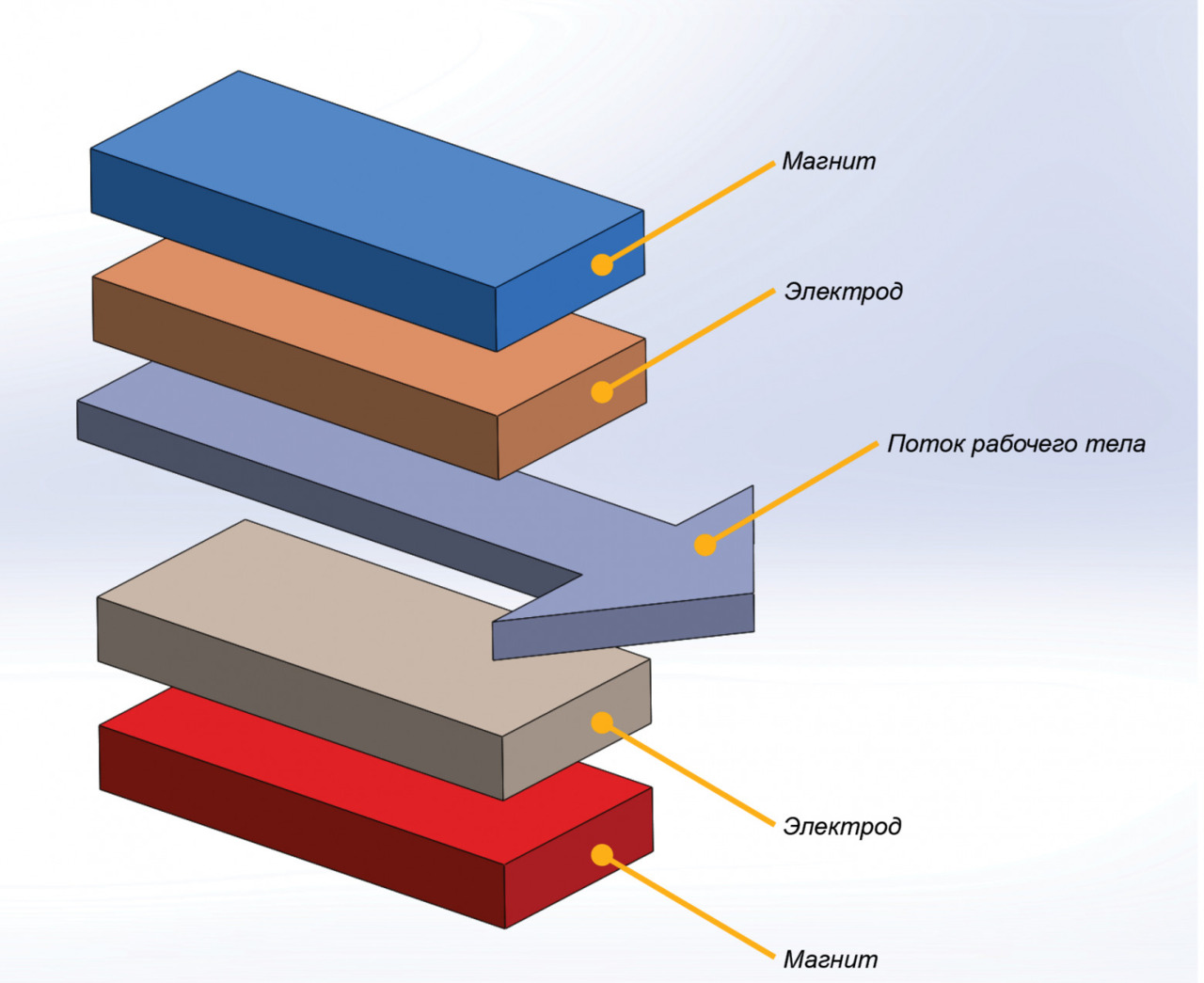
The principle of operation of an MHD generator is based on Michael Faraday’s law of electromagnetic induction. The idea of using a liquid conductor was first proposed by Faraday in 1832. He demonstrated that a moving conductor subjected to a magnetic field generates an electric current. Thus, the English scientist William Hyde Wollaston was able to measure the electromotive force induced by tidal waves in the English Channel in 1851. Research on MHD generators began in the 1930s when scientists started studying the possibility of using magnetic fields for energy conversion. In 1937, American scientist Lester H. Hunt proposed the idea of using the magnetohydrodynamic effect for electricity generation.
The first experiments to create MHD generators were conducted in the 1940s and 1950s. These early experiments laid the foundation for further research and development in the field of magnetohydrodynamics. In the 1960s, research was conducted to improve the efficiency of MHD generators and expand their applications. As a result, more compact and efficient MHD generators were developed, which can be used in various fields, including space and industry. In the 1970s, research was carried out to create MHD generators that can operate at higher temperatures and pressures. This led to the development of more efficient MHD generators suitable for generating electrical energy on spacecraft and other objects. This idea was also implemented in our country. For example, in 1971, the world’s first U-25 MHD generator suitable for industrial electricity generation was put into operation in Moscow. Currently, MHD generators continue to evolve. Modern MHD generators can be used for electricity generation in large power plants, as well as in space and other areas. They are more efficient and environmentally friendly than traditional generators, making them increasingly popular in various industrial and scientific fields.
There are many different types of MHD generators, each with their own characteristics and applications [1;12]. Let us consider some of them in more detail.
Open-cycle MHD generators are high-temperature enhancements to conventional power cycles, capable of increasing their efficiency to 60%. They can also serve as powerful sources of short-duration electrical energy.
Closed-cycle MHD generators utilize gas and coal to heat inert gas in regenerative heat exchangers. However, they face a drawback related to the sealing of the closed-loop system with minimal impurity content and prevention of contamination in the regenerative heat exchangers.
Pulsed MHD generators employ self-exciting magnetic systems with an induction of 3–3.5 T and uncooled MHD channels. Gunpowder serves as the fuel for these installations.
Liquid MHD generators generate electricity solely by converting the kinetic or potential energy of a flow of constant-temperature conducting liquid.
Conduction MHD generators use a magnetic field to generate electric current as the working fluid passes through it. This current is then extracted through removable electrodes to harness energy.
Induction MHD generators lack electrodes and generate only alternating current. They require the creation of a magnetic field running along the channel to function [5;3].
Each of these types of MHD generators possesses unique characteristics that determine their applications in different fields. The choice of a specific generator type depends on the required power, operating conditions, and other technical specifications necessary for the device’s operation. Studying and understanding the differences between open-cycle, closed-cycle, pulsed, liquid, conduction, and induction MHD generators enables engineers and energy specialists to select the most suitable solution for a particular task. The various types of MHD generators represent crucial engineering solutions that contribute to the advancement of energy technology and the enhancement of electricity production efficiency.
Features of MHD generators. Magnetohydrodynamic (MHD) generators are devices that can operate in both open and closed cycles. In closed MHD generators, the thermal energy obtained from fuel combustion is transferred to a heat exchanger with a working fluid, which, after passing through the MHD generator, returns and repeats the work cycle. Nuclear reactors and heat exchange devices based on the principle of releasing a large amount of heat can act as heat sources.
In open devices, combustion products serve as the working fluid, and used gases, after removal of alkali metal impurities, are released into the atmosphere. The working fluid in an MHD generator can be electrolytes, liquid metals, and plasma.
Liquid metals and electrolytes are natural conductors, but gas needs to be ionized to a certain degree to become electrically conductive. This is mainly achieved by heating to temperatures sufficient to initiate thermal ionization (at temperatures around 10,000 K). To operate at lower temperatures, alkali metal vapor (e.g., K, Cs, Na) or their salts are added to gases, making them conductive at a mixture temperature of 2.2–3 K, allowing the plasma to be accelerated to high speeds of 2000–3000 m/s [1;25].
In most MHD generators, plasma is utilized, where free electrons and positive ions are the charge carriers, deviating under the influence of magnets from the trajectory the gas would follow in the absence of a magnetic field. In strong fields, charged particles can shift relative to each other between collisions. This directed displacement of charged particles in an MHD generator leads to the emergence of an additional electric field.
The MHD channel is the main and technically most complex element that determines the characteristics of an MHD generator. The design of the channel depends on the type, purpose, and operating mode. The channel must provide maximum operational lifespan and minimal thermal, hydraulic, and electrical losses. The magnetic system is intended to create the maximum possible induction force and its distribution in the working volume.
There are various forms of channels, such as linear, disk, and coaxial Hall channels in conduction generators, as well as radial channels in induction generators. Sectioning of electrodes in the MHD generator channel is done to reduce current circulation along the channel and through solid electrodes, in order to direct charge carriers’ perpendicular to the channel axis towards the electrodes and into the load. The greater the Hall effect, the more sections are needed to divide the electrodes. Since the 1970s, conduction linear MHD generators using combustion products with alkali metal additives in an open cycle have become widely used. Obstacles in the development of open-cycle MHD systems included challenges in MHDG settings affecting device efficiency and reliability, as well as issues with combustion chambers and the creation of a superconducting magnetic system with an induction of 4.5–6 T. It is worth noting that the application of a Hall MHD generator scheme is most advantageous with high magnetic fields. By having a longitudinal electric field in Hall and MHD generators with diagonal electrode connections, significant output voltage can be obtained from the generator (Figure 3).
The use of MHD generators for increasing the efficiency of power systems, for onboard power systems of space technology, and as power sources for devices requiring high power for short periods of time (e.g., powering aerodynamic tube electric heaters, etc.) is discussed. The main advantages of an MHD generator as a powerful device for generating electricity are highlighted:
The absence of moving nodes or details directly involved in the conversion of thermal energy into electrical energy, allowing for a significant increase in the initial temperature of the working fluid and, consequently, the efficiency of the energy installation.
The simplicity of the MHD energy conversion cycle, which does not require complex equipment such as a «steam boiler and steam turbine.»
Furthermore, the MHD generator differs from steam/gas turbine installations in its quick start-up time, ability to be in constant readiness in a preserved state, important for peak and emergency power stations, and better environmental performance compared to competitive installations at the same output power levels [5;2].
The main disadvantage of the MHD generator is the insufficient level of achieved characteristics of high-temperature generator nodes, MHD channels, and the high cost of the generated energy, hindering the industrial implementation of powerful MHD generators for a long time. However, these issues can be addressed by installing such a generator on a rocket nozzle, where the surrounding space would cool the external parts of the device and enhance the efficiency of the magnets. Engine modifications would provide the spacecraft with additional energy, particularly beneficial for long-distance space travel. For example, within the NERVA program, a project was developed for onboard power sources for spacecraft based on a 2.5 m diameter disk MHDG operating in a closed cycle and gas-cooled by a nuclear reactor.
Prospects for the application of MHD generators in everyday society include their use in transportation to create more efficient and environmentally friendly power systems. Electric vehicles, such as trains and buses, could be equipped with MHD generators to generate power without the need for traditional fuel sources or as an additional power source in unforeseen circumstances. Additionally, MHD generators can be applied in the field of renewable energy sources by utilizing various working fluids and heating systems. Their use in nuclear and hydroelectric power plants could improve the efficiency and reliability of these systems, contributing to the development of renewable energy. Furthermore, MHD generators can be used to create more efficient power supply systems in households, leading to reduced energy consumption and increased energy efficiency of various devices and energy systems.
Moreover, MHD generators can be utilized in industry to establish more efficient power supply systems at manufacturing plants. Their use could reduce energy costs and increase production capacity, thereby enhancing the competitiveness of enterprises. MHD generators could find application in the power supply systems of large infrastructure facilities such as hospitals, educational institutions, airports, and other public establishments as a primary or backup source of energy, depending on the type and role of the installation. Their use could ensure more reliable and economical energy supply for facilities where uninterrupted operation is crucial.
So, there are numerous potential applications for MHD generators in various aspects of society’s daily life. Their implementation could lead to the creation of more efficient, environmentally friendly, and sustainable energy supply systems, contributing to the development of infrastructure, increased energy efficiency, and reduced negative impact on the environment.
Prospects for the application of MHD generators in space. In space conditions, where access to traditional sources of energy is limited, MHD generators can become an important source of energy for spacecraft and stations. One example of the application of MHD generators in the space industry is their use as a power source for spacecraft modules. This can significantly improve the efficiency and maneuverability of spacecraft, which is particularly important for long-duration space missions. Additionally, MHD generators can be used to provide power on space stations and bases, where they can replace traditional energy sources such as solar panels or nuclear reactors. This can enhance the reliability and durability of energy systems in space and ensure more stable operation of spacecraft.
Advanced technologies in the field of MHD include the development of new materials to improve the efficiency of generators, design optimization to minimize weight and volume, and integration with other aircraft systems to ensure synergy and optimal operation. Potential future developments in the field of MHD generators include the creation of compact and highly efficient devices capable of providing power for complex space systems. It is also possible to develop integrated systems that combine MHD generators with other energy sources to ensure continuous and stable power supply. These research and development directions in the field of MHD generators in spacecraft can significantly expand the possibilities of applying this technology and contribute to the development of more efficient and innovative solutions in aviation and space.
Thus, the application of MHD generators in the space industry represents a promising direction of development that can lead to significant improvements in energy efficiency, reliability, and performance of space technologies. Further research and development in the field of MHD generators for the space industry could lead to the creation of more sustainable and self-sufficient power supply systems for long-duration space missions, including manned and unmanned space flights, exploratory missions to other planets, and prolonged stays in orbit. Moreover, the use of MHD generators in the space industry could reduce dependence on traditional energy sources such as solar panels or nuclear reactors and provide a more stable and environmentally friendly alternative for space missions. Thus, the integration of MHD generators into the space industry represents a promising direction of development.
References:
1. Бекнев В. С., Михальцев В. Е., Шабров А. Б., Янсон Р. А. Турбомашины и МГД-генераторы газотурбинных и комбинированных установок / Учеб. пособие для студентов втузов, обучающихся по специальности «Турбиностроение». — М.: Машиностроение, 1983. — 392 с.
2. Берлин Е. В., Григорьев В. Ю., Сейдман Л. А. Индуктивные источники высокоплотной плазмы и их технологические применения. — Москва: ТЕХНОСФЕРА, 2022. — 464 с.
3. Магнитогидродинамический генератор // [Электронный ресурс]. URL: https://genmaster.ru/about/articles/magnitogidrodinamicheskiy-generator/Lfnf (дата обращения: 25.12.2024)
4. Мамаев О. Как из движения сделать электричество: МГД-генераторы // [Электронный ресурс]. URL https://www.nkj.ru/archive/articles/26919/ (дата обращения: 15.11.2024)
5. Истягин А. А., Комаров С. П. МГД устройства // [Электронный ресурс]. URL https://elib.sfu-kras.ru/bitstream/handle/2311/7989/s021-056.pdf?sequence=1&isAllowed=y (дата обращения: 15.11.2024)
6. Панченко В. П. Введение в магнитогидродинамическое (МГД) преобразование энергии // [Электронный ресурс]. URL: http://wwwcdl.bmstu.ru/e8/MGD-4/MGD-4.pdf (дата обращения: 15.11.2024)
Ефимов Д. П.
Prototype of a Cosmic Magnetic Accelerator
Efimov D.P., 3rd year student «Radio Engineering and Spacecraft Control Systems»
Scientific adviser: Eshanov A. A., PhD in Physico-Mathematical Sciences, lecturer
Space Engineering and Technology College, Federal State Budgetary Educational Institution of Higher Education «Technological University named after twice Hero of the Soviet Union, Pilot-cosmonaut A.A. Leonov», Korolev, Russia
A Gauss’ cannon is a type of electromagnetic cannon that uses created magnetic fields to accelerate ferromagnetic objects inside the barrel. An electromagnetic kinetic pulse-type cannon transforms electrical energy into kinetic mediations of the Lorentz force. Use such a device can be used to shoot satellites from the side of a spaceship or the surface of the Earth.
Keywords: magnetic field, ferromagnet, capacitor, coil, magnetic accelerator.
The principle of operation of the Gauss cannon is based on the use of strong electromagnetic fields. The field created in the trunk channel attracts a ferromagnetic object, giving it acceleration and direction of movement. In order that the projectile does not magnetize to the barrel, the barrel is made of non-magnetic material, mainly plastic with a small wall thickness. The thinner the stem wall, the more effective the front energy of the crop. The cannon consists of one or more electromagnets arranged around the barrel. When electromagnets are energized, they create a magnetic field in the channel of the stem. The formed field creates jets in the magnetized object and pulls it into the stem. Then it starts to accelerate it to the middle of the barrel, after which the magnets are switched off. In multi-stage accelerators, magnets are connected consecutively and create a continuous movement of the projectile on the barrel. As mentioned earlier, the projectile accelerates to the middle of the barrel, after which the magnetic field is switched off and the projectile flies out of the barrel in a given direction due to inertia, and the kinetic energy obtained during the operation of the magnetic field. The gun can be used for single shots as well as for rapid fire. The charging speed will be limited by the battery charge rate of the capacitors. An equally important limiting factor during firing may be the overheating of electromagnets, due to the leakage of a large current in the wire coil. Despite the limitations, the speed of the magnetic accelerator is very high compared to other alternative devices. [1; 93].
The presented magnetic accelerator project is not new, as such work was already proposed long before my scheme. But space is increasingly attracting the attention of researchers and designers, there are new discoveries made and the latest developments applied. The conversion of magnetic energy into motion can be very useful when shooting satellites from a station, or sending small loads between ships, using compressed air or jet engines will cause the main vehicle to deviate from its trajectory. The use of magnetic accelerator as a method of shooting satellites is not limited to one application, this device can create a strong current pulse with voltage 16 volts and more. By disconnecting the coil and adding a wire, the device can be used as spot welding, which can also be useful in various situations. We can design a more powerful facility that could launch small satellites directly from the Earth’s surface, without using jet engines. On planets with a weak magnetic field and atmosphere such installations will be able to launch entire spacecraft, giving them great acceleration. The application of the device is limited only to the purposes and goals for which it is intended by the user.
Use cases. This kind of device can be used in the study of the behavior of the substance at extremely high speeds, which are done in Large Hadron Collider type installations. Another field of application of the Gaus gun is protection from space threat and especially asteroids and comets, as well as from space debris. In addition, magnetic accelerators can be used to bring satellites into orbit from other spacecraft, as such a device has no recoil when fired, which means that the carrier ship will not have to spend energy on course adjustment. They can be used in any environment where you need to give acceleration to an object. You can imagine using a magnetic accelerator to protect agricultural fields from pests by firing poison or fertilizer on the field from one point. But it should be remembered that the Gauss guns are the basis for creating fundamentally new weapons systems, they are working on the largest companies in the world. Therefore, it is necessary to be extremely careful in the creation and use of these installations for peaceful purposes only.
Theory. The main power element of our gun is an inductance coil for firing a projectile. The power source is a capacitor battery with a total capacity of 62000μF and rated voltage of 16 volts. Capacitors can be charged, for example, from battery batteries through a booster converter or from a charger. Capacitors are able not only to store energy, but also to give it over a very short time before the projectile reaches the center of the coil. However, the capacitors need to be charged somehow. Matching capacitance of capacitors is a compromise between the energy of the shot and the time of charging installation. Before each shot we wait for the charge of capacitors from the transformer. The speed of such a device depends on the power of the charging circuit. The more powerful it is, the faster it will be able to charge the capacitor battery [3; 110].
The next task is to discharge all the accumulated charge into the coil through a powerful key. As a result, the generated magnetic field will transmit a certain acceleration. To control the trigger, it is better to set the relay. Ferromagnetic projectile is inserted into the tube beginning of the tube. When a constant voltage is applied to the solenoid, the projectile, being pulled into the area of the magnetic field of high tension, accelerates during movement. In this case, the projectile magnetizes according to the poles of a solenoid and somehow sticks in its middle, experiencing in this place attraction in the opposite direction. Therefore, to achieve the right effect, it is necessary to apply a powerful but short current pulse to the solenoid. This task is performed by a computer scheme.
Calculations. For a rough understanding of the characteristics of the device, it was necessary to make calculations of the power part of the installation.
— the formula for the energy of a magnetic field in W.
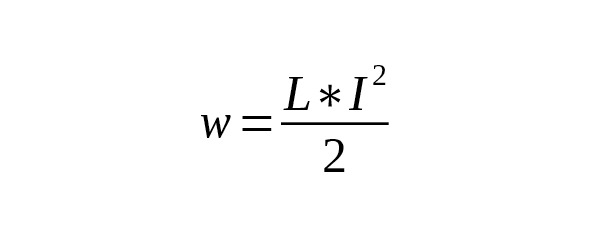
— the magnetic flux formula in Wb.

— Stored energy in condensers in W.
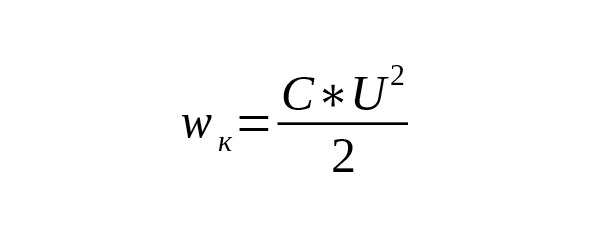
To increase the capacity of the installation, it is necessary to increase the current in the coil and the capacitance of the condensers. The current in the coil will create a sufficient magnetic field, and the capacitor will provide the coil with this current. Since the circuit I planned to make a low voltage, it means the voltage will be 16 volts. To increase the current in the low-voltage coil, it was advisable to reduce the number of turns to a minimum, which will lower the resistance, and therefore increase the current in the circuit. [2; 41].
= 7,94Вт. — capacity stored in condensers
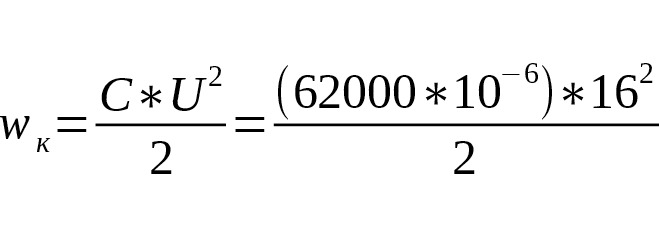
The energy of the magnetic flux and magnetic flux could not be calculated, because the inductance of the electromagnet is unknown.
Practice. The battery of capacitors is placed on a textile platform and mounted with an attached mounting. Under each capacitor two holes were drilled for the terminals, after which they were connected to each other by copper cores. Such unusual mounting measures were taken to account for their low cost and reliability of high-precision circuit assembly. To poison the chamber of such size was not advisable, and the use of copper wires guarantees their integrity when passing high currents. The computing part is assembled on the basis of foliated glass fiber and then attached to the power part, on which the capacitor battery and reducing transformer were located.


The first scheme did not receive a final implementation, because serious errors were found in the modernization methods. The power part has been changed and the computational part has been redesigned, which has improved the efficiency and reliability of the installation.

Name: MU-16-62K Deciphering: MU- magnetic accelerator; 16- power supply voltage; 62K- capacitance of the battery of the capacitors in micq. Farads. In the final sample, the battery capacity was raised to 62000μF

The case of an old computer drive was used as a housing, closed with wooden inserts. Foam inserts were manufactured to improve the resistance to vibration.
Results and options of modernization. Summing up the work carried out, it is possible to make certain conclusions regarding the assembled installation. The designed installation showed decent characteristics and in relation to its size and working voltage It became clear that to increase the power of the device, you need to increase the current in the coil circuit and therefore the voltage supplied to it. The efficiency depends directly on the magnetic coil circuit magnetization time, which needs to be individually selected [4; 137]. There are several ways to upgrade my device:
1. Increase the voltage in the coil circuit, which will help the installed relay not connecting the power part of the device with the control part. But do not exceed at the threshold of 45 volts, otherwise the voltage will not be safe for a man.
2. Increase the capacitance of the condenser battery, which will help to raise the output power of the device as the transformer overheats at such currents during firing.
Output. Gauss’s gun disperses the projectiles with the help of electromagnetic forces, as well as a freecrotron. But if the projectile moves between two contact rails in the rail, on the first being part of an electrical circuit, then the electromagnetic coils are used in the Gauss gun for its firing. The projectile from ferromagnolic is dispersed along a dielectric tube through a solenoid, when the magnetic field forming is activated, which «pushes» the projectile from ferromagnolic forward. This acceleration of the projectile does not cause recoil when fired, so you do not have to make a very strong base for installation. Unlimited range of fire and the ability to change the speed of the projectile, and therefore the trajectory along which the object will move after leaving the channel of the installation barrel are undeniable advantages.
References:
1. Лехачев Е. В., Перегудов Е. В., Павлов П. В. Электромагнитная пушка: оружие будущего // Профессиональные компетенции государственных служащих: формирование и развитие. — 2016. — С. 188—192.
2. Смолин А. А. и др. Многокаскадный электромагнитный ускоритель–пушка Гаусса // Современные проблемы физики и технологий. VII-я Международная молодеж. Конференция. — 2018. — С. 61.
3. Санников П. Е., Квасков Р. С., Васильев Н. В. Принцип работы линейного электродвигателя на примере физической модели пушки Гаусса // Вестник студенческого научного общества. — 2017. — Т. 8. — №. 2. — С. 127—129.
4. Серякова И. Н., Сизов Д. О. К вопросу о перспективах статуса электромагнитного оружия в Российском уголовном праве // Актуальные вопросы деятельности уголовно-исполнительной системы на современном этапе: проблемы и перспективы. — 2019. — С. 133—137.
5. Тарасов С. А. Пушка Гаусса и перспективы её применения в современном мире // LIV Всероссийская конференция по проблемам динамики, физики частиц, физики плазмы и оптоэлектроники. — 2018. — С. 297—298.
6. Надточий А. А., Меньшов Е. Н. Импульсное оружие по принципу Гаусса // Энергетика, экология, химия: сборник студенческих работ. –Ульяновск: УлГТУ, 2013. — 238 с.
Ефимочкин Д. А., Харчевская Е. Н.
Fifth-Generation Mobile Networks: Opportunities, Applications, and Safety
Efimochkin D. А., 3rd year student «Installation, maintenance and repair electronic devices»
Harchevskaya E.N., 2nd year student «Ensuring Information Security of Telecommunications Systems»
Scientific adviser: Yurenskaya S.A., lecturer
Space Engineering and Technology College, Federal State Budgetary Educational Institution of Higher Education «Technological University named after twice Hero of the Soviet Union, Pilot-cosmonaut A.A. Leonov», Korolev, Russia
This article is dedicated to the technology of fifth-generation mobile communication — 5G. It examines the main principles of operation, distinctive features, and applications of the technology across various sectors. Particular focus is given to safety issues and the potential impact of electromagnetic fields on human health. The article presents research findings that confirm the safety of 5G, along with future prospects for its implementation.
Keywords: 5G mobile networks, mobile communication technology, digital information transmission, safety.
The development and implementation of fifth-generation (5G) mobile communication technologies represent a crucial milestone in the evolution of modern information society. By providing significantly higher data transmission speeds, lower latency, and expanding the capabilities of the Internet of Things (IoT), 5G opens new horizons for diverse applications affecting various aspects of human life. However, the widespread adoption of this technology raises concerns related to safety and potential adverse health effects. This paper analyzes the key technical specifications, application domains, and scientific research that supports the safety of 5G technology.
Principles of Operation of 5G Networks. The core principle of 5G networks involves the use of radio waves for the transmission of digital information over large distances [2]. The fifth-generation mobile communication system is based on compact antenna stations, typically installed on towers (see Figure 1). Depending on their height and the terrain features, these stations can transmit signals over distances ranging from 1 to 500 kilometers. Each antenna serves between 10 and 1000 users. Under maximum load conditions, signals from different devices are separated using time division, frequency division, and even power control techniques.
Features of 5G Technology.
New Frequency Ranges. The radio interface specified by 3GPP for 5G is known as New Radio (NR). It operates within two frequency bands: FR1 (600–6000 MHz) and FR2 (24–100 GHz), each with unique capabilities.
Coverage of FR2 and High Frequencies. In the 5G standard, operation at frequencies of 24 GHz and above is supported. Signals in these high-frequency ranges are characterized by limited effective range, typically only a few hundred meters, in contrast to 4G or 5G signals at lower frequencies (up to 6 GHz). Consequently, 5G base stations must be deployed at intervals of a few hundred meters to ensure seamless coverage. Due to high attenuation, these signals poorly penetrate solid objects such as vehicles, trees, and walls. Therefore, small cell stations can be installed indoors or in locations where visual and physical accessibility permits, such as restaurants and shopping centers, allowing flexible deployment and unobtrusive installation.
Beamforming Technology. An essential feature of 5G antennas is beamforming, where a focused signal beam is directed precisely toward a device, ensuring a stable high data transfer rate [2]. This is achieved by combining antenna array elements to create constructive interference in the signal’s direction, while destructive interference diminishes the signal elsewhere. Phased array antennas facilitate this process by phasing signals across different elements, enhancing signal quality and strength. More efficiently, digital array antennas can perform beamforming without phase shifters, by digitally controlling the antenna elements to form narrow, directed beams. This technology improves communication quality and increases data transfer speeds through enhanced signal-to-noise ratios, which scale with the number of antenna elements.
Multi-Element Digital Antenna Array Systems (Massive MIMO) is one of the key technologies for implementing 5G cellular networks. It involves the deployment of multi-element digital antenna arrays at base stations, with the number of antenna elements reaching 128, 256, or more.
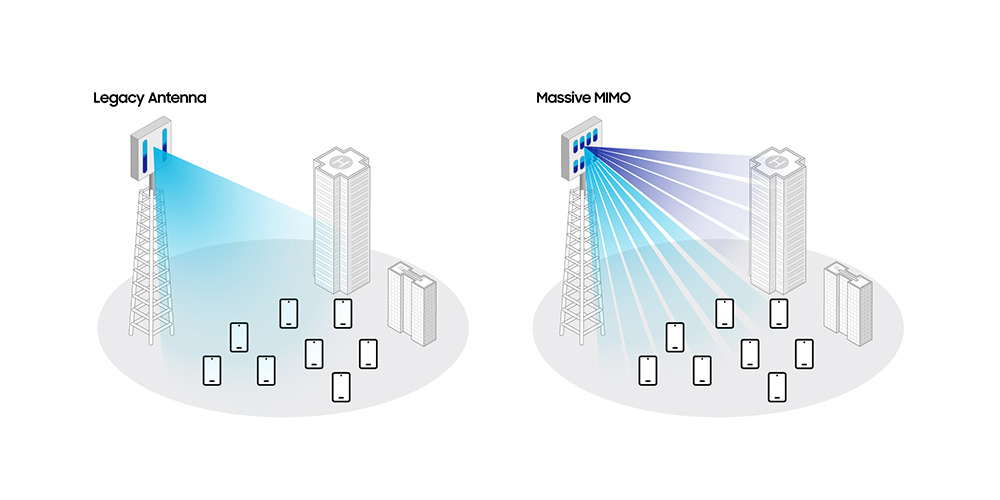
To enhance spectral efficiency, alongside spatial multiplexing, 5G can utilize variants of non-orthogonal multiple access (NOMA) technologies and N-OFDM signals.
Small cells are low-power radio access nodes operating within licensed and unlicensed spectra over ranges from 10 meters to several kilometers. Small cells are critical for 5G networks because high-frequency 5G signals cannot propagate over long distances due to increased attenuation at higher frequencies. Practical deployment involves placing transmitters at street level or above five meters, typically on lamp posts, to ensure coverage and signal quality.
Hardware. At the end of 2018, Intel introduced the XMM 8160 modem (see Figure 3) supporting fifth-generation mobile networks, alongside Qualcomm’s X50, Huawei’s Balong 5000, and MediaTek’s Helio M70 modems.

Further, at the Mobile World Congress (MWC) 2022, Qualcomm Technologies announced the Snapdragon X70 5G modem, capable of supporting all commercial 5G frequency bands from 600 MHz up to 41 GHz [3].

Applications of 5G Technology in Various Sectors. The applications of 5G technology are diverse (see Figure 5). Let us consider some of them.
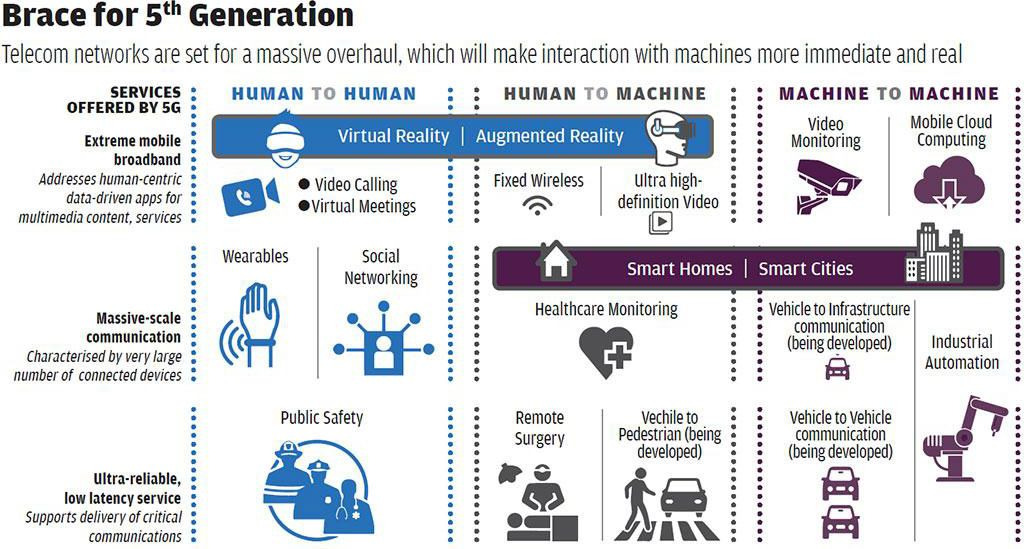
Medicine. Thanks to 5G technology, patients requiring emergency assistance will no longer need to travel to clinics or hospitals. New technologies enable the transmission of vast amounts of data without delay and are in demand in pediatrics, psychotherapy, dermatology, neurology, and even intensive care. If a patient cannot be transferred to another hospital, a critical video consultation with a more specialized expert can save lives. A highly qualified surgeon can remotely observe the ongoing operation via a 5G video feed and provide guidance to colleagues or control auxiliary devices during the procedure [1].
Transport. Thanks to high data transmission speeds, next-generation wireless networks will facilitate the development of autonomous vehicles. According to PwC forecasts, fully autonomous transport will appear in major cities worldwide by 2040. 5G will enable autonomous cars to interact with roads, traffic lights, street signs, and parking facilities. Data from connected vehicles and IoT sensors will be transmitted to cloud storage and processed in real time. Based on this, traffic flow can be monitored, urban transport routes optimized, priority given to emergency vehicles (ambulances, fire services, police, etc.), and violations recorded. 5G will play a critical role in ensuring the safety of autonomous vehicles due to low latency; in emergencies, traffic controllers can take immediate control of vehicles if needed.
Smart Homes. When discussing everyday life, 5G is primarily associated with the Internet of Things (IoT) and smart homes [1]. The number of connected devices constantly grows: smart bulbs, sockets, speakers, cameras, locks, and more. To ensure that a large number of devices communicate with each other swiftly and reliably, a high-speed connection is necessary. 5G technology can address these challenges while simultaneously increasing home security and reducing energy consumption. For example, surveillance systems transmitting signals with delays of only a few milliseconds exist today. IoT-based systems may include smart meters that autonomously transmit readings to utility companies, thermostats that regulate energy consumption, and gas sensors capable of detecting leaks.
Entertainment. It is expected that, thanks to 5G, the global entertainment industry will increase revenue by over $1 trillion [1]. High data transfer rates and minimal latency will lead to breakthroughs in cloud gaming. For instance, as early as August 2019, MegaFon demonstrated the first example of cloud-based 5G gaming. The processing of complex 3D graphics is handled by a dedicated server, and the resulting images are transmitted over the 5G network with minimal delays to a regular laptop. As a result, gameplay matches that of a high-performance gaming PC, eliminating the need to purchase expensive hardware. Furthermore, games can be launched from anywhere covered by 5G, even if the user is sitting on a park bench. 5G will also allow users to download full-length movies within seconds, rather than minutes, and access streaming multimedia content almost instantaneously.
Impact of the Technology on Humans. The deployment of fifth-generation mobile networks (5G) raises public concerns regarding potential negative effects on human health [5]. There are opinions that electromagnetic fields increase the risk of cancer, induce cellular stress, elevate harmful free radicals, cause genetic damage, lead to structural and functional changes in the reproductive system, impair learning ability and memory, induce neurological disorders, and exert overall negative effects on well-being. There have also been claims of harmful impacts on other animals and plants. A group of 240 scientists signed an open letter titled «International EMF Scientist Appeal,» addressed to the United Nations, WHO, and UNEP. Based on this, some individuals argue that the effects of 5G equipment radiation have not been sufficiently studied and that this radiation could be hazardous to human health. Let us examine this issue in more detail.
Some people refer to their so-called «electromagnetic hypersensitivity,» but controlled experiments conducted in 2019 and 2021 found that these individuals did not perceive the presence of electromagnetic fields or radiofrequency radiation on their bodies [4]. Additionally, research has not revealed any evidence of harm from high-frequency electromagnetic radiation at low power, which is used in 5G devices. Moreover, radiation at frequencies of 6 GHz and above is unable to penetrate deeply into the body; the only observed effect is mild skin heating. Researchers have tested hypotheses concerning the genotoxicity of the radiation, its influence on cell proliferation, gene expression, nerve impulse transmission, effects on cell membrane permeability, and other factors. Epidemiological studies have also been conducted to identify possible correlations between 5G radiation and public health. All high-validity studies have found no evidence of any impact of 5G radiation on the human body or health.
In conclusion, it can be noted that 5G technology offers broad prospects for the development of modern society, contributing to improving quality of life and progress across various sectors. At the same time, it is necessary to continue active scientific research to evaluate potential risks and ensure user safety. A systemic approach and strict adherence to international standards will be key to the harmonious implementation of 5G and to achieving maximum societal benefits while minimizing potential negative consequences.
References:
1. Лиманова Н. И., Чариков Е. Н., Чариков Д. Н. Практическое применение сетей 5G: возможности и уязвимости // Бюллетень науки и практики. — 2024. — Т. 10. — №. 7. — С. 397—400.
2. Маншуров Ш. Т., Абдуганиева Ю. Ш. Новейшие технологии интернета связи: от 5G к будущим стандартам передачи данных // Oriental renaissance: Innovative, educational, natural and social sciences. — 2024. — Т. 4. — №. 3. — С. 315—328.
3. Маряшина Д. В. и др. Развитие мобильных сетей 5G: мировые тенденции и российская практика // Финансовый менеджмент. — 2024. — №. 9. — С. 247—255.
4. Смелянский Р. Л. Эволюция вычислительной инфраструктуры // Вестник Московского университета. Серия 15. Вычислительная математика и кибернетика. — 2024. — №. 4. — С. 190—233.
5. Хансарыева О., Атаев Ш., Мириев Б. Возможности и проблемы технологии 5G // Символ науки. — 2024. — №. 11-1-1. — С. 109—111.
Figures:
1. https://www.gizchina.com/wp-content/uploads/images/2022/10/fortuneindia_2021-06_6507dd8a-7c99-4333-bd50-99c005610c5b_MN1X8T__1_-768x509.jpg (рис.1)
2. https://www.ixbt.com/img/n1/news/2020/11/3/Massive-MIMO-White-Paper_main1FF_large.jpg (рис.2)
3. https://img.tek.id/img/content/2019/06/27/17627/intel-bakal-lelang-6-500-aset-wireless-cellular-milik-mereka-KYpgWCbKC4.jpg(рис.3)
4. https://4apk.ru/wp-content/uploads/2018/08/EM5100_5G_F_re.jpg (рис.4)
5. https://i.playground.ru/p/qGC6pPXOEJdfs70ZNQBrPg.jpeg (рис.5)
https://www.kv.by/post/1057433-seti-5g-budushchee-mobilnoy-industrii-ili-chuma-21-veka (рис.6)
Жилякова В. В.
Космическая ономастика
Жилякова В. В., обучающаяся 2 курса направления подготовки специалистов «Проектирование, производство и эксплуатация ракет и ракетно-космических комплексов»
Научный руководитель: Серова Т. О., кандидат филологических наук, доцент, доцент кафедры иностранных языков
ФГБОУ ВО «Технологический университет имени дважды Героя Советского Союза лётчика-космонавта А. А. Леонова», Королёв, Россия
В статье анализируются названия космических объектов разных типов, учитывая исторический контекст и адаптацию к условиям современности.
Ключевые слова: ономастика, космический объект, культурный контекст, новые открытия, международный каталог небесных тел.
Космическая ономастика довольно разветвлённая наука, существуют следующие разделы: астронимика, изучает названия «точечных» небесных тел, астротопонимика — раздел астронимики, который исследует названия объектов на поверхности планет, и космонимика, анализирует наименования зон космического пространства; представляет собой важную и многогранную область, которая объединяет историю, культуру и науку. В условиях развития астрономии и космических технологий космическая ономастика будет продолжать оставаться актуальной темой для исследования и обсуждения. Целью данной статьи является анализ исторических и культурных аспектов именования космических объектов, исследовании их связи с мифологией и традициями общества, а также в оценке значимости стандартизации имен в современной астрономии.
Именования космических объектов имеют давнюю историю и некоторые из них были подвергнуты изменениям, так как обозначают не только сам астрономический объект, но и отражают культурные представления общества. Астрономы Древнего Египта и Греции использовали названия для планет, звёзд и созвездий, опираясь на мифологию, и давали названия космическим объектам по схожим характеристикам. Часто встречается именование объекта в честь его открывателя, людей, внёсших вклад в своей области, космонавтов или астронавтов.
Современная астрономия требует стандартизации именования небесных объектов. Международный астрономический союз (IAU) играет ключевую роль в данном процессе, устанавливая правила и рекомендации для именования новых открытий. Однако, несмотря на научный подход, имена могут вызывать споры. Существует несколько каталогов небесных тел, разделяющихся на типы: источники рентгеновского излучения, звёзды, туманности и скопления, галактики, планеты и экзопланеты. Рассмотрим на примере объектов Солнечной системы связь именования с культурой и наукой.
Меркурий — ближайшая планета к Солнцу, сидерический период которой равен 87,97 земных суток, что является наименьшим периодом обращения среди планет Солнечной системы. Из-за быстрого движения была названа римлянами в честь бога Меркурия, соответствовавшего греческому Гермесу — вестником Богов, покровителем торговли и плутовства. Древние египтяне именовали планету Собкоу из-за частых сравнений с переменчивостью и быстротой. В наше время Собкоу именуется равнина на планете. В Скандинавии и Германии — Суйсей, в Индии — Будх, что связывали с высшей мудростью в человеке.
Вторая от Солнца планета, Венера, названа в честь римской богини любви и красоты Венеры, Афродиты у греков. Самый яркий объект на небосклоне после Луны, хорошо отражает солнечный свет благодаря поверхности, укрытой газовым слоем атмосферы с несколькими слоями облачности.
Существует несколько версий того, почему третья планета называется Землёй. По первой теории, в большинстве языков название планеты происходит от имён богинь, связанных с почвой и плодородием. Так, у древних скандинавов богиня Ёрд, священная божественная земля, от которой произошло английское «Earth». У кельтов — Эхте, у римлян планета называлась Теллус, а у греков богиней Земли была Гея. По второй версии — Земля получила своё именование от понятия самой почвы, твёрдой поверхности. В переводе с латыни Земля — «Terra», что означает «пол», «твердь». Следует отметить, что название отражает не только наличие твёрдой поверхности, но и одну из основ существования человечества.
В грунте Марса содержится высокий уровень оксида железа, и из-за своего выраженного красного цвета назван в честь бога войны. Греки называли планету «Фаэтон», что означает «блистающий, лучезарный», Аристотель назвал Марс «Аресом» по имени бога войны, но его связывали также с понятиями плодородия, жизненной силы и природы в целом. Названия двух его спутников, Фобос и Деймос, с греческого языка означают «страх» и «ужас». Фобос в некотором смысле и правда вызывал страх для учёных из-за необычного ландшафта, кроме того, вращение Фобоса и Деймоса обращено в противоположную сторону другим спутникам планет.
Самая крупная планета Солнечной системы — Юпитер, радиус которой больше радиуcа Земли в 11,2 раза. Вследствие своего превосходства по сравнению с другими объектами, назван в честь верховного бога античной мифологии, Зевса у древних греков и Юпитер у римлян.
Связь между именованием Сатурна и культурными представлениями общества может быть объяснена двумя различными теоретическими подходами. По первому предположению, Сатурн у древних римлян — бог посевов и урожая, празднование Сатурналии, посвященное богу, приходилось на декабрь. По другому мнению, шестая планета известна своим медленным движением по небу из-за дальности орбиты, у древних греков могла возникнуть ассоциация с верховным божеством — Кроносом, покровителем времени.
Уран был впервые замечен греческим астрономом Гиппархом, но из-за медленного вращения и тусклости, Гиппарх ошибочно принял планету за звезду. В 1781 году британский астроном Уильям Гершель открыл Уран, но Уильям считал присваивание именований из мифологии устаревшей традицией, и решил назвать планету в честь британского короля Георга III, чтобы увековечить большим образом его память в истории для человечества и создать корреляцию открытия Урана с периодом правления короля. Впоследствии Иоганн Боде предложил название «Уран», опираясь на важность традиции, существующей с древних времён. Уран в древнегреческой мифологии — олицетворение неба, планета получила своё название именно из-за небесно-голубого цвета.
Нептун — первая планета, открытая путём математических расчётов Джона Адамса и Урбена Леверье. Леверье поначалу предлагал назвать планету в свою честь. Идея была поддержана французским обществом ученых, Уран был вновь назван «Гершель», в честь первооткрывателя, пытаясь поддержать нововведённую традицию называть планеты в честь их первооткрывателей. Всемирным научным сообществом не был принят данный подход присваивания имен планетам. Василий Струве, русский астроном, 29 декабря 1846 г. предложил присвоить восьмой планете имя «Нептун». Тем самым поддерживалась традиция использования имён древнеримских богов для обозначения планет.
Именования, присвоенные в далёком прошлом самым ярким и заметным звёздам, используются и сегодня. В основном названия даны древнегреческие, но большинство имеют арабское происхождение: Денеб с арабского «хвост птицы», звезда действительно расположена в хвосте астеризма Лебедя, Ригель в переводе «нога», звезда расположена в «левой ноге» Ориона, Акраб — скорпион с арабского, звезда является a созвездия Скорпиона.
В 1603 году Иоганном Байером был выпущен каталог звёзд, в котором он использовал греческие буквы для обозначения звёзд в порядке убывания их яркости: самая яркая звезда созвездия будет обозначена как «альфа» — a, второй по яркости будет «бета» — В, и далее по убыванию. За греческой буквой следует название созвездия в родительном падеже. Приведённая классификация используется в современной астрономии.
В современной астрономии используют именование звёздам буквенно-цифровых значений, поскольку приблизительная численность звёзд в Млечном Пути достигает 400 миллиардов. Цифры, добавляемые к буквенным обозначениям звёзд, обычно следуют определённой системе нумерации, которая может варьироваться в зависимости от каталога или системы классификации. Существует большое количество различных каталогов: в каталоге Генри Дрейпера звёзды обозначаются буквой «HD» с последующим номером, который указывает на последовательность их открытия или наблюдения. Например, HD 148164 — это звезда, которая была включена в каталог под номером 148164. В некоторых каталогах звёзды были упорядочены по их координатам.
Таким образом, была проанализирована корреляция исторических и культурных аспектов именования космических объектов. Именования небесных объектов могут существенно влиять на общественное восприятие: вызывать страх, интерес или вдохновение. Космическая ономастика, как обширная и многогранная область, представляет собой важное пересечение астрономии, истории и культуры. В статье проведён всесторонний анализ различных аспектов именования космических объектов, включая их исторические и культурные корни, а также связи с мифологией и традициями общества. Имена планет и звёзд не только отражают научные достижения, но и служат зеркалом культурных представлений, которые формировались на протяжении веков. В итоге, космическая ономастика продолжает быть актуальной темой для исследований, открывая новые горизонты для понимания как научных, так и культурных аспектов.
Литература:
1. Сурдин В. Г. Астрономия: век XXI, ДМК-Пресс, 2022. 622 с.
2. Дрейпер Г. Каталог Генри Дрейпера. — URL: https://in-the-sky.org/data/catalogue.php?cat=HD&const=41&type=&sort=0&view=0
Звягин К. К.
Economic Security in the Age of Globalization: Risks and Strategies
Zvyagin K.K., 3rd year specialist degree students «Economic security»
Scientifc adviser: Krasikova T.I., PhD in Philology, Professor, Head of the Department of Foreign Languages
Federal State Budgetary Educational Institution of Higher Education «Technological University named after twice Hero of the Soviet Union, Pilot-cosmonaut A.A. Leonov», Korolev, Russia
Economic security has become a critical issue in the modern globalized world. While globalization offers opportunities for economic growth and development, it also introduces various risks, including financial crises, trade wars, cyber threats, and economic dependence on other countries. The increasing interdependence of national economies has made it essential for governments and businesses to develop effective strategies to protect their economic interests. This article explores the key risks associated with economic security in the context of globalization and discusses strategic approaches that nations and businesses can adopt to mitigate these risks. Special attention is given to financial stability, technological resilience, and sustainable development as fundamental pillars of economic security.
Keywords: Economic security, globalization, financial stability, trade wars, cyber threats, risk management, economic policy.
Globalization has significantly transformed the global economy, facilitating international trade, investment, and technological exchange. However, alongside its benefits, globalization also poses substantial risks to economic security. Economic security refers to the ability of a nation or an economic system to ensure stable growth, protect national interests, and withstand external and internal economic shocks. In the current era, factors such as geopolitical tensions, financial instability, and technological disruptions increasingly threaten economic security.
As economies become more interconnected, a crisis in one country can quickly spread to others, leading to economic downturns on a global scale. The COVID-19 pandemic and the war in Ukraine have demonstrated how fragile global supply chains and financial systems can be in times of crisis. Moreover, economic security is no longer just about maintaining stable markets; it now involves cybersecurity, resource management, and sustainability efforts. Given these complexities, governments and businesses must adopt proactive strategies to minimize risks and ensure long-term economic stability.
Key Risks to Economic Security. Firstly, Financial and Economic Crises. Global financial crises, such as the 2008 economic downturn, demonstrate how interconnected economies can suffer from systemic risks. The dependence of national economies on global financial markets makes them vulnerable to external shocks, including stock market crashes, inflation, and currency devaluation.
Secondly, Trade Wars and Economic Protectionism. Trade conflicts between major economies, such as the U.S.-China trade war, highlight the risks of economic nationalism. The imposition of tariffs, sanctions, and other restrictive measures disrupts global supply chains, increases production costs, and reduces economic stability.
Next, we need to talk about Cybersecurity Threats. The digitalization of economies has led to new vulnerabilities, including cyberattacks on financial institutions, state infrastructure, and multinational corporations. Economic espionage, data theft, and ransomware attacks can cause significant financial losses and undermine economic security.
Furthermore, Dependence on Foreign Resources and Technologies. Many nations rely on foreign suppliers for critical resources such as energy, rare metals, and semiconductor components. This dependency creates economic vulnerabilities, especially during geopolitical conflicts or supply chain disruptions.
Moreover, Climate Change and Environmental Challenges. Global warming and environmental degradation pose long-term economic risks by affecting agriculture, infrastructure, and energy production. The economic impact of climate-related disasters, such as hurricanes and droughts, can weaken national economies and threaten global stability.
Strategies for Enhancing Economic Security: reducing dependence on a single industry or trading partner can enhance economic resilience. Governments should promote innovation, support small and medium-sized enterprises (SMEs), and invest in research and development to ensure economic diversification. Additionally, robust financial policies, transparent banking regulations, and effective monetary policies help prevent economic crises. Establishing financial safety nets and international cooperation in financial oversight can enhance economic stability. Governments and businesses must invest in cybersecurity infrastructure, develop national cybersecurity strategies, and collaborate internationally to combat cyber threats. Strengthening data protection laws and digital security standards is crucial for mitigating cyber risks. Also nations should develop domestic industries, invest in alternative energy sources, and secure access to critical raw materials through strategic partnerships. Reshoring and nearshoring production can reduce supply chain vulnerabilities.
In addition, Promoting environmentally sustainable policies, investing in renewable energy, and adopting green technologies can improve economic security while addressing climate change risks. Public and private sector cooperation is essential for developing a resilient and sustainable economy.
What problems concerning international security are particularly acute at the present stage of globalization? How effective are the international community’s efforts for solving them?
International terrorism, for example, is becoming a strategic threat to mankind’s sense of security. The brutal terrorist acts which have swept the world in recent months, and which have claimed a heavy toll on innocent human lives, are a dreadful symptom of this disease.
Terrorists of every hue constantly change their methods and tactics and choose ever new targets for their attacks. The population of the world’s largest megalopolises, strategic sea routes for shipping energy-producing fuels, states’ critical computer networks, and the world’s transport, travel and banking infrastructure — these are far from all targets of terrorists’ attacks.
The leaders of extremist groups now seek to sow discord by resorting to the old stereotypes which they believe distinguish «good» terrorists from the «bad» terrorists. They seek to destabilize the situation in individual countries by sparking religious and ethnic strife, as well as separatism, and look for — and find — weak links in the international community: governments which are weak or shortsighted enough to court international terrorism.
Meeting the challenge of the terrorists, the international community has rallied to counter this new global threat. The international community has united into the largest alliance since World War Two: an antiterrorist coalition which has already demonstrated its effectiveness in Afghanistan where it has delivered a severe blow to the lair of international terrorism. Importantly, these efforts are coordinated under the auspices of the United Nations.
In conclusion, Economic security in the age of globalization requires a comprehensive approach that balances the benefits of international economic integration with the need to mitigate risks.
Governments and businesses must implement strategies that enhance financial stability, protect against cyber threats, ensure resource security, and promote sustainable economic growth. The challenges posed by financial crises, trade disputes, cyber threats, and environmental changes require proactive policies and strategic planning.
Ultimately, economic security is not just about protecting a country’s financial system; it is about ensuring long-term stability, resilience, and prosperity. In a world where economic and political landscapes are constantly shifting, adaptability and foresight are key to maintaining security and competitiveness. By prioritizing economic resilience, nations can create a stable and sustainable future, even in the face of uncertainty.
References:
1. Бережная, Л. И. Экономическая безопасность в эпоху глобализации экономики / Л. И. Бережная, Л. В. Колядов // Проблемы экономики и управления нефтегазовым комплексом. — 2020. — №4 (184). — С. 86—90. — DOI 10.33285/1999-6942-2020-4 (184) -86-90. — EDN OYVROL.
2. Локтионов Вадим Ильич, Локтионова Елена Александровна ПОВЫШЕНИЕ АДАПТИВНЫХ СВОЙСТВ НАЦИОНАЛЬНОГО ФИНАНСОВОГО РЫНКА КАК ОТВЕТ НА РИСКИ ГЛОБАЛИЗАЦИИ // Baikal Research Journal. 2021. №4. URL: https://cyberleninka.ru/article/n/povyshenie-adaptivnyh-svoystv-natsionalnogo-finansovogo-rynka-kak-otvet-na-riski-globalizatsii
3. Zmazneva, E. M. International economic security in the era of globalization / E. M. Zmazneva // Экономика и бизнес: позиция молодых ученых: Материалы 19-ой Международной конференции студентов, магистрантов и аспирантов, Барнаул, 22 апреля 2021 года / Отв. за выпуск О. В. Кузнецова. Vol. Выпуск 19. — Барнаул: Алтайский государственный университет, 2022. — P. 6—9. — EDN GODXGB.
4. Madhok, A. Globalization, de-globalization, and re-globalization: Some historical context and the impact of the COVID pandemic / A. Madhok // BRQ Business Research Quarterly. — 2021. — Vol. 24, No. 3. — P. 199—203. — DOI 10.1177/23409444211008904. — EDN GXEVQN.
5. Rizvan Aliev, Tamerlan Magomaev, Apti Mentsiev ECONOMIC SECURITY IN EUROPEAN COUNTRIES: CHALLENGES, SOLUTIONS, AND RECOMMENDATIONS // RT&A. 2023. №SI 5 (75). URL: https://cyberleninka.ru/article/n/economic-security-in-european-countries-challenges-solutions-and-recommendations
Иванова К. А.
Evolution of Information Security in Space: Threats, Protective Measures and Key Strategies
Ivanova K.A., 2nd year student «Ensuring Information Security of Telecommunications Systems»
Scientific adviser: Yurenskaya S.A., lecturer
Space Engineering and Technology College, Federal State Budgetary Educational Institution of Higher Education «Technological University named after twice Hero of the Soviet Union, Pilot-cosmonaut A.A. Leonov», Korolev, Russia
With the increasing number of space missions and the active utilization of dual-use space technologies, information security in the space sector has become a critical task. This article analyzes key aspects of information protection, including national security, the safeguarding of commercial interests, scientific research, and cybersecurity threats. The author describes essential data protection measures such as encryption, access control, incident detection systems, regular software updates and physical security of assets. The comprehensive implementation of these measures enables reliable protection of critical information and systems against a variety of threats. The article emphasizes that an integrated approach to information security is fundamental to achieving a sustainable and secure future in the space industry.
Keywords: information security, cyber threats, data protection, space industry.
The Importance of Information Security in the Space Sector. With the advancement of technology and the increasing number of space missions, the protection of information has become a critically important task. Information security, both in space and on Earth, encompasses the safeguarding of data against unauthorized access, data leaks, and cyberattacks. The protection of information is particularly significant for the space industry, as data collected from spacecraft is utilized for both scientific research and military purposes. Ensuring information security in space involves a comprehensive set of measures aimed at protecting critical data, communication systems, and control mechanisms [2]. It includes all aspects, from onboard software of satellites and spacecraft to ground control centers, ensuring the reliable and secure operation of all components within the space system.
Key areas of focus in ensuring information security include:
1. National Security: Given that space technologies can be employed for both civilian and military purposes, the leakage of confidential information may pose a threat to national security and the strategic interests of the state.
2. Commercial Interests: There are companies that develop satellites and space technologies for commercial use. For such companies, it is vital to protect data to prevent intellectual property theft and ensure competitiveness.
3. Scientific Research: Data obtained from spacecraft is of immense importance for scientific research and discoveries; thus, leaks or distortions of such data may lead to incorrect conclusions and negatively impact the development of science.
4. Cyber Threats: With the increasing number of space missions, the risk of cyberattacks on satellites and ground stations rises. A successful attack could result in the loss of control over spacecraft and damage to critical infrastructure.
5. Trust and Reputation: Data protection contributes to building trust among government institutions, private companies, and research centers. Data leaks can adversely affect reputation and lead to financial losses at various levels.
The History of Information Security in Space. The exploration of space began long ago in 1957 with the launch of the first spacecraft — the artificial Earth satellite. The first documented breach of information security, as confirmed by official sources, occurred in 1998 when hackers infiltrated the control system of the German-American satellite ROSAT X-Ray [3]. By gaining access to the computer controlling the satellite, the intruders directed ROSAT X-Ray’s solar panels directly at the Sun, resulting in the rapid depletion of the solar battery and rendering the satellite inoperable. The mission was terminated, and the satellite «returned» to Earth in 2011. Another notable incident in the history of space exploration occurred in 1999 when hackers seized control of the British military satellite Skynet and held it ransom in an attempt to extract payment from the government [3].
Currently, a significant amount of data is transmitted between spacecraft and terrestrial control centers. This data transfer occurs via line-of-sight radio-relay links or at extremely high frequencies. To safeguard this data, modern space agencies and companies are actively developing cutting-edge technologies and methods for information protection, including cryptography, authentication systems, and multilayered data security [1]. Thus, in today’s world, information security has become an integral part of space activities, and its importance continues to grow year by year.
In the space industry, three types of security threats faced by organizations and companies are identified:
1) Cyberattacks on satellites and ground stations — These involve negative impacts on space infrastructure through computer methods [4]. For instance, in 2022, hackers attacked the American satellite company Viasat. The malware known as «AcidRain» erased all information on Viasat’s modems and routers, causing them to continuously reboot or shut down, effectively rendering them inoperable.
2) Confidential information leakage occurs for three main reasons: vulnerabilities in satellite systems, the lack of government standards in this area of security, and the use of cheap and widely available components. An example of this is the case of the theft in March 2011 of a NASA laptop that contained control codes for the International Space Station (ISS).
3) Physical interference with the operation of equipment refers to unauthorized actions affecting objects, which can lead to a complete distortion of their functioning. An example is the deployment of the ELSA-d space debris removal system, which utilizes a multi-magnetic capture technology [6]. By default, the system is secured to the spacecraft with a mechanical locking mechanism, but during operation, it detaches and uses magnetic capture to seize drifting objects.
Table 1 presents the measures and means of information protection that have been implemented in the space sector.
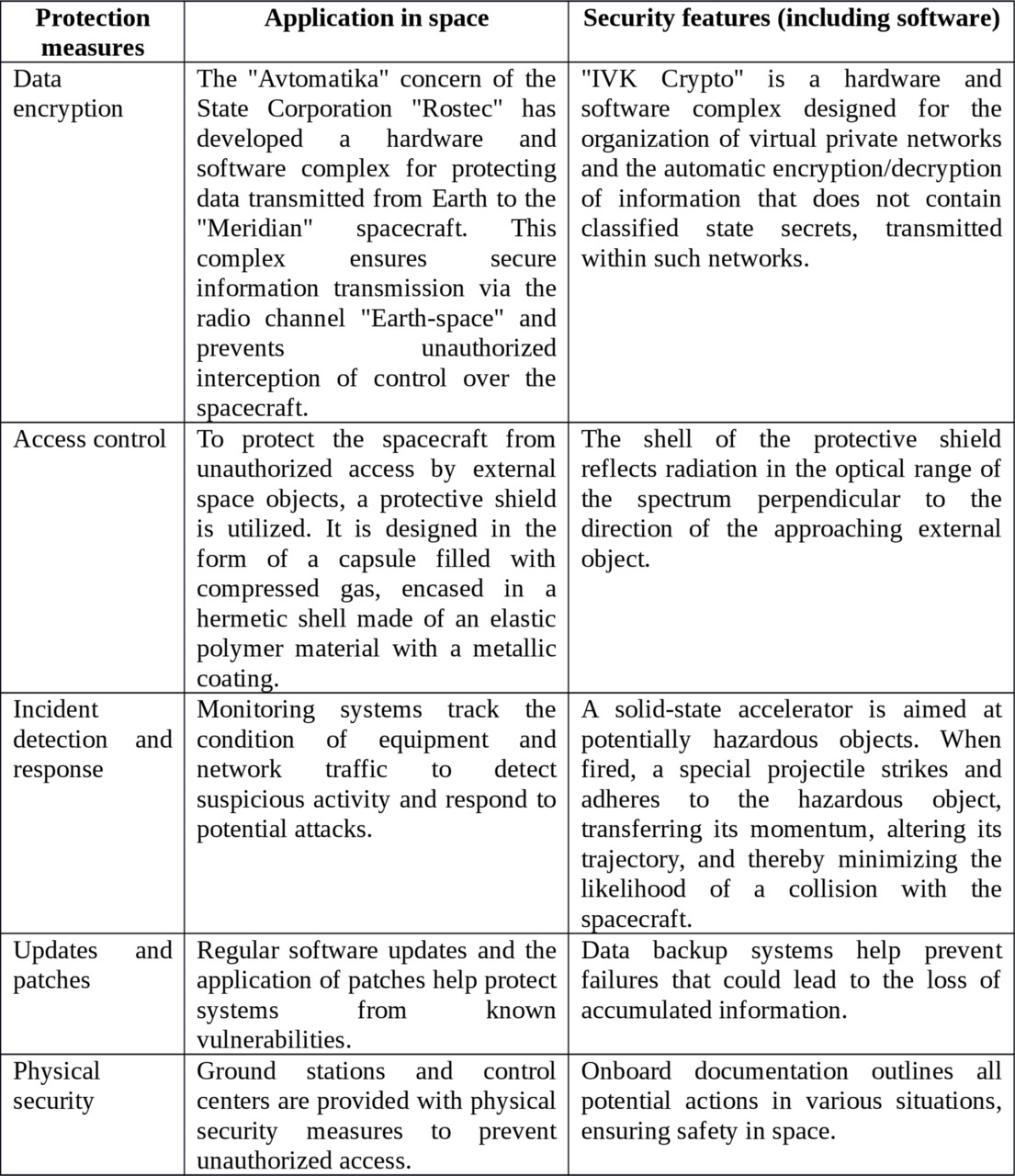
To achieve a high degree of effectiveness with the proposed protective measures and means, space companies implement them in conjunction, thereby ensuring reliable information security in space and protecting critical data and systems from various threats [5]. Professionals in this field should pay particular attention to the protection of critical infrastructure (as space systems provide communication, navigation, and monitoring essential for national security), data management protection (satellites collect vast amounts of data that must be safeguarded against unauthorized access and loss), and the prevention of emerging threats (cyberattacks are becoming increasingly sophisticated, requiring space security systems to adapt to new challenges).
In conclusion, it is important to note that information security in the space industry is a crucial component of any successful mission, as the increasing number of satellites and space technologies also elevates security threats. Protecting space data safeguards the national interests of states and the commercial interests of private companies in this domain. Given the growing reliance on space technologies to address various challenges, ensuring information security becomes a prerequisite for preventing crises and conflicts. Effective information protection in space forms the foundation for a sustainable and secure future, as well as for maintaining stability and safety in the world.
References:
1. Бокова О. И. и др. Модель комплекса средств противодействия угрозам информационной безопасности в сетях связи специального назначения //Моделирование, оптимизация и информационные технологии. — 2020. — Т. 8. — №. 2. — С. 41—42.
2. Жук Е. И. Моделирование процессов обеспечения информационной безопасности //Машиностроение и компьютерные технологии. — 2022. — №. 05. — С. 6—8.
3. Зиновьева Е. С. Международное сотрудничество по обеспечению информационной безопасности: субъекты и тенденции эволюции //Москва: МГИМО. — 2022. — С. 50—54.
4. Кудашев Е. Б., Филонов А. Н. Развитие инфраструктуры распределенных хранилищ спутниковых данных: интегрированная распределенная среда неоднородных информационных ресурсов исследования Земли из космоса //Тр. Х Всерос. науч. конф. «Электронные библиотеки: перспективные методы и технологии, электронные коллекции». RCDL. — 2023. — С. 299—308.
5. Педанов В. А. Международное правовое регулирование в условиях трансформации угроз международной информационной безопасности //Глобализация, цифровизация и правовая карта мира. — 2021. — С. 190—196.
6. Статьев В. Ю., Докучаев В. А., Маклачкова В. В. Информационная безопасность на пространстве «Больших данных» // T-Comm-Телекоммуникации и Транспорт. — 2022. — Т. 16. — №. 4. — С. 21—28.
Ильютенко С. Ю.
Microbiological contamination of the international space station: risk assessment and research prospects
Ilyutenko S.Y., 3rd year Bachelor Degree student «Microbiology»
Scientific adviser: Krivosheya I.A. Senior lecturer
Belarusian State University, Minsk, Belarus
This article discusses the microbiological contamination of the International Space Station (ISS), examining the unique conditions that foster microbial growth in space, analyzing the types of microorganisms found, and assessing the potential risks to astronaut health and station functionality. It highlights the challenges of controlling microbial contamination, including biofilm formation and antibiotic resistance, and emphasizes the need for further research and effective control methods for future space missions.
Keywords: International Space Station (ISS), microbiological contamination, space microbiology
The International Space Station (ISS), a unique orbital laboratory, faces the problem of microbial contamination. Long-term operation, extreme space conditions, and constant human presence create a favorable environment for the proliferation of microorganisms. Studies have identified a variety of bacteria and fungi on the ISS, including opportunistic species that can cause illness in astronauts and damage equipment. Of particular concern are biofilms that promote antibiotic resistance in microorganisms and cause corrosion and clogging of life support systems. Maintaining cleanliness on the ISS is difficult due to limited resources and the peculiarities of microgravity. Further research is required to assess the risks and develop effective methods for controlling microbial contamination to ensure the safety of astronauts and the reliability of the station.
The International Space Station (ISS) is a complex international project involving 14 countries. The orbital station functions as a manned laboratory for conducting a wide range of scientific research in microgravity conditions, including the study of the physiological effects of space flight on the human body, as well as experiments in astronomy, biology and physics.
Construction of the ISS began in 1998 with the launch of the first functional cargo module «Zarya». The station was subsequently expanded with key modules such as the Unity docking module, the «Zvezda» service module, the «Destiny» laboratory module, the «Harmony» docking node, and the «Columbus» and «Kibo» research modules. Truss structures were installed to accommodate external equipment such as solar panels and cooling system radiators.
The ISS was originally scheduled to expire in 2024, but was extended to 2030. Experts predict an increase in the likelihood of equipment failures after 2025, due to its long service life and accumulation of damage [2, 3].
During long-term operation of the ISS, the level of microbial contamination has increased. The ISS is a sealed system exposed to unique factors of the space environment, such as microgravity, ionizing radiation, increased concentrations of carbon dioxide, and air recirculation through HEPA filters. These conditions create a specific «extreme environment» in which microorganisms can survive and reproduce. The ISS microbiota is formed from microorganisms brought to the station since its foundation, as well as from microorganisms arriving with the crew and cargo.
Standard methods for microbiological monitoring of space stations are based on traditional cultivation methods. However, it is known that a significant portion of microorganisms cannot be cultivated under standard conditions. For a more complete analysis of microbial diversity on the ISS, molecular and cultural methods were used, including quantitative polymerase chain reaction (PCR) and 16S rRNA gene sequencing [1].
The samples were collected from eight locations throughout the ISS during three flight missions over 14 months.
The studies revealed that the bacterial load reached 10^10 CFU/m2 (colony forming units per square meter) in the following areas of the ISS: the left-hand side panel near the dome, L5 (overhead 4), L7 (overhead lab 3), and L8 (living quarters), indicating a high level of contamination. Fungi were also detected, although in smaller quantities compared to bacteria. The fungal population was lower by 2—3 orders of magnitude in all locations except L6, where the fungal load was 100 times greater than the bacterial load (up to 3.1 × 10^8 CFU/m2) [1].
The microbiota of the ISS is represented by a wide range of microorganisms, including opportunistic bacteria Members of the families Staphylococcaceae and Enterobacteriaceae with multiple antibiotic resistance, as well as fungi that can potentially cause allergic reactions and damage materials (Penicillium, Aspergillus, Cryptococcus, and Rhodotorula). Comparative analysis of the ISS microbiome and terrestrial ecosystems showed that the ISS microbiota is more similar to the animal skin microbiome than to the soil microbiome, which may be due to the thorough cleaning of cargo before sending it to the station [1].
The predominant microorganisms on the ISS are human-associated species, including opportunistic strains. Many microorganisms found on the ISS are capable of forming biofilms, which increases the risk of infections and contributes to the spread of antibiotic resistance. In addition, biofilms can cause corrosion and clog life support systems, reducing the reliability of the station.
Experience on the ISS suggests that humans can coexist relatively safely with their microbiomes in low Earth orbit. However, upcoming missions to the Moon and Mars raise new questions about the potential risks associated with microbial exposure during longer spaceflights and elevated radiation levels. The ISS is currently located below the Van Allen radiation belts, which reduces the level of ionizing radiation. Astronauts and microorganisms pass through these belts during interplanetary flights, they will be exposed to increased radiation exposure. This may lead to increased rates of genetic mutation in microorganisms, which in turn may affect their pathogenicity and resistance to antimicrobial drugs. Thus, additional research is needed to assess the impact of elevated radiation on spacecraft microbiota and develop measures to ensure crew safety during interplanetary missions.
In conclusion, microbiological contamination of the ISS is a serious problem that requires further study and development of effective control methods. Comprehensive studies are needed to assess the risks associated with the impact of microorganisms on crew health and station operations, as well as to develop strategies to minimize microbial load and prevent biodeterioration.
References:
1. Checinska Sielaff, A., Urbaniak, C., Mohan, G.B.M. et al. Characterization of the total and viable bacterial and fungal communities associated with the International Space Station surfaces. Microbiome 7, 50 (2019). https://doi.org/10.1186/s40168-019-0666-x (date of access: 14.03.2025).
2. «Why can’t the ISS operate forever?» [Electronic resource] / The planetary society, 2022. URL: https://www.planetary.org/articles/why-international-space-station-cant-operate-forever (date of access: 20.03.2025).
3. У МКС есть запас прочности [электронный ресурс] / российское новостное интернет-издание IZ.RU, 2022. URL: https://iz.ru//1333314/nataliia-mikhalchenko/u-mks-est-zapas-prochnosti (дата обращения: 20.03.2025).
Иматшоев Д. Х.
Digitalization of urban economy
Imatshoev D.Kh. 2nd year bachelor degree student «Business Informatics»
Scientifc adviser: Kyuregyan M.P., PhD in Sociology, Associate Professor of the Department of Foreign Languages
Federal State Budgetary Educational Institution of Higher Education «Technological University named after twice Hero of the Soviet Union, Pilot-cosmonaut A.A. Leonov», Korolev, Russia
The ongoing process of urbanization leads to an increasе in the complexity of the processes necessary for maintaining favourable living conditions of the population and for functioning of urban infrastructure. Due to the increasing number of these processes, it becomes important to use digital tools to track and manage them effectively. Both public authorities and local governments should take part in the process of digitalization.
Keywords: digitalization, «smart city», digital transformation.
Digitalization of the urban economy means the development of the economy and society by converting information into digital form. This process can help accelerate economic growth and labor productivity, as well as improve the quality of life.
In order to solve the problem of ensuring the accelerated introduction of digital technology in the economy and social sphere in the Russian Federation, Digital Economy of the Russian Federation national program was formed and approved on June 4, 2019, under which the Smart City urban digitalization project is being implemented [1].
Smart City is a digital technology that controls and manages a city automatically. The goal of Smart City is not only to digitalize and automate processes, but also to comprehensively improve the efficiency of urban infrastructure and create safe and comfortable living conditions for citizens.
To determine the level of digitalization of the urban economy, the IQ index of cities was introduced. It is calculated based on the development of 10 areas:
1. City Administration
2. Smart housing and utilities
3. Innovation for the urban environment
4. Smart urban transport
5. Intelligent public safety systems
6. Intelligent environmental safety systems
7. Tourism and service
8. Intelligent social service systems
9. Economic status and investment climate
10. Communication networks infrastructure
Because of such a wide range of components, the IQ index of cities allows to find out which city is more developed as well as to identify the strengths and weaknesses of settlements.
Below is a chart showing the data of the three cities: Moscow, Korolev, and Maykop. I have chosen these cities as part of my research because it will be more convenient for me to collect information about them in the future. It should be noted that Moscow relates to the Largest cities (population of over 1 million people), while Maykop and Korolev are Large cities (population of 100—250 thousand people).
There is a turning point in the dynamics of changes in indicators after 2021. While Moscow was able to score the maximum allowable points (120), the rating of Korolev and Maykop began to decline. The method for calculating the IQ of cities uses «inverse indicators», which, unlike conventional indicators, reduce the overall score. Thus, even with stable technological development, the final result may show a decrease in the effectiveness of the transformation of the city.
At the moment, there are a number of objective obstacles that slow down the Smart City project implementation. One of the major issues is the high costs of the project. For example, if we consider a new key element — Smart support, then the cost of equipment for this program will range from 250 to 2500 thousand rubles, and for the widespread introduction of this technology in a large city, we will be talking about billions of rubles. Another barrier is a long implementation period of such projects. Along with this, other hindering factors can be identified, such as imperfect technologies, low awareness of city administration staff, and a low level of digital literacy among the population.
Despite these problems, the project is relevant and has prospects for future development and improvement. The society demonstrates its interest in the transformation of the city and tries to help scientists solve the problems of territorial development. On November 14, 2023, the MBI Cosmos Youth Centre of Korolev launched the Convenient City project, within which anyone can contribute to the development of the cities of the future.
Such joint activities of science and society increase the efficiency of work in order to improve urban infrastructure. In case of successful implementation of the tasks set, this project can become the basis for the introduction of technologies into regional and later into public administration.
Thus, summing up, we can say that the digitalization process is able to form an effective urban management system and create safe and comfortable living conditions for people. This will, in turn, lead to the creation of complex integrated systems which can subsequently be further developed both in the regions and the whole country. However, it should be borne in mind that in order to achieve the best result, it is necessary to involve citizens in participating in the digital transformation of the Russian Federation.
References:
1. Положение Об утверждении методики оценки хода и эффективности цифровой трансформации городского хозяйства в Российской Федерации (IQ городов): утв. Приказом Министерства строительства и жилищно-коммунального хозяйства Российской Федерации от 31 декабря 2019 г. №924/пр, [электронный ресурс]. — Режим доступа: https://minstroyrf.gov.ru/upload/iblock/257/prikaz-924pr.pdf — Дата доступа 17.05.2024.
2. Результаты оценки хода и эффективности цифровой трансформации городского хозяйства Российской Федерации (IQ ГОРОДОВ) по итогам 2020 года [электронный ресурс]. — Режим доступа: https://minstroyrf.gov.ru/upload/iblock/501/List-s-gorodami-IQ-Final.pdf — Дата доступа 19.05.2024.
3. Результаты оценки хода и эффективности цифровой трансформации городского хозяйства Российской Федерации (IQ ГОРОДОВ) по итогам 2021 года [электронный ресурс]. — Режим доступа: https://minstroyrf.gov.ru/upload/iblock/672/REZULTATY-OTSENKI-KHODA-I-EFFEKTIVNOSTI.pdf — Дата доступа 19.05.2024.
4. Результаты оценки хода и эффективности цифровой трансформации городского хозяйства Российской Федерации (IQ городов) по итогам 2022 года [электронный ресурс]. — Режим доступа: https://minstroyrf.gov.ru/upload/iblock/183/2jpwh2e8xiqo0qc2mcteb
4x0pnit36i9/Rezultaty-IQ-2022.pdf — Дата доступа 19.05.2024.
5. Результаты расчёта индекса IQ городов (2023 год) [электронный ресурс]. — Режим доступа: https://minstroyrf.gov.ru/upload/iblock/d7b/7puty7h314qwo6pm7wfj0
6vvsc2z10tg/IQ-svod_reyting. pdf — Дата доступа 03.09.2024.
Исаков А. В., Давыдова А. А.
Сравнительный анализ способов контроля герметичности сосудов, работающих под давлением
Исаков А. В., Давыдова А. А., обучающиеся 3-го курса направления подготовки бакалавров «Управление качеством»
Научный руководитель: Квач И. В., старший преподаватель кафедры техники и технологии
ФГБОУ ВО «Технологический университет имени дважды Героя Советского Союза лётчика-космонавта А. А. Леонова», Королёв, Россия
Проведен сравнительный анализ методов и способов контроля герметичности трубопроводов и сосудов, работающих под давлением, выявлены преимущества, недостатки и ограничения применения каждого из исследуемых способов и даны рекомендации по их применению.
Ключевые слова: герметичность, контроль качества сосудов, течеискание, сравнительный анализ.
Одним из основных факторов, определяющих качество и надежность работы сосудов, работающих под давлением (далее — сосуды), является их соответствие требованиям герметичности [1 — 3]. Контроль герметичности изделий проводят в тех случаях, когда они предназначены для работы под давлением газов или жидкостей. Необходимость контроля, методы и способы испытаний на герметичность и их объем устанавливается в технической документации в зависимости от назначения, условий работы изделия и выполнимости тех или иных методов и способов.
В целях определения предельных значений чувствительности наиболее часто применяемых методов контроля герметичности авторами был проведен сбор и анализ информации, находящейся в открытом доступе, результаты которого представлены в таблице 1 [1 — 3].
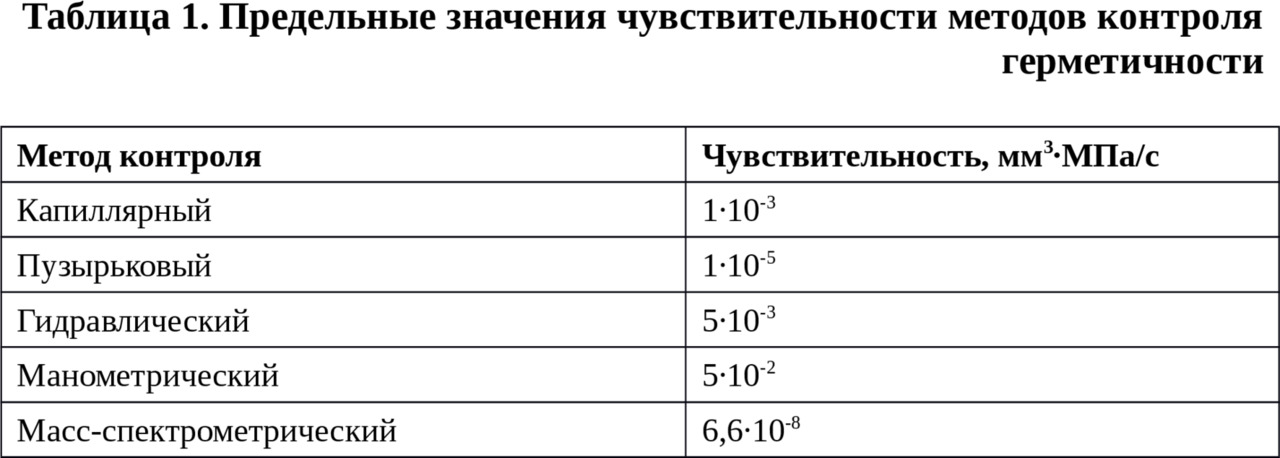
Также авторами был проведен сравнительный анализ способов контроля герметичности, наиболее часто используемых на предприятиях машиностроительной и ракетно-космической отрасли. Результаты сравнительного анализа представлены в сводной таблице 2. Сравнение способов происходило по различным критериям, основными из которых являются: назначение способа; используемые в процессе контроля средства контроля; контрольное или пробное вещество; признак обнаружения дефекта.
По результатам проведенного сравнительного анализа авторами была составлена таблица, демонстрирующая особенности применения наиболее часто применяемых способов определения герметичности сосудов (таблица 3) [1]. Для обозначения наличия (или отсутствия) представленных критериев использовались следующие обозначения:
— «+» — наличие у способа критерия;
— «±» — наличие у способа критерия с ограничениями;
— «-» — отсутствие у способа критерия.
Из таблицы 3 видно, что каждый из представленных способов имеет как ряд бесспорных достоинств, которые отражены в столбце критериев оценки, так и свои ограничения. Поэтому, целесообразность применения каждого из способов определяется требованиями проведению контроля герметичности и характеристиками сосуда, подлежащего контролю.
Согласно данным таблицы можно отметить способы контроля герметичности, отвечающие полностью или ограниченно максимальному количеству критериев, такие как способ индукторных масс, способ мыльной эмульсии, способ обдувания и способ щупа. Также были отмечены способы, соответствующие меньшему числу критериев, но имеющие возможность автоматизации процессов измерения или расчета суммарной негерметичности контролируемых сосудов (способы повышения и спада давления, способ вакуумирования с применением масс-спектрометрических течеискателей), что может говорить о перспективности применения данных способов на предприятиях машиностроительной и ракетно-космической промышленности.
Таким образом, результаты сравнительного анализа позволили выявить принципиальные различия способов контроля, их преимущества и недостатки, а также дать рекомендации и ограничения по применению способов контроля герметичности на практике.
Так, например, контроль герметичности крупногабаритных емкостей высокого давления (рисунок 1) целесообразно осуществлять масс-спектрометрическим методом течеискания, способом помещения в вакуумную камеру (вакуумирования). Это связано, прежде всего, с тем, что, несмотря на ряд недостатков (дороговизна, отсутствие мобильности средств контроля и относительно высокие временные затраты), способ является универсальным и возможен к применению с единственным ограничением — на габаритные размеры испытываемого сосуда.
Литература:
1. Барвинок В. А. Монтажно-испытательные процессы в производстве летательных аппаратов. Ч. I. Методы и средства монтажа и испытаний баков-емкостей в производстве летательных аппаратов: учеб. пособие / В. А. Барвинок, Ю. В. Федотов, Н. П. Родин. — Самара: Изд-во Самар. гос. аэрокосм. ун-та, 2007.– 80 с.: ил.
2. ГОСТ 24054—80 «Методы испытаний на герметичность. Общие требования».
3. Методические рекомендации о порядке проведения контроля герметичности технических устройств и сооружений, применяемых и эксплуатируемых на опасных производственных объектах Серия 32. Выпуск 8 / Колл. авт. — М.: Открытое акционерное общество «Научно-технический центр по безопасности в промышленности», 2012. — 87 с.
Калиновский А. Д.
Electrodynamic tether in near-Earth cosmonautics
Kalinovsky A.D. 2nd year specialist degree student «Design, production and operation of rockets and rocket-space complexes»
Scientifc adviser: Romanov P.S., Doctor of Pedagogy, Associate Professor, Professor of the Department of Foreign Languages
Federal State Budgetary Educational Institution of Higher Education «Technological University named after twice Hero of the Soviet Union, Pilot-cosmonaut A.A. Leonov», Korolev, Russia
Reduction of spacecraft mass is an urgent task both during the whole development of cosmonautics and in the foreseeable future. No need for fuel for spacecraft propulsion, or combining the functions of propulsion and generator in a single device — these solutions aimed at optimising the mass of spacecraft, which can offer such a device as electrodynamic tether.
Keywords: electrodynamic tether, satellite, ionosphere, Earth orbit.
Reduction of spacecraft mass is an urgent task both during the whole development of cosmonautics and in the foreseeable future. No need for fuel for spacecraft propulsion, or combining the functions of propulsion and generator in a single device — these solutions aimed at optimising the mass of spacecraft, which can offer such a device as electrodynamic tether.
In the article Electrodynamic Propulsion System Tether Experiment (T-Rex) the following definition is given: electrodynamic tether (hereinafter referred to as EDT) is a long wire stretched from the spacecraft. The gravity gradient field (also known as «tidal force’) will tend to orient the tether in a vertical position. If the tether is travelling in an orbit around the Earth, it will cross the magnetic field lines of the Earth at orbital velocity (7—8 km/s). The movement of the conductor across the magnetic field causes tension along the entire length of the tether.
If the system has a means of collecting electrons from the ionospheric plasma at one end of the tether and pushing them back into the plasma at the other end of the tether, the voltage can induce a current along the tether. This current will in turn interact with the Earth’s magnetic field, creating a Lorentz force (FL=q*v*B*sinα) that will counteract the motion of the tether and whatever it is attached to. This «electrodynamic drag force’ will cause the orbit of the tether and the launch vehicle to decrease. Essentially, the tether converts the orbital energy of the launch vehicle into electrical energy, which is dissipated as ohmic heating of the tether.
In an «electrodynamic thrust’ system, the tether can be used to propel the spacecraft into orbit. If a power source is added to the tether system and used to direct the current in the opposite direction to that in which it should normally flow, the tether can «push back’ against the Earth’s magnetic field by means of the Ampere force (FA=I*B*Δl*sinα) to raise the orbit of the spacecraft. The main advantage of this method over other space propulsion systems is that it does not require any propellant. It uses the Earth’s magnetic field as the «reactive mass’. By eliminating the need to launch large amounts of propellant into orbit, electrodynamic tethers can significantly reduce the cost of space propulsion (see Fig. 1) [3].
The EDT can be applied as a generator. The concept of current collection on a bare conducting tether was first formalised by Sanmartin and Martinez-Sanchez. They note that the most area-efficient cylindrical current collection surface is one that has an effective radius of less than ~1 Debye length (10—3m), where the physics of current collection is known as constrained orbital motion (COD) in a stalkless plasma. As the effective radius of the bare conducting tether increases past this point, there is a predictable decrease in collection efficiency compared to OOD theory. In the EDT system, the best performance for a given tether mass is achieved with a tether diameter chosen smaller than the electronic Debye length for typical ionospheric environmental conditions, so it is in the OOD regime.
Another application would be to simply compensate for atmospheric drag to allow the spacecraft to «fly’ lower and longer. Fig. 2 shows an example of using a 2 km long tether (1.5 km insulated, 0.5 km uncoated, 2 mm diameter) driven by a power source providing 150 W to the tether system to maintain and even slightly increase the altitude of the spacecraft to about 350 km at 35o orbital inclination over a week of operation. The spacecraft is assumed to have a mass of 960 kg (about 1000 kg total mass with tether system) and a tethered area of 9 m2. Without the tether, an altitude loss of about 5 km would have occurred in the same time. In order to minimise changes in inclination angle due to electronic tether actuation, the control was activated only when the thrust vector was within 25o of the orbital plane. This resulted in a 49% duty cycle. The slight increase in orbit over a one-week time period could be eliminated by further reducing the tether operating time or further increasing the thrust vector control interval. This analysis assumes no libration or temperature fluctuations. due to the day-night change. In addition, it is assumed that power is supplied from the existing on-board power system [1].
Practical realisation of the concept and view on EDT development.
According to NASA report, the STS-75 mission (space shuttle Columbia) was launched on 22 February 1996. Its main task was to test the TSS-R1 satellite system (tethered satellite system). After entering an orbit of 184 statute miles (296 kilometres) with an inclination of 28.45 degrees to Earth’s equator, the satellite, weighing 1,141 pounds (518 kilograms) and 5 feet (1.6 metres) in diameter, was to be deployed from its pallet in the shuttle’s cargo bay 12.4 miles (20.7 kilometres) above the orbiter as an attached electrically conductive tether with a diameter of 0, 1 inch (2.5 millimetres) in diameter made of nomex and Kevlar (this super strong and thin filament also contains a bundle of insulated tin-coated copper wires, making it electrically conductive), which unwinds from a motorised spool. The purpose of this mission was to demonstrate the ability to deploy and control satellites on long tethers in space and to conduct space plasma experiments that involve generating electricity. During the period of maximum tether deployment, voltages on the order of 3500 volts were achieved at a current of 1 ampere [4]. The tether failed as a result of arcing and burning of the tether, but this experiment tested a way to generate electricity from interaction with ionospheric plasma using a satellite «collector’ and a conductor tether. As Les Johnson writes in Electrodynamic Tethers For Spacecraft Propulsion, the bare tether is expected to provide a more efficient collection of ionospheric electrons (per unit area). This is because the small transverse size of the tether allows electrons to be collected in the orbitally constrained mode (OCM), which should provide the highest possible current density. The open tether design represents a breakthrough that makes short tether electrodynamic amplification practical for moderate power requirements. The EDM tether itself, if left uninsulated in parts, will function as its own very efficient anode. The tether has a positive bias with respect to the plasma over some or all of its length. This is because the non-isolated part of the tether with a positive bias collects electrons from the plasma. The following features are in favour of the bare tether concept: 1. The small cross-sectional size of the tether makes it a much more efficient collector of electrons from the cosmic plasma. 2. The large current collector area is distributed along the tether itself, eliminating the need for a resource-intensive plasma contactor or a large, massive and/or highly resistive sphere at the end of the tether to collect electrons: this significantly reduces the centre of gravity displacement in both cases and reduces cost and complexity in the case of an active contactor. 3. The system self-adapts to changes in electron density. This is achieved by «naturally expanding the part of the tether that shifts positively relative to the ionosphere whenever the density drops’ (this is further illustrated in Fig. 3). The accumulation of charged particles is determined by the stronger gradients associated with smaller sizes, and is thus a two-dimensional process whose duration has no relation to the current density being collected. When the radius is small compared to both the Debye length and the gyroradius of the electrons, there is neither space charge nor magnetic guidance effects, and we are in the OCM regime. In this regime, the current takes the maximum possible value for a given geometry and bias. Even better, it turns out that in cylindrical geometry the OCM regime is fulfilled for radius-to-Debye length ratios even of the order of unity. Fig. 4 shows the current data collection efficiency with an unprotected tether compared to a sphere of equal area using TSS-1R data. Thus, the future development of EDTs is seen as partially bare tethers rather than tethered satellite systems [2].
Annex
Бесплатный фрагмент закончился.
Купите книгу, чтобы продолжить чтение.