
Бесплатный фрагмент - Science, Culture and Youth
Сборник трудов по материалам IX Международной студенческой научно-практической конференции (21 марта 2024 г.)
Секция «Актуальные проблемы современности»
Очные доклады
Алексеева Е. Г., Бородулина А. А.
Механизм бессмертия раковых клеток
Алексеева Е. Г., Бородулина А. А., студентки 1 курса направления подготовки бакалавров «Государственное и муниципальное управление»
Научный руководитель: Зинина Ю. М., кандидат филологических наук, доцент
Негосударственное образовательное частное учреждение высшего образования «Московский экономический институт», Москва, Россия
В наше время рак является одним из самых страшных заболеваний. Раковыми клетками называют те клетки, которые из-за мутаций функционируют и выглядят иначе, чем нормальные клетки организма. В большинстве случаев раковые клетки ведут к неотвратимой смерти человека. Но при этом удивительно, как они могут бесконтрольно размножаться, распространяясь по организму. Раковые клетки «бессмертны», потому что не подвержены запрограммированной клеточной смерти. Можем ли мы использовать эти клетки для того, чтобы жить вечно?
Ключевые слова: раковые клетки, ДНК, репрограммирование, бессмертие
Что если клетки нашего организма, которые, как казалось, обречены на постепенное истощение, хранят в себе путь к бессмертию, только им для этого нужно стать раковыми? В начале развития многоклеточного организма все клетки являются стволовыми, т.е. не специализированными. Их основная функция — делиться, наращивая массу организма. В процессе развития каждая из таких клеток приобретает свою специализацию: кто-то становится нейроном и выполняет функцию проводника нервного импульса, кто-то становится миоцитом и сокращается. Химические процессы в клетках происходят непрерывно. Если правильность процессов будет нарушена под влиянием химических или физических факторов, то в клетке накапливаются мутации, которые могут вызвать у нее что-то вроде амнезии. Клетка перестаёт помнить свою специализацию, и эта потеря памяти может заставить её откатиться в некое детское состояние. Клетка снова начнёт думать, что она стволовая. Такие бесконтрольно делящиеся клетки называют раковыми.
Стоит уточнить отличительные особенности раковых клеток:
1. Хроническая пролиферация или бесконтрольное деление клеток. Если здоровые клетки нуждаются в ростовых факторах, то раковые клетки самостоятельно обеспечивают себя сигналом «роста». В таком случае развитие раковой опухоли можно представить как автомобиль без тормозов.
2. «Бессмертность». У нормальных клеток роль так называемого спидометра выполняет белок p53, который является сенсором повреждённого ДНК, запускающий апоптоз клетки — программируемую клеточную смерть. Многие виды рака лишены функции p53, из-за чего процессы самоуничтожения не запускаются.
3. «Инфильтративный рост» — проникновение и разрушение соседних тканей злокачественными опухолями.
4. Способность рецидивировать — вырастать снова после удаления, химиотерапии или лучевой терапии на том же месте.
5. Метастазирование — образование вторичных опухолей и близких по структуре к первичной опухоли в результате перемещения в здоровые ткани и органы организма. [1]
У клеток, которые содержат ядро (эукариотические клетки) есть предел того, сколько раз они могут поделиться — примерно он составляет 50—70 раз. Теломеры не позволяют хромосоме повредиться и «склеиться» с другими хромосомами. С каждым делением клетки теломеры укорачиваются, а после исчезают совсем — тогда клетка запускает программу самоуничтожения. Теломераза — это фермент, который удлиняет концевые участки хромосом. С помощью теломеразы раковые клетки могут делиться бесконечно [4].
Кстати говоря, технология возвращения к зародышевому состоянию, известна уже почти 15 лет. Такое репрограммирование состоит в том, чтобы запустить в клетках работу четырех факторов Яманаки (белков), которые выключают гены, связанные со специализацией клетки, и она превращается в стволовую. Для достижения частичного репрограммирования, учёные вводили РНК факторов Яманаки в течение четырех дней в стенки сосудов человека. Для этого эксперимента они использовали клетки пожилых (60—90 лет) доноров, а затем сравнивали репрограммированные клетки с клетками молодых (25—35 лет) доноров. В результате репрограммированные клетки оказались ближе к молодым, чем к старым донорам. В то же время, в репрограммированных клетках исследователи не обнаружили маркеров стволовых клеток — это значит, что они не потеряли свою специализацию. Однако даже частичное омоложение клеток может повлечь за собой бесконтрольное деление, поэтому учёным потребуются тщательные проверки и опыты для того, чтобы репрограммированные клетки не становились раковыми. Существуют теории касательно того, чтобы извлечь свойство «бессмертия» раковых клеток и обратить это свойство во благо организма. Ровно также в ходе экспериментов с репрограммированием клеток необходимо учитывать способности клеток к сохранению своих основных свойств и отсутствие побочных, влекущих за собой неотвратимые процессы [2].
Пока история с омоложением и впоследствии поиски путей к бессмертию только начинают развиваться, технологию репрограммирования уже успешно используют, например, для лечения глазных болезней, а совсем недавно репрограммированные клетки впервые подсадили в сердце пациента. Что касается раковых клеток, то всемирно известная линия «бессмертных» клеток HeLa, полученная из раковой опухоли шейки матки пациентки по имени Генриетта Лакс, умершей от этого заболевания в 1951 году, используются во многих научных исследованиях. Кстати, клетки HeLa в 1968 году на борту советского космического аппарата «Зонд-5» облетели вокруг Луны, таким образом став объектом биологических исследований, достигших лунной орбиты.
Остановимся на некоторых экспериментах с клетками HeLa. Выяснилось, что линия клеток пригодна для размножения полиовирусов (вакцина против полиомиелита была создана Джонасом Солком), а также для ряда других вирусов, например, паротита и кори, герпеса и ветряной оспы. Клетки HeLa замораживали и размораживали, чтобы оценить их живучесть. Их даже отправляли по почте, превращали в гибриды и заставляли сливаться с клетками мыши. Одни ученые помогали клеткам «метастазировать» снова и снова, а другие — пытались их убить. HeLa облучали рентгеном, обдували кислородом, поливали антибиотиками, кроличьими антителами, бактериальными токсинами.
В то же время некоторые ученые-биологи, например, Джордж Гай, пытались превратить эти клетки в лекарство. Гай потратил несколько десятилетий на то, чтобы научиться выращивать опухолевые клетки в культуре. Его лаборантка кормила их свежей кровью (за которой приходилось ездить то на скотобойню, то в роддом). Его жена, бывшая хирургическая медсестра, вымуштровала сотрудников дезинфицировать все поверхности в лаборатории. А сам ученый построил с помощью подручных материалов вращающийся инкубатор для клеток, чем-то похожий на бетономешалку, он делал буквально пару оборотов в час — и, по замыслу создателя, должен был имитировать медленный ток крови в человеческой ткани.
В середине 1950-х вирусологи, среди которых был Честер Саутэм, подселили их в организмы нескольких десятков тюремных заключенных из Огайо в надежде, что встреча с чужой опухолью сработает как прививка от собственных. Некоторым пациентам клетки HeLa кололи в качестве теста: считалось, что, если иммунная система с ними не справляется, значит она ослаблена, и где-то в организме имеется недиагностированный рак. Каждому заключенному Саутэм делал несколько инъекций клеток, и в отличие от смертельно больных пациентов, эти мужчины победили рак. С каждой новой инъекцией организм реагировал быстрее, и, казалось, что эти клетки усилили иммунный ответ на рак у заключенных. Когда Саутэм обнародовал результаты эксперимента, пресса расценила это как огромный прорыв, который может однажды привести к созданию вакцины от рака.
В ходе долгих лет изучения клеток HeLa, ученые много узнали о них: чем они питаются и как часто, особенности их размножения, как они дают отпор иммунитету, какими генами пользуются и какие строят белки. Чем больше ученые погружались в исследования, тем яснее становилось, что эти клетки совсем не похожи на обычные клетки человека. Главное отличие, безусловно, заключается в том, что они раковые. В их восьмой хромосоме находится вирус папилломы человека 18 типа, который своим присутствием заставляет работать ген с-Мус — это известный онкоген, который регулирует работу других генов и побуждает клетки делиться. Видимо, именно благодаря ему HeLa исправно размножаются раз в сутки на протяжении вот уже семидесяти лет. У клеточной линии совершенно неприличное число хромосом — их 76—80 вместо положенных человеческим клеткам 46: 22—25 из них аномальные, то есть обломки существующих хромосом или вообще химеры из нескольких участков генома. В настоящее время существует подозрение, что отдельные HeLa с разных концов света стали даже друг с другом иметь не так много общего. Также является до конца не выявленным, в какой момент 46 хромосом превратились в 80 — внутри тканей Генриетты или уже снаружи.
Прожив на свете в два с лишним раза дольше самой Генриетты, покорив все континенты и побывав в космосе, принеся ученым десяток Нобелевских премий и защитив от полиомиелита миллионы детей, прямо сейчас в тысячах инкубаторов на Земле вечные осколки Генриетты Лакс настойчиво копируют свою ДНК, готовясь мутировать, эволюционировать и дальше бороться за свою свободу [3; 5].
Человек — разумное многоклеточное существо, сочетающее в себе множество биологических механизмов. Вполне возможно, что загадка «бессмертия» заключается в нас самих.
Литература:
1. Варнавский Е. В. Раковые клетки. URL: https://clck.ru/3GBBPY (дата обращения 17.03.2024).
2. Лосева П. Частичное репрограммирование омолодило клетки человека на пять лет. URL: https://clck.ru/3GBBRv (дата обращения 17.03.2024).
3. Лосева П. 70 лет рабства. Приключения клеток HeLa на службе у человечества. URL: https://clck.ru/3GBBT4 (дата обращения 17.03.2024).
4. Милевски И. Механизм бессмертия раковых клеток. URL: https://clck.ru/3GBBUo (дата обращения 17.03.2024).
5. Склут Р. Бессмертная жизнь Генриетты Лакс. — М.: Карьера Пресс, 2012. –392 с.
Анохина В. С., Линёв И. Ф., Иматшоев Д. Х.
Methods of attracting new audience to streaming and video-hosting platforms
Anokhina V., Linev I., Imatshoev D., 1st year Bachelor Degree students «Business Informatics»
Scientific adviser: Atrokhin A.M., PhD (Philology), Associate Professor of the Department of Foreign Languages
Federal State Budgetary Educational Institution of Higher Education «Technological University named after twice Hero of the Soviet Union, Pilot-cosmonaut A.A. Leonov», Korolev, Russia
Every year, concurrency between streaming video services gets more intense, that is why specific methods of attracting new users to the services are relevant and actual. To complete this article, we used both logical and statistical ways of learning. Creating of original content, increase of connection and links between online-cinemas, usage and development of ecosystems and constant feedback from viewers were outlined as methods of attracting new audience to streaming and video-hosting platforms.
Keywords: online-cinema, movie, streaming video-services, attraction of audience
Streaming services in Russia have been developing quickly for the last ten years, constantly extending its viewers amount, which seemingly follows world modern multimedia era tendency. Content is spread through online-cinemas and other services, allowing a direct connection between the costumer and content-maker. [1].
At this moment, Russia has officially over 20 online-cinemas.
Leaders in 2023’s revenue «pie’ are [2]:
33,9% «Kinopoisk» (owned by Yandex group)
19,3% «ivi»
13,4% «Wink» (Project of «Rostelecom»)
10,5% «Okko» (Bought by «Sberbank»)
8,5% «START» (Owned by «Megafon»)
8,5% «Kion» (Owned by «MTS»)
1,6% «More.tv» (a part of «National media holding»)
1,1% «Premier» (project of «Gazprombank»)
From the several last years’ statistics, cinemas and television tend to lose their customers amount, but online-cinemas show their upgrading audience and revenue change.
In 2023 video-services summary revenue reached the amount of 63,3 billion rubbles compared to 60,3 billion rubble the year before. Thus, revenue growth is 5% versus 54% growth by the end of 2021, which means that this index is 50 points lower than the previous mark. 2021 is an absolute record-breaker for the last 4 years — from 2019 to 2020 the growth percentage was stable, equalled 52%.
The main reasons of this drastic revenue-growth cut are leaving of Netflix, Megogo and other massive distributors from Russian market, restriction of official access to foreign-made films which led to consecutive drops of advertisement expenses from remaining online-cinemas, huge increase of viewers audience on obscured (unofficial) video-services and more importantly, recession of pay-ability of Russian audience.
Therefore, not to only maintain, but add in profit our video-services have to attract new viewers and preserve settled audience. For that to work out, online-cinemas use different methods:
1. Creating of original content
The most efficient way of getting new followers on a platform is certainly a new TV-series of film. Streaming services, you can tell, «with a pleasure’ invest their own capital in new content production, by that strategy they enhance diversity of the content and create a media-product, based on viewers’ preferences. Also, brand new films and TV-series are exclusive ones, that can only be seen on the platforms that produced them.
Russian online-cinemas on usual make more TV-series, than films. Almost all revenue-leaders illustrated on stats before make their own products. For example, TV-series «Korol i Shut» on their release-day counted more than 410k subscriber-views on «Kinopoisk». According to the service, that was the viewers peak-mark of all time (on release-day). However, the giant and undefeated leader in producing of new content is platform «START», the amount of released on the platform TV-series is more than 100.
2. Development of connection between online-cinemas
With increase of number of online-cinemas and their content, people want to see all of it, but the problem is that it’s not beneficial for them to buy a full and not only one subscription to watch one favourite film or tv-series. To solve this problem, online-cinemas sell the access to best hits (films or tv-series) to other platforms (for example «Vampires of the middle zone», can be viewed on «Kinopoisk», «Wink» etc.) and add mutual subscription programs (on «Kinopoisk» you can also buy a subscription to “More.tv” and «Amediateka»).
Also, due to the growing need for new production and cost reduction, video platforms are ready to cooperate with each other. One of the forms of such interaction is coproduction. For example, «The Boy’s Word» was produced with the support of Wink/START and NTV, and «New Daddy’s Daughters» was produced with the support of START and STS.
«START»’s online-marketing director Anastasia Batsueva give her comment on this issue: «TV-series filming is objectively expensive, all «players» try to adjust to a healthy economy. We can look at many collaborations between online-cinemas. We are leaders in tv-series producing, but we still buy best «titles» from such services as «Kinopoisk». And I can tell, there are more collabs to see].
3. Development of feedback from users
For successful promotion, online-cinemas set up and operate with familiar and same strategies. And because of that common feature, the deciding factor is the strength and popularity of the brand. In most cases, people choose video-service, that they heard about, known as a brand and was advised to use by friends. That is why companies in this field try to make up as much as possible hype of themselves. Profoundly planned press-releases significantly help to promote a show. The mentioned aspects are more relevant to the most popular movie-showing marks because they always concur for the first place. It leads to monthly analyses of mentions of the platforms and their concurrent in social media, also accounting the facts about what was more exciting for people to talk about and see.
The most advanced in «communication with clients» service is «Kinopoisk»: the service sponsors podcasts on their platform about filming, tv-show and series making and film industry in general. On YouTube, «Kinopoisk» shows their backstage videos, examples of their work, even of their competitors, and simple advises for beginner-actors and fans.
4. Introduction in ecosystems and services cooperation for users’ comfortable view and enjoyment of film products.
In 2020, «Yandex» added to their subscription cinema-platform «Kinopoisk». Subscription includes many different services of «Yandex» such as «Yandex» Fresh Food, Yandex Market. This union definitely attracts new subscribers because of its convenience — you can have all in one.
It’s worth noticing that online-cinemas cooperation is also remarkable, but not so developed and advanced in Russia for this moment. For example. «Okko» in pandemic period organized with a delivery service «Samokat» (scooter) delivery of popcorn and snacks when people want to watch a film on «Okko», both film and snacks were at least 10% off in cost.
As Eastern Europe OTT TV and Video Forecast view the situation, up to 2027 in Europe will be no less than 43 million subscribers in summary. Quite evidently, this growth will touch Russia, but with a certain lack because of sanctions and other restrictions. For the same time there are new international film market that are open to cooperation with Russia: Latin America, Asia, Middle East.
But still, the main focus of users is on our native production and that’s what our people enjoy the most. Also, the concurrency tense is not going to disappear and video-services are ready to spend a decent amount of money on it.
References:
1. Kazyuchits, M. Pandemic according to the Author: streaming, series and message in Russia / M. Kazyuchits // Telekinetics. –2021. –No. 1 (14). -WITH. 18—23. –EDN PZWWIZ.
2. Yuri Serebrov. IAA TelecomDaily: Russian online cinemas lacked turnover https://clck.ru/3GBBWv
3. Formation of competitive advantages of online cinemas / A. R. Akopyan, A. M. Arakelyan, Yu. V. Vorontsova, V. V. Krysov // University Bulletin. –2022. –No. 1. –S. 146—156. –DOI 10.26425/1816-4277-2022-1-146-156. –EDN QMCQGF.
Афанасьев А. Д.
Innovative and Сurrent methods of providing energy to spacecraft orbiting the Earth
Afanasyev A.D., 1st year Specialist Degree student «Design, production and operation of rockets and rocket and space complexes»
Scientifc adviser: Romanov P.S., Doctor in Pedagogy, Associate Professor, Professor of the Department of Foreign Languages
Federal State Budgetary Educational Institution of Higher Education «Technological University named after twice Hero of the Soviet Union, Pilot-cosmonaut A.A. Leonov», Korolev, Russia
This text explores innovative methods of providing energy to spacecraft orbiting Earth. Each energy system is discussed in terms of efficiency, power generation, and space mission applications. The comparison table demonstrates the duration of operation, energy efficiency, weight, and need for fuel reserve of energy systems. The conclusion emphasizes the energy-efficient ways of powering spacecraft and highlights the potential of low-power energy sources in conjunction with existing energy systems for increased efficiency in near-Earth unmanned kosmonautics.
Keywords: power supply system, spacecraft, Earth orbit.
Introduction
The Earth’s orbit is the area of outer space that is most actively used at the present time and will undoubtedly continue to be actively exploited in the future. The article discusses various energy supply methods that could be used by a spacecraft orbiting the Earth. The purpose of the article is to review and compare the above-mentioned methods of energy supply with subsequent conclusions.
Types of energy systems and comparison of their efficiency.
Primary Batteries:
— Produce direct current by electrochemistry
— Currently used: LiCFx (lithium polycarbon monofluoride) electrolyte
— Economical for small spacecraft for missions of relatively short duration.
Solar PV — Battery:
— Photovoltaic cell, semi-conductor material, directly converts sunlight to electricity.
— Most widely used energy-conversion device for spacecraft
— Provide relatively high power levels over long duration (up to 10 to 15 years).
— Batteries required to provide power during eclipse.
Radioisotope-Thermoelectric Generators (RTGs):
— Compact and continuous source of power
— Used in deep-space missions over several decades
— Considered nuclear fuel but relatively easy to handle safely: Curium-244 & Plutonium-238 [strontium-90 less expensive but not safe to handle]
— High energy particles heat a thermoelectric material that, in turn, produces an electric potential: Lead telluride SiGe (silicon germanium) doped w. phosphorous
Fuel cells:
— Produce direct current by chemical reaction of an oxidant and a fuel.
— Currently used: O2 & H2.
— Work as long as supply of oxidant & fuel available.
Solar Concentrator — Dynamic:
— Mirrors used to concentrate sunlight to heat a working fluid that powers a turbine: Steam Liquid metal, e.g. potassium chloride Gas, e.g. helium, xenon
Chemical Dynamic:
— Burn fuel & oxidant, e.g. H2 & O2, CH4 & O2, to power a turbine.
Additional low-power energy sources:
— Solar panels designed to convert sunlight reflected from the Earth into electrical energy.
— Free Energy Generator.
Options for electrical-power production & storage for space missions, current and under development, are shown in the following figures in terms of power vs. mission duration [3, 6]:
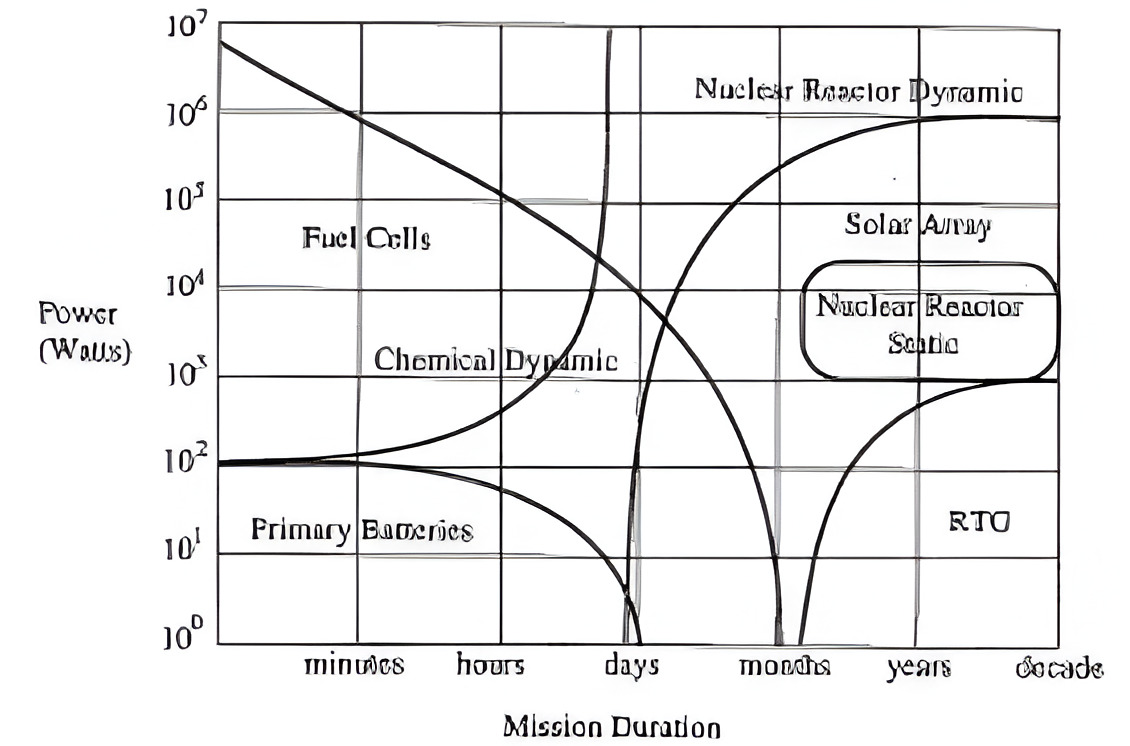
Solar PV — Battery System
The most common electrical-power-generation system for spacecraft is the combination of solar photovoltaic arrays and batteries as shown schematically in the following figure:
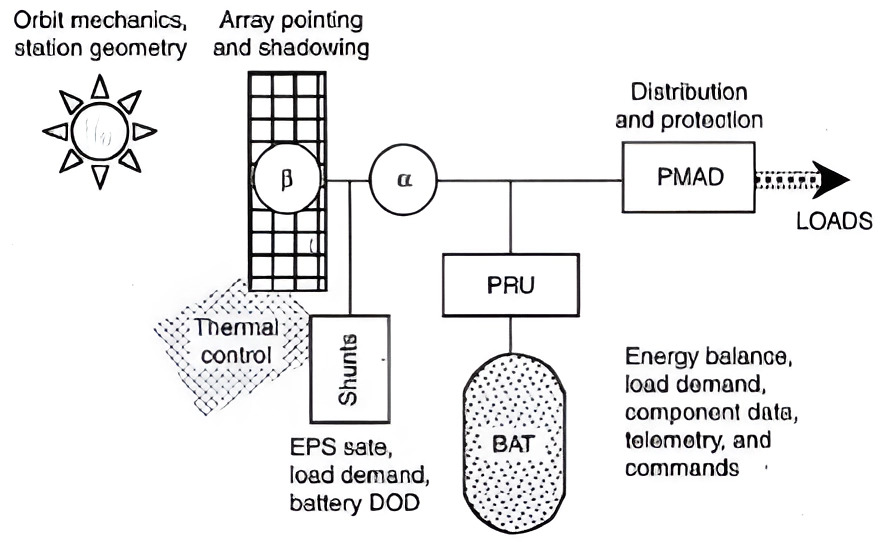
The PV Cell
The building block of the solar array is the PV cell:
— Diode-type junction of two crystalline semiconductors
— Generates electricity directly under sunlight
— Photons transferred to electron system of the material, create charge carriers
— Charge carriers produce a potential gradient (voltage), circulate as current in an external circuit
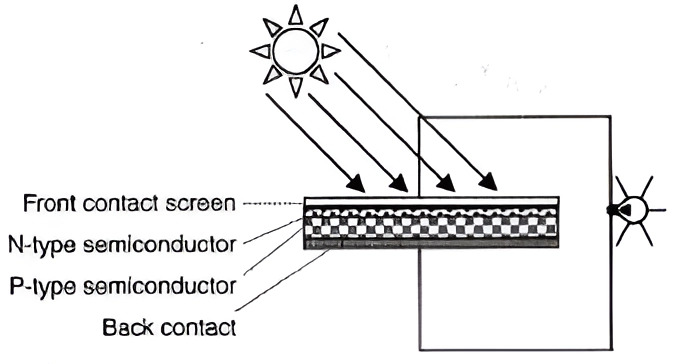
— Concept illustrated in the following simple schematic:
Thermal Control:
— Solar panels can also be used for thermal control purposes. In addition to producing electricity, they can help dissipate excess heat generated by space systems or regulate temperature with thermal management techniques.
Battery Charging:
— Solar panels power the onboard batteries on spacecraft. The extra electrical energy produced by the panels when there is high sunlight can be stored in the batteries for use when the spacecraft is in shadow or during eclipses [6].
Batteries
A satellite power system with solar arrays needs energy storage to provide power during eclipse periods.
— The most common method of energy storage is through a system of rechargeable batteries.
Batteries store energy in an electrochemical form and come in two basic types:
Primary — The electrochemical reaction is irreversible and the battery cannot be used again after it has been discharged. This type of battery is used in short-term missions, such as payloads on sounding rockets.
— Rechargeable — The electrochemical reaction in this type of battery can be reversed. The battery can be recharged using direct current from an external source, such as a solar array. This type is suitable for long-term space missions and is widely used.
— The internal construction of a typical battery (cell) is illustrated schematically in the following figure:
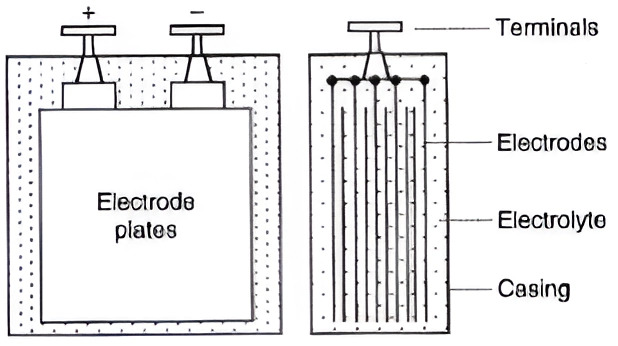
Electrode plates are positioned at positive and negative locations (the negative end is usually connected to the ground, such as in automotive systems).
The electrode plates are separated by an electrical insulator.
— Electrolyte volume and electrochemical reaction provide the necessary conditions for the electrode plates to function.
— The cell voltage is determined by the electrochemical reactions and not by the size of the current and power.
— Common voltage levels are 1.5 — 3.5 Volts when fully charged, depending on the degree of discharge [5].
Fuel cells
A fuel cell is a device that directly and continuously converts the chemical energy of a fuel and an oxidant into electrical energy in the form of direct current (DC).
— The fuel and oxidant, typically gases, continuously flow into the cell from external sources, such as storage tanks.
— Within the fuel cell, the process occurs at constant pressure (isobaric) and temperature (isothermal).
Similar to battery cells, reactions take place at the cathode (+ terminal) and the anode (- terminal), producing a flow of electrons. This process is generally illustrated in the following figure:
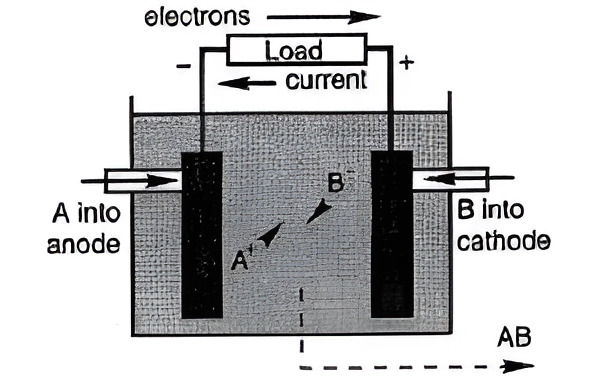
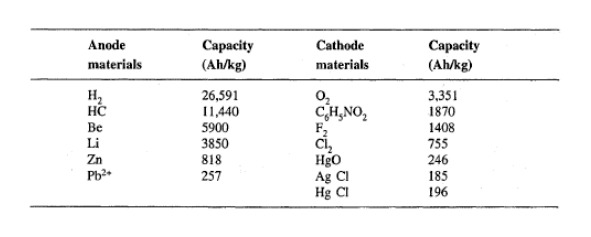
Some cell substance capacity densities are listed in the following table:
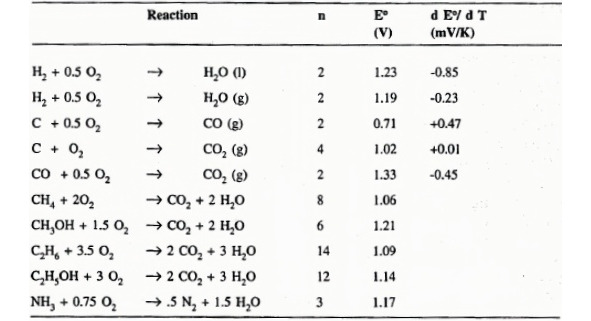
The table below gives values of the valence change, n, the open-circuit voltage, Eo, and the sensitivity to temperature, dEo/dT, at 298 K, for several common reactions:
Fuel cells offer several benefits for space exploration:
— High Energy Efficiency: Fuel cells have a higher energy efficiency than traditional combustion-based power systems, as they can convert a greater proportion of the fuel’s energy into electricity. This means there is less waste heat, making them more efficient.
— Lightweight and Compact: Fuel cells have a high power-per-unit-mass ratio, which makes them ideal for spacecraft missions where weight and space are critical.
— Quiet and Vibration-Free: Unlike combustion engines, fuel cells run silently and generate minimal vibrations. This is important for delicate scientific instruments and other equipment on spacecraft, as it helps prevent damage and improve the mission’s reliability.
— Environmentally Friendly: Fuel cells generate electricity without emitting harmful greenhouse gases or other pollutants, making them an environmentally friendly power source for spacecraft.Reliable Power Supply: Fuel cells have a long operating life and can provide a constant and reliable power source for extended periods of time, which is crucial for long-term space missions [4, 6].
— Radioisotope-Thermoelectric Generator (RTG)
The radioisotope thermoelectric generator (RTG) directly converts the high-energy particle-radiation from radioactive decay of an isotope to electrical energy in a semiconductor material:
— Isotope → Plutonium (Pu) 238,
— Semiconductor → Silicon-Germanium (Si-Ge)
Returning to the figure on p. 9—1, the combination of radioisotope-thermoelectric (TE) is most suitable to provide relatively low levels of electrical power, generally <1 kW, for long durations.
The technology has been successfully deployed on a number of space missions, as listed in the following table:
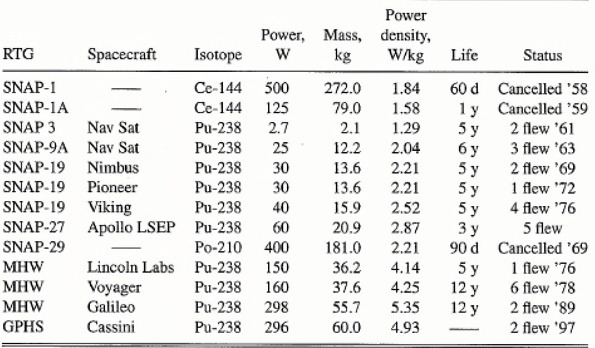
The thermoelectric generator is shown schematically in the following diagram,
— Each leg is of a different type of semiconductor material, one p-type and the other, n-type.
Schematic diagram and electrical model for an RTG (Patel):
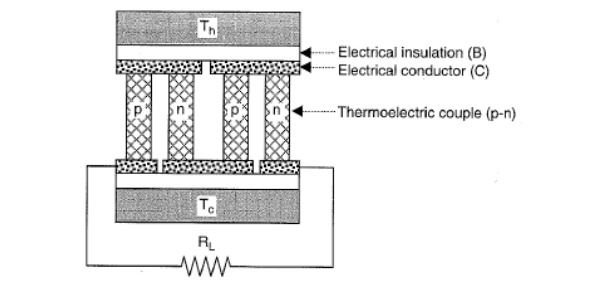
Typically, two or more n-p couples are stacked in series, in a single-stage multi-coupler assembly.
Design features:
— The units have to be connected in series in order to achieve the bus voltage.
— The current depends on the cross-sectional area of the semiconductor material.
— Units with a standard design (area), are connected in parallel in order to meet the load current requirements.
— The total load power determines the amount of isotope needed.
— Any heat input that is not converted to electrical power must be rejected through a radiator [5, 6].
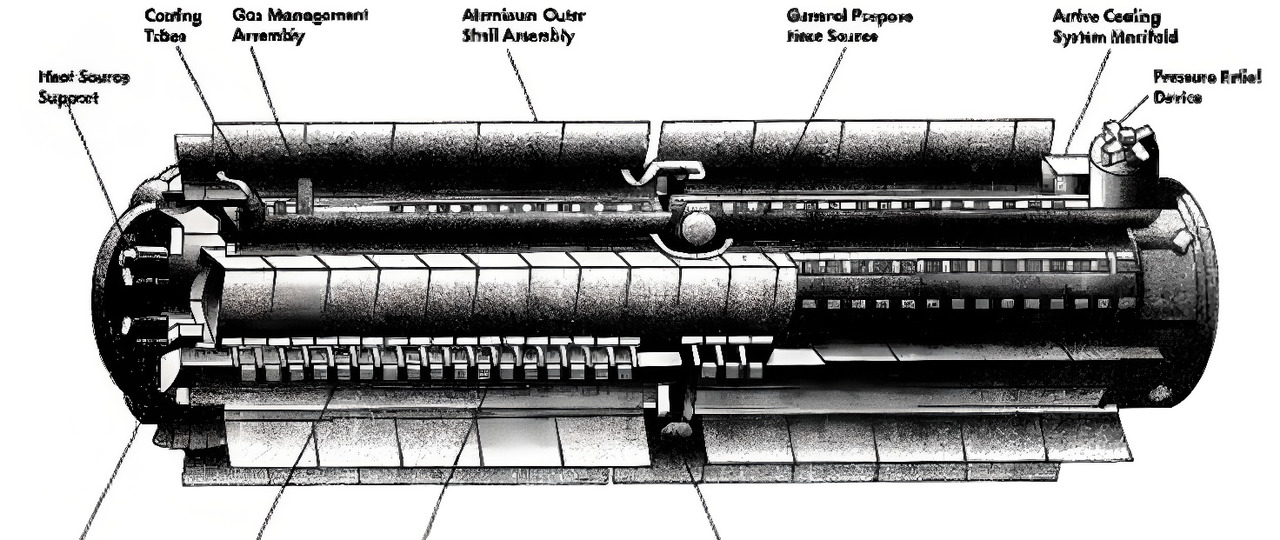
A cross-sectional view of the Cassini (Saturn) RTG is shown in the following figure:
Additional low-power energy sources
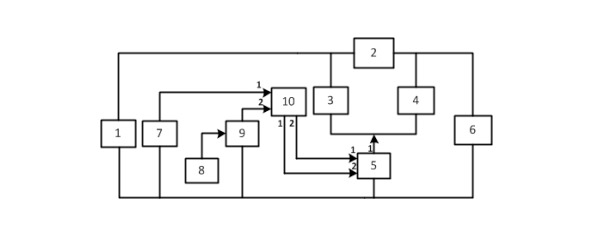
The choice of the type of power supply system for spacecraft can be significantly complicated by the required weight and size characteristics. The optimal type for a spacecraft ESS with the use of additional low-power energy sources is a system with split buses and with a series-parallel connection of a voltage stabilizer.
— Such a ESS scheme makes it possible to include additional elements designed for the generation, conversion and accumulation of electricity from low-power energy sources.
— The following elements are included in the SES using low-power energy sources: a group of solar batteries (SB) of direct sunlight 1, voltage stabilizer 2, charger 3, discharge device 4, rechargeable battery 5, a group of solar panels designed to convert sunlight reflected from the Earth into electrical energy 7; generating circuit 8, which is a set of conductors (winding) located along the body of the spacecraft apparatus; rectifier device 9. As a consumer of low-power energy, a battery charge controller from low power power sources can be used 10:
— While orbiting, the spacecraft or its individual parts may rotate. This is due to the task of stabilizing the spacecraft in space or to the design features of the spacecraft. The generating circuit is rigidly attached either to the housing the spacecraft, or to its rotating part. Figure 3 shows an example of the spacecraft’s appearance, stabilized by rotation, when the generating circuit is rigidly attached to the spacecraft body. When rotating, the generating circuit crosses the magnetic field induction lines As a result, according to the law of electromagnetic induction, an instantaneous electromotive force is induced in the generating circuit:
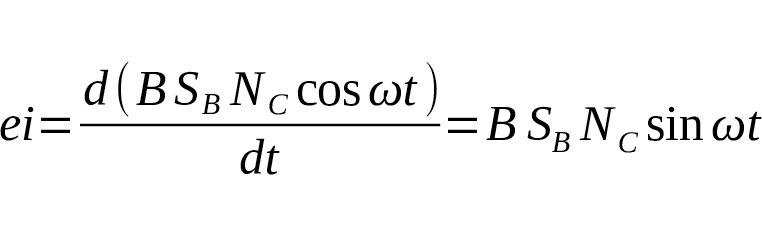
where B is the induction of the Earth’s magnetic field; S is the cross-sectional area of the generating circuit; N is the number of turns in the circuit; — angular rotation frequency
A simplified diagram of the spacecraft’s orbital motion in the Earth’s magnetic field is shown in Figure:
— Thus, the kinetic energy transmitted by the spacecraft in combination with the energy of the Earth’s magnetic field is converted into electrical energy. The higher the torque of the spacecraft, the greater the electromotive force (EMF) induced in the generating circuit and the higher its power will be. The electric energy generated in this way through the rectifier the device 9 and the battery charge controller from low-power electricity sources 10 can be supplied, for example, to individual battery cells for recharging them.
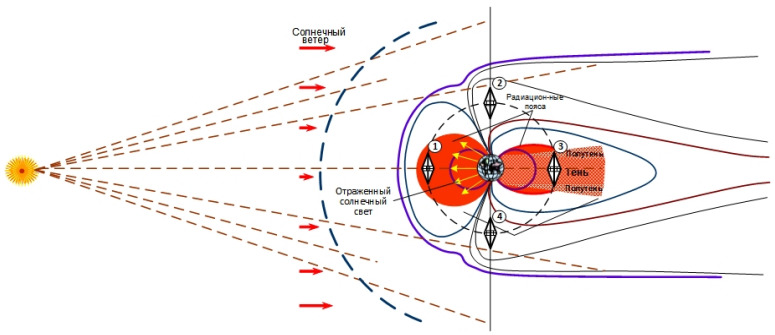
— Modern models of the geomagnetic field make it possible to calculate the induction of the magnetic field with high accuracy at altitudes up to 18000—20000 km from the surface.
However, above the Earth’s magnetic field weakens and the influence of the solar wind becomes more significant. This leads to the need to use high–altitude models of the Earth’s magnetosphere, the area of interaction of the MPZ with the solar wind.
— The power supply system of the spacecraft using low-power energy sources is capable of receiving, converting and storing: a) the energy of direct and reflected sunlight from the Earth; b) the kinetic energy of rotation of the spacecraft in the Earth’s magnetic field. The use of a microcontroller charger as part of the power supply system, which allows charging the battery from low-power electric energy sources (reflected sunlight and energy from the Earth’s magnetic field), This will increase the active life of the spacecraft [1].
Conclusion
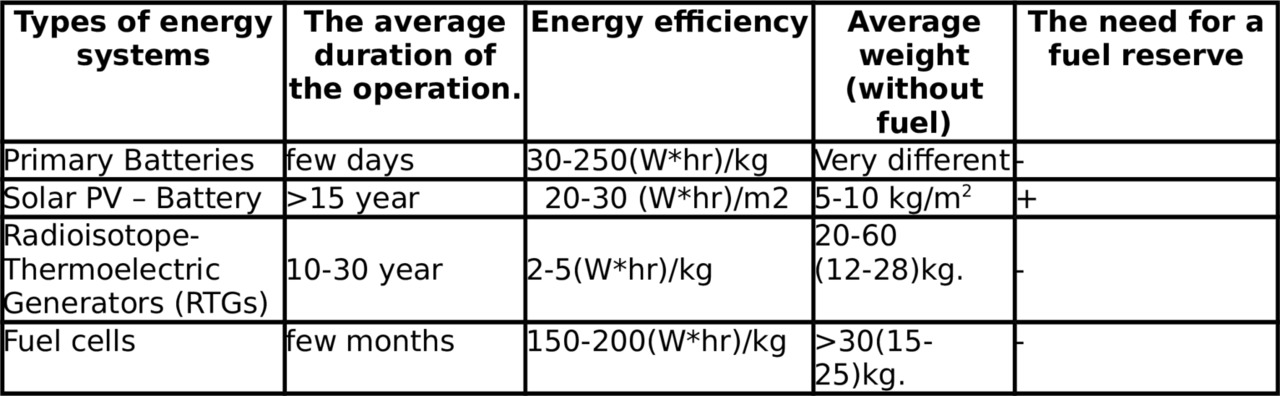
(Other types of energy systems are not listed in the table due to the fact that they are auxiliary and or do not exist in practice) [1] [2] [5] [6].
From this table, it becomes clear that the most energy-efficient ways to power a spacecraft are rechargeable batteries or fuel cells, and solar panels or (RTGs) are the most durable. It is also worth considering low-power energy sources, which, working in symbiosis with the above-mentioned energy sources, can increase their efficiency. According to the authors of the article «Power supply of the Spacecraft Using Additional Low-power Sources», it is for energy sources extracting it from the environment that the future of energy supply for near-Earth unmanned astronautics lies. However, since other spacecraft are orbiting, other methods of energy supply will not lose their relevance.
References:
1. Бедняков, А. М. Система Электроснабжения Космического Аппарата С Использованием Дополнительных Маломощных Источников / А. М. Бедняков, Д. Л. Каргу, А. В. Немиров // Энергии Вестник Самарского университета. Аэрокосмическая техника, технологии и машиностроение, Том 15, №3 / ред. Шахматов, Е. В. — Самара, 2016. — ISSN 2541—7533.
2. Галкин, В.В., Солнечные и аккумуляторные батареи ОАО «Сатурн» на космических аппаратах с инженерами-электронщиками / В. В. Галкин // Электронный журнал «Труды МАИ». Выпуск №60. — 2012.
3. Hyder, A.K. et al., Spacecraft Power Technologies/ A.K. Hyder — Imperial College Press, 2000. — ISB 1-86094-117-6.
4. O’Hayre, R. et al., Fuel Cell Fundamentals/ R. O’Hayre, — John Wiley & Sons, Inc., 2006. — ISBN-13 978-0-471-74148-0.
5. Patel, M.R. Spacecraft Power Systems/ M.R. Patel, — CRC Press, 2005. — ISBN 0-8493-2786-5.
6. Spacecraft Power //Auburn University: [website] — URL: ttps://www.eng.auburn.edu/~dbeale/ESMDCourse/PaulPenko81109Chap ter%209.pdf, (date of reference 10.3.2024).
Гибелева М. И.
A portrait of human identity in cyberspace
Gibeleva M.I., 2nd year Bachelor Degree student «Applied mathematics and computer science»
Scientifc adviser: Ozhereleva V.S., Senior Lecturer of the Department of Foreign Languages
Federal State Budgetary Educational Institution of Higher Education «Technological University named after twice Hero of the Soviet Union, Pilot-cosmonaut A.A. Leonov», Korolev, Russia
The article considers a problem of person’s self-identification in cyberspace. The study examines various aspects and reasons for creating a virtual personality and its influence on real life. The issue of multiple virtual personality is also considered. New questions and prospects for the study of human personality in the virtual space are discovered.
Keywords: Cyberpsychology, virtual personality, self-identification.
Since the Internet became a part of our reality, we discovered numerous self-expressing opportunities in there. We can create more than one account in social societies, and furthermore we can present ourselves as a completely another person. A virtual personality can not only be an extension of a real personality, but also be essentially different.
With the advent of the opportunity for a person to express himself in cyberspace, we can observe some interesting phenomena related to the self-determination of his personality and behavior patterns on the Internet. The most interesting are the following:
1) presenting as a person completely different from our real one.
2) creation of more than one virtual personality.
Considering the first point, we can say that, firstly, the desire to create another personality is often a desire to realize the ideal self. It can be either authentic or false, i.e. imposed from the outside. In the first case, a person already has the makings of those qualities that are necessary for him to become who he wants. If he does not try to achieve his ideal image in real life, he either does not see those qualities or does not want to develop them. He chooses to passively live the individual experience of a virtual personality, which does not create any product of activity other than receiving emotions from his own fantasies.
The second case is when we create a false self. It forms an even more noticeable gap between the real person and the fictional one. Regardless of whether a person transfers his virtual personality into the real world, this entails a numerous psychological problem and exacerbates the internal conflict that arose due to the inability to be real. Cyberspace provides an opportunity for an imaginary resolution of this conflict, but over time it can lead to a serious personal crisis.
The second point is when people create more than one virtual personality. «We tend to believe that the emergence of a virtual personality is due to the motivation to replicate oneself in new images and the need to live not one life, but several. There are effects of multiplicity — a person can be in many places at the same time, have different images, while creating different virtual personalities», — writes A.I. Luchinkina in her article «The model of Internet socialization of personality». But how often does it appear that people create many different accounts in order to put their interests into various personalities instead of creating a single one? And for how long can we be satisfied with such divided life? It can be assumed that a real person does not contain the various aspects of his personality and is forced to give up his integrity in favor of separability. Discovering our diversity and sharing it with people can lead not only to a new exciting experience but also to a loss of self-sentiment as a whole person.
But despite the negative aspects of creating a virtual self, presented above, there are also positive benefits that a real person receives. For example, we can create an account of a different gender or age to get a virtual communication experience, which we often physically cannot get in reality. If a person, realizing his needs and desires, chooses such a way to satisfy them, and this suits him, then his virtual personality is an addition to the real one and does not threaten to violate integrity.
In figure 1 you can see some identified correlates of self-presentation, which reflect virtual personality benefits in cyberspace (Stanculescu, 2011).
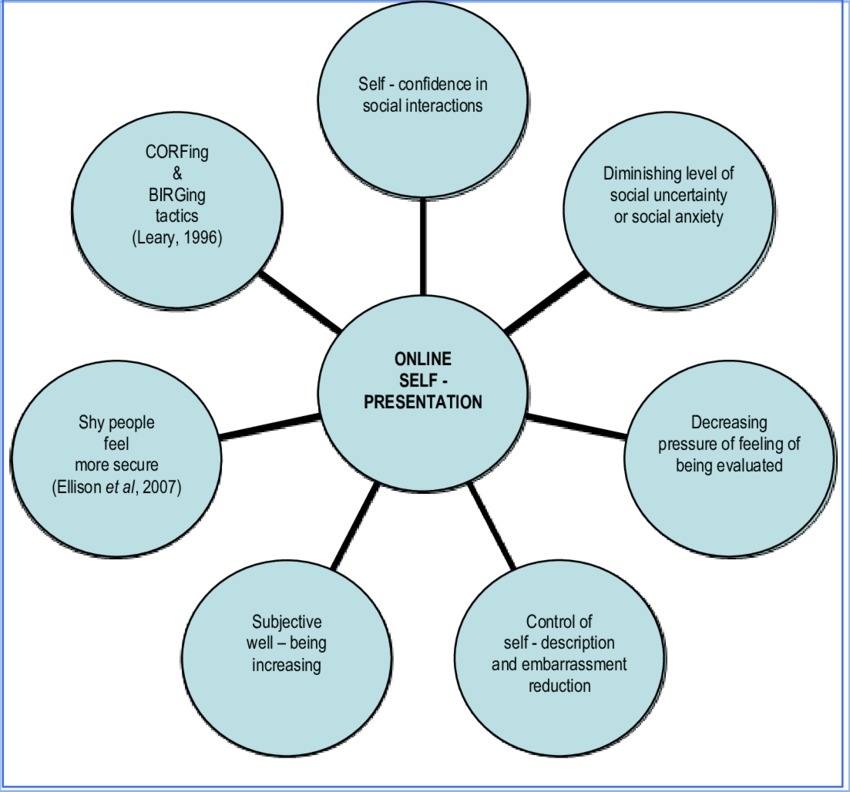
In conclusion, we can say that from the one hand, the analysis of virtual personality and its manifestations allows us to look deeper into a person. And from another hand we can pose questions about personality development as a part of integration of virtual-self and real-self.
References:
1. Gackenbach, J.I., & Bown, J. (Eds.) (2017). Boundaries of Self & Reality Online: Implications of Digitally Constructed Realities. San Diego: Elsevier/Academic Press.
2. https://clck.ru/3GBDw9
3. Лучинкина А. И. Модель интернет-социализации личности — CYBERPSY URL: https://cyberpsy.ru/articles/model-internet-socializacii-lichnosti/
4. Алексенко Н. Н. Психоаналитические аспекты поведения человека в киберпространстве — CYBERPSY URL: https://cyberpsy.ru/articles/aspekty_povedeniya_v_kiberprostranstve/
Дубойская О. А.
Auswirkungen der ehelichen Orientierung junger Menschen auf die demografische Situation
Duboyskaya O.A., Studentin im 2. Studienjahr «Werbung und Öffentlichkeitsarbeit»
Wissenschaftlicher Leiter: Massalskaya Yu. V., Kandidatin der philologischen Wissenschaften, außerordentliche Professorin
Technologischen Universität, benannt nach dem zweifachen Helden der Sowjetunion, dem Piloten und Kosmonauten A. A. Leonov, Korolev, Russland
Die Familie ist die wichtigste soziale Gruppe für jeden Menschen. Sie stellt ein Schlüsselelement bei der Bildung der menschlichen Persönlichkeit dar und erfüllt wichtige Funktionen im Bereich der Erziehung und der geistigen Entwicklung. Heutzutage, im Zeitalter der technologischen Innovationen und der Software, haben sich die Werte der Familie und ihre Bedeutung in der Gesellschaft stark verändert. Die jüngere Generation legt mehr Wert auf Bildung, Karriere, finanzielles Wohlergehen, persönliche Ambitionen und Anerkennung in der Gesellschaft, während die Bedeutung von Familie und Kindern in den Hintergrund rückt. Heutzutage ist die Heirat kein obligatorischer Schritt mehr, um eine Familie zu gründen, sondern eine reine Formalität, die im Leben der Menschen in den Hintergrund tritt. Diese Einstellung wirkt sich negativ auf die demografische Situation in verschiedenen Ländern der Welt aus, denn die Zahl der Neugeborenen geht zurück.
Das globale demografische Problem erfordert besondere Maßnahmen und die Erforschung der Ursachen dieser Situation. Die Überalterung der Bevölkerung, die niedrige Geburtenrate, die Lebensbedingungen und die Migration — all diese Aspekte wirken sich auf die soziale Dynamik aus und erfordern Aufmerksamkeit. Man muss sich darüber im Klaren sein, dass kein soziales Phänomen ohne eine Ursache auftritt, und die Bewältigung dieses Problems ist ein Schlüsselaspekt für die Gewährleistung einer nachhaltigen Entwicklung der Gesellschaft.
Keywords: demografisches Problem, Jugend, Familie, Ehe.
Die Familien- und Eheorientierung junger Menschen spielt eine wichtige Rolle bei der Gestaltung der demografischen Situation in der Gesellschaft. Die Einstellung junger Menschen zu Ehe und Familie kann die Fruchtbarkeit, die Familienstruktur und die allgemeine demografische Stabilität erheblich beeinflussen. In diesem Artikel wird untersucht, welche Faktoren die Ehe- und Familienorientierung junger Menschen beeinflussen und welche Folgen dies für die demografische Situation haben kann.
Nach Lukyanov A. K. und Tsaturov A. A. ist die familien- und ehebezogene Einstellung einer Person die Vorstellung einer Person über Ehe und Familie, die den Zustand der Bereitschaft zur Ehe und ihr Verhalten in der Ehe bestimmt. Die Struktur dieser Einstellung besteht aus einer emotionalen, einer kognitiven und einer aktiven Komponente. Die emotionale Komponente — die Wahrnehmung der eigenen Person als Objekt der familiären und ehelichen Beziehungen — manifestiert sich in der Position einer Person in Bezug auf die Ehe. [3] Die kognitive Komponente umfasst das für die Interaktion in der Familie erforderliche Wissen. Die Aktivitätskomponente bestimmt die psychologische Bereitschaft einer Person, eine Familie zu gründen. Folglich ist die Einstellung zur Familie und zur Ehe der wichtigste Aspekt im Leben eines Menschen, insbesondere bei jungen Menschen.
In verschiedenen Epochen und Kulturen wurden unterschiedliche Modelle der familiär-ehelichen Orientierung beobachtet. So herrschte im Mittelalter in Europa das Modell der «Elternehe» vor, bei dem die Entscheidung über die Wahl des Ehepartners von den Eltern getroffen wurde und die Ehe in erster Linie als Zusammenschluss zweier Familien angesehen wurde. Dieses Modell war auf die Festigung des sozialen Status und den Erhalt des Besitzes ausgerichtet und nicht auf die individuellen Vorlieben der jungen Menschen. Die Auswirkungen dieses Modells auf die demografische Situation waren gering, da Fruchtbarkeit und Heirat hauptsächlich durch soziale und religiöse Normen gesteuert wurden.
Mit der Entwicklung der Industrie und der zunehmenden Bevölkerungswanderung im neunzehnten und zwanzigsten Jahrhundert entstanden neue Modelle der ehelichen Orientierung. Es entstanden stärker individualistische Modelle, bei denen das persönliche Glück, die Liebe und die Kompatibilität der Partner im Mittelpunkt standen. Dieser Wandel in der Familienorientierung wirkte sich auf die Demografie aus. So ist in den westlichen Ländern ein Rückgang der Eheschließungen und der Fruchtbarkeit zu beobachten, da junge Menschen die Heirat hinauszögern oder ganz aufgeben und verschiedene Formen des unverheirateten Zusammenlebens oder nicht konventionelle Familienmodelle vorziehen.
Das Heiratsverhalten junger Menschen kann jedoch von Region zu Region und im Laufe der Zeit stark variieren. In einigen asiatischen Ländern und bei einigen ethnischen Gruppen gibt es beispielsweise nach wie vor traditionelle Heiratsmuster, die auf kollektiven und verwandtschaftlichen Bindungen beruhen, was zu hohen Heiratsraten und hoher Fruchtbarkeit beitragen kann.
Zum gegenwärtigen Zeitpunkt lässt sich eine solch starke Veränderung der Situation in Bezug auf die Ehe dadurch erklären, dass sich die Interessen der Gesellschaft und der jungen Menschen, von denen die Geburtenrate in größerem Maße abhängt, geändert haben. Die Jugend von heute ist mit vielen sozialen, wirtschaftlichen und kulturellen Faktoren konfrontiert, die ihre Einstellung zu Ehe und Familiengründung beeinflussen. Ein wichtiger Aspekt ist der Grad der wirtschaftlichen Stabilität. Junge Menschen können die Heirat und das Kinderkriegen aufgrund hoher wirtschaftlicher Anforderungen und Instabilität auf dem Arbeitsmarkt aufschieben. Möglicherweise streben sie vor der Heirat auch ein bestimmtes Niveau an Bildung und beruflicher Entwicklung an.
Der Wandel gesellschaftlicher Werte und kultureller Einstellungen kann jedoch dazu führen, dass sich die Heiratsorientierung junger Menschen ändert. Der Wunsch nach individueller Freiheit, die berufliche Entwicklung und die Verlagerung der Verantwortung für die Gründung einer Familie auf spätere Lebensabschnitte können die Fruchtbarkeit und die Familienstruktur beeinflussen.
Es ist wichtig festzustellen, dass die Familien- und Heiratsorientierung junger Menschen einen direkten Einfluss auf die demografische Situation hat. Wenn junge Menschen dazu neigen, spät zu heiraten oder sich weigern, eine Familie zu gründen, kann dies zu einer Verringerung der Fruchtbarkeit und letztlich zu einem Rückgang der Bevölkerungszahl führen. Umgekehrt kann sich der aktive Wunsch junger Menschen, eine Familie zu gründen und Kinder zu bekommen, positiv auf die demografische Situation auswirken und zum Bevölkerungswachstum und zur allgemeinen demografischen Stabilität beitragen.
Gegenwärtig ist die demografische Situation in Russland durch die folgenden Haupttrends gekennzeichnet:
1. Die Bevölkerung des Landes schrumpft. Nach den neuesten Daten von Rosstat ist die Bevölkerung Russlands im Vergleich zum Vorjahreszeitraum um etwa -221 116 Menschen gesunken. [2]
2. Das Durchschnittsalter der Bevölkerung nimmt zu. Aufgrund der steigenden Lebenserwartung und der niedrigen Geburtenrate findet in dem Land ein Alterungsprozess statt.
3. Die Geburtenrate ist rückläufig. Nach Angaben von Rosstat wird die Zahl der Geburten in Russland im Jahr 2023 um 3,2 Prozent auf 1,26 Millionen Menschen sinken.
4. Das Niveau der Migration bleibt niedrig. Die Migrationsprozesse in Russland sind nach wie vor unbedeutend, obwohl die Regierung in den letzten Jahren Maßnahmen ergriffen hat, um hochqualifizierte Fachkräfte und Investoren ins Land zu holen.
5. Im Jahr 2023 ging die Zahl der Eheschließungen in Russland im Vergleich zum Vorjahr zurück, und auch die Zahl der Scheidungen sank, berichtet IA DEITA.RU unter Berufung auf die «Parlamentskaya Gazeta» [1].
In Anbetracht dieser Trends ergreift die russische Regierung verschiedene Maßnahmen, um die Geburtenrate anzukurbeln, die demografische Situation zu verbessern und Familien mit Kindern zu unterstützen. Dennoch bleibt die demografische Krise eines der größten Probleme des Landes.
Um den Einfluss der familiären und ehelichen Orientierungen von Studenten auf die demografische Situation zu untersuchen, haben wir eine soziologische Studie in Form einer Online-Umfrage durchgeführt, an der 110 Personen im Alter von 18 bis 35 Jahren teilnahmen. Der Anteil der männlichen Befragten lag bei 64,5 Prozent, der Anteil der weiblichen Befragten bei 35,5 Prozent.
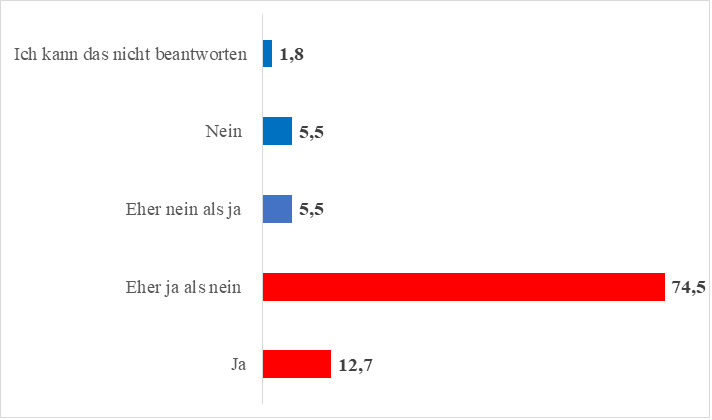
Es gibt eine Zunahme der Scheidungszahlen und eine Abnahme der Zahl der in offiziellen Ehen geborenen Kinder. Bei der Umfrage wurde festgestellt, dass der überwiegenden Zahl der Befragten (82,8%) haben junge Menschen in den letzten 10—15 Jahren begonnen, seltener Familien zu gründen und Ehen zu schließen (Summe der Antworten «Ja» und «Eher ja als nein» auf die Frage: «Glauben Sie, dass junge Menschen in den letzten 10—15 Jahren begonnen haben, seltener Familien zu gründen und Ehen zu schließen?»). Weniger als ein Fünftel (17,2%) vertritt den gegenteiligen Standpunkt (Summe der Antworten «Nein» und «Eher nein als ja» auf die Frage: «Glauben Sie, dass junge Menschen in den letzten 10–15 Jahren begonnen haben, seltener Familien zu gründen und zu heiraten?»). (Abb 1)
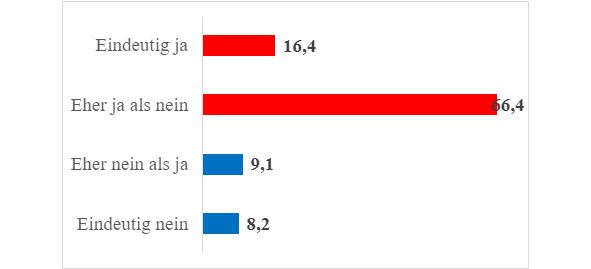
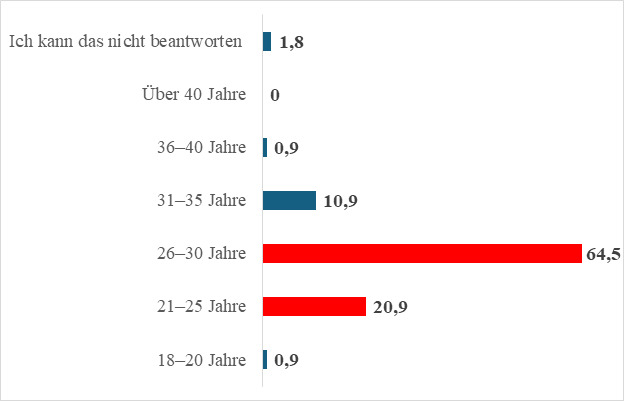
Die Ergebnisse der Umfrage bezüglich der Geburt des ersten Kindes unterscheiden sich jedoch von den Ergebnissen des akzeptablen Heiratsalters. Hier wurde festgestellt, dass für mehr als die Hälfte der Befragten (64,5%) das akzeptable Alter für die Geburt des ersten Kindes bei 26 Jahren beginnt und bei 30 Jahren endet. Ein Fünftel der Befragten (20,9%) gab das Alter zwischen 21 und 25 Jahren an. (Abb. 2)
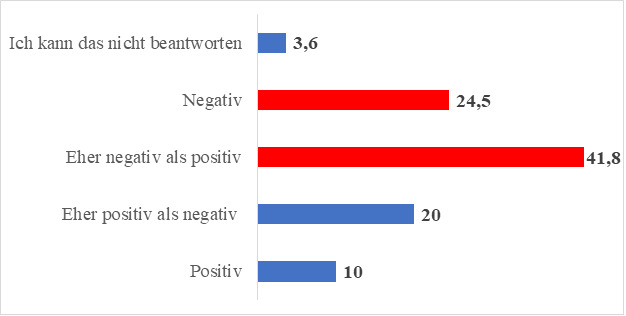
Drei Viertel der Befragten (66,3%) hatten eine negative Einstellung zum Kinderkriegen während der Ausbildungszeit (Summe der Antworten «Nein» und «Eher nein als ja» auf die Frage: «Wie stehen Sie zum Kinderkriegen während der Ausbildungszeit (von 18 bis 22 Jahren)?»). Weniger als ein Viertel der Befragten sind jedoch gegenteiliger Meinung. (Abb. 3)
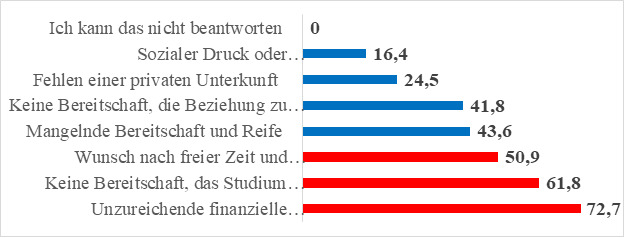
Zwei Drittel der Befragten (72,7%) begründeten diese Situation damit, dass sie die Beziehung zu ihrem Partner nicht abbrechen wollten oder befürchteten, mit dem Kind allein gelassen zu werden. Mehr als die Hälfte (61,8%) begründete ihre Position damit, dass sie ihr Studium wegen der Schwangerschaft nicht unterbrechen wollten, sowie mit dem Wunsch, ihr Studium zu beenden und einen Abschluss zu machen. Die jungen Menschen gaben also Karriere, Bildung und Freiheit den Vorrang. (Abb. 4)
Modetrends können die Familiengründung und das Kinderkriegen in vielerlei Hinsicht beeinflussen. Auch die Entwicklung von Karriere und Bildung kann sich auf den Kinderwunsch auswirken, denn viele Menschen wollen zunächst beruflich erfolgreich sein. Die große Mehrheit (87,23%) glaubt, dass neue gesellschaftliche Trends die demografische Situation im Land beeinflussen (Summe der Antworten «Ja» und «Eher ja als nein» auf die Frage: «Glauben Sie, dass neue gesellschaftliche Trends die demografische Situation im Land beeinflussen?»). Jeder zehnte Befragte (10%) vertritt die gegenteilige Meinung. (Abb. 5)
Um hier Abhilfe zu schaffen, schlugen drei Viertel der Befragten (66,4%) Informationskampagnen und Bildungsprogramme vor, die darauf abzielen, das Bewusstsein für die Bedeutung von Fruchtbarkeit und Familienwerten zu schärfen sowie deren Stereotypisierung oder Diskriminierung mit Unterstützung des Staates abzubauen. Jeder Zweite (52,7%) nannte die Inanspruchnahme von Informationshilfen und psychologischer Unterstützung durch den Staat. (Abb. 6)
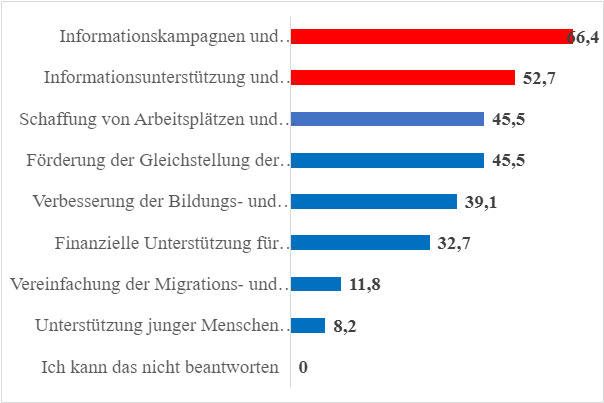
Es ist erwähnenswert, dass einige Befragte von gesellschaftlichen Trends sprachen, die jungen Familien bei der Beschaffung von Wohnraum helfen, um die demografische Situation im Land zu beeinflussen.
Schlussfolgerungen.
Die jungen Menschen von heute gehen oft freier an ihre Beziehungen heran, geben der Ehe nicht den Vorrang und ziehen eine längere Zeit des Zusammenlebens vor der offiziellen Heirat vor. Dies führt dazu, dass die Zahl der Scheidungen zunimmt und die Zahl der in offiziellen Ehen geborenen Kinder abnimmt.
Die Mehrheit der Befragten ist der Meinung, dass sich die Einstellung der jungen Menschen zu Ehe und Familie in letzter Zeit stark verändert hat. Junge Menschen haben in den letzten 10 bis 15 Jahren begonnen, Familien zu gründen und seltener zu heiraten, was auf Veränderungen in der Gesellschaft und auf Prioritäten in Beruf und Ausbildung zurückzuführen ist.
Das akzeptabelste Alter für die Geburt des ersten Kindes liegt nach Ansicht der Umfrageteilnehmer zwischen 21 und 25 Jahren. Ein Fünftel der Befragten gab das Alter von 21 bis 25 Jahren an.
Modetrends und Änderungen des Lebensstils können die Entscheidung, eine Familie zu gründen und Kinder zu bekommen, ebenso beeinflussen wie die demografische Situation im Lande.
Die Untersuchung der familiären und ehelichen Orientierungen junger Menschen und ihres Einflusses auf die demografische Situation ermöglicht es also, wichtige Trends zu erkennen und geeignete Maßnahmen zu entwickeln, um die demografische Situation in der Gesellschaft zu erhalten und zu verbessern, sowie den Einfluss der familiären und ehelichen Orientierungen junger Menschen auf die demografische Situation besser zu verstehen und Maßnahmen zu ihrer Verbesserung vorzuschlagen.
Quellen:
1. Беляев М., Милонов В. Браков и разводов стало меньше в России [Текст] / Беляев М., Милонов В. // Рамблер. — 2024. — https://clck.ru/3GBE2M
2. Демография / [Электронный ресурс] // Росстат: [сайт]. — URL: https://rosstat.gov.ru/folder/12781 (дата обращения: 18.02.2024).
3. Лукьянов А. К., Цатуров А. А. Особенности семейно-брачных установок современной молодежи // Международный студенческий научный вестник. — 2015. — №6.
Заблоцкая А. А.
The issue of the development of 3D technologies in the bionic prosthesis market
Zablotskaya A.A., 3rd year Bachelor Degree student «Business Informatics»
Scientific adviser: Atrokhin A.M., PhD (Philology), Associate Professor of the Department of Foreign Languages
Federal State Budgetary Educational Institution of Higher Education «Technological University named after twice Hero of the Soviet Union, Pilot-cosmonaut A.A. Leonov», Korolev, Russia
In the modern world, prosthetic limbs play an important role in the field of medical technology and have great potential to improve people’s quality of life. According to experts, it is this area in the Russian Federation, in the current conditions, namely in connection with the accession of new republics and the political situation, that will be in maximum demand. The withdrawal of foreign companies from the market opens up new opportunities for domestic players, however, today, due to many sanctions, the bionic prosthesis industry is facing an urgent issue of developing domestic information design systems, as well as monitoring, increasing the creation of 3D scanners and other equipment that helps automate business processes of modeling and creating rehabilitation devices of a new type time.
Keywords: Bionic prostheses market, medical automation import substitution, IT technologies
Experts believe that the first rehabilitation devices of this kind appeared only in 2007 thanks to the British company TouchBionics, but today the global market for bionic prostheses has grown significantly, and according to scientists’ forecasts, it will progress.
According to the research company Coherent Market Insights, the global bionic prosthesis market in 2022 amounted to 131.52 billion rubles, its average annual growth rate over the next seven years is expected to be 8.8% [2]. Analysts predict that by 2030 the global market will reach RUB 258.24 billion. [2] (see fig. 1).
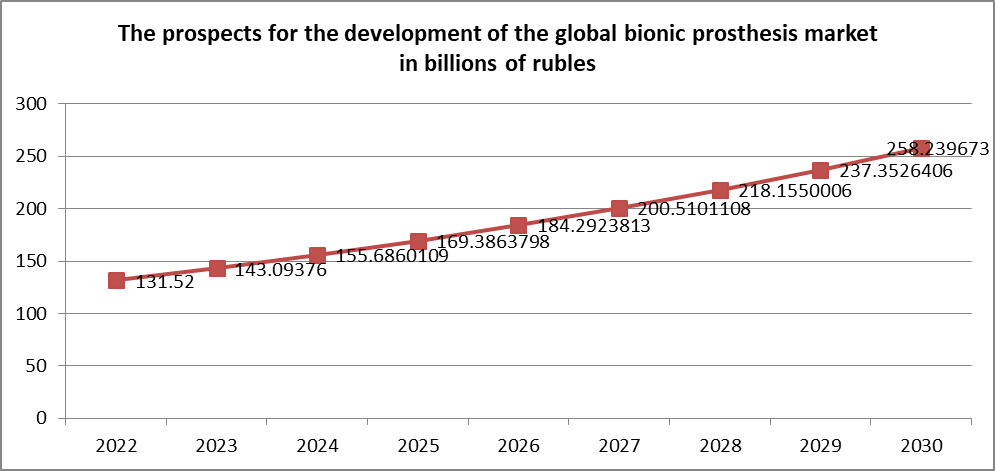
The Russian market is currently one of the largest in terms of the number of patients in need of prosthetics.
By 2020, the global 3D printing market has reached almost $12 billion. GlobalData forecasts that the global market for additive technologies will reach $32 billion by 2025 and $60 billion by 2030. Russia ranks eleventh in the world in the production and implementation of 3D printing technologies. The share of the domestic market in this area is only 2%, but at the same time, the Russian market of additive technologies has grown tenfold over the past eight years.
The global market for additive technologies grew at an average annual rate of 19.3% from 2014 to 2020, reaching a volume of almost $12 billion by 2020. According to the GlobalData report, the 3D printing market currently accounts for less than 0.1% of the total global manufacturing market, which is estimated at $12.7 trillion (Fig. 2).
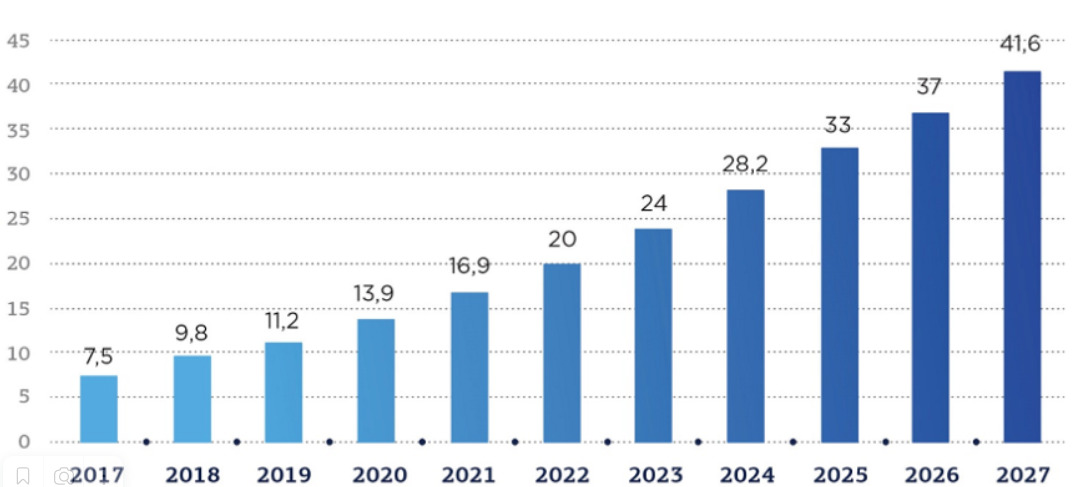
The largest market players, and therefore the main capacities, are concentrated in North America and Europe, but the Asia-Pacific region has shown the highest annual growth rates in recent years. Europe is leading in the field of additive manufacturing of metal objects, and America is ahead of the rest of the world in the additive manufacturing of polymer objects.
Competition in the 3D printing market is growing every year, especially with the arrival of Chinese companies. Nevertheless, the old market players continue to hold their positions.
The main global manufacturers of additive technologies are:
— 3D Systems (USA)
— EOS (Germany)
— SLM Solutions (Germany)
— Stratasys (USA)
— EnvisionTEC (USA — Germany)
— ExOne (USA)
— Voxeljet (Germany)
— Arcam (Sweden)
The leaders in the 3D printer market with revenue of more than $1 billion as of 2019 were three companies: Carbon ($1.7 billion), Desktop Metal ($1.5 billion) and Formlabs ($1.06 billion). All three companies have developed and commercialized their own 3D printing technologies [14].
The most serious problems in the domestic bionic prosthesis market at the moment are: problems with the component base — microelectronics, equipment and software, as well as the high dependence of the market on Chinese imports.
Today, 3D scanners are used in the market of specialized equipment for automating the measurement process to create bionic prostheses. They significantly reduce the patient’s admission time, thereby increasing the number of clients served.
Models of domestic and foreign production are presented in Russia, however, it should be understood that the 3D scanner is selected depending on the objectives of the enterprise, as well as the field of prosthetics. In this regard, the author decided to analyze these devices and give them a brief description (see Table 1).
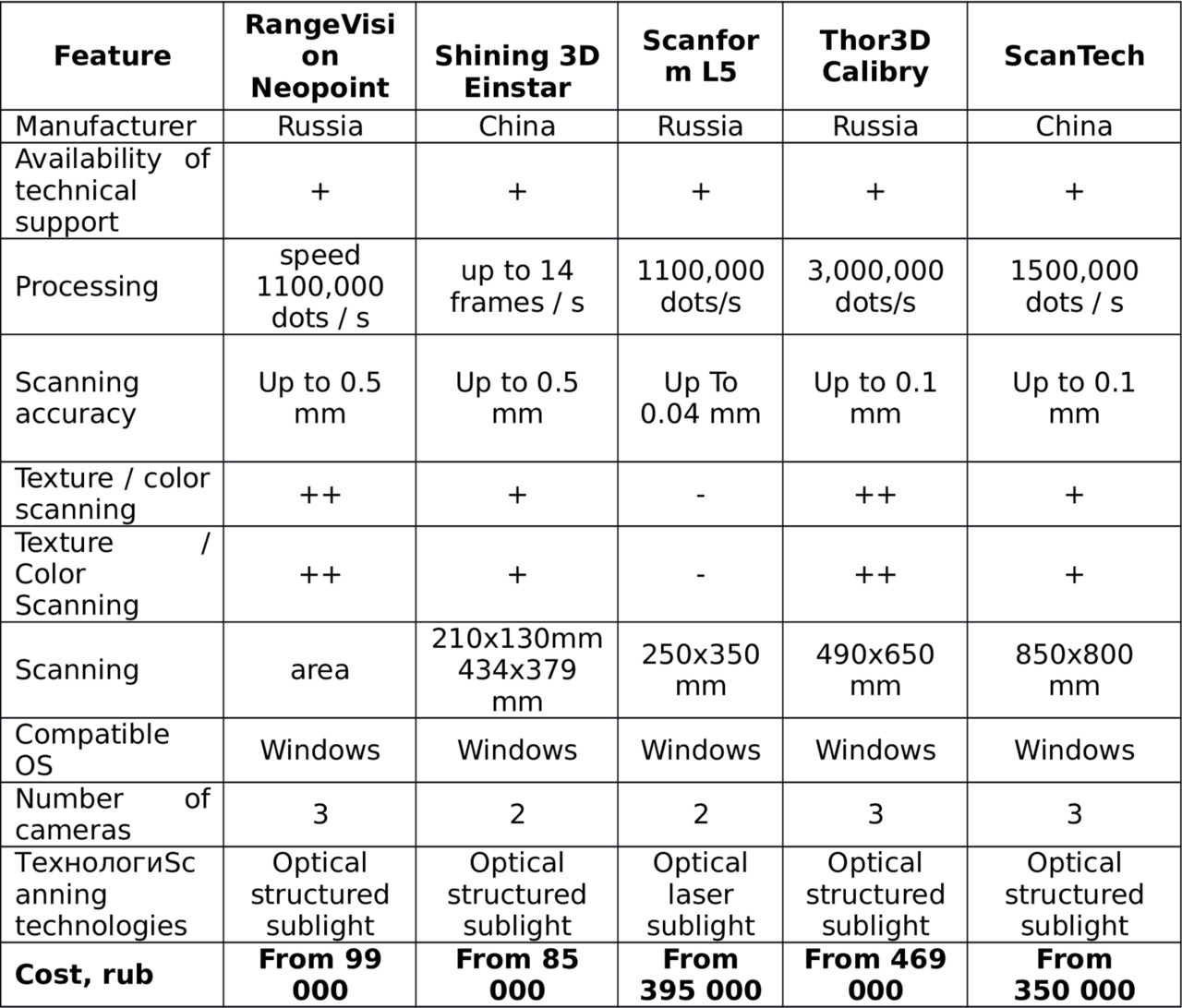
Thus, the author revealed that all 3-D scanners offered in Russiaare compatible exclusively with the Windows operating system, however, despite this, developers suggest using special products that help adapt this device. The table also shows that the cost of such a product almost directly depends on the data transfer rate and scanning accuracy.
According to experts, the most popular model of a 3-Dscanner in the current conditions is «Thor3D Calibry», since it has all the necessary characteristics to use it in order to take measurements from patients who want to purchase a rehabilitation device for limb replacement.
Considering specialized equipment for the production of bionic prostheses, we can not fail to mention 3Dprinters, which allow us to speed up the process of manufacturing prostheses, reducing the risks of re-development of rehabilitation equipment, which in turn reduces the time and financial costs associated with this business process (see Table 2).
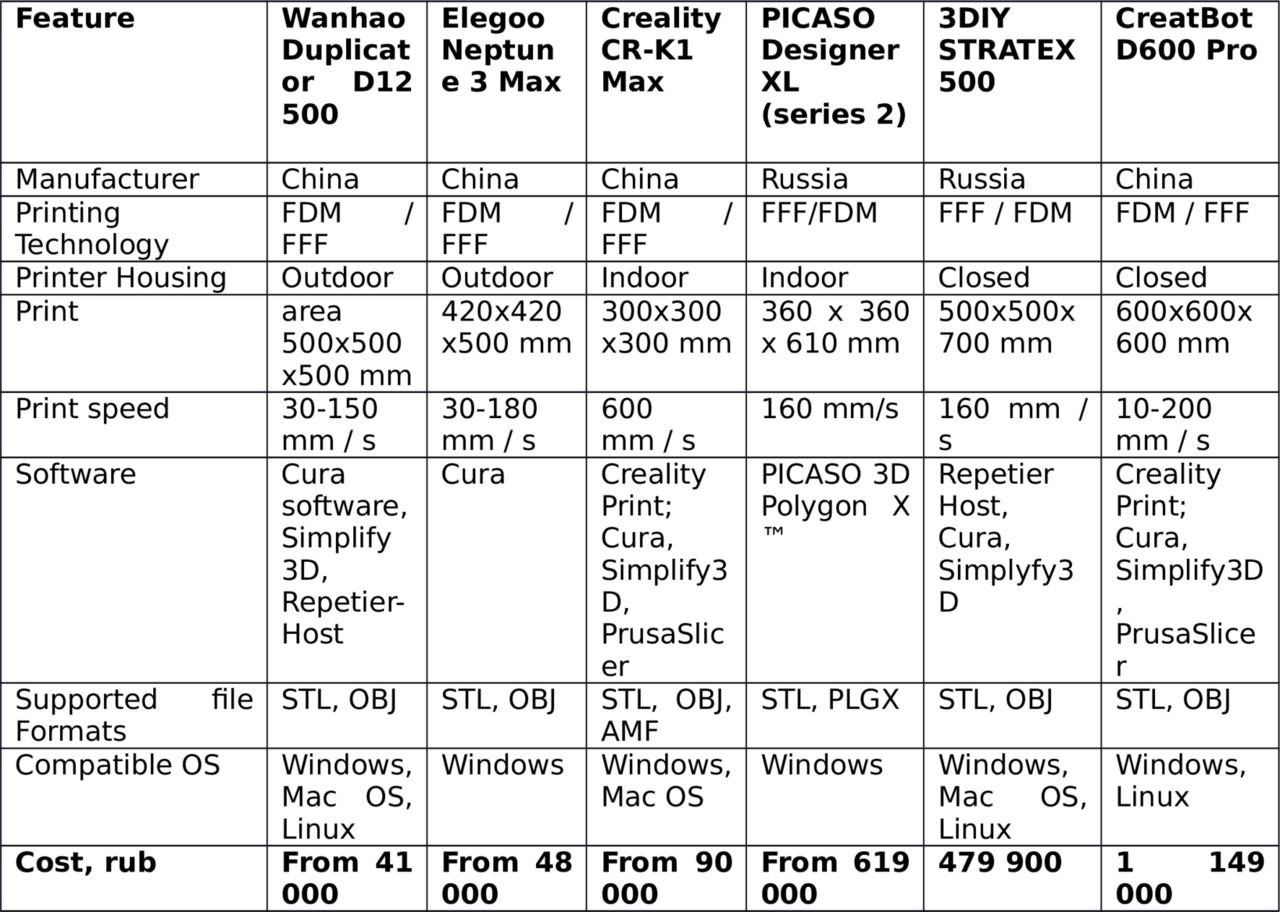
Thus, analyzing the table data, it was revealed that all the offered domestic 3Dprinters on the market have a high cost, but their characteristics are not inferior to their Chinese counterparts.
According to experts, the most popular modelsof 3Dprinters in terms of import substitution in the bionic prosthesis market in Russia are-3DIY STRATEX 500 and CreatBot D600 Pro (Russian and Chinese production).
After analyzing these products in more detail, the author gave his preference to domestic development, since this product is not inferior in its characteristics to its foreign counterpart, has a lower cost, and in cases of failure, the user will not have problems ordering the necessary components.
Due to the fact that the production process of modern rehabilitation devices is high-tech and requires a lot of time and money spent on modeling, refining and testing this kind of prosthesis, engineers usually use special information systems (CADsystems) that significantly simplify the business design process.
СAccording to the experts ' opinion, the implementation of the CADsystem allows the enterprise to achieve the following economic effects [22]:
— Reduction of costs in monetary terms for designing and modifying structures of parts and assemblies by an average of 2—3 times;
— Reduce the design time for creating design documentation, interactive electronic technical manuals, by an average of 3—5 times;
— Reduce the monetary cost of dynamic gap estimation, dimensional analysis, and optimization by 70%.
Today, despite the departure of major suppliers of this information system, Russian developers are actively creating and bringing their own products to the market. Currently, there are high-quality and competitive domestic CAD systems in Russia (see Table 3).
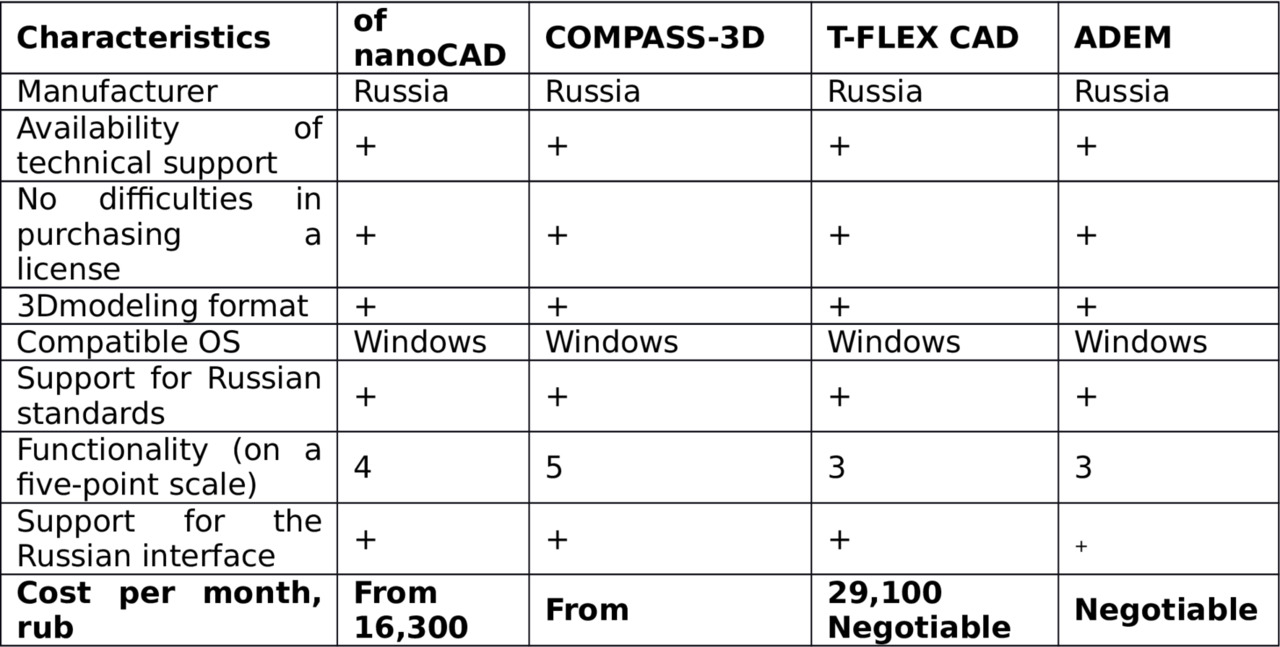
Analyzing CADsystems of domestic production, the author found that they have the same problem as 3Dscanners, namely: compatibility exclusively with the Windows operating system, but their other functionality is not inferior to foreign analogues.
The most popular CADsystems among design engineers areKOMPAS-3D and nanoCAD, since their price is fully justified by the quality.
In connection with the above, despite the presence of some problems in the domestic market of 3Dtechnologies, experts in this field believe that Russia, despite all the difficulties, conducts an active policy of import substitution. It manages to create not only supply citizens with domestic IT products, but also create the latest IT solutions for manufacturers of bionic prostheses.
A striking example is the creation of a project for remote monitoring of high-tech rehabilitation facilities of Motorika LLC together with Vimpel Communications PJSC [1], which combines bionic prostheses with mobile operator technologies and creates a digital space in which people with disabilities will undergo rehabilitation. Prosthetics will collect data and send it to the cloud platform (Attilan), and doctors will have access to this information, and therefore they will be able to remotely adjust the rehabilitation program of each individual patient [5, 11].
Thus, assessing the prospects of import substitution in the market of modern rehabilitation devices, it is worth saying that despite all the difficulties, according to experts, by 2030 Russia will be able not only to fully provide manufacturers with domestic analogues, but also to create the latest solutions for this industry.
References:
1. Билайн интегрировал SIM-карты в технологичные протезы / [Электронный ресурс] // mbradio.ru: [сайт]. — URL: https://mbradio.ru/publication/3244 (дата обращения: 18.12.2023).
2. Бионические протезы // www.tadviser.ru URL: https://www.tadviser.ru/index.php/Статья:Бионические_протезы (дата обращения: 10.12.2023).
3. Бионические протезы: кто создаёт киборгов в России? / [Электронный ресурс] // rb.ru: [сайт]. — URL: https://rb.ru/longread/bionic-cyborgs/ (дата обращения: 10.12.2023).
4. В поисках руки рынка / [Электронный ресурс] // www.kommersant.ru: [сайт]. — URL: https://www.kommersant.ru/doc/5633776 (дата обращения: 10.12.2023).
5. Главные характеристики 3D-принтера // vektorus.ru URL: https://vektorus.ru/blog/harakteristiki-3d-printerov.html (дата обращения: 20.10.24).
6. Инженеры создают протезы, с помощью которых можно определять предметы на ощупь / [Электронный ресурс] // hightech.fm: [сайт]. — URL: https://hightech.fm/2023/06/01/somatosensory-feedback (дата обращения: 18.12.2023).
7. Как выбрать 3D-принтер по характеристикам // top3dshop.ru URL: https://clck.ru/3GBFEA (дата обращения: 20.10.23).
8. Лучшие 3D сканеры 2023 среднего класса / [Электронный ресурс] // 3dtool.ru: [сайт]. — URL: https://clck.ru/3GBFGJ (дата обращения: 18.12.2023).
9. Микроэлектроника (мировой рынок) // www.tadviser.ru URL: https://clck.ru/3GBFKd (дата обращения: 20.10.23).
10. Обзор оптических 3D-сканеров: технология, производители, модели / [Электронный ресурс] // habr.com: [сайт]. — URL: https://habr.com/ru/companies/top3dshop/articles/509882/ (дата обращения: 18.12.2023).
11. Программисты создали систему дистанционного управления протезами / [Электронный ресурс] // transnetiq.ru: [сайт]. — URL: https://transnetiq.ru/info/news/03-11-2021/ (дата обращения: 18.12.2023).
12. Протезы, которые «чувствуют»: операция по сенситивной связи протезов с нервной системой человека / [Электронный ресурс] // habr.com: [сайт]. — URL: https://habr.com/ru/articles/595249/ (дата обращения: 18.12.2023).
13. Рынок 3D сканирования / [Электронный ресурс] // мниап.рф: [сайт]. — URL: https://мниап.рф/analytics/Rynok-3D-skanirovania/ (дата обращения: 18.12.2023).
14. Рынок технологий 3D-печати в России и мире: перспективы внедрения аддитивных технологий в производство // 3dtoday.ru URL: https://clck.ru/3GBFp5 (дата обращения: 12.03.2024).
15. САПР: что такое система автоматизированного проектирования / [Электронный ресурс] // sapr-soft.ru: [сайт]. — URL: https://clck.ru/3GBFrP (дата обращения: 18.12.2023).
16. Создание протезов с помощью 3D-технологий: эра новых возможностей / [Электронный ресурс] // dzen.ru: [сайт]. — URL: https://dzen.ru/a/YBA5Y6Pkfn7oKzZh (дата обращения: 18.12.2023).
17. Тестируем новинку 2023 года — большой, отечественный FDM 3Д принтер, Stratex 500 конкурент D600 Pro? // 3dtool.ru URL: https://clck.ru/3GBFwL (дата обращения: 20.10.23).
18. ТОП-15 лучших 3D-принтеров: Рейтинг 2023—2024 года // tekhnogarant.com URL: https://clck.ru/3GBGnR (дата обращения: 20.10.23).
19. Топ-15 программ САПР: бесплатные и коммерческие / [Электронный ресурс] // nterior-design-programs.ru: [сайт]. — URL: https://interior-design-programs.ru/sapr-programmy.php (дата обращения: 18.12.2023).
20. Части тела: как рынок протезов в России пошел на взлет / [Электронный ресурс] // www.rbc.ru: [сайт]. — URL: https://www.rbc.ru/industries/news/65377d919a7947c1f7a2dd21 (дата обращения: 10.12.2023).
21. Частный бизнес и рынок протезирования / [Электронный ресурс] // www.if24.ru: [сайт]. — URL: https://clck.ru/3GBGq4 (дата обращения: 10.12.2023).
22. Эффективность внедрения CAD-систем / [Электронный ресурс] // pandia.ru: [сайт]. — URL: https://pandia.ru/text/78/154/60170.php (дата обращения: 26.12.2023).
23. CAD // adem.ru URL: https://clck.ru/3GBGsd (дата обращения: 20.10.23).
24. 3D-сканирование автоматизирует и ускоряют изготовление протезов / [Электронный ресурс] // industry3d.ru: [сайт]. — URL: https://clck.ru/3GBGxv (дата обращения: 18.12.2023).
Кашина О. А.
Переплетение музыки и математики на примере творчества Иоганна Себастьяна Баха
Кашина О. А., студентка 1 курса направления подготовки бакалавров «Программная инженерия»
Научный руководитель: Серова Т. О., кандидат филологических наук, доцент, доцент кафедры иностранных языков
Федеральное государственное бюджетное образовательное учреждение высшего образования «Технологический университет имени дважды Героя Советского Союза, летчика-космонавта А. А. Леонова», Королёв, Россия
В статье исследуется взаимосвязь между музыкой и математикой на примере творчества Иоганна Себастьяна Баха. Автор обращается к древнегреческим идеям о музыке как науке о числах и подчеркивает влияние математических законов на звуковые проявления. Через анализ творчества Баха, особенно его использование чисел и пропорций в композициях, раскрываются глубокие математические структуры, лежащие в основе его музыкальных произведений. Кроме того, рассматривается символическая значимость чисел в музыке Баха, особенно в контексте христианской символики и нумерологии. В исследовании подчеркивается важность взаимодействия музыки и математики как ключевых компонентов создания произведений искусства.
Ключевые слова: музыка, числа, пропорции, символика, христианская нумерология.
С момента своего зарождения в Древней Греции музыка стала объектом пристального внимания учёных не только как вид искусства, но и как предмет для глубокого математического анализа. Древние греки рассматривали музыку как науку о числах, где звуковые проявления представали как результат математических закономерностей и пропорций.
К примеру, великий древнегреческий ученый Пифагор был не только математиком и философом, но и музыкальным теоретиком. В учении Пифагора музыкальная гармония рассматривалась как модель вселенской гармонии, состоящей из нот, представляющих аспекты космоса. Пифагор верил, что звуки, порождаемые звездами и планетами, объединяются в божественную гармонию, которую он описывал как «музыку сфер». [7]
Также эксперименты Пифагора привели к открытию основных гармонических отношений между звуками, таких как октава, квинта и кварта. Используя различные инструменты, включая струнные и духовые, Пифагор установил, что эти законы применимы к широкому спектру музыкальных инструментов, что способствовало более глубокому пониманию принципов звукового сочетания и гармонии в музыке. [6] [3]
Например, высота звучания ноты определяется частотой колебаний струны, что является результатом того, сколько колебаний струна совершает за единицу времени. Так, например, ля первой октавы имеет частоту 440 Гц, что соответствует 440 колебаниям в секунду. Музыкальные интервалы могут быть выражены как отношения двух частот, что подчеркивает глубокую связь между музыкой и математикой в ее фундаментальных аспектах.
Музыка представляет собой символический мир, устроенный по математическим законам, которыми активно пользовался Себастьян Бах. Как представитель барокко, Бах использовал числа и пропорции для создания своих произведений, придавая им глубокий символический смысл. Его композиции характеризуются строгой структурой, основанной на математических закономерностях и символических аллюзиях. [2]
Числа становятся важным инструментом для выражения музыкальных идей Баха, раскрывая глубину его творческого мировоззрения.
Исследователи творчества Баха находили на полях нотных листов заметки с математическими расчетами. Таким образом, мы можем знать, что во время творческого процесса композитор производил предварительные вычисления. [1]
Для полного понимания математических аспектов музыки Баха важно учитывать традиции христианской нумерологии. Согласно одной из этих традиций, многозначные числа могут быть приведены к однозначному виду путем сложения их цифр (к примеру, 14 = 1+4 = 5), что также известно как извлечение цифрового корня или применение правила «модуль-9». Другая традиция связана с нумерацией букв латинского алфавита, где каждая буква может быть присвоена числовому значению, что позволяет наделять символы, слова или имена числовой символикой.
В контексте христианства многие числа имеют специальное значение, которое обычно ассоциируется с библейскими сюжетами и символикой. Многие из них использовались в произведениях Баха. Рассмотрим некоторые из них более подробно [4]:
1. Число 1: символизирует Единого Бога, творца вселенной, выражая идею единства и первоначала.
2. Число 3: часто ассоциируется с Святой Троицей, состоящей из Отца, Сына и Святого Духа. Также символизирует Христово Воскресение, так как Иисус воскрес третьего дня после распятия.
3. Число 4: часто связывается с крестом, на котором был распят Иисус, а также с четырьмя апостолами-евангелистами: Матфеем, Марком, Лукой и Иоанном. Также это число ассоциируется с четырьмя сторонами света и четырьмя стихиями (земля, вода, воздух, огонь).
4. Число 7: число семь часто используется в символике христианства как символ совершенства и целостности. Оно ассоциируется с семью дарами Святого Духа и семью днями творения мира.
5. Число 14: символизирует дважды семь, что может быть связано с идеей полноты и завершенности. Также ассоциируется с монограммой BACH (B — 2, A — 1, C — 3, H — 8), которая имеет числовое значение 14.
Другие числа, такие как 41, 59, 68, 73 и 79, также могут иметь свои символические значения в контексте христианской символики и мистицизма. Например, 41 может быть связано с монограммой J.S. BACH, а 79 — с монограммой CHRISTE (Христос).
Проведем анализ произведения Баха, имея выше представленную информацию. В качестве исследуемого взято произведение из сборника «Хорошо темперированный клавир. Том первый» Прелюдия до мажор.
Ее структура включает в себя 35 тактов. Данное число можно рассматривать как результат сочетания божественного числа 7 и человеческого числа 5.
Кроме того, композитор Иоганн Себастьян Бах использовал концепцию точки золотого сечения в данном произведении, отмечая ее значимость. Таким образом, умножив количество тактов в произведении 35 на 0.62, мы получаем приблизительно 21—22 такта. Свою монограмму «B A C H» он разместил именно в этой точке, что придает дополнительное значение музыкальной структуре и гармонии произведения.
В данной статье была исследована взаимосвязь между музыкой и математикой на примере творчества великого композитора Иоганна Себастьяна Баха. Анализ музыкальных произведений Баха, таких как «Хорошо темперированный клавир», позволил выявить глубокие математические структуры и закономерности, лежащие в основе его музыкальных композиций.
Также в статье был проведен анализ символической значимости чисел в музыке Баха, где они становятся не только математическими элементами, но и символами религиозной и мистической значимости. Особое внимание уделено числам 1, 3, 4, 7, 14 и другим, которые ассоциируются с христианской символикой и нумерологией.
В конечном итоге исследование творчества Баха подчеркивает глубокие связи между музыкой и математикой, показывая, как эти две области знаний переплетаются и взаимодействуют, чтобы создать произведения искусства, которые вдохновляют и восхищают как ум, так и сердце.
Литература:
1. Андреева А. Назад к Баху: от контрапункта к синтезу // Традиции И. С. Баха в современной культуре: музыка, литература, кино. — М., 2008.
2. Воинова М. Символика И. С. Баха в органной музыке XX века. // Музыка и проповедь: к интерпретации наследия И. С. Баха: материалы научной конференции. — М., 2006.
3. Герцман Е. В. История музыки. Пифагорейское музыкознание: учебник для вузов / 2-е изд., испр. и доп. — М.: Издательство Юрайт, 2024 // Образовательная платформа Юрайт — URL: https://urait.ru/bcode/539865 (дата обращения: 24.02.2024).
4. Гудимова С. А. Числа сакральные, числа символические // Вестник культурологии. 2017. №3 (82). URL: https://clck.ru/3GBHu3 (дата обращения: 24.02.2024).
5. Крюкова С. А. Работа над полифоническими произведениями И. С. Баха в классе фортепиано -учебное пособие // Орел: Орловский гос. ин-т культуры — URL: https://clck.ru/3GBHs6 (дата обращения: 23.02.2024).
6. Пифагор и музыка // Музыкальная школа ArtGrand — URL: https://artgrand.by/encyclopedia/pifagor-i-muzyka/(дата обращения: 23.02.2024).
7. Рожкина Н. Р., Рымарчук А. А., Ланденок А. В. Космическая музыка в концепциях Пифагора // Актуальные проблемы авиации и космонавтики. 2010. №6. URL: https://clck.ru/3GBH5c (дата обращения: 24.02.2024).
Мотин А. Р.
Formation of information and analytical culture to solve the problem of illusory knowledge
Motin A. R., 1st year student «Economics and accounting (by industry)»
Scientifc adviser: Fedotova E.A., PhD in Pedagogy, teacher of the highest category
Space Engineering and Technology College, Federal State Budgetary Educational Institution of Higher Education «Technological University named after twice Hero of the Soviet Union, Pilot-cosmonaut A.A. Leonov», Korolev, Russia
Today the globalization of information is due to technological advances and universal access to information. In the information society, information is the main resource, and most workers are engaged in the production, storage, processing and dissemination of information and knowledge. Information and communication technologies have a significant impact on the development of modern management systems in many areas, including economics, public administration, defense, national security and law enforcement. However, there are also negative aspects of this transformation: the integrity of obtaining knowledge is lost, the illusion of having information appears, the basic abilities of mental activity decrease. The article discusses the main problems associated with the globalization of information and ways to solve them.
Keywords: illusory knowledge, globalization of information, information and analytical culture.
It is observed, in the process of formation of the information society, there is a globalization of cognitive activity and its results, as well as in connection with the dissemination and integration of information, a kind of global knowledge system is being formed. Universal access to information could become the basis for the transition to a knowledge society, but difficulties arise related to processing, analysis, confirmation of its reliability, as well as trends towards the emergence of various problems with the use and perception of information. These problems arise due to the fact that there is no specific culture of using modern technologies, so an illusory knowledge is formed, namely the feeling that we really know something, but in fact we only have access to this information. And it goes without saying, in order to generate new ideas, thoughts, and develop new technologies, it is necessary not only to have information, but to thoroughly study the issue in a particular area.
It is intersting, Steven Sloman says that the nature of thinking is such that it easily uses any knowledge that it can find and cannot draw a clear line between what is inside and outside our consciousness, thus creating the illusion of knowledge [2].
Gurfova R.V., Shumakhova K.S. indicate the following most significant threats of the transition period to the information society: the mass media have an increasing influence on public thinking; information technologies can destroy the private lives of people and organizations; there is a problem of selecting complete, high-quality and reliable information; difficulties in adapting to the information environment of society, since there is the danger of a gap between people involved in the development of information technology and consumers, of course [1].
Let’s talk about the main causes of illusory knowledge:
1. As can be seen from the last reseachers, the availability of information has led to a decrease in the ability to remember. If at any time it is possible to obtain all information we want, just using the Internet at hand, then only the method of obtaining information is remembered, and not its essence and meaning. Indeed, if you can find out any information at any time, then why waste your energy and memorize it? In this way, brain resources are freed up for another purposes, allowing the Internet to take over the function of the so-called memory bank.
2. Excessive flow of information. Excessive flow of information. The large flow of information and knowledge coming from the Internet, as well as the inability to filter and structure them, strongly affect our perception of reality. It also affects the ability to focus and concentrate, to hold attention. At the same time, lack of concentration and fragmented thinking can persist, interfering with daily activities. And without any doubts, this prevents the cultivating thinking skill. And we can’t call it a positive impact on our brain.
3. Lack of practical experience. Lack of practical experience. To develop and become a specialist, you need to apply your knowledge in practice, and not only read or watch videos, you need to apply knowledge in real life, not be afraid to develop in various directions and face problems. You have to be sure that you have strength to deal with any issues. And the Internet should be a tool in our hands to achieve our goals, not the meaning of life.
A well-known scientist, Tom Nichols, decided with his book to pay attention to the problem of widespread ignorance, in which, in his opinion, the modern world found itself. «The demise of expert knowledge is not only about rejection of the traditional knowledge system. And now we live in a post-industrial, information-oriented world where all citizens consider themselves experts in literally everything.» [3]
How to cope with the problem of illusory knowledge?
Scientists says in order to cope with the problem of illusory knowledge, it is necessary to form an information and analytical culture of society. First of all, Internet access provokes the so-called illusion of competence: when the material studied is easily accessible, people often convince themselves that they have already learned it well. You can avoid the illusion of competence only by deliberately testing your knowledge through exercises, tasks, or explanations to other people. Secondly, social networks and the Internet in general switch thinking to the mode of endless consumption of information, interval repetitions help to cope with this — they transfer information to long-term memory. If we want to maximize the benefits of repetitions, we should not only reread the material studied, but also remember it on purpose. it significantly deepens and strengthens the formed neural connections. Thirdly, there is the problem of delegating knowledge: we are so surrounded by various assistants that we do not strive to solve problems on our own. Therefore, you need to control yourself and force yourself to solve problems and tasks on your own instead of using gadgets at the first opportunity. It is a controversial question if the Internet makes us stupid. Although the Internet offers unprecedented access to information and learning opportunities, its impact on intelligence largely depends on how we use it. All in all the influence of the Internet on our intelligence is a reflection of our own choice and behavior. I am absolutely convinced, we must remember how we interact with the digital world, seeking a balance between taking advantage of its benefits and reducing its potential disadvantages.
Current trends in the growth of demand for data analysis specialists.
There is a great number of open jobs worldwide that require data science skills, driven by a talent shortage so severe that it has its own name: the data skills gap. In many cases, these positions are no longer simply called «data analyst.» It is because almost every industry benefits from data analytics, and data science is branching out into many different niches. Nowadays there are data analysts who specialize in finance, business, healthcare, e-commerce, and marketing. Data analytics is driving our digital economy in new ways, partialy thanks to big data. Data plays an important role in almost every industry these days.
According to the researchers, data analysts are mostly employed by the following industries: Business Intelligence, Finance, Sharing Economy Services, Healthcare, and Entertainment.
And the most in-demand professions are: Data Analyst, Data Science Specialist, Data Engineer, System Analyst, Product Analyst, Business Analyst, 1C Analyst, 1C Analyst, SQL, BI and Mathematics.
Business intelligence (BI) was first implemented in the 1990s. BI combines data collection, storage, knowledge management, and data analytics to evaluate and transform big data into actionable insights that can be used to inform business strategies, operational optimization, and other critical decisions. Financial firms such as investment banks, venture capital firms, and consumer banks use data analytics to conduct risk assessments, inform investment decisions, identify trends, and make forecasts.
These positions are often eligible for cash bonuses and stock options from their employers. There is the possibility of career advancement or simply switch to neighboring industry to get promoted. Data analytics helps businesses gain valuable insights from vast amounts of data, allowing them to make informed and strategic choices. As data becomes the lifeblood of modern businesses, the demand for skilled data analysts is growing.
References:
1. Gurfova R.V., Shumakhova K.S. «Development of the information society in Russia Scientific news, 2019.
2. Stephen Sloman, Philip Fernbach «The Illusion of Knowledge. Why we never think alone,» 2017.
3. Tom Nichols, «The death of expertise: the campaign against established knowledge and why it matters, first edition», © Oxford University Press 2017
Макеева М. И.
Социальные сети: гениальное изобретение человечества или путь, ведущий в никуда?
Макеева М. И., студентка 1 курса направления подготовки бакалавров «Государственное и муниципальное управление»
Научный руководитель: Зинина Ю. М., кандидат филологических наук, доцент
Негосударственное образовательное частное учреждение высшего образования «Московский экономический институт», Москва, Россия
Статья посвящена проблеме влияния социальных сетей на человека и общество. В работе отражены положительные и отрицательные стороны социальных сетей, анализируются современные тренды, активно продвигаемые блогерами, приводится мировая статистика по количеству часов экранного времени детей и взрослых. В заключение делается вывод о предназначении и состоянии социальных сетей, а также об этике использования научных достижений.
Ключевые слова: социальная сеть, человек, тревога, реальная и виртуальная жизнь
Социальные сети стали неотъемлемой частью нашей жизни. У каждого человека, у которого в кармане лежит смартфон, есть аккаунт в социальной сети. Мы загружаем в интернет-пространство свои фото, видео с отпуска или «истории», сообщая всем своим «друзьям», что наша жизнь наполнена незабываемыми приключениями, путешествиями и эмоциями. В свою очередь, блогеры выкладывают тематический контент, продвигая свои идеи, свой бренд или бизнес.
Однако правда ли соцсети так безобидны, как кажутся на первый взгляд? Останется ли идея соцсетей также привлекательна, если изучить эту виртуальную среду? Правда ли, что соцсети вызывают тревогу, искажают представление о реальности и влияют на формирование мировоззрения? И что же такое «соцсети» на самом деле — гениальное изобретение человека или верный путь к разобщению общества?
Немногим известно, что понятие «социальная сеть» появилось в 1954 году [3]. Ввел его социолог Джеймс Барнс. Но тогда этот феномен не имел ничего общего с тем, что мы подразумеваем сейчас, произнося слово «соцсеть». В 50-ые годы 20 века понятие «социальная сеть» толковалось как «социальная структура, состоящая из группы узлов, которыми являются социальные объекты (люди и организации) и связи между ними (социальные взаимоотношения)». Если говорить простым языком, то социальная сеть — это группа людей, между которыми есть определенные взаимоотношения, двусторонние и односторонние связи. С появлением интернета в 1969 году научная концепция Джеймса Барнса стала набирать популярность. Это привело к развитию социальных сетей в мировой паутине.
Первая социальная сеть с использованием компьютерной техники появилась в 1971 году. Она использовалась военными для передачи информации через Компьютерную сеть, созданную в 1969 г. в США агенством Министерства обороны по перспективным исследованиям и явившаяся прототипом сети интернет.
Однако настоящую популярность социальные сети обрели в 1995 году. Тогда американец Ренди Конрадс создал Classmates.com — первую соцсеть в современном понимании. В ней зарегистрированные пользователи получают доступ к каталогу выпускников различных учебных заведений. Таким образом любой желающий может найти одноклассников/однокурсников. Интересно, что «Одноклассники» являются русским аналогом Classmates.com.
Сейчас самыми популярными социальными сетями в России являются «ВКонтакте» и «Telegram».
В настоящее время социальные сети представляют собой онлайн-сервисы и приложения для обмена информацией, контактом, идеями и поддержанием связи с людьми. Они позволяют пользователям создавать так называемые аккаунты или профили, добавлять друзей, делится постами, фотографиями, видео, а также комментировать, оценивать и «репостить» контент других пользователей. ВКонтакте и другие социальные сети могут использоваться для того, чтобы найти единомышленников или людей, близких по духу и ценностям, человек может найти поддержку, совет или поделиться личным опытом. Очевидное преимущество соцсетей — доступность общения. Мы можем быстро связаться с друзьями и позвонить родственникам, которые находятся в другом городе или даже в другой стране. Также социальные сети имеют преимущества с точки зрения когнитивных способностей для пожилых людей [9]. Акт взаимодействия занимает у нас всего несколько «кликов», но помогает буквально «преодолеть границы». Онлайн-платформы используют компании для привлечения клиентов, а университеты, выкладывая видео, могут сообщить абитуриентам о том, какая у них насыщенная студенческая жизнь, новостные организации публикуют свежие новости на онлайн-платформах, будоража чувства зрителей.
Соцсети — свободная площадка для самовыражения. Сейчас можно найти десятки ресурсов, на которых люди выставляют видео, музыку, авторские тексты и фотографии. С помощью распространения творчества через интернет, многие современные знаменитости именно так обрели свою популярность.
Когда нам становится скучно или грустно, соцсети вновь приходят к нам на помощь: мы смотрим кино, развлекательные видео, листаем новостную ленту, смеемся, глядя на «мемы»: всё это помогает нам отвлечься или взбодриться.
Социальные сети по определению не могут существовать без людей. Пользователи — это движущая сила, которая создает тенденции изменения или развития. Однако социальные сети легко могут стать ловушкой — когда мы можем получить информацию так быстро, когда красочная картинка мгновенно привлекает внимание, реальный мир может просто отойти на второй план. Неслучайно это называют «виртуальным миром»: общество как бы переселяется в более свободную среду, где становится доступно всё и какие-либо ограничительные рамки размываются, отвергая «тяжелую» действительность.
Так социальные сети стали как бы «симулятором» идеального мира [4]. В своих профилях люди создают такую версию себя, которой хотели бы быть в реальном мире: публикуют красивые образы, красивый макияж (если это девушка, конечно), говорят о том, что прочитали за сутки книгу в 600 страниц, выучили иностранный язык за месяц, подтянули фигуру всего за неделю, а о том, что они каждые выходные летают за границу, даже и говорить не стоит, ведь как минимум 10 фотографий на эту тему уже размещены на их аккаунтах. Таким образом, многие блогеры продвигают идею «идеальной жизни/ идеального человека», которая состоит из следующих пунктов:
— подъем в 5 утра;
— занятия спортом 4—5 раз в неделю по 1,5 часа;
— питание, состоящее только из полезных продуктов, подобных свежим овощам и фруктам;
— путешествия по миру;
— духовное, умственное и психологическое самосовершенствование;
— идеальное тело, в котором нет ни грамма жира;
— идеальная кожа, на которой нет ни одного шрама или бугорка;
— наличие большого количества друзей, с которыми ты должен «тусоваться»;
— головокружительная карьера;
— большие доходы;
— идеально убранный и обставленный дом;
— идеальная семья;
— здоровые, осознанные отношения и т. д.
В топе современных трендов, несомненно, экологичность, минимализм, здоровый образ жизни, естественность и осознанность, всё чистое и натуральное. Звучит это и выглядит действительно привлекательно, но, что будет, если разобраться в таком образе жизни получше?
Проведем небольшой анализ и для примера возьмем такой популярный женский тренд в TikTok, как «Clean girl» — образ жизни, который максимально активно продвигают в соцсетях. Люди, придерживающиеся этого образа жизни, помешаны на чистоте, тщательном уходе за собой и минимализме в отношении моды и красоты. Причем ассоциируется это с очень узким списком брендов: нижнее белье от «Scims», косметика от Хейли Бибер (американская модель), масло для волос и тела «Gisou», фен «Dyson», спортивный комплект от «Alo”и масло «St. Barth». Каждое утро «clean girl» начинает с бьюти-рутины: она бережно умывается под Loft Chill Music, уделяет часик-другой на уход за своей кожей, затем идет завтрак, состоящий исключительно из полезных продуктов. Такие девушки аккуратно зачесывает волосы в хвостик или пучок, одевают простую, но стильную одежду, и сводят к минимуму декоративную косметику на лице. Они никуда не спешат, у них в приоритете — чистота, порядок и комфорт. Откуда в этой «формуле» берутся деньги — для простых обывателей соцсетей остается загадкой.
За исключением золотых аксессуаров, которые являются неотъемлемой частью этого тренда, всё должно быть максимально чисто и просто, как будто девушка только что вышла из душа и без лишних усилий дарит миру свою естественную красоту. Стиль жизни, конечно, должен соответствовать данной эстетике: вместо кофе — матча-латте, вместо обычной тренировки — часик пилатеса и вместо овсяной каши — тост с авокадо и яйцом.
Многие согласятся, что вся эта красота выглядит очень заманчиво: как будто каждый день — это суббота, ты уже разбогатела и делаешь всё, что захочешь. Однако, если разобраться, то эстетика «чистой девушки» на самом деле не такая уж и чистая. Если просмотреть публикации в социальных сетях с хэштегом «cleangirl», то можно сделать вывод, что жить такой жизнью могут позволить себе девушки, у которых достаточно свободного времени и, по всей видимости, доход выше среднего. Почему? Во-первых, здоровое питание — цены в магазинах, которые продают экологически чистые продукты, намного выше, чем в обычных продуктовых магазинах (ВкусВилл, Магнолия, Naked Food, Dinky goes green…). Во-вторых, коллекции из десятков премиальных баночек с кремами для ухода за телом и волосами на полочках в ванной, а также золотые украшения, определенный интерьер, брендовая одежда и многое другое, что в совокупности стоит огромных финансовых вложений. Вследствие этого возникает два важных вопроса: нужны ли эти брендовые вещи вам на самом деле и если девушка пользуется другими, более доступными средствами для ухода за собой, то она является грязной и неухоженной?
На самом деле, понятие «чистая девушка» уже звучит как-то сомнительно. Не для кого не секрет, что в 18—19 веках понятия «чистота» и «богатство» почти отождествлялись, ведь обеспеченные люди сами не работали и, вследствие чего, не пачкались, а свои доходы тратили на облагораживание своих домов и самих себя. Инфекционные заболевания, вызванные отсутствием гигиены, поражали бедняков, и тем самым угрожали аристократам. В подобном контексте недостаточная чистота приравнивалась к бедности. И вот, спустя несколько лет, появляется модифицированная версия классового неравенства в виде тренда «cleangirl». Ведь такой образ жизни могут позволить себе лишь единицы: пользоваться только самой трендовой косметикой, питаться только самыми лучшими продуктами и посвящать всё свое время только себе и своему саморазвитию. Всё это выходит за рамки обычных девушек, которые зарабатывают гораздо меньше, а значит, автоматически, выходят за рамки этого «идеального образа жизни». И девушки, смотря этот контент, фиксируют у себя в голове: «я не страшная, а просто бедная», что приводит к проблемам с самооценкой и восприятием реальности.
Онлайн-платформы могут предложить большие возможности для людей, которые испытывают тревожность при реальном общении или взаимодействии. Существует гипотеза социальной компенсации [8], согласно которой индивиды используют соцсети для того, чтобы компенсировать дефицит социальных навыков или когда испытывают дискомфорт при общении с человеком лицом к лицу. Социальные сети помогают людям найти единомышленников, не выходя из дома и затрачивая минимум физической и эмоциональной энергии. Общаясь в соцсетях, человек не ведет живой диалог, виртуальные собеседники не видят друг друга, не испытывают зрительный контакт, не считывают язык тела и невербальные сигналы, что помогает расслабиться и просто печатать сообщения, не волнуясь о том, что о тебе подумает другой человек, потому что самое главное в электронной переписке — это отсутствие личного присутствия при разговоре с человеком, что снижает напряженность организма. Благодаря этому, человеку с низкими социальными навыками не нужно волноваться.
Но у этого преимущества есть недостаток — общаясь большую часть жизни в интернете, человек, итак не умеющий коммуницировать, совсем потеряет навык живого общения и связь с реальностью, что, в глобальном смысле, в дальнейшем приведет к разобщению общества.
Когда время, проведенное в отрыве от действительности, превышает 10% от всего времени — это опасно [1]. Проведение более двух часов в день на онлайн-платформах связано с высоким психологическим стрессом, плохой самооценкой, суицидальными мыслями и отсутствием поддержки со стороны близких. В 2010-ых годах даже появился термин «Facebook depression», введенный Американской академией педиатрии из-за выявления опасного влияние социальных сетей на психологическое состояние молодежи [8]. Почему так произошло? Почему социальные сети, изначально направленные на улучшение и облегчения жизни общества, привели к совершенно противоположному?
Первое, что не добавляет краски социальным сетям, это возможность сравнения своей жизни с тем, что транслируется в интернете. Будь то фотография роскошного гостиничного номера, песчаного пляжа или картины, которую человек только что нарисовал собственными руками — всё это сразу становится объектом сравнения, что позволяет человеку думать: я не умею так хорошо рисовать, как он; я не могу себе позволить такую же красивую одежду; я не езжу каждые полгода на море, как она, и т. п. Активный обмен людьми яркими событиями своей жизни, которые они выкладывают через определенный промежуток времени, заставляет зрителей думать, что их собственная жизнь недостаточно активная, идеальная или насыщенная. Со временем это приводит к искажению восприятия реальности и тревоге.
Второе — становится трудно отличить хорошо спланированный контент от реальной жизни. Блогеры транслируют свои достижения в работе, в личной жизни, в сфере своих хобби, показывают, какие брендовые вещи они носят, в каких местах бывают, какой косметикой или гаджетами пользуются, забывая упомянуть о том, что ведение аккаунта в социальных сетях является их работой, что бренды платят им за использования продукта и что весь контент, который они выкладывают, является заранее спланированным сценарием. И обычный человек, видя эту идеально картинку на экране своего смартфона, будет стремиться подражать блогеру, потому что хочет быть таким же успешным, красивым и крутым. И вопрос, — работает ли это в контексте их собственной, реальной жизни, — становится второстепенным.
И третье — это потеря времени [6]. Социальные сети забирают очень большое количество времени. Согласно последним глобальным исследованиям, число экранного времени взрослого человека составляет 7 часов в сутки, а подростков и детей — 9 часов. Во всем мире люди проводят в среднем 44% времени бодрствования перед экранами [7]. Американские подростки семей с низким доходом (заработок: менее 35 000 долларов США в год) проводят перед экраном в среднем 9 часов 16 минут: на 2 часа 3 минуты больше, чем дети из обеспеченных семей (заработок: более 100 000 долларов в год). По данным Центра по контролю и профилактике заболеваний, среднее количество часов экранного времени в день для каждой детской возрастной группы в США составляет:
— 6 часов для детей 8—10 лет;
— 9 часов для детей 11—14 лет;
— 7,5 часов для подростков 15—17 лет.
Эти цифры не учитывают использование гаджетов в образовательных целях, что говорит о необходимости более тонкого понимания экранного времени: стоит разобраться не только в том, сколько времени мы тратим на «сидение» в телефоне, но и в том, на просмотр чего мы его тратим. Согласно отчетным данным, большую часть экранного времени человек проводит на стриминговых сервисах (Netflix и Amazon Prime) — 90,9%. В Англии британцы проводят в социальных сетях 1 час 56 минут в день, что составляет треть от общего числа экранного времени, а американцы, в свою очередь, тратят на соцсети 2 часа 46 минут в день.
Что касается молодежи, то опрос американских подростков, проведенный Common Sense Media, показывает, что они проводят большую часть экранного времени за просмотром телевизора и видео (3 часа 16 минут) [9]:
— игры (1 час 46 минут);
— социальные сети (1 час 27 минут);
— просмотр веб-сайтов (51 минута);
— другое (29 минут).
В итоге, мозг человека, который половину дня смотрит фильмы, потом листает ленту в TikTok, а потом смотрит ТВ-шоу, не способен адекватно воспринимать и оценивать реальный мир, который не имеет точно спланированного сценария, как в кино или сериале. И время, которое мы проводим перед экраном, незаметно и безвозвратно утекает, что лишает нас возможности проводить его с семьей или друзьями, уделять его любимому делу или учиться чему-то новому.
Как и всё в этом мире, онлайн-площадки имеют свои плюсы и минусы. Такие сервисы, как ВКонтакте, TikTok, Telegram помогают нам развлечься, найти единомышленников и вдохновение, узнать что-то новое и интересное. С помощью социальных сетей становится возможным виртуально посетить легендарные музеи и увидеть шедевры мирового искусства на экране телефона. Интернет-площадки помогают нам найти старых друзей, а пожилым людям вступить в сообщество, которое разнообразит их жизнь.
В настоящее время сложно найти подростка, который не был бы зарегистрирован в какой-либо социальной сети. Однако, что является плохим индикатором, большинство из детей уже зависимы от них. Изначально придуманные для объединения общества, доступности общения, «расширения границ», социальные сети превратились в площадки для заработка денег, рекламы, пропаганды идей и разного рода пагубных увлечений, ведь существуют тренды, которые в буквальном смысле способны убить человека, чье мировоззрение еще не сформировалось [5].
Социальные сети — это онлайн-платформа, компьютерная программа, одно из великих достижений науки. Но «великое» не значит абсолютно полезное и безобидное. Человечеству известны несколько случаев, когда научные открытия становились способом уничтожения. В книге Дэна Брауна «Ангелы и демоны» написано: «Человеческая мораль совершенствуется медленнее, чем развивается наука… Наука, по определению, бездушна. К её изобретениям инструкция по этике, к сожалению, не прилагается. И это само по себе вызывает опасения» [2]. Может быть, социальные сети и не убивают нас физически, но наши ценности, наше представление о мире, наш естественный способ общения и взаимодействия, наша реальная жизнь находятся под угрозой изменения на 180 градусов.
Литература:
1. Аловиддинов К. К. Интернет-зависимость учащихся средней школы // URL: https://eee-science.ru/item-work/2023-1469/ (дата обращения 30.03.2024)
2. Браун Д. Ангелы и демоны: [роман] / [пер. с англ. Г. Косов]. — Москва: АСТ, 2022. — 637с.
3. История социальных сетей: появление и развитие // AskHow, Яндекс. Дзен, 2022 // URL: https://dzen.ru/a/YyCGVp6Vk2KNw7Yl (дата обращения: 30.03.2024)
4. Как соцсети изменили мир? [Электронный ресурс] // Art of introvert. 2023 // URL: https://clck.ru/3GDZhX (дата обращения: 30.03.2024)
5. Марк Цукерберг извинился перед родителями жертв соцсетей // Телеканал 24kz // URL: https://clck.ru/3GDZmE (дата обращения 30.03.2024)
6. Banford M. Facebook Depression: 5 ways Facebook could be secretly making you feel bad. October 24, 2018 // URL: https://clck.ru/3GDZj3 (дата обращения 30.03.2024)
7. Binns R. Screen time statistics 2024: Global increases/decreases, mobile vs desktop, and screen time’s effects on children // Independent Advisor// URL: https://clck.ru/3GDZnx (дата обращения 30.03.2024)
8. Dobrean A., Pasarelu C.R. Impact of Social media on Social Anxiety: a systematic review. 2016 // URL: https://clck.ru/3GDZpX (дата обращения 30.03.2024)
9. The common sense census: media use by tweens and teens 2021 // Common Sense Media // URL: https://clck.ru/3GDaMG (дата обращения: 30.03.2024)
Солодовникова Е. А., Петросян Л. С.
About the problem of social adaptation
Solodovnikova E.A., Petrosyan L.S., 1st year Bachelor Degree students «Economy „Finance and credit“»
Scientific adviser: Ershova O.V., PhD in Pedagogy, Associate Professor, Associate Professor of Department of Foreign Languages №1
Plekhanov Russian University of Economics, Moscow, Russia
The article considers the social adaptation of young people to new collectives and the problems associated with it. The phenomenon of social adaptation, which is still being studied, does not exclude the emergence and manifestation of problems completely different in nature and content, respectively requiring different approaches to study. One of these problems may be the necessity for a young person to go into one of the following extremes: «to fit into society» or «to be happy». The article raises the issue of the mutual coexistence of these metamorphoses. Thus, the object of the study is such a social and age group as youth (young people). Undoubtedly, the difficulties in adaptation are not only related to the age period of personal development, but also depend on various events in a person’s life. Nevertheless, the most vulnerable and most frequently exposed to adaptation problems in society are young people.
The authors analyse psychological publications, scientific works of sociologists, as well as other relevant information on the topic under the study, on the basis of which it is concluded about the reason for the presence of such a choice. The study of this topic can contribute to the development of scientific knowledge and its application in practice. This may be related to the psychological aspects of choice, social influence on decision-making, ethical and moral issues. The results of the study can also be used to develop practical recommendations that will help people cope with the need to make a choice between «fitting into society» and «being happy».
Keywords: social adaptation, the problem of social adaptation, youth
Social adaptation is the process of active adaptation of the individual to the conditions of the new social environment, which is very important for such an age group as young people. Young people are understood as a social construct, a generalised image for the separation of people more or less of a certain age [1]. Stephen Fries proposed borders from 11 to 28/30 years. There are many problems that can arise if a young person gets into a new social environment, but the most urgent recently has become a dilemma: to merge into society or to be happy. The expression «they chose to be happy» is gaining popularity, among the young generation, which means that a person acted in favour of his or her desires, thus distorting the concept of «happiness» and lowering the importance of social adaptation, called «into society».
It is worth noting that the difficulties in the process of social adaptation are associated with the collision of two parties, which for one reason or another cannot coexist, as a result of which a conflict situation arises. Depending on the subjects involved, there are two types of contradictions that accompany social adaptation.
Firstly, the conflict, where the opposing parties are the individual as a set of socially significant traits and society as a dynamic system that includes various types of interaction between people and forms of their unification. Researchers identify many causes of such a conflict, but the most common are the following: the struggle of opposites, the divergence of the qualities of the individual with the qualities required by society, the rejection of particular standards of behaviour imposed by society.
° The struggle of opposites [2] (according to the first Hegelian law of materialistic dialectics). The presence of two opposing elements — society and individual with a position of nonconformism. Such a person does not want to adapt socially, «to be happy» for her is to stand in opposition to society, therefore, the solution of the problem is possible only if a person has the desire.
° The divergence of personal qualities, the abilities of a young individual and the requirements that society makes for the need, the demand of this person in his environment. After the emergence and formation of a contradiction, the young man faces a choice: making efforts, to develop the abilities necessary for the society, on which depends the success of its performance of various types of socially important activities, that is, «fit into society», or «be happy» — to ignore the problem, to close his or her eyes to it and, being unclaimed for society, at best — to stagnate, at worst — to degrade. In this case, there is a substitution of concepts, when «to be happy» becomes identical to inaction, unwillingness to improve, to learn something new. People do not think about what meaning they put into the words they say, there is a Crowd effect described by Gustav Lebon [3], a psychological phenomenon that encourages a person to move in the same direction as others to do what others do. According to this effect, the individual repeats after the crowd, incorrectly defining «happiness»; the choice of «fit into society or be happy» is distorted to «adapt or forget».
° Rejection by the subject of certain standards of behaviour imposed by society. This situation is possible in totalitarian or authoritarian societies; associations, where a model of behaviour other than the permitted one is condemned; respectively, a person who gets into such an environment will have problems with social adaptation due to the lack of knowledge of norms and rules for this particular society. Once in such surroundings, it is difficult to «join» it; it is possible to «be happy» if you are in the society for a sufficiently long period of time, for which the person not only gets used to the existing rules, but also begins to realise himself as a part of the society. In the event that an individual with established values and views finds himself in the association in question, his model of behaviour is conformism.
The second type of contradiction is related to the dissonance of the person itself, its internal disagreement, arising in many cases due to the inconsistency of the individual’s ideas with reality.
Within the framework of social adaptation, this type of conflict is quite difficult to consider due to the distinctiveness of the individual, circumstances and other factors that cause successful or unsuccessful experience of social adaptation. Despite this, after examining some studies and analysing the patterns of problems in the process of social adaptation, on the basis of many similar, repetitive situations, it is possible to draw a conclusion about the impact of socialisation on social adaptation. From which it can be concluded that an individual who had problems with socialisation is less adapted to entering a new collective, in his or her head there are more often questions of choosing a «suitable» model of behaviour for society and contradictions between them, entailing problems with social adaptation.
Summing up, we can conclude that, on the one hand, young people have a desire to belong to society, meet its expectations, and on the other hand, they want to be happy in their uniqueness and have freedom of choice. Thus, it is vital to find a balance between these aspects: to enter into society or to be happy, taking into account both social norms and personal needs.
References:
1. Frith Steven. The Sociology of Youth. London: Open University Press, 1984.
2. Hegel Georg. «The science of logic. Vol I. Objective logic»; (trans. from German. B. City Stolpner), Primedia E-launch LLC, 2017.
3. Lebon Gustave «Psychology of Peoples and Masses»; (transl. from French. E. Pimenova), Eksmo, 2023.
Смоленский Е. Ю.
Фоносемантика поэтического текста. трудности перевода
Смоленский Е. Ю., студент 1 курса направления подготовки бакалавров «Государственное и муниципальное управление»
Научный руководитель: Серова Т. О., кандидат филологических наук, доцент, доцент кафедры иностранных языков
Федеральное государственное бюджетное образовательное учреждение высшего образования «Технологический университет имени дважды Героя Советского Союза, летчика-космонавта А. А. Леонова», Королёв, Россия
В данной статье рассмотрены основы теории фоносемантики, некоторые приемы звукописи и приведен сравнительный анализ переводов отрывка оригинального произведения на К. Д. Бальмонта на английский язык, с целью наглядно показать важность использования фоносемантики при переводе поэтического текста.
Ключевые слова: Фоносемантика, звукопись, перевод.
Фоносемантика — относительно молодой и крайне занимательный раздел лингвистики, предметом изучения которого является звукоизобразительность лексики. С. В. Воронин, основатель Санкт-Петербургской школы фоносемантики, дал следующее определение понятию «звукоизобразительность»: «… это необходимая, существенная, повторяющаяся и относительно устойчивая фонетически непроизвольная мотивированная связь между фонемами слова и полагаемыми в основу наименования признаками объекта-денотата» [2]. Иными словами, звукоизобразительность — это мотивированная связь между звуком и значением в слове. Для понимания важности данной лингвистической дисциплины в контексте переводческой деятельности необходимо немного углубиться в теорию фоносемантики — изучить универсальную классификацию звукоизобразительной лексики.
Изначально эта классификация была разработана, основываясь на материалах английского языка, но позже она была адаптирована и для других языков [2]. Универсальная классификация звукоизобразительной лексики включает в себя две подсистемы: звуподражательную и звукосимволическую. В рамках данной работы будет рассмотрена лишь звукоподражательная система, состоящая из пяти различных классов ономатопов (звукоподражательных слов) [3]:
— Инстанты (от анг. instantance — «мгновенноcть»);
— Континуанты (от анг. continuance — «продолжительность»);
— Фреквентативы (от анг. frequance — «частота»);
— Инстанты-континуанты;
— Фреквентативы-квазиинстанты.
Инстанты — класс ономатопов, обозначающих некий мгновенный звук (удар, щелчок, касание). Хорошим примером инстанта служит слово tap [tæp]. Данное слово является акустической копией отрывистого звука, который слышится при ударе одного предмета о другой [3]. Континуанты. Этот класс включает в себя звукоподражания, характеризующиеся длительностью звучания, которое может быть тоновым, шумовым и тоно-шумовым. Ярким примером могут послужить слова hiss [his] и beep [bi: p] каждое из которых содержит в себе довольно продолжительный звук [3]. Фреквентативы характеризуются диссонансовым звучанием, обозначающим дрожание, разного рода дробные, резкие звуки. В современном английском языке такие слова полностью отсутствуют, однако в качестве примера можно привести слово purr [pɜ {{{ː}}}], которое считается историческим фреквантивом [3]. Инстанты-континуанты — класс смешанного типа. Слова из данного класса обозначают удар с последующим или предшествующим неударом (томом или шумом). В качестве примера можно привести два довольно похожих слова — plump [plʌmp] и slump [slʌmp], обозначающих резкий звук соприкосновения, которому предшествовало длительное (шумное) падение [3]. Последним классом ономатопов в рамках звукоподражательной системы универсальной классификации звукоизобразительной лексики являются фреквентативы-квазиинстанты. Они служат для обозначения смешанных звучаний, одним из компонентов которых является диссонансное звучание. Ярким примером данного класса являются слова crick [krɪk], scroop [skru: p] и rustle [{{{ˈ}}} rʌs (ə) l] [3]. Фоносемантика, находясь на стыке фонетики, семантики и лексикологии, существует в неразрывной связи с таким понятием, как звукопись [2]. Суть звукописи состоит в использовании различных фонетических приемов с целью усиления звуковой выразительности текста [4]. Чаще всего в поэтических текстах встречаются следующие приемы звукописи, непосредственно связанные с фоносемантикой:
— Аллитерация — прием, который заключается в повторе согласных звуков;
— Ассонанс — представляет собой повторение гласного, стоящего под ударением, или их сочетания в пределах одного стиха или фразы;
— Диссонанс — вид звукописи, при котором в качестве рифмы используется слова, схожие по своему фонетическому составу;
— Ономатопея — данный прием является ярким примером связи звукописи и фоносемантики (он подразумевает под собой использование ономатопов);
Изучив основы теории фоносемантики и основные приемы звукописи, можно прийти к тому, что в поэзии связь смысла и звучания слов играет невероятно важную роль, что необходимо учитывать при переводе произведения на иностранный язык. Однако, с этим связаны определенные сложности, ведь при переводе поэтического текста необходимо сохранить и размер стиха, и такт, и ритм, и количество строф и что самое главное — смысл, задумку автора. Учитывая все эти факторы, перевод поэтического произведения является задачей невероятно сложной, но выполнимой. Переводчику критически важно учитывать малейшие тонкости, ему необходимо иметь глубокие познания в лингвоэтнических различиях языков и понимать исторический контекст, чтобы использовать нужный, стилистически оправданный лексикон [4]. Далее будут рассмотрены примеры переводов на английский язык строфы знаменитого стихотворения «Камыши» К. Д. Бальмонта — одного из виднейших представителей поэзии Серебряного века, который часто в своих произведениях прибегал к различным приемам звукописи. Оригинальный отрывок звучит так:
Полночной порою в болотной глуши
Чуть слышно, бесшумно, шуршат камыши.
Беглого взгляда на данные строки достаточно, чтобы сразу заметить и приемы звукописи, и некоторые ономатопы. Практически во всех словах встречаются буквы «ш» и «ч». Использование именно этих согласных, а также их постоянное и последовательное повторение (аллитерация), создает такой уникальный эффект, что при прочтении данного стихотворения читатель буквально слышит «шёпот» камышей. Здесь также используется ономатопея. К примеру, данная строфа практически полностью состоит из шумовых континуантов. Для наглядности воспользуемся двумя вариантами перевода этого текста и сравним их. Автором первого перевода является С. Боура, второго — П. Селвер. Вот эти два перевода:
When midnight has come to the desolate fen,
Almost unheard is the reeds’ rustle then.
(С. Боура)
When midnight has come on the desolate slough,
Scarce heard are the reeds, so softly they sough.
(П. Селвер)
Как видно, первые строчки переводов практически идентичны, за исключением последних слов, которые хоть и являются синонимами, но имеют совершенно отличное друг от друга звучание. Вторые строчки отличаются сильнее: у Селвера перевод выходит более красочным за счёт наличия прилагательного «softly». В переводе Селвера также более выражена аллитерация. В подавляющем числе слов присутствуют согласные «s» и «h», которые также характерны для шумовых континуантов, но уже в английском языке, а в переводе Боура к указанным выше буквам также добавляется «r», что уже характерно для фреквентативов и фреквентативов-квазиинстантов. Выходит, что с точки зрения фоносемантики перевод Селвера является намного точнее перевода Боура и даже несмотря на то, что оба переводчика правильно передали лексический смысл строфы, Селвер смог ближе подойти к звучанию оригинала. Стоит также обратить внимание на слова, которыми оканчиваются строчки данной строфы и в оригинале, и в переводах. Во всех трех вариантах используются парные способы рифмовки. В оригинале это «глуши-камыши», у Боура это «fen-then», а у Селвера — «slough-sough». Здесь уже роль играют лингвоэтнические особенности русского и английского языков. К. Д. Бальмонт не зря выбрал именно эти слова для рифмы в конце тех двух строках в своем произведении. В русском языке слова «глушь» и «камыш» прекрасно рифмуются со словом «шепот», что крайне важно для этого произведения, ведь если бы вместо слова «глушь» использовался какой-либо синоним, к примеру «глухомань», «чаща» или «гуща», стихотворение утратило бы свой шарм и камыши перестали бы «шептать». В английском языке в слове «whisper» четко слышится звук [s], поэтому для рифмы и ассоциации с этим конкретным словом переводчику необходимо подобрать слова, в которых данный звук слышится также громко и четко. И, как видно, слова «slough» и «sough» в данном случае подходят намного лучше, чем «fen» и «then». Вновь выходит, что перевод Селвера оказывается и благозвучнее, и корректнее.
В итоге стоит отметить, что перевод поэтического текста — очень сложный процесс. Для того, чтобы создать действительно качественную работу, переводчику необходимо не только перевести слова оригинального текста, но и сделать это так, чтобы получившийся перевод передавал и задумку автора оригинала, и имел ту же систему рифмовки и даже звучал для читателя схожим образом, учитывая лингвоэтнические различия. Хороший переводчик поэтического текста обязан уметь пользоваться приемами звукописи, ведь без этого стихотворение может полностью утратить свой шарм, как было показано выше в сравнительном анализе. И Селвер, и Боура — оба являются профессиональными писателями, поэтами и переводчиками. Однако, как видно, при создании своего перевода П. Селвер, в отличие от С. Боура, пользовался приемами звукописи и учитывал различия языков, в результате чего он получился и точнее, и благозвучнее для читателя. Конечно, перевод Боура также передает смысл предложений, и читатель сможет понять, о чем повествует автор в данном стихотворении, однако он (читатель) не сможет прочувствовать всех тонкостей оригинала и познать изначальную задумку автора.
Литература:
1. Бальмонт К. Д. Собрание сочинений: В 7 т. Т. 1: Полное собрание стихов 1909—1914: Кн. 1—3; Вступ. ст. В. Макарова. М.: Книжный Клуб Книговек, 2010.-504 с. — ISBN 978-5-904656-82-9
2. Воронин С. В. Основы фоносемантики. — М.: ЛЕНАНД, 2006. — 248 с. с. — ISBN 5-9710-0052-7.
3. Мирошниченко И. В. Звукопись в художественной речи. — М.: Издательство А-Приор, 2009. — 134с с. ISBN: 978-5-384-00121-8
4. Флаксман М. А. Словарь английской звукоизобразительной лексики в диахроническом освещении. — СПб.: НОУ ВПО Институт иностранных языков; Издательство РХГА, 2016. — 201 с. ISBN 978-5-88812-801-5
5. Интернет ресурс «Russian Poetry in Translation» — https://ruverses.com/konstantin-balmont/
Сесина Ю. Н., Османова Н. Ш.
Development of logistics for the functioning of online commerce in Russia
Sesina Y.N., Osmanova N.Sh., 4th year Specialist Degree student «Customs»
Scientific adviser: Krasikova T.I., PhD (Philology), Professor, Head of the Department of Foreign Languages
Federal State Budgetary Educational Institution of Higher Education «Technological University named after twice Hero of the Soviet Union, Pilot-cosmonaut A.A. Leonov», Korolev, Russia
The article presents a scientific study on the influence of logistics on the organisation of an effective delivery system for online stores. In order to assess consumer preferences related to the delivery of goods, its speed and optimal cost, a survey among potential buyers is conducted. Based on the analysis of this data, conclusions are drawn on how to effectively build logistics processes for e-commerce. Also, the article identifies three directions of improving logistics for the functioning of Internet commerce in Russia.
Keywords: logistics, online marketplaces, product delivery, e-commerce.
Introduction
Nowadays, the purchase of various goods via the Internet is becoming more and more popular and widespread for everyone. This is connected with the development of modern technologies due to scientific and technological progress, and the development of international economic relations due to the globalisation of the world. People more and more often prefer to buy goods online rather than visiting real shops and shopping centers. The reasons for this choice are consumers’ access to new and diverse products from all over the world and the possibility of comparing prices for the same products in different online shops to choose the most attractive offer. Moreover, online shopping allows consumers to save time and money.
Every year the volume of online sales in the world’s trade volume and, in particular, in our country has been growing rapidly since the tenth years. According to Rosstat, the percentage of online purchases in Russia increased from 0.7% to 7.9% from 2014 to 2023, which is a clear indicator of the growing involvement of online commerce in the country’s overall trade turnover. Especially the e-commerce share increased between 2020 and 2023. This growth can be explained by the emerging epidemiological situation in the world caused by COVID-19. The anti-COVID measures forced the people to stay in their homes and avoid large crowds, which made it difficult to do shopping in real stores. Due to this, consumers started to pay attention to fast and high-quality delivery of the required goods. Therefore, there has been an increased demand for logistics services among online shopping providers, which can deliver any types of food and non-food products with minimal cost for the seller and with high speed for the buyer. Moreover, after the pandemic ended, the popularity of shopping through online marketplaces has not subsided. That is why the topic of this article is relevant to the present day [4].
Thus, there is a problem of forming an effective logistics system that can serve the needs of e-commerce subjects.
Methods.
The article uses theoretical and empirical methods of scientific research. Theoretical research consists of the analysis of scientific articles, statistical data, Internet resources and other data sources.
As empirical methods, a survey was conducted among respondents of different ages who regularly shop online. More than 100 people participated in the research. The questionnaire contained questions related to the frequency of purchasing goods with the help of online stores, consumer preferences in price, speed and delivery method. The most popular online marketplaces and logistics operators that deliver goods were also identified.
Results.
Internet business is one of the most profitable and perspective fields of trade at the moment. In the conditions of intense competition of sellers, logistics can contribute to the choice of a particular online marketplace. The main requests for quality logistics service are:
— Low cost of delivery;
— High speed of delivery;
— On-time delivery;
— High speed of order processing;
— Minimal damage to goods during transportation;
— Possibility of delivery of goods in different ways;
— Possibility to deliver goods from other countries [2].
In order to find out the opinion of consumers about their preferences in the delivery of goods from online stores, a survey was conducted. The results of the survey revealed that every respondent buys goods online: most of them (65%) make online purchases at least several times a month, 18.3% — several times a week and 16.7% — several times a year.
Figure 1 shows the most popular e-shopping sites.
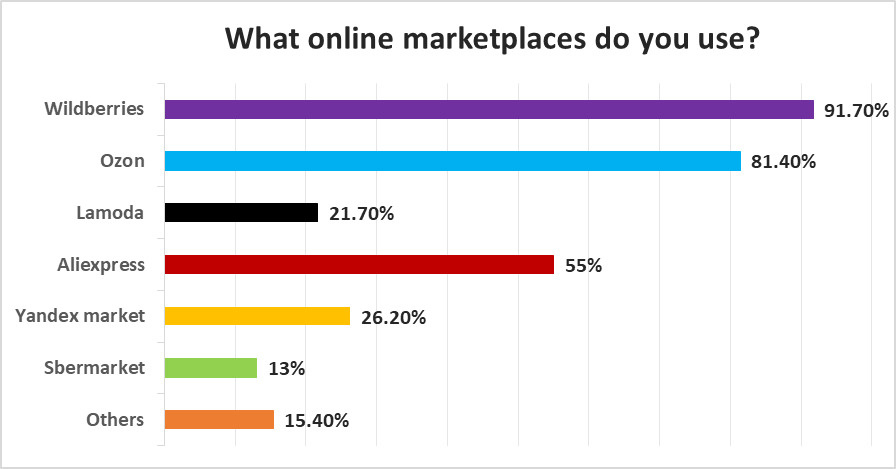
According to the respondents, the most popular online retailers are Wildberries (91.7%), Ozon (81.4%) and Aliexpress (55%). The stores that are not in such high customer favor are Sbermarket (13%) and Lamoda (21.7%).
Then, the results presented in Figure 2 related to consumers’ preferences in choosing logistics services should be analyzed.
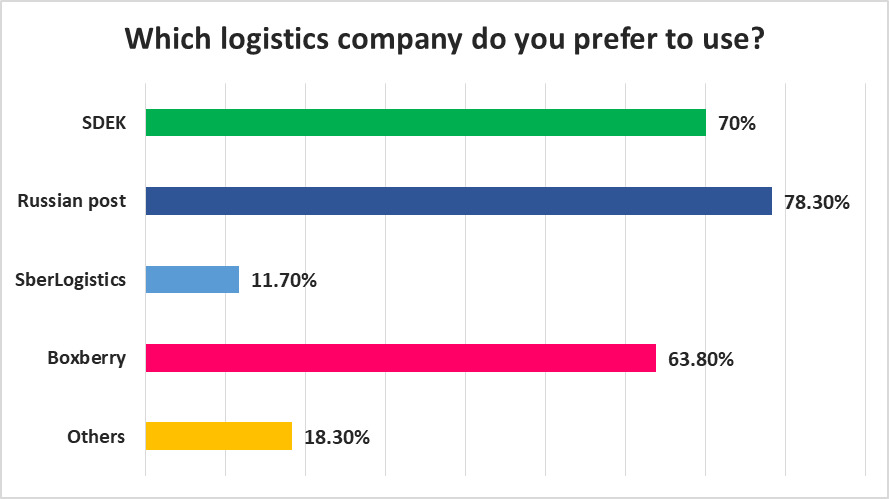
The leaders in this sphere are Russian Post with 78.3% and SDEK with 70%. However, it should be noted that the popularity of Russian Post is due to its monopolistic position in the Russian market of logistics services. Such a company as SberLogistics is not in high demand (11.7%).
In addition, the survey contained a question about which delivery method is the most convenient for respondents. The survey showed that the most preferred delivery option is to special delivery points (75%). Nevertheless, other types of delivery points are also popular for shipping online orders: self-pickup from the store (48.3%), to a postamat (40%) and by a courier (33.3%).
Next, we should analyze the results of the survey related to the cost of delivery of Internet orders. Regarding the question of whether the price for delivery affects the desire to buy a product, many respondents answered positively (90%). The majority of respondents believe that delivery should be paid by the seller (81.7%) rather than by the buyer (18.3%). And the most appropriate price that consumers are ready to pay for it is less than 100 rubles (78.7%) or from 100 to 500 rubles (25%). The share of those who are ready to pay more than 500 rubles is 3.3%. On the question, what kind of delivery is more acceptable for customers, 86.7% of respondents choose the option «slow but cheap (or free) delivery». This shows that online shopping customers are not willing to pay for expedited shipping.
Figure 3 shows the percentage of ideal delivery times for Internet orders in Russia according to customers’ opinion.
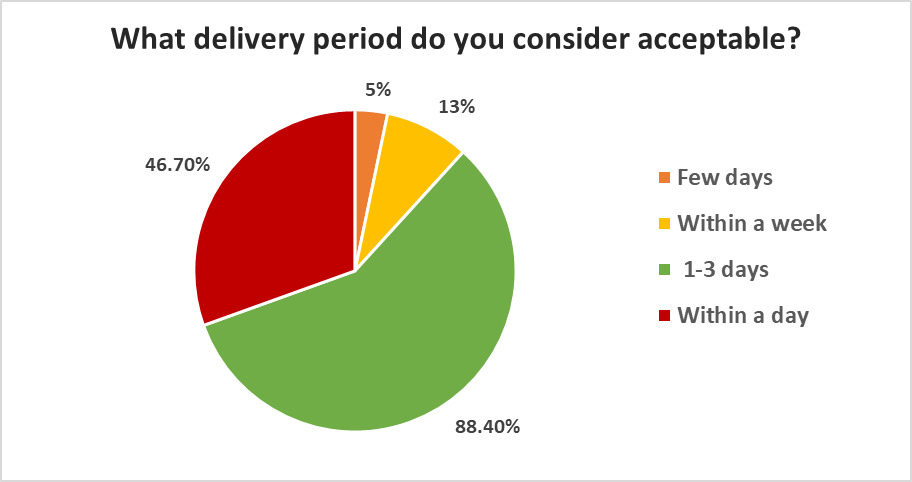
As for the time frames that customers consider acceptable for delivery of goods in Russia, 88.4% of people chose 1—3 days and 46.7% chose within a day.
Thus, the survey data allows to conclude that the delivery of goods significantly affects the desire to purchase goods. Consumers prioritize fast delivery of goods with minimal cost. Therefore, efficiently built logistics operations will be demanded in the nearest future.
In conditions of increased demand, logistics systems and operators are constantly innovating and improving by automating many processes related to transportation and warehouse services, exchange of statistical data. However, currently there are certain aspects of logistics that are not perfect and require further improvement [3].
— Digitalization of different spheres of trade
Lack of implementation of advanced technologies on the territory of our country hinders the fast delivery of goods. In Russia, cloud infrastructures are not widely used, new technologies in the field of information analysis, artificial intelligence and others are slowly adapted. Also, there is no ability of electronic payment between legal entities without resorting to bank accounts [5].
— Integrated interaction of all subjects of a trade deal
An important task of logistics processes development is the establishment of a unified information system that would bring together vendors, transporters, intermediaries and customers. Such cooperation would allow to concentrate a large amount of information on trade operations in one place, reduce the time of collection, analysis and processing of this data, thus accelerating the delivery of goods. In addition, it is necessary to improve logistics infrastructure, especially in remote regions of our country. The creation of digital platforms, distribution warehouses and hubs in such places would lead not only to the development of adjacent territories and the domestic trade market, but also to the potential attraction of foreign manufacturers and foreign investment in the EAEU Internet platforms, and increase the competitiveness of logistics services [1].
— Legislative system regulating online commerce
At the moment, the sector-specific base of laws in the sphere of e-commerce regulation is under development. In fact, for a long time the online market was regulated only by general legislative acts: the Civil Code of the Russian Federation, the Civil Procedure Code of the Russian Federation, regulations of the Central Bank of the Russian Federation, the Customs Code of the EAEU and others. To regulate Internet trading, it is necessary to adopt the Federal Law on the rules of electronic commerce, which establishes requirements for potential sellers and the activities of online marketplaces, guarantees, types of transactions, protections and mechanisms [2].
All these shortcomings lead to more expenses for vendors and logistics operators, which will consequently affect the price of goods for end consumers.
Conclusion.
To summarize the scientific research, it should be said that the epidemiological situation in the world has become a powerful stimulus for the development of e-commerce. The tendencies of customers to choose fast delivery of online orders have stimulated the rapid development of logistics services in our country. Nevertheless, the logistics industry in Russia faces challenges in terms of digitalization, complex interaction between trade participants and a comprehensive legislative framework for e-commerce. Solving these problems will lead to increased efficiency and cost reduction in the logistics sector.
References:
1. Lazarev, V.A. Logistics services of trade enterprises / V.A. Lazarev, D.A. Karh // Upravlenets. — 2019. — №3. — P. 78—82
2. Shaydullina, V.K. State and prospects of electronic commerce in Russia / V.K. Shaydullina // Vestnik University. — 2019. — №4. — P. 118—122
3. Report on the development of digital (Internet) trade of the EAEU [Electronic resource]. — Mode of access: https://clck.ru/3GDbcs — Date of circulation: 11.03.24
4. Share of Internet sales in the total volume of retail trade turnover (starting from the results for 2014) [Electronic resource]. — Access mode: https://rosstat.gov.ru/ — Date of access: 11.03.24
5. First Deputy Head of the Federal Customs Service: multimodal transportations — the most promising for the Russian Federation logistics [Electronic resource]. — Access mode: https://tass.ru/interviews/12320941. — Date of access: 11.03.24
Заочные публикации
Абрамов Н. В.
Countering Radio Suppression of Unmanned Vehicles
Abramov N.V., 5th year Specialist Degree student «Radioelectronic Systems and Complexes»
Scientific adviser: Kyuregyan M.P., PhD (Sociology), Associate Professor of the Department of Foreign Languages
Federal State Budgetary Educational Institution of Higher Education «Technological University named after twice Hero of the Soviet Union, Pilot-cosmonaut A.A. Leonov», Korolev, Russia
In the ever-evolving landscape of unmanned vehicles, radio suppression presents a significant challenge. Unmanned vehicles, ranging from drones to autonomous ground vehicles, heavily rely on radio communication for navigation, control, and data transmission. When this communication is disrupted or suppressed, it poses serious threats to the operations and safety of these vehicles.
Keywords: Radio suppression, jamming, electromagnetic interference, Unmanned Vehicles
Radio suppression refers to the intentional or unintentional interference with radio frequency (RF) signals, disrupting communication between unmanned vehicles and their operators or control systems. This interference can occur through various means, including jamming, spoofing, or electromagnetic interference (EMI).
Jamming involves transmitting radio signals at the same frequency as the communication signals used by unmanned vehicles, effectively blocking or overpowering legitimate transmissions. This can be achieved using specialized equipment designed to emit strong radio signals within specific frequency bands.
Spoofing entails the creation of false radio signals to deceive unmanned vehicles into accepting them as legitimate commands or data. By mimicking authentic signals, spoofers can manipulate the behavior of unmanned vehicles, leading to potentially dangerous outcomes such as altered trajectories or unauthorized access.
EMI arises from natural or artificial sources, causing disruptions in radio communication due to electromagnetic radiation. Common sources of EMI include electronic devices, power lines, and atmospheric conditions, all of which can interfere with the transmission and reception of RF signals.
The impact of radio suppression on unmanned vehicles is far-reaching and multifaceted, affecting their operational capabilities, safety, and mission success.
Radio suppression can disrupt the real-time communication link between operators and unmanned vehicles, hindering command and control functions. This disruption impairs the ability to remotely pilot or monitor the vehicles, leading to operational delays or mission failure.
Interference with GPS or other positioning systems through radio suppression can result in navigation errors for unmanned vehicles. Without accurate positioning information, drones and autonomous vehicles may deviate from their intended paths or lose their way entirely, posing risks to people and property in their vicinity.
Spoofing attacks can compromise the integrity and confidentiality of data transmitted by unmanned vehicles. By intercepting or altering data packets, adversaries can obtain sensitive information or inject malicious commands, jeopardizing the security of missions and compromising the privacy of individuals involved.
Unmanned vehicles subjected to radio suppression may exhibit erratic behavior or lose control, posing safety hazards to nearby objects and personnel. In scenarios where drones or autonomous vehicles operate in close proximity to humans or infrastructure, such malfunctions can lead to accidents or collisions with potentially severe consequences.
Addressing the challenges posed by radio suppression requires a multifaceted approach that encompasses technological advancements, regulatory measures, and operational strategies. Below are several strategies for countering radio suppression and enhancing the resilience of unmanned vehicle systems.
FHSS is a modulation technique that mitigates the impact of jamming by rapidly switching frequencies within a predefined range. By dynamically adapting to changing RF conditions, FHSS enables unmanned vehicles to maintain communication links even in the presence of jamming signals. Implementing FHSS requires robust hardware and software solutions capable of swiftly adjusting transmission parameters to counteract interference effectively.
Encrypting communication signals and implementing authentication mechanisms can prevent unauthorized access and manipulation of data transmitted by unmanned vehicles. Advanced encryption algorithms ensure the confidentiality and integrity of sensitive information, while authentication protocols verify the legitimacy of command signals, mitigating the risk of spoofing attacks. By incorporating cryptographic techniques into communication protocols, unmanned vehicle systems can thwart malicious interference attempts and safeguard critical operations.
Deploying redundant communication channels provides backup options for unmanned vehicles to maintain connectivity in the event of primary channel failure or interference. By leveraging multiple communication mediums such as radio, cellular networks, and satellite links, operators can establish resilient communication architectures capable of adapting to diverse operating environments and mitigating the effects of radio suppression. Redundancy also enables seamless switchover between communication channels, ensuring continuity of operations without compromising mission objectives.
Employing signal filtering and processing techniques can mitigate the impact of electromagnetic interference on unmanned vehicle systems. Filtering algorithms selectively attenuate unwanted frequencies or noise components present in RF signals, enhancing signal-to-noise ratio and improving communication reliability. Signal processing algorithms can further enhance the robustness of communication systems by extracting meaningful information from noisy or distorted signals, enabling unmanned vehicles to decipher commands and telemetry data accurately despite adverse RF conditions.
Developing and enforcing regulatory frameworks for spectrum allocation and usage are essential for mitigating radio suppression and ensuring fair access to RF spectrum resources. Regulatory agencies play a crucial role in overseeing spectrum management practices, allocating frequency bands for specific applications, and enforcing compliance with standards and regulations governing radio communications. By promoting cooperation among stakeholders and establishing guidelines for responsible spectrum usage, regulatory frameworks can mitigate interference conflicts and foster a conducive environment for innovation in unmanned vehicle technologies.
Raising awareness among operators and stakeholders about the risks associated with radio suppression is paramount for enhancing preparedness and resilience against potential threats. Providing training programs and educational resources on cybersecurity best practices, threat detection, and incident response procedures empowers personnel to recognize and mitigate risks effectively. By fostering a culture of vigilance and accountability, organizations can strengthen the human factor in safeguarding unmanned vehicle systems against malicious interference and ensuring mission success.
Radio suppression poses significant challenges to the operation and safety of unmanned vehicles, necessitating proactive measures to counteract its effects effectively. By leveraging technological innovations, regulatory frameworks, and operational strategies, stakeholders can enhance the resilience of unmanned vehicle systems against jamming, spoofing, and electromagnetic interference. By embracing a holistic approach to cybersecurity and risk management, the unmanned vehicle industry can navigate the complexities of radio suppression and unlock the full potential of autonomous technologies in diverse applications and environments.
As advancements in unmanned vehicle technologies continue to evolve, addressing the cybersecurity implications of radio suppression will remain a critical priority for ensuring the reliability, security, and safety of autonomous systems in an increasingly interconnected world. By staying vigilant, adaptive, and collaborative, stakeholders can effectively mitigate the risks posed by radio suppression and pave the way for a future where unmanned vehicles operate seamlessly and securely in complex and dynamic environments.
References:
1. Макаренко С. И. Анализ средств и способов противодействия беспилотным летательным аппаратам. Часть 3. Радиоэлектронное подавление систем навигации и радиосвязи // Системы управления, связи и безопасности -2020 №2. — ISSN 2410—9916
2. Мельничук, А. И. Способы и средства противодействия беспилотным летательным аппаратам /А. И. Мельничук, Н. В. Горячев, Н. К. Юрков // Надежность и качество сложных систем. — 2020. — №4 (32) — DOI 10.21685/2307-4205-2020-4-14
3. Nurmuhamedov T. Q. Methods and means of foreign armies in the fight against unmanned aerial vehicles // science and innovation — 2020 №2 — ISSN: 2181—3337
Абрамов Н. В.
Leveraging Space Systems for Emergency Monitoring and Response
Abramov N.V., 5th year Specialist Degree student «Radioelectronic Systems and Complexes»
Scientific adviser: Kyuregyan M.P., PhD (Sociology), Associate Professor of the Department of Foreign Languages
Federal State Budgetary Educational Institution of Higher Education «Technological University named after twice Hero of the Soviet Union, Pilot-cosmonaut A.A. Leonov», Korolev, Russia
In an era where natural disasters, humanitarian crises, and unforeseen emergencies are increasingly common, the role of technology in monitoring and responding to these events has become paramount. Space systems, including satellites and other orbiting platforms, have emerged as invaluable tools in providing real-time data, enabling swift response, and enhancing preparedness for emergencies worldwide.
Keywords: Space systems, emergency monitoring and response, Geographic Information Systems, predicting natural disasters
Space-based assets offer a unique vantage point, providing a comprehensive view of the Earth’s surface and atmosphere. Satellites equipped with various sensors and imaging technologies enable continuous monitoring of environmental parameters, natural phenomena, and human activities. These systems can capture data across different wavelengths, allowing for the observation of phenomena that may be invisible or difficult to detect from the ground.
One of the primary applications of space systems in emergency management is disaster monitoring and early warning. Satellites can detect and track various natural hazards such as hurricanes, floods, wildfires, earthquakes, and volcanic eruptions. By continuously monitoring vulnerable regions, space agencies and disaster management authorities can issue timely alerts and warnings, enabling at-risk communities to evacuate or take necessary precautions.
Following a disaster, space-based imagery plays a crucial role in assessing the extent of damage and identifying areas in need of assistance. High-resolution satellite images can provide detailed insights into the impact on infrastructure, agriculture, and the environment. These assessments are instrumental in guiding relief efforts, prioritizing resources, and coordinating response operations effectively.
Space systems also contribute to monitoring long-term environmental changes and understanding climate patterns. Satellites equipped with instruments for measuring atmospheric composition, sea surface temperature, ice melt, and deforestation enable scientists to study the dynamics of our planet’s ecosystems. This data is invaluable for predicting and mitigating the impacts of climate change, including extreme weather events and sea-level rise.
In addition to Earth observation, space systems facilitate communication and connectivity during emergencies. Satellites provide essential communication links in remote or disaster-affected areas where terrestrial infrastructure may be damaged or non-existent. This capability enables emergency responders to maintain communication channels, coordinate relief efforts, and provide critical information to affected populations.
Space-based data is often integrated into Geographic Information Systems (GIS) for visualization, analysis, and decision-making. GIS platforms enable stakeholders to overlay satellite imagery with various geospatial datasets, such as population demographics, infrastructure maps, and hazard zones. This integrated approach enhances situational awareness and supports informed decision-making throughout the emergency management cycle.
Several notable examples demonstrate the effectiveness of space systems in emergency monitoring and response:
— Hurricane Tracking and Forecasting: Organizations like NOAA (National Oceanic and Atmospheric Administration) and NASA utilize satellites to track hurricanes and predict their path with increasing accuracy. Timely forecasts enable authorities to issue evacuation orders and implement preparedness measures, ultimately saving lives and minimizing damage.
— Wildfire Detection and Management: Satellite-based sensors, such as MODIS (Moderate Resolution Imaging Spectroradiometer), provide near-real-time monitoring of wildfires worldwide. These observations help firefighting agencies identify fire hotspots, assess their spread, and allocate resources efficiently.
— Earthquake and Tsunami Early Warning: Satellites equipped with radar and seismographic instruments contribute to earthquake and tsunami early warning systems. By detecting ground movements and changes in sea surface height, these systems provide critical seconds to minutes of advance warning, allowing coastal communities to evacuate to safer ground.
— Flood Mapping and Risk Assessment: During floods, satellites capture imagery of inundated areas and generate flood extent maps. These maps assist emergency responders in identifying population centers at risk, planning evacuation routes, and estimating the scope of damage for post-disaster recovery efforts.
While space systems offer tremendous potential for emergency monitoring, several challenges must be addressed to maximize their effectiveness:
— Data Accessibility and Affordability: Ensuring universal access to satellite data, particularly for low-resource countries and humanitarian organizations, remains a challenge. Efforts to increase data sharing, reduce costs, and improve data processing capabilities are crucial for broadening the reach of space-based technologies.
— Integration with Ground-Based Observations: Combining space-based observations with ground-based sensor networks and citizen science initiatives can enhance the accuracy and reliability of emergency monitoring systems. Collaborative approaches that leverage both space and terrestrial assets offer a comprehensive view of unfolding events and facilitate more effective response strategies.
— Capacity Building and Training: Building technical capacity and expertise in utilizing space-based technologies for emergency management is essential, particularly in regions prone to disasters. Training programs, workshops, and knowledge-sharing initiatives can empower local stakeholders to harness the full potential of space systems in disaster preparedness and response.
— Advancements in Technology: Continued advancements in satellite technology, including miniaturization, increased sensor resolution, and onboard processing capabilities, will further enhance the capabilities of space systems for emergency monitoring. Emerging technologies such as small satellites, constellations, and artificial intelligence hold promise for revolutionizing disaster management practices in the years to come.
Space systems play a critical role in emergency monitoring and response, offering unparalleled capabilities for observing, analyzing, and predicting natural disasters and humanitarian crises. From early warning systems to damage assessment and communication support, satellites and other orbiting platforms provide indispensable tools for disaster management authorities, humanitarian organizations, and communities at risk. By harnessing the full potential of space-based technologies and fostering international collaboration, we can enhance our resilience to emergencies and minimize their impact on vulnerable populations worldwide.
References:
1. Global Facility for Disaster Reduction and Recovery (GFDRR) — [Электронный ресурс]: Leveraging space-based satellite technologies for emergencies and disasters in China URL: https://clck.ru/3GDbgU (дата обращения 14.03.2024)
2. European Union Agency for the Space Programme — [Электронный ресурс]: Space Solutions for Emergency Response URL: https://clck.ru/3GDbhj (Дата обращения 14.03.2024)
3. Tanya V. Emergency Response Networks for Disaster Monitoring and Detection from Space / Tanya Vladimirova, Martin N. Sweetingab, Ivan Vitanovc and Valentin I. Vitanovd // Proceedings of SPIE — The International Society for Optical Engineering — 2009 — 7347 — DOI:10.1117/12.820772
Абрамов Н. В.
The Role of Radar Technology in Farming
Abramov N.V., 5th year Specialist Degree student «Radioelectronic Systems and Complexes»
Scientific adviser: Kyuregyan M.P., PhD (Sociology), Associate Professor of the Department of Foreign Languages
Federal State Budgetary Educational Institution of Higher Education «Technological University named after twice Hero of the Soviet Union, Pilot-cosmonaut A.A. Leonov», Korolev, Russia
In the realm of agriculture, where precision and efficiency are paramount, the integration of advanced technologies has been transformative. Among these innovations, radar technology stands out as a powerful tool reshaping the landscape of modern farming. Radar, originally developed for military and aerospace applications, has found its niche in agriculture, offering a plethora of benefits ranging from crop monitoring to soil analysis.
Keywords: Farming, radar, crop monitoring, soil analysis
Radar, an acronym for Radio Detection and Ranging, operates on the principle of emitting electromagnetic waves and analyzing their reflections to determine the properties of objects in its path. This technology has evolved significantly since its inception, with modern radar systems boasting enhanced sensitivity, resolution, and versatility.
In agriculture, radar sensors are commonly mounted on aerial platforms such as drones or satellites, providing farmers with invaluable insights into their crops and fields. These sensors emit microwave radiation towards the Earth’s surface and capture the reflected signals, which are then processed to generate detailed imagery and data.
Applications of Radar in Agriculture:
— Crop Monitoring and Management: Radar technology enables farmers to monitor their crops with unprecedented detail and accuracy. By analyzing radar imagery, farmers can assess crop health, detect pests and diseases, and identify areas requiring irrigation or fertilization. This real-time monitoring allows for timely interventions, optimizing crop yields and minimizing losses.
— Soil Moisture Analysis: One of the critical factors influencing crop productivity is soil moisture content. Radar sensors can penetrate the soil surface and measure moisture levels at various depths, providing farmers with crucial information for irrigation scheduling and water management. This data-driven approach enhances resource efficiency and mitigates the risk of over- or under-watering.
— Crop Mapping and Yield Prediction: Radar imagery facilitates the creation of high-resolution crop maps, delineating different vegetation types and growth stages within a field. By integrating this spatial data with historical records and predictive models, farmers can forecast crop yields with remarkable accuracy. Such insights empower decision-making, aiding in supply chain planning and market forecasting.
— Crop Damage Assessment: Natural disasters, such as storms, floods, and wildfires, pose significant threats to agricultural productivity. Radar technology plays a crucial role in assessing the extent of crop damage following such events. By comparing pre- and post-disaster radar images, farmers and insurers can quantify losses, expedite recovery efforts, and streamline insurance claims processes.
Advantages of Radar Technology in Agriculture:
— All-Weather Capability: Unlike optical remote sensing techniques, radar is not hindered by adverse weather conditions or cloud cover. Its ability to penetrate clouds and vegetation ensures continuous data acquisition, enabling year-round monitoring irrespective of atmospheric conditions.
— High Spatial Resolution: Modern radar systems offer exceptional spatial resolution, capturing detailed imagery at scales relevant to agricultural applications. This high resolution allows farmers to discern subtle variations in crop health, soil properties, and field conditions, facilitating precise management decisions.
— Multi-Spectral Sensing: Radar sensors can operate across multiple wavelengths, providing farmers with valuable multi-spectral information. By analyzing different bands of the electromagnetic spectrum, farmers can gain insights into diverse aspects of agricultural systems, including vegetation structure, soil composition, and water content.
— Cost-Effectiveness: While the initial investment in radar technology may be significant, its long-term benefits outweigh the costs. By optimizing resource use, minimizing inputs, and maximizing yields, radar-equipped farming operations can achieve substantial cost savings and improve overall profitability.
As radar technology continues to advance, its integration into agriculture is poised to accelerate further. Future developments may include the deployment of smaller, more affordable radar sensors, enhanced data processing algorithms, and the integration of radar with other sensing modalities such as LiDAR and hyperspectral imaging.
However, several challenges must be addressed to fully realize the potential of radar in agriculture. These challenges include data interpretation and integration, regulatory hurdles, privacy concerns, and accessibility issues for small-scale farmers. Overcoming these obstacles will require collaboration among stakeholders, investment in infrastructure, and the development of user-friendly tools and interfaces.
Radar technology has emerged as a game-changer in modern agriculture, empowering farmers with unprecedented insights into their crops, fields, and soil. From crop monitoring and soil analysis to yield prediction and disaster management, radar’s applications are diverse and far-reaching. As technology continues to evolve and barriers are overcome, radar-equipped farming is poised to revolutionize the way we produce food, enhancing sustainability, resilience, and productivity in the face of global challenges.
References:
1. Dragonfly Aerospace — [Электронный ресурс]: 7 APPLICATIONS OF REMOTE SENSING IN AGRICULTURE URL: https://clck.ru/3GDbjY (дата обращения 14.03.2024)
2. Space Sense — [Электронный ресурс]: What is radar satellite imagery and how will it revolutionize the agriculture industry? URL: https://clck.ru/3GDbpC (дата обращения 14.03.2024)
3. Thota S. Advances in Radar Remote Sensing of Agricultural Crops: A Review / Thota Sivasankar, Dheeraj Kumar, Hari Shanker Srivastava, Parul Patel // International Journal on Advanced Science Engineering and Information Technology — 2018 — №8 (4) — DOI:10.18517/ijaseit.8.4.5797
Ануфриева П. И.
Globalisierung 3.0 und 4.0: Konzepten einer neuen Welt
Anufrijewa P.I., Ökonomie, 4. Studienjahr
Scientific adviser: Sagaydatschnaya E. N., Kandidat der Philologie, Deutschlehrerin
Rostower Staatliche Universität für Wirtschaft, Rostow am Don, Russland
Der Artikel behandelt eine Analyse der aktuellen Trends und Perspektiven der Globalisierungsprozesse. Eigenschaften der letzten beiden Globalisierungswellen — 3.0 und 4.0 — werden verglichen. Der Artikel betrachtet den Übergang vom traditionellen Verständnis der Globalisierung zu einer neuen Form der Globalisierung, die als Globalisierung 4.0 bekannt ist. Der Artikel konzentriert sich auf die Besprechung der möglichen Risiken und Herausforderungen, die mit den neuen Formen der Globalisierung verbunden sind, nämlich Sicherheitsfragen. Mögliche Lösungen für die einzigartigen Herausforderungen, die durch die Globalisierung 4.0 verursacht werden, sind in der Arbeit ebenfalls vorgestellt.
Keywords: Globalisierung, globale Gesellschaft, Herausforderungen, internationale Organisationen
Der Begriff «Globalisierung 4.0» entstand zum ersten Mal beim Weltwirtschaftsforum (WEF) 2019 in Davos und ist derzeit ein Diskussionsthema unter akademischen Experten, insbesondere im Bereich der digitalen Forschung. Laut einem offiziellen Dokument, das vom Weltwirtschaftsforum einige Monate nach dem WEF 2019 in Davos veröffentlicht wurde, zielt «Globalisierung 4.0» darauf ab, die durch die vierte industrielle Revolution hervorgerufenen bedeutenden Veränderungen in den Bereichen Verwaltung und Zusammenarbeit zu erfassen. Die vierte industrielle Revolution ist die Verschmelzung digitaler, physischer und biologischer Fortschritte. Im Gegensatz zu ihrer Vorgängerin, der dritten industriellen Revolution, die sich vor allem auf die Erweiterung des Zugangs zu digitalen Technologien konzentrierte, wird erwartet, dass diese neue Revolution weitreichendere und umwälzendere Auswirkungen auf die Organisation der Gesellschaft, die menschliche Interaktion und die Globalisierung haben wird. Der Begriff Globalisierung 4.0 wurde von dem Wirtschaftler Richard Baldwin [3] geprägt und bezieht sich auf störende Auswirkungen der Technologie auf den Globalisierungsprozess. Diese Definition unterstreicht den bedeutenden Einfluss des digitalen Fortschritts sowohl auf den öffentlichen als auch auf den privaten Sektor, einschließlich Bereiche von Gesundheit, Bildung, Transport und Energieversorgung, der die globalen Realitäten grundlegend verändert. Die zentrale Rolle der Technologie im Konzept der Globalisierung muss unbedingt anerkannt werden.
Das Phänomen der Transformation wird durch Umweltkrisen und geopolitische Veränderungen tiefgreifend beeinflusst. Trotz einiger Stimmen, die eine Abkehr von der Isolation und eine Betonung der nationalen Souveränität fordern, ist festzustellen, dass die Globalisierung nicht zum Stillstand gekommen ist, sondern sich neu ausrichtet und rasch voranschreitet. Diese neue Form der Globalisierung erfordert neue Steuerungs- und Kooperationsstrategien, die das etablierte Weltsystem erschüttern könnten.
Globalisierung 4.0 ist ein wichtiges Kapitel im laufenden Globalisierungsprozess, der durch aufeinander folgende Wellen gekennzeichnet ist, die die Interaktionen zwischen Nationen und Gemeinschaften auf der ganzen Welt grundlegend verändert haben. Wie die renommierten Wirtschaftswissenschaftler Richard Baldwin und Philip Martin [3] festgestellt haben, kann es schwierig sein, den genauen Beginn und das Ende dieser Wellen zu bestimmen, aber es gibt einen Konsens über ihren zeitlichen Ablauf.
Die Industrielle Revolution begann in der späten 19. Jahrhundert und wurde durch Fortschritte in der Transport- und Kommunikationstechnologie, einschließlich dampf- und kohlebetriebener Transportmittel und Erfindungen im Bereich der Fernkommunikation, ausgelöst. Die erste Welle der Globalisierung, die vor dem Ersten Weltkrieg stattfand, führte zur Schaffung neuer Regulierungsinstrumente und Regierungsinstitutionen wie der Internationalen Telegraphen-Union, dem Internationalen Eisenbahnkongress und der Internationalen Sanitätskonvention (dem Vorläufer der Weltgesundheitsorganisation). Der Ausbruch des Ersten Weltkriegs 1914 führte jedoch zu einer erheblichen Einschränkung des grenzüberschreitenden Waren- und Personenverkehrs und läutete das Ende dieser Welle ein.
Die Globalisierung 2.0 begann nach dem Zweiten Weltkrieg mit der Gründung großer internationaler Organisationen, die bis heute die internationalen Beziehungen regeln. Auch technologische Innovationen trugen zur Schaffung eines neuen Ordnungsrahmens bei, wie die Gründung der Internationalen Atomenergiebehörde zeigt. Die Entstehung des World Wide Webs in Verbindung mit dem liberalen Durchbruch der 1980er Jahre und dem anschließenden Abbau von Barrieren nach dem Ende der amerikanisch-sowjetischen Konfrontation hat zu dem beigetragen, was gemeinhin als Globalisierung 3.0 bezeichnet wird.
Die Globalisierung 3.0 hat zur Wiederherstellung der Legitimität und des Einflusses globaler Institutionen, einschließlich der Vereinten Nationen und ihres Systems von Organisationen, geführt. Sie hat auch zur Schaffung von Kooperationsmechanismen wie regionalen Zusammenschlüssen wie der Asiatisch-Pazifischen Wirtschaftskooperation (APEC) oder dem MERCOSUR und zur Gründung globaler Clubs wie der G20 geführt. Die Welt ist also zunehmend vernetzt [4].
In dieser Phase entstehen internationale Arbeitsteams, Arbeitsteilung, Outsourcing und andere damit verbundene Prozesse. Infolgedessen ist ein beträchtlicher Teil der Weltbevölkerung in die Produktions- und Dienstleistungssektoren integriert. Die «Globalisierung 3.0» wurde begünstigt durch Fortschritte in der Kommunikationstechnologie wie Mobiltelefone und Internet sowie durch den Wandel der Unternehmensbürokratie von vertikalen Hierarchien hin zu flexibleren horizontalen Strukturen. Die Welt wird zunehmend vernetzt, was zu gleichen Wettbewerbsbedingungen führt, in denen für alle die gleichen Regeln gelten. Daher ist der Geburtsort nicht mehr so ein großes Handicap wie früher. Man kann sagen, dass die dritte Phase der Globalisierung durch den Wettbewerb zwischen Individuen und nicht zwischen Ländern oder transnationalen Unternehmen gekennzeichnet ist. In der heutigen Welt wird allgemein anerkannt, dass eine Ausbildung, die vielseitige Fähigkeiten fördert, von entscheidender Bedeutung ist. In dem Maße, in dem standardisierte Tätigkeiten in andere Länder verlagert werden, garantiert eine enge Spezialisierung jungen Menschen in den entwickelten Ländern nicht mehr das gewohnte Einkommen. Daher ist es wichtig, flexible Fähigkeiten und die Fähigkeit zur Anpassung an ein sich wandelndes Umfeld zu erwerben, damit der Einzelne sein Potenzial durch den Wechsel von Berufen und Tätigkeitsfeldern ausschöpfen kann [1].
Jede der aufeinander folgenden Globalisierungswellen seit dem Ende des 19. Jahrhunderts hat zu bedeutenden technologischen Fortschritten und geopolitischen Verschiebungen geführt. Diese Veränderungen haben unweigerlich zu entsprechenden globalen institutionellen Veränderungen geführt. Die gegenwärtige Phase der Globalisierung, die als Globalisierung 4.0 bezeichnet ist, stellt eine besondere Herausforderung dar, da sie durch zunehmende Ungleichheiten gekennzeichnet ist, die zu Polarisierung und Fragmentierung führen. Infolgedessen stoßen unsere bestehenden Kooperations- und Regulierungsansätze auf Schwierigkeiten in Bezug auf Legitimität, Effizienz und soziale Unruhen.
Die Legitimität der großen internationalen Organisationen wird derzeit im Kontext der Globalisierung 4.0 in Frage gestellt [2]. In der NATO wird eine Führungskrise befürchtet, wie sie der französische Präsident Emmanuel Macron beschrieben hat, und die WTO wird von mehreren Analysten als im Niedergang begriffen angesehen. Es ist erwähnenswert, dass die Globalisierung 4.0 eher durch Fragmentierung und Zerstörung als durch Umstrukturierung und Reorganisation gekennzeichnet ist [1]. Auch wenn die Meinungen zu bestimmten Themen auseinandergehen, ist klar, dass es ein allgemeines Gefühl der Unzufriedenheit mit der Mitgliedschaft in den wichtigsten Strukturen des internationalen Kooperationssystems gibt. Es herrscht jedoch weitgehend Einigkeit darüber, dass das System selbst, das auf der Idee einer internationalen Gemeinschaft beruht, nicht zur Disposition steht. Die Tatsache, dass die USA, die eine Schlüsselrolle bei der Schaffung des Kooperationssystems nach 1945 gespielt haben, dessen Relevanz in Frage stellen, hat eine komplexe und nuancierte Debatte ausgelöst. Für viele globale Akteure stellt dies eine Gelegenheit dar, die Legitimität der liberalen internationalen Ordnung in Frage zu stellen, die seit 1989 weitgehend unangefochten ist.
Die Effektivität internationaler Organisationen ist eng mit der öffentlichen Wahrnehmung verbunden, insbesondere in der sich ständig verändernden Landschaft der Globalisierung 4.0. Informelle Leitungsorgane wie die G20 werden oft als fähiger Ersatz für ihre fehlende Legitimität angesehen. Anders gesagt werden die Vereinten Nationen zwar weithin als legitime Institution anerkannt, ihre Effektivität kann jedoch aufgrund von Einschränkungen in Frage gestellt werden. Die jüngste Entwicklung des Multilateralismus hat zu einer Neubewertung dieser weit verbreiteten Ansicht geführt [4].
Anomie bezeichnet einen gesellschaftlichen Zustand, der durch die Erosion etablierter Normen und Werte gekennzeichnet ist, die das gesellschaftliche Zusammenleben bestimmen. Das Thema Anomie ist in jüngster Zeit zu einem wichtigen Bestandteil der Diskussionen über die Bedeutung des internationalen Rahmens nach 1945 geworden. Positiv ist zu vermerken, dass diese Entwicklung auf das Potenzial für die Emanzipation des Individuums auf globaler Ebene hinweist, das der Wirtschaftler Albert Hirschman häufig als «globale Stimme» bezeichnet. Es lohnt sich jedoch, Hirschmans Paradigma von «Rückzug, Protest oder Loyalität» in Betracht zu ziehen, das darauf hindeutet, dass es ein Potenzial für einen weit verbreiteten «Rückzug» in Form von wachsender Unzufriedenheit und Misstrauen gegenüber Regierungen und zwischengeschalteten Stellen gibt. Es ist wichtig anzuerkennen, dass es sich hierbei um eine subjektive Einschätzung handelt, die klar als solche gekennzeichnet werden sollte [1].
Es sei argumentiert, dass die Dritte Industrielle Revolution die wirtschaftliche Entwicklung erheblich vorangetrieben und zu einer Verringerung des Nord-Süd-Gefälles geführt hat. Die meisten der ärmsten Menschen der Welt leben heute in Ländern mit mittlerem Einkommen. Dies hat zu Forderungen nach neuen Ansätzen für die Umverteilung des globalen Wohlstands geführt. Zu den Antworten auf diese Herausforderungen gehören:
1) Vernetzung: das Konzept der Vernetzung in der Politik handelt sich um ein einfaches Zusammenbringen verschiedener Gesellschaften und Gemeinschaften. Es beinhaltet auch die wichtige Aufgabe, fragmentierte Einheiten, die von der rasanten Entwicklung der digitalen Revolution betroffen sind, wieder miteinander zu verbinden. Dazu gehört auch die Überwindung der wachsenden Kluft zwischen denen, die von den globalen Auswirkungen der dritten industriellen Revolution profitieren, und denen, die zurückbleiben. In Ländern wie China und anderen aufstrebenden Mächten, in denen die Entwicklung vielleicht weniger weit fortgeschritten, die Einheit aber stärker ist, besteht die Möglichkeit, diese Kluft zu überbrücken und ein ausgewogeneres Spielfeld zu schaffen.
2) Das Potenzial von Konnektivitätsinitiativen, zu der vom Weltwirtschaftsforum (WEF) befürworteten neuen internationalen Architektur beizutragen, kann längerfristig realisiert werden. Allerdings muss man sich darüber im Klaren sein, dass diese Initiativen nicht direkt die institutionellen Herausforderungen angehen, die von der Gemeinschaft in Davos gestellt werden. Derzeit befassen sie sich in erster Linie mit den Effizienzproblemen der Globalisierung 4.0, insbesondere mit der dringenden Notwendigkeit einer verbesserten Wohlstandsverteilung und Inklusivität im Kontext der vierten industriellen Revolution. Die Umsetzung solcher Initiativen kann von Land zu Land unterschiedlich sein und hat noch nicht zu einem weltweit vereinbarten Satz von Normen und Praktiken geführt [1].
Die Bewältigung der Herausforderungen der Globalisierung 4.0 ist ein vielschichtiger Prozess, für den es keinen vorgefertigten Fahrplan gibt. Die derzeitigen Kooperationsformate, die während des Zweiten Weltkriegs geschaffen wurden, haben inhärente Grenzen und führen, selbst wenn sie aktualisiert werden, zu einer Reihe komplexer Herausforderungen in Bezug auf Effizienz, Legitimität und soziale Unruhen, die heute ihren Höhepunkt erreicht haben. Die globale Architektur, die nach 1945 geschaffen wurde, basierte auf Normen, die vom westlichen Liberalismus beeinflusst waren, mit einigen Änderungen, um der Entkolonialisierungsbewegung und den Ansichten der Entwicklungsländer Rechnung zu tragen. Diese internationalen Normen beginnen sich jedoch aufzulösen. Es könnte notwendig sein, neue internationale Normen zu definieren, um den globalen institutionellen Rahmen für die Zusammenarbeit neu zu strukturieren.
Die Konnektivitätspolitik Chinas, Japans und der Europäischen Union sowie die Integration der Idee der «Nachhaltigkeit» behauptet, dass die Antwort auf das Problem der Fragmentierung, das die Globalisierung 4.0 kennzeichnet, keine rein technische, «wertfreie» sein kann: normative Entscheidungen scheinen unvermeidlich. Der Prozess, in dem diese Entscheidungen getroffen werden, ist unweigerlich mit einem globalen Kampf um Konzepte und Einflussmöglichkeiten verbunden. Der Fall der Konnektivitätspolitik im asiatisch-europäischen Raum zeigt jedoch, dass dieser Wettbewerb nicht zwangsläufig zu tieferen Spaltungen führen muss, sondern im Gegenteil eine neue normative Grundlage für die globale Zusammenarbeit schaffen kann.
Literaturverzeichnis:
1. Postel-Vinay K. (2020) Globalization 4.0 and New Modes of International Cooperation. International Organizations Research Journal, no.2 (15), 82—92
2. Baldwin R., Martin P. (1999) Two Waves of Globalization: Superficial Similarities, Fundamental Differences. National Bureau of Economic Research (NBER), Working Paper no. 6904, URL: https://www.nber.org/papers/w6904.pdf (Stand 21 Februar 2024)
3. Jia W., Jiang H. (2019) Globalization 4.0 Should Go Beyond Technology and Economy. Chinese Social Sciences Today, URL: http://www.csstoday.com/Item/7071.aspx (Stand 25 Februar 2024)
4. Globalization 4.0 — what does it mean? // World Economic Forum, URL: https://clck.ru/3GDbto (Stand 21 Februar 2024)
Асрутдинова Д. Н., Насруллаева Э. Р.
Development of logistics for the functioning of online commerce in Russia
Asrutdinova D.N., Nasrullayeva E.R., 3rd year Specialist Degree student {Customs}
Scientific adviser: Krasikova T.I., PhD {Philology}, Professor, Head of the Department of Foreign Languages
Federal State Budgetary Educational Institution of Higher Education «Technological University named after twice Hero of the Soviet Union, Pilot-cosmonaut A.A. Leonov», Korolev, Russia
This article discusses the importance of paying customs duties. Customs payments are money charged by the customs authorities for the passage of goods across the state border. These payments may include duties, taxes, fees and other mandatory payments. They can be charged both when goods are imported into the country and when they are exported from the country. Customs payments are used to regulate international trade, protect local producers from competition, and ensure the safety and quality of imported goods.
Keywords: customs, taxes, export, import, economic, duties, anti-dumping, goods, money, payments.
Foreign economic relations are constantly evolving, and it is therefore necessary to study customs payments as a tool for fiscal regulation. These payments play a significant role in contributing to a state’s income, determining its status and position. Today, customs payments and other fees account for over 65% of the federal budget, making them an important source of revenue for replenishing the budget. Receipt of these payments is directly linked to the volume of foreign trade and the effectiveness of legal measures used to ensure timely and complete payment of customs duties into the state budget. Customs payments refer to mandatory payments imposed by customs authorities on participants in foreign economic activities in the form of taxes, fees, and duties when goods, vehicles, or other items cross the customs border of the Eurasian Economic Union (EAEU). The Customs Code of the Eurasian Economic Union, which came into effect on January 1, 2018, defines customs duties through Article 46:
1. Import Customs Duty.
2. Export Customs Duty.
3. Value Added Tax (VAT) levied on goods imported into the customs territory of the EAEU.
4. Excise Taxes (Excise Tax or Excise Duty) levied on imported goods into the EAEU’s customs territory.
5. Customs Duties this list also includes a classification of customs payments.
In addition to these custom payments listed, Article 71 of the Customs Code also establishes the application of special and anti-dumping duties.
When describing each type of duty, it is important to start with the most significant one: import customs duty. This duty is charged when goods are brought into the Customs Territory of the Union. The rate of this duty is set in the Unified Customs Tariff of the Eurasian Economic Union (hereinafter referred to as the «EEA Customs Tariff»).
There are three types of import duty rates in the EEA Customs Tariff:
— Ad valorem.
— Specific.
— Combined.
Specific customs duty rates are determined in monetary terms, depending on physical characteristics such as quantity, mass, and volume. In this case, the monetary unit is either the euro or the US dollar. Ad valorem rates are set as a percentage of customs value, while combined rates combine ad valorem with specific taxes. Both the cost and quantity of goods crossing the customs border is taken into account in this situation. Special, anti-dumping and countervailing duties must also be mentioned. These are intended to protect domestic manufacturers from foreign competition, but each of these duties only applies in certain circumstances. Therefore, special duties are imposed as a protection measure or in reaction to discriminatory practices that could harm Russia’s interests.
The anti-dumping duty is levied on goods imported into Russia at a lower price than their normal value. This can cause material harm to domestic producers. A countervailing duty is imposed on goods that have received certain subsidies during production or importation, which can affect the interests of companies that produce such goods.
Export customs duties are levied when goods are exported from the Customs territory of the union. These duties are imposed to achieve the following objectives:
1. Encouraging the export of highly processed products.
2. Protecting the economic security of the country.
This duty is primarily used in developing and underdeveloped countries. However, there are no export tariffs in developed countries. For example, the US constitution prohibits the use of these tariffs.
Furthermore, the value-added tax (VAT) should be considered, as it is an indirect tax added to the cost of a product. The term «VAT» refers to its very definition — an additional cost to the product’s price. The VAT has two related functions: one is fiscal, helping to fund the government budget, and the other is regulatory, enhancing control over product quality and ensuring proper enforcement of regulations. VAT is the primary type of indirect tax levied by end-users, who pay it on goods imported to Russia, regardless of the origin of the goods.
As for excise taxes, they are also federal indirect taxes paid by buyers on a specific list of products. These taxes are designed to help the federal government by charging more money than the profit from the production of highly profitable items. Excise taxes are common in countries with market economies, where they perform a regulatory role by replenishing the federal budget as well as the budgets of regional entities within the Russian Federation. The main purpose of this tax is to tax goods that harm people, such as alcohol and tobacco products. By doing so, the state attempts to limit the consumption of these goods. Other luxurious goods and items that are in high demand also fall under excise taxes.
Customs duties are mandatory payments levied by customs authorities to perform customs operations related to releasing goods and vehicles, as well as other activities specified in the Customs Code of the Eurasian Economic Union and (or) legislation on customs regulations of Member States. The customs duty is not a tax, so it can only charge an amount that does not exceed the estimated cost of activities related to the duty imposed by the customs authority. It is a mandatory payment, but not regular, meaning it only applies in certain situations. Additionally, customs duties are a refundable payment, which means they assume some form of compensation for those paying the duties.
Therefore, the various types of payments mentioned account for up to 75% of the revenue in the federal budget. These payments have fiscal, regulatory, stability-promoting, protectionist and stimulating functions among others.
In our article, we are going to consider several cases of non-payment of customs duties. Here are some funny cases of non-payment of customs duties that occurred in practice.
Clothes of famous brands were imported under the guise of threads and fabrics. In August 2017, the agencies found out during operational search activities that luxury clothing was delivered to Russia through Koltsovo airport in Yekaterinburg. On August 11, the Yekaterinburg company Realma LLC tried to bring 405 kg of clothing from the Christian Dior and Rosie Assoulin brands to Russia for the capital’s multi-brand boutiques under the guise of threads and fabrics. According to false documents, the cost of imported products was only 6.5 dollars per kilogram, while the real cost of the batch was 26.1 million rubles. At the same time, the company did not pay 4.6 million rubles of customs duties to the budget.
In February, 8 criminal cases were opened against two residents of Novosibirsk at once. They were accused of fraud on a particularly large scale and smuggling. Merchants cut down the forest and illegally exported it through Irkutsk customs abroad: to Japan, South Korea, Germany, Uzbekistan and Azerbaijan. In total, from 2012 to 2014, they managed to illegally export 17 thousand cubic meters of timber worth more than 70 million rubles. It is noteworthy that at the same time they also wanted to get VAT back.
In conclusion, it is important to say that customs payments are an important tool for regulating international trade. They allow the State to control the flow of goods across its borders and ensure the safety and quality of imported goods. Customs payments include various types of payments such as duties, taxes, fees and other mandatory payments. Therefore, it is important to carefully study the laws and regulations governing customs payments in order to correctly assess their impact on business and consumer behavior.
References:
1. Lazarev, V.A. Logistics services of trade enterprises / V.A. Lazarev, D.A. Karh // Upravlenets. — 2019. — №3. — P. 78—82
Ахмедеева Д. Р.
The social and legal status of women in Russia and the United Kingdom
Ahmedeeva D. R., 1st year Specialist Degree student «Economic Security»
Scientific adviser: Kyuregyan M.P., PhD (Sociology), Associate Professor of the Department of Foreign Languages
Federal State Budgetary Educational Institution of Higher Education «Technological University named after twice Hero of the Soviet Union, Pilot-cosmonaut A.A. Leonov», Korolev, Russia
The social status of women in England and Russia is an interesting topic for research and analysis in any era. The study compares the historical development of women’s rights, as well as current social attitudes towards women in both societies. The research highlights the differences and similarities in the socio-economic and cultural factors that influence the status of women in Russia and England, providing valuable insights into the challenges and advancements in gender equality in these two countries. This comparative analysis offers a comprehensive view of the social position of women in these two nations, shedding light on the progress and remaining obstacles towards achieving gender equality.
Keywords: woman, law, fight for independence, social and legal status
Human rights are receiving increased attention in the modern world. The idea of human rights has the potential to ensure the required level of social justice in order to eliminate discrimination against women and to implement additional protections for children. The third generation of human rights, known as collective rights, includes women’s rights. Initially, all legal standards and human rights norms were created as universal, applicable to all people regardless of nationality, class, or gender.
Women’s employment in Russia over the past decade has had a mixed dynamic. According to statistical data, the share of women in the labor force in the country has gradually increased from 2010 to 2020. For example, while in 2010 the share of employed women was around 65%, by 2020 this figure had reached 70%. It is worth noting that some areas of women’s employment in Russia remain traditional, such as the service industry, healthcare, and education. However, there has also been an increase in the number of women holding managerial positions and working in fields such as information technology, engineering, and other technical sectors. Despite the increase in the share of women in the labor force, there is still wage inequality between men and women, as well as insufficient representation of women in leadership positions. It is also worth mentioning that as a result of the COVID-19 pandemic, women were one of the hardest-hit groups in the labor market due to increased household responsibilities and challenges in accessing work. Overall, women’s employment in Russia over the past decade has shown a positive trend, but challenges remain in the area of equality of rights and opportunities for women in the labor market. [1]
In the United Kingdom, women’s participation in the workforce has been systematically documented since 1971, and in general, the overall trends in employment in Russia and the UK share similarities. Recent official data reveals that the number of employed women in Britain has reached a historic high. A groundbreaking 71.8% of women of working age were part of the workforce during the first quarter of this year. The gender gap in employment rates has been steadily decreasing over the years, with 15.4 million women currently actively employed in comparison to 17.3 million men. Increasing employment rates are typically seen as a boon for the economy, as indicated by the ONS (Office for National Statistics), which suggests that the labour market in the UK «remains robust.» However, recent analysis by the ONS implies that this trend may not be universally welcomed, particularly among older women. Recent statistics indicate a decline in the number of women retiring between the ages of 60 and 65, suggesting that financial constraints are compelling some women to remain in the workforce longer than desired, as they cannot afford to retire until they qualify for their state pension. [4]
According to statistics, it is clear that working women are absolutely normal nowadays, but this was not always the case, so it is worth talking about the legal status of women in Russia and the UK in the past and present. Historically women were seen in law as a chattel of their husband, but times have changed.
In England, the dominance of Christianity emphasized the sacredness of marriage, making divorce a rare occurrence. The Roman Catholic church, in particular, viewed marriage as a union that united man and wife as one entity in the eyes of the law, often resulting in women having to sacrifice their own autonomy. During the Victorian era, husbands possessed the authority to confine their wives, leading to situations where women had no recourse in cases of abuse, with husbands controlling all aspects of their wives’ finances and property. The Matrimonial Relations Act of 1857 marked a significant turning point by allowing divorce, yet the legislation still favored men over women. While men could seek divorce on grounds such as adultery, women were limited to petitioning for divorce only if adultery was accompanied by additional offenses like bigamy, incest, or desertion. The Married Women’s Property Act of 1870 revolutionized women’s rights by granting them control over their incomes and the ability to inherit property in their own names, alongside a provision stipulating shared responsibility for child maintenance by both parents. A prior, more modest achievement occurred in 1918 when women aged over 30 meeting specific property requirements were granted the right to vote. However, the significant triumph came with the 1928 Representation of the People (Equal Franchise) Act, extending voting rights to all individuals aged 21 and above, serving as a pivotal moment for the suffragette campaign. 1929 sees the first general election in which all women can vote. The Matrimonial Causes Act of 1973 further addressed the financial aspects of marriage and divorce, setting the groundwork for modern marital laws. Despite historical disparities, these legislative milestones have paved the way for greater equality and protection within marriages in England today. [2]
Several centuries ago in Russia, women were completely subservient to the will of their fathers or husbands: without their permission, they couldn’t even leave the house or speak to others. During the times of Ancient Rus, women of noble descent had much more rights and freedoms than in subsequent eras. They governed principalities, served as ambassadors in other countries, and acted as advisors to high-ranking husbands. In peasant society, however, a woman couldn’t exist outside the family and was obliged to submit to the man’s will in all matters. Before marriage, a girl was expected to obey her father and older brothers, and upon marriage, she became part of her husband’s family and fully submitted to him and his parents. The primary female duty was considered to be bearing and raising children, with key virtues being humility, obedience, patience, and religiosity. During the time of Muscovite Russia, patriarchal laws became even stricter, with women not even allowed to go outside without the permission of their husband or father. Sometimes, the only place a woman could visit was the church, and only on Sundays. Without a man’s permission, she couldn’t even make purchases or simply socialize with new people. However, in the household, the woman was considered the mistress: she managed the servants, the kitchen, the garden, and the pantry supplies. Child-rearing was also her main responsibility. These norms of patriarchal society were reflected in the «Domostroy» — a collection of ethical and domestic recommendations. It also enshrined the husband’s right to beat his wife with a whip for any transgression: it was believed that beatings purified the woman from sins and strengthened her soul. During his reforms, Peter the Great forbade keeping women in isolation and obliged them to invite them to court evenings, the so-called Peter’s assemblies. This was the first step towards supporting women’s rights in Russia. Under Catherine II, schools were opened for girls from poor families, but until the middle of the 19th century, access to higher education was closed to women. The first women’s public organization caring for the needy appeared in 1812. The problem of women’s rights in Russia became especially relevant by the middle of the 19th century, when girls from the upper classes demanded the right to receive education on an equal basis with men. Women in Russia had limited employment and earning opportunities. Some noblewomen were looking for ways to circumvent the ban on education or work by marrying fictitiously. However, it was not until 1863 that women were allowed to attend lectures at universities, and in 1869 the first higher women’s courses were opened. Despite this, by the end of the 19th century, women remained without the right to vote, completely dependent on men and receiving much less remuneration for their work. A new wave of struggle for equality of rights began during the 1905 revolution. In 1921, under the new government, the II Communist Women’s Conference was held in Moscow. Its participants decided to commemorate the role of women in the February Revolution and, in honor of this event, establish International Women’s Day as an official holiday with a fixed date — March 8th. In all the republics of the USSR, on this day, women workers were celebrated for their labor achievements, and the party leadership traditionally announced new measures of social support for women. [3]
The social status of women in England and Russia is different today, although work continues in both countries to ensure gender equality.
In England, women have legal guarantees of equal remuneration for work with men and actively occupy senior positions in various fields. However, the problem of the wage gap between the sexes is still relevant, and women on average earn less in the same positions. In the field of politics, English women are playing an increasingly significant role, but there is still an inequality in the representation of women and men in parliament.
In Russia, women are also protected by law and have the right to equal remuneration for work, although problems with the wage gap also remain. Women occupy high positions in business, politics, science, and the arts. In the political sphere, in Russia, women occupy about 15% of the seats in parliament. However, the process of increasing the representation of women in all spheres of society in both countries is still ongoing. In Russia, special attention is also paid to the protection of women from violence and the creation of conditions for combining family life and career.
Thus, the study of the social status of women in Russia and the UK allows us to see both similarities and differences in approaches to gender equality in both countries. Despite some successes in protecting women’s rights and raising their status, the problems of wage inequality, limited representation in politics and other spheres, as well as violence against women remain relevant. It is important to continue to support and strengthen efforts to ensure gender equality and eliminate gender-based discrimination in order to create a more just and equal society in both Russia and the UK. Development prospects represent a promising path to the realization of the ideals of equality and justice for all citizens, regardless of their gender.
References:
1. Additional economic analysis of the latest UK labour market headline statistics and long-term trends for May 2019 // Office for national statistics: сайт. URL: https://clck.ru/3GDbz3 (дата обращения: 28.02.2024)
2. Legal rights for women in England | Maguire Family Law: сайт. — URL: https://family-law.co.uk/legal-rights-for-women-in-england/ (дата обращения: 19.03.2024)
3. История женских прав в России: от Домостроя до наших дней: сайт. — URL: https://clck.ru/3GDc2H (дата обращения: 19.03.2024)
4. ТРУД И ЗАНЯТОСТЬ В РОССИИ 2023 // Федеральная служба государственной статистики: сайт. — URL: https://rosstat.gov.ru/storage/mediabank/Trud_2023.pdf (дата обращения: 28.02.2024)
Белоусова В. И.
The importance of investing and issuing commercial banks in securities
Belousova V.I., 3rd year Specialist Degree student «Economic Security»
Scientific adviser: Kyuregyan M.P., PhD (Sociology), Associate Professor of the Department of Foreign Languages
Federal State Budgetary Educational Institution of Higher Education «Technological University named after twice Hero of the Soviet Union, Pilot-cosmonaut A.A. Leonov», Korolev, Russia
Recently, experienced investors believe that the future of the Russian economy is linked to the development of the securities market, despite the unstable economic situation. Economists note the important role of commercial and investment banks in the Russian stock market. Commercial banks seek to obtain additional sources of income, improve their financial situation and actively participate in the securities market. The relevance of this topic is beyond doubt due to the rapid changes in the market and significant investment opportunities. Commercial banks play an important role in this system, so studying their activities in the securities market is important for understanding this area.
Keywords: commercial banks, investments, issue, securities, securities market
A commercial bank is a credit institution that carries out banking operations for legal entities and individuals (settlement, payment transactions, attracting deposits, providing loans, as well as operations on the securities market and intermediary operations). [1]
Banks’ investments in securities are of great importance not only for the banking sector, but also for the entire economy of the country. The securities market allows you to diversify your business, issue financial instruments, increase your investment portfolio and maintain the business reputation of all participants.
The most common type of securities that banks invest in are bonds. Bonds are debt securities that are issued by companies, states and other organizations and represent an obligation to pay interest and repay the principal amount at the end of the term.
Banks can also invest in stocks, which are shares of companies that are usually traded on the stock exchange. Investing in stocks can be riskier than investing in bonds, as stock prices can fluctuate significantly.
Banks can also invest in other types of securities, such as investment funds, currencies, commodities and other assets.
Commercial banks decide on the expediency of investments depending on the following main factors: profitability, liquidity and risk.
Profitability plays an important role in determining the attractiveness of securities for investment by commercial banks. It is determined by the ratio of income to invested funds and expressed as a percentage.
Liquidity is one of the most important factors of investment in securities by commercial banks. In the context of this issue, liquidity means the ability to convert securities into money in a short time and at minimal cost.
For a commercial bank, when investing in securities, it is important to take into account three main aspects of liquidity. Firstly, liquid securities should be widely available on the market. Secondly, a commercial bank should be able to sell these securities quickly and efficiently in order to receive money, if necessary. And thirdly, liquid securities should be able to attract the maximum number of buyers in order to quickly sell them at the best price.
Commercial banks must conduct a thorough risk analysis before investing in securities, so banks use methods of diversifying their investments to reduce the overall risk of the portfolio, and can also use financial derivatives (a financial instrument based on obligations in relation to other investment assets or goods. In fact, a derivative is a security for a security) to protect itself from the risk of changes in securities prices.
For commercial banks, the issue of securities is an effective tool for attracting investors, including institutional and international ones, which allows the bank to expand its customer base, provide liquidity and finance long-term projects through which the bank can expand its business and increase its market share. Also, the issue of securities allows banks to attract additional capital that is not related to attracting deposits. This may be especially important for banks that are planning to expand their business or restructure. However, the issue of securities is also subject to the risk of changes in interest rates, inflation and unpredictable investor behavior, which requires banks to seriously analyze and strategically plan, have reliable risk management, control and analytics systems.
By issuing its own shares, the bank acts primarily as a joint-stock company. By issuing bonds, certificates of deposit, and promissory notes, banks help accelerate the country’s money turnover and, accumulating free funds of legal entities and individuals, invest them further in the most priority sectors of the national economy. [2]
Thus, commercial banks occupy an increasingly important and significant place in the stock market both as a professional participant and as an integral institution of its infrastructure, since even performing direct banking functions requires commercial banks to participate in the securities market in one capacity or another. At the same time, using their incredibly huge financial — as well as technical, technological, resource, etc. — potential, commercial banks contribute to the formation of favorable conditions for the development of securities trading in general.
References:
1. Commercial Bank // URL: https://clck.ru/3GDc3P (date of access: 03/15/2024).
2. Koshechkina, Yu. I. Activity of commercial banks as professional participants in the securities market / Yu. I. Koshechkina. — Text: direct // Young scientist. — 2019. — №6 (244). — Pp. 127—129. — URL: https://moluch.ru/archive/244/56313/ (date of access: 03/15/2024).
Бочарова А. С.
The effectiveness of using vital resources in the labor market
Bocharova A.S., 3rd year Specialist Degree student «Economic Security»
Scientific adviser: Kyuregyan M.P., PhD (Sociology), Associate Professor of the Department of Foreign Languages
Federal State Budgetary Educational Institution of Higher Education «Technological University named after twice Hero of the Soviet Union, Pilot-cosmonaut A.A. Leonov», Korolev, Russia
With a general scientific interest in the problems of human capital, its vital components are an insufficiently studied aspect. In the process of analyzing the effectiveness of the use of vital, in other words, vital resources, special attention is paid to the relationship with other types of resources, as well as to identifying factors and causes that determine the presence or absence of vital resources of the population.
This article will describe the theoretical aspects in the content of the category «vital resource». They include, as well as the definition of the concept itself, and consideration of the coefficient of participation of the subject in the market, the study of the cash flow quadrant, as well as problems related to vital resources. At the end, measures will be proposed to maintain and preserve the vital components of human capital in modern conditions. The proposed approach to the study of human capital will allow a new assessment of vital elements through the interconnection of economic, social and demographic spheres of life.
Keywords: vital resources, human capital, labor market, resource potential
Vital resources are the resources necessary to maintain the vital activity of organisms and society as a whole. These include water, food, energy, natural resources and others [2].
In a more traditional approach, vital resources include money, time, knowledge and energy. People have different reserves of resources. Someone has enough money and knowledge, but has difficulty using them effectively due to lack of time. Another may have financial resources and an excess of energy, but lack knowledge. Consequently, such dynamics create opportunities for the exchange of resources in society.
Touching upon the economic sphere of society, it can be concluded that resources are actively used in the market, which differ from the rest in that they receive value expression. Society primarily values unusual knowledge, and those that can be converted into capital, that is, generate income when implementing specific projects.
The specificity of the vital resources market lies in the fact that each participant has all four vital resources, but some of them are in excess, and some are in short supply.
To assess the unequal resources that arise in the labor market, some scientists propose to introduce a calculated coefficient of participation of the subject in the vital resources market. This indicator acts as one of the regulators of market relations and can be considered an important market characteristic, since it gives a picture of the state of the labor market and its links in a certain time interval [1].
When considering the calculated coefficient, the designation of primary vital resources is introduced, which include:
• money;
• energy;
• knowledge;
• time.
The result of the activity is marked with the symbol «X» and presented as a function depending on the four allocated resources. The formula looks like this:
X = X (M, E, I, T).
Thus, the proposed observations emphasize the uniqueness of vital resources. It is a critically important component that affects the social and economic aspects of human life.
The basis for the study of researchers in the field of vital resources is the «Cash Flow Quadrant» proposed by R. Kiyosaki. This work involves dividing most categories of people into four groups, depending on the way they earn money.
1. E (Employee), i.e. employees for hire.
This group includes people with a fairly low income level. Employees work for the head and, accordingly, it is he who sets their salary. According to Robert Kiyosaki himself, people in this group will never gain full financial independence.
2. S (Self-employed), i.e. people who work for themselves or self-employed people.
There are significantly fewer such people compared to the first group. Self-employed people are more free in their choice. This is due to the fact that they have the right to independently plan their personal activities, but also have a greater degree of responsibility, unlike people from the «E» group.
3. B (Business Owner), i.e. businessmen.
About 4% of working people belong to this group. They are radically different from the two previous groups due to the fact that they have only managerial functions. Businessmen try to spend a minimum of their labor and time, thereby getting more free time to implement their projects. Along with the positive facts of leadership, the entrepreneur assumes great risks of capital loss.
4. I (Investor), i.e. investors.
Only 1% of all people belong to this group. Money, not people, works for investors, and this is the difference from all previous groups. As long as the capital makes a profit, the investor can do what he likes. But there is also a risk in this group, because not everyone manages to ensure constant earnings and not burn out [4].
To summarize, it can be noted that the difference between these groups is that S and E work for money, while B and I make money work for themselves. When analyzing this system, it can be concluded that each market entity is forced to spend its predominant vital resource and actively look for a replacement for the missing ones.
The classification of Drozdov A. Yu., which was based on the work of Kiyosaki R., allows us to find the relationship between the subjects of the quadrant of the monetary approach, such as the owner of a business, the owner of a profession, an innovator and an investor, and between vital resources, which include time, money, energy and information [3].
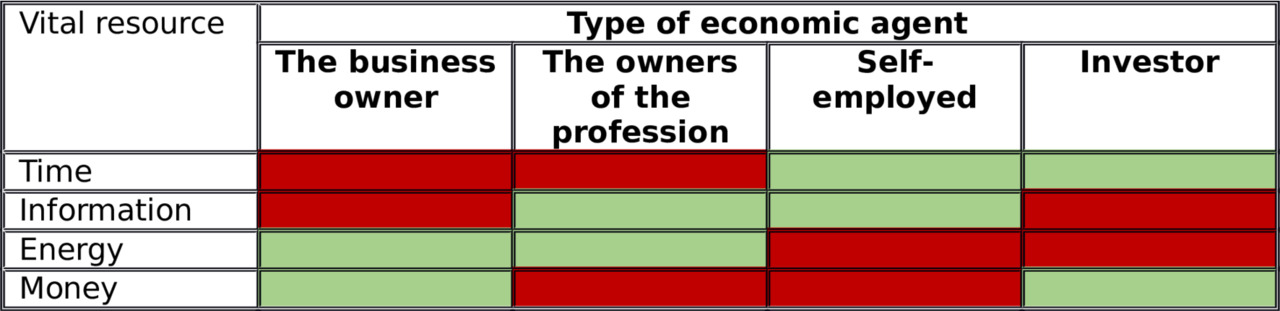
The business owner produces two key resources to the market — money and the energy embodied in his company. The presence of energy represented by hired labor classifies the owner as an energy-rich market participant, and the presence of a company makes it possible to evaluate him as a market entity with cash.
The owners of the profession in the market, including both employees and self-employed persons, offer their knowledge and energy. This group covers a wide range of liberal professions, from SMM specialists, tutors and lawyers to creative professionals such as artists and architects. Despite the diversity, both subgroups, employees and freelancers, essentially offer the same exchange — their professional skills and energy in exchange for financial compensation and free time.
Innovators bring time and knowledge to the market. As a rule, by teaming up with investors and entrepreneurs looking for new ways to develop their business and generate passive income, innovators earn income through joint business projects, sharing a share in enterprises.
Investors have money and time, managing their resources through others. In the search for energy in the form of an existing or potential organizational structure, an investor also needs knowledge about where and how to invest his funds. Having free time allows him to actively search for the vital resources he needs — energy and knowledge.
Thus, vital resources are also reflected in the cash flow quadrant system. However, the vital resources market has enormous contradictions. Despite the growth of inventors and innovators, due to the large amount of unstructured, incorrect and paid information, they often face difficulties. People often fall into the hands of scammers. The dissatisfaction of employees and freelancers is the engine on the path of progressive change.
To summarize the above, the effective use of vital resources allows you to optimally spend resources with the least loss and maximum efficiency. It also ensures sustainable development and well-being for present and future generations by developing more efficient technologies to increase the amount of free time, as well as increasing awareness and education in the field of rational use of resources.
This approach helps to strengthen international cooperation and take legislative measures to ensure the sustainable use of vital resources and prevent their depletion.
References:
1. Balatsky E.V. Vital resources market and its properties// «Society and economics» — 2018 — No. 8 — pp. 35—38.
2. Varrava M. Yu. Vital resources: Expanding the interpretation of human capital // Elibrary.ru — 2020 — pp. 16—17.
3. Dmitrienko V.V. Vital resources market: a new look at economics // Cyberleninka — 2020 — No. 1 — p. 4.4.
4. «The Cash flow Quadrant» // Open Journal URL: https://journal.open-broker.ru / (accessed: 11/29/2023).
Вахидова В. П., Дернова А. С.
The main elements of assessing the level of digital transformation in an enterprise
Vakhidova V. P., Dernova A. S., 3rd year Bachelor Degree students «Business Informatics»
Scientific adviser: Kyuregyan M.P., PhD (Sociology), Associate Professor of the Department of Foreign Languages
Federal State Budgetary Educational Institution of Higher Education «Technological University named after twice Hero of the Soviet Union, Pilot-cosmonaut A.A. Leonov», Korolev, Russia
This article examines the impact of digital transformation on enterprise management and business process performance indicators. The main elements of assessing the level of development of the digital transformation of an enterprise and methods for evaluating the effectiveness of planned actions for digital transformation are described.
Keywords: digital transformation, business management, business process efficiency, digital maturity assessment, digital tools
The analysis of the management of the company’s activities in the context of digital transformation significantly affects the indicators of improving the efficiency of the organization’s business processes. The effectiveness of the main indicators characterizing the activities of an enterprise is achieved by the introduction of digital tools, as well as their implementation in the area of the enterprise where the shortcomings that directly affect the current state of affairs of the organization as a whole are most significantly reflected. The introduction of digital tools contributes to improving the quality of goods and services produced by the enterprise, increasing profitability, automating business processes, maintaining the sustainable development of the enterprise’s activities, as well as analyzing stocks, the state of production facilities and operational processes of the enterprise.
Currently, there are basic elements for assessing the level of development of a digital transformation of an enterprise. The assessment of the digital maturity of an enterprise is a multi–level study of an organization that allows you to assess its growth potential, identify the most favorable industries where digital tools are actively used, as well as develop an individual digital transformation strategy [2]. The description of criteria for evaluating the effectiveness of planned actions for the digital transformation of an enterprise is an important component that allows you to assess the implementation of digital transformation in the company’s activities, and also allows you to implement the project of introducing digital tools that was created by a specific enterprise in order to improve the efficiency of its activities [1].
It is necessary to be guided by these elements of evaluating digital transformation at a particular enterprise, since in the process of system transformation there is always a risk that a project developed by a certain enterprise for the introduction of digital tools will be implemented only formally and subsequently will not lead to qualitative changes in the area of the organization in which these innovations are significantly needed.
To analyze the level of development of digital transformation in an enterprise, there are certain elements that provide an assessment of the company’s activities in terms of its active use of digital tools.
The main elements of assessing the digital transformation of an enterprise are:
1) Management processes and products;
2) Storing large amounts of data;
3) Availability of digital competencies of employees;
4) Infrastructure and tools;
5) Algorithms and models of the company based on innovations;
6) The level of digital organizational culture.
I would like to mention that with any chosen approach to assessing the digital maturity of an enterprise, it is necessary to maintain exactly the target state of the organization, set by the requirements of digital transformation.
If the digital transformation of an enterprise is carried out at the level of process management, that is, activities for the formation of purposeful behavior of the organization by highlighting, describing complementary processes of the organization, then at this stage the result of the introduction of digital transformation should be an analysis of the results of the organization’s activities, the rejection of unnecessary processes, the creation of a digital platform of the organization.
If the digital transformation of an enterprise is carried out at the level of project management, that is, a method of managing large-scale tasks in conditions of time and resource constraints to achieve the stated results and goals, then at this stage of the results of the implementation of digital transformation there should be an improvement in quantitative and qualitative indicators, namely, this improvement should be reflected in reducing the project implementation time, obtaining the required characteristics of the results.
If the digital transformation of an enterprise is carried out at the level of innovation, then in this case the enterprise should provide for the development of new integrated information solutions and management tools, as well as increasing the level of competence of employees of an organization.
Within the framework of this topic, we can single out such a term as a digital enterprise — an organization that actively uses and implements digital technologies in its activities, acting as a competitive advantage in internal and external operations involved in the activities of the enterprise [4]. Currently, a term such as digitalization is repeatedly used — it is the improvement of production management of goods and services, as well as production in general, based on the active use of end-to-end modern information technologies [4].
End–to-end digital technologies are advanced scientific and technical industries that ensure the creation of high-tech products and services, as well as having a significant impact on economic development, contributing to the formation of new markets. It is thanks to end-to-end technologies that the development of digital transformation at the enterprise is achieved in a relatively short period of time. Informatization as a factor in the development of society is the introduction of digital technologies into all spheres of human life. The informatization of society is an organized socio–economic, scientific and technical process of creating optimal conditions to meet the information needs of society.
Also, enterprises actively use such a concept as a technological process — a system of interrelated actions that are performed from the moment the initial data appears until the desired result is obtained [4].
Next, it is necessary to analyze end-to-end digital technologies that are actively used in the activities of enterprises.
In this regard, the main tools of digitalization of the technological process that stimulate the level of economic development are: digital data, the effectiveness of various types of technologies, artificial intelligence (Artificialintelligence, AI), machine learning (Machine Learning, ML), robotics, cloud technologies, digital platforms and services, creation of a digital layout, computer engineering, RFID technologies, technologies for collecting, processing and analyzing big data, automated lines, Internet of Things (InternetofThings, IoT). Of course, this list of end-to-end digital technologies that significantly facilitate the production activities of the enterprise is incomplete, in turn, these digital solutions are a stimulating factor in the development of effective use of all types of enterprise resources, namely labor, financial, reproductive (labor, equipment, etc.) and other resources directly involved in the activities of the enterprise.
To understand the content of the main tools of the digital economy, it is necessary to reveal the essence of each of the above concepts.
Digital platforms are the main basis for designing key links in the technological chain, individual processes or elements [4]. Artificial intelligence is a digital assistant, an automated control system for technological processes that coordinate the activities of various information systems [4].
An important and relevant area of the digital economy is the use of digital layouts. For example, creating a digital layout of a metal part in production. The need to create a digital layout is due to the correction of potential errors and the elimination of defects in the production cycle of the enterprise [3].
Robotics is a science that deals with the design, manufacture, improvement and application of programmable mechanical devices. Robotics, in turn, studies electronics, mechanics, cybernetics, computer science, and radio engineering [4].
Machine learning is a specialized way to train computers without resorting to programming in order to perform certain tasks that do not have explicit instructions or algorithms. Machine learning is one of the most common forms of artificial intelligence application by business in modern conditions [4].
Before proceeding to the explanation of the term «computer engineering», it is necessary to mention the key factors of the competitiveness of managers such as digital design and modeling, which ensure a significant increase in competition in the market. Computer–aided design is the process of developing 3D models in CAD systems, that is, in systems that allow you to create drawings, design or process documentation. Examples of such systems are CATIA, SolidWorks, Siemens NX, Autodesk, Compass 3D.
Computer engineering is a set of methods and tools for modeling based on appropriate software. This software is called CAE Systems (Computer–Aided Engineering) [4].
Computer engineering allows you to simulate the behavior of structures, machines, physico-mechanical and technological processes.
Automated lines are a group of machines that, having common control mechanisms, automatically perform a cycle of product processing operations in a technological sequence. The automatic line is equipped with automatic vehicles for moving products from one machine to another.
The Internet of Things is the concept of a data transmission network between physical objects equipped with built-in tools and technologies for interacting with each other or with the external environment [4].
The above-mentioned digital technologies, in fact, are a tool for stimulating the development of an enterprise’s production activities.
Thus, it can be concluded that digital transformation plays a key role in improving the efficiency of business processes of enterprises. The assessment of the digital maturity of the enterprise makes it possible to identify the most favorable industries for the introduction of digital tools and develop a digital transformation strategy. Evaluating the effectiveness of planned actions for digital transformation is an important component that allows you to evaluate the implementation of digital tools and implement projects aimed at improving the efficiency of the enterprise.
References:
1. Anisiforov A.B. features of digital transformation projects of industrial enterprises and some aspects of preparation for their implementation // Economics and Environmental management. 2022. No.2. URL: https://clck.ru/3GDc6Q (date of application: 11.03.2024).
3. Alexey G. Tashkinov stages of formation of the strategy of digital transformation of an industrial enterprise // π-Economy. 2023. No.6. URL: https://clck.ru/3GDc74 (date of application: 11.03.2024).
4. Statsenko E. V. ON DIGITAL TRANSFORMATIONS IN ENTERPRISES // Economics of construction and environmental management. 2022. №1—2 (82—83). URL: https://clck.ru/3GDc7c (date of application: 11.03.2024).
Вахидова В. П., Дернова А. С.
Digital technologies in logistics at the national and international levels
Vakhidova V. P., Dernova A. S., 3rd year Bachelor Degree students «Business Informatics»
Scientific adviser: Kyuregyan M.P., PhD (Sociology), Associate Professor of the Department of Foreign Languages
Federal State Budgetary Educational Institution of Higher Education «Technological University named after twice Hero of the Soviet Union, Pilot-cosmonaut A.A. Leonov», Korolev, Russia
This article explores the gap in the use of digital technologies in the national market in comparison with the international market, as well as provides explanations and reasons for such gaps.
Keywords: national market, international market, digital technology, gap
In order to be able to draw any conclusions about the digitalization of logistics, it is necessary to analyze which technologies are used in this area in practice, and how successful their application is. It is worth noting that, as described earlier, the digitalization of logistics in the Russian Federation lags far behind the most successful countries in this area, so it would be advisable to compare the situation in this industry in the Russian Federation with the situation in such countries.
The authors propose to make a comparison for each digital technology, evaluating the data on the volume of use presented in Table 1, methods of application, investment volume and development prospects for each technology.
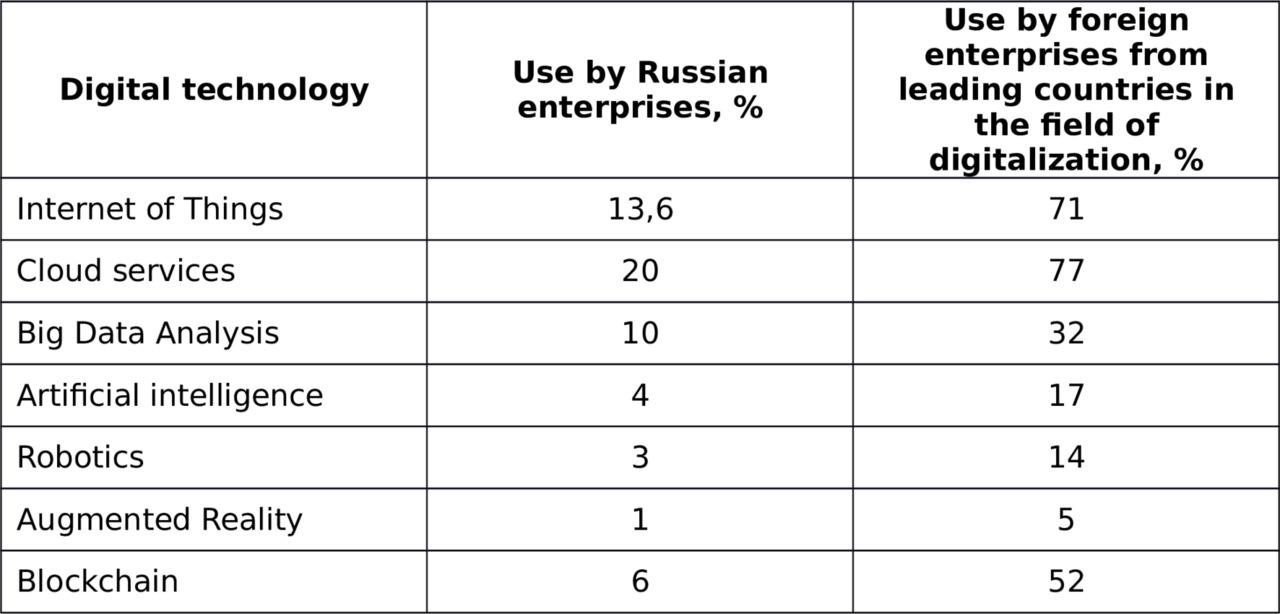
Note: compiled by the authors.
The Internet of Things can be chosen as the first digital technology for analysis. This digital technology originated a long time ago and does not require large investments for its implementation. Therefore, this technology has become extremely widespread. But even with the use of such technology, there is a serious difference between the national market and the foreign one. If we consider the most developed countries from the point of view of logistics, we can see that «about 71% of enterprises actively use this technology» [1 p.9]. «For national enterprises, this indicator is noticeably lower — only 13.6%» [2 p.91]. Since this technology has been used for a long time, its scope of application is quite extensive. In the national market, its use is often limited to warehouse solutions, which is reflected in such a low percentage of use.
From the above statistics, it can be seen that national companies use this technology 5 times less often, which is a very significant difference.
The reasons for this gap, according to the authors, should be assessed later, after the general characteristics of the industry, since many of the reasons will be common to all the technologies under consideration.
The authors propose to consider cloud services as the next technology. This technology also does not require large costs for its use, therefore, «the statistics of its use by enterprises in the most developed countries from the point of view of digitalization of logistics is also high — 77%» [1 p.9]. «For Russia, this indicator is much lower, but also quite high — 20%» [2 p.91]. According to the authors, this indicator is also due to the low level of application of this technology in the regions. «Given the fact that the Russian Federation is actively striving to digitalize the economy, especially in the field of cash flow to track tax payments, the author believes that by 2030 the Russian Federation will be able to catch up with even the most developed countries in this industry» [3]. This position is due to the fact that in the conditions of the modern market in Russia, it is not only more convenient for enterprises to store data in cloud services, but also the Federal Tax Service stores some of the documents of enterprises on its servers, which can also be conditionally called cloud storage for enterprise logistics.
At the moment, there is a noticeable 4–fold lag in this technology for the national market.
Another technology that the authors propose to consider is big data analysis. In fact, this technology is closely related to the previous two, but its implementation requires significantly higher investments, so only «32% of companies from the most developed countries in the field of logistics use this technology» [4, p.58]. «In the national market, the technology is widespread only among 10% of enterprises» [2 p.91]. The scope of application of this technology, as the name implies, is limited exclusively to large logistics enterprises. It makes no sense to use this technology in a small company, which leads to a low percentage of its use, both in the national market and in foreign companies.
Based on their statistics, it can be seen that domestic enterprises ready to use this technology are only 3 times less than in the most developed countries in this area.
Statistics on artificial intelligence technology also reflect the relatively high cost of its implementation. In the most developed countries in this area, «17% of companies use this technology» [9]. «Domestic companies use this technology less often — 4%" [2 p.91]. Based on these data, it can be seen that domestic companies are 4 times behind. The scope of these technologies is also limited exclusively to large enterprises, which leads to a lower prevalence.
Robotics is used even less often: «only 14% of enterprises for the external market» [4, p.58]. «In Russia, robotics is used even less often — only 3%» [2, p.91]. It is worth noting that statistics on this technology are not entirely correct, since automated manipulators, conveyor belts and other technologies that have already proven themselves well in the market are mostly used in Russia. At the same time, foreign companies are resorting to more modern options — robotics for moving racks, assembling orders and other options. Based on statistical data, it can be concluded that domestic companies use this technology 5 times less often.
The next technology is augmented reality technology. This technology is one of the newest for the logistics market, so its scope of application is relatively small. «Less than 1% of the enterprise in the domestic market and about 5% in the foreign market» [2 p.91]. The scope of this technology is limited to large warehouses, which are available to a small number of logistics companies in the national market, while for most companies this technology does not make sense due to the disorganization of small warehouses.
«Blockchain for the foreign market is already an established technology used by 52% of companies» [4, p.58]. «For the national market, this is still a new technology, which is used by only 6% of enterprises» [2, p.91]. Thus, in Russia, this technology is used 9 times less often. The scope of this technology is limited to the conclusion of contracts. Digital platforms that simplify this process are actively developing in Russia, which leads to a decrease in the pace of development of this technology.
Unmanned vehicles, as mentioned above, cannot be used on the national market due to legal problems, so there is no point in comparing the spread of this technology.
Digital technologies play a key role in modern logistics both at the national and international levels. They make it possible to optimize supply chain management processes, improve demand forecasting, and increase the efficiency of warehousing and cargo transportation. Through the use of digital platforms and management systems, companies can improve their operational efficiency, reduce costs and improve the quality of customer service. At the international level, digital technologies help to reduce the time of cargo delivery, improve tracking and monitoring of cargo transportation, as well as simplify customs procedures. In general, digital technologies are becoming an integral part of modern logistics, providing more efficient and transparent supply chain management at various levels.
References:
1. Digital technologies in logistics and supply chain management: an analytical review [Text] / V. V. Dybskaya, V. I. Sergeev, N. N. Lychkina, etc.; under total. and scientific ed. by V. I. Sergeev; National research. Higher School of Economics Univ., Moscow: Publishing House of the Higher School of Economics, 2020. — 190, [2] p. — 500 copies. URL: https://clck.ru/3GDcAJ (date of application: 11.03.2024). — Bibliogr. in the book. — ISBN 978-5- 7598-2348-3 (in the region). — ISBN 978-5-7598-2243-1 (e-book). — the text is electronic.
2. Digital transformation: expectations and reality: dokl. to the XXIII Yasinskaya (April) International Scientific Conference on problems of economic and social development, Moscow, 2022 [Text] / G. I. Abdrakhmanova, S. A. Vasilkovsky, K. O. Vishnevsky, M. A. Gershman, L. M. Gokhberg, etc.; author’s hand. Col. P. B. Rudnik; National research. Higher School of Economics Univ., Moscow: Publishing House of the Higher School of Economics, 2022. — 221 p. URL: https://clck.ru/3GDcKe (date of application: 11.03.2024).– Bibliogr. in the book. — ISBN 978-5-7598-2468-8 (e-book) — electronic text.
3. Digitalization in the Federal Tax Service. TAdviser media. [electronic resource]. URL: https://clck.ru/3GDcM5 (FTS) (date of application: 11.03.2024).
4. Wang Xiuying APPLICATION OF DIGITAL TECHNOLOGIES IN INTERNATIONAL SUPPLY CHAINS // Bulletin of the RUSSIAN State University of Economics. 2020. No.4 (72). URL: https://clck.ru/3GDcMZ (date of application: 05/10/2023)
5. Alexey G. Tashkinov stages of formation of the strategy of digital transformation of an industrial enterprise // π-Economy. 2023. No.6. URL: https://clck.ru/3GDcNS (date of application: 11.03.2024).
Велиев А. Я.
Некоторые аспекты системы современного здравоохранения в России и других странах
Велиев А. Я., студент 2 курса направления подготовки «Международный бизнес»
Научный руководитель: Сагайдачная Е. Н., кандидат филологических наук, доцент кафедры иностранных языков для экономических специальностей
Ростовский государственный экономический университет (РИНХ), Ростов-на-Дону, Россия
Данная статья посвящена актуальной проблеме современности — проблеме здравоохранения. В современном обществе здоровье является одним из основных приоритетов, и поэтому эта тема весьма значима для любого кандидата, стремящегося стать президентом. Комплекс мер, предложенных в данном исследовании, направлен на улучшение качества медицинской помощи, развитие диагностики и лечение различных заболеваний, а также предотвращение эпидемий и повышение продолжительности и качества жизни.
Ключевые слова: здравоохранение, медицинская помощь, диагностика, лечение, эпидемии, цифровизация, научно-технические достижения.
Проблемы здравоохранения являются обязательным пунктов в современной повестке любого сильного кандидата в президенты. Этот пункт с легкостью перевешивает многие другие обещания предвыборной повестки, что сигнализирует о его чрезвычайной актуальности. Этот комплекс мер направлен на обеспечение высокого качества медицинской помощи, улучшение диагностики и лечения различных заболеваний, а также предотвращение возникновения новых эпидемий и болезней, увеличение продолжительности жизни, повышение ее качества. Эта область активно развивается как в России, так в других странах, применяя передовые научные и технические достижения. [5]
Современная Россия цифровизирует все сферы жизни, внедряя новые технологии и в область здравоохранения. Одним из ярких примеров служит использование системы электронного здравоохранения (ЭЗО), которая позволяет собирать и обрабатывать данные о состоянии пациента, проводить удаленные консультации и обмен информацией между медицинскими учреждениями. Эта система способствует повышению эффективности медицинской помощи и сокращению времени ожидания в очереди на получение этих видов услуг. В других странах также активно развиваются медицинские науки и новые технологии в здравоохранении. Например, в Китае уже запущена система электронного здравоохранения, которая позволяет проводить удаленные консультации и обмен информацией между медицинскими учреждениями. Кроме того, в Китае активно исследуются методы использования стволовых клеток для лечения различных заболеваний и внедряется технология распознавания лица в медицинской сфере.
В Индии также существует система обязательного медицинского страхования, которая обеспечивает доступность медицинских услуг для всех граждан. [3] Однако, в Индии также существуют проблемы с доступностью качественной медицинской помощи в отдаленных районах страны.
В целом, доля онлайн-консультаций по медицинским направлениям может различаться в разных странах в зависимости от уровня развития медицинских наук и новых технологий в здравоохранении. Однако, использование передовых научных и технических достижений в медицине способствует повышению качества медицинской помощи и улучшению доступности для всех видов населения.
Следует отметить инновационные медицинские технологии, активно внедряющиеся в России, среди которых роботизированная хирургия и применение искусственного интеллекта в диагностике и прогнозировании заболеваний занимают особое место. Роботы-хирурги позволяют проводить сложные операции с высокой точностью и минимальными травмами для пациента. Искусственный интеллект с помощью алгоритмов машинного обучения и обработки больших данных позволяет создавать модели заболеваний, прогнозировать их развитие и подбирать оптимальные методы лечения. [1]
Однако не только Россия, но и другие страны активно развивают медицинские науки и новые технологии в здравоохранении. Например, в США проводятся интенсивные исследования в области генетики и генной терапии. Ученые работают над созданием новых методов лечения генетических заболеваний с помощью коррекции генов. Также в США широко применяются теледокторские консультации, которые позволяют пациентам получать медицинскую помощь на расстоянии с помощью видеосвязи. [6] Доля ВВП, выделяемая на здравоохранение или страхование, может варьироваться в разных странах. В России государство предоставляет бесплатное медицинское обслуживание своим гражданам, а расходы на здравоохранение покрываются из федерального бюджета. Конкретное разделение между общей и дополнительной страховкой может различаться, но в целом они покрывают основные медицинские услуги, такие как посещение врача, госпитализация, диагностические тесты и лекарства. Кроме традиционных медицинских услуг, Россия активно внедряет инновационные медицинские технологии, такие как роботизированная хирургия и использование искусственного интеллекта для диагностики и прогнозирования заболеваний. Роботизированные хирурги позволяют выполнять сложные операции с высокой точностью и минимальным травматизмом для пациента. Искусственный интеллект, используя алгоритмы машинного обучения и обработку больших объемов данных, помогает создавать модели заболеваний, прогнозировать их развитие и определять оптимальные методы лечения. Стоит отметить, что не только Россия, но и другие страны активно развивают медицинские науки и новые технологии в сфере здравоохранения. Например, в Соединенных Штатах интенсивно ведутся исследования в области генетики и генной терапии. Ученые разрабатывают новые методы лечения генетических заболеваний путем коррекции генов. [2] Телемедицинские консультации, которые позволяют пациентам получать медицинскую помощь удаленно через видеосвязь, также широко используются в Соединенных Штатах. Чтобы сравнить медицинскую страховку в России, важно учитывать основного поставщика медицинской страховки в стране, который является Обязательным Медицинским Страхованием (ОМС). ОМС — это государственная программа, финансируемая из бюджета, которая предоставляет базовое медицинское покрытие для всех граждан и резидентов России.
Основные аспекты ОМС в России:
1. Покрытие: ОМС охватывает широкий спектр медицинских услуг, включая первичную медицинскую помощь, консультации специалистов, диагностические тесты, госпитализацию, неотложную помощь и определенные лекарства. Однако покрытие может варьироваться в зависимости от региона и конкретного страхового плана.
2. Доступ к медицинской помощи: с ОМС физические лица могут получать медицинские услуги через государственные медицинские учреждения, такие как поликлиники, больницы и специализированные медицинские центры. Выбор медицинских учреждений может быть ограничен теми, которые входят в сеть ОМС.
3. Стоимость: ОМС финансируется обязательными взносами работодателей и работников, а также федеральным и региональными бюджетами. Стоимость ОМС зависит от доходов и статуса занятости физического лица. Некоторые услуги могут потребовать дополнительных платежей или дополнительных сборов в зависимости от конкретного страхового плана.
4. Ограничения: Несмотря на то, что ОМС предоставляет базовое покрытие, он может не покрывать определенные элективные процедуры, косметические обращения и экспериментальные лечения. Кроме того, доступность определенных специализированных услуг и медицинских технологий может быть ограничена в некоторых регионах.
Что касается внедрения инновационных медицинских технологий в России, таких как роботизированная хирургия и использование искусственного интеллекта в диагностике и прогнозировании заболеваний, то следует отметить, что эти достижения набирают обороты в системе здравоохранения страны.
Роботизированная хирургия позволяет проводить точные и минимально инвазивные хирургические вмешательства, снижая травматичность для пациента и улучшая результаты операций. Искусственный интеллект, с помощью алгоритмов машинного обучения и обработки больших данных, позволяет создавать модели заболеваний, прогнозировать их развитие и выбирать оптимальные методы лечения. [4]
Приведем сопоставительный анализ основных параметров доступности медицинских услуг для всех видов населения в разных странах.
1. В России: В России существует обязательная медицинская страховка (ОМС), которая обеспечивает доступ к основным медицинским услугам для всех граждан. Однако, доступность некоторых видов медицинских услуг может быть ограничена в зависимости от региона и уровня медицинского обслуживания.
2. В Китае: Китай имеет государственную систему медицинской страховки, которая обеспечивает доступ к медицинским услугам для всех граждан. Однако, как и в России, доступность некоторых видов медицинских услуг может быть ограничена в зависимости от региона и уровня медицинского обслуживания.
3. В США: В США медицинская страховка является добровольной, и доступ к медицинским услугам может различаться в зависимости от наличия страховки. Некоторые люди могут иметь ограниченный доступ к медицинским услугам из-за отсутствия страховки или низкого дохода.
Что касается самых частых случаев обращений по простой страховке, то это может варьироваться в зависимости от страны и вида страхования. В общем случае, наиболее распространенными причинами обращений по медицинской страховке являются простудные заболевания, травмы, аллергии и проблемы с пищеварением.
Развитие медицинских наук и новых технологий в здравоохранении является прогрессивным шагом не только для улучшения качества медицинской помощи, но и для экономики каждой страны. Однако важно учитывать этические аспекты применения новых технологий, а также обеспечивать доступность медицинской помощи для всех слоев населения.
Таким образом, развитие медицинских наук и новых технологий в здравоохранении является важным элементом развития как в России, так и в других странах. Это позволяет улучшить диагностику, лечение и прогнозирование заболеваний, а также сократить время ожидания и сделать медицинскую помощь более доступной для всех пациентов.
Литература:
1. «Проблемы здравоохранения в современной России» // Под редакцией д. м. н., профессора И. Н. Добровольского. — М.: 2019.
2. «Цифровые технологии в здравоохранении: опыт и перспективы» // Под редакцией д. м. н., профессора А. А. Коновалова. — М.: 2018.
3. «Электронное здравоохранение: опыт и перспективы развития» // Под редакцией д. м. н., профессора А. А. Коновалова. — М.: 2017.
4. «Медицинские науки и новые технологии в здравоохранении: опыт и перспективы развития» // Под редакцией д. м. н., профессора А. А. Коновалова. — М.: 2018.
5. «Применение стволовых клеток для лечения различных заболеваний: опыт и перспективы» // Под редакцией д. м. н., профессора И. Н. Добровольского. — М.: 2019.
6. «Распознавание лица в медицинской сфере: опыт и перспективы» // Под редакцией д. м. н., профессора А. А. Коновалова. — М.: 2018
Воробей Н. В.
Unity’s new failed policy
Vorobey N.V., 3rd year Bachelor Degree student «Applied Informatics»
Scientific adviser: Arutyunyan D.D., PhD (Pedagogy), Associate Professor, Associate Professor of the Department of Foreign Languages
Federal State Budgetary Educational Institution of Higher Education «Technological University named after twice Hero of the Soviet Union, Pilot-cosmonaut A.A. Leonov», Korolev, Russia
The article discusses the new earnings policy of Unity and the negative consequences for it.
Keywords: monetization, the game engine, game development, Unity
The popular Unity game engine announced on September 12 that, starting in 2024, the company will charge developers «for installing» Unity projects they have created.
In an appeal on the Unity blog, it was announced that the «standard rate» for installing the Unity project would be $0.20, although there is some pricing flexibility, depending on the profitability of the project [1].
Axios author Steven Totilo shared a few clarifications on Twitter after contacting Unity:
— if the player deletes the game and downloads it again, this is 2 installations, and the fee will be charged 2 times,
— if they are installed on 2 devices, then this is also 2 payments,
— if charity games/projects exempt from fees.
This was the original plan, but after a huge negative reaction from the gaming community and the game development community, the details were changed, as Totilo once again explains, that «Unity is in a hurry to clarify the price increase plan, as game developers are furious.» [2]
Unity has changed the rules and now says that the fee is charged only for the initial installation of the game.
Falconeer developer Thomas Sala has previously spoken highly of Unity and why he chose this particular game engine. After the announcement, Thomas tweeted: «Raise your hand if you’re a publisher who just wrote to his developers, „Hey, isn’t it too late to port to Unreal?“»
Another anonymous developer who talked to GameDeveloper.com, stated that the fee «annoys indie developers and smaller developers the most.»
Unity general manager Mark Whitten announced the revised platform’s payment policy in a blog post after weeks of backlash. The company is now offering a strict limit on Unity execution fees for some developers [3].
According to the new plan, anyone who creates with Unity Personal and earns less than $200,000 in revenue over a 12-month period will not pay any commission, and these developers will no longer need to turn on the «Made with Unity» screensaver. No game that earns less than $1 million over a 12-month period will also pay a fee.
Studios using the Pro and Enterprise packages will be subject to a new platform fee if they upgrade to the next version of Unity shipping in 2024. Projects currently in development will be subject to a fee only if the studio switches to this new version of Unity, that any developer who stays on the old version will still work with their original terms of service [4].
Whitten said that the planned fee was also different then. Games with revenue in excess of $1 million will be subject to a 2.5 percent revenue split, which is half of what Unity’s Unreal Engine competitor charges, or Unity will calculate the amount owed based on «the number of new people who participate in the game every month.»
The last part is a bit vague, but on a separate FAQ page, Unity recommended that developers rate it based on the number of upfront payments or new user accounts created. If the developers do not provide their own figures, Unity will make its own estimates based on the data available as a result of the integration that the developer initially agreed to in his contract [5].
Whitten said that developers will self-report on their income and engagement, and the fee charged will always be the lesser of the two amounts. Games distributed through streaming or subscription services, including Xbox Game Pass games, will still be charged.
References:
1. Unity in Action, Second Edition Multiplatform game development in C#:. Joseph Hocking:, 2018. 400 с.
2. An open letter to our community [Электронный ресурс]. URL: https://blog.unity.com/news/open-letter-on-runtime-fee (Дата обращения: 18.01.2024).
3. Unity announces new fee policies after intense backlash [Электронный ресурс]. URL: https://videogames.si.com/news/unity-runtime-fee-new-policy (Дата обращения: 20.01.2024).
4. Unity announcement outrages developers, backtracks within hours [Электронный ресурс]. URL: https://videogames.si.com/news/unity-engine-per-install-charge-backlash (Дата обращения: 20.01.2024).
5. Unity plan pricing and packaging updates [Электронный ресурс]. URL: https://blog.unity.com/news/plan-pricing-and-packaging-updates (Дата обращения: 19.01.2024).
Ворощук Д. В.
Problems of the Russian economy and ways to solve them
Voroshchuk D.V., 3rd year Bachelor Degree student «Economics»
Scientific adviser: Arutyunyan D.D., PhD (Pedagogy), Associate Professor, Associate Professor of the Department of Foreign Languages
Federal State Budgetary Educational Institution of Higher Education «Technological University named after twice Hero of the Soviet Union, Pilot-cosmonaut A.A. Leonov», Korolev, Russia
Currently, the Russian economy is experiencing some difficulties due to political, demographic and economic factors. The article presents the main problems of the Russian economy and ways to solve them.
Keywords: Russian economy, main problems, reforms, investments
Over the past 20 years, Russia has experienced several crises. This caused a severe decline in the economy as a whole, which still affects the well-being of society and the state. Also, the Russian economy has not been able to fully recover and stabilize at the moment. In addition, numerous sanctions have been imposed on Russia by hostile countries. Thus, Russia is in a rather difficult situation, but despite this, the Russian economy has stabilized slightly after the fall of the ruble to a critical level and the imposition of sanctions by the international community, but the situation still remains tense. Political, economic and cultural events have a significant impact on the Russian economy. Numerous footsteps from neighboring countries that have become unfriendly threaten Russia, its development, the welfare of the people, and also form new problems of the Russian economy.
The situation is also complicated by the low investment attractiveness of the country — entrepreneurs can develop solely at the expense of their own or borrowed funds. Given the lack of finances, the number of jobs is decreasing, and wages remain at the same level with a constant increase in prices for food and utilities. Thus, the problems of the Russian economy are acutely felt by the poorest segments of the population.
The main problems of the Russian economy can be noted:
— Sharp and unpredictable fluctuations in gas and oil prices.
— Constant criticism from unfriendly states.
— Low income level of citizens.
— Poor infrastructure development.
— Low labor productivity.
It often happens that highly qualified workers go abroad, realizing that they will be able to receive a higher salary there than in their native state. This is complemented by high taxes. Small and medium-sized businesses in Russia are in critical condition. Since the beginning of work, taxes simply «eat up» the entrepreneur, which does not allow him to develop further. In addition, there are practically no incentives for small and medium-sized businesses. But the problem lies in the fact that it is small and medium-sized businesses that raise the economy, and it is understood by the words «domestic manufacturer». Although the sanctions have given some opportunity to many entrepreneurs to break into the market, the state still does not provide an opportunity to run a conscientious and profitable small and medium-sized business.
All these aspects shape the situation of the Russian economy in which it is practically impossible to develop the state. This creates such a difficult situation for the Russian Federation both on the global and domestic markets.
Solutions
Starting in 2019, a special fund was created that will invest high amounts of public money in this area of the economy for six years — perhaps about 3% of GDP — which, in turn, will attract the private sector. The state offers to use the money to create this fund. In order to attract money to the market and channel it into investments that lead to large government assets and that will run on emissions.
In the current situation, the use of exclusive financing instruments for infrastructure investments is quite justified. When the government takes over the operating costs, nothing good comes of it. When working on infrastructure, the main condition is that this infrastructure leads to a significant improvement in the quality of people’s lives.
The fact that today Russia has a low level of sovereign debt by world standards (about 13% of GDP) means that we have a large resource. This means that in the coming years, the state has reserves that we can use to invest in infrastructure. We must understand that investments in public debt have a large — and indeed multiplying — effect resulting from the growth of private investment.
The Government must create stable conditions. This means that the tax system will not change over the next six years. Adjustments are currently being approved. We see action in this direction as reducing the tax burden, which negatively affects business. The state is creating a mechanism that will be of interest to individuals and work officially. It depends on a large contribution to GDP.
It is also necessary to halve the level of administrative burden, which determines the business. The state should see 1—2 million new entrepreneurs in Russia every year.
Pension savings need to be transferred to the system. This is necessary according to favorable criteria: to provide pensioners with a decent profit and basic cash.
Increasing household savings is an increased risk. To do this, it is necessary to create a mechanism for long-term savings. If in the next six years we do not see a significant funded pension system and life insurance system in Russia, then we certainly cannot talk about significant application.
It is necessary to develop a funded system to ensure decent pensions, in particular, voluntary individual pension capital. Such an institution should be established, and it should focus on expanding the pension system.
It is necessary to double non-primary exports no later than 2024. Also, double the number of Russian companies entering the global market. There should be a «green channel» for companies, support and various forms of export support incentives. Export growth is the main, most complete indicator of economic efficiency.
A change in growth rates for the entire population is an increased growth rate for the entire population and the population around the world.
Russia is in a very difficult position. Russia’s path to economic recovery and growth directly depends on the pace of reforms. The solution to the problems of the Russian economy lies exclusively in reforms, which should take place in three directions: economic, social, and Special attention should be paid to smoothing the conditions of competition, determining the licensing procedure, simplifying inspections, and so on; administratively. The establishment of the work of the «top» in the management sphere, the fight against corruption; social. Reforms in the field of healthcare and education. The introduction of structural changes is particularly important for Russia’s desire to simultaneously realize demographic and economic transformation in the long term. To implement the reforms, it will be necessary to privatize certain sectors (for example, textiles), transparent and effective public investment, improve customs management, and minimize trade barriers to increase the efficiency of the domestic market.
There are many echoes of the last century in the current situation of the Russian economy. For example, such a bright event in the economic (and not only) history of Russia as privatization. Due to the overwhelming predominance of state ownership in our country, this process was necessary for the demonopolization of the economy and stabilization of the economic situation, the development of the democratic nature of ownership and management of enterprises, for the rational operation of the public sector, to increase the efficiency of enterprises, to stimulate various forms of entrepreneurship, improve the state of public finances and reduce inflation. At the beginning of privatization, it was assumed that the established ownership structure would be transitional and should be further transformed into a more efficient structure, and the main factor during privatization would be the arrival of new external investors, including foreign ones, who would invest in the development of these enterprises through the stock exchange and over-the-counter stock markets in exchange for participation in the share capital. However, these expectations were not fulfilled — many enterprises were unable to attract real investments in exchange for equity participation. As a positive result, it should be noted that in parallel with the privatization process, there was an intensive formation of new private enterprises. Privatization is one of the most important steps taken by the state over the past 20—30 years, which has dramatically affected the current state of the Russian economy. The role of households as economic agents in the formation of the Russian economy can be traced with the naked eye. Consider the events of the last decade. As you know, households can contribute in various ways. One of them is the creation of individual entrepreneurship (IE). Having collected all the documents, any household can organize its activities. Before organizing an individual entrepreneur, a household must decide what it will produce or what services it will provide as an individual entrepreneur. Households have great prospects for starting their own business, as they can provide a wide variety of services. As a result, the development of small and medium-sized businesses in the national economy. As we know, the gradual development of small and medium-sized businesses in the country will lead to the evolution of the service sector from a minimal market share to a prevailing one. And according to scientists, a developed service sector is an indicator of a developed country.
References:
1. Belousov, V. I. On the role of the technological factor and modernization of the domestic economy in overcoming the economic crisis / V. I. Belousov, A.V. Belousov // Problems of modern economics. — 2010. — №2 (34). — Pp. 19—21.
2. Belousov, V. I. Anthology of modernization of economies: from adaptive to constructive / V. I. Belousov, A.V. Belousov, E. P. Shatalov. — Saarbrücken: LAP LAMBERT, 2012. — 516 p.
3. Borsch L.M. The development of the financial system of the Russian Federation in the context of economic integration. 2016 https://e/lanbook.com/journalArticle/374753/#1
4. Medved A.A. Institutions as an investment process in the economy of the Russian Federation M. 2018 http://znanium.com/bookread2.php?book=936785
5. Xiaomei L. Small and medium-sized businesses in the global economy M. 2014 https://clck.ru/3GDcVH
6. Chumakov A.N., Theory and practice of solving global problems, 2014 http://znanium.com/bookread2.php?book=514114
7. Economic security of modern Russia: aspects and priorities of development at the regional level / S. V. Bakulina, S. V. Shaikina, N. I. Korda, A.V. Belousov // Russia’s economic security in the context of macroeconomic instability: Materials of the Interuniversity round table, Voronezh, April 18, 2016. Voronezh: International Institute of Computer Technologies, 2016. pp. 43—49.
Глазунова Е. С.
The securities market of China and Russia
Glazunova E.S., 2nd year Specialist Degree student «Economic Security»
Scientific adviser: Kyuregyan M.P., PhD (Sociology), Associate Professor of the Department of Foreign Languages
Federal State Budgetary Educational Institution of Higher Education «Technological University named after twice Hero of the Soviet Union, Pilot-cosmonaut A.A. Leonov», Korolev, Russia
This article examines the securities market of China and Russia. There are many stock exchanges in China and various types of stocks are also involved. In Russia, there are a couple of major stock exchanges. And besides stocks, various types of securities are involved.
Keywords: securities market, exchanges, shares, bonds
Today, the securities market is one of the key elements of the financial system in the world and plays an important role in attracting investments and capital formation. In order to consider the structure of the securities market in different countries, let us take China and Russia.
Chinese stock exchanges are not as popular as American ones, but they are among the ten largest by capitalization. In addition, in 2019, the Chinese bond market ranked third in the world in terms of its size. Its volume was about 95% of GDP, and more than 50% of issuers were represented by state-owned companies.
The main feature of the stock exchanges of mainland China is excessive demand from individual investors with a limited number of shares. The fact is that about 90% of the bidders on the Chinese stock exchange are individuals. Because of this, the market is characterized by high volatility and high demand for securities that are traded domestically.
In addition, the Chinese government itself is trying to keep capital inside the country as much as possible. Therefore, in order to obtain foreign listings even outside mainland China, including in Hong Kong, Chinese companies must obtain permission from the regulator, and it issues them in exceptional cases [1].
The Chinese stock market is currently formed by four exchanges:
— Shanghai,
— Shenzhen,
— Hong Kong,
— Beijing.
There are several types of shares traded on Chinese stock exchanges.
A-shares. Ordinary shares that are registered in mainland China and denominated in Chinese yuan. They are traded on the Shanghai and Shenzhen Stock Exchanges. They are available only to residents or institutional investors with specialized QFII or QDII qualifications developed by the Chinese government.
B-shares. Ordinary shares that are denominated in yuan, but they are traded in Hong Kong dollars in Shenzhen and US dollars in Shanghai. They are available to Chinese private investors with foreign currency accounts, as well as non-residents.
The remaining types of shares are traded on China’s offshore market — in Hong Kong. This means that non-residents can buy them almost without restrictions:
— H-shares are securities registered in mainland China but traded in Hong Kong dollars.
— Red chips are securities registered in Hong Kong, but the main business of the issuer is conducted in mainland China. This type of shares is issued by Chinese state-owned companies.
— P-chips are securities issued by individuals whose business is mainly concentrated in mainland China.
— N-chips are securities of companies that receive most of their profits in mainland China, but are traded on foreign exchanges, such as the NYSE. Such actions are also called ADR.
Most of the listed shares of companies on the stock exchange are fully or partially state-owned. Investors can access shares traded on the Hong Kong Stock Exchange, and on the Shanghai and Shenzhen Stock Exchanges — only type B shares originally created for foreign investment [1].
The securities market in Russia is one of the largest and most developed in the country. It is a system within which the purchase and sale of various types of securities, such as stocks, bonds, investment fund units and others, is carried out.
The main participants in the securities market in Russia are investors, issuers (companies or the state issuing securities), brokers and dealers, exchanges and depositories [2].
The current state of the securities market in Russia is characterized by the following features:
— Development of electronic trading platforms. Modern technologies allow trading on the securities market electronically. In Russia, there are several electronic trading platforms on which trades are carried out using modern information technologies.
— Increase in trading volumes. Trading volumes on the securities market in Russia are constantly growing. This is due to an increase in the number of investors interested in this market, as well as the development of financial instruments and investment opportunities.
— Development of the derivatives market. The derivatives market in Russia is also actively developing. Derivatives are financial instruments whose price depends on the value of the underlying asset (for example, a stock or an index). The development of the derivatives market allows investors to protect their investments from risks and carry out speculative operations.
— Improvement of the legal framework. In recent years, a number of legislative acts have been adopted in Russia aimed at improving the legal framework of the securities market. This helps to strengthen the rights of investors and increase the transparency and efficiency of the market.
— The influence of macroeconomic factors. The state of the securities market in Russia also depends on macroeconomic factors such as inflation, interest rates, political and economic stability. Changes in these factors can have an impact on securities prices and trading volumes [2].
According to the Bank of Russia, as of October 26, 2022, six organizations have a license for the exchange:
— Moscow Exchange («Moscow Exchange MICEX-RTS»);
— «St. Petersburg Exchange» (until July 2021, «St. Petersburg Exchange»);
— SPVB (St. Petersburg Currency Exchange);
— SPbMTSB (St. Petersburg International Commodity Exchange);
— «St. Petersburg Stock Exchange»; NTB («National Commodity Exchange») [3].
Of these, only three can be attributed to stock exchanges — the Moscow Stock Exchange, the St. Petersburg Stock Exchange and the SPVB, which operates the stock market department.
In the Russian Federation, an action is understood as a security paper, the owner of which receives the rights to participate in the management of a commercial organization and income from it. There are ordinary shares (owners of shares can participate in the general meeting of shareholders with the right to vote on all issues of its competence) and preferred shares (owners of shares do not have the right to vote at the general meeting of shareholders).
The securities market in China allows procedures with government bonds issued by the Ministry of Finance, financial bonds issued by banks and non-bank financial institutions, and corporate bonds issued by enterprises financed and controlled by central government departments.
While in Russia there are such types of bonds:
— Government bonds of the federal loan (OFZ) For investments in rubles within Russia, government securities or federal loan bonds (OFZ) are the most reliable. They are issued by the Ministry of Finance of the Russian Federation;
— Municipal bonds. In addition to the federal authorities, debt securities are also issued by regions (such bonds are called sub-federal) and even by individual cities. Municipal bonds, as a rule, are characterized by higher yields than federal bonds and low (or even zero) trading volume.
— Corporate bonds are issued by companies and banks. Their reliability is lower than the state ones, but their profitability is also higher.
— Eurobonds are denominated in foreign currency and traded on the international market. They are produced by both companies and states [4].
In conclusion, we can say that the securities market in China and Russia is well developed. The main distinguishing feature of China is the high degree of state influence. The State plays an important role in the development of the securities market, creating the necessary legal and institutional conditions. In Russia, in general, the current state of the securities market in Russia is characterized by its active development, an increase in trading volumes and an improvement in the legal framework.
References:
1. China’s Securities Market [Electronic resourse] — Access mode: https://clck.ru/3GDcWW
2. Features of the securities market in Russia Market [Electronic resourse] — Access mode: https://clck.ru/3GDcWw
3. Stock exchanges in Russia [Electronic resourse] — Access mode: https://clck.ru/3GDcXv
4. Types of bonds In Russia [Electronic resourse] — Access mode: https://clck.ru/3GDcZ8
Гончарик В. В.
Индивидуально-психологические особенности подростков с разной позиций в буллинг-структуре
Гончарик В. В., студентка 2 курса направления подготовки магистратуры «Психология (практическая социальная психология)»
Научный руководитель: Семёнова Е. М., кандидат психологических наук, доцент
Российский государственный социальный университет, Филиал в г. Минск, Беларусь
В статье рассматривается индивидуально-психологические особенности подростков с разной позиций в буллинг-структуре. По результатам исследования делаются выводы о ролевых различиях в выраженности индивидуально-психологических особенностей. Исследование позволит лучше понять механизмы буллинга и его последствия для участников, поможет разрабатывать более эффективные методы предотвращения и борьбы с этим явлением. Как итог, приводятся рекомендации по борьбе с буллингом в школе.
Ключевые слова: буллинг, инициатор, жертва, помощник, защитник, наблюдатель, индивидуально-психологические особенности.
Впервые публикации, освещающие тему школьной травли, появились в начале XX в. — первым исследователем, опубликовавшим свою работу в 1905 г., стал К. Дьюкс. Но вот масштабные и систематизированные исследования школьной травли были проведены значительно позднее, в 1970-х гг. в Норвегии шведским исследователем — доктором Д. Олвеусом [4].
Феномен буллинга привлек к себе внимание во многих странах, что ставит его на важное место среди вопросов, касаемых школьного обучения. Согласно многочисленным исследованиям (К. Д. Хломов, Р. Донеган, А. А. Бочавер, А. Дункан, Ф. Мишна и др.) существует необходимость более глубокого анализа данного вопроса, поскольку речь идет о преднамеренных физических, словесных и психологических актах агрессии, которые могут быть однократными или повторяться с течением времени [5].
С позиции Ничишина, Т.В. буллинг (от англ. «bully» — хулиган, грубиян, насильник; «bullying» — травля, запугивание, третирование) — «длительное физическое или психическое насилие со стороны индивида или группы в отношении индивида, который не способен защитить себя в данной ситуации» [2, с. 5].
Д. Олвеус обращает внимание на то, что буллинг не является разовым актом девиантного поведения. Важным в этом взаимодействии является обязательное присутствие свидетелей, что приводит к формированию определенного типа группового взаимодействия [6].
С позиции О.Л Глазмана можно выделить следующие роли, которые могут занимать подростки в буллинге:
1. Инициатор — это тот, кто активно участвует в насилии и унижении других людей. Хулиганы могут быть физически или эмоционально агрессивными и часто привлекают внимание к своему поведению за счет угроз, оскорблений или насмешек.
2. Помощник — это человек, который поддерживает и поощряет хулиганов в их поведении, например, своим молчаливым одобрением или участием в издевательствах. Сообщники могут сами не проявлять агрессии, но их поддержка помогает усилить буллинг-структуру.
3. Жертва — это тот, кто становится объектом насилия и унижения со стороны хулиганов. Жертвы могут страдать от физических или эмоциональных травм и испытывать страх, стыд и низкую самооценку.
4. Защитник — это человек, который выступает против буллинга и стремится защитить жертву и изменить отношение к насилию в обществе. Защитники могут выступать как независимо, так и в рамках различных программ и инициатив по предотвращению и пресечению буллинга.
5. Наблюдатель — это тот, кто наблюдает за инцидентами буллинга, но остается безучастным или отказывается вмешиваться. Свидетели могут играть важную роль в усилении или ослаблении буллинг-структуры, в зависимости от того, как они реагируют на насилие. [1].
Согласно результатам проведенного в 1992 г. интервью среди школьников, большинство учащихся считают, что в ситуации буллинга жертва сама провоцирует нападение со стороны агрессора. Сами пострадавшие указали, что это было потому, что они были меньше или слабее, чем хулиган, или не выглядели так, будто могут постоять за себя, дать отпор. Часто жертвы считают себя менее привлекательными, чем другие, имеют более низкие оценки, меньше физически развиты, имеют лишний вес, различные хронические заболевания и т. д. [3].
Для более подробного рассмотрения вопроса было проведено эмпирическое исследование, с использованием следующих методик: 16-ти факторный личностный опросник Р.Б Кэттелла, Тест на выявление «буллинг-структуры» Е. Г. Норкиной.
Выборка исследования: 100 учеников ГУО «Средняя школа №2 г. Каменца» из которых 55 (55%) девочек и 45 (45%) мальчиков.
Для определения индивидуально-психологических особенностей в ролевой буллинг-структуре по четырём независимым группам (инициатор, защитник, жертва, наблюдатель; роли помощник как основной, в выборке не присутствует) мы использовали критерий Краскела-Уоллиса и получили следующие данные (см. Таблица 1):
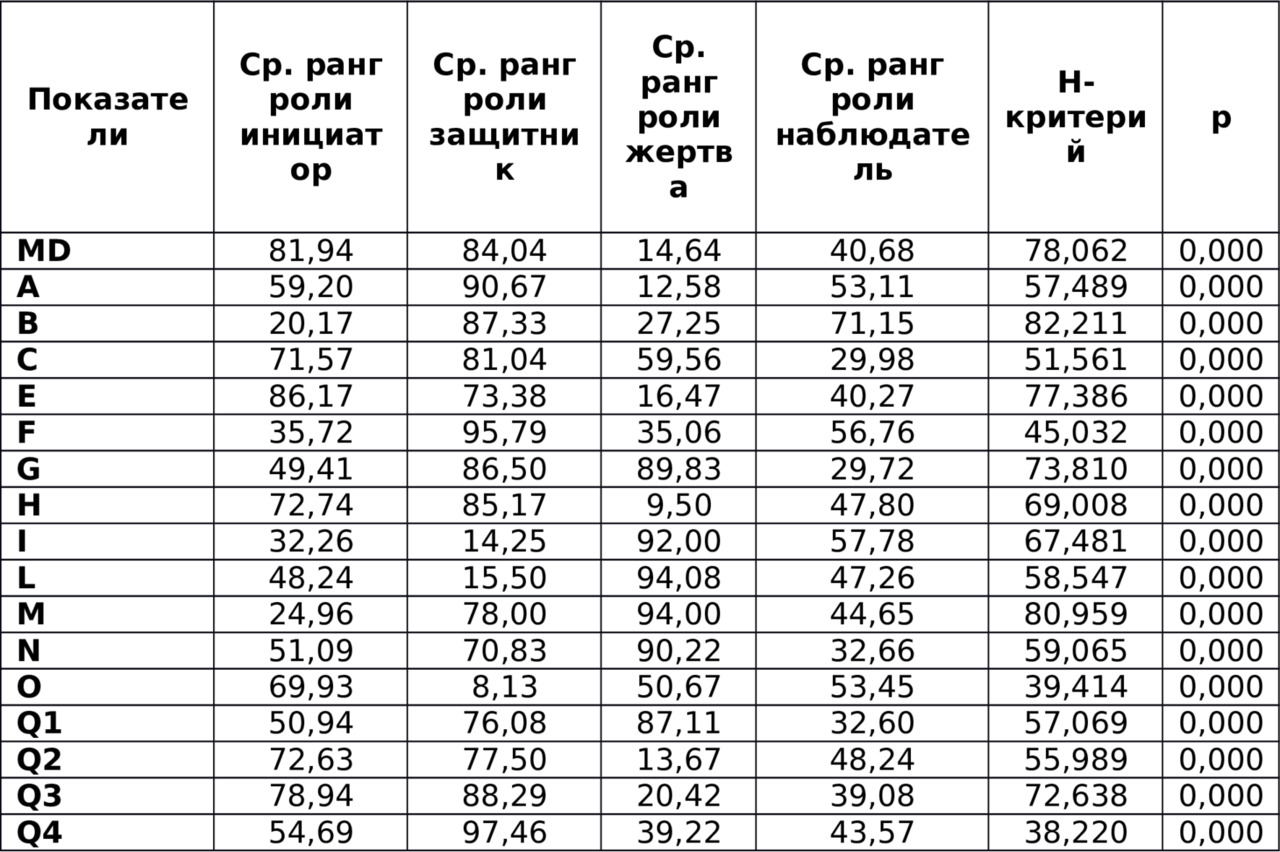
Данные полученные в ходе статистического анализа свидетельствуют о следующих значимых различиях:
У подростков, с ролью инициатор в буллинге, преобладают следующие индивидуально-психологические особенности:
— Шкала Е (доминантность) (H=77.386, p <0.001).
Инициаторы стремятся установить свою власть и влияние за счет унижения и запугивания других.
— Шкала О (тревожность) (H=39.414, p <0.001).
Некоторые подростки могут инициировать буллинг из-за своих собственных негативных эмоций и тревог. Они могут проявлять агрессивное поведение как способ справиться со своими эмоциональными проблемами и стрессом.
Подросткам, с ролью инициатор в буллинге, не свойственны следующие индивидуально-психологические особенности:
— Шкала В (интеллект) (H=82.211, p <0.001).
Низкий интеллект может стать причиной недостаточного образования и отсутствия культуры общения, что в свою очередь может способствовать агрессивному поведению и насилию в отношении других людей. Низкий интеллект может повлиять на способность адекватно оценивать последствия своих действий и контролировать свои эмоции.
— Шкала М (мечтательность) (H=80.959, p <0.001).
Подростки-инициаторы булинга, часто имеют проблемы с эмпатией и уважением к другим людям. Они склонны к агрессивному поведению и пренебрежительному отношению к окружающим, что мало совместимо с мечтательностью и романтическим мышлением. В большинстве случаев у них отсутствует стремление к чему-то высокому и духовному.
У подростков, с ролью защитник в буллинге, преобладают следующие индивидуально-психологические особенности:
— Шкала МD (стремление выглядеть лучше) (H=78.062, p <0.001).
Подростки, играющие роль защитника в буллинге, могут иметь высокий уровень стремления выглядеть лучше из-за необходимости поддерживать свой статус в группе или избежать негативной оценки со стороны своих сверстников.
— Шкала A (общительность) (H=57.489, p <0.001).
Высокий уровень общительности может помочь защитникам буллинга в установлении социальных связей с другими участниками группы, что в свою очередь может обеспечить им определенную поддержку и защиту.
— Шкала B (интеллект) (H=82.211, p <0.001).
Интеллектуальные способности защитников буллинга могут использоваться для планиования более успешной борьбы с буллингом и более эффективной защиты себя и других от негативных воздействий.
— Шкала C (эмоциональная стабильность) (H=51.561, p <0.001).
Отсутствие эмоциональной неустойчивости может помочь защитникам буллинга сохранить контроль над собой во время конфликтных ситуаций и оставаться сдержанными.
— Шкала F (экспрессивность) (H=45.032, p <0.001).
Высокая экспрессивность может помочь защитникам буллинга проявлять доминирующую позицию в группе за счёт эипатичности.
— Шкала H (смелость) (H=69.008, p <0.001).
Смелость позволяет защитникам буллинга демонстрировать свою силу и уверенность, что может способствовать их успеху.
— Шкала Q2 (нонконформизм) (H=55.989, p <0.001).
Некоторые защитники буллинга могут проявлять нонконформизм в своем поведении, что помогает им отличаться от других участников группы и устанавливать свою уникальность.
— Шкала Q3 (самоконтроль) (H=72.638, p <0.001).
Хороший самоконтроль позволяет защитникам буллинга действовать осознанно и контролировать свои эмоции и поступки в конфликтных ситуациях.
— Шкала Q4 (напряжённость) (H=38.220, p <0.001).
Защитник ощущает угрозу собственной безопасности и хочет сохранить свою неприкосновенность. Кроме того, часто защитник чувствует себя одиноким и недостаточно поддержанным, что также может усиливать напряженность. В целом, буллинг может вызывать у защитника стресс, тревогу и чувство беспомощности, что влияет на его эмоциональное состояние и уровень напряженности.
Подросткам, с ролью защитник в буллинге, не свойственны следующие индивидуально-психологические особенности:
— Шкала I (чувствительность) (H=67.481, p <0.001).
Проявление чувствительности неприемлемо из-за необходимости быть сильным и защищать других. Защитники могут скрывать свои эмоции и стараться быть более независимыми.
— Шкала L (подозрительность) (H=58.547, p <0.001).
Подростки, играющие роль защитника, вероятно, не склонны к подозрительности, так как они фокусируются на защите других и решении конфликтов, а не на поиске скрытых мотивов у окружающих.
— Шкала O (тревожность) (H=39.414, p <0.001).
Роль защитника может помочь подростку справляться с тревожностью, так как они вовлечены в активное решение проблем и предотвращение конфликтов, что может уменьшить их общую тревожность.
У подростков, с ролью жертва в буллинге, преобладают следующие индивидуально-психологические особенности:
— Шкала G (моральная нормативность) (H=73.810, p <0.001).
Подростки, играющие роль жертвы в буллинге, могут иметь высокий уровень моральной нормативности, что может делать их более уязвимыми в ситуациях конфликта. Они могут придерживаться строгих моральных убеждений, что делает их менее склонными к самозащите или активному решению проблемы буллинга.
— Шкала I (чувствительность) (H=67.481, p <0.001).
Подростки, играющие роль жертвы, могут быть более чувствительными к критике, сплетням и агрессивным действиям со стороны сверстников. Это может делать их целью для буллинга и усложнять процесс адаптации к негативным ситуациям.
— Шкала L (подозрительность) (H=58.547, p <0.001).
Высокий уровень подозрительности у подростков может привести к тому, что они будут труднее доверять другим людям и проявлять вербальную или невербальную защиту от потенциальных атак со стороны обидчиков. Это может также повысить вероятность их участия во взаимоотношениях, в рамках которых они подвергаются буллингу.
— Шкала M (мечтательность) (H=80.959, p <0.001).
Мечтательность может быть индивидуально-психологической особенностью, делающей подростков более уязвимыми к агрессии и доминированию сверстников. Они могут быть более податливыми и менее способными к эффективной самозащите.
— Шкала N (дипломатичность) (H=59.065, p <0.001).
Низкий уровень дипломатичности может делать подростков менее способными к конструктивному разрешению конфликтов и наличию стрессоустойчивости в ситуациях буллинга. Они могут испытывать трудности в установлении здоровых взаимоотношений со сверстниками и тем самым оказываться в роли жертвы.
— Шкала Q1 (радикализм) (H=57.069, p <0.001).
Жертвы буллинга могут развивать радикализм из-за чувства беспомощности, отчаяния и недовольства своим положением. Они могут начать искать выход из ситуации через радикальные и экстремистские идеологии, которые предлагают им чувство силы, контроля и принадлежности к какой-то группе.
Подросткам, с ролью жертва в буллинге, не свойственны следующие индивидуально-психологические особенности:
— Шкала МD (стремление выглядеть лучше) (H=78.062, p <0.001).
Подростки, находящиеся в роли жертвы в буллинге, могут испытывать негативные эмоции и низкую самооценку, что делает им менее склонными к стремлению выглядеть лучше. Они могут сосредоточиться больше на негативных аспектах своей жизни, чем на своем внешнем виде.
— Шкала A (общительность) (H=57.489, p <0.001).
Жертвы буллинга могут испытывать социальную изоляцию и отчуждение от сверстников, что отрицательно сказывается на их уровне общительности.
— Шкала E (доминантность) (H=77.386, p <0.001).
Жертвы буллинга часто испытывают чувство беспомощности и унижения, что приводит к снижению уровня доминантности.
— Шкала F (экспрессивность) (H=45.032, p <0.001).
Негативный опыт буллинга может сделать жертву более замкнутой и скрытной в выражении своих эмоций.
— Шкала H (смелость) (H=69.008, p <0.001).
Подростки, страдающие от буллинга, могут испытывать страх и тревогу, что делает их менее смелыми в проявлении своих желаний и мнений.
— Шкала Q2 (нонконформизм) (H=55.989, p <0.001).
Жертвы буллинга могут стремиться к соответствию и подчинению в попытке избежать новых конфликтов и страданий.
— Шкала Q3 (самоконтроль) (H=72.638, p <0.001).
Негативный опыт буллинга может сказаться на уровне самоконтроля жертвы, приводя к чувству беспомощности и отсутствию контроля над ситуацией.
— Шкала Q4 (напряжённость) (H=38.220, p <0.001).
Постоянное напряжение и стресс, связанные с буллингом, могут привести к увеличению показателей напряженности у подростков-жертв.
Подросткам, с ролью наблюдатель буллинге, не свойственны следующие индивидуально-психологические особенности:
— Шкала C (эмоциональная стабильность) (H=51.561, p <0.001).
Подростки, наблюдающие за буллингом, могут быть более эмоционально вовлечены в происходящее, чем другие. Они могут испытывать стресс, беспокойство или даже страх из-за ситуации буллинга.
— Шкала G (моральная нормативность) (H=73.810, p <0.001).
Наблюдатели в буллинге могут не видеть своего вмешательства как моральную необходимость или обязанность. Они могут увидеть эти ситуации как нечто, вне их контроля или ответственности, и поэтому не чувствуют себя обязанными вмешиваться.
— Шкала N (дипломатичность) (H=59.065, p <0.001).
Некоторые наблюдатели могут опасаться вмешательства из-за боязни конфликта или негативной реакции со стороны агрессора или его сторонников. Они могут бояться, что их вмешательство приведет к еще более сложным и неприятным последствиям.
— Шкала Q1 (радикализм) (H=57.069, p <0.001).
Наблюдатели могут бояться оказаться в центре внимания или стать жертвой буллинга самим, поэтому предпочитают оставаться нейтральными или даже присоединяться к буллингу.
Буллинг является серьезной проблемой в школах, которая может привести к психологическим и эмоциональным последствиям для детей и подростков. Для борьбы с этим явлением необходимо принимать меры на уровне школьного коллектива, родителей и общественности в целом. Вот несколько рекомендаций для борьбы с буллингом в школе:
— Развивайте уважение к другим: обучайте детей и подростков уважать других и ценить различия между ними.
— Созывайте антибуллинговые программы: проводите мероприятия (проводите уроки, беседы, тренинги и др.), которые помогут учащимся понять вредность буллинга и научат их правильно реагировать на него.
— Обеспечьте поддержку жертвам: создайте условия, в которых дети и подростки могут обратиться за помощью, если они стали жертвами буллинга.
— Привлекайте родителей: включите родителей в обсуждение проблемы буллинга и объедините усилия для ее решения.
— Формируйте позитивную атмосферу: создайте дружественную и поддерживающую обстановку в школе, где каждый ученик чувствует себя безопасно и защищенно.
— Постоянная работа: борьба с буллингом должна быть постоянным процессом, включающим в себя обучение, мониторинг и реагирование на инциденты.
Литература:
1. Глазман, О. Л. Психологические особенности участников буллинга / О. Л. Глазман. // Известия РГПУ им. А. И. Герцена, 2009. — №105. — C. 159–165.
2. Ничишина, Т. В. Моббинг в подростковой среде: пособие / Т. В. Ничишина; Брест, гос. ун-т им. А. С. Пушкина. — Брест: БрГУ, 2015. — 89 с.
3. Adolescents Perception of Bullying. Who is the victim who is the bullying? What can be done to stop bullying? / A. Frisen [et al.] // Adolescence. — 2007. — Vol. 42, №168. — P. 749–761.
4. Duncan, A. Bullying in American Schools: A Social-Ecological Perspective on Prevention and Intervention / A. Duncan // Journal of Catholic Education. — 2006. — Vol. 10, №2. — P. 256–258.
5. Mishna, F. Bullying: A Guide to Research, Intervention, and Prevention / F. Mishna // NY: Oxford University Press. — 2012. — P. 3–16.
6. Olweus, D. Annotation. Bullying at school: basic facts and effects of a school based intervention program / D. Olweus // J.: Child Psychol. Psychiatry. — 1994. — Vol. 35, №1171. — P. 90–112.
Гордиков К. А.
Hybrid rocket engines for launch vehicles
Gordikov K.A., 2nd year Specialist Degree student «Design, production and operation of rockets and rocket and space complexes»
Scientifc adviser: Romanov P.S., Doctor in Pedagogy, Associate Professor, Professor of the Department of Foreign Languages
Federal State Budgetary Educational Institution of Higher Education «Technological University named after twice Hero of the Soviet Union, Pilot-cosmonaut A.A. Leonov», Korolev, Russia
The article describes rocket engines using hybrid fuels, their basic principle of operation, advantages and disadvantages, as well as their application.
Keywords: rocket and space complexes, hybrid engine
Introduction
Hybrid rocket engine (GRD) refers to the section of propulsion systems using combined rocket fuel with separated fuel and oxidizer. In this case, the charge of a solid combustible material (THM) burns in a stream of uniformly sprayed liquid or gaseous oxidizer (direct circuit GRD), or the charge of a solid oxidizer burns in a jet of sprayed liquid or gaseous fuel (reverse circuit GRD). The world’s first hybrid rocket engine GIRD-9, powered by condensed gasoline and oxygen in the form of gas, was created by S. P. Korolev and M. K. Tikhonravov in the 20s of the last century. After World War II, intensive research in the field of GRD was conducted both in Europe and in the USA.
The principle of operation
In an engine running on hybrid fuel, the processes of orderly movement of gas particles, both fuel and combustion products in the combustion chamber, were initially worked out. The main processes are as follows: fuel enters the combustion chamber of the engine tangentially (along the circumference of the combustion chamber), over its entire area, using slot nozzles to create the most orderly (laminar) fuel movement. The rotational movement of the fuel and combustion products at high speed creates a large centrifugal force, which enhances the laminar effect due to a more uniform distribution of gases and combustion products along the walls of the combustion chamber.
Even at low pressure in the combustion chamber, when the engine is running, the gas stream coming out of the nozzle behaves like a weakly ionized plasma, the number of ionized particles is really small. However, the properties of plasma appear immediately and can be defined as permanently active (stationary). Each particle interacts with many other particles surrounding it, so that plasma particles, in addition to chaotic thermal motion, can participate in various ordered movements.
Advantages
Compared with LRE and RDTT, the hybrid engine has the following advantages:
1. simplicity of design, reliability;
2. Simple combustion chamber cooling system;
3. High specific thrust impulse;
4. reduction of development and operation costs without significant loss of specific impulse and its density;
5. Safer performance characteristics;
6. Spent fuel vapors are less toxic;
7. Much less sensitivity to cracking and delamination of fuel pellets;
8. The ability to change the thrust in a wider range, as well as turn off, restart;
9. When the engine is started at low thrust, the supersonic clap occurs so quickly that in the future a feeling of silent operation is created.
Disadvantages
At the same time, it is impossible not to mention the disadvantages of the hybrid engine. The disadvantages include the following points:
1. for the practical implementation of engines of this class, it is important to ensure high energy characteristics of the GRD, which reduce the cost of launching and putting spacecraft into orbit;
Gorenje 2. the complexity of the nozzle head design and its placement in the combustion zone of the solid fuel loading channel, which affects the reliability of its operation up to partial or complete destruction;
3. Lower combustion efficiency of the mixture compared to liquid or solid fuels.
In addition, the lack of a low regression rate of solid fuels has attracted the attention of many researchers and scientists, and means to increase the regression rate are being tested in various ways to solve this problem and improve hybrid engines.
Application
The hybrid rocket propulsion system has been approved for flights for many space and defense purposes. Many sounding rockets were launched to obtain various kinds of information. Ground launches of heavy hybrid booster engines have been successfully carried out. At the moment, the development and testing of GRD for combat missiles is underway, which will surpass existing models in efficiency.
References:
1. Dobrovolsky M. B., «Liquid rocket engines: fundamentals of design», Bauman Moscow State University, 2005, p. 487.
2. Hybrid Rocket Technologies: An overview by S. Krishnan, Professor of Mechanical Engineering, Kyungpuk National University, Daegu, South Korea (Presented as a plenary report at the 6th Asia-Pacific International Symposium, Kuala Lumpur, Malaysia, 2002).
3. Mezonnev Yu., Hodon J. S., Lecourt R. and Lengel G., «Hybrid propulsion system for satellites: design and testing», Fifth International Symposium on Special Topics in the field of chemical propulsion (5-ISICP): Combustion of energy-containing materials, Stresa, Italy, June 19—22, 2000.
4. Pustylnik M. Yu., Fink M. A., Nosenko V., Antonova T., Hagle T., Thomas H. M., Zoblin A.V., Lipaev A.M., Usachev A.D., Molotkov V. I., «Plasmacrystall-4: A new laboratory of (dusty) plasma on board the International Space Station.», Review of Scientific Instruments, Volume 87, 2016.
Дьякова А. И., Власова Т. В.
Auswirkungen sozialer Netzwerke auf zwischenmenschliche Beziehungen und psychische Gesundheit
Diakowa A. I., Vlasova T. V., Zoll, 2. Kurs
Wissenschaftlicher Leiter: Massalskaya Yu. V., Kandidatin der philologischen Wissenschaften, außerordentliche Professorin
Technologischen Universität, benannt nach dem zweifachen Helden der Sowjetunion, dem Piloten und Kosmonauten A. A. Leonov, Korolev, Russland
In diesem wissenschaftlichen Artikel werden wir die Auswirkungen sozialer Medien auf zwischenmenschliche Beziehungen und die psychische Gesundheit von Menschen untersuchen. Wir werden die positiven und negativen Punkte analysieren, Beispiele und Statistiken nennen, und darüber hinaus die Auswirkungen sozialer Netzwerke auf die Gesellschaft betrachten, um ein Verständnis für dieses Problem zu haben. Lassen Sie uns auch über die Abhängigkeit von sozialen Medien, ihre Auswirkungen auf das Selbstwertgefühl und die zwischenmenschlichen Beziehungen zwischen den Nutzern sprechen. Wir werden verschiedene Wege und Methoden vorschlagen, um das Problem der schädlichen Auswirkungen sozialer Medien auf die psychische Gesundheit zu lösen und Sie uns über die psychischen Probleme, die bei Menschen auftreten, wenn sie von sozialen Medien abhängig sind.
Schlüsselwörter: soziale Netzwerke, psychische Gesundheit, zwischenmenschliche Beziehungen, Forschung, Benutzer.
Soziale Netzwerke sind Online-Plattformen, auf denen Menschen Informationen teilen und Inhalte veröffentlichen, Gemeinschaften, Gruppen aufbauen und Beziehungen zwischen Menschen auf der ganzen Welt bilden. Heutzutage sind soziale Medien zu einem festen Bestandteil des täglichen Lebens vieler Menschen geworden. Sie ermöglichen es den Menschen, in Kontakt zu bleiben, zu kommunizieren, Meinungen und Emotionen auszutauschen. Die Auswirkungen sozialer Medien auf zwischenmenschliche Beziehungen und psychische Gesundheit verursachen jedoch gewisse Ängste und Diskussionen [1].
Das häufigste Problem besteht darin, die Illusion der Kommunikation zu erzeugen. Wir kommunizieren mit Menschen, ohne die wahren Emotionen und Gefühle einer Person zu kennen. Dies zeigt sich in der Abnahme des Wertes der realen Kommunikation und der Qualität der Kommunikation, der Interaktion zwischen Menschen im wirklichen Leben. Laut Studien in verschiedenen Ländern nutzen mehr als 70% der Bevölkerung soziale Netzwerke, wobei die Anzahl der Nutzer weiter wächst. Gleichzeitig gibt es eine Zunahme von zwischenmenschlichen Störungen und einer Verschlechterung der psychischen Gesundheit bei Nutzern sozialer Netzwerke. Neben all den früher erwähnten negativen Aspekten wecken soziale Netzwerke auch den Wunsch, sich mit anderen Nutzern zu vergleichen. Menschen, die viel Zeit in sozialen Medien verbringen, neigen dazu, ihr Leben, ihr Aussehen und ihre Erfolge mit dem Leben anderer Menschen zu vergleichen [3]. Dies kann zu Neid, Unzufriedenheit mit sich selbst und zur Entwicklung von Komplexen führen. Letztendlich können all diese schädlichen Einflüsse zu Depressionen und Angstzuständen führen. Auch soziale Netzwerke können Konflikte zwischen Menschen verursachen, zum Beispiel hat ein Bekannter ein Foto gepostet, das seinem Freund nicht gefiel, es verursacht eine negative Reaktion und führt zu einem Streit. Darüber hinaus fördern soziale Netzwerke neue Formen der Kommunikation, die weniger emotional und unmittelbar sind als die Kommunikation in der realen Welt. Dies kann zu einer Verschlechterung der zwischenmenschlichen Beziehungen, einem Mangel an Empathie und Verständnis führen [4].
Und am wichtigsten ist, dass die Auswirkungen sozialer Medien auf die psychische Gesundheit ebenfalls unbestreitbar sind. Die Forschung zeigt, dass eine übermäßige Nutzung sozialer Medien mit erhöhten Stress-, Depressions- und anderen psychischen Störungen verbunden ist. Darüber hinaus kann das ständige Studium von Nachrichten und Informationen auf Plattformen zu Müdigkeit, Irritationen und Verspätungen führen [2]. Heutzutage missbrauchen die meisten Menschen jedoch die Nutzung sozialer Medien und leben buchstäblich die meiste Zeit darin, was zu Abhängigkeit führt. Ein weiterer wichtiger negativer Einfluss von sozialen Medien auf die psychische Gesundheit ist Schlafstörungen, dies liegt an dem blauen Licht der Bildschirme und der Erregung der gesehenen Informationen.
Aber abgesehen von negativen Aspekten haben soziale Medien auch positive Aspekte. Wenn Sie also soziale Netzwerke nicht missbrauchen und kompetent nutzen, können sie zu einem nützlichen Helfer im Leben werden. Um die positiven Auswirkungen sozialer Medien auf zwischenmenschliche Beziehungen und die psychische Gesundheit zu bestätigen, nehmen wir zum Beispiel von eine Studie des Pew Research Center. Es gibt, dass 72% der erwachsenen Social-Media-Nutzer sie nutzen, um Kontakt mit ihren Freunden und Angehörigen zu halten, was zu einer erhöhten Stimmung führt. Es gibt auch weitere Beispiele, in denen die Nutzer des Internet-Netzwerks mithilfe von sozialen Netzwerken Gleichgesinnte für ihr Hobby gefunden haben und warme Freundschaften geschlossen haben, sowie ehemalige Mitschüler und Freunde aus der Kindheit gefunden haben, die sie lange nicht gesehen haben und den Kontakt verloren haben. Aber es gibt auch Studien, die negative Auswirkungen auf das Leben von Menschen zeigen. Eine davon: Eine Studie der Universität von Arizona ergab, dass übermäßiges Zeitvertreib in sozialen Medien mit einem Gefühl der Einsamkeit und mangelnder Aufmerksamkeit verbunden ist. Darüber hinaus kann die Vertiefung in die virtuelle Welt der sozialen Medien die zwischenmenschlichen Fähigkeiten schwächen. Beispiele dafür können in unserem täglichen Leben gesehen werden. Heutzutage bevorzugen Menschen eher die Kommunikation über Text- und Sprachnachrichten, anstatt ihren Zeitvertreib in echten Gesprächen zu organisieren. Aus den Statistiken kann man lernen, dass die jüngere Generation durchschnittlich mehr als 3 Stunden pro Tag in sozialen Netzwerken verbringt, was zu einer Verkürzung der Zeit für echte Kommunikation führt. Infolgedessen führt dies zum Verlust der Fähigkeit zur realen Kommunikation und Interaktion, einschließlich nonverbaler Signale und emotionaler Verbindung, die zu den Hauptfaktoren der Kommunikation und der Beziehung zwischen Menschen gehören [5].
Betrachten wir nun Möglichkeiten, die dazu beitragen können, die negativen Auswirkungen der Nutzung sozialer Medien auf unser Leben und unsere psychische Gesundheit zu reduzieren:
— Eine klare Begrenzung der Zeit, die Sie in sozialen Netzwerken und im Internet verbringen können. Nehmen Sie sich zum Beispiel eine Stunde pro Tag Zeit, um sich auf solchen Plattformen zu unterhalten.
— Versuchen Sie, sich und Ihr Leben nicht mit anderen Benutzern und ihrem Leben zu vergleichen. Denken Sie daran, dass Benutzer in den meisten Fällen die besten Momente und die Seite ihres Lebens posten, und dies zeigt nicht die Vollständigkeit ihres wirklichen Lebens.
— Nähern Sie sich dem Lesen von Informationen kritisch an, mit Besonnenheit und Gelassenheit, die Sie in den Weiten der sozialen Netzwerke beobachten. Überprüfen Sie die veröffentlichten Informationen immer und nehmen Sie sich Zeit, sie zu glauben, sondern überprüfen Sie sie in zuverlässigen Informationsquellen.
— Versuchen Sie, soziale Netzwerke zu nutzen, um Beziehungen zu Menschen aufzubauen, Hilfe und Unterstützung zu finden, aber missbrauchen Sie sie nicht. Denken Sie daran, dass es andere Kommunikationswege gibt, wie zum Beispiel im wirklichen Leben mit Ihren Freunden und Verwandten zu verbringen.
— Lernen Sie, soziale Medien weniger als Entspannung und Entspannung zu nutzen, suchen Sie nach anderen Wegen und Methoden, wie zum Beispiel Sport treiben, meditieren oder Bücher lesen.
Abschließend wollten wir sagen, dass soziale Medien sowohl positive als auch negative Faktoren haben, die unsere psychische Gesundheit und zwischenmenschliche Beziehungen beeinflussen. Diese Plattformen bieten uns die Möglichkeit, neue Bekanntschaften zu schließen, Unterstützung zu finden und Ratschläge von Menschen zu erhalten, Stimmung zu steigern und positive Emotionen zu erzeugen, können aber auch Gefühle von Angst, Depression, Neid und Einsamkeit hervorrufen. Um die negativen Auswirkungen der Nutzung sozialer Netzwerke zu verringern, müssen Sie den Zeitvertreib auf diesen Plattformen reduzieren, die veröffentlichten Informationen vernünftig behandeln und nicht missbrauchen. Daher ist es wichtig, sich sowohl der positiven als auch der negativen Aspekte der Nutzung sozialer Medien bewusst zu sein und ein Gleichgewicht zwischen ihnen zu finden. Die bewusste Nutzung sozialer Medien verhindert negative Auswirkungen auf zwischenmenschliche Beziehungen und die psychische Gesundheit.
Literaturliste:
1. Гревцов, В. Е. Развитиe социальных связей и отношений в виртуальных сообществах // Социосфера. — 2010. — №1. — С.59 — 61.
2. Неровнова, Д. 5 опасностей виртуального общения в интернете// Аргументы и Факты. — 2013. — №44. — с.7—9.
3. Сорокина, А. Б. Интернет в жизни современных подростков: проблема и ресурс// Современная зарубежная психология. — 2015. — Т.4. №1. — С.45 — 46.
4. Влияние социальных сетей https://dzen.ru/a/ZaaxcV7lXU6GZJ_f (дата обращения: 10.03.2024).
5. Хроники пандемии: влияние социальных сетей на психологическое состояние населения https://clck.ru/3GDcbU (дата обращения: 10.03.2024).
Дяденко А. Е., Лямина А. Д.
Die Beziehung zwischen Eltern und Kindern in der modernen Welt
Dyadenko A.E., Lyamina A.D., Zoll, 2. Kurs
Wissenschaftlicher Leiter: Massalskaya Yu. V., Kandidatin der philologischen Wissenschaften, außerordentliche Professorin
Technologischen Universität, benannt nach dem zweifachen Helden der Sowjetunion, dem Piloten und Kosmonauten A. A. Leonov, Korolev, Russland
In diesem wissenschaftlichen Artikel werden wir die modernen Trends in den Beziehungen zwischen Eltern und Kindern in der heutigen Welt analysieren. Wir werden verschiedene Aspekte dieses Themas beleuchten, darunter die Auswirkungen digitaler Technologien auf die familiäre Dynamik, Veränderungen in der Familienstruktur und deren Auswirkungen auf die Rollen und Verantwortlichkeiten von Eltern und Kindern, das Streben moderner Kinder nach Selbstständigkeit und Selbstausdruck sowie das Ausbalancieren von Arbeit und familiären Verpflichtungen. Unser Ziel ist es, diese Trends aus der Perspektive zeitgenössischer Theorien der Familienpsychologie und -dynamik zu analysieren, die Hauptfaktoren zu identifizieren, die die modernen Beziehungen zwischen Eltern und Kindern bestimmen, und mögliche Strategien zur Schaffung gesünderer, harmonischerer und unterstützenderer familiärer Bindungen in der heutigen Gesellschaft zu diskutieren.
Schlüsselwörter: Beziehung zwischen Eltern und Kindern, moderne Welt, familien Dynamik. Veränderungen in der Familienstruktur, Familienwerte, soziale Medien.
Die Beziehung zwischen Eltern und Kindern spielt eine Schlüsselrolle bei der Formung der Persönlichkeit und der Entwicklung der Individualität jedes Kindes. In der heutigen Welt sind diese Beziehungen verschiedenen Einflüssen ausgesetzt, darunter technologische Veränderungen, kulturelle Verschiebungen und soziale Trends. Lassen Sie uns einige der wichtigsten Aspekte der modernen Beziehungen zwischen Eltern und Kindern betrachten.
Technologischer Einfluss: Eine der bedeutendsten Veränderungen der letzten Jahrzehnte ist die Einführung digitaler Technologien in den Alltag. Smartphones, Tablets, soziale Netzwerke — all dies bietet neue Möglichkeiten und Herausforderungen für die familiäre Interaktion. Erwachsene und Kinder können über Messenger oder soziale Netzwerke ständig miteinander in Verbindung stehen, was die Kommunikation verbessern, aber auch zu einer Abhängigkeit von Technologie führen und das Risiko einer Entfremdung im realen Leben erhöhen kann [1, c. 14]
Veränderungen in der Familienstruktur: Moderne Familien unterscheiden sich oft von traditionellen Modellen. Die zunehmende Anzahl alleinerziehender Eltern, Patchwork-Familien und Familien mit beiden berufstätigen Elternteilen beeinflusst die Dynamik der Beziehungen. Diese Veränderungen können sich auf die Verteilung von Rollen, Aufgaben und die Zeit auswirken, die für die Interaktion zwischen Eltern und Kindern zur Verfügung steht [1, c. 17].
Streben nach Individualität: Moderne Kinder und Jugendliche streben oft nach Selbstausdruck und Unabhängigkeit. Dies kann sich in der Ablehnung traditioneller Normen und Werte äußern, die ihre Eltern pflegten, und in der Suche nach ihrem eigenen Weg im Leben. Dies wiederum stellt eine Herausforderung für Eltern dar, die einen Ausgleich zwischen der Unterstützung der Individualität ihres Kindes und der Bewahrung der grundlegenden Familienwerte finden müssen.
Erweiterung des Bildungs- und kulturellen Erfahrungshorizonts: Heutzutage haben Kinder Zugang zu einer viel größeren Menge an Informationen und vielfältigen kulturellen Einflüssen dank des Internets, Reisen rund um die Welt und anderen Möglichkeiten. Dies eröffnet neue Horizonte, kann aber auch zu Konflikten zwischen den Generationen führen, aufgrund von Unterschieden in Werten und Weltanschauungen [2].
Balance zwischen Arbeit und persönlichem Leben: Moderne Eltern stehen oft vor der Herausforderung, Arbeit und familiäre Verpflichtungen in Einklang zu bringen. Der Wunsch, für das Wohlergehen ihrer Familie zu sorgen, kann dazu führen, dass Eltern weniger Zeit für die Interaktion mit ihren Kindern aufwenden, was sich auf ihre Beziehung auswirkt [2].
All diese Faktoren betonen die Bedeutung der Anpassung von Familien an sich ändernde Bedingungen und Bedürfnisse. Schlüsselelemente sind hier Offenheit für Dialog, Respekt für die Individualität jedes Familienmitglieds sowie der Wunsch nach Kompromissen und gemeinsamen Interessen. Moderne Eltern und Kinder stehen vor zahlreichen Herausforderungen, haben aber auch die Möglichkeit, engere und harmonischere Beziehungen zu entwickeln, die auf Verständnis und Unterstützung basieren.
Literaturliste:
1. Абраменкова, В. А. Асланиди, М. В. Лукина Взаимоотношения между родителями и детьми в семье // Свое издательство. — 2017 — с. 14—17.
2. Проблемы между детьми и родителями в современном мире и пути их решения https://dzen.ru/a/ZC1s3J4NEQkaLC59 (дата обращения: 18.03.2024).
3. Опасные родители: как нельзя себя вести с ребенком https://dzen.ru/a/ZWR9S4iOolNl8HA6 (дата обращения: 18.03.2024)
Ерёменко Е. А.
Review on investigations of synthetic diamond graphitization under the influence of low-energy laser pulses
Eryomenko Y., 4th year Bachelor Degree student {Applied Physics}
Scientific adviser: Gusakov G.A., PhD {Solid State Physics}
Belarusian State University, Minsk, Republic of Belarus
We discuss the phenomenon of nanoablation, a process where laser irradiation induces controlled material removal from diamond surfaces without significant graphitization. Nanoablation involves weakening molecular bonds on the diamond surface through multiphoton absorption, increasing its chemical reactivity. Various factors, including ambient pressure, atmosphere composition pulse energy and duration influence the rate of ablation. Photochemical oxidation plays a crucial role, with water acting as an inhibitor and oxygen as the primary oxidizing agent.
Keywords: synthetic diamond graphitization, low-energy laser pulses
The concept of laser surface modification and defect generation in crystals and glasses has long been recognized. The adaptation of similar processes to diamond, characterized by a high lattice stiffness and chemical stability, was first demonstrated in 2003. A specific laser irradiation regime was defined in which the energy density falls below the threshold for single-pulse graphitization, but etching processes are preserved. It is noteworthy that the material removal rate sharply decreases to values below 10—3 nm per pulse. This unique regime was termed «nanoablation,» a term that is now widely used in the literature. Notably, nanoablation in diamond does not lead to significant graphitization — minimal sp2-hybridized bonds are formed, contributing insignificantly to surface optical absorption. In 2017, another critical aspect of the nanoablation process was revealed, showing the formation of NV centers in the surface layer of diamond, both in neutral and negatively charged states [1]
The initial discovery of laser ablation on the surface of diamond without graphitization occurred during studies of laser annealing of natural type IIa diamond single crystals implanted with ions [2] Using nanosecond KrF laser radiation (λ = 248 nm) in ambient air, experiments were conducted with energy densities ranging from 4 to 20 J/cm2 and up to 300,000 laser pulses. The position of the surface in the irradiation zone was monitored throughout the irradiation process. Initially, defects were introduced into the diamond, causing a decrease in its mass density and leading to surface elevation by several tens of nanometers in the implantation area. Laser annealing aimed at correcting these embedded defects was conducted at energy densities below the graphitization threshold. In this scenario, the reverse process occurred — the surface subsided in the irradiation zone. With prolonged exposure, the surface subsided even below the level of the original, non-implanted diamond. These results sparked interest as they suggest the possibility of controlled material removal from the surface of diamond without the need for graphitization. This gradual etching has practical significance for various applications of diamonds in electronics, photonics, and other fields requiring precise surface processing. Increasing the irradiation energy faced limitations due to the onset of traditional ablation. At constant laser energy, the channel depth linearly increased with the number of irradiation pulses.
Experimental studies on laser irradiation of single crystal diamond in an inert atmosphere (helium, argon) were conducted in a flow mode [3] The sample was placed in a vacuum chamber, evacuated to ≈1 torr pressure using a pre-installed vacuum pump, followed by backfilling the chamber with inert gas at slightly above atmospheric pressure. Gas flow through microslits in the chamber was used to prevent air ingress to the sample. Experiments on diamond irradiation under these conditions revealed either the absence or noticeable suppression of nanoablation. The term «suppression» here denotes instability of effects: sometimes no crater was formed, while in other cases, it formed only on part of the irradiated surface, with its depth significantly less than during irradiation in ambient air. Noticeable reduction in the nanoablation rate during diamond irradiation in a helium stream emphasized the crucial role of oxygen availability in this process.
The dependence of diamond etching rate on the surrounding medium pressure, observed during surface irradiation with the second harmonic of a femtosecond titanium-sapphire laser (τ = 120 fs, λ = 400 nm), demonstrated a significantly non-monotonic trend [4] In the high vacuum range from 10—7 to 10—5 torr, the nanoablation rate almost linearly increased with increasing pressure. However, further pressure increase led to a sharp decrease in the material removal rate, maintaining a constant rate of 5 × 10—7 nm/pulse in the range from 10—3 torr to atmospheric pressure.
The surrounding medium pressure also influenced the topography of the craters formed during nanoablation, manifesting in two aspects. The first aspect included significant differences in crater depths obtained with a single dose of irradiation at different pressures. The second aspect led to a change in the profile shape at low pressures. In the pressure range from atmospheric to 10—5 torr, nanoablation craters have a profile close to Gaussian, reflecting the Gaussian intensity distribution in the laser beam. However, at 10—6 torr pressure, the bottom of the crater becomes noticeably leveled, and at 10—7 torr, a elevation appears in the center of the crater. Essentially, at low pressures, the nanoablation rate in the center of the irradiation zone is significantly lower than at its periphery, despite the higher radiation intensity at the center.
The nonlinear behavior of the nanoablation rate with changing ambient pressure is consistent with the photochemical mechanism of surface oxidation, whose characteristics are primarily determined by the processes of oxygen and water adsorption and desorption on diamond. The main evidence for this conclusion is the etching regime at pressures below 10—5 torr. The almost linear increase in the material removal rate with increasing pressure observed in this regime rules out the evaporative mechanism of substance removal and indicates that nanoablation is a photo-stimulated oxidation reaction of diamond.
In chemical reactions, the rate is usually determined by the probability of single oxidation and the concentrations of reactants. In this context, the probability of single oxidation is influenced by the temperature in the reaction zone and the intensity of laser irradiation. Under unchanged conditions of these parameters, the etching rate is proportional to the amount of reactants. The amount of carbon remains constant, equal to the number of atoms in the top monolayer. Experimental data show that the amount of the second reactant is proportional to the ambient pressure, which suggests that the second reactant is one of the components of atmospheric air. Indeed, oxygen is widely recognized as the most chemically active element in the air, easily forming various oxides upon interaction with different substances. At the same time, carbon oxides (CO, CO2) are volatile compounds, meaning that upon formation on the surface of diamond, they evaporate, leading to crater formation rather than film deposition. Therefore, the photo-stimulated oxidation mechanism provides a consistent explanation for the kinetics of nanoablation at pressures below 10—5 torr. In this range, the main factor affecting the material removal rate is the lack of atmospheric oxygen, which serves as the oxidizing agent. By comparing the nanoablation rate with the oxygen delivery rate to the irradiated area, conclusions can be drawn about the efficiency of the diamond oxidation photoprocess. Considering that the main source of necessary oxygen is the surrounding atmosphere, the use of principles of molecular-kinetic gas theory allows for estimating the maximum amount of oxygen on the surface.
The phenomenon of etching rate stabilization at pressures above 10—3 torr is explained by the presence of molecular complexes, such as -OH, on the surface of the diamond, formed by the interaction of water vapor from the atmosphere with the diamond surface. Thermodesorption spectroscopy and infrared spectroscopy data show that water readily adsorbs on diamond even at room temperature, leading to the formation of hydroxyl, ether, and carbonyl groups. The existence of hydroxyl groups on diamond facets is confirmed by surface X-ray diffraction data. Experiments also suggest that water acts as an effective inhibitor of oxidation, likely due to the formation of OH groups, which saturate broken carbon bonds, thus stabilizing the diamond surface. The amount of water needed to form a monolayer on the diamond surface between pulses is supplied from the atmosphere at a pressure of 10—3 torr. Therefore, despite the excess of oxygen in the pressure range from 10—3 torr to atmospheric, the efficiency of the nanoablation process remains relatively low. Water not only interacts with broken carbon bonds but also physically hinders oxygen from reaching the diamond surface. The formation of a water layer on diamond was primarily investigated from the perspective of diamond surface conductivity. Electroosmotic measurement data were used to calculate the thickness of the stagnant water layer near the diamond surface, which is approximately 95 Å, equivalent to approximately 30 monolayers [4] It is expected that a water layer of this size will reduce the probability of oxygen adsorption, impeding oxygen access to the sample surface.
Undoubtedly, in catalyzing chemical reactions through photostimulation, the excitation of the electronic subsystem of the initial substances plays a key role. This excitation leads to the weakening of molecular (lattice) bonds, resulting in increased chemical activity. Although ionization of both covalent bonds in diamond and molecular oxygen is probable, the distinctive features observed in nanoablation curves coincide with multiphoton absorption in diamond. In this case, laser irradiation, devoid of initiating graphitization, induces the transition of certain electrons from the valence band to the conduction band. This, in turn, temporarily reduces the bond energy for the corresponding number of atoms in the diamond lattice, with some of these atoms, located on the surface, demonstrating a higher probability of interaction with adsorbed oxygen. In the proposed model [4], the nanoablation rate correlates with the number of weakened bonds on the surface, which in turn is influenced by the intensity of radiation used, a consequence of multiphoton absorption. Thus, the dependencies of nanoablation rate on pulse energy observed in experiments, representing power functions, can be attributed to one-, two-, and three-photon absorption of light at 193 nm (6.4 eV), 248 nm (5.0 eV), and 515 nm (2.4 eV) radiation, respectively, where the exponent denotes the multiphotonness [3].
The influence of pulse duration on the nanoablation process manifests in two different ways. The first aspect is straightforward: at constant pulse energy, the duration determines the efficiency of multiphoton absorption, thereby affecting the number of weakened bonds inside the crystal. The second aspect of the influence of laser pulse duration on nanoablation is only apparent when using ultrashort pulses (approximately τ ≈ 100 fs) and connected with ultrafast phenomena.
In addition to the aforementioned interaction processes of laser radiation with diamond, a wide range of phenomena associated with photoemission, photoexcitation, mobility, and recombination of electronic carriers in diamond are currently actively studied. Furthermore, significant progress has been made in the development of Raman spectroscopy methods for studying the structure of carbon materials, as well as in the study of thermal graphitization of diamond, its oxidation, methods of implantation and annealing, processes involving electron and ion beam processing.
References:
1. Nitrogen-vacancy defects in diamond produced by femtosecond laser nanoablation technique / V. V. Kononenko // Applied Physics Letters. — 2017. — Vol. 111, №8. — pp 81—101
2. Laser Induced Nanoablation of Diamond Materials/ M. S. Komlenok // Physics Procedia. — 2011. — Vol. 12, Part B. — pp 37–45.
3. Lehmann, A. Two-photon polarization-selective etching of emergent nanostructures on diamond surfaces/ A. Lehmann, C. Bradac, R. P. Mildren //Nature Communications. — 2014. — Vol. 5.
4. Davies, G. Graphitization of Diamond at Zero Pressure and at a High Pressure / G. Davies, T. Evans // Proceedings of the Royal Society A: Mathematical, Physical and Engineering Sciences. — 1972. — Vol. 328, №1574. — pp 413–427
Ерхов И. М.
The Mental Health Issues in the Modern World
Erkhov I.M., 2nd year Bachelor Degree student «Design and Technological Support of Engineering Industries»
Scientifc adviser: Massalskaya Yu. V., PhD (Philology), Associate Professor of the Department of Foreign Languages
Federal State Budgetary Educational Institution of Higher Education «Technological University named after twice Hero of the Soviet Union, Pilot-cosmonaut A.A. Leonov», Korolev, Russia
Mental health is one of the main components of a person’s overall well-being and quality of life. In the modern world, where we are faced with the constant development of technology, social changes and increased demands, mental health problems have become particularly relevant. Anyone, regardless of their profession or status, can face mental health problems, and understanding and recognizing this problem is the first step to solving it.
Keywords: mental health, the modern world, stress.
Mental health, as defined by the World Health Organization, is a state of well — being in which a person can realize their own potential, withstand the casual stresses of life, work productively and fruitfully, and contribute to the existence of their community.
The concepts of «positive mental health», introduced by the psychiatrists of the 20th century (primarily the 1960-s), inspired the formulation of fundamental mental health criteria.
The analysis of a person’s adequate functioning as a process with self-consistent value constitutes the foundation of the aforementioned concept, described substantially through notions of self-realization, self-actualization (K. Goldstein, A. Maslow, S. Bueller), sufficient human functioning (K. Rogers), authenticity (J. Rosenthal), striving for meaning (V. Frankl).
Sigmund Freud defined mental health as «the ability to love and work.» This definition reflects the bioenergetic model of the psyche created by Freud, in which a person’s healthy development centers on sublimation — the effective redistribution of libido-based energy into constructive life goals (creativity and intimacy with other people).
The World Health Organization lays emphasis on the following criteria for mental health:
1) self-awareness and a sense of continuity, permanence and identity of one’s physical and mental self.
2) a sense of permanence and identity of experiences in similar situations.
3) being critical of oneself and one’s own mental output (activity) and its results.
4) the correspondence of mental reactions (adequacy) to the strength and frequency of environmental influences, social circumstances and situations.
5) the ability of behavioral self-management in accordance with social rules, regulations, and laws.
6) the ability to plan one’s own life activities and realize them.
7) the ability to adapt one’s behavioral patterns to continually fluctuating circumstances
Stress is one of the most common mental-health-related problems. In a rapidly changing reality, the human psyche is constantly subject to excessive informational, emotional, and intellectual pressure. This leads to psychological and physiological exhaustion, impaired productivity, and professional hazards portending to chronic stress, which adversely affects the mental state of a person. Constant demands, a lack of leisure time, and a continuous flow of information all lead to the accumulation of nervous tension. Stress causes fatigue, unrest, anxiety and can ultimately trigger serious mental disorders.
Another mental health problem is depression. In fact, depression is not just a «bad mood» or temporary sadness, but a serious mental illness that has a strong impact on a person’s life. The prevalence of anxiety disorders and depression has increased by 25% worldwide. The number of people in need of psychological or psychiatric care is increasing faster than the number of people suffering from cancer (17%). The disease begins as a complex awareness and acceptance of one’s essence and an inability to adequately express one’s inner world. The monotony and unpredictability of modern life, social isolation, financial and familial problems, as well as lack of support from others can contribute to the development of depression.
Anxiety disorder poses as yet another problem primarily for the younger generation. Constant feelings of uneasiness, unrest, fear and panic attacks can seriously hinder a person’s quality of life and their opportunities for self-realization. The constant access to social networks with never-ending comparisons between people, social pressure and uncertainty of the future can become the root cause of the development of an anxiety disorder. Furthermore, modern society imposes certain standards and expectations on us, which may be more than some people can handle. The painful desire to be successful, attractive, and irresistible can lead to feelings of low self-esteem, depression, and anxiety. Infinite comparison with others can only reinforce these feelings.
In addition, the modern world has also witnessed an increase in the incidence of mental disorders related to the use of the Internet and social media. Modern man is experiencing limitations in realizing his inner potential, and there is a tendency to replace spiritual needs with material ones. The focus has shifted to digital transformation, automation, and robotics. The transition to mechanical and contactless manipulation of the mind, will, motivation, and life of an individual is obvious. This suppresses a person as an individual, a unique nature, an active subject of vitality. The more a person stays inside the «digital noise», the more he experiences loneliness, losing his fortitude.
The psychological protection of consciousness and subconsciousness from harmful informational influences that can alter a person’s psychological and behavioral traits against their will is becoming an urgent problem of the mental health condition worldwide. An average Internet user spends 6 hours and 43 minutes online daily, constituting a number of more than 100 days spent online yearly. Gadget addiction affects the cognitive, emotional, motivational and behavioral levels of the human psyche. The proportion of Internet users aged 12—24 years is the largest in relation with other age categories, amounting to approximately 97%. WHO (The World Health Organization) recognizes Internet addiction as a disease. Abuse of social media usage, constant comparison with other people, negative comments and cyberbullying can consequently lead to low self-esteem, anxiety and depression.
Moreover, a person’s workplace and job-related relationships can also influence one’s mental health. An increased degree of tension causes a person to have psychological conditions that have a negative impact on his vitality and performance. This results in deterioration of the mental well-being of employees and the general working atmosphere in the team, as well as significant productivity losses. In order to minimize such hazards and ensure the psychological stability of the employees, it is necessary to develop skills and abilities supporting a person’s competence in problem-solving, overcoming fears and insecurities in spite of stressful situations, force majeure conditions and life adversities. For example, Russians assessed their willingness to quit due to toxic colleagues. 1,257 people from 15 Russian cities took part in the survey. Two thirds (75%) of them complained that they had encountered toxicity at work from time to time. For half of them (53%), this had an effect on their productivity. At the same time, an unhealthy atmosphere may serve as a reason for dismissal for 71% of respondents, most of whom are people aged 25—34 years. Women are more likely to quit (75%) than men (67%) under these circumstances.
To sum up, there is a general need to implement certain measures in order to properly breach the problems of mental health. It’s important to pay close attention to one’s mental well-being and take steps to reduce the influence of stress in one’s life. For instance, relaxation practice, exercising, and spending time with loved ones can be of great help to one’s mental state. The support of others also plays a significant role, so it’s crucial to be bold, to discuss one’s issues and seek help. Additionally, creating a more mindful approach when using the internet and social media may also help reduce the risk of developing mental disorders.
All these measures can help create pertinent conditions for maintaining and strengthening one’s mental health in the realities of the modern world.
References:
1. Mental health. The World Health Organization. Date of application: January 6, 2017. Archived on November 28, 2016.
2. National Alliance for the Mentally Ill, 2011
3. Russians appreciated their willingness to quit because of toxic colleagues, February9th, 2024. //https://lenta.ru/news/2024/02/09/toxic/
Захарова А. Т.
Le rôle de la douane dans la mise en œuvre de politiques commerciales vertes au service de la protection de l’environnement
Zakharova A.T., étudiante de 2 année «Douanes»
Directeur scientifique: Kogteva E.V., PhD (Philologie), maître de conference
Établissement d’enseignement public fédéral de l’enseignement supérieur» Université Technologique du nom du double Héros de l’Union soviétique, pilote-cosmonaute A. A. Leonov», Korolev, Russie
Dans l’article, il s’agit du rôle important des douanes dans la protection de l’ environnement et de ses actions en matière d’écologie. Dans les cadres de cette question, il porte sur des programmes différents comme «zéro carbone», «zéro déforestation» appliqués aux chaînes logistiques mondiales. Il s’agit des efforts des douanes contribuant à la lutte contre criminalité environnementale et leurs mesures regroupées sous l’appellation générale «douanes Vertes».
Mots-clés: Douane, environnement, vert, mesures
Dans divers domaines, les administrations douanières peuvent jouer un rôle plus actif dans le règlement des questions environnementales.
La douane joue un rôle essentiel dans la protection de l’environnement aux frontières, avec l’application d’accords multilatéraux sur l’environnement (AME) et la lutte contre les infractions environnementales. Ces fonctions de la douane peuvent être rassemblées sous l’appellation générale de « douanes vertes».
Dans différents domaines, les administrations des douanes peuvent adopter un rôle davantage proactif pour les questions environnementales.
La fiscalité écologique, aussi nommée fiscalité environnementale ou écofiscalité, est une forme de fiscalité émergente qui vise, au moyen d’un signal-prix (et non directement par une norme ou loi contraignante), à protéger l’environnement et les ressources naturelles en limitant leur dégradation et surexploitation, voire en finançant leur restauration ou gestion restauratoire.
En droite ligne avec la loi de finances, la Douane a instauré en 2022 un dispositif de mesures fiscales, tarifaires et réglementaires, à la fois incitatif et de protection, visant à stimuler la croissance, accompagner le rebond de l’économie et contribuer à la prise en charge de préoccupations gouvernementales d‘ordre social, environnemental et énergétique.
Dans le respect des engagements pris par certains pays en matière de protection de l’environnement et de développement durable, une TIC verte a été instaurée en 2022 sur les lampes à incandescence et sur les équipements électroménagers énergivores. Ces derniers sont soumis à des quotités de taxation progressives en fonction de leur classe énergétique. Le but en est d’inciter le consommateur à utiliser les équipements les plus économiques en matière de consommation d’électricité. Dans ce même esprit et inspirée des meilleures pratiques à l’international, une TIC, dite écologique ou de recyclage, a vu le jour en 2022. Elle s’applique à certains appareils électroniques ainsi qu’aux batteries pour véhicules présentant, au terme de leur cycle d’utilisation, un risque de pollution. L’institution de cette taxe vise à assurer une gestion efficace et efficiente des déchets des équipements électriques et électroniques.
L’Union européenne a adopté un programme ambitieux pour décarboner les chaînes logistiques mondiales, qui inclut le paquet « Ajustement à l’objectif 55». Plusieurs réformes douanières sont en cours ou doivent être mises en œuvre dans le domaine de l’environnement. Cela suppose une évolution considérable des opérations de la douane. [1]
Voici des exemples de mesures de soutien :
• Une meilleure identification des biens et services environnementaux dans la nomenclature du SH profiterait à la surveillance de leurs échanges. L’Union européenne s’intéresse actuellement aux produits ayant des effets bénéfiques pour l’environnement, dont les produits pour la préservation de l’eau ou la production d’énergie hydroélectrique.
• En UE, le rôle de la douane devrait évoluer, avec l’application d’une politique « zéro carbone» aux frontières. L’évolution de la réglementation relative au transfert de déchets devrait faciliter la circulation transfrontière des déchets recyclables en mettant l’accent sur les « pays tiers».
• La proposition relative aux produits « zéro déforestation» contribuera à limiter les gaz à effets de serre puisque seuls les produits de ce type pourront être admis sur le marché de l’UE.
L«évolution possible des activités de la douane sera guidée par la numérisation (par le biais du Guichet unique européen), les normes (écoconception aux services de produits durables et circulaires), la collecte de données pour davantage de transparence au sujet de l’empreinte environnementale des produits (passeport produits numérique), la croissance de l’économie circulaire (commerce de biens d’occasion), des administrations des douanes plus soucieuses de l’environnement (efficacité des ressources, marchés publics verts).
Les tendances commerciales récentes démontrent l’expansion rapide des flux de l’économie circulaire qui jouera un rôle prépondérant dans les échanges internationaux de demain. On expose quatre principes d’action, afin de guider les activités dans les possibles domaines d’action collective:
1) Le classement SH des biens de l’économie circulaire
2) les liens avec les biens et services environnementaux
3) la création de normes internationales qui reposent sur les principes de l’économie circulaire
4) la prise en compte des pays en voie de développement comptent parmi les principaux domaines d’actions à cibler. [2]
Les tendances mondiales de la déforestation sont principalement alimentées par le développement des surfaces agricoles (à l’origine de 80 à 90%), et les conséquences pour les échanges internationaux et les répercussions environnementales connexes sont importantes. Avant d’être importés en UE, certains produits de base, tels le soja, l’huile de palme, le bœuf, les produits ligneux, le cacao et le café, ont un effet dévastateur en termes de déforestation. Le renforcement de la traçabilité des biens échangés est important pour prévenir la déforestation mondiale.
Dans ce contexte, la douane joue un rôle crucial pour l’application des lois environnementales sur la déforestation: contrôle de la conformité des produits avec les normes environnementales ou encore coopération avec d’autres douanes et forces de l’ordre sur les questions de la gestion des risques liés aux produits non conformes.
La douane joue un rôle important dans la réglementation des échanges transfrontières de déchets, qui ne va pas sans son lot de problématiques transfrontières considérables mais qui peut en même temps s’appuyer sur un solide partage d’expérience des douanes.
Les exportations de déchets plastiques continuent d’augmenter, et les pays de l’OCDE sont responsables de près de 90% des flux correspondants. Le développement des échanges illicites de plastique constitue une tendance alarmante, estimée à 15 milliards d’euros. Ce commerce illicite revêt différents aspects, dont la dissimulation (les déchets sont cachés), les fausses déclarations (déclaration falsifiée d’une cargaison) et le transbordement (recours à plusieurs ports et transporteurs pour brouiller les pistes en masquant l’origine, l’expéditeur, le destinataire, etc.). [3]
L’une des priorités absolues est l’inscription d’un plus grand nombre de codes de déchets dans le SH. Pour que les déchets électroniques soient intégrés à la liste de 2020, il a fallu dix ans de négociations. En ce qui concerne les déchets électroniques, une amélioration de la correspondance entre codes des déchets plastiques dans le SH et dans la Convention de Bâle contribuera à simplifier le classement de ces biens.
Le recyclage cible différents produits de base, dont les métaux, le papier, les textiles, les déchets électroniques, les plastiques, l’acier inoxydable et les alliages spéciaux, les pneumatiques et le caoutchouc. Les échanges mondiaux de matériaux recyclables sont considérables et s’élèvent en 2021 à près de 927 millions de tonnes, pour une valeur estimée à environ 191 milliards de dollars. L’identification appropriée des déchets et des matériaux recyclables peut être délicate et provoquer plusieurs exemples de fraudes douanières, dont des erreurs de classement des biens. Pour mieux distinguer les déchets des matériaux recyclables entre les pays, des normes internationales doivent être mises en œuvre.
L’initiative Douanes vertes est un bon exemple de partenariat où la douane est active en première ligne dans la lutte contre les infractions environnementales.
Dans le contexte de la portée des douanes vertes, le rôle des administrations des douanes est aussi actif que crucial: elles contrôlent la circulation transfrontière des produits de base susceptibles d’être nocifs pour l’environnement. Les fonctions de la douane tendent progressivement à faciliter la circulation de biens écologiques, et pourraient encore évoluer, avec la promotion d’échanges respectueux des objectifs de l’économie circulaire.
Bibliographie:
1. DELAHAYE Vincent, « La fiscalité verte doit être une fiscalité de substitution», Gestion & Finances Publiques, 2022/HS1 (N° Spécial), p. 41—42.
2. Politique du commerciales vertes au service de la protection de l’environnement. [Электронный ресурс] Режим доступа: https://www.douane.gouv.fr/
3. Регламент 178—2002 Европейского Парламента и Совета от 28 января 2002 года.doc (Regulation — 178/2002 — EN — EUR-Lex).
Зуёнок С. С.
Review of modern well-known technological and unique biotechnological methods of energy conservation to solve the global problem of energy shortages
Zuenok S.S., 2nd year student «Biotechnology»
Scientific adviser: Brych V.V., Senior English Instructor
Belarusian State University, Biological faculty, Minsk, Republic of Belarus
This article aims to review new pathways to clean energy production and efficient use as renewable energy sources and storage become increasingly popular. The objective of the report is to trace the development trends of modern energy storage devices, including lithium-ion batteries, graphene batteries and unique biotechnological approaches which allow the most efficient storage of generated energy.
Keywords: energy shortages, batteries, biotechnology
It is a widely known fact that humanity is concerned about the global problem of energy shortages. The energy problem is the problem of sustainable provision of humanity with fuel and other resources. Limited resource reserves lead to the need for strict energy savings and the use of new resource-saving technologies. Global energy consumption growth slowed in 2022 (+2.1%), but remained above the average growth rate for 2010—2019 (+1.4% per year) [3]. Thus, with the growth of humankind, the issue of rational use of energy resources becomes more and more urgent.
There are two fundamental ways to overcome the energy crisis. The first involves the use of new, renewable energy sources. Green biotechnology approaches can reduce the damage caused to the environment by greenhouse gases, thereby causing climate change, including global warming [6].
The second approach is aimed at more rational use and primarily involves the creation of improved energy-efficient storage devices. Such energy carriers must meet some fundamentally important conditions: first, of course, storing energy for a long time with minimal losses. Secondly, the durability of the system itself. Another necessary point is safety, and this also includes resistance to various storage conditions (for example, attitude to heating) or maintenance (if we are talking about large-scale systems, such as pumped storage power plants).
Speaking of energy storage methods, the greatest growth rate is in the development of batteries and capacitors. Batteries are chemical power sources and can hold electricity for longer, but capacitors, which store energy in the form of charges, are able to release the stored energy more efficiently, that is, at a faster rate. As we know, lithium-ion batteries are still the market leader in the energy storage market. But they have a number of drawbacks, including high fire and temperature sensitivity, self-discharge capability, and susceptibility to aging. Nevertheless, lithium-cobalt batteries are the most in demand. They have been tried many times: it has been proposed to use a new electrode and silicon cathode, which would increase the thermal range, but in practice, the performance varies from copy to copy; lithium-metal batteries, which are more energy-consuming than lithium-ion batteries, have been developed, but the main issue in their use remains safety; it has also been proposed to use sulfur-magnesium batteries, but it turned out that after a certain number of cycles, the efficiency of their use drops by half. Thus, the main problem in creating new energy storage technologies is that when one parameter is improved, the others deteriorate.
According to the report of the international «Cobalt Institute» in 2022 global demand increased by 13% and reached 187 thousand tons [2]. The largest consumer of cobalt for the creation of batteries remains the electric vehicle industry, which is almost 40% of total demand. It is predicted that by the end of the decade, the electric vehicle sector will be responsible for 89% of demand, while other energy storage devices will account for 3%. Thus, the search for new batteries alternative to lithium-cobalt batteries is one of the most promising sectors in the economy.
One of the promising energy storage devices is a graphene battery. Its advantages are large capacity, high conductivity, low weight and a very fast charging cycle, which can range from a few seconds to a couple of minutes. The main advantage for the economy in using graphene energy batteries is that it is possible to produce graphene on an industrial scale in a cheap way.
Biotechnology offers new, unique approaches to solving the global problem of energy resources. As it is known, biotechnology is a fundamental and practical science that deals with the use of living organisms, their systems or products of their vital activity to solve technological problems. The fact is that the demand for electricity, according to some estimates, is 3 terawatts (TW) per year (about 28,000 TWh) [4], [7]. Although biological systems are capable of using and storing more than 130 TW per year, their direct interface with electricity has only rarely been studied. Now the main hopes for use in biological systems to obtain energy resources are hydrogen, CO, formate, methanol or acetate.
However, given that biotechnology research directly involves biological systems (in most cases, living organisms are meant), the results often suffer from a mismatch between engineering and cellular goals. Of course, living organisms are easier to use for the purposes of industrial biotechnology, but in order to avoid the above-mentioned disadvantages it is necessary to use more «sterile» artificial systems. Such studies are called in vitro. The narrow specialization of their use is due to the fact that they depend on the need for external chemical energy. And to saturate such systems, electrical energy must be converted into biochemical energy, which is contained in high-energy (macroergic) bonds of adenosine triphosphate (ATP) molecules [1].
To create an artificial biological system capable of storing energy, researchers would have to overcome the basic difficulties inherent in living cells. Since the process of transferring the energy of redox bonds into ATP energy is a summation of complex events interconnected with the entire life activity of the cell, it is necessary to create a simplified model consisting of a small number of enzymes involved in the reaction. Membrane-bound components pose a particular challenge, as their operation largely depends on correct stoichiometry (i.e., correct geometric arrangement in the membrane).
A team of scientists led by specialists from the Max Planck Institute for Terrestrial Microbiology in Marburg (Germany) coped with this task.
As scientists say: «We sought to design an interface between electricity and biological systems that would provide a simpler way from electrical energy into ATP. Specifically, we aimed to realize a new-to-nature electrobiological module…» [1].
The main goals that the researchers pursued:
1) comprises a minimal set of biological components,
2) does not involve membrane-bound charge separation,
3) can be coupled to other in vitro modules, providing a direct way to power complex cell-free biological systems with electricity.
Scientists suggested using high molecular weight compounds as an alternative way to store electricity. The researchers have developed an artificial metabolic pathway that uses electricity to produce adenosine triphosphate, that can then be used to form energy-rich chemical compounds. The metabolic pathway was named «AAA Cycle». It is formed by only four biocatalysts. The first and main enzyme, aldehyde ferredoxin oxidoreductase (AOR), removes an electron from the cathode and reduces the working molecule propionate, which then participates in three more reactions before returning to its original state. The AOP enzyme was discovered by studying a little-known species of proteobacteria Aromatoleum aromaticum. This amazing biocatalyst is highly active at room temperature and relatively stable when exposed to an oxygen-containing atmosphere (half-life is more than an hour) [1].
According to the study, the efficiency of this method is 47%, which is almost equivalent to power-to-gas technology (although some estimates put the efficiency as high as 75%), which uses renewable energy to electrolyze and produce hydrogen, which can then be converted into methane (the gas is then stored in special tanks and released as needed).
Another international group of scientists, led by a team from Monash University (Australia), is also concerned about the possibility of using biotechnological methods for energy accumulation. Scientists have studied in detail the structural and mechanistic basis of hydrogen oxidation by the bacterium Mycobacterium smegmatis. In particular, they isolated the enzyme Huc, which is responsible for the reaction of hydrogen oxidation and further generation of energy in bacterial cells. Whole films of this enzyme were also created, which were applied to an electrode and the generation of electricity was studied depending on the amount of hydrogen in the surrounding air. According to the experimental results, Huc is able to selectively bind and oxidize hydrogen. The efficiency of this binding does not depend on the oxygen concentration, which means that Huc is an oxygen-insensitive enzyme. In addition, Huc turned out to be an extremely stable protein. The purified enzyme can be stored for long periods of time, frozen and heated to 80 degrees Celsius without losing its energy generation ability [8].
In addition, there is currently a great interest in developing biocompatible batteries for use in electronic medical implants. Aqueous Zn–air batteries (ZAB) are emerging as promising candidates due to their safety, low cost, environmental friendliness and high theoretical capacity. Recently, a group of Spanish scientists proposed a model of a primary Zn-air battery with a neutral electrolyte containing human hemoglobin (Hb) as an electrocatalyst for the oxygen reduction reaction (ORR). Hb is a well-known iron-containing oxygen transport protein that is present in the red blood cells of almost all vertebrates [5].
Summing up on biotechnological methods of energy storage this is a completely new technology that radically changes the very understanding of energy storage, and it is too early to say whether it can be widely used. But it is quite obvious that ideal technologies for converting and storing energy are still far away and therefore the main trend in solving the global problem of our time regarding the rational handling of energy is modernization and search for new methods. Despite the fact that there is only one undisputed leader, there are many cool modern projects being prepared to replace it.
Despite the lower efficiency, the ability to store energy in living systems seems logical and, most uniquely, a radically new way. Experience shows that the introduction of biotechnological methods in solving global problems of our time has a positive effect by opening up new horizons for the imagination of scientists and revealing the potential of everyday, widely used biological systems. Time will tell what the batteries of the future will be like. But the development of this industry will not stop, because energy is life, so the preservation of clean energy is the key to the successful development of the human race.
References:
1. ATP production from electricity with a new-to-nature electrobiological module / S. Luo [и др.] // Joule. — 2023. — Т. 7, №8. — С. 1745—1758.
2. Cobalt Institute [Электронный ресурс]. — Режим доступа: https://www.cobaltinstitute.org/. — Дата доступа: 18.03.2024.
3. Electricity consumption by country, around the world [Электронный ресурс]. — Режим доступа: https://clck.ru/3GDcfD — Дата доступа: 18.03.2024.
4. Global Electricity Review 2022 [Электронный ресурс]. — Режим доступа: https://clck.ru/3GDcgC — Дата доступа: 18.03.2024.
5. Human Hemoglobin-Based Zinc–Air Battery in a Neutral Electrolyte / V. García-Caballero [и др.] // Energy Fuels. — 2023. — Т. 37, №23. — С. 18210—18215.
6. Kalyani, V. GREEN ENERGY: The NEED of the WORLD / V. Kalyani, M. Dudy, S. Pareek // Journal of Management Engineering and Information Technology. — 2015. — Т. 2 — С. 2394—8124.
7. Statistical Review of World Energy 2022 [Электронный ресурс]. — Режим доступа: https://clck.ru/39Ymt9 — Дата доступа: 18.03.2024.
8. Structural basis for bacterial energy extraction from atmospheric hydrogen / R. Grinter [et al.] // Nature. — 2023. — Vol. 615, №7952. — P. 541—547.
Кабанова Я. Г.
The impact of speculative strategies on the Russian securities market
Kabanova Y.G., 3rd year Bachelor Degree student «Economics»
Scientific adviser: Arutyunyan D.D., PhD (Pedagogy), Associate Professor, Associate Professor of the Department of Foreign Languages
Federal State Budgetary Educational Institution of Higher Education «Technological University named after twice Hero of the Soviet Union, Pilot-cosmonaut A.A. Leonov», Korolev, Russia
The securities market is an important part of the economic system. Among the participants in the securities market, speculative investors can be identified, who play one of the key roles. The article discusses the features and role of speculation, types of speculative strategies and their impact on the securities market in Russia.
Keywords: securities market, speculative strategies, speculation
The securities market occupies an important place in the system of economic relations, ensuring the effective functioning of the financial system and the formation of the investment climate.
Currently, the derivatives market continues to actively develop and attract the attention of securities market participants.
Participants in the derivatives securities market are speculators, who play one of the key roles. In contrast to the negative connotation that is often given to the concept of speculation in Russian, Western scholars such as John M. Keynes and John R. Hicks have a positive assessment of the role of speculators. They argue this by saying:
1. Speculators quite accurately determine the future price, unlike hedgers, who do not set themselves the task of predicting future prices, since their main goal is to protect against risks of other assets.
2. Speculators increase the elasticity of the market and contribute to the smooth movement of prices.
3. Speculators take on the risk of hedgers in the hope of making money on accurate estimates of future prices.
Based on this, speculators play an important role in the securities market and their speculative strategies are of particular interest. In Russia, the securities market is in its infancy, but is developing rapidly. The derivatives market has an even shorter history, but recent years have shown its potential for development. In this regard, the role of speculators in the Russian derivatives market is significantly increasing, which makes the study of their activities and strategies especially relevant.
Speculative strategies are investment methods that seek to profit from short-term changes in asset prices. The essence of speculative strategies is that investors try to predict future changes in asset prices in order to profit from such changes.
These strategies may include trading the stock and foreign exchange markets, using derivatives such as options and futures, and using margin lending to increase potential profits.
One of the main features of speculative strategies is their high level of risk as investors attempt to profit from short-term changes that may be difficult to predict.
Speculation is possible when asset prices fluctuate over time and space, and depending on the type of asset. These fluctuations are due to the uneven distribution of supply and demand in different markets at any given time. However, differences in prices for the same asset caused by differences in quality, delivery conditions and trading rules do not form the basis for speculative transactions.
Originally, «speculation» was associated with the supply and sale of tulips and appeared in Holland in 1562. The first speculator was John Law, who, using advertising and rumors, created schemes aimed at increasing profits by deception. Speculation in Russia has been unfavorable and has been associated with negative consequences in financial markets. For example: war, inflation, unstable political situation.
There are different types of speculative strategies: spread trading, day trading, position trading, arbitrage, technical analysis, news trading, and insider trading.
Analyzing the exact impact of speculative strategies on the securities market is a complex task, since many factors influence price dynamics and understanding their interaction requires in-depth analysis.
First, speculative strategies can increase market volatility. Frequent and rapid trading activities cause temporary price fluctuations, which subsequently leads to a more volatile market environment, especially over short time frames. For example, when during a trading session the stock price changes in the range of 1% to 25%. Such sharp fluctuations can create high volatility and uncertainty in the market, making it less predictable and stable for other participants. In addition, speculative strategies can also lead to the creation of market bubbles, where prices are significantly higher than the true value of assets.
Secondly, speculative strategies bring more trading volume to the market, which increases its liquidity. The more liquidity in the market, the lower the risks usually are. Market liquidity reflects the presence of a sufficient number of buyers and sellers willing to transact and facilitates easy entry and exit from positions. This can reduce the risk of loss when selling assets and increase confidence in the ability to complete transactions at favorable prices.
Third, speculative strategies can have a significant impact on asset prices in the short term. Speculative traders typically make decisions based on technical analysis, news and other factors, and they can quickly initiate purchases or sales of assets.
Finally, speculative strategies can influence the behavior of other market participants. When one strategy becomes popular and profitable, it can attract the attention of other traders who may join in trading that strategy. This can create a «herd» effect, where massive activity around a certain strategy or asset can lead to increased demand or supply in the market. Such situations may affect market dynamics and cause changes in prices and volatility.
It is important to note that the impact of speculative strategies on the market may be temporary and their effects may be transitory. It should also be taken into account that there are other factors at play in the securities market, such as economic events, political decisions, macroeconomic trends and much more. Analyzing and understanding the interrelationship of all these factors allows us to better understand how speculative strategies affect the securities market.
Links:
1. Speculation in the USSR in 1945—1953 [https://clck.ru/3GDcjZ]
2. Stock market strategies [https://clck.ru/3GDcmP]
Bibliography:
1. Securities market B.I. Alekhine. 2023, Moscow, publishing house «Urayt».
2. World finance: structure and analysis of world markets M.A. Eskidarov. 2023, Moscow, publishing house «Urayt».
Карнаухова И. С.
The role of end-to-end technologies in the enterprise economy
Karnaukhova I.S., 2nd year Bachelor Degree student «Business Informatics»
Scientific adviser: Kyuregyan M.P., PhD (Sociology), Associate Professor of the Department of Foreign Languages
Federal State Budgetary Educational Institution of Higher Education «Technological University named after twice Hero of the Soviet Union, Pilot-cosmonaut A.A. Leonov», Korolev, Russia
In today’s economy, end-to-end technologies play a key role in improving the efficiency and competitiveness of enterprises. The article outlines global experience in the implementation and use of end-to-end technologies in the business processes of companies, as well as ways to overcome the risks and barriers to the implementation of end-to-end technologies.
The study of the role of end-to-end technologies in the economics of an enterprise has important theoretical significance, as it contributes to a deep understanding of the mechanisms and principles of digital business transformation.
Keywords: End-to-end technologies, digital economy, digitalization
In the era of globalization and digitalization, when the pace of technological progress is continuously accelerating, the introduction of innovative solutions is becoming not just an opportunity for business development, but also a critical condition for its survival in the market. End-to-end technologies, ensuring an uninterrupted flow of data between various links in the production and management chains of an enterprise, open up new horizons for optimizing processes, reducing costs and increasing profits.
The relevance of this topic is due to the growing requirements for management efficiency, the need to minimize errors and losses in production and logistics processes, as well as the desire of companies to achieve maximum customer focus. In conditions of intense competition and increased consumer expectations, the successful implementation and use of end-to-end technologies becomes a significant factor determining the ability of an enterprise to quickly adapt to changes in the market environment, effectively respond to customer requests and occupy a leading position in its industry.
The purpose of this work is a comprehensive study of the role of end-to-end technologies in the economy.
The study of the role of end-to-end technologies in the economics of an enterprise has important theoretical significance, as it contributes to a deep understanding of the mechanisms and principles of digital business transformation. Theoretical analysis allows you to systematize knowledge about digital technologies, their classification, functions and potential for optimizing business processes. It reveals the relationship between technological innovation and key economic indicators of the enterprise, such as labor productivity, profitability and competitiveness. The theoretical study identifies factors that influence the success of the implementation of end-to-end technologies and examines the conditions necessary for their effective use. Thus, the theoretical significance of the work lies in enriching the academic discourse in the field of digital economy and innovation management, as well as creating a basis for further research in this area.
The practical significance of the study lies in the development of specific recommendations and strategies for enterprises seeking to increase their efficiency and competitiveness using end-to-end technologies. The results of the work can be used by company managers to make informed decisions on the implementation of digital innovations, optimization of processes and improvement of management quality. Analyzing the risks and barriers associated with digital transformation will help businesses avoid potential problems and minimize the costs of introducing new technologies.
Fundamental cross-cutting technologies include big data, blockchain, artificial intelligence, quantum technologies, robotics, wireless communications, industrial Internet of things, virtual and augmented reality technologies, and new manufacturing technologies. These technologies play a key role in the implementation of the tasks of the digital economy, contribute to the integration of the physical and virtual worlds, and improve the quality and speed of task completion.
Examples of end-to-end technologies include quantum computing, which uses quantum mechanics to transmit and process data, promising revolutionary changes in computing and cryptography. Quantum sensing, which is the development of ultra-precise and sensitive sensors, promises breakthroughs in medicine, satellite communications and archaeology. The Industrial Internet of Things, which connects computer networks and production facilities to collect and exchange data, allows production to be controlled automatically, without human intervention, which leads to increased efficiency and reduced costs.
In 2021, the artificial intelligence (AI) market in Russia achieved significant growth, increasing by 28% and reaching a volume of 550 billion rubles. This growth reflects the steady development of the big data sector since 2010, which increased by 15% last year to RUB 46 billion. The leading players in the AI market have become large companies such as Yandex and VK, while only about 100 companies cover more than 98% of the market. Government funding in the field of AI has also increased significantly thanks to the launch of the federal project «Artificial Intelligence,» which contributed to the active development of the venture capital market [2].
As part of the Digital Economy program, it is planned to implement 1,000 projects related to the development and implementation of information technologies. In addition, training and advanced training for 4,600 specialists in the field of artificial intelligence are provided. These measures are aimed at stimulating the use of domestic digital technologies and increasing the efficiency of enterprises and government bodies. The main benefits of digitalization include increased labor productivity, increased competitiveness of companies, reduced production costs and the creation of new jobs. These factors together contribute to accelerated economic development and improved quality of life for the population.
Analysis of Rosstat data shows that digitalization is covering more and more organizations throughout the country, which indicates expanding access to digital technologies and the Internet among Russian companies. However, despite the general growth of digitalization, there are regional differences in the pace and volume of implementation of digital technologies. Some regions, such as the Belgorod and Kurgan regions, show positive dynamics in Internet access coverage, while others face problems associated with digital inequality and the need to reduce digital gaps [7].
End-to-end technologies in Russian regions demonstrate significant potential for transforming the economic and social environment, reflecting global digitalization trends. An analysis of the situation at the beginning of 2023 shows that, despite some challenges, Russia is actively integrating digital innovations into various sectors of life, from banking to public administration and education. Thus, the number of Internet users amounted to 127.6 million people, which confirms the high level of Internet penetration in the country.
Thus, end-to-end technologies in Russian regions are a key factor in the sustainable development and digital transformation of the country. They help create an inclusive, open and efficient economy that can adapt to changes in the global digital landscape.
References:
1. Sukharev, M. V. Relationship between the levels of digitalization and economic indicators in the regions of Russia / M. V. Sukharev // Theoretical and Applied Economics. — 2021. — No. 1. — P. 1—12.
2. Yesenin, M. A. Heterogeneity of digitalization development in the regions of Russia: Multidimensional statistical analysis / M. A. Yesenin, M. I. Kazyrid // Management accounting. — 2022. — No. 4—2. — pp. 381—387.
3. Kuratova, L. A. Features of digitalization of the space of the Arctic regions of Russia / L. A. Kuratova // Arctic and North. — 2023. — No. 50. — P. 154—174.
4. Nikolaev, M. A. The role of digitalization in the formation of network structures in the regions of the North-Western Federal District of Russia / M. A. Nikolaev, M. O. Peryshkin // Scientific works of the Free Economic Society of Russia. — 2023. — T. 243, No. 5. — P. 98—117.
5. Situkho, A. N. Integration of end-to-end technologies into the agro-industrial complex of Russia / A. N. Situkho, I. A. Saltovets // Increasing the efficiency of resource use in agricultural production — new technologies and new generation equipment for crop and livestock production: Collection of scientific reports XXII International Scientific and Practical Conference, Tambov, September 27–29, 2023. — Tambov: Federal State Budgetary Scientific Institution «All-Russian Scientific Research Institute for the Use of Equipment and Petroleum Products in Agriculture», 2023. — P. 75—80.
6. Kopnin, A. A. Analysis of key end-to-end technologies and their directions of development in the digital economy of Russia at the present stage / A. A. Kopnin // Fundamental and applied scientific research: Collection of papers based on the XII International Research Competition, Ufa, 24 April 2023. Volume Part 1. — Ufa: Limited Liability Company «Scientific Publishing Center «Bulletin of Science», 2023. — P. 207—214.
7. Martens, A. A. Transformation of the Russian financial market in the conditions of digitalization / A. A. Martens, N. O. Derkach, E. A. Sharomova // Vector of Economics. — 2023. — No. 4 (82).
8. Kovalevsky, Yu. New support measures, first end-to-end projects and the future of semiconductor technologies in Russia / Yu. Kovalevsky // Electronics: Science, technology, business. — 2021. — No. 9 (210). — P. 36—47.
9. Ishmeeva, A. S. Possibilities and prospects for the use of end-to-end technologies in the system of the Ministry of Internal Affairs of Russia / A. S. Ishmeeva, A. V. Borsch // Modern trends and prospects for the development of economics and management in Russia: Collection of articles of the X All-Russian Scientific and Practical Conference (November 18, 2022), Moscow, November 18, 2022. — Moscow: Private institution, educational organization of higher education, Institute of Economics and Culture, 2022. — P. 120—125.
10. Timchenko, E. E. End-to-end technologies based on artificial intelligence within the framework of the implementation of the digital economy in Russia / E. E. Timchenko, V. N. Ruchkin // Informatics and Applied Mathematics. — 2022. — No. 28. — P. 106—109.
11. Zvereva, A. S. Formation of the digital economy and development of end-to-end digital technologies in Russia / A. S. Zvereva // Lomonosov scientific readings for students, graduate students and young scientists — 2023: Collection of conference materials: in 2 volumes, Arkhangelsk, 01– April 30, 2023 / North. (Arctic) federal University named after M.V. Lomonosov. Volume 1. — Arkhangelsk: Northern (Arctic) Federal University named after M.V. Lomonosova, 2023. — P. 261—265.
Карчёва Н. Р.
Human factors as an internal threat to critical information infrastructure
Karcheva N.R., 2nd year Bachelor Degree student «Information Security»
Scientifc adviser: Romanov P.S., Doctor in Pedagogy, Associate Professor, Professor of the Department of Foreign Languages
Federal State Budgetary Educational Institution of Higher Education «Technological University named after twice Hero of the Soviet Union, Pilot-cosmonaut A.A. Leonov», Korolev, Russia
The text is devoted to the issue of security of the critical information infrastructure (CII) of the Russian Federation, which consists of objects that ensure the vital activity of society and the state in various spheres. The author considers the role of the human factor in ensuring the security of CII facilities against computer attacks, as well as ways to control compliance with legal requirements in this area. The author identifies typical violations and the reasons for their occurrence, with special attention paid to violations arising due to personnel involved in the installation and configuration of information systems at CII facilities. The author concludes that it is necessary to take into account thoroughly the human factor when developing and implementing measures to ensure the security of CII, and to minimize any possibility of setting mutually exclusive rules when configuring information protection systems.
Keywords: Critical Information Infrastructure inspection acts, human factor, inspection of information object, overlay of protection system programs, GOSSOPKA, Critical Information Infrastructure
Critical information infrastructure (CII) is a set of objects that ensure the functioning of important spheres of activity for the state and society, such as healthcare, science, transport, communications, energy, finance and others. CII objects include information systems, information and telecommunication networks, automated control systems, as well as telecommunication networks used for their interaction. Belong to CII subjects, could be considered as state bodies, state institutions, Russian legal entities or individual entrepreneurs.
In accordance with Federal Law No. 187-FZ dated 26.07.2017 «On the Security of Critical Information Infrastructure of the Russian Federation», CII facilities are subject to categorization i.e., establishing their compliance with the significance criteria and indicators of their values, assigning them one of the significance categories, and verifying information on the results of their assignment. Categorisation of CII objects is carried out in order to determine the level of their protection against cyberattacks and to establish requirements for their security.
Due to the result of the categorisation, ITI objects are divided into two types: those with a category of significance and those without an assigned category of significance.
CII facilities with the assignment of a category of significance
CII objects with a category of significance are CII objects that have a high degree of influence on ensuring national security, national defence, safety of citizens, functioning of vital infrastructure facilities, as well as on the fulfilment of international obligations of the Russian Federation. Such objects are called significant KII objects and are included in the register which maintained by the Federal Service for Technical and Export Control (FSTEC of Russia).
The following criteria are used to determine the category of significance of an ICI object:
— the degree of influence on ensuring national security, national defence, safety of citizens, functioning of vital infrastructure facilities, as well as on the fulfilment of international obligations of the Russian Federation;
— the degree of influence on the functioning of the CII subject and (or) its individual divisions;
— the degree of influence on the functioning of other CII subjects and/or their individual subdivisions;
— the degree of impact on the functioning of critical information infrastructure objects and (or) their individual elements;
— the degree of impact on the functioning of infrastructure objects that are not critical information infrastructure objects.
For each criterion, indicators and their values are established so that characterise the degree of influence of the CII object on the relevant criterion. The indicators and their values are defined in the List of Indicators of Critical Information Infrastructure Facilities of the Russian Federation Significance Criteria and Their Values, approved by Resolution of the Government of the Russian Federation No. 12063 dated 16.10.2018.
The sum of the values of the indicators of the significance criteria determines which of the four categories of significance: I, II, III or IV, a CII subject belongs to. An ICI facility with category I has the highest degree of significance, while an ICI facility with category IV has the lowest. The level of protection against cyberattacks and the security requirements for a facility depend on the category of importance assigned to it according to the regulations in force in this area. CII facilities without assignment of a category of significance.
CII objects without assignment of a category of significance are CII objects that do not have a high degree of influence on ensuring national security, national defence, safety of citizens, functioning of vital infrastructure facilities, as well as on fulfilling international obligations of the Russian Federation. Such CII objects are not included in the register of significant CII objects and are not subject to categorisation by significance criteria.
There is no need to protect such CII objects from cyberattacks or impose security requirements on them. However, this does not mean that they are not vulnerable or important. On the contrary, the CII subjects that own such CII objects are obliged to ensure their protection against cyberattacks by applying measures to prevent, detect, localise and eliminate the consequences of cyberattacks, as well as by complying with the requirements for their security established by the FSTEC of Russia.
To verify the security of information systems against external and internal attacks, internal audits are carried out to identify gaps in the defence system. Any internal and external audits are carried out in accordance with the guiding documents in this area established by the authorised state bodies
— FSTEC of Russia and FSB of Russia.
CII inspection reports are documents that record the results of the inspection of the state of protection of CII objects against computer attacks, as well as the identified violations and the reasons for their occurrence. CII inspection reports have a certain form and content, which are established by the relevant regulatory acts.
One of the most common causes of violations detected during inspections is the human factor. Hereinafter, by human factor the author means people who configure information protection systems before and during operation. The security of critical information infrastructure (CII) largely depends on the people who ensure its operation and protection. They can both contribute to the level of security of CII facilities and become a source of threats and breaches. People may make mistakes, disregard rules, lack the necessary knowledge or skills, or deliberately commit actions aimed at harming CII facilities. For example, information security specialists may deliberately leave loopholes when configuring information security systems to install software that simplifies work but is not licensed and authorised for installation by the organisation. Therefore, it is important to consider the human factor when developing and implementing measures to ensure the security of KII. The human factor may manifest itself in the following aspects:
— Access to KII objects. It should be mentioned that only authorised employees of FII subjects have access to FII objects and their components, as well as to information classified as state secrets. For this purpose, it is necessary to use reliable means of identification and authentication, such as strong passwords, biometric data, and electronic signatures. It is also necessary to prevent the transfer of credentials to third parties and the loss or theft of keys or data carriers.
— Operation of CII facilities. It is necessary to comply with the rules of operation of KII facilities that ensure their reliable and safe operation. For this purpose, only verified and licensed software should be installed, anti-virus and firewall protection programmes should be enabled and updated, and regular data backup and recovery should be performed. You should also avoid installing unnecessary or suspicious applications, disabling security mechanisms, or ignoring warnings or alerts.
— Information processing. It is necessary to comply with the rules for processing information that is subject to protection by the CII. This requires the use of encryption, digital signatures, data integrity and confidentiality control. It is also necessary not to disclose information on measures to ensure the security of KII or the state of its security against attacks, not to transmit information through unprotected communication channels, not to store information on publicly accessible or unreliable devices.
— Security incident response. Security incident response procedures should be followed to enable timely detection, identification, localisation and elimination of threats to KII facilities. For this purpose, it is necessary to provide information on the facts of computer attacks or their consequences, to take measures to restore the normal functioning of CII facilities, to co-operate with state authorities or other CII subjects. It is also necessary to analyse the causes and lessons learned from security incidents, develop contingency plans, and conduct drills and training sessions.
— Intentional acts. It is necessary to prevent deliberate actions aimed at disrupting the functioning of, or damaging, KII facilities. This requires identifying and deterring internal or external perpetrators who may introduce malicious code, block access to data, delete or distort information, sabotage or commit espionage. It also requires disciplinary or administrative action, investigation and co-operation with law enforcement.
In order to reduce the risks associated with the human factor, it is necessary to improve the information culture and professional training of the employees of CII subjects, to strengthen control over their activities, and to improve the organisation of work of CII subjects. As a rule, the first thought that arises when talking about strengthening control over the activities of employees of CII subjects is the creation of another department that will control the activities of employees of CII subjects, but this thought is not correct. The very possibility of creating loopholes when setting up information protection systems should be levelled. In this way, it is possible to ensure a higher level of KII security and protection against threats.
When creating an informatisation object where restricted information will be processed, it is necessary to take into account the information security requirements, which are determined depending on the class of information security and the level of information system security. Information security requirements include the composition and content of organisational and technical measures to ensure the security of personal data, as well as requirements for the use of cryptographic information protection means.
The technology of information processing at the object of informatisation should correspond to a number of factors that determine the specifics and objectives of the information process. Among these factors the following can be distinguished:
— Features of the information to be processed, such as type, format, volume, structure, source and purpose;
— Types of tasks to be performed, such as analytical, managerial, operational and project tasks;
— Requirements for frequency, urgency and accuracy of data processing, which depend on the nature and dynamics of information flows;
— Compliance with the time regulations of interaction of production processes and their elements, which determine the order and synchronisation of information processing operations;
— Types, number and characteristics of technical means of information processing that provide the necessary level of automation, productivity, reliability and security of the information process.
In addition, the technology of information processing should take into account such aspects as:
— The importance of information, which determines the extent to which it is protected from unauthorised access, distortion and loss
— The category of information processed, which determines its classification in terms of secrecy, confidentiality and availability.
— Conditions of functioning during information processing, which determine the mode of operation of an informatisation object, its autonomy or non-autonomy and its connection with other objects.
At the same time, the technology of information processing at the informatisation object shall comply with the current legislation in the field of information security of the Russian Federation.
One of the important stages of ensuring the security of an informatisation object is its survey, which is carried out before the start of operation or after changes in its configuration. To ensure information security requirements are met, a set of measures is conducted on an informatisation object. These measures involve documentation analysis, physical security inspections, network security testing, software auditing, risk assessment and problem-solving recommendations. The configuration of an informatisation object must exclude any possible information security violations by users, which may be related to misuse, unauthorised access, malicious actions or errors. For this purpose, the following measures should be applied:
— Distinguishing the rights and responsibilities of users and controlling their actions, e.g. by means of a system of accounting and authentication, logbooks, monitoring and analysis system.
— Training and instructing users on information security rules, and testing their knowledge and skills, for example, through tests, surveys, simulations or practical tasks.
— The use of cryptographic protection of information, as well as compliance with rules for its storage, transmission and destruction, e.g. by encryption, digital signature, certification, erasure or destruction of media.
However, at the moment, the very system of protection of an informatisation object may lead to violations of information security rules if it does not comply with modern standards, requirements and technologies. Such violations may be related to outdated or low-quality software, low performance or compatibility of the system, absence or insufficiency of updates or patches, as well as the presence of hidden functions or defects. To prevent such violations, it is necessary to constantly improve the protection system of the informatisation object, namely:
— Conduct regular assessment of the compliance of the information object protection system with information security requirements, and obtain appropriate certificates or licences confirming its quality and reliability.
— Ensure timely updating and modernisation of the information object protection system, as well as elimination of all detected vulnerabilities, bugs or inconsistencies, e.g. through patches, service packs, versions or configurations.
— Apply modern and effective information protection technologies and adapt them to the specifics of the object of informatisation, e.g. using artificial intelligence, cloud computing, blockchain or quantum cryptography.
Another factor that can reduce the security level of an informatisation object is the imposition of protection system programs that do not correspond to the specifics and peculiarities of the informatisation object. Overlaying protection system programmes is the installation of additional information protection means on an informatisation object that are not part of its embedded software. Overlaying protection system programmes may be associated with various purposes, such as increasing the level of protection, strengthening control, improving functionality or compatibility. However, overlaying protection system programmes can meet the next challenges:
— Possible conflicts between firmware settings and settings of superimposed security features, e.g. due to mismatched parameters, protocols, algorithms or keys.
— Deterioration of the quality and efficiency of the informatisation object, e.g. due to increased load, slower speed, reduced stability or reduced resources.
— Increased complexity and costs of maintaining and supporting the informatisation object, e.g. due to the need for additional configuration, upgrades, testing or adjustments.
Therefore, in order to ensure the security of an informatisation object, it is necessary to avoid overlaying protection system software that does not correspond to its specifics and peculiarities. Instead, it is necessary to develop software directly with inbuilt state-of-the-art security features that take into account the requirements and peculiarities of the informatisation object. Such software should be:
— Adapted to the informatisation object, e.g. by type, purpose, functionality or architecture.
— Compliant with current information security standards and requirements, such as security level, cryptography, authentication or auditing.
— Integrated with the informatisation object, e.g. by interface, compatibility, interaction or management.
In the conclusion, the author summarises the results of his research and draws conclusions about the importance of the human factor in ensuring the security of critical information infrastructure (CII) of the Russian Federation. The author emphasises that the human factor is one of the most complex and dangerous for the security of CII, as it can be not only accidental, but also deliberate, as well as difficult to predict and control. The author also points out the need to strengthen compliance monitoring in the area of CII, as well as to conduct regular CII audits that identify and address human error violations. The author proposes a number of measures to reduce the risks associated with the human factor, namely: increasing the level of information culture and professional training of employees of CII subjects, strengthening control over their activities, improving the organisation of work of CII subjects, eliminating any possibility of mutually exclusive rules when setting up information protection systems. The author concludes the text with the statement that taking into account the human factor in the development and implementation of measures to ensure the security of CII contributes to increasing the country’s resilience to external and internal threats. The author believes that this topic has not sufficiently covered the highlighted topic and reserves the right to conduct a more in-depth study of this issue using other methods and sources.
References:
1. On the security of critical information infrastructure of the Russian Federation: Federal Law of 26 July 2017 No. 187-FZ // Collection of Legislation of the Russian Federation. — 2017. — №31. — Art. 4736. — [Electronic resource]. Mode of access: https://clck.ru/3GDcqx.
2. On Approval of the Rules for Determining the Subjects of Critical Information Infrastructure of the Russian Federation and the Rules for Maintaining the Register of Subjects of Critical Information Infrastructure of the Russian Federation: Resolution of the Government of the Russian Federation of 15 February 2018 No. 127 // Collection of Legislation of the Russian Federation. — 2018. — №8. — Art. 1114. — [Electronic resource]. Mode of access: https://clck.ru/3GDcrn.
3. On Approval of the Requirements for the Acts of Verification of the State of Protection of Critical Information Infrastructure Objects of the Russian Federation from Computer Attacks: Order of the Federal Service for Technical and Export Control of 18 December 2018 №538 // [Electronic resource].Mode of access: https://clck.ru/3GDcsT.
4. On Approval of the Requirements for the Acts of Verification of the State of Protection of Critical Information Infrastructure Objects of the Russian Federation from Computer Attacks: Order of the Federal Security Service of the Russian Federation of 10 August 2018 №378 // [Electronic resource]. Access mode: https://clck.ru/3GDcst.
5. On Approval of the Rules for Processing of Information Attributed to State Secrets at the Objects of Critical Information Infrastructure of the Russian Federation: Order of the Federal Service for Technical and Export Control of 18 May 2018 No. 373 // [Electronic resource]. Access mode: https://base.garant.ru/70391358/.
6. On Approval of the Rules for Processing of Information Attributed to State Secrets at the Objects of Critical Information Infrastructure of the Russian Federation: Order of the Federal Service for Technical and Export Control of 18 May 2018 No. 373 // [Electronic resource]. — Access mode: https://base.garant.ru/70391358/.
7. Decree of the President of the Russian Federation of 05.12.2016 No. 646 «On Approval of the Doctrine of Information Security of the Russian Federation» // Collection of Legislation of the Russian Federation. — 2016. — №49. — Art. 6883.
8. Federal Law of 26.07.2017 No. 187-FZ «On the security of critical information infrastructure of the Russian Federation» // Collection of Legislation of the Russian Federation. — 2017. — №31. — Art. 4788.
9. List of indicators of criteria of significance of critical information infrastructure objects of the Russian Federation and their values: Resolution of the Government of the Russian Federation of 16.10.2018 No. 1206 // Collection of Legislation of the Russian Federation.- 2018. — №43. — Art. 6494.
Керимов Д. Н.
Artificial Intelligence and Information Security in Russia: What threats can artificial intelligence pose to Russia’s information security?
Kerimov D.N., 2nd year Bachelor Degree student «Information security»
Scientific adviser: Arutyunyan D.D., PhD (Pedagogy), Associate Professor, Associate Professor of the Department of Foreign Languages
Federal State Budgetary Educational Institution of Higher Education «Technological University named after twice Hero of the Soviet Union, Pilot-cosmonaut A.A. Leonov», Korolev, Russia
Artificial intelligence (AI) is a rapidly developing field that has various applications in different domains, including information security. However, AI also poses potential threats to the information security of countries, especially those that are involved in geopolitical conflicts or have strategic interests in certain regions. This paper aims to analyze the main threats that AI can pose to Russia’s information security, based on the existing literature and official documents. The paper also discusses the possible ways to mitigate these threats and enhance Russia’s information security in the era of AI.
Keywords: artificial intelligence, information security, Russia, threats, countermeasures
Information security is defined as the protection of information and information systems from unauthorized access, use, disclosure, modification, or destruction. Information security is essential for ensuring the sovereignty, integrity, and stability of any country, as well as its economic, social, and political development. Information security is also closely related to national security, as information is a valuable asset and a source of power in the modern world.
Artificial intelligence (AI) is a branch of computer science that deals with the creation and application of machines and systems that can perform tasks that normally require human intelligence, such as perception, reasoning, learning, decision making, and problem solving. AI has various applications in different domains, such as medicine, education, entertainment, industry, agriculture, and defense. AI can also be used to enhance information security, by providing tools and techniques for data analysis, encryption, authentication, intrusion detection, malware prevention, and cyber defense.
However, AI also poses potential threats to the information security of countries, especially those that are involved in geopolitical conflicts or have strategic interests in certain regions. AI can be used by adversaries to conduct cyberattacks, espionage, sabotage, propaganda, and influence operations, as well as to create and deploy autonomous weapons and systems that can act without human supervision or control. AI can also increase the complexity, scale, speed, and unpredictability of cyber conflicts, making them harder to detect, prevent, and respond to.
Russia is one of the countries that faces significant threats from AI, as it is engaged in various regional and global disputes and competitions, such as the conflict in Ukraine, the war in Syria, the rivalry with NATO and the US, and involvement in the Middle East and Africa. Russia is also a target of cyberattacks and information warfare from various actors, such as states, non-state actors, and private entities, who seek to undermine its security, sovereignty, and interests.
The main threats that AI can pose to Russia’s information security can be classified into four categories: cyberattacks, espionage, sabotage, and influence operations.
Cyberattacks are malicious actions that aim to compromise the confidentiality, integrity, or availability of information and information systems. AI can be used to conduct cyberattacks by automating the process of finding and exploiting vulnerabilities, generating and distributing malware, bypassing or breaking encryption, and launching distributed denial-of-service (DDoS) attacks. AI can also be used to create and control botnets, networks of compromised devices that can be remotely commanded to perform malicious tasks, such as sending spam, stealing data, or launching DDoS attacks. AI can also enable the creation of more sophisticated and adaptive cyberattacks, such as polymorphic malware, which can change its appearance and behavior to evade detection, or adversarial examples, which are inputs that are designed to fool machine learning models and cause them to make errors or misclassifications.
Espionage consists of obtaining sensitive or confidential information without the owner’s consent. AI can facilitate espionage in a variety of ways. It can enhance the capabilities of human spies by providing them with tools for facial recognition, voice analysis, natural language processing, and data analysis. It can also build and deploy autonomous agents such as drones, robots, or software agents that can infiltrate, observe, and collect information from targeted networks, systems, or locations. In addition, it can analyze and process large amounts of data such as images, video, audio, text, or metadata to extract valuable information and insights.
Sabotage is the deliberate destruction, damage, or obstruction of something, especially for political or military purposes. Artificial intelligence (AI) can be used to commit sabotage in a variety of ways, such as:
— manipulating, defacing or deleting information and information systems, such as databases, servers, networks or devices;
— creating and deploying autonomous weapons and systems, such as missiles, drones, robots, or cyberweapons that can attack, disable, or destroy targeted infrastructure, facilities, or personnel;
— creating and launching false alarms, fake alerts, or spoofed messages that could cause confusion, panic, or disorientation among targeted decision makers, operators, or users.
Influence operations aim to affect the opinions, emotions, attitudes, or behavior of individuals, groups, or organizations, in order to achieve a desired outcome. AI can facilitate influence operations in various ways. For example, it can create and disseminate false, misleading, or biased information, such as fake news, deepfakes, or propaganda, that can manipulate, deceive, or persuade the target audience. It can also create and control social bots, automated accounts that can mimic human behavior and interact with social media platforms, to amplify, distort, or suppress information, as well as to influence, polarize, or mobilize the public opinion. Moreover, it can create and employ personalized and adaptive strategies, such as microtargeting, nudging, or gamification, that can tailor and optimize the content, timing, and delivery of information, based on the preferences, profiles, and feedback of the target individuals or groups.
I believe that in order to mitigate these threats and enhance its information security in the era of AI, Russia needs to adopt a comprehensive and proactive approach, that involves the following measures:
— Developing and implementing a national AI strategy, that defines the vision, goals, priorities, and principles of AI development and application, as well as the roles and responsibilities of different stakeholders, such as the government, the private sector, the academia, and the civil society.
— Investing and supporting research and innovation in AI, that fosters the creation and adoption of advanced and ethical AI technologies and solutions, as well as the development and retention of skilled and talented AI professionals and experts.
— Establishing and enforcing legal and regulatory frameworks, that regulate the use and governance of AI, as well as the protection of data and privacy, in accordance with the national and international laws, norms, and standards.
— Enhancing and modernizing the information infrastructure and systems, that ensure the security, resilience, and interoperability of the networks, devices, and platforms, as well as the availability, quality, and accessibility of the data and information.
— Strengthening and diversifying the information sources and channels, that provide reliable, credible, and balanced information, as well as the education and awareness of the public, media, and policymakers, about the opportunities and challenges of AI.
— Cooperating and collaborating with other countries and organizations, that share common interests and values, in order to exchange information, experiences, and best practices, as well as to coordinate actions and responses, in the field of AI and information security.
Conclusion
Artificial intelligence is a double-edged sword, that can be used for both good and evil purposes, in the domain of information security. Russia faces significant threats from AI, as it is involved in various regional and global disputes and competitions, and is a target of cyberattacks and information warfare from various actors. Russia needs to adopt a comprehensive and proactive approach, that involves developing and implementing a national AI strategy, investing and supporting research and innovation in AI, establishing and enforcing legal and regulatory frameworks, enhancing and modernizing the information infrastructure and systems, strengthening and diversifying the information sources and channels, and cooperating and collaborating with other countries and organizations, in order to mitigate these threats and enhance its information security in the era of AI.
References:
1. ГОСТ Р 51275—2019 Информационная безопасность. Термины и определения. М.: Стандартинформ, 2019. 32 с.
2. ГОСТ Р 58712—2019 Искусственный интеллект. Термины и определения. М.: Стандартинформ, 2019. 24 с.
3. Абрамова О. В., Авдеева З. К., Глушкова Н. В. Искусственный интеллект и информационная безопасность: учебное пособие. М.: Издательство МГТУ им. Н. Э. Баумана, 2017. 312 с.
4. Бодрова А. В., Королев В. А., Семенов А. Л. Искусственный интеллект в кибербезопасности. М.: Издательство Юрайт, 2018. 240 с.
5. Васильев А. Н., Кузнецов С. О., Тихомирова Т. Н. Искусственный интеллект и национальная безопасность России. М.: Издательство МГИМО-Университет, 2019. 368 с.
6. Городецкий В. И., Карпов А. Е., Карский Е. В. Информационная безопасность и искусственный интеллект: сборник научных трудов. СПб.: Издательство Политехнического университета, 2016. 512 с.
7. Зегжда П. Д., Ковалев А. А., Семенов А. А. Информационная безопасность: учебник. М.: Издательство Юрайт, 2017. 448 с.
8. Корнеев В. В., Лаптев В. В., Степаненко В. С. Искусственный интеллект в кибератаках и киберзащите. М.: Издательство БИНОМ. Лаборатория знаний, 2019. 304 с.
9. Лукьянова С. Н., Михайлова Е. В., Петров И. Б. Искусственный интеллект и информационное право. М.: Издательство Норма, 2018. 256 с.
Комиссаров Е. М.
Развитие хронической воспалительной демиелинизирующей полинейропатии на фоне сахарного диабета 1-й степени
Комиссаров Е. М., студент 2 курса направления подготовки специалистов «Лечебное дело»
Научный руководитель: Зинина Ю. М., кандидат филологических наук, доцент
Государственный университет просвещения, Мытищи, Россия
Сахарный диабет (СД) считается крайне важным социально значимым заболеванием в современном мире. У него имеется больше количество осложнений, а опаснейшим можно назвать диабетическую полинейропатию (ДПН). Симптоматика ДПН схожа с хронической демиелинизирующей полинейропатией (ХВДП). Однако существуют разные мнения на взаимосвязь СД и ХВДП, в связи с чем появляются трудности с диагностикой и дифференцировкой диагнозов. В этой статье обсуждаются виды невропатий, диагностика и походы к лечению, взаимосвязь ХДВП и СД.
Ключевые слова: сахарный диабет, диабетическая полинейропатия, хроническая воспалительная демиелинизирующая полинейропатия
Диабетические и недиабетические невропатии (классификация и клинические формы).
Термином «полинейропатия» описывают клинические состояния, обусловленные дистрофически-дегенеративными изменениями в строении и соответствующими нарушениями функции периферических соматических (чувствительных и двигательных) и вегетативных нейронов, и возникающие чаще всего на фоне различных соматических заболеваний [5]. Диабетическая полинейропатия (ДПН) является крайнее распространенным поздним осложнением сахарного диабета (СД) и главной причиной развития язв стоп. В определенных случаях повреждение нервных волокон идет до развития других осложнений СД и может выступать в качестве первого клинического признака нарушения углеводного обмена.
Факторы, повышающие риск развития диабетической полинейропатии: пожилой возраст, артериальная гипертензия, декомпенсированная гипергликемия, длительное течение сахарного диабета, курение, ожирение [1].
Наиболее часто встречающимися типами ДПН у пациентов являются: дистальная симметричная сенсомоторная ДПН, автономная диабетическая нейропатия, она же диабетическая автономная нейропатия (ДАН).
В клинической практике широко применяется посиндромная классификация:
1. Генерализованная симметричная нейропатия. В зависимости от преимущественного поражения чувствительных или двигательных волокон подразделяется соответственно на сенсорную и моторную нейропатию. При одновременном поражении обоих типов нервных волокон говорят о комбинированной нейропатии.
2. Автономная (вегетативная) нейропатия. Подразделяется на судомоторную, кардиоваскулярную, респираторную, урогенитальную и гастроинтестинальную формы.
3. Мультифокальная (фокальная) нейропатия. К ней относятся хроническая воспалительная демиелинизирующая, туннельная, краниальная нейропатия, плексопатия (радикулонейропатия), амиотрофия. [1]
Однако в данный момент это разделение определенным образом устарело. Согласно последним исследованиям Американской диабетической ассоциацией предложена новая классификация, согласно которому различают следующие формы поражений нервной системы (ПНС): 1) генерализованная диабетическая полиневропатия (ДПН, с поражением соматических и автономных нервных волокон); 2) фокальная и мультифокальная ДПН (краниальные невропатии, моно- и множественные невропатии нервов рук и ног); 3) радикулопатия (грудная) и радикулоплексопатия (пояснично-крестцовая, шейно-плечевая) [2].
У людей страдающих СД, одновременно с диабетическими, могут развиться и иные формы полинейропатий, такие как аутоиммунные воспалительные, наследственные, токсические. Помимо этого, случается и сочетание вышеописанных полинейропатий с ДПН, что крайне отяжеляет постановку диагноза, так как полинейропатии имеют схожую симптоматику.
Бесплатный фрагмент закончился.
Купите книгу, чтобы продолжить чтение.