
Бесплатный фрагмент - UAE: A Collection of Masterpieces
Chapter 1. BURJ AL ARAB
The Hotel That Became a Symbol of Human Audacity
When You See It for the First Time
You do not simply enter the Burj Al Arab.
You approach it.
The road curves gently to the right, and before you appears a silhouette that resembles no other building on Earth. White, curved, like a taut sail, it stands upon an artificial island in the Arabian Gulf — separate from everything, as if to say:
“I am not part of the city. The city is part of me.”
Even if you have seen it in photographs a thousand times, in person, it strikes you harder.
Dubai has many skyscrapers.
Many expensive hotels.
Many buildings that scream of money.
But the Burj Al Arab does not scream.
It stands calmly — like a king who knows he has no need to prove his superiority.
How It Came to Be
In the 1990s, Dubai was wealthy, yet not legendary.
Sheikh Mohammed bin Rashid Al Maktoum wanted the emirate to possess a symbol that would be recognised in any corner of the world — like the Eiffel Tower for Paris or the Statue of Liberty for New York.
He told the architects a simple thing:
“Do not build me a hotel. Build me an icon.”
The project was entrusted to the British architect Tom Wright.
And he created a masterpiece of madness — a hotel in the shape of the sail of an Arabian dhow, standing on its own island, 280 metres from the shore.
To achieve this, they first created the island.
Millions of tonnes of rock and sand were poured into the sea.
Then, they reinforced it with piles so the building would not sink beneath the water.
This was not merely an engineering project.
It was a challenge to the ocean.
Architecture That Should Not Have Worked
The Burj Al Arab is unlike ordinary buildings.
It has no standard floors.
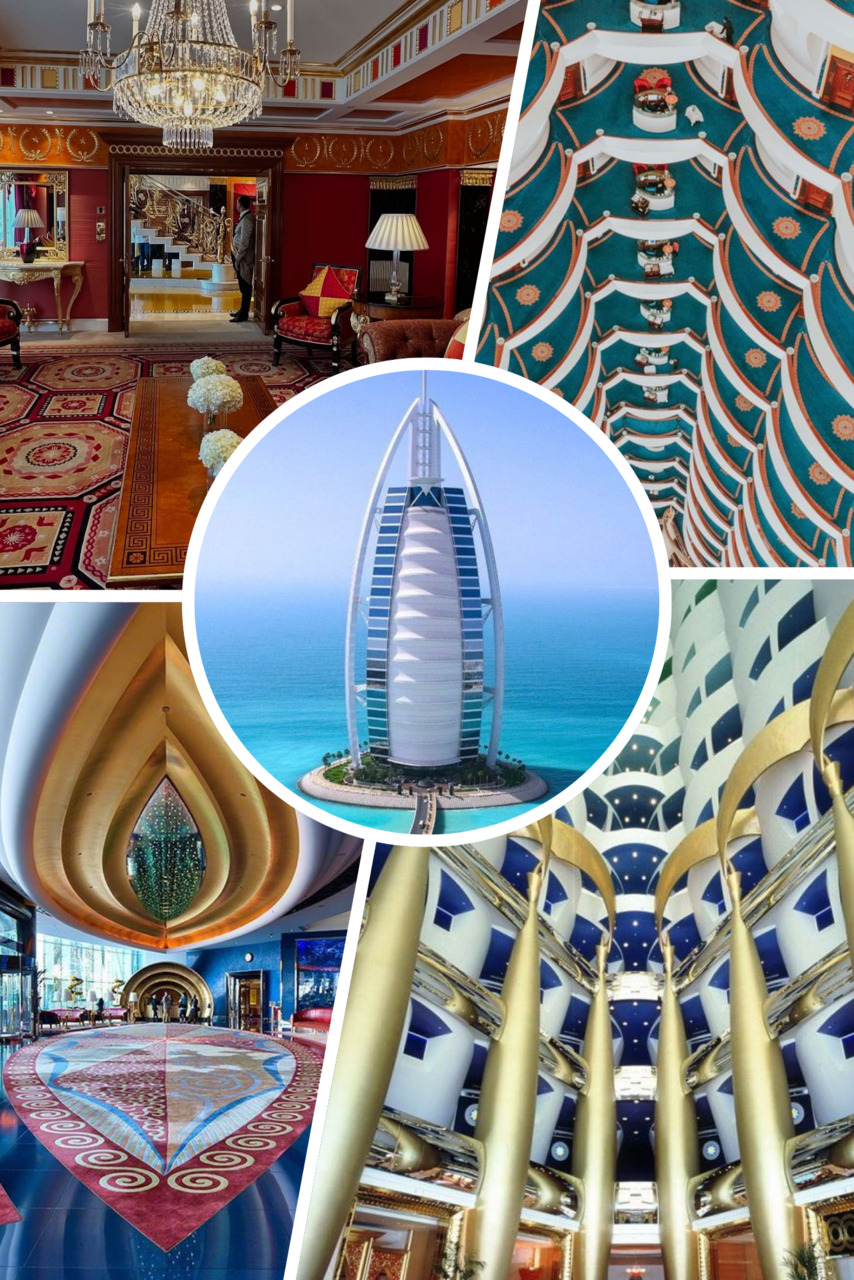
Inside lies a colossal atrium, 180 metres high, the tallest in the world.
When you enter, it feels as though you are inside a cathedral.
But instead of stained glass — there is gold, glass, and light.
The interior utilises:
— Over 8,000 m² of 24-carat gold
— Marble from Italy and Brazil
— Handmade carpets
— Lifts with panoramic views of the ocean
This is not minimalism.
This is demonstrative luxury.
The Burj Al Arab was built to show the world:
“We can do anything.”
Why It Is Called 7-Star
Officially, 7-star hotels do not exist.
The maximum is 5.
But the Burj Al Arab transcended this classification long ago.
Here:
— Every suite has a personal butler 24/7
— Transfers are conducted via Rolls-Royce or helicopter
— All rooms are suites (starting from 170 m²)
There are no standard rooms.
Only luxurious apartments.
The First Step Inside
You step out of the car.
The door is opened by a person in a perfectly pressed uniform.
He does not say “hello”.
He looks you in the eye and smiles as if he had been waiting specifically for you.
Inside — the air smells not of perfume, but of cleanliness and money.
The silence is thick, like velvet.
Every step on the carpet sounds different.
You feel that this is not just a hotel.
It is a performance, where you are now one of the actors.
Inside the Suites: What Life Looks Like Behind Golden Doors
When the lift doors close, you are no longer in Dubai.
You are in a world where reality submits to money.
The lift rises silently.
No familiar hum.
No vibrations.
Only soft light and the sensation that you are ascending not upwards, but to another level of existence.
The doors open.
And you enter the suite.
The First Sensation
The first thing you feel is space.
The Burj Al Arab does not do narrow corridors or small rooms.
Here, even the entrance is a hall the size of a standard flat.
Before you:
— A staircase with a handmade carpet
— Columns
— Huge floor-to-ceiling windows
— And the ocean, which seems to hang in the air
This is not a room.
These are the apartments of a person who does not ask the price.
Duplex Life
All suites here are two-storey.
On the first level:
— A living room with sofas you can drown in
— A study
— A dining area
— A bar
— Panoramic windows overlooking the Arabian Gulf
On the second level:
— A bedroom
— A bathroom with a jacuzzi
— A dressing room
— A separate relaxation area
You literally live in two worlds:
Day — in the light of the ocean.
Night — in the soft gold of the interiors.
Gold Everywhere
Gold here is not an accent.
It is the background.
Door handles.
Mirror frames.
Furniture elements.
Even the buttons on the remote controls are gold-plated.
This is not screaming luxury.
It is a demonstration:
“We can afford to spend gold on things others spend plastic on.”
Technology Inside the Suite
Every suite is equipped with:
— A “smart home” system
— Touch control panels
— A personal iPad
— High-speed internet
— A multimedia system
You can:
— Order food
— Summon the butler
— Adjust the lights, music, curtains
— Even choose the scent of the room
With a single touch.
The Butler
You have a personal butler.
Not on request.
He is assigned to you.
This is a person who knows:
— How you take your coffee
— What water temperature you prefer
— When you wake up
— And what you dislike
If you say:
“I am cold.”
Within a minute, a blanket will be brought to the room.
If you say:
“I want cake.”
It will appear.
If you say nothing —
he will sense it anyway.
The Bathroom
The bathroom here is not a place for hygiene.
It is a ritual.
Marble.
Gold.
A jacuzzi overlooking the ocean.
A separate shower.
A set of elite Hermès cosmetics.
You sit in the water, look at the sea, and realise:
In ordinary hotels, you wash.
Here — you live.
How the Night Feels
When the sun departs, the Burj Al Arab becomes something else.
The city lights up.
The ocean darkens.
Inside the suite, soft lighting engages.
You sit on the sofa, look at the lights of Dubai, and realise:
You are above the city.
You are not a tourist.
You are part of this world’s elite.
Even if only for one night.
Who Lives in the Burj Al Arab
One does not arrive at the Burj Al Arab by accident.
People who look for “good value for money” do not stay here.
One does not come here for discounts.
One does not book a room “simply because the beach is nearby”.
Those who come to the Burj Al Arab want to be above the world.
Typical Guests of the Burj Al Arab
1. Billionaires and Business Empire Owners
For these people, the Burj Al Arab is not a luxury.
It is a convenience.
Here:
— High level of security
— Confidentiality
— Personalised service
— No one asks unnecessary questions
Many come here for:
— Deals
— Secret negotiations
— Meetings with partners
The Burj Al Arab is not just a hotel.
It is neutral territory for global money.
2. Stars and Global Celebrities
Guests have included:
— Hollywood actors
— Pop stars
— Top models
— Athletes
— Members of royal families
But most importantly — they are not photographed here without permission.
The hotel knows how to keep secrets.
Celebrities love the Burj Al Arab because:
— You can go to the beach and remain unnoticed
— The staff do not tell tales
— Security works invisibly
3. The Arab Elite
For wealthy families from Saudi Arabia, Kuwait, and Qatar, the Burj Al Arab is almost like a second home.
They arrive:
— With children
— With security
— With drivers
— With personal chefs
And the hotel adapts to them.
Sometimes, a single family with their staff occupies an entire suite.
For them, it is not a room — it is a temporary palace.
4. People Celebrating Life
There is a special category of guests.
These are people celebrating:
— A wedding
— A honeymoon
— An anniversary
— A divorce
— A major deal
— The start of a new life
They do not come here for practicality.
They come for the feeling that this moment is the most important in their life.
How Guests Behave
Interestingly, in the Burj Al Arab, people do not behave like tourists.
There is no fuss.
No noise.
No running around with cameras.
Everyone behaves as if:
“I am here because I am meant to be here.”
Even those who have arrived for the first time.
Quiet Luxury
In the Burj Al Arab, there are no ostentatious logos.
Brands do not scream here.
The level screams.
The watches on the guests’ wrists cost as much as houses.
Handbags — as much as cars.
Jewellery — as much as small countries.
But no one stares at anyone else.
Because here, everyone is equally outside of ordinary reality.
What You Feel Beside Them
When you are amongst these people, you sense a strange thing:
You realise that for them, the world works differently.
For them:
— Planes are taxis
— Countries are neighbourhoods
— Money is a tool, not a goal
And the Burj Al Arab is their drawing room.
Restaurants Where Dining Is a Performance
In the Burj Al Arab, food is not about hunger.
It is about the feeling that you are living in a film.
One does not “go to eat” here.
One goes to live through an evening.
Every restaurant is a stage.
Every dinner is a performance.
You are not just a guest — you are part of the production.
Al Muntaha — The Restaurant in the Sky
It is located 200 metres above the sea.
Its name translates as “The Ultimate” — and this is not marketing.
You step into a lift that whisks you upwards along the building’s façade.
Through the glass, you see the ocean and Dubai become toy-like.
When the doors open, you enter a hall where:
— The walls are glass
— The ceiling is light
— The city is beneath your feet
Here they serve:
— French cuisine
— Seafood dishes
— Tasting menus from world-class chefs
You sit with a glass of wine, looking at the lights of Dubai, and realise:
People below are living.
You — are soaring.
Al Mahara — The Underwater Restaurant
This is the Burj Al Arab’s most famous restaurant.
You enter a tunnel.
The light turns blue.
And suddenly, before you — a massive aquarium.
You sit at a table, and beside you:
— Sharks swim
— Rays
— Tropical fish
You eat lobster while a shark glides past.
This is not a zoo.
It is the sensation that you are dining inside the ocean.
Here they serve:
— The freshest seafood
— Oysters
— Caviar
— Signature dishes from the chefs
It is not cheap.
But you are not paying for food.
You are paying for an impossible experience.
Skyview Bar — Cocktails Above the World
This bar is at the same height as Al Muntaha, but the feeling is different.
Here:
— Subdued lighting
— Sofas
— Live music
— People in evening wear
You sit, drinking a cocktail, looking at a city burning with thousands of lights.
This is a place where:
— Deals are struck
— Romances begin
— People feel beautiful
Junsui — Japan in the Heart of Dubai
This restaurant is an entire gastronomic world.
Here:
— Sushi
— Teppanyaki
— Asian cuisine
— Live cooking stations
You can:
— Watch the chef slice the fish
— Watch the fire burn
— Watch the food being created
This is not just a restaurant.
It is gastronomic theatre.
How You Are Served
Waiters do not simply serve dishes.
They know:
— What you love
— What you ate yesterday
— What you cannot tolerate
The plate is not placed on the table — it appears.
Wine is not poured on request — but at the precise moment.
Here, they do not ask you:
“Did you enjoy everything?”
Because here, everything must be perfect by default.
The Feeling of Dinner at the Burj Al Arab
You do not leave the restaurant full.
You leave changed.
Because you didn’t just eat.
You lived an evening in a world where everything is created to make you feel chosen.
The Cost of Living in a Legend
The Burj Al Arab is not a hotel where one asks the price.
It is a place where the price is accepted as a given.
One does not buy a night’s stay here.
One buys status, emotion, and the feeling that you have stepped beyond the bounds of the ordinary world.
How Much a Room Costs
The simplest suite in the Burj Al Arab is around 170 square metres.
Price:
— From $1,500–2,000 per night in the quietest periods
— Up to $10,000–25,000 per night in high season or for superior suites
Royal apartments can cost $30,000–40,000 per night.
This is not a mistake.
This is reality.
What Is Included in This Price
You are not paying for a bed.
You are paying for:
— A personal butler
— Privacy
— Security
— The level of service
— Access to restricted areas
— Status
You can order:
— A helicopter
— A yacht
— A personal chef
— A shopping concierge
— Security detail
And no one will say “no”.
How Much Dinner Costs
Dinner in the Burj Al Arab’s restaurants:
— From $200–300 per person
— Up to $1,000+ for a tasting menu with wine
But you are not paying for food.
You are paying for:
— The view
— The atmosphere
— The silence
— The people around you
What You Are Really Paying For
The Burj Al Arab does not sell luxury.
It sells the feeling of exclusivity.
You pay so that:
— No one stands next to you in a queue
— No one disturbs you
— Everything is tailored to you
You pay for the world to slow down.
Who This Hotel Suits
It suits:
— People with substantial money
— Those who want maximum comfort
— Those who value privacy
— Those celebrating an important moment in life
It does not suit:
— Those looking for a “good deal”
— Those who love simplicity
— Those who dislike luxury
— Those who do not want to be the centre of attention
The Burj Al Arab is not about rest.
It is about asserting oneself.
The Final Sensation
When you check out of the Burj Al Arab, the city seems different.
It seems:
— Noisy
— Fast
— Ordinary
And you realise:
You have been in a place where the world bends to the will of the individual.
Construction, Cost, Famous Guests and Reviews
— What the Legend of the Burj Al Arab Conceals
The Burj Al Arab in Dubai is not just a hotel.
It is an architectural symbol, a city landmark, the investment project of the century, and a legend of luxury known across the world.
Construction: How the World’s Most Expensive Hotel Was Created
The idea of creating a symbol-hotel was born in the early 1990s. The Sheikh of Dubai set a task: to build not merely a hotel, but an architectural beacon that would become the emirate’s calling card, like the Eiffel Tower for Paris.
The architectural design was developed by the British architect Tom Wright with the support of the international firm Atkins (UK). The task was for the building to resemble the sail of a traditional Arab dhow vessel, reflecting the region’s maritime heritage.
The most difficult part was not building the hotel, but placing it in the middle of the sea.
To do this:
— An artificial island was created off the coast, approximately 280m from the shore.
— 230 concrete piles, up to 40m long, were driven into the island to ensure stability and protection against erosion.
— The construction of the island took up to 3 years, while the hotel itself was erected in under three years.
In total, up to 2,000–3,500 construction workers participated in the project simultaneously, and more than 3,000 companies and designers worked on its engineering, architectural, and decorative solutions.
How Much the Project Cost
There is no exact official cost — the UAE government and Jumeirah Group have never disclosed it.
However, expert estimates suggest that construction cost approximately $1 billion — making the Burj Al Arab one of the most expensive hotels in history.
Of this sum:
— About 2 years went into creating the island,
— The remaining 3 years — on building the structure itself,
— Significant funds were spent on finishing materials, including tonnes of marble, rare woods, and gold leaf particles in the interiors.
The Burj Al Arab, 321m high with 56 floors and one of the tallest hotels in the world, was not only expensive to build but requires constant expenditure on maintenance and staff.
Famous Guests and Stories
The Burj Al Arab attracts the attention not only of tourists but of the most famous people on the planet. Some stories have become part of global pop culture:
— Tiger Woods / Andre Agassi / Roger Federer
Legendary tennis players played on the hotel’s upper helipad. Tiger Woods hit his first tee shot from there, while Agassi and Federer played a friendly match above the clouds over the city.
— Michael Jackson
The King of Pop came here not only to relax but simply for a special dish — Spicy Buffalo Wings, which became his favourite.
— The Million-Dollar Dessert
Once, a billionaire’s daughter celebrated her 21st birthday at the hotel — and ordered a dessert costing around $1,000 featuring truffle chocolate, vanilla, and edible gold.
— Mr. Mystery Guest
In 2011, a man arrived at the hotel under a pseudonym, with heightened security requirements, encrypted phones, and total isolation from the outside world. He vanished as suddenly as he appeared — and the room sat empty under security surveillance for another 2 weeks.
This confirms the thought that the Burj Al Arab is not only for holidays, but a place for deals, secret meetings, and elite private space.
Guest Reviews — What People Say
Most guests leave enthusiastic reviews about:
— First-class service — many note that staff remember names, food preferences, room temperature, and even favourite drinks.
— The atmosphere of exclusivity — the feeling that the world around slows down.
— Views from windows and restaurants — panoramas of the Arabian Gulf and exquisite dishes are remembered for a long time.
But not everything is perfect.
Some reviews — especially regarding events (weddings, banquets, or large celebrations) — point to problems:
— Service does not always match the claimed level
— Staff can be overloaded
— Coordination of service is sometimes weak
In one case, guests attending a wedding banquet noted staff disorganisation, disrespectful treatment, and dishes that did not match the menu — which is surprising for a “seven-star” brand.
Such reviews show that even a legendary hotel faces the human factor — especially during mass events.
What You Are Really Paying For
When you pay for a room at the Burj Al Arab, you are buying not just a room.
You are paying for:
— An architectural symbol
— Privileged access
— Personal service and attention
— Exclusive restaurants and bars
— Status and an experience that cannot be faked, even if you do not show it to those around you
The room cost — from $1,500–2,000 per night to $30,000+ for royal suites with a rotating bed — reflects not just accommodation, but the status experience of life at the top of the world.
The Burj Al Arab is not just a hotel.
It is:
— The architectural achievement of the century
— An engineering miracle
— A place for legends and stories
— A social symbol of luxury
— A home for the most sophisticated guests
And even more than 25 years after opening, it continues to remain the benchmark — a place where luxury becomes a lifestyle.
Chapter 2. ATLANTIS THE ROYAL The Hotel That Rewrote the Concept of Luxury
When Dubai Decided to Build Not Just a Hotel, But a New World
If the Burj Al Arab is the icon of old Dubai,
then Atlantis The Royal is the Dubai of the future.
It was not built as a hotel.
It was designed as an architectural manifesto.
When you look at Atlantis The Royal from the outside, you do not immediately realise that it is a hotel.
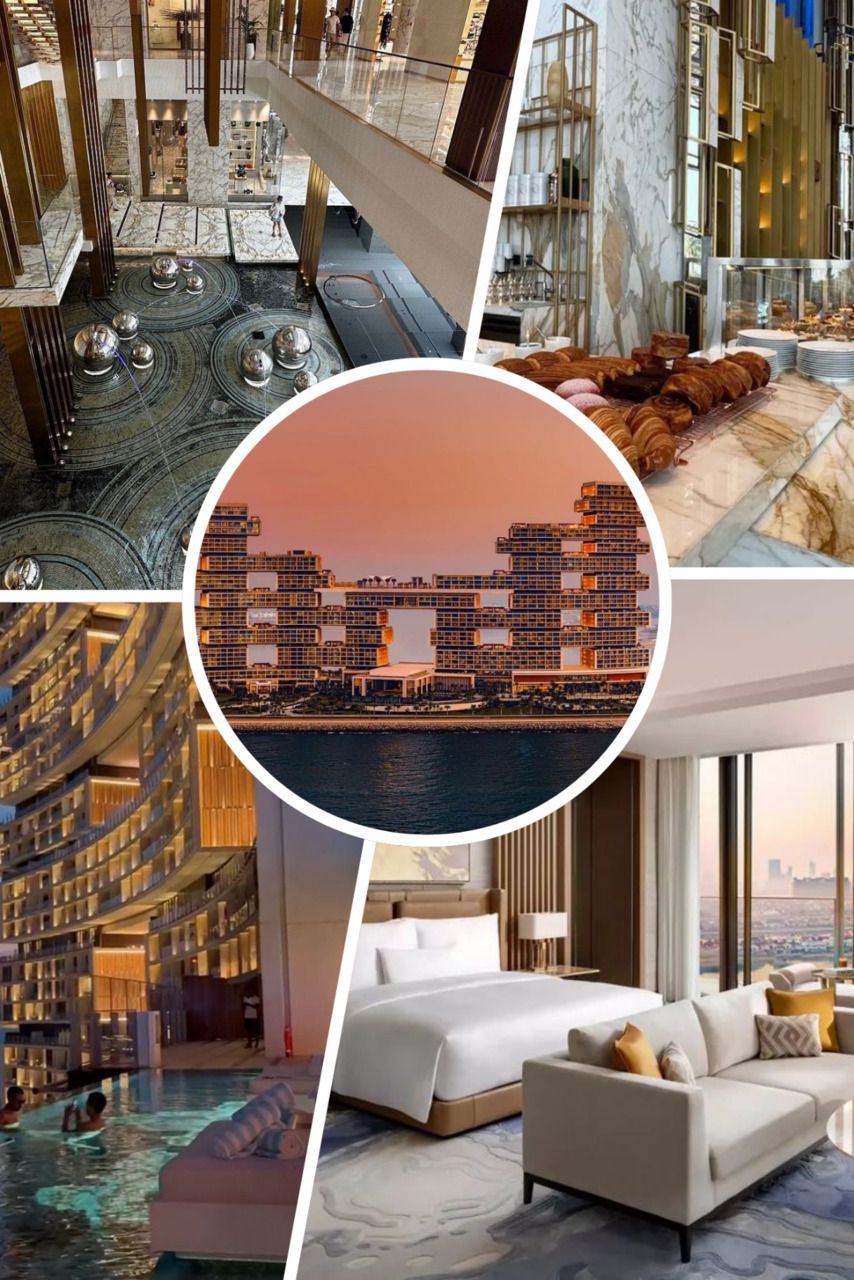
It looks like a city raised into the air: giant blocks stacked upon one another, terraces, bridges, hanging gardens, waterfalls, pools, lights.
This is not a building.
This is architectural audacity.
Why They Decided to Build It
After the success of Atlantis The Palm, Dubai understood a simple thing:
people are willing to fly halfway across the world for a single hotel, if it is legendary.
But the Sheikh and the investors wanted more.
Not just another resort.
Not simply luxury.
They wanted to create:
the most impressive hotel in the world.
Thus was born Atlantis The Royal — a project intended to surpass everything ever built in the hospitality business.
Who Built It
The project was undertaken by:
— The architectural firm Kohn Pedersen Fox (KPF) — some of the best skyscraper architects in the world
— Interior designers GA Design and Sybarite
— The developer — Kerzner International, the same company behind Atlantis, One&Only, and ultra-luxury resorts worldwide
Construction lasted nearly 8 years.
Every element — from the façade to the pools — was designed individually.
How Much Atlantis The Royal Cost
Official figures have not been published, but according to developer and investor estimates:
the project cost exceeded $1.4 billion.
This is one of the most expensive hotels ever built on the planet.
And the reason is simple:
this is not just a building.
It is hundreds of pools, terraces, restaurants, engineering systems, lifts, climate technologies, and design elements.
The First Impression When You Approach
You drive along the Palm Jumeirah, seeing the sea, luxurious villas, yachts…
And suddenly — there it is.
Atlantis The Royal does not rise.
It looms.
It seems to look at the old Atlantis Palm and say:
“You were good. But now I am here.”
When you drive up to the main entrance:
— You are met by mirrored façades
— Massive building cantilevers
— Waterfalls cascading from terraces
Everything looks as if you are entering a futuristic palace.
Stepping Inside
Inside — space, light, and silence.
Not a noisy resort.
Not tourist bustle.
But the feeling that you have found yourself in a place where:
— Every step costs money
— Every detail is thought out
— Every second must be perfect
There are no ordinary registration desks here.
You are led.
They do not say “stand here”.
They say:
“Allow us to show you your world.”
Rooms and Residences of Atlantis The Royal:
What Life Looks Like at the Summit of Dubai
Atlantis The Royal is arranged not like an ordinary hotel with “standards” and “deluxes”.
It is designed as a vertical resort, where every level is a different lifestyle.
Here there are:
— Designer rooms
— Suites with private pools
— Sky-villas
— And residences where people live for months
1) Seascape Rooms — Rooms with a View of the Arabian Gulf
This is the entry point into the world of The Royal, but even a “basic” room here is at the suite level of any other hotel.
Space and Layout
— Panoramic floor-to-ceiling windows.
— A balcony overlooking the ocean or Palm Jumeirah.
— A king-size bed with a soft headboard, as if upholstered in yacht leather.
— A spacious relaxation area with a sofa, armchairs, and a table.
Interior
— Warm shades of sand, cream, and deep blue.
— Stone, glass, and soft textiles.
— The lighting is recessed so the room does not look lit — it seems to glow from within.
Bathroom
— A separate bathtub by the window.
— A tropical rain shower.
— Double vanity.
— Premium cosmetics (often created specifically for the brand).
You look at the ocean, lying in the bath, and realise:
here, even an ordinary evening feels like a scene from a film.
2) Skyline Rooms — Rooms with a View of Skyscrapers
These rooms look not at the sea, but at Dubai Marina, the skyscrapers, and the night lights.
They are chosen by:
— Business guests
— Lovers of urban landscapes
— People who value the energy of the metropolis
The Sensation
If Seascape is tranquillity,
then Skyline is Dubai in its purest form.
You see:
— The lights of the roads
— The movement of yachts
— Towers stretching into the sky
These are rooms for those who want to feel the pulse of the city without leaving their bed.
3) Junior Suites — The First Levels of True Luxury
Here begins Atlantis The Royal as it was conceived.
Space
— Separate living room.
— Bedroom.
— Large dressing room.
— Expanded bathroom area.
How They Differ from Ordinary Rooms
— More air.
— More privacy.
— A clear separation between “day” and “night”.
In these suites, you can already:
— Receive guests
— Host dinners
— Live not as a tourist, but as a resident
4) Executive & Grand Suites — For People Who Work and Relax Simultaneously
These suites were created for:
— Company owners
— Top managers
— Families travelling with staff
What is Inside
— Large living room with a dining area.
— A study.
— Bedroom with a separate relaxation area.
— Sometimes — a private kitchen.
Here you can:
— Conduct negotiations
— Receive partners
— Host private meetings
This is no longer a room.
It is an office + apartment + five-star service.
5) Sky Pool Suites — Suites with Private Pools
One of the most famous categories of Atlantis The Royal.
These rooms are located on the building’s terraces and feature:
— A private infinity pool
— Sun loungers
— A tanning area
— A view of the ocean or the city
You step out of the bedroom — and find yourself in your own personal resort tens of metres above the ground.
Why People Choose Them
Because here you:
— Swim away from prying eyes
— Watch the sunset
— Do not share space with other guests
This is the level of a private villa, but in the sky.
6) Sky Villas — The Pinnacle of Atlantis The Royal
This is no longer a hotel.
These are aerial palaces.
Sky Villas are:
— Separate residences
— With multiple bedrooms
— Huge living rooms
— Terraces
— Private pools
— Sometimes — private lifts
Living in such villas are:
— Royal families
— Billionaires
— Global celebrities
You can spend a month here without once feeling like you are in a hotel.
7) Royal Mansions — The Elite of the Elite
These are the most expensive and rare apartments in Atlantis The Royal.
They are booked by:
— Heads of state
— Corporate owners
— Ultra-wealthy families
Here there are:
— Multiple bedrooms
— Halls
— Dining rooms
— Private pools
— Staff quarters
— Security rooms
This is not a room.
It is a temporary palace.
What Unites All Rooms at Atlantis The Royal
Regardless of category, you receive:
— Absolute silence
— An ideal climate system
— Personal service
— The feeling that the world has adjusted itself to you
There are no “ordinary” guests in this hotel.
Everyone here is a character in their own luxurious story.
Atlantis The Royal is not just a hotel.
It is a global address of status, where people fly not for tourism, but for a sensation that cannot be described in words — it must be experienced.
Why People Come Here
Do not confuse this with an ordinary holiday. Those who come to Atlantis The Royal are those who:
— Have already seen the world
— Have already travelled to the planet’s best hotels
— Already have experience of holidays in the Maldives, Seychelles, and the Côte d’Azur
— And now want not a place, but an event
One does not “spend a holiday” here — here, one:
— Makes major business deals
— Celebrates life events
— Meets with families
— Organises private groups with their own rules
— Works and relaxes simultaneously
Atlantis The Royal is a hotel complex + resort + cultural hub, where people do not go “on vacation”.
They go there to be seen, heard, and to feel that they are living at the pinnacle of their own success.
Typical Categories of Guests
1) The Global Business Elite
These are corporate owners, investors, bankers, founders of funds.
Many hold regular meetings here for deals in the hotel’s private zones.
They choose:
— Residences with a private pool and ocean view
— Large suites with studies
— Private personnel
Often decided here are:
— IPOs
— Latest investment rounds
— Strategic alliances
Atlantis The Royal is not just a place of rest, but neutral territory for major negotiations.
2) Sports Stars
Hockey, football, tennis — the sports elite loves the complex for:
✔ Privacy
✔ High level of service
✔ Availability of sports facilities in the hotel and nearby
✔ Proximity to the airport
Visitors have included (official and unofficial confirmations from guest lists, press reports, and closed sources):
— Cristiano Ronaldo — during off-season breaks (according to correspondents, he booked 2–3 suites simultaneously for himself and his entourage)
— Lionel Messi — official guest visits during holidays with family
— Novak Djokovic — noted at events on private terraces
— LeBron James — group stops after basketball tour matches
These athletes choose Atlantis The Royal not only for comfort but for the opportunity to relax calmly away from the paparazzi.
3) Actors and Musicians
Atlantis The Royal is a magnet for media personalities.
Stays have been reported for:
Jennifer Lopez and Ben Affleck — family holiday and a private event on a terrace over the ocean
Shakira — with friends, during tour breaks
The Weeknd — keeps a separate suite as a “personal hotel” during extended visits
Many artists come for a short time — 2–3 days, to seclude themselves, breathe the Emirates air, taste fine dining at Al Mahara and Al Muntaha, and fly back.
4) International Billionaire Families
These are families with their own pilots, chefs, and bodyguards.
Their visits are:
— Extended (weeks/months)
— With a full staff roster
— Booking multiple residences for guests and entourage
They often stay in Sky Villas, with personal kitchens, pools, and guest zones.
5) Lovers of Extreme Luxury (Non-Commercial Guests)
These are people who:
— Have collections of private jets
— Live in luxurious homes around the world
— Travel to unique hotels
— Collect experiences instead of objects
Atlantis The Royal is the key to closed lists of elite travellers who move from life to life, from hotel to hotel, from impression to impression.
Stories and Cases Discussed Within the Industry
The Secret Billionaire’s Wedding
In 2021, a closed ceremony took place at Atlantis The Royal, which was not filmed by the media, but reports leaked due to huge floral arrangements, guests’ personal cameras, and jets parked on the runway.
Guests said:
“It was more beautiful than any wedding we have seen.”
“It was a gathering of the most influential people on earth.”
“It is not a celebration — it is an event for the world.”
Closed Music Event with a World-Class DJ
Atlantis The Royal organises private parties where they invite top-10 global DJs, for an audience of no more than 200 people.
Such events are not advertised officially but enter closed guest lists (via personal channels).
How Guests Look Through the Eyes of Staff
Staff at Atlantis The Royal often say that the usual categories of “tourist / business guest / family” do not work here.
Guests here are a portrait of success and experience:
— They fly daily on private jets
— They discuss their plans for the next year, not their holiday
— They sit in restaurants as if it were their living room
— They respect service, but do not demand proof of status
One employee (anonymously) said:
“We do not serve guests.
We serve people who could change the world tomorrow.
It is important for us to be useful, not just luxurious.”
Reviews and Impressions
Client Reviews (Based on real ratings and guest managers)
Hotel: Atlantis The Royal
Source: TripAdvisor / Booking / Vanity Fair / Insider
Analysis Period: 2023–2025
“It was like staying inside a movie about the future. The atmosphere surpasses any luxury I have seen before.” — Business guest, NY
“The service here understands you before you say a word.” — Family from Europe
“The cuisine, views, service — everything is like a performance. But at the same time, it is not noisy here. It is grown-up.” — Frequent traveller
“The best thing that has happened to me in my travels.” — Guest from Asia
Why Celebrities Go Specifically Here
Atlantis The Royal works on three levels of attraction:
1) Privacy
No one takes photos without permission.
No paparazzi.
Security is invisible, but it works.
2) Personal Service
Personal butler, personal transport, the ability to close off a floor for oneself.
3) Iconicity
The Burj Al Arab is a symbol.
Atlantis is the new symbol of the future of luxury.
People do not just relax here.
They want to be part of the history of this place.
Atlantis The Royal is not just a luxury hotel.
It is an architectural statement.
It is what Dubai wanted to say to the world: “We no longer copy the future. We design it.”
1. Why Atlantis The Royal Looks So Strange and So Mesmerising
If you look at the building from afar, it resembles no other hotel in the world.
It is not a tower. Not a palace. Not a resort.
It is a layered mega-structure, as if giant blocks were stacked upon one another, shifted, suspended, and connected by bridges.
And this is not accidental.
The architects at KPF wanted to create the effect of: a “vertical city”
Every level is:
— A separate world
— A separate terrace
— A separate stage of life
You do not live in a building. You live in a landscape that ascends into the sky.
2. The Architectural Idea: The Hotel as an Artificial Archipelago
Inspiration was drawn not from skyscrapers, but from:
— Islands
— Cliffs
— Terraced villages
— Mountain plateaus
Atlantis The Royal was conceived as: “an archipelago of villas, raised into the air”
Each block of the building is like a separate island. Between them lie bridges, pools, gardens, restaurants, waterfalls.
You can move through the hotel without descending:
— From room to restaurant
— From restaurant to pool
— From pool to bar
— From bar to another wing
And all of this — on different levels.
3. Why There Are So Many Terraces and Open Spaces
Ordinary skyscrapers grow upwards. Atlantis The Royal grows outwards.
Every room, every restaurant, every villa has:
— A balcony
— A terrace
— Open space
Because in Dubai, the main thing is not walls. The main thing is air, light, and the view.
Here, you never feel “inside”. You always feel as though you are on the edge of the world, between the sky and the sea.
4. Water as the Main Element of Architecture
In Atlantis The Royal, water is not decoration. It is part of the structure.
Here there are:
— Hundreds of pools
— Waterfalls
— Mirror-like water surfaces
— Infinity edges
— Reflecting canals
Water is used as:
— Cooling
— An acoustic filter
— A visual effect
— A method of separating spaces
When you walk along the terraces, you do not hear the city. You hear water.
It drowns out the noise, creating the sensation of a resort, even at a height of 40–50 metres.
5. An Engineering Miracle: How This Building Stands at All
Atlantis The Royal is one of the most complex engineering projects in the history of hospitality architecture.
Why? Because:
— Building blocks overhang one another
— Some terraces protrude by tens of metres
— Pools and gardens are located at skyscraper height
This means: tonnes of water, earth, plants, and people are suspended in the air.
To achieve this, they used:
— Ultra-strong steel beams
— Multi-layered concrete slabs
— Weight compensation systems
— Special vibration dampers
The building literally “breathes” — it is calculated for:
— Winds
— Temperature fluctuations
— Soil movement
— Seismic activity
6. How the Sky-Pools and Pools in the Sky Are Made
The most insane aspect is the pools, which:
— Are located on terraces
— Protrude over the void
— Have glass edges
The water in them creates pressure of tens of tonnes.
Every pool:
— Stands on a separate engineering platform
— Has its own filtration system
— An emergency drainage system
— And double waterproofing
If even one layer fails — water does not enter the building. This is technology previously used only in space projects and super-skyscrapers.
7. Gardens in the Sky
In Atlantis The Royal, there are real:
— Trees
— Shrubs
— Tropical plants
They grow on levels where:
— There is no natural soil
— There is wind
— Strong sun
For this, they created:
— An artificial soil system
— Drip climate control
— Root protection against overheating
You walk along a terrace and see palm trees, as if you are on an island. But beneath your feet lie tens of metres of air.
8. Interior as a Continuation of Architecture
Inside, the hotel does not argue with the façade.
Here there are:
— Huge open spaces
— Ceilings several storeys high
— Panoramic glass
— Natural stone
— Warm metals
— Soft light
The design does not scream “luxury”. It whispers: “You will remember forever how this felt.”
9. Why This Hotel Became an Icon
Atlantis The Royal has become what the Burj Al Arab was in the 2000s.
It is:
— An architectural symbol
— An object printed on covers
— A point people want to reach simply to say: “I was there.”
This is not just a hotel. It is a symbol of the era.
Restaurants, Chefs, and the Gastronomic Theatre of Atlantis The Royal
Atlantis The Royal is not just a hotel with world cuisines. It is a culinary complex that has gathered dozens of concepts under one roof, each of which could stand alone as a gastronomic festival.
There are no “simple lunches” here — here, every meal becomes an event, and the protagonist of this performance is the chef.
General Gastronomic Concept Atlantis The Royal offers 17 world-class restaurants, including 8 establishments created by famous international chefs. This is more than most mega-hotels on the planet.
Here intersect:
— Innovative cuisine
— Historical recipes
— The gastronomic culture of different countries
— A reflection of traditions and modern craftsmanship
Every restaurant is a stage for flavour, and every dinner is a performance.
1. Dinner by Heston Blumenthal — British Gastronomy, But Not As You Know It This is the restaurant behind which stands the name of Heston Blumenthal — one of the most famous chefs in the world, the author of Molecular Gastronomy concepts and owner of The Fat Duck (3 Michelin stars).
Concept Dinner is a journey through time, starting from British cuisine of the 14th century up to the 18th century. Dishes are reconstructed based on historical recipes, but with a modern approach to technique and plating.
Signature Dishes
— Meat Fruit — chicken liver parfait disguised as fruit (Heston’s signature “calling card”).
— Tipsy Cake — an 18th-century dessert with a boozy sauce.
— Roast Halibut with Green Sauce — a modern interpretation of a British dish.
Interesting Facts
— The restaurant received a Michelin star just a few months after opening thanks to the precision of technique, historical approach, and journey in taste (according to journalistic research).
— The chef and team studied historical archives and even collaborated with museum curators and the British Library to recreate original recipes.
— Preparation of a single dish can take up to 10 days, and service involves measuring salt by the gram and presentation with theatrical precision.
Dinner is not just a kitchen; it is a vision of how food influenced culture and history, and the table here is like a museum exhibit that you can eat.
2. estiatorio Milos Dubai — The Greek Sea on a Plate This restaurant is a celebrated representative of Greek Mediterranean cuisine, founded by chef Costas Spiliadis — one of the most respected specialists in seafood.
Specialisation
— The freshest marine delicacies
— Raw bar delicacies
— Delicacies from Greek and Mediterranean shores
Dishes Worth Trying
— Wild Greek oysters
— Traditional Greek ceviche
— Citrus tzatziki with homemade bread
— Grilled octopus and sea snails with herbs
Atmosphere The restaurant is located by the Skyblaze fountain and has a terrace overlooking the water and light show, making dinner not only a gastronomic but also a visual experience.
3. Jaleo by José Andrés — Spain Through the Taste of History This restaurant brings Spanish food culture to Dubai through the lens of José Andrés — one of the most famous chefs in Spain and the USA. His concept is tapas, a place for fun and open fine-dining, reflecting the diversity of Spanish cuisine.
Distinctive Dishes
— Patatas Bravas — classic Spanish tapas
— Paella with chicken, rabbit, and green beans
— Cured baby suckling lamb ham — an unusual Spanish delicacy
The design, from the table football game at the entrance to the terrace with olive trees, creates an atmosphere of celebration, communal dining, and unity of taste.
4. Nobu by the Beach — The World’s First Beach-Nobu This restaurant from Nobu Matsuhisa brings the famous Japanese-Peruvian cuisine (Nikkei) straight to the shore.
Signature Dishes
— Black Cod Miso — Nobu’s calling card
— Yellowtail Jalapeño — a spicy and fresh interpretation of Japanese flavours
Concept Feature Nobu by the Beach is not just a restaurant, but a fusion venue where pool-side dining meets the sounds of a DJ and exquisite cuisine, perfectly suited for cocktails at sunset.
5. La Mar by Gastón Acurio — Peruvian Culinary Art La Mar is a project by Gastón Acurio, who put Peruvian cuisine on the global gastronomic map.
What They Cook Here
— Spicy ceviche and tiradito
— Fried calamari
— Anticucho (traditional Peruvian grilled meat)
Philosophy La Mar’s cuisine is rich in influences:
— Japanese
— Chinese
— Spanish
...making it one of the most recognisable Peruvian cuisines in the world.
6. Gastronomy — International Fine Dining Buffet This is not “just a buffet”. Gastronomy is the whole world of food under one roof. Distinguished by:
— Live-oyster bar
— Huge wine list
— Kitchen stations with chefs from different regions
Here you can:
— Try dishes from Europe, Asia, America
— Select the ideal wine pairing
— See the cooking process live
7. The Royal Tearoom & Little Venice Cake Company For those with a sweet tooth, Atlantis The Royal offers The Royal Tearoom — a chic tea salon with desserts, noble tea varieties, and light bites, created in collaboration with the famous pastry chef Christophe Devoille.
Nearby is the Little Venice Cake Company (design by Mich Turner), a legendary patisserie with desserts prepared for royal courts and celebrities.
The Most Expensive Dishes and Experiences In Atlantis The Royal, there is no “cheapest”, but there are very expensive gastronomic experiences:
Degustation Sets In many fine-dining restaurants — for example, Dinner by Heston or Nobu — there are multi-course tastings that can cost several hundred or even thousands of dirhams per person, especially with wine pairing.
Exclusive Wine Pairings Key restaurants offer exclusive wine selections, including rare bottles with limited release — these can add several thousand dollars to the table bill.
Gastronomy as Theatre Food here is not just taste. It is:
— The script of presentation
— Visual design
— A story on a plate
Dinner by Heston, for example, requires staff to know not only the recipes but the history of every dish in order to tell it to the guest.
Conclusion The gastronomy of Atlantis The Royal is not just a collection of restaurants. It is a gallery of the world’s flavours, where ancient traditions meet avant-garde cuisine, where every dish is a conversation starter, and every dinner is a separate story.
Your lunch here is not just a meal. It is part of a journey that will become one of the brightest pages of your life.
In most hotels, luxury is measured by:
— Square metres
— Number of stars
— Room price
In Atlantis The Royal, everything is measured differently: by how little you need to think.
You do not resolve issues here. You simply live, and the hotel adjusts to you.
1. Personal Butler — Not a Formality, But Your Shadow Almost every guest of suites and villas receives:
— A personal butler
— A personal coordinator
— A direct line to the service centre
This is not a person who brings towels. This is the manager of your life inside the hotel.
He can:
— Organise a helicopter in 20 minutes
— Close a restaurant for a private dinner
— Find a chef at 2 AM
— Prepare the room for a party
— Ensure confidentiality
You do not ask. You hint.
2. Private Transport and Closed Logistics Atlantis The Royal is not a place one “arrives at”. One is delivered here.
Guests have access to:
— Rolls-Royces and Bentleys with drivers
— Private yachts
— Helicopter transfers
— Private airport terminals
You step off the plane — and you are already in the hotel system. Customs, passport control, luggage — everything happens away from ordinary people.
3. Spa and Next-Generation Wellness The Spa at Atlantis The Royal is not just a massage. It is:
— Recovery
— Biohacking
— Anti-stress
— A medical approach
Here they use:
— Rejuvenation technologies
— Oxygen capsules
— Detox programmes
— Massages created for your profile
You do not “relax”. You reboot the body.
4. Pools and Private Zones Besides the public infinity pools, there are:
— Private sky pools
— Closed zones for celebrities
— VIP terraces
— Private beaches
Many guests never see the ordinary pools at all. They live in their own version of the hotel.
5. Security You Do Not See Atlantis The Royal serves:
— Presidents
— Royal families
— Billionaires
Therefore, here there are:
— Hidden security systems
— Private corridors
— Separate lifts
— Closed floors
You could be standing next to one of the most influential people on the planet and not know it.
6. Entertainment Not Sold in Brochures The hotel can organise:
— Private concerts
— Private DJs
— Shows exclusively for your group
— Rooftop dinners
— Events not on the schedule
This is not “animation”. This is staged life.
Chapter Finale — What Atlantis The Royal Really Is
When people say that Atlantis The Royal is “expensive”, they do not quite understand what they are paying for.
You are not paying for:
— A room
— A pool
— Food
You are paying for: the feeling that the entire world temporarily belongs to you.
This is a hotel in which:
— You are not judged
— You are not checked
— You are not disturbed
There is no word “cannot”. There is only the phrase “however is most convenient for you”.
Atlantis The Royal is not about an overnight stay. It is about life on another level of reality.
и
Chapter 3. ATLANTIS, THE PALM. The Island of Dreams Where Atlantis Lives
Atlantis, The Palm is not just a hotel; it is one of the most recognisable symbols of Dubai and an engineering miracle located at the apex of the man-made island of Palm Jumeirah.
1. Architecture and Design The architectural style of the hotel can be described as a blend of Arabian motifs and the myth of Atlantis.
— Concept: The building consists of two towers (Royal Towers) — East and West, connected by a bridge (the Royal Bridge Suite).
— Style: The architecture features traditional Islamic arches and spires, but they are stylised with an oceanic theme (shells, waves, corals).
— Interior: The lobby is adorned by a famous blown-glass sculpture 10 metres high, created by the American artist Dale Chihuly. It consists of 3,000 pieces and resembles a frozen firework or sea corals.
— Scale: The hotel has 1,539 rooms.
2. Who Built and Designed It? The project was the result of a collaboration between international giants.
— Developer: The hotel was built by Kerzner International (founded by the South African magnate Sol Kerzner) in partnership with Istithmar World (the investment arm of the Dubai government).
— Architects: The design was handled by the renowned architectural firm WATG (Wimberly, Allison, Tong & Goo). They specialise in luxury resorts and entertainment complexes.
— Interior Design: Wilson Associates studio.
3. How Was It Built? Construction was an immensely complex logistical task, as it took place on a reclaimed island 5 km from the mainland.
— Location: The hotel stands on the “crescent” (breakwater) which protects the “fronds” of the palm from sea waves.
— Foundation and Protection: To prevent the building from sinking or eroding, colossal ground reinforcement works were required. The breakwater consists of millions of tonnes of rock and sand.
— Material Delivery: All materials were delivered first via temporary crossings, and then through an underwater road tunnel connecting the “trunk” of the palm to the crescent.
— Timeline: Construction took about 2 years. The opening took place in September 2008.
4. The Financial Side
— Construction Cost: Approximately 1.5 billion US dollars.
— This was a huge investment, especially considering the opening coincided with the beginning of the 2008 global financial crisis.
5. The Grand Opening (Event of the Century) The opening ceremony on 20 November 2008 went down in history as one of the most expensive parties in the world.
— Party Budget: About 20—25 million dollars.
— Fireworks: The display was 7 times larger than the opening of the Beijing Olympics. It was visible from space.
— Stars: Kylie Minogue performed at the opening (fee approx. $2—3 million). Among the 2,000 VIP guests were Michael Jordan, Robert De Niro, Charlize Theron, and Denzel Washington.
6. Interesting Facts
— Aquarium: Inside the hotel lie The Lost Chambers Aquarium and the Ambassador Lagoon, holding 11 million litres of water. About 65,000 marine inhabitants live there, including sharks and rays.
— The Most Expensive Room: The Royal Bridge Suite, connecting the two towers, spans 924 sq. m. A night there costs around $30,000. It has its own lift, security, and chefs.
— “Leap of Faith” Slide: In Aquaventure waterpark, there is a near-vertical slide the height of a 9-storey building, which carries a person in a transparent tube straight through a shark-filled pool.
— Underwater Rooms: The hotel has two “underwater” suites (Poseidon and Neptune), where the bedroom and bathroom walls are huge windows into the aquarium.
— Gold: Real 24-carat gold is used in some décor elements and even in spa treatments.
History and Prerequisites for Construction
Context and Idea In the early 2000s, Dubai was actively positioning itself as a future global tourism capital. The ruler of Dubai, Sheikh Mohammed bin Rashid Al Maktoum, initiated the creation of the artificial archipelago Palm Jumeirah. However, the island itself needed a “flagship” — an iconic building that would become a magnet for tourists and a symbol of engineering triumph.
Developers and Partners The project was the result of a partnership between two giants:
— Kerzner International: The company of South African hospitality magnate Sol Kerzner. By that time, they already owned the successful Atlantis Paradise Island resort in the Bahamas and wanted to scale this model.
— Istithmar World: The investment arm of the Dubai government.
Construction Chronology
— Start: The construction contract was signed with British construction giant Laing O’Rourke in 2005.
— Process: Construction lasted just over 3 years (from 2005 to September 2008).
— Opening: The official opening took place on 24 September 2008.
2. Engineering Challenges and Logistics Building Atlantis was unique as it took place not on solid ground, but on the apex (crescent) of an artificial reclaimed island 5 km from the coastline.
— Logistics: One of the main problems was delivering materials and workers. Before the road tunnel and monorail were built, all cargo was delivered via temporary tracks or by sea.
— Soil and Foundation: Since the island consists of sand and rocks, complex ground reinforcement (vibro-compaction) was required so the heavy hotel towers would not sink.
— Workforce: At the peak of construction, over 10,000 workers laboured on the site around the clock.
3. Design Model and Architecture The architectural model of Atlantis, The Palm is based on two key concepts: replication of a successful model and localisation of style.
Бесплатный фрагмент закончился.
Купите книгу, чтобы продолжить чтение.