
Бесплатный фрагмент - The Tunguska Catastrophe: Brilliant Sky Glows
Eyewitness Accounts
Preface
The collision of the Tunguska cosmic body with the Earth took place on the morning of June 30, 1908. The first researchers reached the epicentre of the explosion many years later. However, the Tunguska event did not go unnoticed. Beginning in the first days of July 1908, about a hundred eyewitness accounts of an inexplicable glow in the sky appeared in print. The extraordinary twilight illumination, similar to the white nights of northern Russia, was observed over a vast territory: from St. Petersburg to Crimea in latitude and from Siberia to Great Britain in longitude.
The eyewitness accounts below are divided into sections depending on the longitude of the locality where the phenomenon was observed. The Tunguska cosmic body exploded over Siberia, so the material begins from Siberian newspapers. As A.M. Shönrok noted, there were few reports from Central Russia, as this territory was covered by clouds. The most surprised eyewitnesses were in the southern latitudes, where neither the polar lights nor the white nights ever come.
In 1908, time on the territory of the Russian Empire was measured using the Julian calendar. The transition to the Gregorian calendar (currently used) in secular life occurred in Russia only in 1918. Church life in Russia still follows the Julian calendar. In this regard, June 30, 1908, according to Western European Time corresponds to June 17 according to Russian time. In most Russian publications we are dealing with June 17th (Old Style). However, in later works, June 30th (New Style) is used.
There has been much debate about the nature of this mysterious phenomenon, which resembled the dawns after the explosion of the Krakatoa volcano. One thing can be said for sure, that it is connected with the dispersion of cosmic matter in the Earth’s atmosphere. It is important to note that the unusual atmospheric glow began before the fall of the Tunguska body and continued in a weakened form for about a month. Reports of such sightings are also given below.
2025, Ioffe Institute, St. Petersburg
Section 1. Observation from settlements located east of 50° east longitude
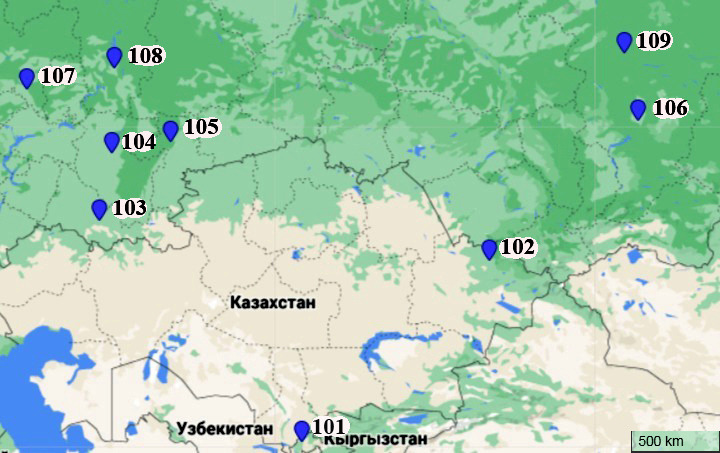
101. Krinov, E.A. The Tunguska Meteorite. Moscow-Leningrad: Publishing House of the USSR Academy of Sciences. 1949; Кринов Е. А. Тунгусский метеорит. М.-Л.: Из-во Академии наук СССР. 1949.
Tashkent (41° 18′ N 69° 15′ E)
Academician V.G. Fesenkov told the author that, having prepared for the regular astronomical observations at the Tashkent Astronomical Observatory on the night of June 30 to July 1, 1908, he could not wait for darkness to fall. As a result, it was not possible to carry out the programmed astronomical observations that night.
102. Krinov, E.A. The Tunguska Meteorite. Moscow-Leningrad: Publishing House of the USSR Academy of Sciences. 1949; Кринов Е. А. Тунгусский метеорит. М.-Л.: Из-во Академии наук СССР. 1949.
Ust-Kamenogorsk (49° 57′ N 82° 37′ E) East Kazakhstan region
In his letter to Kulik dated June 1, 1924, A.N. Beloslyudov wrote: «Regarding the phenomenon of June 17, 1908, I remember it well — I was in Ust-Kamenogorsk during those days… We… couldn’t help but notice the illuminated sky in the north. I remember as if it were yesterday, three brightest streaks of pillars in the north; this lasted for two or three days.»
103. Atmospheric Phenomena. // Tsaritsyn Bulletin. 1908. No. 2885. June 25. (Tsaritsyn); Атмосферические явления. // Царицынский вестник. 1908. №2885. 25 июня. (Царицын)
Orenburg (51° 46′ N 55° 06′ E)
Orenburg. For several days now, a phenomenon reminiscent of the northern lights has been observed here.
104. A Rare Phenomenon. // Ufa Bulletin, 1908, No. 120, June 19 (Ufa); Редкое явление. // Вестник Уфы 1908. №120. 19 июня (Уфа).
Ufa (54° 45′ N, 56° 05′ E)
A rare phenomenon
On the night of June 17th, a rare meteorological phenomenon was observed in Ufa: the entire northeastern part of the sky was illuminated throughout the night. Thanks to this, an unprecedented white night was in Ufa. At dawn the sky began to turn crimson.
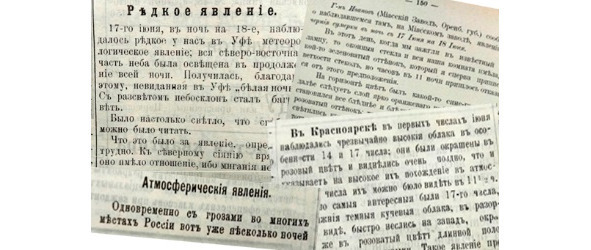
It was so light that one could read freely.
It’s difficult to determine what this phenomenon was. It’s unlikely to have been related to the northern lights, as there was no flickering.
105. Ivanov. Evening Twilight on the Night of June 17–18. // Astronom. Review 1908. No. 5. P. 150; Иванов. Вечерние сумерки в ночь с 17 июня на 18 июня. // Астроном. обозрение 1908. №5. С.150.
Miass (55° 03′ N 60° 06′ E)
Mr. Ivanov (Miass plant, Orenburg province) reports on a phenomenon observed there, at the Miass plant: «…evening twilight on the night of June 17 to June 18.
On this day, when we lit the lamp at a certain hour, the window panes and our entire room had some kind of greenish tint, which I initially attributed to the deterioration of the glass, but at about 11 o’clock at night I had to abandon this assumption.
On the horizon the colour was a dirty blue, then followed by a layer of bright orange, which became paler and paler as it went higher, and finally turned into a pinkish hue: the edges of the clouds glowed with the same colour, i.e. pinkish, and their middle part had the same colour as on the horizon; the sky shone with a dull greenish sheen.
Until midnight, or even later, it was possible to read and write (without using a lamp, of course). Then the phenomenon gradually faded, but the colours changed little. I observed it until 1 a.m. It all happened in the northern part of the sky; apparently it covered a wide area, since, for example, the phenomenon was also noticed in Siberia.
We’ve had autumn weather since Monday, June 30th.»
106. Krasnoyarets. 1908. No. 136. June 24 (Krasnoyarsk); Красноярец. 1908. №136. 24 июня (Красноярск)
Krasnoyarsk (56° 00′ N 92° 52′ E)
In Krasnoyarsk, in the first days of June, extremely high clouds were observed, especially on the 14th and 17th. They were coloured pink and were visible very late, which indicates their high position in the atmosphere. On the 14th they could be seen at 11:30 pm. But the most interesting were on the 17th, when the lower dark cumulus clouds, in a torn form, quickly rushed to the west, while those painted in a pinkish colour remained motionless in a long strip. This phenomenon lasted until half past twelve at night.
107. Krinov, E.A. The Tunguska Meteorite. Moscow-Leningrad: Publishing House of the USSR Academy of Sciences. 1949; Кринов Е. А. Тунгусский метеорит. М.-Л.: Из-во Академии наук СССР. 1949.
Urzhum (57o07′ N 50o00′ E), Kirov region.
V. Spassky in his letter described the phenomena he observed on the night of June 30, 1908 as follows:
«Our family spent the summer of 1908 in the village of Klyuchi, 6–7 versts from the town of Urzhum, Vyatka province… One June evening… after a rainy day, my sister and I walked out onto the porch of our house. We could see the horizon to the west, north, and east. The sky was overcast, except for the northern and eastern sections, where there were significant holes in the clouds. It was already dark — I’d guess about 10 p.m. local time. Already at the first moment, as soon as we went out, we were struck by an unusual phenomenon observed in a cloudless part of the sky: to the northeast, or perhaps to the east-northeast of us, a luminous spot was visible, its wide base resting on the horizon line, and its pointed top going quite high up. Zodiacal light is usually depicted in this shape in drawings. Perhaps the spot’s shape was due to part of it being obscured by clouds. The light from this spot was even, completely without flickering, milky white; I can’t judge its intensity now, but nevertheless the phenomenon was very striking.
How long we watched, I can’t imagine now, I only remember that in the end everything was covered with clouds…»
108. Atmospheric Phenomena. // Turkestan Military Newspaper, 1908, No. 41, June 29 (Tashkent); Атмосферические явления. // Туркестанская военная газета 1908. №41. 29 июня (Ташкент).
Perm (58° 01′ N 56° 15′ E)
Atmospheric phenomena
Along with thunderstorms, interesting nocturnal phenomena have been occurring in many places in Russia for several nights in a row. So in Perm on the night of June 18 there was no twilight, and throughout the entire night one could freely read small print. The northern side of the sky was brightly lit; the general colour of the sky was greenish.
109. Krinov, E.A. The Tunguska Meteorite. Moscow-Leningrad: Publishing House of the USSR Academy of Sciences. 1949; Кринов Е. А. Тунгусский метеорит. М.-Л.: Из-во Академии наук СССР. 1949.
Yeniseisk (58° 28′ N 92° 08′ E)
O.E. Olfinskaya from t. Yeniseisk (Siberia) wrote to Kulik in her letter dated December 26, 1927: «At this time of year (June 30th), midnight is the darkest hour here (in Yeniseisk). Nevertheless, it was so unusually light outside that I was amazed. This phenomenon attracted the attention of other residents as well.» The observer further noted that, having been on the street for about an hour, she did not notice the onset of darkness, and it soon began to get light.
Section 2. Settlements between 40° and 50° east longitude
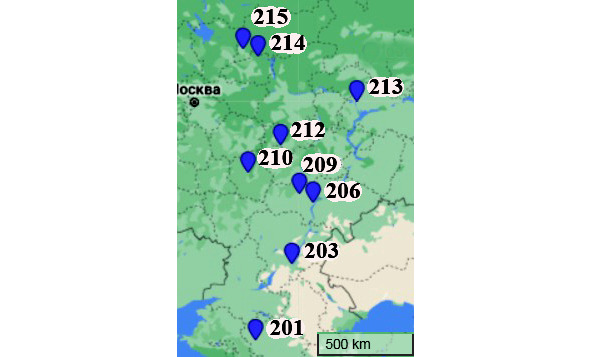
201. Shönrok, A.M. Zarya, June 17 (30), 1908. // Monthly Meteorological Bulletin of the Nikolaev Main Physical Observatory. 1908. No. 6. 1—4; Шенрок А. М. Заря 17 (30) июня 1908. // Ежемесячный метеоролог. бюллетень Николаевской главной физической обсерватории. 1908. №6. 1—4.
Stavropol (45°02 {ʹ} N, 41°58 {ʹ} E)
Very few observers call this phenomenon the aurora borealis, and only four descriptions hint at it. An observer in the village of Medvezhye, Stavropol Province, says the dawn resembled a glow of flickering light with flashes.
202. Apostolov, L. More on the Bright Night of June 30, 1908. // Mirovedenie 1926. 15 (3). 281; Апостолов, Л. Еще о светлой ночи 30 июня 1908 года. // Мироведение 1926. 15 (3). 281.
Stavropol (45°02 {ʹ} N 41°58 {ʹ} E)
In issue No. 1 of «Mirovedenie» for 1925, a note by A.V. Voznesensky was published about a meteorite that fell on June 30, 1908, in the vicinity of the Podkamennaya Tunguska River (in Siberia); I had the idea of a close connexion between this phenomenon and the white night phenomenon that I observed in the town of Stavropol-Kavkazsky on June 17 (30), 1908, i.e., on the same day that the meteorite fell in Siberia. Stavropol-Kavkazsky is located at a latitude of 45° 3», and on June 30 the evening glow there completely fades at 9:15 p.m., and therefore at 9 p.m. it is already completely dark. Preparing for the regular meteorological observation at 9 o’clock in the evening, I was very surprised that it was completely light outside and the sunset was so bright that I didn’t even need a flashlight for observations. Having made my observations, I immediately went to the telegraph station to cheque if the telegraph was functioning properly and to determine whether this was the aurora borealis during a severe magnetic storm. But the telegraph, it turned out, was functioning perfectly, and dispatches were being transmitted without hindrance.
Even more surprised, I returned home and saw that the extraordinary illumination had been noticed by many, some of whom had climbed onto the roof and thought that the sun would rise very soon in the north. It was already 10 o’clock in the evening, but the brightness of the sunset made it clear that this illumination would not fade all night and we would witness an unprecedented phenomenon — a white night at latitude 45° nine days after the summer solstice. At 11:00 p.m., some bright stars finally appeared. By 12:00 p.m., the dawn in the sky was approximately the same brightness as in Tver, i.e., 17° further north.
After midnight, the dawn began to increase, and the sun rose just after 4:00 a.m., exactly according to the calendar. Nothing special was noticeable in the sky during the day. There were no more white nights, but still the dawns were much longer; they faded after 7 p.m. and came on around 2 a.m., i.e. an hour later in the evening and an hour earlier in the morning for at least 10 days; however, until the end of the summer the dawns were longer than normal, but this lengthening gradually decreased and decreased, and at the end of August they became normal.
Then I assumed that the Earth had flown into some kind of cosmic mass; and I thought that the Earth had either encountered the remains of some comet, or had plunged into a mass that served as the source of the so-called zodiacal light. I assumed the latter because I knew from literature that the zodiacal light sometimes describes 360° around the Earth and that its brightness is not constant at all.
Having read the note by A.V. Voznesensky in 1926, i.e. 18 years later, I felt that I had found a solution to the cause of the phenomenon that occurred in 1908. My assumption about the Earth’s encounter with a cosmic mass was completely justified.
Head of the Methodological Bureau of the Kuban-Black Sea Regional Institute
Member of the Russian Society of L.M. L. Apostolov
203. An Extraordinary Natural Phenomenon. // Tsaritsyn Life, 1908, No. 134. June 19 (Tsaritsyn); Необычайное явление природы. // Царицынская жизнь 1908. №134. 19 июня (Царицын).
Tsaritsyn (Stalingrad, Volgograd) (48° 43′ N 44° 30′ E)
An extraordinary natural phenomenon
On the night of June 17—18, an unusual natural phenomenon was observed in Tsaritsyn and its environs. It was already about 11 o’clock at night, but twilight had not yet set in and it was so light outside that one could easily read a large print. The western horizon was so brightly lit that it seemed as if the sun had just disappeared behind the visible hill. It only became somewhat dark around 1 a.m. But by 2 a.m., it seemed like a full dawn had already arrived.
The least educated public in the city was very frightened by this phenomenon and talked in every possible way about the «end of the world» and so on.
But this phenomenon is nothing new to science. The light observed in Tsaritsyn on the night of June 17—18 is called the zodiacal light. It is a faintly glowing spindle-shaped band, usually visible in the west after sunset and in the east before sunrise. In the Northern Hemisphere, it is best seen in the spring evenings and in the fall mornings…
Most scientists believe that the phenomenon is caused by the reflection of sunlight from tiny particles of meteoric dust surrounding the sun in the form of a continuous ring, the limits of which reach the Earth’s orbit.
In general, the public should note that all natural phenomena have a reason. With the possible exception of volcanic eruptions, no changes occur suddenly. Everything changes only gradually.
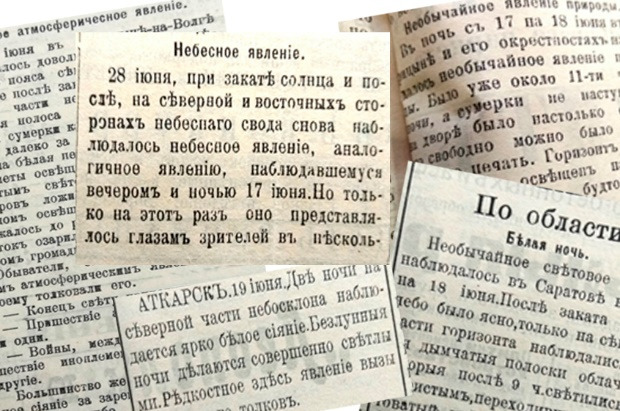
204. A Celestial Apparition. // Tsaritsyn Life, 1908, No. 144. July 1. (Tsaritsyn); Небесное явление. // Царицынская жизнь 1908. №144. 1 июля. (Царицын).
Tsaritsyn (48°43′N 44°30′E)
A celestial apparition
On June 28, at sunset and after, a celestial phenomenon was again observed on the northern and eastern sides of the sky, similar to the phenomenon observed in the evening and night of June 17. But this time it was presented to the eyes of the audience on a slightly smaller scale than before.
205. A Rare Atmospheric Phenomenon. // Southern Telegraph 1908. No. 1979. June 22. (Rostov-on-Don); Редкое атмосферическое явление. // Южный телеграф 1908. №1979. 22 июня. (Ростов-на-Дону).
Tsaritsyn (48° 43′ N 44° 30′ E)
A rare atmospheric phenomenon
On June 17, the northern lights, which are quite rare for the temperate latitude belt, were observed in Tsaritsyn-on-Volga. Just after sunset, a strong streak of light appeared in the northern part of the sky. The usual evening twilight seemed endless, and it was light well past midnight. It was the white night of St. Petersburg. All objects were illuminated by some kind of greenish light, and shadows fell from the houses and fences, as if by moonlight. This phenomenon continued until dawn, when the northeast was illuminated as if by the bright glow of a huge fire.
The common people, intrigued by this rare atmospheric phenomenon, interpreted it in their own way.
«The end of the world is coming.»
«The coming of the Antichrist!» Some said.
«Wars, internecine strife, invasions of foreigners,» others interpreted.
Most, however, mistook the northern lights for the glow of a large fire in one of the nearby villages.
206. White Night. // Tsaritsyn Bulletin. 1908. No. 2882. June 21. (Tsaritsyn); Белая ночь. // Царицынский вестник. 1908. №2882. 21 июня. (Царицын).
Saratov (51° 32′ N 46° 00′ E)
White Night
An unusual light phenomenon was observed in Saratov on the night of June 18. After sunset the sky was clear, only on the northern horizon were thin smoky stripes of clouds visible, which after 9 o’clock glowed with a silvery gleam that turned yellowish (closer to the zenith); the rest of the sky was also distinguished by the same light. At eleven o’clock in the open one could easily see the dial of a pocket watch and read a newspaper. The opposite bank of the Volga with its forest, cisterns and piers stood out sharply, and boats with people on board were clearly visible; the light intensity was approximately equal to the light that occurs at this time around 9 o’clock in the evening. By midnight the glow had weakened considerably, but the room was still light enough without lamps. By midnight the glow had weakened considerably, but the room was still light enough without lamps. After midnight it was already getting light, and by 1 a.m. it was as bright as 3 a.m. The sunrise was normal, missing only the pinkish glow of dawn.
(«S.V.»)
207. Shönrok, A.M. Zarya, June 17 (30), 1908. // Monthly meteorological bulletin of the Nikolaev Main Physical Observatory. 1908. No. 6. 1—4; Шенрок А. М. Заря 17 (30) июня 1908. // Ежемесячный метеоролог. бюллетень Николаевской главной физической обсерватории. 1908. №6. 1—4.
Saratov (51° 32′ N 46° 00′ E)
As for the intensity of the light, it was obviously striking everywhere and, of course, produced a special effect in the more southern latitudes, where even in summer the nights are always dark. Almost all observers indicate that it was possible to read freely in the dawn light; from Saratov they write that one could easily see people riding in a boat; passing steamships were clearly visible at a distance of 3 miles (1 mile=1609 m).
208. Dimo, N. Complicated rainbow and white night in Saratov. // Meteorological Bulletin. 1908. Vol. XVIII. No. 7. 271–272; Димо Н. Сложная радуга и белая ночь в Саратове. // Метеорол. вестник. 1908. Т. XVIII. №7. 271–272.
Saratov (51° 32′ N 46° 00′ E)
Complicated rainbow and white night in Saratov
On June 17, old style, at about 8 p.m. local time, a complicated rainbow was observed. For several days, strong easterly and southeasterly winds prevailed in Saratov and its environs, raising thick clouds of dust and completely hiding the city and the opposite bank of the Volga from an observer located on the nearest heights surrounding Saratov. On the night of the 17th and throughout the day of the 17th, it rained several times, but so lightly that it only slightly knocked down the dust. By the evening of the 17th, the entire eastern part of the sky was covered with cumulonimbus and thunderclouds, while the western part was completely clear. The sun low before sunset beautifully illuminated the city, cleared of dust, and the opposite side of Volga with the Pokrovskaya Sloboda; and the strongly inclined sunset rays formed a magnificent, full, unusually bright rainbow on these rain clouds.
Since in some areas of the eastern sky there was rain coming from the clouds, the rainbow had a different character. Those parts of the rainbow that fell on the clouds were simple seven-coloured, while those that fell on the rain stripes formed complex multi-coloured parts of the rainbow. The rainbow had its maximal brightest at 7:50 p.m., and in areas with a complex rainbow, four red, inward-facing concentric bands could be clearly seen. The green stripes were also clearly visible: three of them were clearly visible, but the fourth was much weaker…
Just before sunset, a strong squall blew in from the southwest, the sky was covered with thunderclouds, 2—3 peals of thunder were heard, a short (2—3 minutes) downpour began, gusts of wind sometimes strengthened, sometimes weakened, and by 9 p.m. there was a complete calm, the whole sky became completely clear.
The western, and later the northwestern part of the sky was completely painted in the orange-red colour of dawn. The light intensity did not diminish until 11 p.m. At 11 p.m., one could still easily read large print and clearly distinguish the colours of leaves, flowers, and surrounding objects. The character of the illumination most closely resembles the light of electric lamps, and in its strength, the illumination surpassed the brightest moonlight during the full moon. As mentioned above, the dawn moved from west to east towards the rising sun, and until 12:30 midnight, the pinkish-orange light of the dawn could still be clearly discerned on the northern horizon. After this time, a strong storm arose, which intensified towards the morning, and the light of the night dawn soon merged with the light of the rising sun.
An observer whose western sky was not obscured by the Saratov Heights, but who had a wide horizon available for viewing from the heights, asserts that the western and northern parts of the horizon were covered by distant, low, brightly illuminated clouds, and the entire sky was covered as if by a light haze, so that the stars twinkled faintly and were surrounded by vague halos.
Those returning to Saratov from the Kostychevskaya Experimental Station area in the southern Novouzensky District of Samara Province report that even there, daylight had quietly faded into a faint twilight, and at 10:30 p.m., they could still see their surroundings clearly. At 12:30 midnight, a clear, delicate pinkish-orange colouration was observed in the north; one could read freely, birds began to chirp in the foliage of the trees and in the garden, roosters began to crow, and in general, daytime bird life began.
In addition to the report of a complex rainbow, it can be added that this phenomenon has been observed in Saratov for the second time this summer. The raindrops formed two magnificent rainbows, the inner one of which became so complex that five red and green stripes could be clearly distinguished inside.
N. Dimo
Saratov. Soil Laboratory.
209. Atmospheric phenomena. // Tsaritsynsky Bulletin 1908. No. 2885. June 25. (Tsaritsyn); Атмосферические явления. // Царицынский вестник 1908. №2885. 25 июня. (Царицын).
Atkarsk (51°52′N 45°00′E)
Atkarsk. June 19. For two nights, a bright white glow has been observed in the northern sky. Moonless nights become completely light. This rare phenomenon here is causing much talk.
210. Svyatsky, D., «Illumination of Twilight.» // Nature and People, 1908, No. 37, pp. 665–666; Святский Д. Иллюминация сумерек. // Природа и люди 1908. №37. 665—666.
Tambov (52° 43′ N, 41° 26′ E)
The author of these lines has seen the northern lights many times, and he witnessed this phenomenon on the night of June 17—18 in Tambov. There was nothing resembling the northern lights. There was simply an endless twilight from sunset to sunrise, so bright that everyone noticed. At night at 12:30, it was so light you could read outside. A red, or rather dirty orange, streak was visible to the north. But it never occurred to me to compare it to a segment of the aurora borealis. It was simply a streak of evening light, not extinguished that night, but lingering until morning. It was as if the white night of St. Petersburg, so beautifully celebrated by A.S. Pushkin, had been transported here to Central Russia, from the distant north. It felt as if the sun was about to rise, even though it was only midnight.
The white nights of St. Petersburg, a common phenomenon in Northern Russia, are explained by the fact that the sun doesn’t set very far below the horizon in spring and early summer, so the twilight doesn’t have time to fade. «One dawn hurries to replace another, giving the night half an hour,» as the poet Alexander Pushkin puts it.
The southern sun sinks deeper, and there is no white night, but the dawn lasts longer than in winter, because the sun, having hidden behind the horizon, does not descend vertically, but goes obliquely under it and thus lengthens the twilight.
In 1902, after the famous eruption of Montagne Pelée in Martinique, everyone’s attention was drawn to the unusually bright and intense red-hued dawns that occurred in the autumn and winter of that year. Astronomers and meteorologists explained this phenomenon by the fact that the volcanic dust ejected by Montagne Pelée formed large clouds that floated at a great height and reflected the sun’s rays, which caused the effect of bright and long-lasting dawns, or «illuminations of twilight,» as the French call this phenomenon (les illuminations crepuscules). The writer of these lines observed the twilight illumination in Orel at that time and can now say that the phenomenon that took place here on the night of June 17—18 is in every way reminiscent of twilight illumination, the only difference being that this phenomenon was now more intensely expressed than then. But this is precisely explained by the fact that then it was autumn and winter, when the sun sets deep below the horizon, and now it is summer, when it moves not far below it.
Another curious detail I observed in Tambov. The sky wasn’t clear and clean during the event, but rather shrouded in a thin mist hovering somewhere high above. Below it, a veil of cirrus clouds stretched across the sky. This type of cloud, as is known from meteorology, consists of ice crystals and hovers very high, certainly higher than other types of clouds.
It’s likely that on the night of June 17—18, these cirrus clouds rose above their normal altitude, to where the sun’s rays reached them. The sun was hidden below the horizon for the observation point. The cloud crystals, reflecting the sun’s rays, illuminated the sky, causing the effect observed that night.
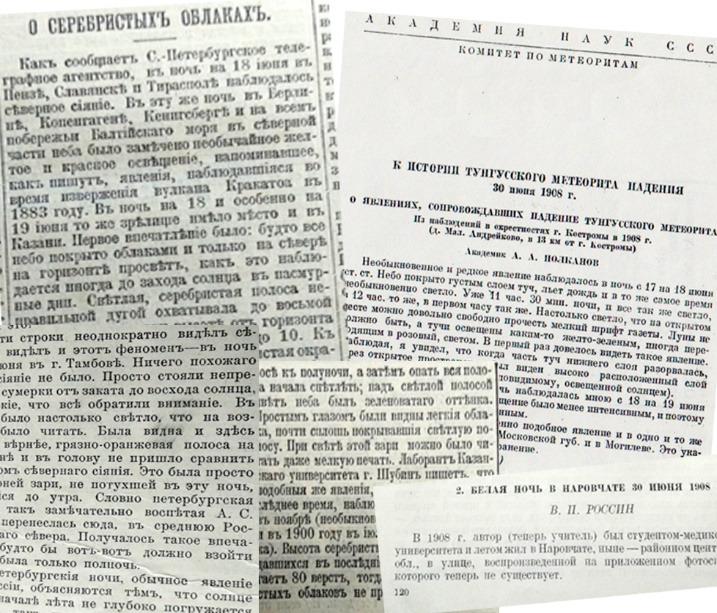
211. An extraordinary dawn on the night of June 17—18, 1908, old style, in Tambov // Astonom. Review 1908. No. 6. 174; Необычайная заря в ночь с 17 на 18 июня 1908 г. ст. ст. в г. Тамбов // Астоном. обозрение 1908. №6. 174.
Tambov (52° 43′ N 41° 26′ E)
An extraordinary dawn on the night of June 17—18, 1908, old style, in Tambov
The extraordinary dawn, already sufficiently described in the pages of «Astonom. Review», was also observed by me in the town of Tambov. At night (12 h. 30 min.) it was so light that one could read outside. A red, or more accurately, dirty-orange streak was visible here in the north, without the usual colour transitions of a normal dawn. Higher up, cirrus streaks stretched across the sky, and the entire atmosphere seemed opaque. The next day, a severe cold set in.
⠀
212. Rossin, V.P. White Night in Narovchat on June 30, 1908. // Meteoritics. 1941. Issue 2. 120–122;. Россин В. П. Белая ночь в Наровчате 30 июня 1908 года. // Метеоритика. 1941. Вып. 2. 120 — 122.
Narovchat (53°53′N 43°44′E), Tambov Region.
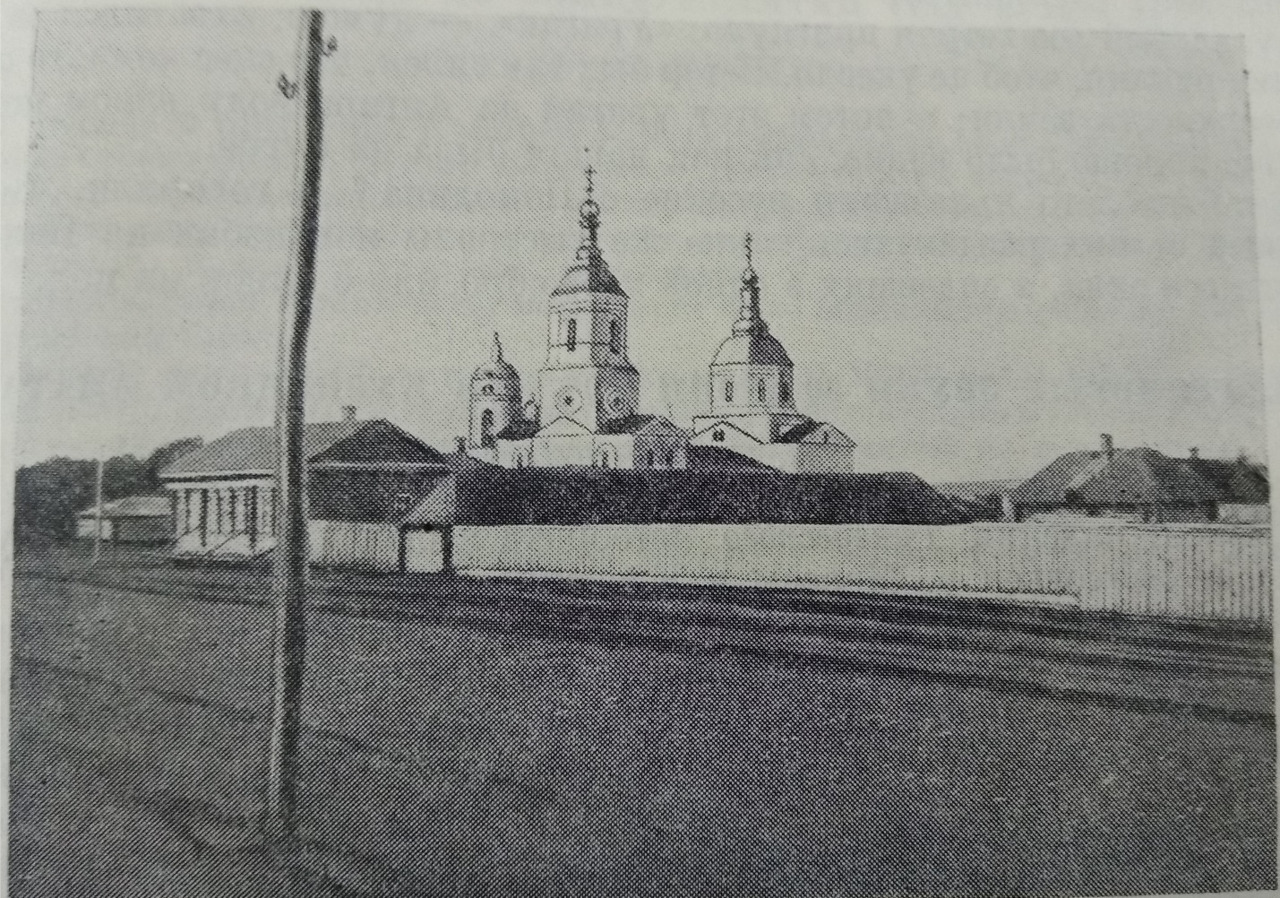
White Night in Narovchat, June 30, 1908
In 1908, the author (now a teacher) was a medical student at Kazan University and spent the summer in Narovchat, now a district centre in the Tambov region, on the street shown in the attached photograph, in a house that no longer exists.
The author has preserved «Notebook No. 2» for 1908, on page 46 of which is the following entry:
«In the town of Narovchat, on June 17, 1908, there was no night (white night) (daylight length 18 hours 44 minutes).»
At that time, surprised by this phenomenon and, of course, knowing nothing about the fall of the meteorite, the author believed that night of June 17 was the St. Petersburg white night, which reached Narovchat in the same way that the northern lights occasionally reach us.
While taking photographs on the porch of the above-mentioned house on June 17, 1908 (which corresponds to June 30, n.s.), the author set up his camera and at 11:30 p.m. began shooting the view of the part of the city recorded in this photograph. The exposure ended precisely at 12 midnight. During the shoot, the author, without any artificial lighting, of course, read the newspaper quite freely.
June 17/30, 1908 was the third day of the new moon: sunrise at 2:42 a.m., sunset at 9:25 p.m. according to the tear-off calendar. A look at the photograph reveals that the shot could only have been taken between sunset and sunrise. This is convincingly demonstrated by the shadows on the southern side of the temple building and the southwestern wall of the corner house. The late dawn light illuminated the subjects from the northwest during the exposure. On a normal evening, the eastern sky would not have been as bright as it was in this case.
Nevertheless, on the night in question, the sky was bright enough to permit photography. This means there was «dust» in the stratosphere, illuminated by the night sun and diffusely reflecting its rays. As we now understand, these were noctilucent clouds.
The night of June 17/30, 1908 was not an ordinary white night in the north: in the following three decades there were no more white nights in Narovchat.
The author still has a beautiful negative in excellent condition, a print of which is included here. It captures a phenomenon observed on June 30, 1908, in Narovchat, which accompanied one of those events that occur on Earth perhaps once every few centuries.
July 28, 1938 Narovchat
213. About Noctilucent Clouds. // Novoye Vremya, 1908, No. 11600. (St. Petersburg); О серебристых облаках. // Новое время 1908. №11600. (СПб).
Kazan (55° 47′ N 49° 07′ E)
About noctilucent clouds
According to the St. Petersburg Telegraph Agency, the northern lights were observed in Penza, Slavyansk, and Tiraspol on the night of June 18. That same night, in Berlin, Copenhagen, Königsberg, and along the entire Baltic Sea coast, an unusual yellow and red light was observed in the northern part of the sky, reminiscent, as they say, of the phenomena observed during the eruption of the Krakatoa volcano in 1883. On the night of June 18th and especially on June 19th, the same show took place in Kazan. The first impression was as if the entire sky were covered in clouds, with only a clearance in the northern horizon, as sometimes observed before sunset on cloudy days. A light silvery stripe in an abnormal arc covered up to an eighth of the horizon at a height of up to 10 degrees from the horizon in the northern part. Towards the edges and upwards the yellow-silver colouring turned into red. The red colour intensified and spread across the entire strip towards midnight, and then the entire strip began to brighten again; above the light strip, the colour of the sky was greenish. With the naked eye, light clouds were visible, almost completely covering the bright strip. In the light of this dawn, even small print could be read. Kazan University laboratory assistant Mr. Shubin writes that similar phenomena, which have become more frequent recently, were observed in November 1902 (unusually red dawns) and in July 1900 (luminous clouds). The height of the noctilucent clouds observed in recent days also reaches 80 miles, while the height of the cirrus clouds does not exceed 27.
214. Shönrok, A.M. Zarya, June 17 (30), 1908. // Monthly meteorological bulletin of the Nikolaev Main Physical Observatory. 1908. No. 6. 1—4; Шенрок А. М. Заря 17 (30) июня 1908. // Ежемесячный метеоролог. бюллетень Николаевской главной физической обсерватории. 1908. №6. 1—4.
Kineshma (57° 26′ N 42° 08′ E), Ivanovo region.
Doctor Nagorsky, who was travelling along the Volga from Kineshma to Nizhny Novgorod on the night of July 2, reports that seagulls were flying behind the steamer at night, and they could be seen flying across the shallows. In Kineshma, he was told, on the night of July 1st, a noticeable stir was observed among the jackdaws, who were constantly flying from place to place. However, the large number of inquiries we received about how to explain this phenomenon is sufficient evidence of the unusual brightness of this dawn.
The above-mentioned observer, Dr. Nagorsky, who, however, saw this phenomenon only on July 1, gives a very detailed description of it, which is completely unlike the northern lights, which he himself points out, and he considers luminous cirrus clouds to be the most likely cause of the phenomenon. The bright spot he saw consisted of very thin horizontal bands, with brightly shining ones interspersed with duller ones. On the left, western side, the glow was sharply delimited, shaped like a reverse З, and the horizontal bands ended abruptly at this boundary. Beyond it was a clear sky, on which the moon stood.
215. Polkanov, A.A. On the History of the Tunguska Meteorite That Fallen on June 30, 1908 // Meteoritics. 1946. Issue II. P. 69; Полканов А. А. К истории Тунгусского метеорита падения 30 июня 1908 г. // Метеоритика. 1946. Вып. II. С. 69.
Maloe Andreykovo (57°43 {ʹ} N 41°04 {ʹ} E).
On the phenomena that accompanied the fall of the Tunguska meteorite
From observations in the vicinity of Kostroma in 1908
(Mal. Andreykovo village, 13 km from Kostroma)
Academician A.A. Polkanov
An unusual and rare phenomenon was observed on the night of June 17—18, old style. The sky was covered with a thick layer of clouds; it was raining, and at the same time it was unusually light. It’s already 11:30 p.m., and it’s still light, at 12 o’clock it’s the same, at one o’clock it’s the same. It’s so light in the open that you can read the small print of a newspaper quite easily. There shouldn’t be a moon, and the clouds are illuminated by a yellow-green light, sometimes tinged with pink. It was the first time I’d witnessed such a phenomenon. As I watched, I saw that when part of the lower cloud layer broke apart, a high-lying layer of golden-pink cloud (apparently illuminated by the sun) was visible through the open space.
I observed a completely similar night from June 18 to 19 old style, only it seemed to me that the lighting was less intense, and therefore the phenomenon seemed more mysterious.
According to newspaper reports, a completely similar phenomenon was observed at the same time in Tsaritsyn, Moscow Province, and in Mogilev. This indicates its widespread distribution.
(Notes from the diary for 1908)
Section 3. Settlements between 30° and 40° east longitude
Бесплатный фрагмент закончился.
Купите книгу, чтобы продолжить чтение.