
Бесплатный фрагмент - The Secret Life of the Two-Faced Virgin
Part 1
PART ONE. BORN BLESSED
The Birth of Natasha
The arrival of every person into this world is a special act predetermined by fate. The country, the family, and the moment in which a new inhabitant of planet Earth is born determine their future destiny. Our heroine was fortunate to come into this world not alone, but together with her twin sister. Yet the very birth might not have happened, as the doctors persistently urged the mother of the future sisters to undergo an abortion, frightening her with claims that she had serious pregnancy complications, that she would be unable to carry the child to term, and that she would die during childbirth. Soviet medicine at that time did not know what ultrasound was, so the question of how many children would be born and of what sex remained a great mystery for expectant mothers in the USSR. Our heroine was born in a Soviet maternity hospital in the year when the Moon was conquered by the Apollo 11 lunar module, when the USSR experienced a military conflict with China, and when the first message was transmitted through the ARPANET network (the prototype of the Internet), in 1969. Her birthday, July 10, was also quite unusual, as it coincided with another anniversary of the adoption of the first Soviet Constitution of 1917, which established the dictatorship of the proletariat and nationalization. According to legend, on that same date in the year 1040, Lady Godiva rode naked through the city of Coventry on horseback in order to compel her husband to reduce the unbearable taxes imposed on the townspeople. If we trust numerology, the symbolic meaning of the birth number “10” signifies “the beginning and the end, the alpha and the omega, the first and the last.” Every Christian will easily recognize in these words the well-known sayings of John the Theologian in his work The Apocalypse.
Moreover, in the Old Testament chapters of the biblical books, the date written in calendar form as “the tenth day of the seventh month” (July 10) corresponds to one of the most significant Jewish holidays — the “Sabbath of rest,” or the Day of Atonement, Yom Kippur, when the name of God (Yahweh) was pronounced in the Temple only once a year. It is from this Jewish holiday that the expression “scapegoat” originates, as on this day two goats were offered in sacrifice: one was killed, and the other was released to die in the wilderness. Such is the “tenth day of the seventh month,” the day our heroine came into the world.
After being discharged from the maternity hospital, the sisters were reunited. It was at that moment that their shared life as twin sisters began — with identical toys, hairstyles, clothing, and shoes. However, their appearance was not identical, as our heroine was a head taller and larger than her sister, who was very small and fragile. Their resemblance was limited to their facial features, while their figures were completely different. So it was impossible to confuse them. Their personalities also differed. Natasha, as the older sister, possessed strong will and assertiveness, and she always protected her younger sister, who had a weaker character. The life of twins is a world of its own, with relationships unlike those of other children, when everything is shared between two — a room, toys, classmates, friends, and acquaintances. It also means sharing one birthday. For most people, this day belongs only to them — the gifts, the flowers, the attention. But twins, especially in childhood, are forced to divide this day with their “other half.” Moreover, gathering guests for two birthday children at once was also a problem, especially as they grew older, because guests had to spend money on two gifts instead of one. Therefore, with each passing year, bringing friends and acquaintances together for a celebration during the summer vacation season became a real challenge for Natasha and her sister.
According to scientists who have studied multiple pregnancies, communication between twins begins while they are still in their mother’s womb; in other words, they begin to acquire social and communication skills even before birth. And this is precisely the circumstance that may distinguish twins from other individuals and determine their future destiny. One confirmation of this may be an unusual habit of Natasha and her sister — they had two favorite dolls, both of which the sisters named the same: Lyo-nyechkas. The dolls had no hair; they were completely bald. When their parents bought them new dolls, Natasha and her sister still played with the old ones or plucked the hair from the new dolls. And they always played with both dolls at the same time, never with just one. Their parents could not understand what caused this twin-like habit. But in fact, each of the two bald dolls was, in a sense, a reminder of their interaction with the bald “little dolls” in their mother’s womb.
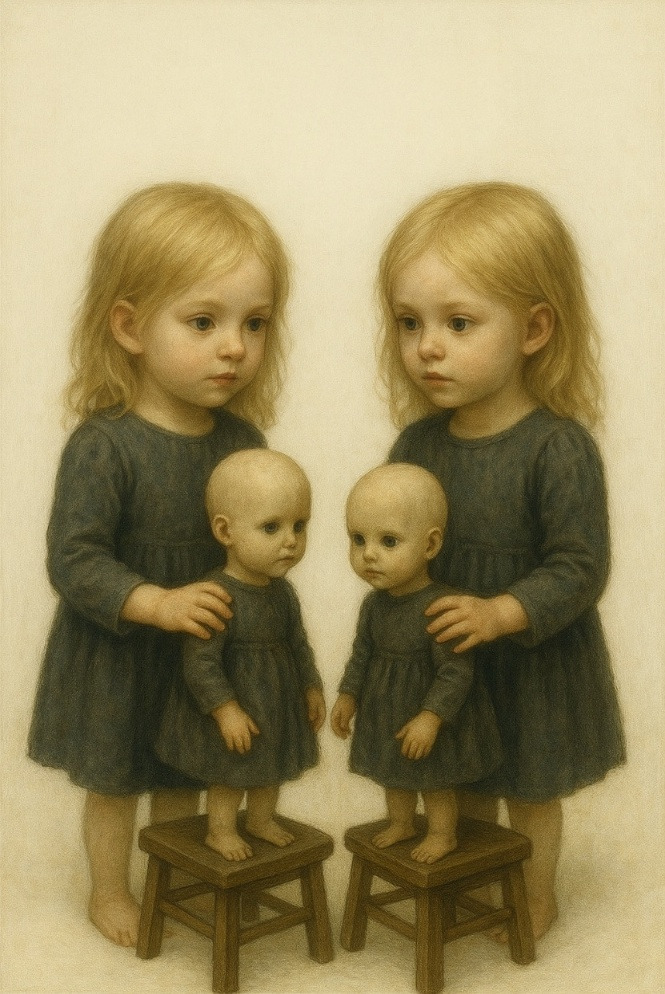
Yet why the twin sisters felt the need to interact not with one doll, but only with two, remains to this day a mystery still awaiting discovery. Although there is one possible explanation: in their mother’s womb, Natasha was not with just one sister, but with two. This fact may be the most significant explanation for Natasha’s behavior. As she grew older, Natasha learned that her mother had carried three, not two fetuses (infants). But that is another story, a secret yet to be uncovered.
Parents. Relationship with Her Brother
Natasha was also fortunate when it came to her parents. Her father, Nikolai Pavlovich, was a tall, handsome brunette with a stately figure and remarkable physical strength. Yet his character was modest and kind. When Natasha was born, her father worked as a shop supervisor at a machine-building plant and studied in the evening program at the Polytechnic Institute. Her mother, Maria Alexeyevna, was also a very beautiful woman; she had graduated from a culinary school and worked as a cook at the same plant as her husband. In character, however, she differed from her husband, as she was quite vain and self-centered — something that later greatly complicated Natasha’s life. But despite such differences in temperament, the parents of the twins lived in love and harmony.
There was also an older child in the family — a son, who was 4 years old at the time the twins were born. If our heroine was fortunate with her parents, then with her brother she was disastrously unlucky. The birth of two sisters was met by the boy, who had an egocentric personality, with jealousy that later grew into pathological hatred, accompanied by numerous direct attempts to kill his sisters or to arrange “accidents” for them.
Before her birth, Natasha’s parents lived in a private house where they rented a room while waiting for their cooperative apartment — a two-room flat they had already paid for halfway — to be completed. But after the birth of the twins, the state immediately provided them with a two-room, unrenovated apartment on the first floor, with one walk-through room, shared outdoor facilities, and a cellar. A few years later, the family received a four-room apartment from the state in a new building on the 8th floor with all amenities, and the cooperative apartment under construction was given to the grandmother — the mother’s mother — who was brought from the village to the city, where she settled with the mother’s younger brother.*
Natasha’s early childhood was not as joyful or carefree as that of most children. Together with her sister, she caused her parents a great deal of trouble. Life for Soviet women was not easy, as maternity leave lasted no more than 3–6 months, after which a child had to be placed in daycare or left with a grandmother. Shopping for groceries took a long time, as stores had huge lines, and the shortage of most essential household and children’s goods made the lives of Soviet mothers a heavy burden. As Natasha’s mother later said, “She spent half her life standing in queues.” Clothes also had to be sewn or knitted at home. Instead of diapers there were mountains of cloth swaddles that had to be washed daily, and instead of automatic washing machines — everything was washed by hand. Managing one child in a home with no modern conveniences, during breaks between work, was difficult; managing three children was three times harder.
Seeing how hard their mother worked, one day Natasha and her sister decided to help her with housework. The sisters “cooked” porridge, destroying an entire month’s supply of grains and pasta by mixing everything together in a basin and pouring water over it. When their mother came home, she scolded the girls, and afterwards cried for a long time. Another favorite pastime of the sisters was ripping wallpaper off the walls, for which their mother also punished them.
Natasha and her sister rarely heard affectionate words or praise from their mother, and only in the presence of others or relatives. At home, she did not call her daughters by their names, only by nicknames she had invented: Natasha was “cow” or “Sivka-Burka,” and her sister was “cracker” or “dry twig.” It is hard to say what caused such an attitude — whether exhaustion from domestic routines and poor living conditions, or problems at work — but the phrase “you amaze me in batches” often came from her lips directed at her daughters. Natasha’s mother clearly had not adopted the experience of her own mother, who had raised seven children, including two older twin brothers, who had also caused the grandmother many troubles. It was precisely this attitude of their mother toward Natasha and her sister that caused the daughters to drift farther and farther away from her, trusting her neither with their secrets nor their problems. But there were joyful moments in Natasha’s life as well, when she and her sister would put on entire performances for guests. They sang, recited poems, and even staged puppet-theater shows.
Natasha and her sister hardly attended kindergarten like other children. Rather, their parents enrolled them, but something there displeased them. What exactly Natasha did not like, she never understood. Perhaps it was that boys and girls slept in the same rooms, or simply the collective environment away from family. Natasha and her sister would run away from kindergarten and go home. Their mother would take them through a private housing area to the trolleybus stop, then they rode several stops by trolleybus. By that time, Natasha already knew her exact address and last name. She and her sister would crawl through a hole in the fence and walk to the trolleybus stop. They would get on the trolleybus, ride exactly two stops, and get off. All the passengers would ask the girls where their parents were, and Natasha would reply that they were going home by themselves. Natasha and her sister ran away from kindergarten many times. After the last time, their mother decided it was better for the girls to stay at home. By then, Natasha and her sister had begun to fall ill often. According to their mother, their sicknesses had been caused by a vaccination administered by a nurse from the clinic. But in truth, the cause of their deteriorating health was the jealousy of their older brother.
When Natasha was three years old, a rat appeared in the cellar where food was stored, and it bit their father. After that, the father forbade his son and daughters to go into the cellar, because he had placed bread there covered with rat poison. But the brother, left alone with his sisters, climbed into the cellar and forced them to lick what was on the bread. Natasha and her sister, remembering their father’s warning, refused to lick the poisoned bread because it was life-threatening. But their brother insisted that his sisters taste the rat poison.
Although childhood memory usually does not allow recalling life events before the age of five — except the most emotional or dangerous — Natasha and her sister remembered that day very well. On that day Natasha fell outside, and an ambulance took her unconscious to the hospital. Her twin sister suffered a heart attack, doctors later even diagnosing a congenital heart defect, and for the first time they discovered serious vision problems. Of course, Natasha could not say with certainty whether she had licked the rat poison at age three or not. But considering that rat poison, in small doses when it does not kill, affects the respiratory center, the heart, and the retina, the conclusion is clear: their brother had indeed “treated” his sisters to poison. After that fateful day, Natasha spent most of her childhood in hospitals and sanatoriums with a diagnosis of bronchial asthma, which she suffered from until the age of thirteen. Another hardship for Natasha was a speech defect — stuttering. What caused it, neither she nor her parents knew. Only when she grew older was she able to almost overcome her stutter, though under strong emotional stress it still made itself known.
The Baptism of Natalia and Her Sister
After Natasha became ill, her mother took her and her sister to their grandmother, Pelageya Afanasyevna (their father’s mother), in the village. The grandmother brought her granddaughters to a private house where an old priest lived. That was how the secret baptism of Natasha and her sister took place — the priest dipped them one after the other into a basin of water. There was something unusual in this whole baptismal process, because Natasha remembered the moments of her baptism very clearly. The little crosses that the priest hung around the necks of Natasha and her sister were eventually lost. The names that Natasha and her sister received during the baptism also remained a mystery.
A Dangerous Situation with Gypsies. Loss of 50% of Vision
From childhood, Natasha and her sister were afraid of gypsies. When the family had just moved into their new four-room apartment, gypsies often came to their building. One day, Natasha was home alone. The doorbell rang. She approached and asked, “Who is it?” Looking through the peephole, she saw three gypsy women. They told Natasha to open the door, saying they wanted to look at her red coat, which she wore at the time. They also said they knew her sister and her parents, and that she and her sister were twins. Natasha replied that she would not open the door for them. The gypsies began knocking on the door and pulling hard on the door handle. Natasha became frightened and crawled under the bed. She stayed there until her parents came home. The gypsies continued pounding on the door for a long time and shouted something.
Since ancient times, there have been cases where gypsies kidnapped only one of the twins, because it was believed that twins possessed a rare gift. The biblical story also points to a certain chosenness of twins, since one of the twins, Jacob, became the founder of the God-chosen people of Israel after he “wrestled with God.” In fascist concentration camps, cruel experiments were likewise carried out on twins in attempts to uncover their hidden abilities. The Bulgarian prophetess Vanga called twins “warriors of Light.” In Soviet times, it was forbidden to speak both about faith in God and about the hidden abilities of a person that had no relation to the material world. It is possible that Natasha’s parents noticed certain peculiarities in the behavior of their daughters but concealed them carefully so as not to fall under KGB persecution and to avoid ruining their children’s lives — and their own.
At the age of ten, Natasha went to a sanatorium in Yalta for vacation, where she caught a cold, and a severe exacerbation of bronchial asthma began. She was given many different injections that were prohibited for her due to her drug allergies. After one of the injections, she completely lost her vision, as if the light had been switched off. Only eight hours later did her sight begin to return little by little, but it never fully recovered — only about 50%.
A doctor who worked at the children’s sanatorium took Natasha to a certain clinic in Yalta, where the doctor’s grandfather worked. Natasha remembered the long corridors, with carpets everywhere — on the floors and on the walls. The most unusual thing was the absence of queues. Natasha’s eyes were examined for a long time using some sort of equipment. Most likely, it was a specialized medical facility for VIP members of the Soviet nomenklatura. After the examination, the old doctor told his granddaughter that he had taught her always to look closely at the follicles in the eyes. He said that Natasha had very large follicles and that such an organism possessed a strong self-defense mechanism — so strong that even pneumonia would pass without a single pill. But that did not make things easier for Natasha. Her vision was permanently damaged. From that year on, she was forced to wear glasses for reading and later permanent-wear contact lenses.
An Unsuccessful Attempt by Natasha’s Brother to Hang Her and Her Sister. The Brother’s Dangerous Games
Despite the fact that Natasha’s parents punished her brother for the incident with the bread laced with rat poison, the hatred he felt toward his sisters only grew stronger in the six- or seven-year-old boy. One day, an incident occurred that led Natasha’s parents, following the advice of relatives, to send their son for a year to another city to be raised by the mother’s brother. After that, the mother never again left her son alone for long with her little daughters while he was still living at home. She had to quit her job and spent eight years as a housewife, which was highly disapproved of in Soviet times. One day, after stepping out briefly to the store, the mother returned home to a horrifying scene: the daughters were standing on stools, with nooses from makeshift gallows tightened around their necks. Natasha’s six-year-old brother had made the gallows, placed his sisters on the stools, put the nooses around their necks, and tightened them. All that remained was to kick the stools out from under their feet. Had the mother returned just a few minutes later, there would have been no one to write this book — and no one it could be written about. It is hard to say how such a young boy could have managed on his own to construct gallows and plan everything in such detail in order to get rid of his sisters. But it appears that this could hardly have happened without the influence of dark forces. Well-known are the cases of demonic possession, including accounts by the Apostle of entire legions of demons entering a person. Not to mention Satan himself entering Judas, who betrayed Christ. But one fact is clear: evil, working through the brother, tried from early childhood and throughout their entire lives to take the lives of Natasha and her sister.
A year after returning from their uncle’s, the brother harbored even greater resentment toward his sisters because he had been forced to live temporarily away from their parents. Realizing that directly harming his sisters could lead to consequences and punishment, he began arranging “accidents” during dangerous “games” he forced them to play. These games involved jumping from a wardrobe to a bed, from one bed to another. He made a bow and arrows, attaching real needles to the tips, and forced them to run through doorways while he shot them with these arrows. On one occasion, Natasha’s sister jumped and hit her head hard against the wall near the bed, losing consciousness for a short time.
When the family moved to an apartment on the 8th floor, the older brother’s “games” became more sophisticated. He forced his sisters to walk along the balcony railing on the 8th floor, holding only onto the clothesline. This was a “circus act game.” But he himself did not walk along the railing. Natasha and her sister were then six or seven years old, and he was ten or eleven. If Natasha refused to play, he would hit her. When the sisters successfully walked along the railing, he became very angry, apparently expecting the opposite outcome. Natasha and her sister were children and did not understand this. This continued for many years until the sisters grew older and began to recognize the danger of the games their brother proposed. When Natasha was ten to twelve years old (and her brother fourteen to sixteen), he began inventing “challenge-games.” One of these challenges involved crawling from one balcony to another in adjacent rooms. Natasha said it was suicidal and not worth doing. But the brother crawled across the balcony partition on the 8th floor. Natasha and her sister wanted to stop him, but it was impossible — he was stronger than they were. The sisters were terrified and told him he had gone mad, that he could fall and break himself. After that, he tried to force the sisters to crawl across, but they flatly refused. Natasha and her sister were no longer naive children, and he realized it. A few days later, a friend of the brother from a neighboring building came to visit. Natasha told him about her brother’s recent actions. The friend was extremely shocked. He said that for several weeks, the brother had come to his house every day to practice crawling from balcony to balcony, but on the first floor in an apartment with a layout identical to the one where Natasha’s family lived. After this incident, the brother’s friend stopped interacting with him.
One day, the brother, supposedly “as a joke,” compressed Natasha’s carotid arteries. At that time, she still did not understand that this was effectively an attempt to kill someone, if the person was not resuscitated in time — and in some cases, resuscitation might be impossible. She lost consciousness. Her sister began shaking her, and the brother also became frightened, but he would not allow her sister to call an ambulance. After about 10–15 minutes (time seemed to pass very slowly, and to her sister it felt like much longer), Natasha opened her eyes. She said that she had gone somewhere else, and that it felt so good, so light. She said she could hear her sister screaming and calling her, but she did not want to leave the place where she was. Then, some beings appeared — perhaps Angels — and told her that she had died, but that it was not yet her time to leave this life. Therefore, she urgently needed to be returned. Natasha thought about how her sister would be left without her, that she might never see her again, and that they would be separated forever. And then she came back to consciousness. What the brother intended by conducting this “experiment” is unclear. Perhaps he was practicing for future victims using his sisters — we can only speculate. But this was already the third time Natasha’s life had been in serious danger due to her brother’s “love”: rat poison, the gallows, and the compression of her carotid arteries.
When the brother was sixteen and joined a boxing club, his sisters became punching bags for him. However, he did not stay in the club long — he was expelled after severely beating a boy who had been paired with him in the ring. Later, when he joined a karate club, all the techniques and throws were tested on his sisters. But even there, he did not stay long — he was expelled again. A person with sadistic tendencies should not be allowed to participate in such sports.
Natasha and her sister often complained to their parents that their brother was beating and tormenting them. Their father punished him several times for this, but afterwards, things became even worse. He tormented and beat them even more, taking revenge for being punished. At the same time, the brother also complained to their mother that it was Natasha and her sister who were bothering and tormenting him. The mother began to protect him. Natasha and her sister lived in fear. They had no one to complain to. And if their father tried to punish the brother, the mother would intervene and defend him. Moreover, the brother constantly accused his sisters of being born, claiming that if they did not exist, everything would be bought only for him. And when the parents spent money on their daughters, the sisters were, in his view, taking what should belong to him alone. Because of this, he would also constantly take the sisters’ personal savings, which they had been saving for school lunches.
In addition to physical abuse, the brother also used psychological abuse, insulting their personalities and human dignity. These attacks were the hardest for Natasha to endure. The best way she found to avoid encounters with her brother and protect herself while their parents were at work was to close her bedroom door with a wardrobe. Natasha and her sister would push the wardrobe along with the clothes together to block the entrance to their room, placing the wardrobe legs on potato slices for better leverage. And when their parents came home and Natasha heard the front door open, they would push the wardrobe back into place. This went on for many years.
Natasha’s Abuse by Her Brother from Age 10 to 12
But there was another circumstance in Natasha’s life that permanently defined her future relationship with her brother. Upon reaching sexual maturity, he decided to satisfy his urges at his own sister’s expense. When Natasha was 10 years old, he began locking himself with her in the bathroom and engaging in sexual acts — initially without intercourse, but eventually progressing to full sexual penetration. This continued for three years. Her brother terrorized Natasha by threatening to tell everyone that his sister was a prostitute if she ever complained to their parents. For many years afterward, Natasha experienced profound aversion toward boys and men before she gradually began recovering from this psychological trauma. Nevertheless, the physical health consequences remained. All this abuse finally ended one day when their father came home from work earlier than usual and caught his son in the act. The boy received a severe punishment then and there. However, the parents chose not to disclose the incident publicly, wishing to avoid bringing shame upon the family and to protect Natasha’s future prospects. Despite this, their mother suddenly began blaming Natasha, accusing her of having seduced her own brother and making her feel guilty.
When Natasha’s parents had turned a blind eye to their only son’s misdeeds during childhood, dismissing everything as thoughtless actions of a small child and never punishing him seriously, they inadvertently created a monster. This boy, raised in an atmosphere of impunity, came to believe that everything was permitted to him.
A Miracle on New Year’s Eve
Despite all the problems and trials that Natasha faced in her childhood, her favorite day of the year was always New Year’s Eve. This holiday somehow brightened up the gray everyday life. Every year, her father would bring a large Christmas tree, always a real one with the fresh scent of pine, reaching up to the ceiling. Natasha and her sister would decorate it with colorful lights and garlands. A New Year’s celebration without a tree was almost a catastrophe. This holiday felt magical, and Natasha believed in the miracles that could happen on that day.
When Natasha was eleven, for the first time in all those years, her father did not buy a tree. For Natasha and her sister, the holiday was spoiled. Although her father had gone to the market to look for a tree, at that time it was very difficult to buy one. Around 8:00 PM, her mother gave Natasha some money so she and her sister could go to the store to buy sweets and drinks, to somehow lift their spirits. When Natasha and her sister left the building, a huge Christmas tree was standing by the entrance door, its branches blocking the way into the building. Natasha and her sister went to the store, and when they returned, the tree was still there. Natasha thought that someone from the first floor had put the tree outside. Two hours later, at around 10:00 PM, Natasha went down again — the tree was still standing there alone. No one was around. Natasha realized that apparently someone had bought two trees and simply left one outside so it wouldn’t take up space in the apartment. In Soviet times, by 9:00 PM everyone was already sitting at their tables, seeing out the Old New Year, and the streets were empty. Natasha and her sister brought the tree home. It barely fit into the elevator because it was so tall and fluffy. Her parents couldn’t understand where their daughters had gotten a Christmas tree on New Year’s Eve. Natasha explained that the tree had been standing under the entrance for about three hours, and no one had wanted it. That evening, Natasha and her sister quickly decorated the tree, and they celebrated New Year’s as usual. It was the most beautiful tree they had ever had. Natasha hung the purchased candies on the tree and admired the glowing lights with her sister for a long time. That night, Natasha believed that miracles do happen. Many years later, Natasha learned that the prototype of Santa Claus was Saint Nicholas the Wonderworker and realized whom she should thank for that evening of happiness.
Adventures at Grandmothers’ House in the Village During the Holidays
During the holidays, Natasha, her sister, and her brother were taken by their parents to spend time with their grandmothers in the village — her father’s mother, Pelageya Afanasyevna, who had become a widow during the war, and her younger sister, Irina Afanasyevna, who had never married and had no children. The village was situated on a hill, with the Sozh River flowing in the lowlands; there were also many lakes and a large forest. At that time, Natasha’s family did not yet have a car, so they had to travel by public bus. Natasha had an allergy to the damp smell of the house in which her grandmothers lived, so she often slept at neighbors’ homes. The grandmother’s house consisted of an entryway, a dining room, a kitchen, and one large room. There was a large stove and a resting platform in the kitchen. Natasha and her sister loved to sit there and often hid from their parents. The large room was divided by a single curtain, behind which were the beds of the two grandmothers. This room also had a stove. Against the wall were an old sofa and a newer one. Above the sofas hung various rugs depicting scenes from fairy tales: the Turnip and Puss in Boots. Rare portraits and framed photographs hung on the walls. Icons hung in the corner of the room, partially hidden by curtains. For some unknown reason, Natasha and her sister were afraid to be alone in this room, feeling as if someone were watching them. A slight chill would run over their bodies.
The grandmothers had a large household: two cows, several pigs, hens, and chicks. Natasha loved to play with the chicks and feed them. There were also several cats in the house, and Natasha would hide the chicks from them. For lunch, Natasha, her sister, and grandmother Irina would go down the hill to the pasture where the grandmother milked the cows. The cows gave a lot of milk, and the grandmother would carry back almost full ten-liter buckets. The grandmothers made homemade cottage cheese and butter from the milk, while some milk was delivered to the collective farm. They made butter from the cream, manually churning it in a jar until it reached the desired consistency.
The grandmothers also had a large garden and orchard, with many types of apple trees, currant and gooseberry bushes, and several irga bushes. There was a large strawberry patch. But the main part of the garden was occupied by potatoes, legumes, and vegetables. Natasha’s favorite spot in the garden was the strawberry patch. The flower beds had perennial flowers and lilacs. Natasha, her friends, and her sister often went into the forest to pick mushrooms and berries, or went to the village club to watch movies. The grandmothers’ household was a great help to Natasha’s parents. Her father would go twice a week by suburban bus to buy groceries. Grandmother Pelageya would bring a bag of products to the bus, and her father would take them home. This continued until grandmother Pelageya passed away, when Natasha was thirteen.

Once, an unpleasant incident occurred with Natasha in the village. She and her friends decided to go down the hill to ride horses, but at that time, local village boys around fifteen or sixteen years old arrived on horseback. They decided to scare Natasha and her friends and chased them on horses. One horse stepped on Natasha’s foot, striking her ankle bone. Her foot swelled terribly, and she could not walk. Natasha did not tell her parents that the horse had stepped on her foot. The doctor said it was just a bruise, although a bone fracture was possible.
Natasha’s favorite time in the village was the Kupala Night celebration. On this day, one could indulge in all sorts of mischief. The younger generation of the village, along with visitors from the cities, would gather in groups and play incredible pranks. Everything in sight — carts, horses, benches — was moved from one end of the village to the other. In the morning, all the villagers would search for their missing items. They also set various traps near the houses: ropes across doors, hanging containers of water that would spill on whoever opened the door or gate. Even though everyone knew this happened every year, no one bothered to hide their belongings. It was a festival of fun and games. The next morning, the entire village walked around, seeing what had been moved where.
The Death of Grandmother Pelageya, and Natalia’s Sister’s Prophetic Dream About Her Death
When Natasha turned twelve, grandmother Pelageya suddenly passed away. That year, her sister Elena had a prophetic dream that their grandmother was about to die. Natasha told their parents about the dream, but they paid it no mind. A month and a half later, grandmother Pelageya died from gangrene. She had spent almost one and a half months in the hospital in the town of Vetka. Their parents constantly visited and cared for her. Grandmother Irina told Natasha that grandmother Pelageya really wanted to see her granddaughters, but the parents never took Natasha and her sister to the hospital because the sight of her illness would have been too much for their young minds. Once, the parents and brother went to the hospital when grandmother had surgery to amputate her leg. The brother returned alone from the hospital and asked Natasha and her sister to help him look for something in the attic. The three of them searched for something unusual but found nothing. Natasha asked her brother what they were looking for, but he did not say. Then he said the floors needed to be opened. Natasha said he had gone mad and refused to do it. Then grandmother Irina arrived, and the brother stopped searching. He told Natasha and her sister not to tell anyone about it. That evening, the parents returned and said that grandmother Pelageya had died. Natasha was deeply shaken — the prophetic dream of her sister Elena had completely come true. Natasha never saw her grandmother alive or spoke to her one last time. Afterwards came the funeral, grief, and sorrow. Natasha forgot about what her brother had been searching for in the grandmother’s house. Only many years later did she recall this incident. It had happened just before her grandmother’s death, and perhaps she could have told their father something important, and her brother might have overheard. But he did not find it.
After grandmother Pelageya’s death, Natasha and her sister visited and stayed in the village a few more times. But being alone in the house became even scarier. They seemed to sense someone’s presence. It was an inexplicable feeling. Natasha often dreamed of her grandmother, who seemed to want to tell her something in her dreams, but she could not hear her, as if something was preventing it. One day, an incident occurred that made Natasha and her sister not want to visit grandmother Irina in the village anymore. Natasha and her sister often liked to lie on the stove platform. That day they were lying there again. Grandmother Irina came with her best friend from the village. Apparently, she thought her granddaughters were somewhere in the garden or playing with friends. She started talking to her friend and said a phrase that shocked Natasha: “Why do they come here? They’re nobody to me. Not my blood, not my kin. Polka was alive, and they still came, but now who are they to me? Polka is gone, and they have no business here.” When Natasha heard this, she couldn’t believe her ears. She had always considered both grandmothers hers and had never distinguished who was more important. She thought both treated her and her sister equally. Natasha told her parents about this, but she never went back to the village. The parents continued to visit and help grandmother with household chores. After grandmother Polya’s death, grandmother Irina gave up the cows, no longer raised pigs, and kept only chickens. At that time, Natasha and her sister did not understand the meaning of grandmother Irina’s words. But many years later, circumstances emerged that revealed the full meaning of what was said — but that is another story from Natasha’s adult life.
After the Chernobyl nuclear disaster, the village where grandmother Irina lived was subject to mandatory evacuation. At that time, her brother had just returned from the army. Natasha’s parents decided to take grandmother Irina in with them. Her brother continued to travel to Sherstin and even lived in the house for some time. Although the authorities forbade taking furniture and many items from the house, her brother nevertheless took several things.
The Parents’ New Summer House and Natasha’s Life There with Her Sister During the Summer
After grandmother Pelageya’s death, Natasha’s parents received a summer cottage plot and began building a temporary house while arranging the plot. Natasha and her sister spent the entire summer at the cottage. At the age of twelve, Natasha and her sister were already independently handling all household chores and preparing their own meals. They lived in an unfinished temporary shed — a small room with a kitchen — while construction of a permanent house began nearby. But this suited Natasha and her sister perfectly, as the cottage was the place where they could fully escape the torment of their brother, who never came there. While living at the cottage, they took full care of the garden, cultivating flowers, vegetables, and berries. They were the first among the local cottages to build a plastic greenhouse and achieved an unprecedented cucumber harvest in it. Their parents only visited on weekends, collected the harvest, and returned to the city. Natasha and her sister lived at the cottage with their dog Gemma, a mix of poodle and mongrel. Gemma was very funny and guarded the sisters at night from passersby.
During one of the rare visits by her brother to the cottage, he nearly set the under-construction house on fire. At that time, the parents were only beginning to build the cottage, and there was a lot of sawdust and insulation dust on the second floor. An iron bed stood there with an old mattress on it. Her brother rested on the bed and smoked. On that day, the entire family went back to the city. Upon arriving home, the neighbors called and reported that as soon as everyone left, smoke began pouring from the second-floor window. The neighbors broke in through the window and found the mattress on fire. They managed to quickly extinguish the fire before the house caught fire. Had the neighbors not been there, Natasha’s family would have returned to a pile of ashes.
School Years. Natasha’s Aptitude for Mathematics and the Exact Sciences
Бесплатный фрагмент закончился.
Купите книгу, чтобы продолжить чтение.