
Бесплатный фрагмент - Small Actions. Strong Results
A Practical Guide to Real Change
Level: CEFR A2–B1
This book is for learners who can read simple English texts and want to read longer texts with confidence.
You will read about small daily actions and how they can create strong results over time. The language is controlled and clear: short sentences, simple grammar, and practical vocabulary.
You will practice:
reading fluency (reading faster, with less stress)
everyday vocabulary for work, habits, planning, and emotions
clear thinking in English through short, realistic explanations
Language inside the book:
mostly simple present and simple past
common modal verbs (can, should)
useful linking words (because, but, so, also, then)
short paragraphs with one clear idea
Structure of each chapter:
the reading text
Vocabulary (key words from the chapter)
Questions (to check understanding and reflect)
Best for: self-study, classroom use, and reading clubs for A2–B1 learners.
HOW TO USE THIS BOOK
Read one chapter at a time. Do not rush.
Start with the text. Read it once without stopping too much. Try to understand the main idea.
Read the text again. This time, underline words you do not know. Do not translate every word. Focus on meaning.
Open the Vocabulary list. Learn the key words from the chapter. Say them out loud and make 1–2 simple sentences with each word.
Answer the Questions. First, answer with short answers. Then, if you can, answer with longer answers.
After 24 hours, come back. Read the chapter again. Your goal is to read faster and feel calmer.
After 7 days, do a quick review. Re-read the Vocabulary and choose 10 words you want to keep.
FOR TEACHERS
This book is designed for mixed A2–B1 groups. The chapters are short and independent, so you can use them in any order.
A simple lesson flow works well:
5 minutes: warm-up question
15–20 minutes: reading (silent + aloud)
10 minutes: Vocabulary practice
10–15 minutes: Questions and discussion
INTRODUCTION
Welcome.
Most people want a better life, but they try to change everything at once. They make a big plan, they push hard for a few days, and then real life wins. Work is busy, the mind is tired, and the plan feels too heavy.
This is not a personal failure. It is a normal result of too much pressure. When a plan needs perfect days, it breaks on normal days. That is why small actions matter.
Small actions are not “too small.” They are realistic. You can do them when you have low energy. You can do them when the day is messy. And because they are easy to repeat, they build trust.
This book keeps things simple. Each chapter gives one clear idea and one clear direction. The goal is not drama or motivation. The goal is steady progress you can actually keep.
Read slowly and stay calm. Do not worry if you do not understand every word. Focus on the main idea, then learn the key words, and answer the questions. Re-reading is part of the process.
You do not need a new personality. You do not need perfect discipline. You only need one small step, again and again.
PART 1 — Small Changes
CHAPTER 1 — One SMALL STEP EVERY DAY
Let’s be clear. Many people want fast change. They want a new life, a new body, a new mind. But big change needs time, and life is already full. Your day has work, tasks, calls, stress, and noise. A big plan looks strong, but it is too heavy for a normal day. This is why small steps matter.
Idea of Small Steps
A small step is simple. It does not need much time, and it does not need much energy. You can do a small step even when you feel tired. You can do it when you feel busy, and you can do it when you feel stressed. A small step fits into almost any moment.
Small steps may look unimportant, but they are not. A small step is a signal. It tells your mind, “I can do this.” When you repeat this message many days in a row, you build quiet trust. And trust is stronger than motivation. Motivation comes and goes, but trust stays.
Think of a long walk. You do not jump to the end. You move step by step. Each step is small, but each step counts. Real change works the same way.
Why Big Plans Fail
Big plans usually start with high energy:
“I will wake up at 5.”
“I will run every day.”
“I will read two hours.”
“I will eat only healthy food.”
This looks good on paper, but life is not paper. You wake up tired, the day starts late, and work needs more time than you planned. Then a problem appears, or someone calls you, so stress goes up. And when stress goes up, your plan breaks.
People blame themselves. They say, “I failed again.” But the truth is simple: the plan was too big, not you. Big plans fail because they need perfect days, and perfect days are rare.
Your brain also hates big pressure. When something looks too hard, your brain stops you. A small step feels safe, but a big plan feels dangerous. So you avoid it.
This is how big plans die and how guilt grows. But guilt does not help you change. A small step does.
One Simple Action
A small action starts real change. It is not heavy. It is not dramatic. It is clear and easy.
Here are simple examples:
Drink one glass of water.
Take one calm breath.
Clean one small corner.
Stretch for thirty seconds.
Write one short line in a notebook.
Walk for three minutes.
Turn off one loud app.
These actions are tiny. But tiny actions open the door. After one small step, the next step is easier. After one minute today, two minutes tomorrow feel possible.
Your action must be simple enough that you cannot say “no.” When the step is small, your brain says, “Fine, let’s do it.” This is how progress begins.
Do not try to change ten things at once. Choose one action. Repeat it. Let it become part of your life. Slow is fine. Slow is strong.
Key Takeaway
Small steps work because they meet you where you are. They fit real life, not a perfect fantasy. A small step builds trust. Trust builds action. Action builds real change.
Big plans fall.
Small steps stay.
Your job is simple:
Show up every day.
Just a little.
Just enough.
This is how you win long term.

VOCABULARY
step — small move forward
plan — idea for future actions
easy — not difficult
tired — low energy
start — begin something
change — make something different
safe — without danger
signal — small message or sign
QUESTIONS
1. Why do big plans often fail?
2. What is a “small step” in this chapter?
3. Why do small steps build trust?
4. Complete the sentences with words from Vocabulary.
a) My _____ is too big for a normal day.
b) I feel _____, so I choose one small action.
c) One small _____ every day is enough.
d) A small action helps me build _____.
5. True or False?
a) Big plans need perfect days.
b) Motivation is stronger than trust.
c) A tiny action can open the door to progress.
d) Small steps fit into almost any moment.
6. What is one small step you can do today?
MINI TASK
✓ Choose one tiny step for today.
✓ Make it so simple you can do it in one minute.
✓ Do it now.
✓ Say quietly: “I can do this again tomorrow.”
CHAPTER 2 — MAKE GOOD HABITS EASY
Here is the truth. Good habits are not about strength, and they are not about willpower. They are about simple choices and easy steps. Your day is busy, and your mind is full. A good habit must fit your real life, not a perfect version of it.
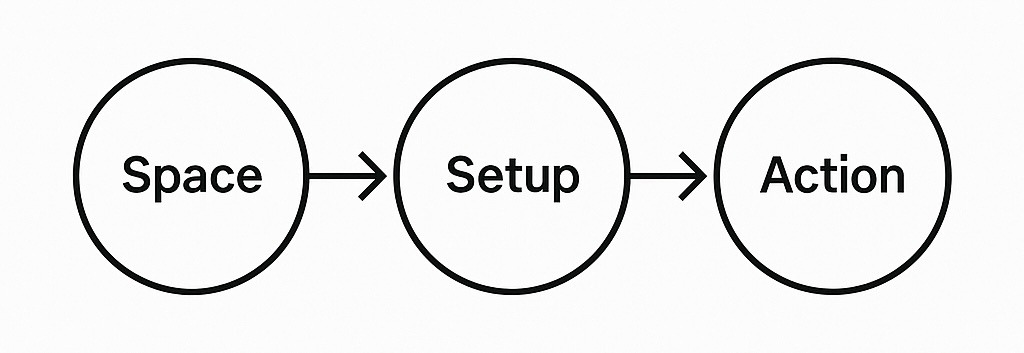
Big change needs energy. But small habits can grow even on a tired day. The key is your environment. When your space supports you, the habit becomes light. When your space fights you, the habit becomes hard.
Environment Helps
Your environment is the place around you. It can help you or block you. Willpower changes every day, but your environment stays the same. This is why environment matters more.
To drink more water, keep the bottle near you.
To read more, put the book where you can see it.
To move more, keep your shoes close to the door.
To learn something, place your tools in a clear spot.
When something is easy to see, it becomes easy to start. The environment gives you a quiet push. It says, “Do it now. It’s simple.”
Many people try to build a habit with strong motivation. But motivation is like weather — it changes fast. Your environment is like the ground — stable, calm, always there. So change the ground first.
Remove Barriers
Small barriers stop good habits. A barrier is anything that makes the first step hard. It can be physical or mental.
A closed door.
A messy desk.
A loud TV.
A cold room.
A phone full of apps.
A bag in another corner.
These small things look simple, but they block action. They make you think, “Later.” And “later” often becomes “never.”
Imagine this: you want to stretch for two minutes. But the mat is behind a chair. You need to move things, find space, and make time. This feels big, so you stop before you start.
You are not lazy.
The barrier was bigger than the habit.
So remove one barrier. Just one.
Move the mat to an open place.
Turn off the TV.
Clear your desk.
Charge your device in another room.
Open the window for fresh air.
When the barrier disappears, the habit becomes light. You begin faster. You finish easier. One tiny change can help you again and again.
Small Setups
A setup is a small plan that makes tomorrow easier. It takes one minute now but saves ten minutes later. A setup is a gift to your future self.
Lay out your clothes at night.
Prepare a small list for the morning.
Put healthy food at eye level in the fridge.
Keep your notebook open on your desk.
Turn off noisy apps before sleep.
Place needed items in one simple spot.
These setups look simple. They are simple. But they remove thinking, and they remove stress. They remove the “Where do I start?” moment that kills habits.
When the next step is clear, your brain relaxes. You feel ready. You act without pressure.
Small setups save energy, and saved energy builds good habits.
Good habits build a better day.
Key Takeaway
Do not push yourself harder.
Shape your environment instead.
Make good habits easy.
Make bad habits hard.
A tiny change in your space can change your day. One small setup. One removed barrier. One friendly place for a good action.
Your job is not to fight.
Your job is to prepare.
Бесплатный фрагмент закончился.
Купите книгу, чтобы продолжить чтение.