
Бесплатный фрагмент - Shadows of Liberea
The Mystery of the Library of Ivan the Terrible
Note from the author
Dear reader, thank you for choosing my work. I hope reading it will bring you a lot of positive emotions and arouse your interest.
The novel is set in the present day, but uses real historical events and figures to unfold the plot. It makes no claim to historical or factual accuracy, and any changes are incidental and intended to enhance the reader’s immersion in the story.
Enjoy reading!
Prologue
1699. Novodevichy Convent
The loud clack of jackboot heels echoed loudly down the long, narrow corridor. The thick black leather shimmered in the light of the torches hanging on either side of the passage, illuminating the stone cellars with a dim, reddish glow. The damp cobblestone floor carried the sound of footsteps, punctuated by the clanking of canes, for tens of feet.
An atmosphere of hopelessness and gloom weighed heavily on everyone who, by fate’s will, found themselves in this place, except for one, who valued its inaccessibility as the most important feature, serving as a kind of guarantee of safety and peace. The visitor’s immense height prevented him from fully straightening up in these catacombs beneath the church vaults of the Novodevichy Convent. A giant, nearly six feet tall, a full head taller than any crowd he had ever stood amidst, he was perfectly aware of his physical peculiarities, yet they rarely bothered him. He walked with a steady gait, reflecting absolute self-confidence and the steadfastness of his resolve, though these were merely imaginary qualities as perceived by his contemporaries. Narrow shoulders, small feet, and excessively long legs caused their owner incredible discomfort when moving, forcing him to periodically lean on a stingray-hide cane with a one-feet-long hardened steel blade that could be drawn from its sheath at the right moment. Smoothing his English mustache, the man reached the exit, ascending to the strelets guardhouse near the Naprudnaya Tower. It was guarded by two loyal soldiers from the Semenovsky and Preobrazhensky regiments, who, upon recognizing the unexpected guest, immediately parted, allowing him to enter, unlocking the heavy oak bolt.
The visitor entered the chambers and saw before him a huge stove decorated with tiles, as well as vaulted ceilings that, although significantly higher than those beneath which the man had passed, nevertheless, despite his constant confinement within, created an incredibly oppressive feeling of being in a “golden cage.” A hunched and frightened woman stood in the corner. She had never been beautiful, and her excessive plumpness was off-putting at first glance. At the same time, her saber-like intellect and insight, combined with her incredible erudition and ability to calculate her actions several steps ahead, made her an unusually dangerous adversary. The woman should have already been dressed in monastic habit, but concessions were made for royalty, and the conditions in these chambers were, to put it mildly, extraordinary. She gazed intently out the window, where the decomposing and stinking corpses of three Streltsy had been hanging for several months after their failed rebellion. To preserve the bodies as long as possible, soldiers periodically removed the dead, replaced them with comrades, bound them tightly with chains, and then hung them up again. In total, more than one hundred and fifty people underwent this procedure, creating an additional oppressive and oppressive atmosphere.
The woman’s gaze constantly lingered on one of the executed men, holding a piece of paper, folded like a petition, tied to his bony hands. It was this scroll that was meant to remind her of her poor decision and the letter she had written to overthrow the government at the opportune moment of the Tsar’s departure abroad.
The visitor entered the center of the room and paused silently, staring intently at his sister, who had become so distant and alien to him. “Hello, Susanna,” he said in a hoarse voice. The woman turned, fixing him with an angry gaze. With all her being, she wanted to growl that her name was Sophia, but at that moment she merely bowed and smiled, saying, “Hello, great sovereign, why have you honored my base existence with your radiant presence?” The Tsar ignored the provocation and calmly continued, “Let us not dwell on the sad; I did not come here to rebel.” “Then why, great sovereign?” the princess continued to writhe, like a snake, ready to pounce on her adversary in a moment of weakness.
“Where is she?” the visitor hissed, completely enraged. “Who then? I don’t understand?” Sophia replied, smiling falsely. “Don’t mock me, you know what we’re talking about!” the sovereign said, raising his voice. “I know, but you’ll never find her, don’t even try. Especially since I’ve traveled to the Germans, my brother, I’ll never see your face again,” the princess declared smiling. The visitor became enraged and shouted, “Shut up, you bastard, and say what I’m asking.” Sophia only laughed even louder, and then declared, “After all he’s done, I would never tell him, and especially not you, great sovereign. You can torture me, kill me, but I still won’t tell you, I’ve forgotten myself.” After this, the king roared even louder, but still left the chamber, loudly slamming the heavy metal door behind him, and headed back down the corridor.
He encountered Menshikov in high spirits. The favorite was striking in appearance: tall, well-built, lean, with pleasant features and very lively eyes. However, it was far from these qualities that had earned him such a high position. Coming from the very bottom of Russian society, Menshikov could not pass up an opportunity to get his hands on some money or another. He wielded incredible influence over the Tsar thanks to his resourcefulness and sycophancy, making him perhaps the richest man in the country. Franz Lefort had recently died, and Menshikov found himself the Tsar’s only truly close confidant, becoming his right-hand man. “Did you confess?” he asked the Tsar with interest. The Tsar merely shook his head, continuing to walk silently, absorbed in himself, his every step echoing loudly. “Secretly search the entire Kremlin and find her,” the monarch finally answered, breaking away from his thoughts.
Chapter 1
1980. Moscow. Kolomenskoye
“Lift it!” came a shout from somewhere in the basement, and a large construction crane began smoothly lifting its hook, tearing out a section of the ancient ceiling. “Come on, more,” said a pleasant-looking middle-aged worker, covered in dust, climbing out of the hole and adjusting his orange hard hat.
In Moscow, preparations were in full swing for the 1980 Olympics, which was to be the largest international tournament held in the entire Soviet Union. Naturally, the party couldn’t afford to lose face, so a boom in construction and renovations unfolded everywhere, including the ancient Church of the Beheading of John the Baptist, located in the now-defunct village of Dyakovo, on a hill on the right bank of the Moskva River, where the royal residence stood in the 16th century. The church overlooked the famous Golosov Ravine, which, according to ancient legends, harbored a wealth of mysticism and supernatural phenomena. According to one version, the name is associated with the Slavic pagan god Veles, while others suggest that in ancient times, the voices of travelers overtaken by robbers were heard from the ravine. Another legend holds that it was here that St. George the Victorious fought the dragon. However, there are more interesting historical facts described in the Sofia Vremennik: in 1621, a small detachment of Tatar horsemen appeared at the gates of the sovereign’s palace, captured by the guards guarding the gates. They revealed that they were warriors of Khan Devlet Giray, whose troops had attempted to capture Moscow in 1571 but were routed. The detachment of Crimeans, fleeing, descended into a deep ravine, shrouded in green fog.
The investigation conducted by Tsar Mikhail Feodorovich revealed the veracity of the story, since the weapons and equipment of the Tatar warriors did not correspond to that time, but resembled the very outdated models of the previous century.
Somewhere in the distance, the rumble of an excavator could be heard, digging through the old church cemetery. According to the plan, only the church was supposed to remain of the entire ancient complex. Just as the crane had finally uprooted part of the remaining ceiling, an entire section of stonework in the wall began to collapse, startling the worker. Terrified, he jumped aside, trying to get out, but the collapse stopped as quickly as it had begun, leaving behind only a trail of debris and construction dust.
Surveying his surroundings with a calmer gaze, the foreman was about to climb out of the hole when his gaze fell on the spot where the collapse had just occurred. Looking closer and shaking out large fragments, he realized that just beyond the blocked-up wall, a passage led deeper into the depths, and a sudden, howling draft of air from the street began to blow in. Taking a large hammer and chisel, the worker began chipping away at the upper layers of the masonry until he came upon a small window, clearly visible through which the passage, hidden for centuries, extended far downwards.
Suddenly, he heard the voice of his partner, who had clearly lost his companion: “Vanya, where did you disappear to? Is everything okay?” He abandoned his work and began climbing outside until he saw bright sunlight. “What’s taking so long?” the crane driver asked rudely, reminding his companion, who had lost track of time, that they were supposed to be doing something completely different. “There’s a passage there, a hatch that’s not on the drawings!” Ivan began excitedly, pointing down the way he’d come. “What? What’s there?” his comrade asked in surprise, jumping out of the truck. “Look, I’ll get the site manager,” the worker continued, running toward the main tent.
Elated by the discovery, he rushed into the desired location, feeling the puzzled gaze of the group leader, who had been carefully studying the reconstruction project’s documentation. He pushed his thick glasses up onto his wrinkled forehead, combed his bangs, and asked in surprise, “Vinogradov, what happened?” Ivan exhaled heavily, clutching his side, before haltingly answering, “There’s a passage there. It wasn’t on any map, and it goes somewhere deep down. “Show me,” Spiridonov said, intrigued, jumping up. Together, they quickly reached the spot where the crane operator remained, carefully examining the crack Ivan had created. “Incredible!” the site manager marveled. “Don’t touch anything, there’s a risk of a collapse. I’ll notify the crew immediately. We need to suspend all work immediately!”
The next day, Vinogradov, who had been carefully monitoring the excavation site for two days to prevent prying eyes from discovering his discovery, noticed three figures in the distance: Spiridonov, animatedly explaining something to his two companions. As soon as they caught up with Ivan, he noticed that one of them was a fat, pompous turkey in a tightly buttoned suit, proudly displaying a red hammer and sickle badge. The other stranger was thin, tall, and pleasant-looking, but something about his demeanor aroused suspicion, as his entire appearance clearly clashed with the inner fire in his soul that he carefully concealed.
Spiridonov said animatedly, “So, under my watchful eye, we’ve discovered a passageway forgotten for centuries, dating back to the time of Ivan the Terrible. It may hold more than one secret, since it was so carefully hidden.” He then asked Vinogradov to show them what the visitors had come for. The worker was furious that his superior had claimed credit for his discovery, but he nonetheless made a neutral gesture, inviting them to follow him. Descending underground, the group found the passageway just as Ivan had left it the day before. The official’s eyes lit up, eager to claim credit for this discovery, just as Spiridonov had done a moment earlier. “This is remarkable,” he hissed, licking his lips with glee. In contrast, the second visitor was as calm as a boa constrictor, not uttering a word. “I understand you stopped all work for this?” he asked unexpectedly. “Of course, we don’t want our cultural heritage to be accidentally damaged by excavations,” said the site manager, deeply alarmed by the question. “You need to immediately concrete the passage and continue the work,” declared the visitor, placing his hands on his waist. “But how? Then we won’t know what’s hidden beneath this church. Legend has it that the famous Libereya could be located there, but what if it really is here, right under our noses!” Spiridonov declared indignantly, blushing with anger. “The Olympics are just months away, and here you are, tearing everything up and not finishing it! You want THIS for our capital’s guests to see, and all the events to be cancelled?” the visitor began to scold him with surprising expressiveness, feeling the official’s astonished gaze on him. “Well, I didn’t even think of that,” the group leader stammered, clearly aware of what was at stake. “Should you have thought about it before stopping the excavations, or should I inform Comrade Brezhnev that your actions are jeopardizing the possibility of holding the Olympics?” the stranger continued to scold him. “No, of course not, we’ll resume work today, everything will be finished on time,” Spiridonov whispered.
“Well, that’s great, we’ll keep an eye on it, that’s for sure,” the visitor concluded his impassioned speech and climbed back out. The official merely shrugged and followed him, leaving Vinogradov and the site supervisor alone in front of the hole. “Fill it in immediately,” the other muttered discontentedly. Ivan wanted to say something against it, but, feeling the supervisor’s murderous gaze on him, he remained silent. That same evening, he watched with bitterness as a concrete mixer arrived on the site and poured the mixture through a construction hose into his opening, completely concealing it from posterity.
Chapter 2
Nowadays
“Are you absolutely certain of your theory?” Taras Prikhodko asked, strolling through the park in the rays of the setting evening sun. Warm red glare gently touched the leaves of the trees in Kolomenskoye Park, the recently restored Golosov Ravine lay beneath his feet, and in the distance, the Church of the Ascension of Our Lord peeked out from behind the treetops, wrapped in a green blanket.
This summer has been truly hot, the most muggy in recent memory. Therefore, the pleasant evening coolness allowed us to cool off after a scorching day in the scorching, bustling city, while at the same time keeping warm at night, when the temperature plummets and a chilling wind comes out into the open spaces, chilling us to the bone after a hot day.
“Of course,” replied Valery, a thirty-year-old man confidently, shuffling along the park paths with a playful gait, as if simultaneously engaged in some unknown competition with an invisible opponent. Vinogradov had graduated from university with a degree in plastic surgery, a field his parents had forced him to choose at seventeen, but since then, he had never worked a single day in the profession. From his very first class, the man — still a young man — knew this occupation was clearly not what he wanted to dedicate his life to, long or short, as fate would have it.
From childhood, he’d been fascinated by two things: cars and history. While he mastered the former as soon as he got his driver’s license and got behind the wheel of his first car, the latter was far more interesting and complex. Initially, Vinogradov wasn’t much of an expert on the past, and it didn’t particularly capture his attention in elementary school. However, the years passed, and young Valera found himself alone in his room with his grandfather after school. His parents had gone out on business, and spending time with his grandson brought him a special joy and an incredible thrill. And then, they reached the section on Ivan the Terrible. Everything seems fine, events unfold as usual, historical plots and themes intertwine, the clear sequence of conquered lands and the monstrous Oprichnina are etched in the memory. However, suddenly, his gaze catches a small paragraph at the end, which tells of the irrevocably lost and mysterious Libereya — the Tsar’s library, assembled by his grandmother, Sophia Paleologue, wife of Ivan III. An animated Valera tells his grandfather about what he’s read, and the grandfather unexpectedly finds a kindred spirit in the boy’s delighted eyes. He leads him to the Church of the Beheading of John the Baptist, restored decades ago, shows him the buried site where he discovered the mysterious tunnel, and declares that it is there, behind this tunnel, that the legendary library may be hidden.
Years passed, and his grandfather died suddenly, but Vinogradov never lost interest in Libereya. Quite the contrary, it grew by leaps and bounds. The young man devoured books, ancient scrolls, and online articles — basically, anything that related to the topic he was interested in. Valery couldn’t let go of this thought; he tried to hold onto it by the tail, like a bird caught by chance, and not let go, hoping to someday find what he was looking for and find himself next to Ivan the Terrible in that very same history section of his sixth-grade textbook.
Taras gave him a stern, focused look, perfectly suited to any situation, given his monstrously large and muscular frame, as well as his perpetually dissatisfied and serious expression. “I hope you’re right, otherwise it was all for nothing. If only you knew what it would have cost me to negotiate the reconstruction of a technically sound cultural heritage site, and even hold a sham tender so no one would complain,” he declared, looking around in the hope that no one had overheard. “Why couldn’t we have done it differently, just come and start digging?” Vinogradov asked, naive for his age, looking at his interlocutor in surprise. Prikhodko cursed silently, but declared, “Because that would have raised questions and attention. This way, we’ve calmly blocked off all approaches to the church and will begin our work without anyone watching.”
After that, they walked for several minutes in complete silence, which was suddenly broken by Valery: “Of course, when you showed up two weeks ago and told me you were ready to help me find the treasure, I was shocked, to say the least. Why would this happen all of a sudden, after so many years?” “You know,” Taras replied, “at university, you kept me talking about this Liberea and your grandfather’s discovery in Kolomenskoye. Naturally, I hadn’t heard anything about it at first, but then, when I read the sources on the subject and saw its significance for the entire world, I immediately became enthusiastic about the idea too.”
At that moment, they approached the temple walls, where construction equipment had already been brought in for the job, and the excavation area was cordoned off. Looking carefully at his men and adjusting the pistol in its holster on his belt, Prikhodko began waving his arms, inviting them to come closer. “I hope you and your grandfather were right,” Taras declared, “otherwise, for all the money you wasted, I’ll have to kill you.” Hearing these words and taking them for an incredible level of irony, Vinogradov laughed. However, his interlocutor’s gaze was incredibly serious and fixed on the empty temple wall.
Chapter 3
Together, Taras and Valery, holding flashlights, walked through the dark church. Visibility was poor in the dim light, but a small source of light from the setting sun shone faintly through small, vertical, narrow windows somewhere near the high ceiling.
“Something tells me this is all in vain,” Prikhodko whispered under a curse. “What makes you think that?” Vinogradov asked in surprise, turning to him and shining the flashlight in his face, causing him to quickly turn away, blinded by the bright white beam. “I’ve read a lot about this in recent months, but only a few people talk about Kolomenskoye. The Kremlin, Vologda, Alexandrov, even Staritsa, but this little church next to the estate of Alexei Mikhailovich, Peter the Great’s father — where could a library be hidden?” Taras began listing, trying to recall everything he’d studied. “Oh, no, you’re completely wrong about that,” Valery countered, turning the light away. “There’s a theory that the church was founded in honor of the Tsar’s coronation in January 1547. There’s also an equally curious theory that its construction is connected to a vow to send the Tsar an heir, or to the very fact of his son’s birth.” Thus, the church is directly connected to Ivan the Terrible himself, not only by the birth of his children, Ivan and Dmitry, but also by his coronation. The Tsar himself was also born in Kolomenskoye. Moreover, Ivan IV stopped here on his way to campaigns against the Kazan Khanate. In the twentieth century, this idea was seized upon by archaeologist Ignat Stelletsky, who heard a story from a former church caretaker about how he and a friend once found a key and opened a small door they had long noticed in the church wall. They descended a narrow stone staircase and discovered iron doors and a decayed skeleton. However, the church was soon renovated, and the secret staircase was hidden under layers of new brick. In 1938, at a depth of 21 feet, an archaeologist came across massive stonework, but excavation work was halted because it was being conducted on cemetery grounds, and local residents demanded an end to this sacrilege. “And most importantly, in 1980, my grandfather carried out the reconstruction of the church for the Olympics.” “You’ve told me this a thousand times,” Prikhodko interrupted. But Vinogradov persisted: “And he repeatedly showed me the place where he had definitely found a passage leading somewhere deep, which matches Stelletsky’s description.”
Having finished his story, Valery fell silent, glancing sideways at his interlocutor, who continued walking, stony-faced, without uttering a word. Together, they walked toward the altar and stopped at the wall that once overlooked the church cemetery, now demolished in the 1980s. Large boxes of ground-penetrating radars, essentially ground-penetrating radars that use high-resolution electromagnetic waves to image underground structures, were already waiting for them there. Naturally, the group wasn’t planning to break anything without first studying the soil, so the first order of business was to conduct a georeconnaissance survey.
Upon turning on the device, the screen lit up, with vertical stripes gradually forming into a single image. After waiting for a while, the companions discovered that directly ahead lay a hidden depression, about 3 feet wide, leading toward the cemetery. Overjoyed by this discovery, Taras took the radio from his belt and said, “Bogdan, Mykola, dig.” From outside, the rumble of an excavator, its thick teeth clawing at the earth, could be heard. “Get going,” Prikhodko said loudly, clapping Valery on the shoulder before heading toward the exit. Valery merely stood silently in the darkened room, his head cocked upward, gazing at the bottom of the large domed vault, as if pleading for something. Then, he finished his lamentation and followed his comrade toward the discovery.
Stepping outside, Vinogradov was stunned to see the construction equipment’s bucket rest against a huge layer of concrete, with chunks of old and coated masonry peeling away just beyond. Then he noticed Taras’s satisfied expression, watching the process and waving his arms vigorously. “Come on, break it up, faster!” he shouted at his subordinates, approaching the edge of the pit. The excavator operator activated a special vibration mode and, like a knife through butter, began piercing the target area, attempting to break it into pieces. This process continued for half an hour, until Bogdan finally used the bucket to lift the broken mass, releasing air and construction dust.
As soon as it settled, Prikhodko waved his hand sharply, signaling the equipment to stop, and approached. The resulting gap revealed an ancient passageway, filled with an incredible mustiness that slowly began to dissipate as soon as oxygen opened up. Reaching it, Valery inhaled the stench deeply and then declared, “It looks like all the khan’s scrolls are starved of air; they should be kept in a well-ventilated room.” “Don’t croak!” Prikhodko growled, beckoning Bogdan and Mykola to him. “Come down and see what’s down there!” “But you don’t know how safe it is down there, what if there’s a cave-in?” the former asked, but upon seeing the commander’s murderous glare, who began reaching for his belt holster, he replied that he would do everything he could.
The two of them found themselves in a narrow, dark corridor, seemingly endless in the all-consuming gloom. The stonework weighed heavily not only on them, but also on them, as it could collapse at any moment if the structure’s seal was breached. Turning on their flashlights, they realized the passageway was twisting in place, running in a semicircle across roughly the same area. Overcoming their fears and finally reaching the end, they found themselves directly in front of a locked door, clearly revealing some hidden chamber. Quickly returning, they reported their discovery to Taras. “It’s just as Stelletsky described. No skeleton?” Vinogradov declared joyfully. The researchers paused for a moment, then shook their heads. “To hell with it,” Prikhodko admonished him. “What door? A grinder would do it?” While his partner was pondering what to say, Mykola replied, “The metal one, yeah, I think so, take the battery-powered one.” The team leader nodded, went into a large black SUV, and pulled out an orange hard hat with a flashlight from the trunk, along with a few ropes, just in case, which he tied to his belt. He also opened one of the drawers containing a battery-powered angle grinder, connected them, and returned to the guys, who were burning with anticipation. “Well,” Taras declared, tossing the grinder into Valery’s hands, “let’s dig her up and prove you were right all these years, just like your grandfather!”
Chapter 4
Together, the four of them walked down a long, narrow, dark corridor. Surprisingly, the ground was completely dry, despite the large amount of underground water. The light from Taras’s helmet, leading the way, illuminated their path into the unexplored depths of the catacombs, hidden from view for centuries.
Finally, they reached the door they were looking for. Black, divided into squares of varying sizes, with hinges monstrous by modern standards, a gigantic metal bolt and a thick lock holding it in place. It had seen many times, but, unfortunately, over all these centuries, few had been able to lay eyes on it. Prikhodko smiled with satisfaction, took the grinder from Valery’s hands, and began sawing at the hinged element. An incredible crunch was heard, and the squeal of cutting metal quickly spread throughout the hallway, echoing off the stone walls. Vinogradov watched the process, mesmerized, lost in his thoughts. He still couldn’t believe that what he had dreamed of for so many years was finally coming true, happening right before his eyes. His grandfather turned out to be right, and Stelletsky too, and now they have all written their names in gold letters in the history of Kolomenskoye, at least the modern one.
The irritating beeping didn’t last long, and the lock split sharply in two, after which Taras switched off his device. Taking a step back, he kicked it off its hinges, sending it flying a foot and a half to the side, causing his companions to freeze in surprise. Throwing back the metal bolt, Prikhodko yanked the door handle with all his might, and it began to open with an incredible squeak, dragging heavily and scraping the floor. Over many centuries of neglect and lack of lubrication, it had sagged to the floor and rusted. “Help,” he hissed, blushing from the effort and bracing his foot against the wall for added leverage. Valery broke away from his thoughts and stepped closer, grabbing the edge of the gate leading to the unknown, pulling it toward him. Bogdan and Mykola followed suit. Together, they pulled it out of the doorway with incredible effort, causing it to fall off its hinges with a loud crash, forcing the unexpected visitors to jump aside. As it fell to the floor, it kicked up a cloud of dust that quickly spread toward the exit, triggering coughing fits among everyone present.
After dusting himself off, Taras looked beyond the obstacle he’d just overcome and spotted a spacious room, devoid of any light. “Please,” he declared, stepping inside in the hopes of finding the treasure he sought. The others followed silently, barely able to see anything in front of them. Stopping right in the middle of the hidden room, Prikhodko looked around and turned white with anger. The room was a circle no more than 12 or 15 feet in diameter, without a single window or other exit. The bare walls held no hint of shelves, books, or scrolls, only three lonely, long-extinguished torches. Precisely in the center stood a pedestal of wood resembling oak, upon which an ordinary broom, about 3 feet long, was carefully placed, like an exhibit.
After searching the room again and finding nothing else, Taras roared and, at full speed, grabbed Valery by the chest. Valery, who had just entered and hadn’t even had time to react, pinned him against the wall, causing incredible pain to his back from the surprise. “You said the treasure would be here!” Prikhodko screamed in rage, glaring at his victim with animal eyes, wanting to finish him off right there. Coughing violently, Vinogradov glanced at the room’s furnishings and, finding no hint of Liberea, not even a single scroll, understood his comrade’s displeasure. “I said she might be here, but that’s just one of the possibilities,” he groaned, fibbing as he went, hoping to reassure his comrade. Bogdan and Mykola stood silently, motionless, watching the ensuing squabble. “Oh no,” Taras objected, “I remember your words clearly, don’t lead me by the nose! Tens of millions in bribes for a rigged tender and equipment purchase, so much effort in preparation and persuasion to participate in this shady reconstruction scheme! And all for what? For a common broom!”
He abruptly released Valery, causing him to fall to the floor, his knees hitting the stones. He then approached the pedestal, grabbed the exhibit, swung it, and began to bring it down, intending to snap it in half in anger. At that moment, Vinogradov saw three carved symbols illuminated by a flashlight on the broomstick and shouted, “Stop, there are hidden symbols here!” Frozen, before he could complete his retribution, Prikhodko looked at him, then carefully examined the object in his hands. Indeed, three symbols had been carefully carved directly into the wooden handle: two lions facing in opposite directions, and a double-headed eagle in the middle, with crowns over each of the birds’ heads.
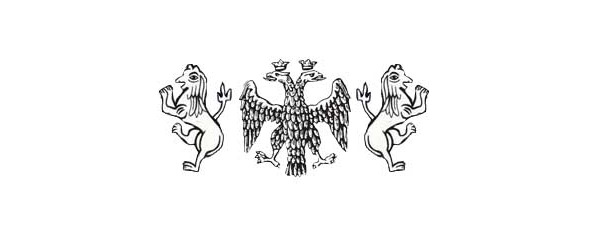
Then the puzzle came together for him, and he declared, “There was never any treasure here, this is the key!” Valery glared at the amused Taras, cleared his throat, and came closer, carefully examining the drawing. “The broom is clearly a symbol of the Oprichnina. G. Staden once wrote that the oprichniks were supposed to wear black caftans and hats, as well as some kind of brush or broom tied to a stick. So this is a sign that Ivan the Terrible hid the library at this particular time, apparently fearing for its safety, believing that his enemies would find it and seize it. He was a very intelligent man and no less well-read, despite his image as a cruel ruler, and he wanted to pass on his treasure to his descendants. But, apparently, something went wrong.” “And what do these symbols mean?” “Taras asked, looking closely at each of them. “The eagle is clear — a symbol of statehood dating back to Ivan III. But what about the lions? Why are there two of them?” Vinogradov thought for a few seconds, observing how their mouths gaped in different directions, as if ready to say something, but what? “The lion is definitely a historical symbol of Vladimir, next to which is the Aleksandrovskaya Sloboda — the capital during the Oprichnina, where Ivan the Terrible spent most of his time from 1564 to 1581. Perhaps we should dig further in this direction,” he said thoughtfully. “This is a huge complex; we can’t look for a needle in a haystack,” Taras countered, pacing the room and examining every nook and cranny in the hope of finding another clue. However, he found only dust, small stones, and torch ash.
Vinogradov hypnotized the lions; they evoked familiar thoughts, as if he’d seen a similar combination in a book before, but couldn’t remember where. Then he brightened and said, “I know someone — an expert on symbols from the time of Ivan IV, and on that era in general. He can help us decipher this code.”
Chapter 5
“Well, it was nice to see you all after the summer,” said Peter, a thin thirty-year-old man wearing round glasses, looking out at the packed lecture hall. As always, in early September, all the conscientious and less conscientious students attended classes actively, but then, until the winter exams, there was a gradual but steady decline, so it was necessary to strike while the iron was hot. Sevastyanov worked as a lecturer in the Mathematics Department of Lomonosov Moscow State University, but always felt it wasn’t his calling. His true passion was books on Russian history, which he devoured in the evenings and constantly searched for new editions in online stores and libraries. He would have happily devoted his entire life to this hobby, without working anywhere and living on the small income he received from renting out his late grandmother’s apartment, but his family kept him from pursuing this idea, as he had to support not only his pregnant wife, but also their little three-year-old daughter.
“Read carefully about the ‘GROUP BY’ operators; they’ll be very useful later. And in a few days we’ll talk about ‘DDL’ and ‘DML,’” he concluded his speech, when he suddenly noticed the door behind the last rows open, and a man of medium build, wearing a hoodie covering his head, slipped into the room. Thinking it was a lazy student who’d been late for the entire class, Petr was about to reprimand him with the sparkling humor he often employed to create a friendlier atmosphere. However, he was very tired today, so he decided to ignore the incomprehensible individual.
The bell rang, and everyone immediately leaped from their seats, a roar echoing through the multi-level rows of the vast auditorium. They began packing their tablets and laptops into their bags, then filed out in a long line toward the next class. Sevastyanov let out a long, drawn-out breath, yawning from lack of sleep, and sat down with a thump on his thin, metal-legged table, more like a regular school desk, pulling his cell phone out of his pocket to catch up on what had happened in the world during that academic hour. Looking at the empty auditorium and the ceiling, which, despite its modernity and pretentious expensiveness, clearly showed signs of neglect in the form of yellow stains on the plaster and peeling linoleum in places, the uninvited guest smoothly rose from his seat and began to walk confidently downstairs, each step echoing loudly in the hall with excellent acoustics.
The teacher ignored him until he approached, throwing back his hood and revealing his curly light-brown hair. “Well, hello, Petya, how are you?” Vinogradov said, extending his hand in greeting. Looking up from his device, Sevastyanov looked up at the visitor, his expression surprised, as if he were seeing the Queen of England before him. He then shook his hand in return, saying, “Valera! What a meeting! I didn’t recognize you. I thought some shady student had walked in. What brings you here?”
It would seem unlikely that two men with completely different professions — a plastic surgeon and a programming teacher — could connect, but fate always has its own plans. They met at a conference dedicated to the reign of Ivan the Terrible, where scholars from across the country presented their research on various topics. Both were attendees, lacking sufficient qualifications or documented evidence, but their extensive reading and long-standing interest in the figure made them among the conference’s leading experts on the subject. Sitting next to each other at the table, they struck up a conversation about their passions, sparking a genuine mutual interest in complementing the overall picture of the historical world. Vinogradov was certain that Peter the Great would be able to provide an answer as to the attribution of an unknown combination of symbols to a specific place and period.
“You know, I’d love to just drop by, but I don’t have the time. I have something to do, and it’s quite interesting,” Valery began his speech intriguingly. “Okay, don’t tell me anything about the lack of opportunity; I don’t really like such excuses, but let’s talk about the complicated situation in more detail,” the teacher replied, looking his interlocutor intently in the eyes, clearly seeing through his selfish motives. Realizing that his elegant approach had failed and that he needed to find more appropriate words, Vinogradov silently pulled his phone from his pocket, opened the gallery where he had stored the photo he’d taken that day of the symbol combination on the broom from Kolomenskoye, and handed it to Sevastyanov. “We need to figure out what place this sign points to and how to find it,” the former declared, looking off to the wall, clearly embarrassed that he hadn’t solved this riddle. Having studied the shaft with interest, zooming in and out on the image several times, Peter handed the gadget back to its owner, after which he said: “I basically understand what this is, but to be sure I’m right, I need to know where these symbols are carved, and what they are for you.”
Valery was slightly puzzled by this gesture, as he hadn’t been particularly eager to expand his treasure-hunting team, only wanting to engage a specialist on a one-time, freelance basis. Apparently, to obtain the necessary information, he had to lay his cards on the table: “We found them on a broomstick from the time of Ivan IV in the basement of a church near Kolomenskoye. We believe the lion is the key to the Aleksandrovskaya Sloboda in the Vladimir region, as it’s their ancient coat of arms.”
“Incredible!” Sevastyanov exclaimed, jumping up from his seat and walking around the table. “You’ve found the key to Liberea!” “Please be quiet! I don’t want anyone else to overhear!” Vinogradov hissed discontentedly, glancing nervously toward the slightly open door to the lecture hall behind him. “But you’re looking in the wrong place,” Peter added. “Why is that?” Valery objected with displeasure, having learned that his theory had been called into question. “Well, Alexandrov’s coat of arms has vices and anvils, and certainly not lions, let alone two. That’s something entirely different,” the teacher continued. “The symbols you showed me can be found separately on two coins from the time of Ivan the Terrible; both reflect power and might. The double-headed eagle, established under his grandfather, Ivan III, first acquired a double crown under him, and the lion was usually depicted in the company of a unicorn, in contrast. However, there is a place where these symbols are united, and it is significantly closer from here than the Alexandrovskaya Sloboda you seek.” “And what is this?” Valery asked impatiently, fingering the knuckles of his thin, skeletal fingers with his hands tucked in his pockets. “Pashkov House,” Sevastyanov declared smugly, finally settling into his chair and reclining in it like a king, realizing he had surpassed in knowledge the equally well-read and intelligent acquaintance who had come to him for help in his time of need.
Chapter 6
“Pashkov House?” Valery asked, bewildered, leaning his hand on the table. “Did I hear you wrong? No, it’s a good joke, but clearly inappropriate. Let’s bring Lenin into this too. He has a library, too, and a state one at that, with windows overlooking the Kremlin! It’s beautiful, you have to admit!”
Not understanding this sparkling humor from his interlocutor, Peter looked at him with displeasure and then replied, “You can have all the fun you want, but the truth remains the same. And we’ll get to Vladimir Ilyich later; he has something to do with this, too.” At these words, Vinogradov nearly choked on his own saliva, moving away from the table a little, his expression surprised. “Now listen very carefully,” Sevastyanov declared, settling comfortably in his chair. “On the site of today’s Pashkov House, there once stood the Oprichny Court — the center of the appanage established by Ivan the Terrible. According to the description by the German oprichnik Heinrich Staden, there were two carved, painted lions on the gates. Mirrors were attached to their eyes. One stood with its mouth open, looking toward the zemshchina, the other, identical, looked into the courtyard. Between these two lions was a double-headed black eagle with outstretched wings. Then, in the 18th century, the area was built up with other buildings, and it was then that the Pashkov House appeared on this site.”
Then everything clicked in Valery’s head, and his eyes widened, the symbols on the broom handle and modern history merging. “Furthermore,” Sevastyanov continued, “rumor has it that this house was built by the renowned architect Bazhenov, who was dismissed from work on Tsaritsyno by Catherine the Great. The true reason for Catherine’s displeasure lay in the figure of Vasily Ivanovich himself. The architect was associated with a Masonic lodge and corresponded with Novikov, the leader of the Moscow Masonic circle. Novikov actively advocated for the transfer of power to Catherine’s son, Pavel Petrovich, and the Empress decided to nip the “Masonic conspiracy” in the bud and put an end to all those involved. In 1796, Bazhenov was suddenly removed from his post, and she entrusted further work at Tsaritsyno to his student and assistant, Matthew Kazakov.
Pashkov was also a Freemason, so he “sheltered” the disgraced architect, commissioning him to design a pompous building in the center of Moscow. It is also said that it was precisely because of his resentment towards Catherine that Bazhenov turned the building away from the Kremlin. Perhaps it was during the reconstruction that the very Libereya, which Ivan IV had hidden with his most trusted confidants at the time, was discovered, and it passed into the hands of the Freemasons, who decided to keep its discovery a complete secret, guarding it like the apple of their eye.
“It’s incredible!” Vinogradov exclaimed, taking a deep breath. “These conspiracy theories aren’t always true, but now everything is fitting together to form a perfectly logical and coherent puzzle, with only a couple of pieces missing. “And then there’s more,” Peter continued, not distracted from his story for a second. “Then Stelletsky, who you know, was exploring Vagankovsky Hill in the 1930s and discovered numerous voids — cellars, passages, basements. He believed these to be the remains of the Oprichnina Court, and mysterious steps were found in one of the dungeons. However, he was unable to examine them because they were collapsed the next day by criminals. Excavations were stopped due to the threat of collapse, and the entrance to the dungeons was hastily concreted over. These hidden galleries were also discovered during the construction of one of the metro stations on the first line of the metro — the V.I. “Lenin.” The builders uncovered a passage lined with ancient bricks, but archaeologists were not allowed to explore it at the time, and the discovered entrance was quickly sealed up. “That’s why I mentioned that library to you, though it proved useful to us in a slightly different way than expected.”
“Fantastic!” Valery exclaimed in a trembling voice, stepping closer and joyfully embracing his companion. Now he had a clear idea of what, and most importantly, where, to look, since Sevastyanov had given him some very interesting ideas. “So, we need to get to the Pashkov House dungeons that open up towards the metro,” Vinogradov said thoughtfully, stroking his chin with his fingers. “I suppose so, but for that we’d need plans and blueprints of both,” Peter replied, glancing at his watch and toward the exit.
Suddenly the bell rang, and a crowd of students immediately began to stream into the auditorium, taking their seats. Turning around and cursing silently, Valery said, “We’ll need you as an expert. When you’re finished, come to my house and we’ll discuss everything. You remember where I live, right?” Sevastyanov nodded calmly and replied, “Sure, fine, I’ll be there after six.” Afterward, the two shook hands, Vinogradov pulled the hood of his sweatshirt back over his head, and quickly headed outside.
Chapter 7
Peter emerged tired from the metro and walked along the autumn streets. The daylight hours were rapidly dwindling, and even at seven o’clock in the evening it was already getting dark. Crickets chirped in the corners of the bushes, and the air was still warm, yet at the same time deceiving and chilling the bones of gullible travelers dressed inappropriately for the weather.
As had been his habit for months, the summer howled throughout the surrounding area. The green treetops, though towering high above, encircled the panel apartment buildings, slightly concealing them behind their mighty backs and creating a more pleasant impression than the standard, identical concrete structures, were still beginning to turn yellow and fall in places, preparing for the fleeting autumn and rapidly approaching winter. Sevastyanov hadn’t even noticed how his two months of rest had flown by after a difficult and grueling exam period with lazy students. But other thoughts troubled him most, thoughts that jeopardized not only his family’s well-being but his life as a whole. He still couldn’t admit to his problems, much less tell his wife about them, but time was running out, and the chance to fix them was fading just as quickly.
As agreed with Valery, the teacher headed to his old apartment in Kuntsevo, inherited from his grandfather, where they spent the evening actively discussing the events of the conference where they had met over a year earlier. They hadn’t seen each other or spoken since, but that single encounter had left a lasting impression on both of them about their level of knowledge in the historical period they were interested in. As soon as Peter learned the origin of the symbols he’d shown him, he was stunned. He never expected Ivan the Terrible’s famous library to be real and existent. But here was living proof — the key to finding it, and most importantly, right there, right before his eyes. But the most interesting thing was that Vinogradov was hunting for this treasure, and he had the resources to do so.
Lost in these thoughts, Sevastyanov finally reached the entrance and rang the intercom. An unpleasant beeping sounded so loud it could be heard in the neighboring yard, and then an unknown voice answered, asking, “Who?” After a moment’s hesitation, thinking he had come to the wrong address, the teacher finally decided to answer, “Peter Sevastyanov.” A brief silence followed, which for the nervous guest, struggling with trembling legs, seemed like an eternity, but then the same voice came from the other end of the line: “Come in!” and the front door opened.
Without further ado, the visitor, now more confident, ascended to the first floor and called the elevator, which creaked open with a loud squeak, inviting him in. Peter pressed the button for the eighth floor. The light overhead flickered, and the doors immediately closed. The mechanism began jerking upward, accompanying each floor with a powerful shaking sound, causing the visitor to grab the handrail in surprise. Upon reaching its destination, the elevator opened, and Sevastyanov saw the apartment he was looking for right before him, its entrance ajar. Stepping inside and closing the old green leather door, divided into sections by sewn-on buttons, behind him with a revolving mechanism and a metal chain, the teacher found himself in an empty room, in complete darkness, with the chandelier off. Looking around, he realized that this was the very room where he had met Valery once before, and that he was at the right address.
In the back room, conversations, more like heated arguments, and male voices could be heard. One of them was definitely the owner’s, but the other was unfamiliar to Petr. Suddenly, apparently hearing someone enter the apartment, everyone fell silent, and Vinogradov emerged from the corner, smiling contentedly upon spotting the welcome guest. “Petya! We’ve been waiting for you, take off your clothes and come in!” he announced, returning to his room. The teacher kicked off his sneakers, hung his coat on the coat rack, and walked slowly and carefully deeper into the apartment. In front of him, he noticed a large table with drawing papers laid out on it, resembling blueprints, and Valery and the unknown man stood in a circle around him. Somewhere in the corner, two more people were lounging on a sofa, eating instant noodles. Sevastyanov stared blankly at them, noticing the pistols holstered on each of their belts. He swallowed nervously, wondering who these strangers were. “This is Peter, our consultant on the Ivan the Terrible period, and this is Taras, the sponsor and organizer of the treasure hunt,” Vinogradov introduced them. They shook hands tentatively, after which Prikhodko quietly whispered, “Are you sure inviting an outsider is a good idea?” Valery calmly turned to him and replied, “I’m an expert on this matter, but Sevastyanov knows things I might be weak in, like runic symbols, which we stalled on after Kolomenskoye, so yes, we need him.”
At that moment, half-eaten by the conversation about himself, the professor approached the table and began examining two blueprints of different sizes, their lines drawn in a blurry, slightly faded color. Looking closer, he realized that one was a plan for a branch of the Red Line metro, and the other for Pashkov’s house in the same area. “Where did you get those?” Peter asked in surprise, looking up at his colleagues who had finished arguing. “We have our own channels; if necessary, we can even get blueprints of buildings on Mars once they’re built,” Taras stated dryly, scratching the back of his head with his whole hand.
Sevastyanov nodded, unslung his bag, and pulled out his laptop. He then fished his phone out of his pocket and began taking photos of both shots, capturing every detail as clearly as possible, especially those that had been ravaged by time. “What are you doing? These are classified documents!” Prikhodko hissed, intending to knock the phone out of his partner’s hands, but Valery interrupted, grabbing his partner by the wrist. “Don’t interfere! He knows what he’s doing,” he declared, quickly releasing his companion. Watching them sideways, Bogdan and Mykola continued to silently and indifferently eat their noodles, not reacting in any way.
After taking a series of photographs, Peter opened his laptop, transferred the images onto it, and then began combining them in a special program, attempting to match the extreme points with geotags on the map to find the exact intersection discovered by construction workers in the early twentieth century during the construction of a subway line. A couple of minutes later, the computer completed its calculations, revealing the location of the tunnel and the wall of the building. “Voila,” the teacher proudly declared, turning the laptop toward his partners. “I think we should start our search from here.” Prikhodko carefully examined the results and then patted Vinogradov on the shoulder, saying, “Okay, let’s take it.”
“The only question is how we’ll get into the subway and then from there into the building. I understand we’ll have to drill through the retaining wall,” Valery asked. “Don’t worry about that, I’ll organize it as a renovation project. We’ll close the corner and start demolishing it. I don’t think we’ll interfere with the trains; there’s enough clearance there for the workers, after all,” Taras replied, clearly perking up as they began to move toward their intended target. “And the noise — well, okay, in the subway, but as soon as we get into Pashkov’s building, there’ll be a rumble, and that’ll raise questions,” Vinogradov continued, asking perfectly logical questions. “I can hack into their security system and set off the alarm. The incessant screaming will be so loud they won’t hear anything, and by the time they figure out how to turn it off, we’ll already be inside,” Sevastyanov took the floor. “I like this guy more and more,” Prikhodko said, brightening up, causing a faint smile to cross Peter’s face. “Then let’s get to work! We’re getting ready and heading out this week! In the meantime, I’ll just negotiate the supposed renovations. I hope those who commissioned us to reconstruct Kolomenskoye are still in their positions.”
Chapter 8
Pashkov House
“So, do you think it’ll work out?” Valery asked, turning to his comrades walking down the corridor after passing through the heavy, sliding doors of the subway. They were all dressed in repair suits and carrying bags containing heavy-duty equipment for chipping chunks of concrete from the tunnel walls.
“I hope so,” Peter replied, adjusting his jacket and badge for the third time, clearly uncomfortable in his unfamiliar role. He held a briefcase containing a laptop he’d used to hack the Pashkov house’s security system. Bogdan and Mykola followed close behind, brought on the mission merely as support staff, tasked with the most difficult and time-consuming tasks.
The group reached a police cordon and a metal detector search of their personal belongings, but Taras quickly pulled a fake ID from his pocket, hastily unfolded it, and immediately turned back. The guard nodded toward the technical barrier for subway employees. Prikhodko pulled aside the metal grate, ushered the entire group inside, closing the exit behind him. Together, they descended the escalator, and a distinctive, hot, rubbery air immediately hit their noses — a sensation that could only be felt and understood once they were in the subway. His helmeted head began to sweat, and thin streams of sweat ran down his forehead, but he had to keep moving; this was only the beginning of the journey. Descending, they saw nothing remarkable: no bronze statues, especially one with a dog, like in Revolution Square; no two rows of octagonal columns and massive bronze chandeliers like in Komsomolskaya; no glittering stained-glass windows between the pylons like in Novoslobodskaya; just a semicircular vaulted ceiling with small round light fixtures and neat, square cutouts. Opening a map on their phone with the intersection geotagged by Peter, the treasure hunters headed toward a door in the corner that housed a staff room, from which they could easily access a utility corridor along the tracks.
As soon as the group stepped onto this narrow path, separated from certain death under the wheels of a speeding train by only a small handrail, Taras declared, “Please, please be more careful and cautious,” and then led the way toward the unknown. It wasn’t far to go, about half a mile, but each passing train seemed to push them aside, dragging them along under pressure, like the wind pulling grains of sand in a pipe. The thick concrete walls and narrow passages created an incredible sense of danger, evoking fear even in those not prone to claustrophobia. The realization that they were deep underground, with no escape except what lay directly behind them, added to the heaviness. The lights, spaced widely apart, merely marked the route, so for additional orientation, the companions turned on their helmet lights. Having finally reached the point where the approximate geolocation coincided with the required point, the group stopped and waited for the next train to pass. Prikhodko then gave the command, and Bogdan and Mykola began preparing the drilling equipment. “Let’s hope it’s here,” Valery whispered, crossing his fingers and looking at the still-intact wall. The cost of a mistake could be high, even leading to a complete collapse of the tunnel, costing the lives of hundreds of passengers unaware of the potential danger.
“Turn on all the alarms at once,” Taras said to Petro, who had already sat down on the floor, his laptop resting on his lap, attempting to access the estate’s security system. A few seconds later, he announced with satisfaction, “Access granted.” Prikhodko turned to his men and said, “Begin!” They immediately turned on their drills and began cutting through the perfectly gray wall, their metal teeth biting into the thick, compacted material, resistant to heavy loads. The noise was so loud it was deafening, forcing them to wear special sound-absorbing headphones. They were of little help, however, and after a few minutes, only a thin strip of the resulting depression, no more than one foot wide, betrayed the impact. To maintain the load-bearing capacity and prevent possible collapses, it was decided to cut a gap about 2 feet wide, large enough to easily squeeze through sideways.
Twenty minutes later, most of the cut had been cut about 12 feet wide, when suddenly the drill slipped, hitting different material. Even through their half-deafened ears and earmuffs, the teammates realized the work had paused. They peered inside, seeing ancient stonework before them, similar to what they’d discovered in the secret tunnel beneath Kolomenskoye. Valery grinned broadly, as did the others, after which Taras picked up a larger sledgehammer and began smashing the discovered wall, each blow sending large fragments flying and dust billowing. Then it finally gave way, revealing a dark room from which they could faintly hear an alarm blaring somewhere above, saying, “Attention, fire alarm, please evacuate immediately!” A satisfied Prikhodko squeezed into the room, shining the flashlight on his helmet, hoping to see rows of books and scrolls before him. Instead, he found himself confronted with another empty hall, no more than 30 feet in size. The rest of the group followed him into the room, hearing only a cry of “Damn it!”
Valery frustratedly surveyed the dark, lightless surroundings, trying to find any clue that would justify his efforts. Suddenly, he spotted a clearly visible, massive wooden door in the corner. However, upon approaching it and opening it slightly, only a pile of debris and earth rained down on him, blocking the entire exit. Somewhere in the background, the fire alarm continued to sound, barely audible over the screams of a frantic Taras, who was slamming his fists against the walls in anger. “No, that’s it, I’ve had enough, I don’t intend to sponsor this Sisyphean labor anymore, finita la commedia,” he muttered in a circle.
Suddenly, Peter stumbled across a table in the corner, tripping over it in the darkness. Shining his light, he discovered a small box in front of him, decorated with tiles and precious stones resembling rubies and sapphires, and underneath it a rolled-up paper. “I found something!” he shouted to his comrades just as the siren from above ceased wailing.
Chapter 9
Peter continued to hypnotize the box, which was clearly not just sitting on the table. The rest of the group quickly surrounded him, peering intently at the find illuminated by their flashlights. Valery pulled a piece of parchment from under the box, trying to decipher the symbols written on it in the dim light, when suddenly a loud roar came from the crack and the train began to rush past, casting large shadows from each car, interrupted by flashes of light from the flashlights peeking through the lintels. The ceiling shook violently, sending dust and small fragments of glass raining down. “It should hold up; we calculated everything correctly,” Taras declared confidently, as if urging Vinogradov to read it.
Looking at the text again, Valery realized it was an ancient letter, presumably from the eighteenth century. “Dear descendants,” he began reading aloud, barely able to make out the faded letters, written in the old style, “you now hold in your hands an incredible relic of the past, which leads to a treasure. When the estate was being built, a hidden room containing this object was found in the remains of the Oprichny Court. We immediately realized it was a key, but we were unable to find what it concealed, as we were not permitted to dig in the area. At a meeting of the Masonic Lodge, it was decided to keep this find a secret for future generations, so that only those pure in heart and soul, who know what they are looking for, could use it. I believe that if you were able to find this room, you will easily decipher the code. Sincerely yours, Peter Yegorovich Pashkov.” At that moment, Sevastyanov opened the box and discovered an ancient gold coin, with a double-headed eagle on one side and a unicorn on the other, minus the lion. “And what is this?” Taras asked discontentedly, leaning against the wall. “I assume it’s a new key,” Vinogradov replied, picking up the coin and examining it carefully, turning it over several times.
Then a train passed outside again, causing the ceiling to shake even more violently, showering the hole with even larger pieces of debris. Everyone tensed, but it was over as quickly as it had begun, so they turned their attention back to the coin. Examining the intricate patterns, Valery suddenly said, “Come on, give me a phone with a good zoom and more light!” Taras handed him the device, and everyone leaned closer to illuminate the find as best they could. Vinogradov brought the camera closer, taking the clearest possible photographs of the design on the eagle’s chest, then set the relic aside and opened the gallery. Carefully examining the photographs he had taken, Valery, in a broken translation of pre-reform Russian, the letters of which had been completely eaten away by corrosion in places, read: “Hurry to unravel the mystery, let your path lead from the white stone wall, and you will learn the hidden scroll.”
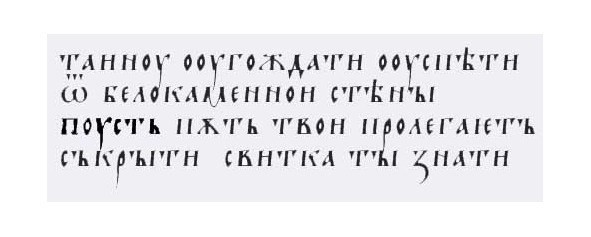
“What does that mean?” Taras asked impatiently, having his phone with the photos returned. “Okay, let’s think about it,” Vinogradov replied, sitting down on the floor. “Judging by the letter, Pashkov and the Masons cracked the code, but someone prevented them from continuing their search, and from the text on the coin, they didn’t realize it was referring to Ivan the Terrible’s library. So, it shouldn’t be too difficult.” “White-stoned, so we need to look for a white-brick building; the Government building would be suitable,” Bogdan muttered from the corner. Peter glanced at him as if he were an idiot, but suddenly his eyes widened. “Of course!” he exclaimed. “Are you all completely nuts?” Prikhodko shouted just as the passing of another train made the ceiling shake even more violently than before. “No, no, no, he’s right, but not entirely,” the teacher explained. “White stone — that’s Moscow; the Kremlin was rebuilt in white brick during the time of Ivan III!” “And the secret — the Taynitskaya Tower!” Valery added, brightening up. “So that’s where we need to go,” Sevastyanov concluded dryly, swallowing the lump in his throat.
“Then we can call it a day,” Vinogradov declared, suddenly saddened by the realization of the hopelessness of the situation. “Why, on the contrary, is everything just beginning?” Taras retorted, placing his hands on his hips. “And how do you even imagine this? How are we supposed to penetrate the Kremlin, let alone conduct a large-scale excavation there? Do you think they’ll invite us themselves, and even roll out the red carpet? Neither Peter the Great nor Stelletsky, with their vast resources, managed this!” Valery expressed his position expressively, watching as another train shook their room, creating a clear risk of collapse, as shards of glass were already falling from the ceiling.
“You understand I’m no ordinary man, and my brave guys have extensive experience infiltrating sensitive facilities. I’ve invested so much money into this that I’m not prepared to stop one step short of a zero-return goal!” Prikhodko began to express his position. “Wait, what operations? What are you talking about?” Vinogradov asked, still unable to put two and two together. “Wow, there were so many of them I can’t remember them all, and it’s better for you not to know, there’s so much bloodshed!” Taras replied, his expression changing contentedly as he pulled his pistol from its holster and twirled it on his finger, as if playing with his weapon.
Valery swallowed nervously, only now realizing who he’d been dealing with all this time. “Wait, but you’re still willing to sacrifice our lives and kill everyone who gets in your way?” he demanded indignantly. “Yes, I will destroy everyone who stands before me and this treasure! A billion dollars isn’t just lying around!” Prikhodko said menacingly, turning to his men, who had also drawn their weapons. “Liberia is a national treasure! You can’t take it for yourself; it belongs to the state and all the people!” Vinogradov exclaimed, glancing at Peter as he approached him. At that moment, another train car passed through the tunnel, causing the ceiling above to shake and the floor to shake, making his feet throb. Sevastyanov immediately realized that in the next two minutes, everything would collapse.
“Do you really think I spent so much money and effort handing over the library to these fat cats, so schoolchildren could gawk at priceless scrolls in museums on field trips? Oh no, it’ll be scattered among closed collections and fetch a lot more on the black market through my connections!” Taras said, smiling broadly. “Then you and I are on different paths,” Valery hissed discontentedly, instantly wiping the smile off Prikhodko’s face. Prikhodko and his teacher stood right by the exit, while their comrades were closer to the dead-end wall opposite. “Oh no, you won’t escape me, just like Peter. I’ll leave you here, walled up in a mass grave. I’ve gotten everything I need from you, you’re useless now! But unfortunately, I can’t let you go either, you know too much! Last chance, are you coming with me or not?” Taras declared, glancing at the crumbling ceiling. Vinogradov exchanged glances with Sevastyanov, glanced at the coin he’d found here, which he held in his clenched fist, and then replied curtly, “No.” “Well, you’ve decided your own fate,” Prikhodko said discontentedly, just as another train passed behind Peter, and the ceiling began to collapse completely.
Chapter 10
Debris rained down overhead like large hailstones during a heavy summer thunderstorm. The dust was so thick that nothing could be seen at arm’s length. The last thing Valery noticed was Taras aiming a gun at him and Peter, and then the collapse began. The rumble of boulders falling from the ceiling was louder than thunder, and the clanking and screeching of the train passing behind was completely deafening. Vinogradov only had time to say, “Run,” before he blindly groped his way through the hole they’d drilled into the subway tunnel. His eyes itched and blurred from the sheer volume of debris, but he spotted Sevastyanov’s silhouette in his peripheral vision, also unable to orient himself properly.
Loud sounds of falling debris could be heard from the room, as well as the obvious attempts of Taras and company to get out before the building completely collapsed. “Come on, we have to go!” the would-be surgeon urged his comrade, approaching him and trying to lift him from the floor, where he had fallen like a sack, exhausted, hoping to curl up like a bed and rest. “We don’t have time, hurry!” Valery shouted, clearly stimulating Peter, who managed to pull himself together. Together, shuffling and limping on one leg each, they moved toward the platform exit along the utility corridor. Suddenly, movement and a loud cough were heard behind them, followed by a deafening roar, and a pungent cloud of dust erupted from the drilled hole into the tunnel. Having come to his senses a little, Taras rested his pistol on his knee, stood up, looked up at the fugitives and shouted angrily: “Valera, stop, it will be worse!” — after which he began firing his weapon at his former comrades.
Bullets whistled overhead, ringing off the metal structures and reflecting off the thick concrete walls. Vinogradov and Sevastyanov could no longer think about treasure or the rightness of their actions; now their minds were consumed by the thought of getting as far away as possible while keeping their legs safe and sound. Prikhodko continued firing after them, but either due to fatigue or the blinding dust, he kept missing. Suddenly, a speeding train appeared ahead, creating incredible pressure around them, nearly dragging down all the Libereya hunters. Prikhodko and company were forced to stop, lowering their guns, but Peter and Valery were so terrified that they raced down the long, endless corridor without stopping. The lights around them flickered, and the locomotive’s spotlight was blinding. Their legs tripped, and breathing in the confined space became increasingly difficult. I felt like I wanted to vomit, when suddenly the bright light of the station platform glimmered ahead. In the distance, crowds of people could be seen approaching the edge, peering into the bottomless darkness, waiting for their train, which, with a bright beam cutting through the tunnel’s darkness, would burst out with a piercing whistle of brakes and whisk them, tired from work, to a warm and cozy home far from all this hustle and bustle, so that tomorrow morning it would all start over again, and they would stand on the platform just like before, waiting for transport, but this time in the opposite direction.
Behind them, the footsteps of their comrades gaining on them thundered, and the shots became increasingly infrequent. Taras was apparently afraid of attracting the attention of the police, who were always on duty at every station to maintain order and security. Vinogradov and Peter ran into the light, blinding them with the sudden warmth and brightness they had grown unaccustomed to during their time in the dungeons of the former Oprichny Court. “Come on, up the escalator,” the former commanded, grabbing the latter by the shoulder and pushing him toward the exit. Together, they raced toward the coveted stairs, when suddenly Taras and his companions burst onto the platform from behind, glaring furiously at the fugitives. “Valera, stop!” Prikhodko shouted angrily, moving toward him. At that moment, Vinogradov and Sevastyanov were already on the escalator. Then, with an incredible roar, another train from the other direction crashed onto the platform and opened its doors, revealing dozens of people rushing and swarming like ants, blocking Taras’s path. “Move aside!” he yelled, pushing aside the obstacles, but they continued to form a barrier between him and his victims. After attempting to dodge them several times, Prikhodko finally managed to escape the crowd onto an empty platform, but he completely lost sight of Valery and Peter, who had already disappeared up the steps. “Damn it!” Taras screamed at the top of his lungs, kicking a nearby trash can with all his might.
Meanwhile, Vinogradov and Sevastyanov reached the surface, running out of the station building into the fresh air. A pleasant, refreshing breeze immediately blew across their faces, gently fanning their hair, providing a pleasant coolness yet simultaneously chilling with its deceptively autumnal nature. However, they had no time to savor this wonder. The sounds of pursuit behind them had ceased, but Valery urged Peter to escape as quickly as possible into the nearby alleys and hide there, taking advantage of their unexpected advantage. Together, they raced past the Alexander Garden, turned onto Vozdvizhenka Street, ran past the Shchusev Museum of Architecture and the Sheremetev Estate, past two cafes enticing with the invigorating aroma of delicious coffee and sweet desserts, until they reached the Boulevard Ring and ducked inside the Arbatskaya station building.
Constantly glancing back, the companions feared to see Taras and his gang with pistols behind them, but surprisingly, there was always no one there. Having rushed inside without tickets along with the other passengers through the opening security doors, accompanied by the disgruntled shouts of the security guards at the entrance, Valery and Peter ran down the escalator and jumped into the first car they saw, which was already closing its doors. It immediately jerked forward, picking up speed and rushing in an unknown direction. Breathing heavily, clutching their hearts, which stabbed and wanted to leap out of their chests and run away, they glanced out the window, watching the changing lights in the darkness, reflected in the glass. They seemed to see the image of their former comrade everywhere, ready to emerge like a shadow from the darkness and overtake the overconfident travelers. However, the minutes passed, and nothing of the sort happened.
Valery looked at Peter with a relaxed expression, then declared, “We need to hide somewhere, sit it out for a while, until he loses interest and goes on to look for the treasure.” “We can’t go to my house; my wife and daughter are there,” Sevastyanov said, slightly tense. “Me either; he knows where I live,” Vinogradov agreed, thoughtfully returning his gaze to the window, where the platform, with its throngs of people waiting, became visible. “Smolenskaya, next stop Kyiv, transfer to the brown and blue lines,” the announcer loudly declared, then repeated it in English. The doors opened, and a crowd immediately began to filter in, taking seats in the available seats. “Then where are we?” the teacher asked, perplexed. “Probably to the hotel, I don’t see any other options,” Valery replied, looking thoughtfully into the distance, watching as the doors closed and the train moved off, heading along its route.
Chapter 11
Taras, enraged, pushed aside everyone blocking his path as he ran up the escalator steps. He held a pistol in his hand, further frightening the subway passengers, but surprisingly, he remained unnoticed by the police in the general chaos. As he emerged onto the street near the station, Prikhodko saw only the Alexander Garden, a long strip stretching along the red Kremlin wall, straight ahead. Somewhere behind him lay the Lenin Library and the Pashkov House, and behind him loomed the tall Cathedral of Christ the Savior. It was evening, and the setting sun’s soft rays touched the pointed towers, dissipating in the city’s autumn haze. A strong wind blew away the already yellowing and falling leaves, in places creating stunningly beautiful compositions, covering the cold and muddy ground, a colorful carpet after the rain typical of this time of year.
Taras glanced around angrily, hoping to spot at least a hint of Valery and Petro’s presence in the surrounding area. However, the large crowd of people on the street and their constant movement made it difficult to focus on details, distracting him with irrelevant aspects. At that moment, Bogdan and Mykola caught up with him, apparently in no particular hurry to catch the fugitives. “Lost them?” one of them asked the obvious question, further angering his superior. “Of course,” he replied dryly, holstering his weapon as unnecessary. “How could it be otherwise? Although I forgot, you have the brains of a Tyrannosaurus rex — the size of a pea.” The others weren’t offended by this comparison; rather, they seemed pleased, which brought satisfied, genuine smiles to their faces.
Looking around once more, still hoping to find at least some trace, Prikhodko waved his hand in disappointment and walked past the library building, muttering under his breath. His partners immediately rushed after him, trying to understand what he was saying. Taras headed toward a black Geländewagen parked alone on the sidewalk. The license plate had a combination of the letters “o” and “1” — the same one they’d driven here, traditionally preferred by anyone connected to criminal activity, not only in the past but also in the present. Getting inside and slamming the door behind him, Prikhodko clasped his head in his hands, trying to concentrate. On the one hand, they’d found another clue to the treasure, but on the other, Libereya was once again missing. A logical question arose: how many more clues had their distant ancestors left behind to keep the library’s location a secret from prying eyes? Moreover, two key experts, who had been driving the investigation forward, have escaped, and now there’s simply no one left to solve the mysteries. The final clue is that the treasure may be located in the Kremlin, somewhere near the Taynitskaya Tower, but where is a big question. Furthermore, infiltrating a highly sensitive facility requires much more serious preparation and carries greater risks.
Bogdan and Mykola climbed into the car, and Taras started the engine. He still hesitated to drive off, hoping not to miss anything while they were there. Prikhodko pulled out his phone and opened the gallery, where he had saved a photo of the coin they’d found, the one Valery had stolen from under his nose just in time. Fortunately, he had a photograph, which, unfortunately, due to his lack of knowledge of Old Russian, offered little to complete the picture.
Suddenly, there was a knock on the window, and Taras was abruptly pulled from his thoughts. Glancing to the side, he spotted a traffic police officer gesturing for him to roll down the window. The car’s owner did so after hearing the man introduce himself: “Lieutenant Sidorenko, you’ve violated parking regulations. Please provide your documents.” Prikhodko feigned indifference to the reprimand, opened the glove compartment, pulled out a wad of five-thousand-ruble bills, pulled out a few, and tossed them in the officer’s face. The officer, taken aback by such impudence, declared, “Are you offering me a bribe?” “I already gave you one, now get out of here and don’t bother me,” Taras replied, even more irritated, intending to roll down the window. “Wait, get out of the car immediately,” the officer replied, reaching for the radio on his belt. Cursing under his breath, Prikhodko pulled his pistol from its holster and pointed it at his interlocutor. “Any more questions? Now go away and don’t bother me!” he declared, rolling up the window and shifting into gear, pulling away with a jerk, leaving the law enforcement officer far behind, his mouth wide open in shock. The man was so taken aback that he didn’t even have time to notice the car’s license plate or call his colleagues to announce the interception plan.
Meanwhile, the group was speeding through the evening capital, disregarding traffic regulations and honking loudly at anyone who lingered even a second too long at intersections. The polished car, gleaming in the rays of the setting sun and the flickering streetlights, headed toward the suburban highway where one of Taras’s several houses was located. Having quickly reached it, the car pulled into a perfectly paved parking lot surrounded by trimmed bushes and stopped.
Directly in front of her stood a three-story Scandinavian-style mansion with huge panoramic windows and thick beams protruding from the walls, creating a strange sense of disarray yet simultaneously a warm, cozy feeling. Its roof was moss-covered in places over time, and the paint was peeling, but this added a certain charm and charisma to the house, suggesting antiquity and experience. Prikhodko rarely lived here, as he mostly conducted business abroad, but he always returned with pleasure to this estate, which was the first built with the money he earned.
Getting out of the car, Prikhodko tossed the keys to the quickly arriving butler, who had accompanied him everywhere for the past eight years, and told him to drive the car to the garage. The elderly man, his hair thickly covered in gray but always neatly styled, always at work in a formal business suit with pins, cufflinks, ties of various colors, and handkerchiefs, nodded silently, glanced at his polished shoes, and headed toward the Geländewagen. Taras simultaneously entered the house, finding himself in a room with a monstrously large marble staircase leading up to the second floor in a semicircle. Holding onto the cast-iron railings, adorned with small knobs — symbols of power and might that people in all cultures have always favored — he climbed up past a display of guns, rifles, and pistols from various eras (he was a great admirer of all things weaponry), and entered his spacious office. Above the thick oak desk facing the entrance hung a massive boar’s head, which had been stuffed for Prikhodko after he personally shot it on a hunt. Throwing off his repairman’s jacket onto the polished marble floor, Taras plopped down in a chair upholstered in calfskin and finally relaxed. Rubbing his eyes, which were watering from the dust of the subway, he pulled out his phone again, connected it to the computer, and tossed it onto the desk. A larger image of the coin appeared on the screen, allowing him to discern its fine details. Looking closely at the discovered text, Prikhodko was once again convinced that they were on the right track and needed to search in the heart of the capital.
At that moment, Bogdan and Mykola entered the office, leaning against the doorframe. “So, boss, what’s our next plan?” one of them asked. Taras raised a disgruntled glare, and the other removed his hand from the doorway. After a few seconds of thought, he said, “Find out when the next concert is at the Kremlin Palace, find whatever plans you can, and get ready, we’re going after the treasure.”
Chapter 12
Valery and Peter quickly entered the hotel building, located just on the outskirts of Moscow, with windows facing the Moscow Ring Road, the noise from which was audible even with the windows closed as night approached. Entering the small hall, which doubled as a reception area and dining area, the men glanced around, hoping to see the worst of the room, and approached the information desk, made of pieces of chipboard of different colors, crookedly twisted together. The naked eye could see holes where the screws had worn away over time, no longer serving their primary function, and were therefore twisted into other holes. A girl with cow -like eyelashes and a pierced lip covered in tasteless bright red lipstick, resting her chin with her brush, suddenly noticed the customers, then gave a forced smile and said hello, formally fulfilling her job responsibilities but without seeming to strain herself. “Good evening,” she said in the velvety voice usually spoken by everyone in her job description. “Hello,” Valery replied, approaching the counter. “We need a double room for tonight for sure, and for a week, I think.” “I’ll check,” the girl said in a sickeningly saccharine voice, staring at the computer screen. “We have one room left, but there’s a catch.” “We agree, we don’t have time to look for anything else anyway, so what’s the problem?” Peter declared.
The receptionist looked at them and burst out laughing, causing a surprised expression on their faces. She then declared, “There’s only a double bed, but if you need one, I can check you in.” Vinogradov and Sevastyanov exchanged glances, unsure of the reason for the laughter, before replying, “Good enough for us.” “We’ll figure it out as we go,” the former said to the latter, while the girl smiled and said, “Give me your passports.” Valery rolled his eyes, realizing he naturally didn’t have them, and then began ostentatiously patted the repairman’s jacket, pretending to look for his ID. After doing this for several minutes, causing the employee to look disgruntled and rest her hand on her chin in anticipation, Vinogradov declared that there were no passports. The girl exhaled heavily and then said, “Unfortunately, then I won’t be able to check you in.” Valery dug through his pockets, pulling out the thousand he’d saved, and slipped it under the folder on his desk. “Maybe we could come to an agreement?” he asked, smiling unobtrusively. The worker hesitated, but quickly pulled out the bill and tucked it into her pocket. “Okay,” she said, “but to make sure I have my passport tomorrow, let’s give him another one for today.” “Of course,” Peter replied happily, fishing another two thousand from his phone case. “Everything will be perfect.”
After that, the girl quickly pocketed the money and handed them a key with the number “35” on it. It felt like it would open a barn lock, not a hotel room, and pointed to a narrow, dark staircase leading to the second floor. The men nodded gratefully and, barely able to see their way, climbed the stairs. Entering a long corridor with dimly lit lamps, casting long shadows along its length, the companions reached their door and inserted the key into the lock. With a heavy twist, the door swung open, revealing the interior of their room. The room was small: an entryway that flowed smoothly into a small bedroom of about 30 feet with a large double bed, and a tiny bathroom, covered in mold deposits and a persistent smell of sewage. The windows were covered with bright burgundy curtains, and nearby hung strange paraphernalia, more fitting for a brothel than a hotel. Upon closer inspection, Valery realized everything: “This is a brothel for intimate services, not a hotel, as we assumed, that’s why the girl laughed at us so much.” Peter cursed, clearly not intending to stay in such a place, but he had no other choice; the money had already been paid. Taking a napkin from his bag, he quickly wiped the table with it and placed his computer there. Afterwards, he announced that he would go and call his wife to tell her he had been sent on an urgent business trip to a conference and had forgotten to tell her about it yesterday. The lie, of course, was of dubious quality, frankly, downright implausible, but he had no other options for protecting his family from the bandits.
At that moment, Vinogradov threw off his jacket and plopped down on the bed, still wearing his shoes. He was so tired he felt like he was about to fall asleep, but the thoughts plaguing him wouldn’t let him rest: “The Kremlin, no, breaking in there in search of the treasure is suicide. No one has ever managed to find it there, though many have tried. They’ve already done a lot of damage — they’ve dug up the remains of the old cemetery near Kolomenskoye without filling it in, they’ve broken through the basement near Pashkov’s house. It’s scary to imagine what it will take to get to the truth. But even more frightening is that the treasure may not even exist, and all the clues that indirectly confirm connection to it could be a diversion tactic devised by Ivan the Terrible during the Oprichnina, or later, during the Time of Troubles for the Pauls. But on the other hand, if Libereya really does exist, then Taras should not be allowed near it under any circumstances, because then the relics left by the ancestors, valuable in themselves when collected, will be dispersed among private collections, as happened at the beginning of the twentieth century with the tsarist and noble treasures with the advent of Soviet power, and will never be collected again.”
With these thoughts in mind, Peter returned to the room, his face stony and sad, holding the phone. Apparently, his wife didn’t believe him, and being in the brothel was putting additional psychological pressure on him. “We’ll go after her,” Valery suddenly declared after a long period of time. “For what?” Sevastyanov asked, breaking away from his sad thoughts. “Behind the library, we have to find her,” Valery continued. “Are you crazy? We barely escaped here, and where did it lead us? And you want to continue! No, I’m not going to take part in this circus! I’ve had enough!” Peter protested, glaring angrily at his interlocutor. “Just think about it,” Vinogradov tried to reason with him. “We dreamed of learning the secrets of the period of Ivan IV, and this is one of them. We can’t allow a gang of bandits to get their hands on this great treasure!” “As soon as we find it, we’ll go down in history and write our names next to Ivan the Terrible! Isn’t that what you once wanted?” The teacher hesitated; his arguments were weak, but perhaps when they found Liberea, he could take a piece of it for himself and sell it at a black auction, solving his financial problems. “Okay, I agree. What do you propose?” he declared, hoping his comrade wouldn’t understand his hidden motives. Valery looked at him with satisfaction and then replied, “Okay, wait, I need a piece of paper and a pen.”
He began rummaging around the room, searching for what he was looking for, when suddenly his eye fell on a printed document in a file and a chewed-up, partially broken pencil. Upon closer inspection, he realized it was a piece of paper with the inscription: “Dear guests, please do not throw personal hygiene items or related accessories down the drain. We are tired of clearing blockages. Handle the equipment with care, do not break it, it will be useful to other visitors. We wish you success in achieving your goals!” Wincing with distaste, Vinogradov turned it over, picked up the writing utensil, and declared, sketching his thoughts on the paper: “Look, the excavations of Konon Osipov and Ignatius Stelletsky once showed that the passage from Taynitskaya to the Corner Arsenal Tower has been destroyed by time and people. The underground chamber near the Filaret Annex miraculously survived in the depths of Borovitsky Hill.” A passage led from the Faceted Chamber to the Filaret Annex. In the summer and fall of 1894, Prince N.S. Shcherbatov began exploring the underground Kremlin, excavating two-tiered vaults beneath the Trinity Tower and clearing clay and debris from the secret passage connecting the Corner Arsenal and Nikolskaya Towers. The death of Alexander III prevented further excavations, and then the treasury ran out of funds. Somewhere in the middle, they must have connected.”
“Yes, and Stelletsky once wrote that from the royal chambers, somewhere in the basement, there was a descent into the dungeon — a large chamber into which the tunnel between the Annunciation, Archangel, and Dormition Cathedrals widened. It was filled with boxes of books, and beneath it was a lower chamber. Moreover, Wetterman spoke of cellars with ‘double vaults,’ which were found in the Kremlin under the Trinity Tower. An underground passage led from the lower tier of the cellars, and from the library chamber, it headed in two opposite directions: to the Taynitskaya and Corner Arsenal Towers, once called Sobakina,” Peter agreed, pointing with his finger at the circles and lines on the diagram Valery had drawn.
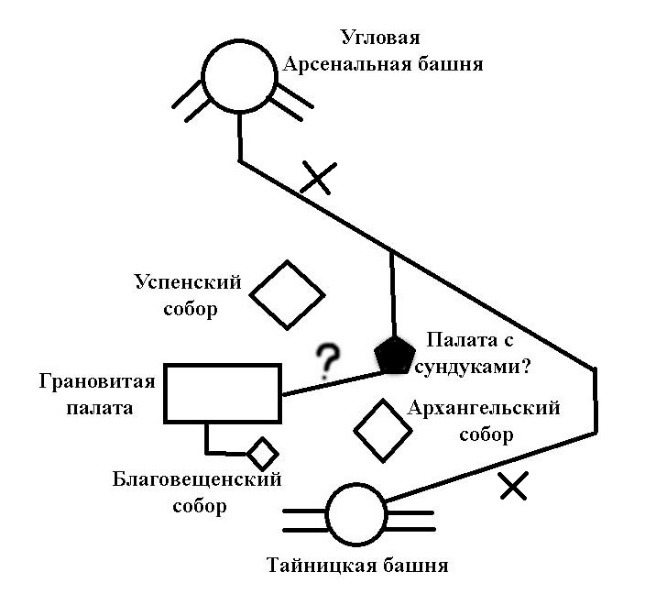
“So, since the code on the coin we found in the Oprichny Dvor refers to the Taynitskaya Tower, but the passage there is blocked, we need to get to that room through the Faceted Chamber,” said Vinogradov, scratching his chin. “Wait, but how are we supposed to get to the cellars beneath it? Surely they won’t invite us there with flowers and gifts of our own free will?” Sevastyanov asked logically. “I have an interesting idea about that,” Valery replied, smiling.
Chapter 13
“And what exactly, may I ask?” Peter asked in surprise, clearly unsure how they could pull this off. “And for that, we’ll need both Kremlin palaces,” Valery declared contentedly, lounging on his bed. Audible noises could be heard from the adjacent room, distracting him from his normal train of thought, but Sevastyanov answered anyway: “Wait, what does that have to do with the Faceted Chamber and the fifteenth- and sixteenth-century underground passages? The Grand Palace was built in 1838—1849 by a group of architects led by K.A. Ton, by order of Emperor Nicholas I, and rebuilt in the 1930s by the Soviet government. And the Small Palace, by the way, was actually built on Nikita Khrushchev’s initiative and was intended to host CPSU congresses; it was opened by the Party in 1961!”
Бесплатный фрагмент закончился.
Купите книгу, чтобы продолжить чтение.