
Бесплатный фрагмент - Read, Speak, Write English with Confidence file
A practical esl book with stories and guided reading, speaking, and writing Practice
Read, Speak, Write English With Confidence
Read, Speak, Write English with Confidence
A Complete Guided Practice Book with Stories, Activities, and Progress Tools
Lydia Nmeribe
Copyright © 2026 Lydia Nmeribe
All rights reserved.
No part of this book may be reproduced, distributed, or transmitted in any form or by any means — electronic, mechanical, photocopying, recording, or otherwise — without prior written permission from the author, except for brief quotations used in reviews or educational references.
This book is intended for educational purposes only.
Published independently.
TABLE OF CONTENTS
Intoduction- How To Use This Book
Chapter 1 — The Missing Phone
Chapter 2 — A Late Morning
Chapter 3 — An Unexpected Test
Chapter 4 — The Results
Chapter 5 — A New Responsibility
Chapter 6 — A Difficult Choice
Chapter 7 — The Exam Day
Chapter 8 — Waiting for the Answer
Chapter 9 — The Final Result
Chapter 10 — Moving Forward
Chapter 11 — A New Beginning
Chapter 12 — Stepping Up
Chapter 13 — A Problem in the Group
Chapter 14 — The Final Presentation
Chapter 15 — What Leadership Taught Her
Chapter 16 — A New Challenge
Chapter 17 — Beyond the Classroom
Chapter 18 — Looking Ahead
Chapter 19 — A New Year Begins
Chapter 20 — The Journey Continues
A Simple Guide for Learners
How to Improve Your Writing Step by Step
How Long Should You Write?
Teacher and Parent Guide
Progress Tracker and Checklist
Speaking Practice Log
Writing Practice Log
Confidence Statements
End Of Book Reflection
Final Message
How to Use This Book for Real Progress
A 10-Week Guided Study Plan (20 Stories)
This book contains 20 stories, each with activities for reading, vocabulary, speaking, writing, and games.
In this study plan, you will study each story per week. This keeps learning balanced and realistic, without pressure.
You can study:
— 4–5 days per week
— 30–45 minutes per session
— You may use this plan:
— alone
— with a parent
— with a teacher
— in the classroom or at home
Week 1 — Getting Comfortable in English
Stories: 1 & 2
Focus:
Understanding simple stories and feeling comfortable with English.
What to do this week:
— Read both stories slowly
— Learn the new vocabulary
— Answer comprehension questions
— Do the puzzles or games
— Speak about the stories (short answers are fine)
— Write 6–8 sentences for one story
Goal:
Feel more relaxed when reading English.
Week 2 — Everyday Situations
Stories: 3 & 4
Focus:
Understanding daily life situations and details.
What to do this week:
— Read both stories
— Learn vocabulary
— Answer all questions
— Do one speaking task
— Write about a similar experience
Goal:
Explain simple events clearly.
Week 3 — Speaking with Confidence
Stories: 5 & 6
Focus:
Speaking without fear.
What to do this week:
— Read stories aloud
— Practice speaking tasks
— Speak for 30–60 seconds without stopping
— Write a short paragraph
Goal:
Speak even when mistakes happen.
Week 4 — Learning Habits
Stories: 7 & 8
Focus:
Practice, habits, and asking for help.
What to do this week:
— Read both stories
— Practice vocabulary
— Answer questions
— Practice asking for help aloud
— Write about learning habits
Goal:
Understand that practice builds confidence.
Week 5 — Communication with Others
Stories: 9 & 10
Focus:
Group work and communication.
What to do this week:
— Read stories
— Practice speaking with a partner (if possible)
— Do the puzzles
— Write about teamwork or communication
Goal:
Communicate clearly with others.
Week 6 — Paying Attention to Information
Stories: 11 & 12
Focus:
Understanding messages and instructions.
What to do this week:
— Read carefully
— Learn vocabulary
— Answer comprehension questions
— Write about a mistake and what you learned
Goal:
Understand details in English.
Week 7 — Real-Life English
Stories: 13 & 14
Focus:
Using English outside the classroom.
What to do this week:
— Read aloud
— Do role-play speaking tasks
— Write about a real-life situation
Goal:
Use English in daily life.
Week 8 — Reading and Understanding More
Stories: 15 & 16
Focus:
Building reading skills and confidence.
What to do this week:
— Read slowly
— Guess meaning from context
— Complete puzzles
— Write about reading habits
Goal:
Read English with less fear.
Week 9 — Responsibility and Balance
Stories: 17 & 18
Focus:
Time management, responsibility, and communication.
What to do this week:
— Read stories carefully
— Study vocabulary
— Answer questions
— Write about balance in life
Goal:
Use English to talk about real responsibilities.
Week 10 — Beyond the Classroom
Stories: 19 & 20
Focus:
Using English confidently in real life.
What to do this week:
— Read both stories
— Review vocabulary
— Complete all activities
— Reflect on progress
Goal:
Feel confident using English in everyday situations.
Final Advice
You do not need perfect English. You need practice, patience, and confidence.
You can:
— repeat the plan
— study again at a faster pace
— use this book to help others
CHAPTER ONE: The Missing Phone
Story
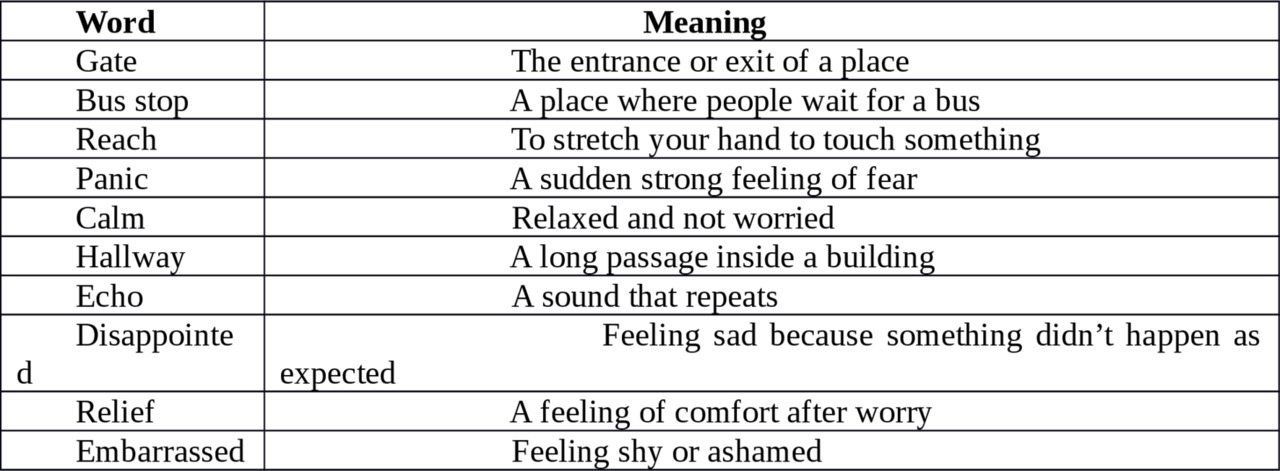
Maria walked out of the school gate slowly after the last lesson of the day. She felt tired and was already thinking about what she would eat when she got home. The afternoon sun was warm, and groups of students were standing around, laughing and talking about their plans for the evening.
Maria stopped at the bus stop and placed her bag on the bench beside her. As usual, she reached inside to check her phone. She liked to scroll through messages while waiting for the bus. Her fingers touched her wallet, her keys, and her notebook — but not her phone.
She checked again, this time more carefully.
The phone was not there.
A sudden feeling of panic rushed through her body. Her heart began to beat faster, and her hands felt cold. She looked around the bus stop, hoping she had dropped it nearby. The ground was empty. No phone.
Maria took a deep breath and tried to calm herself. She began to think carefully about her day. In the morning, she had used her phone at home before leaving for school. She clearly remembered putting it inside her bag. During lunch, she sat with her friends, laughing and sharing stories, but she could not remember using her phone after that.
“Maybe I left it in the classroom,” she said quietly to herself.
Without waiting for the bus, Maria decided to return to the school. The hallways were almost silent because most students had already gone home. Her footsteps echoed as she walked quickly past the lockers and classrooms.
When she reached her classroom, she checked her desk, her chair, and even the floor. Nothing. Her worry grew stronger. She felt disappointed and a little scared. Her phone was important — it had her photos, messages, and contacts.
Just as she was about to leave, she noticed something under the teacher’s desk. She bent down and smiled with relief.
It was her phone.
Maria picked it up, feeling thankful and embarrassed at the same time. She laughed softly, put the phone safely into her bag, and walked out of the classroom. This time, when she reached the bus stop again, she checked her bag carefully — and smiled.
Vocabulary from the Story
Comprehension Questions
— How did Maria feel after leaving school?
— Why did she check her bag at the bus stop?
— What made Maria feel panicked?
— Where did she decide to go after she couldn’t find her phone?
— Describe the school hallways when Maria returned.
— Where did Maria finally find her phone?
— How did she feel at the end of the story?
Speaking Practice
Pair or Group Discussion
— Have you ever lost something important? What was it?
— How did you feel when you lost it?
— Where did you finally find it, or did you replace it?
— What do you usually do when you feel panicked?
— Do you check your belongings often? Why or why not?
Vocabulary Practice
A. Fill in the blanks
— Use the correct word from the box:
— (panic, relief, echo, gate, embarrassed)
— Maria felt a sense of ________ when she found her phone.
— Her footsteps began to ________ in the quiet hallway.
— She felt ________ when she realized the phone was under the desk.
— Students walked out of the school ________ after classes.
— Losing her phone made her feel sudden ________.
B. Match the words
— calm
— disappointed
— hallway
— bus stop
a. Place inside a building
b. Not worried
c. A place to wait for transport
d. Feeling sad about a result
Games & Activities
1. Word Puzzle (Jumbled Words)
— Unscramble the words:
— P A N C I
— Y A L L H W A
— E T A G
— L E R I F E
— C O H E
2. Memory Chain Game
Student 1: “Maria left school after the last lesson.”
Student 2: repeats and adds one detail.
Student 3: repeats all and adds another detail.
Continue until the story is rebuilt.
3. Role Play
Situation:
One student is Maria. Another is a friend.
Maria explains how she lost and found her phone.
The friend asks questions and gives advice.
CHAPTER TWO: A Late Morning
Story
The next morning, Maria woke up suddenly and looked at the clock beside her bed. Her eyes widened immediately.
She was late.
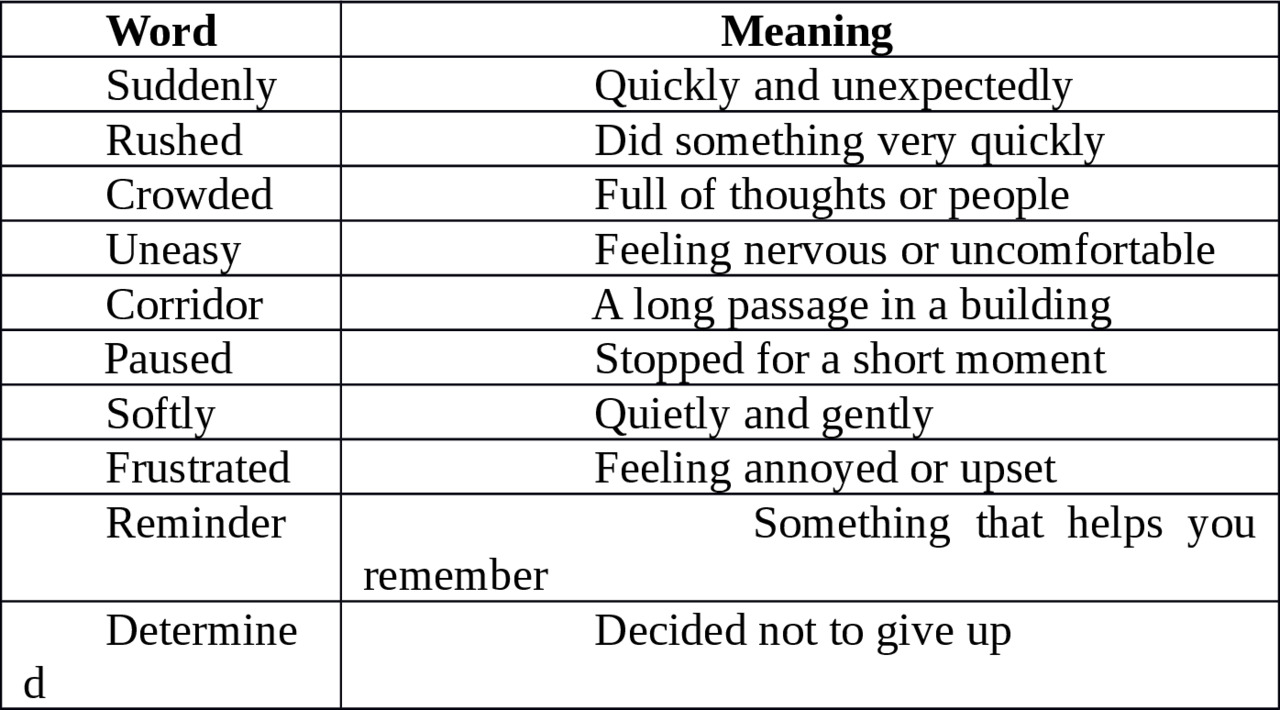
Maria jumped out of bed and quickly got dressed. She skipped breakfast and rushed to pack her bag. Her mind felt crowded with worry as she tried to remember everything she needed for school. When she finally left the house, she was already ten minutes behind schedule.
The bus arrived just as Maria reached the stop. She climbed on, breathing heavily, and found an empty seat near the window. As the bus moved forward, she stared outside, feeling uneasy. She hated being late, especially on days when she had important lessons.
When Maria arrived at school, the bell had already rung. The corridors were busy with teachers and students moving quickly to their classrooms. She walked faster, hoping not to be noticed.
As she opened the classroom door, all eyes turned toward her. The teacher paused mid-sentence and looked at Maria calmly.
“You’re late, Maria,” the teacher said.
“I’m sorry,” Maria replied softly, her face turning warm.
She walked to her seat and sat down quietly. Throughout the lesson, she tried to focus, but her thoughts kept returning to the morning. She felt frustrated with herself and promised to be more careful next time.
During the break, Maria checked her phone. She noticed a message reminder she had ignored the night before: Set alarm. She sighed, realizing her mistake.
That afternoon, Maria went home feeling tired but determined. She set two alarms for the next morning and placed her phone far from her bed. As she turned off the light, she smiled slightly.
Tomorrow would be different.
Vocabulary from the Story
Comprehension Questions
— Why did Maria wake up suddenly?
— What did she skip in the morning?
— How did Maria feel on the bus?
— What happened when she entered the classroom?
— Why did Maria feel frustrated during the lesson?
— What reminder did she notice during the break?
— What decision did Maria make before sleeping?
Speaking Practice
— Answer in full sentences.
— How do you usually feel when you are late?
— What things make you late in the morning?
— Do you use alarms or reminders? How many?
— What is one thing you want to change about your morning routine?
— Is it better to wake up early or sleep longer? Why?
Vocabulary Practice
A. Fill in the blanks
— Use the correct word from the box:
— (uneasy, rushed, paused, reminder, determined)
— Maria felt ________ while sitting on the bus.
— The teacher ________ before speaking.
— She left the house feeling ________.
— The message on her phone was a helpful ________.
— Maria felt ________ to do better the next day.
B. Choose the correct word
Crowded means:
a) empty
b) full
c) quiet
Softly means:
a) loudly
b) angrily
c) quietly
Frustrated means:
a) excited
b) annoyed
c) relaxed
Games & Activities
1. Word Puzzle (Jumbled Words)
Unscramble the words:
R E D U S H
S U D E N L Y D
C O R R I D O R
R E M I D N E R
D E T D R M I N E E
2. Story Order Puzzle
Put the events in the correct order (1–5):
{⬜} Maria entered the classroom.
{⬜} Maria woke up late.
{⬜} She set two alarms at night.
{⬜} The teacher spoke to her.
{⬜} Maria rushed to the bus stop.
3. Find the Word (Mini Word Search)
Find these words in the story:
late — alarm — bus — teacher — phone
CHAPTER THREE: An Unexpected Test
Story
On Thursday morning, Maria arrived at school earlier than usual. She felt proud of herself for waking up on time and getting ready without rushing. As she walked into the school building, she felt calmer than she had all week.
During the first lesson, the teacher wrote something on the board that immediately caught Maria’s attention.
“Surprise Test.”
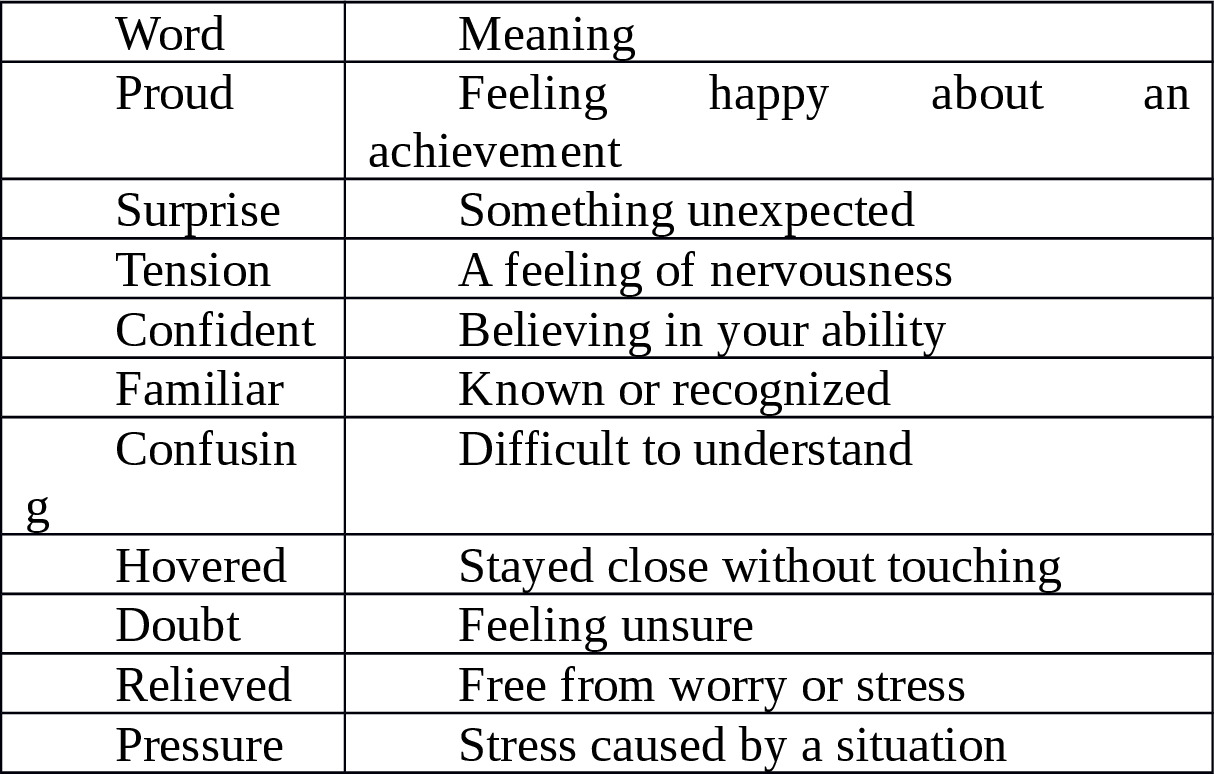
A quiet wave of tension spread through the classroom. Some students sighed, while others quickly opened their notebooks. Maria’s stomach tightened. She remembered studying a little the night before, but she was not fully confident.
The teacher explained that the test would cover topics from the previous week. Maria flipped through her notes, scanning pages quickly. Some information looked familiar, but other parts seemed confusing. She tried to stay focused and avoid panicking.
When the test papers were handed out, the room became silent. Maria read the first question carefully. It was easier than she expected. She moved on to the next question, then another. Slowly, her confidence began to grow.
However, halfway through the test, Maria reached a question she did not understand. She stared at it for a long moment. Her pen hovered above the paper as doubt crept into her thoughts. She took a deep breath and tried to remember what the teacher had explained in class.
Instead of skipping the question, Maria broke it into smaller parts. She wrote what she knew and made a careful guess for the rest. When she finished the test, she checked her answers quietly.
After handing in her paper, Maria felt exhausted but relieved. She had done her best. As she left the classroom, she realized something important: being prepared was not only about studying — it was also about staying calm and thinking clearly under pressure.
Vocabulary from the Story
Comprehension Questions
— Why did Maria feel proud at the beginning of the day?
— What words did the teacher write on the board?
— How did the students react to the announcement?
— Why was Maria not fully confident?
— What helped Maria feel better during the test?
— What problem did Maria face halfway through the test?
— What lesson did Maria learn at the end?
Speaking Practice
— Answer using full sentences.
— How do you usually feel before a test?
— Do surprise tests help students or stress them? Why?
— What do you do when a question is confusing?
— Is it better to guess or skip a difficult question? Explain.
— How do you deal with pressure in school or exams?
Vocabulary Practice
A. Fill in the blanks
— Use the correct word from the box:
— (confident, tension, doubt, relieved, familiar)
— Maria felt ________ when she recognized some questions.
— There was clear ________ in the classroom before the test.
— A feeling of ________ entered her mind during one question.
— Maria felt ________ after handing in her paper.
— Some information looked ________ in her notes.
B. Match the words
— Proud
— Confusing
— Hovered
— Pressure
A. Difficult to understand
b. Stayed close in the air
c. Feeling stress
d. Feeling happy about success
Games & Activities
1. Word Puzzle (Jumbled Words)
Unscramble the words:
T N E S I O N
D O B T U
R E L I D V E E
C O N F T D E N I
R A M I L I A F
2. Sentence Builder Puzzle
Use these words to build correct sentences:
— Maria / felt / proud / morning / the
— The / test / was / surprise / a
— She / calm / stay / tried / to
— Pressure / under / thought / clearly / she
3. True or False
Write T or F.
— Maria arrived late to school.
— The test was announced before class.
— Maria skipped the difficult question.
— She checked her answers before submitting.
— Maria learned the importance of staying calm.
CHAPTER FOUR: The Results
Story
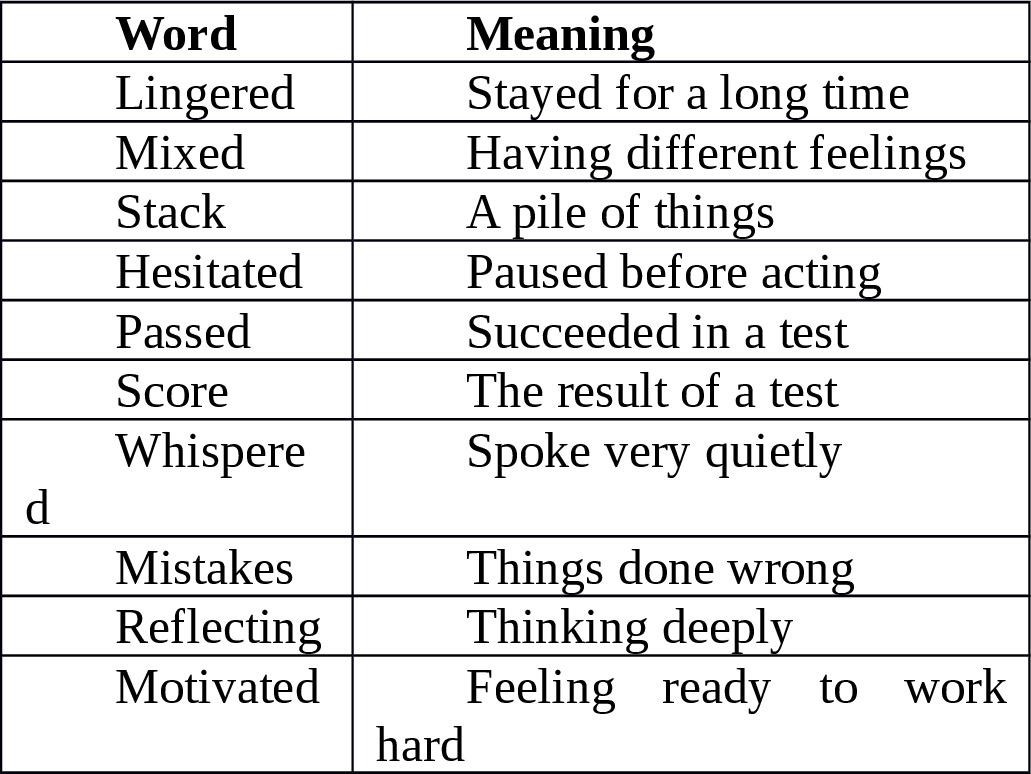
The following week, Maria walked into school with mixed feelings. The surprise test from Thursday still lingered in her mind. Even though she had felt relieved after finishing it, she could not stop wondering how well she had actually done.
During the first lesson, the teacher entered the classroom carrying a stack of papers. Maria recognized them immediately. Her stomach tightened.
“These are your test results,” the teacher said calmly.
A quiet silence filled the room as the papers were handed out one by one. Maria kept her eyes on her desk while she waited. When the paper finally reached her, she hesitated for a moment before turning it over.
She had passed.
Maria felt a wave of relief wash over her. It was not a perfect score, but it was better than she had expected. She read the teacher’s short comment written at the bottom of the page: Good effort. Stay focused.
Around her, some students smiled while others looked disappointed. A few whispered to each other, comparing scores. Maria chose not to join them. Instead, she studied her mistakes carefully. She noticed that most of her errors came from questions she had rushed through.
During the break, Maria sat quietly near the window, reflecting on the result. She realized that her success did not come from luck. It came from staying calm, thinking clearly, and trying her best — even when she felt unsure.
That afternoon, Maria organized her notes at home. She highlighted weak areas and made a short study plan for the next test. As she closed her notebook, she felt motivated.
This time, she was not afraid of the next challenge.
Vocabulary from the Story
Comprehension Questions
— Why did Maria have mixed feelings at the start of the day?
— What did the teacher bring into the classroom?
— Why did Maria hesitate before looking at her paper?
— How did Maria feel about her test score?
— What did the teacher write on Maria’s paper?
— What did Maria notice about her mistakes?
— What decision did Maria make at home?
Speaking Practice
— Answer in full sentences.
— How do you usually feel when waiting for test results?
— Is it better to focus on your score or your mistakes? Why?
— Do you compare results with classmates? Explain.
— What motivates you to study harder?
— How do you usually prepare for the next test?
Vocabulary Practice
A. Fill in the blanks
— Use the correct word from the box:
— (hesitated, motivated, stack, lingered, mistakes)
— Maria ________ before turning over her test paper.
— The teacher carried a ________ of papers.
— The memory of the test ________ in Maria’s mind.
— She reviewed her ________ carefully.
— Maria felt ________ to prepare better next time.
B. Choose the correct meaning
Whispered means:
a) Shouted
b) Spoke quietly
c) Laughed
Reflected means:
a) Ignored
b) Thought deeply
c) Complained
Passed means:
a) Failed
b) Succeeded
c) Skipped
Games & Activities
1. Word Puzzle (Jumbled Words)
Unscramble the words:
D E T A T I S E H
K C A T S
D E T A V I T O M
R E T A S I K M
D E R E G N I L
2. Sentence Order Puzzle
Reorder the words to make correct sentences:
— results / the / teacher / returned
— Maria / passed / test / the
— her / mistakes / she / reviewed
— study / a / made / plan / she
3. True or False
Write T or F.
— Maria forgot about the test completely.
— She received a perfect score.
— Maria focused on learning from her mistakes.
— She compared scores with her classmates.
— Maria created a study plan at home.
CHAPTER FIVE: A New Responsibility
Story
By the middle of the term, Maria’s routine had begun to change. After receiving her test results, she became more aware of how her daily habits affected her performance at school. She started waking up earlier, reviewing her notes in the evening, and organizing her schoolwork more carefully.
One Monday morning, Maria’s teacher made an announcement that caught everyone’s attention.
“For the next project,” the teacher said, “each group will choose a group leader.”
A quiet murmur filled the classroom as students looked around. Some avoided eye contact, while others whispered to their friends. Maria sat still, listening. She had never been a group leader before.
When the groups were formed, Maria was surprised to hear her name.
“We think Maria should be the leader,” one of her classmates said.
Maria felt her chest tighten. Part of her felt proud, but another part felt unsure. Being a leader meant responsibility — not only for her own work, but for the work of others as well. She hesitated, then nodded.
“I’ll try,” she said.
That afternoon, Maria met with her group to discuss the project. She carefully listened to everyone’s ideas and wrote them down in her notebook. Some ideas were creative, while others needed more planning. Maria realized that her role was not to control the group, but to guide it.
Over the next few days, Maria worked harder than usual. She reminded her group about deadlines, shared tasks fairly, and stayed after class to ask the teacher questions. At times, she felt overwhelmed. Balancing her own studies with the group’s needs was not easy.
One evening, while reviewing the project at home, Maria felt tired and frustrated. She considered giving up the leadership role. But after a short break, she returned to her desk and continued working. She reminded herself that growth often came from challenges.
On presentation day, Maria stood in front of the class with her group. Her hands shook slightly, but her voice was steady. The presentation was not perfect, but it was clear and well-organized.
When the class ended, the teacher smiled.
“Well done,” the teacher said. “You showed responsibility and teamwork.”
As Maria packed her bag, she felt something new — not just relief or pride, but confidence. She understood now that responsibility was not a burden. It was an opportunity to grow.
Vocabulary from the Story
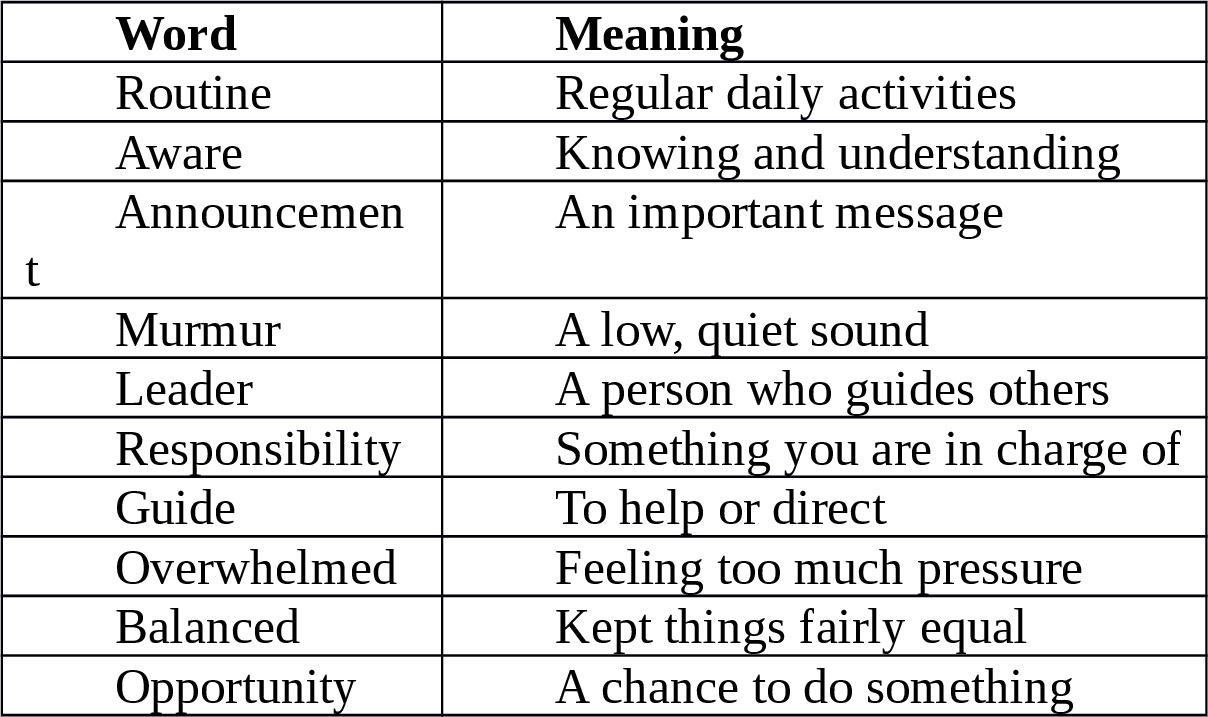
Comprehension Questions
— How had Maria’s routine changed by the middle of the term?
— What announcement did the teacher make?
— Why was Maria unsure about becoming a leader?
— What did Maria do during the first group meeting?
— What challenges did Maria face as a leader?
— Why did Maria feel like giving up one evening?
— What feedback did the teacher give after the presentation?
— What did Maria learn about responsibility?
Speaking Practice
— Answer using full sentences.
— Would you like to be a group leader? Why or why not?
— What qualities make a good leader?
— How do you manage responsibility at school or work?
— Have you ever felt overwhelmed by a task? What did you do?
— Do challenges help people grow? Explain your opinion.
Vocabulary Practice
A. Fill in the blanks
— Use the correct word from the box:
— (routine, murmur, overwhelmed, guide, opportunity)
— The classroom filled with a quiet ________.
— Maria saw leadership as an ________ to grow.
— She tried to ________ her group, not control them.
— Her daily ________ became more organized.
— Maria felt ________ when the work increased.
B. Match the words
— Aware
— Responsibility
— Balanced
— Announcement
a. Knowing and understanding
b. Something you must take care of
c. Shared fairly
d. An important message
Games & Activities
1. Word Puzzle (Jumbled Words)
Unscramble the words:
E T U N I O R
E R D A E L
T I Y L I B I S N O P S E R
E D E D E M L R E V O W
T U N I T Y R O P P O
2. Sentence Builder Puzzle
Reorder the words to make correct sentences:
— Maria / leader / group / became / a
— She / responsibility / accepted / the
— The / presentation / organized / was
— Challenges / help / people / grow
3. True or False
Write T or F.
— Maria refused to become the group leader.
— She listened to her group’s ideas.
— Maria never felt overwhelmed.
— The presentation was clear and organized.
— Maria learned that responsibility can lead to growth.
CHAPTER SIX: A Difficult Choice
Story
As the term continued, Maria noticed that her days were becoming busier than ever. Between lessons, homework, and group projects, her schedule felt full. Even so, she tried to manage her time carefully and avoid falling behind.
One Friday afternoon, as Maria was packing her bag, her close friend Lina approached her with excitement.
“There’s a school event this weekend,” Lina said. “Everyone is going. You should come too.”
Maria paused. She remembered that she had planned to spend the weekend studying for an important exam. The event sounded fun, but the exam mattered to her future. She felt torn between enjoying time with friends and staying committed to her goals.
That evening, Maria sat at her desk with her books open in front of her. However, her attention kept drifting. She imagined the music, laughter, and energy of the event. At the same time, she thought about the exam and the effort she had already put into preparing.
Maria made a list in her notebook. On one side, she wrote reasons to attend the event. On the other, she wrote reasons to stay home and study. The list made her feelings clearer, but the decision was still difficult.
After a long moment of thought, Maria chose a compromise. She decided to attend the event for a short time and return home early to study. This way, she could relax without losing focus completely.
On Saturday evening, Maria went to the event and spent a few hours with her friends. She laughed, talked, and enjoyed herself. When she returned home, she felt refreshed rather than distracted. She studied with renewed concentration and finished earlier than expected.
On Sunday night, as Maria prepared her bag for Monday, she felt satisfied. She realized that making good choices did not always mean giving something up completely. Sometimes, it meant finding balance.
Vocabulary from the Story
Бесплатный фрагмент закончился.
Купите книгу, чтобы продолжить чтение.