
Бесплатный фрагмент - Lewwinski Business Management
Unit 1. Introduction to Business Management
1.1 What is business?
Class objectives:
— Describe the nature of business (AO1)
— Explain the economic sectors: primary, secondary, tertiary,
quaternary (AO2)
— Explain challenges and opportunities for starting up a business
(AO2)
The main point of this chapter to learn essential information. Everything you learn further is based on this chapter.
i. NATURE OF BUSINESS
Describe the nature of business (AO1)
Business is an organisation that provides goods and services and satisfies needs and wants in a profitable or non-profitable way. This definition already includes some extra business terms that we’ll talk about in a moment. I believe the easiest way to understand what business is and how it functions is input-output model, that I outlined for you below.
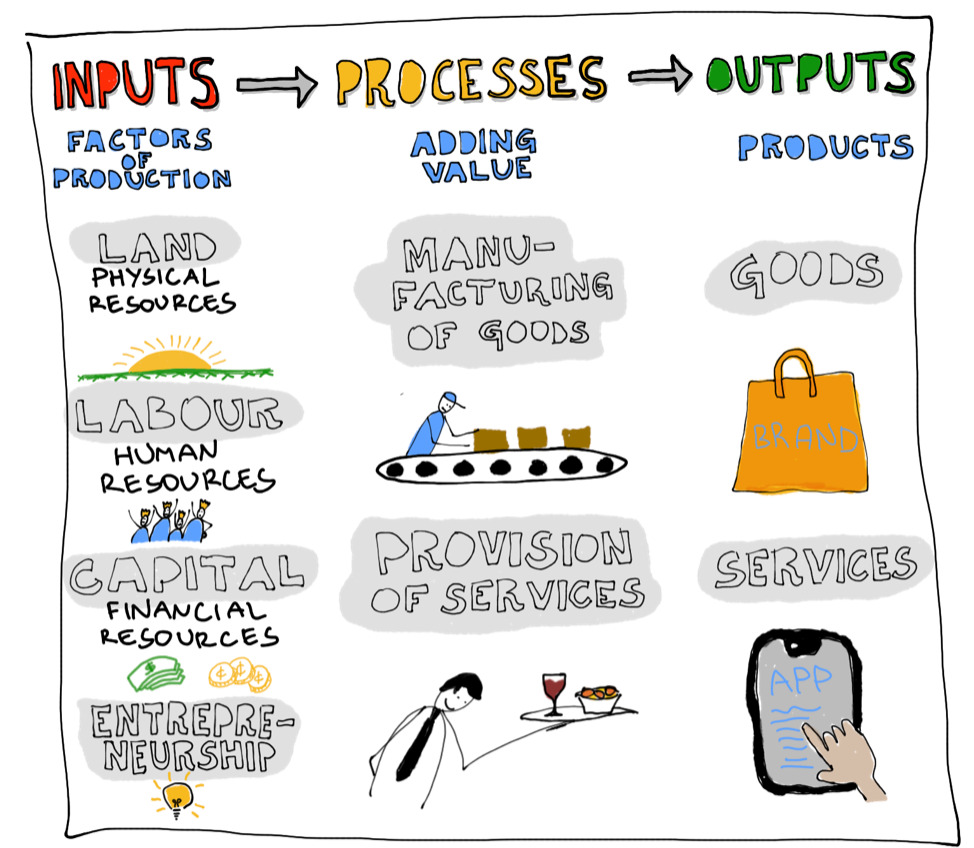
As you can see from Figure 1 above, businesses take inputs (or resources, or factors of production — all of these refer to the same thing in our context), do certain processes with them and add value to them, and transform them into outputs. As simple as that. Now let’s talk about each of the three steps in the input-output model in more detail.
Inputs are the resources that businesses use in order to transform them into outputs by adding value. In traditional economic theory these resources/inputs are called factors of production:
— Land (physical resources) — land, real estate or raw materials, for example, fish, gold, wood.
— Labour (human resources) — people in business: employees and managers.
— Capital (financial resources) — cash and other forms of financial resources as well as capital goods, i.e. things/equipment used in production: office chairs, desks, laptops or assembly line robots.
— Entrepreneurship — skillset that combines all the factors of production in order to transform them into products (goods and services).
The second stage in input-output model is adding value. Added value is extra perks/features that are added to inputs in order to sell them to customers. If there’s no added value, there’s no business. Why would someone pay extra for something that did not undergo any transformations? The two major ways in which businesses add value are production (manufacturing) of goods and provision of services. Speaking of production, it can be either capital-intensive or labour-intensive. Capital-intensive refers to high reliance on machinery in production process. For example, car manufacturing is usually highly automated and is manly performed by robots. Labour-intensive refers to high reliance on human labour. For example, textile industry (manufacturing of clothes) is usually highly labour-intensive and depends on the manual work of people.
And finally, the last stage of the input-output model is outputs. Output is a product, that can either be tangible (good) or intangible (service). Once again, product is either a good or a service. Very often students say “product” but mean “good”. Goods are products, but not all products are goods, because services are also products. Products can also be categorised based on who they are sold to. If a product is sold by one business to another, this is a producer good or service. This relationship of one business to another is called B2B (business-to-business). For example, if a school buys desks and chairs from a furniture manufacturer, that would be a producer good. If a product is sold by business to the general public, this is a consumer good or service. This relationship is called B2C (business-to-consumer). For example, if your parents go to a shop and buy a desk and a chair for your bedroom, that would be a consumer good. As you can see, one and the same thing can be either producer or consumer good or service, depending on who it is sold to.
Once we are clear about what business is and how input-output model works, we’re ready to explore business further and talk about business functions. All businesses, regardless of their size, location and other characteristics have the same 4 business functions:
— Human resource management (HRM) — making sure that the right people are employed and paid by the business, regularly trained, appraised and treated in accordance with Health & Safety regulations.
— Finance and accounts — planning for the future costs, revenues and cash flow and keeping records of the costs, revenues and cash flow in the past, as well as financial analysis and budgeting.
— Marketing — making sure the right product is sold at the right price in the right place using appropriate promotion methods.
— Operations management — making sure that goods are produced using relevant methods of production and/or making sure that the most efficient processes are used to provide services.
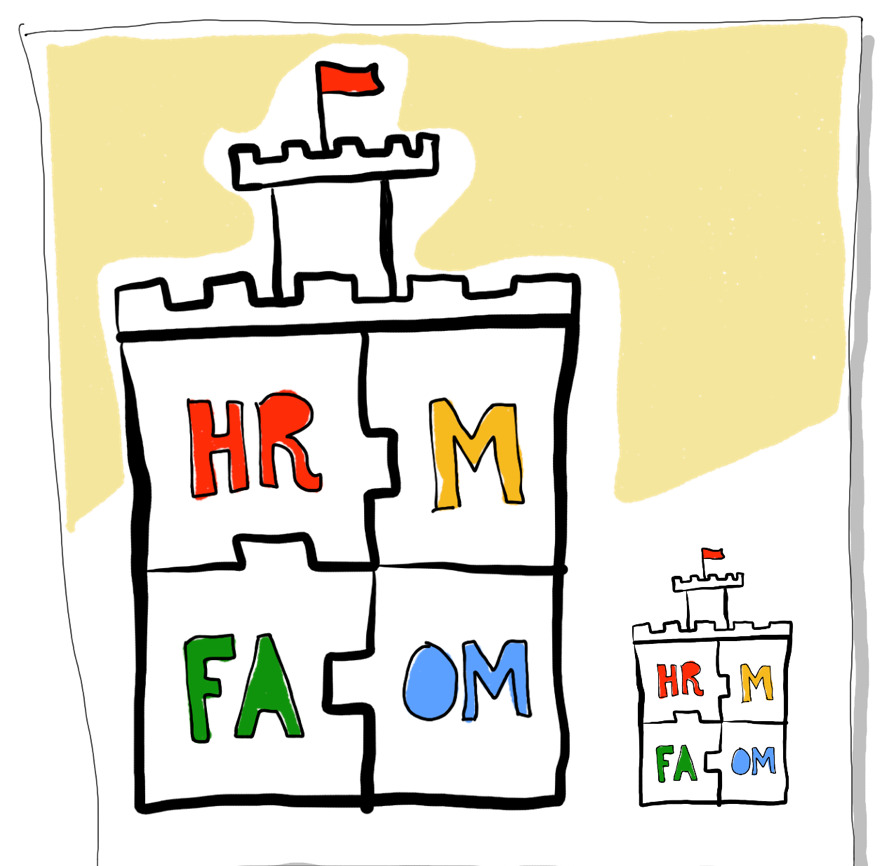
It’s okay if you feel like you don’t fully understand what’s included in these business functions. Usually, Business Management is taught in 5 modules: introduction to BM plus 4 business functions. So, it will take about two years to figure out what these functions actually are, so take your time, and this overall understanding of the functions we have so far is enough, for starters.
Once again, all businesses, regardless of their size, have the same 4 business functions. The only difference is that, for example, a sole trader will perform all four functions on their own while in larger companies these functions will be allocated to departments. So, all businesses have 4 functions, but not all businesses have departments.
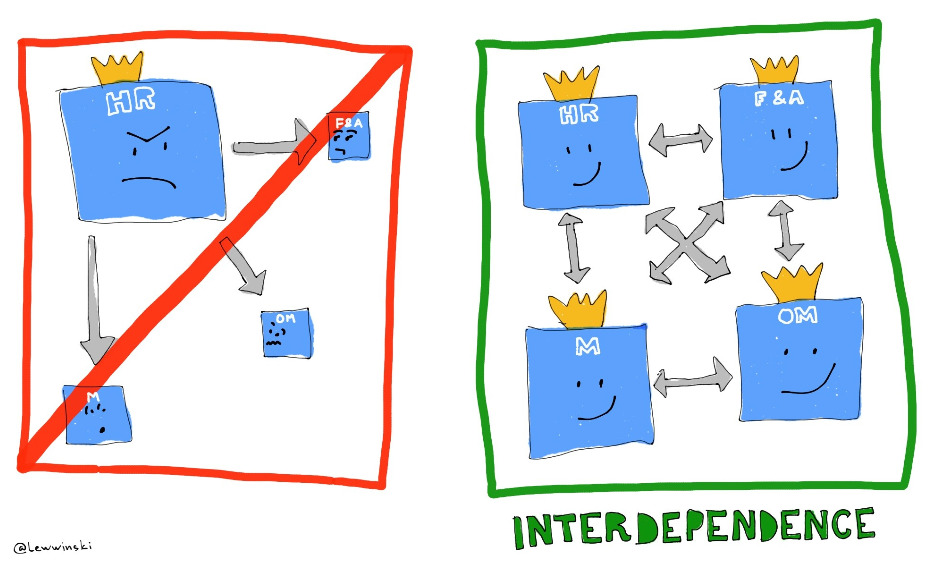
Which business function is the most important? Well, this is a tricky question. On the one hand, it is believed that HR is the one because it has to do with professional relationships. On the other hand, none of the functions should be the most important one or the least important one. Also, if an organisation is broken down into several departments, they should not be too independent from each other. It is extremely important to coordinate the actions of all functional departments and make sure all of them have a shared goal. Otherwise, the organisation will fall apart and will be in a constant state of conflict. This idea of organisation where all functions are united by common goal and rely on each other is called interdependence.
ii. ECONOMIC SECTORS
Explain the economic sectors: primary, secondary, tertiary, quaternary (AO2)
Economic sector (or sector of industry) refers to all the businesses within an economy that are involved in a similar activity. So, if you want to divide all businesses in a country into economic sectors, you have to see what they do. Overall, there are four economic sectors:
— Primary sector refers to all the businesses that extract raw materials: mining, fishing, forestry, agriculture, oil extraction, etc.
— Secondary sector businesses transform raw materials, extracted by primary sector businesses, into goods, i.e. secondary sector refers to manufacturing.
— Tertiary sector refers to provision of services: banking, education, retail stores, cinemas, transportation, etc.
— Quaternary sector is quite similar to tertiary, because it also includes services, but exclusively those services that relate to data, knowledge and IT. For example, app and video game development would be an example of quaternary sector activity. However, selling these apps and video games in retail stores would be an example of tertiary sector activity.
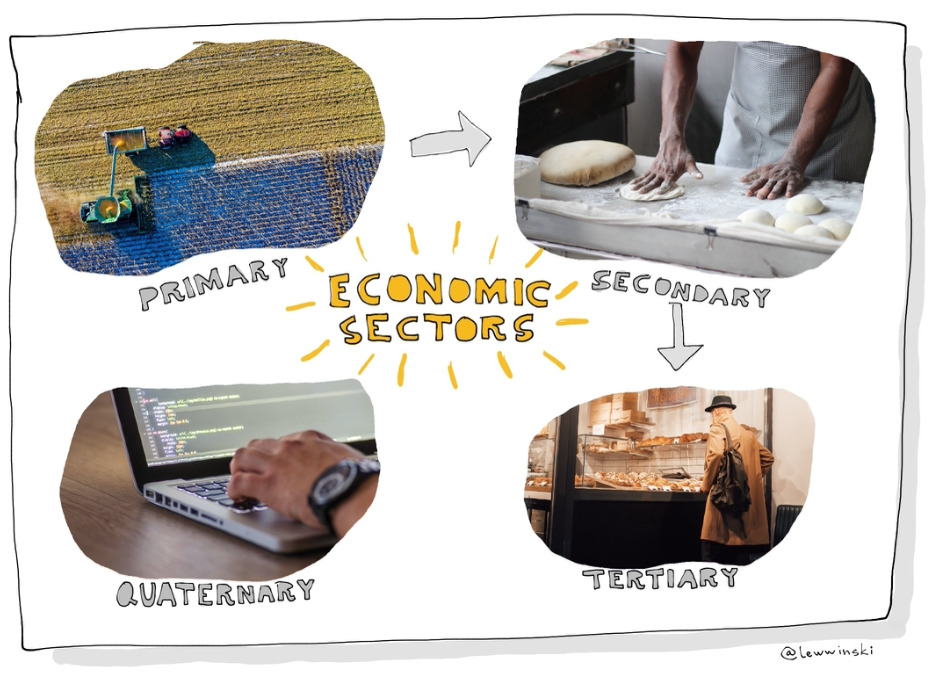
All the consumer goods go through economic sectors. For example, bread that you buy in a local supermarket once was crops that were harvested by farmers in the primary sector, then processed into flour by the bakery in the secondary sector, and then delivered into supermarkets (tertiary sector businesses) all over town that sell this bread to you. This route, or path, or process that raw materials go through on their way of becoming a finished consumer good is called chain of production. For some products, like bread, it is relatively short and doesn’t take much time. But for more complex goods, like airplanes, production chains are more complicated as well.
Why do we need this knowledge about economic sectors? Because you, as a Business Management student and potential entrepreneur, might make a lot of conclusions that your potential business might benefit from in the future, if you know what economic sectors are. One thing you can do is predict the future. History tells us that all economies go through the same stages of development over time. Have a look at a graph below first.
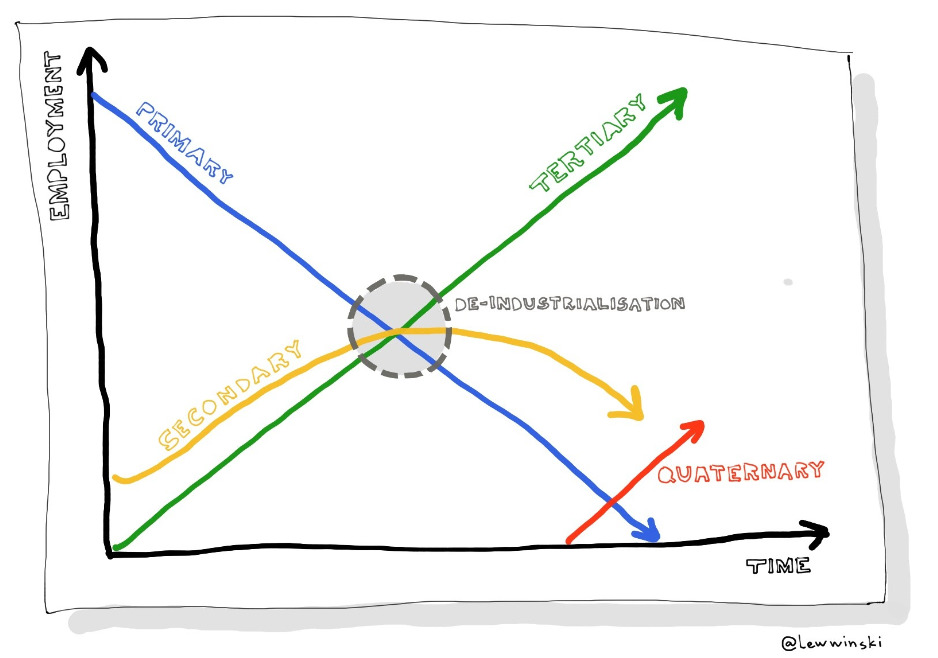
As you can see, as time goes by, the importance of primary sector declines, because there is not much added value there, that sector is simply about extraction of raw materials… Secondary sector increases first (this increase is called industrialisation) as manufacturing is growing, and then after a certain point, usually when it becomes cheaper to manufacture goods in a different country, secondary sector decreases (the decrease of the secondary sector is called deindustrialisation). Tertiary sector is gradually increasing over time, because the more economy develops, the wealthier people usually become, and the more money they prefer to spend on tertiary sector activities, i.e. services: better education, travel, opening a bank account — all of these are services. Also, as time goes by, quaternary activities are increasing because they are proportional to technological progress and development of IT.
Another conclusion that you can make based on the knowledge about relative importance of economic sectors is the type of economy. Economies where primary sector dominates are called less developed economies. This usually means that workforce is not very well educated, and that quality of life and income levels are not very high. Economies where secondary sector dominates are called developing economies. An example could be BRICS: Brazil, Russia, India, China, South Africa. Labour costs in these countries are relatively low and these countries are a good destination to outsource manufacturing of goods. Countries where tertiary and quaternary sector dominate are referred to as developed economies. Income levels there are relatively high, and people spend money on services. At the same time, labour costs in these countries are also pretty high and it might be very expensive to manufacture goods in these economies.
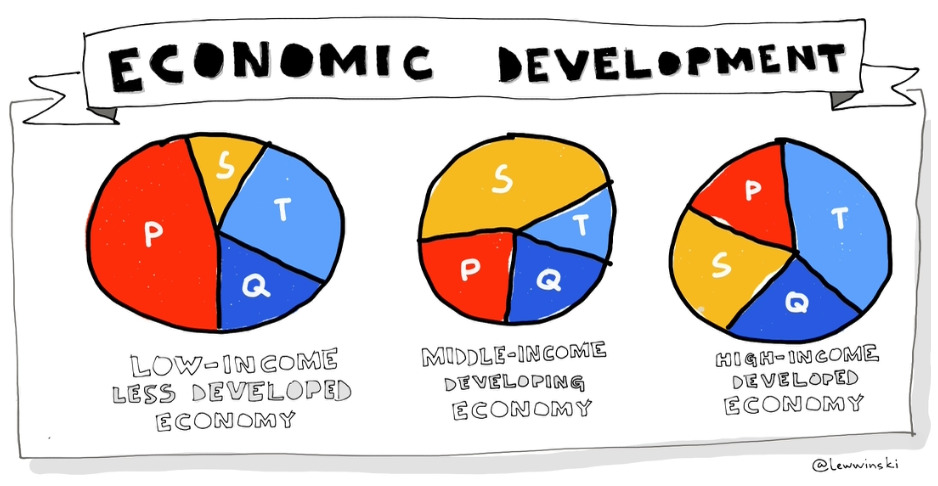
One last thing about economic sectors is how to measure their importance. There are two ways:
— Count the number of people who work in this or that sector. For example, let’s say in a tiny country X there are only 100 people and 75 of them work in tertiary sector businesses: banks, schools, cinemas, barbershops. It means that the relative importance of this sector is 75%.
— Count the proportion or total value of GDP in each sector. If half of the overall GDP comes from manufacturing, then the relative importance of secondary sector is 50% and it is an indicator of a developing economy. Or, if GDP is 1 billion dollars and 600 million is generated by secondary sector, then its importance is 60%.
Keep in mind that if the sector is more important in terms of GDP, it is not necessarily the most important in terms of workforce. Very often tertiary sector generates most value, while primary sector is the most labour-intensive.
You might be interested in relative importance of economic sectors in different countries. Look up “List of countries by GDP sector composition” on Wikipedia and learn more about it.
iii. STARTUPS
Explain challenges and opportunities for starting up a business (AO2)
First, if we’re going to talk about startups (new businesses), we’ve got to talk about entrepreneurship. As you remember, it is one of the four factors of production and an essential part of any business, that refers to a skillset (or knowledge/wisdom) that allows to combine all factors of production and start an enterprise. People who have this skillset are called entrepreneurs. One of the most important characteristics of entrepreneurs is risk-taking. In addition to entrepreneurs, there are also intrapreneurs — people who are similar to entrepreneurs but who work for a company. They are usually provided with a lot of freedom, they hire people for their team themselves, they manage their time own their own and share pretty much the same opportunities and threats as entrepreneurs, but all of this is happening within a company context. Intrapreneurship is very common in Google, for example. Gmail is the product of intrapreneurship.
Having said that, we are going to talk about challenges and opportunities of startups now. The three main topics that relate to that are reasons, process (including business plan) and problems.
Reasons to start up a business. There is no one right answer to what these reasons are but some of them are really common. When I ask my students what they think the main reasons are, they usually give me very good answers! Here’s a top chart of what they usually say and a fancy BM-terminology version (in brackets) of what my students say:
1. “Getting rich!” (financial rewards)
2. “Doing something new” (innovation)
3. “Manage time on your own” (life-work balance)
4. “Find something others don’t do” (filling in the market niche/gap)
5. “No boss” (independence)
6. “I’m the boss!” (responsibility)
7. “Hobby” (commercialising personal interest)
Process of starting up a business. Again, there is no one right answer, however all startups go through pretty much the same experience and follow these steps (not necessarily in this order and not necessarily these steps only):
1. Refine business idea (thinking about what the business is about in general)
2. Outline business plan (more details further)
3. Choose the type of business entity (more details in 1.2)
4. Seeking finance (more details in 3.2)
5. Start trading!
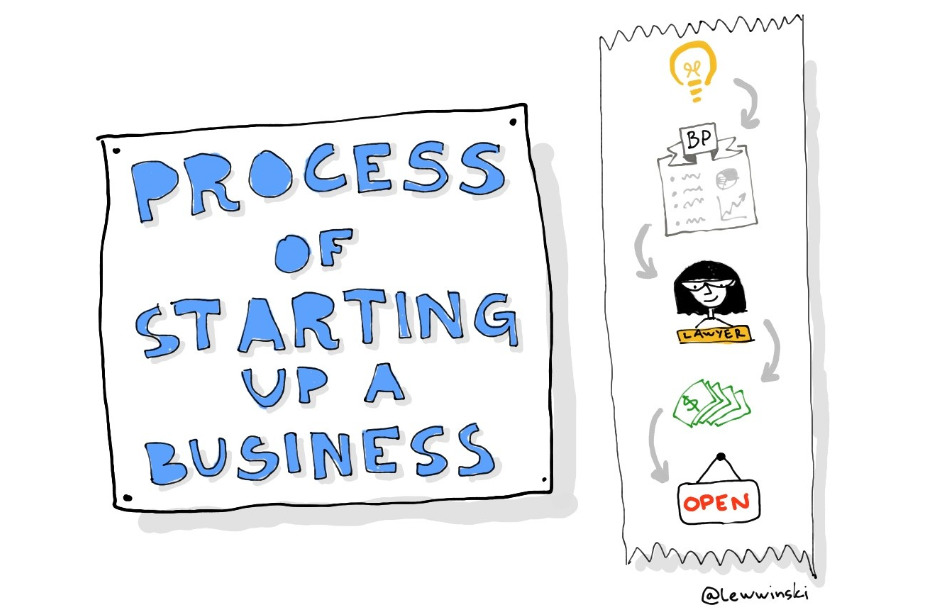
With regards to business plan, it is a document that outlines business idea and explains how business is operated functionally (in terms of 4 business functions). Nowadays, BP often includes sustainability and CSR (more about it in 1.3) — ethical standards that a business is committed to comply with. There is no one standardised format for all BPs, but a good one usually includes the elements mentioned previously in this or that way. You can play with BP and try to create your own. BP samples are easy to find online.
Problems/challenges that startups face. With regards to this topic, my students were of great help again. See below their ranking with a BM-termed explanation in brackets:
1. “No money!” (limited finance)
2. “Don’t know how to run a business” (lack of organisation skills)
3. “Nobody wants to work for me” (recruitment issues)
4. “People don’t work well” (limited expertise)
5. “A lot of other similar businesses” (competition)
Look back at class objectives. Do you feel you can do these things?
— Describe the nature of business (AO1)
— Explain the economic sectors: primary, secondary, tertiary,
quaternary (AO2)
— Explain challenges and opportunities for starting up a business
(AO2)
Make sure you can define all of these:
1. Business
2. Input-output model
3. Inputs
4. Outputs
5. Added value
6. Factors of production
7. Land (physical resources)
8. Labour (human resources)
9. Capital (financial resources)
10. Entrepreneurship
11. Capital-intensive
12. Labour-intensive
13. Product
14. Good
15. Service
16. B2B
17. B2C
18. Consumer goods and services
19. Producer goods and services
20. Business functions
21. HRM (human resource management)
22. Finance & accounts
23. Marketing
24. Operations management
25. Interdependence
26. Economic sector
27. Primary sector
28. Secondary sector
29. Tertiary sector
30. Quaternary sector
31. Chain of production
32. Industrialisation
33. Deindustrialisation
34. Less developed economies
35. Developing economies
36. Developed economies
37. Startup
38. Entrepreneur
39. Intrapreneur
40. Business plan (BP)
Check out these resources to boost your BM knowledge and skills:
— boosty.to/lewwinski
— tiktok.com/@lewwinski. business
— youtube.com/@lewwinski
Look for Lewwinski or Lewwinski Business on other social media!
1.2 Types of business entities
Class objectives:
— Distinguish between private and public sector (AO2)
— Evaluate the main features of the following types
of organisations: sole traders, partnerships, privately held
companies, publicly held companies (AO3)
— Evaluate the main features of the following types of for-profit
social enterprises: private sector companies, public sector
companies, cooperatives (AO3)
— Evaluate the main features of the following type of non-profit
social enterprise: non-governmental organisations (NGOs) (AO3)
The main point of this chapter is to help you understand what the best form/type of business in a given situation is.
i. PRIVATE AND PUBLIC SECTOR
Distinguish between private and public sector (AO2)
Sector in this chapter refers to part of the economy, just like in 1.1, but the sectors we are about to study are not sectors of industry, they are sectors of ownership. If you want to divide all businesses in any economy into four sectors of industry, you consider what this businesses are doing, i.e nature of activity. If you want to divide the same businesses in an economy into 2 sectors (private and public), you consider who they belong to. Thus, any business is in two types of sectors at the same time. For example, Volkswagen manufactures cars and belongs to shareholders, which means it’s in secondary sector (of industry) and private sector (of ownership). BBC (British Broadcasting Corporation) is providing TV programmes and belongs to the UK government, which means that it’s in tertiary and public sectors. The illustration below summarises the main idea of this paragraph:
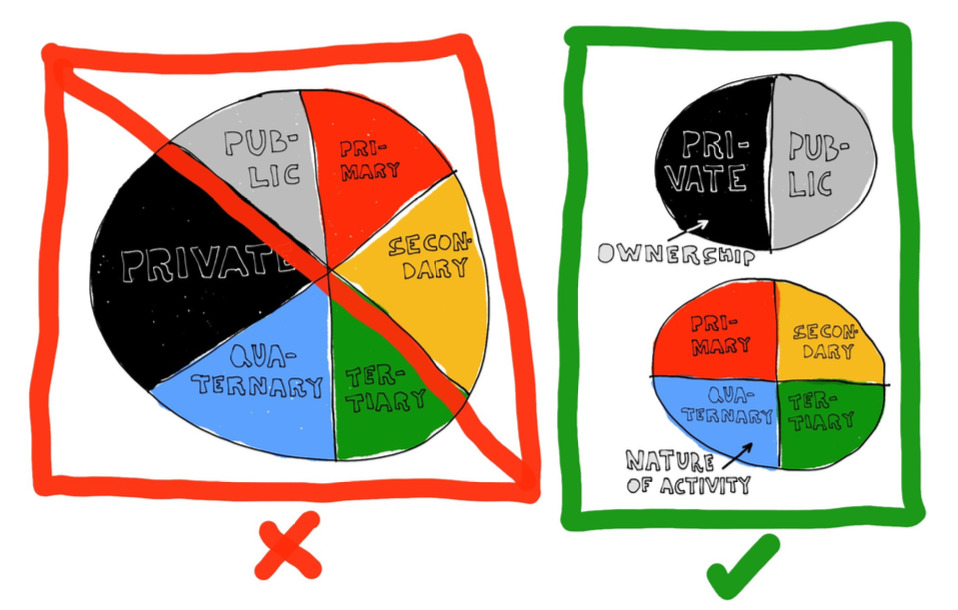
So, once we’re clear about the difference between sectors of industry and ownership sectors, let’s focus on public sector. Public sector refers to part of the economy that is comprised of organisations that are created and run by governments to provide public services, for example police, public transport, healthcare, education, infrastructure. Public sector organisations are mostly funded by tax revenue. They exist to make people’s lives better and they are not supposed to make profits. Even if they charge customers (for example, when you pay for a stamp in the post office) and make profits, these profits are not used to compensate to the owners of these organisations, because there are no owners/shareholders as such. These organisations belong to the government, i.e. to everyone, to all citizens. That is why, these “profits” are actually called surplus — the positive difference between revenues and costs in public sector organisations, that is reinvested in order to improve the services provided to citizens.
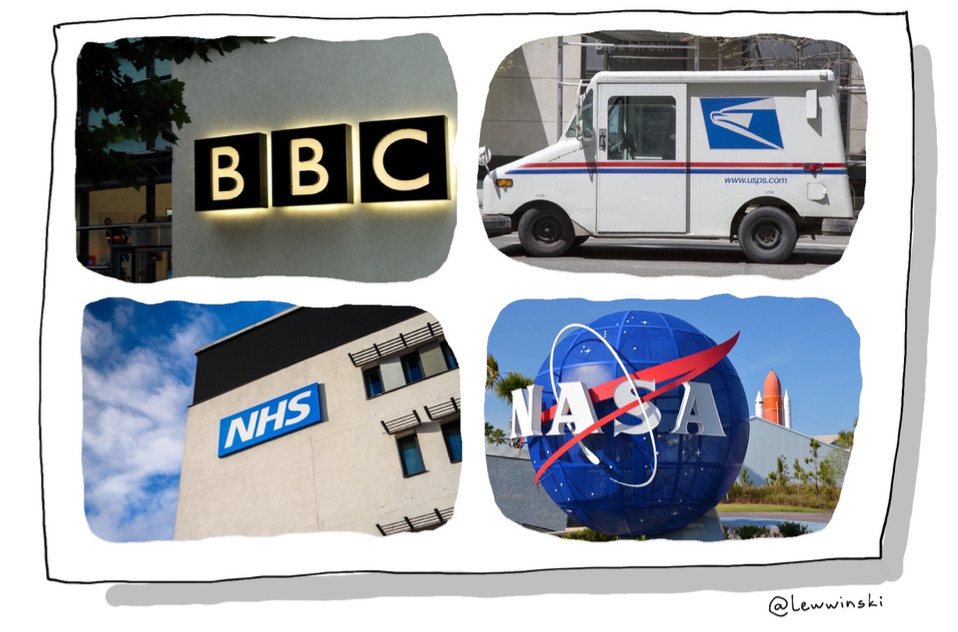
The best thing about public sector organisations is that they are socially-oriented and their essence is to help people. However, they are funded by taxes and they do not face much competition, so they tend to be quite inefficient most of the time. Public sector organisations do not have to fight for their existence and compete with other businesses because very often they are monopolies and are supported by tax revenues. Some examples of public sector organisations would be British Broadcasting Corporation (BBC) and National Health Service (NHS) in the UK, and United States Postal Service (USPS) and National Aeronautics and Space Administration (NASA) in the US.
Private sector refers to all organisations that are owned and created by individuals or group of people in order to satisfy needs and wants and provide goods and services. Most organisations in private sector are created to make money to their owners, which means that they are for-profit. However, there are organisations in private sector that are non-profit and are aimed at helping people, just like in public sector. Even though from mathematical perspective profit is the same as surplus (the positive difference between revenues and costs), we say “profit” when we talk about private sector, and we say “surplus” when we talk about public sector.
The best thing about private sector organisations is that they are efficient and innovative. They are forced to be efficient, innovative and creative, because if they aren’t, they’ll go bankrupt and they’ll be pushed out of the market by competitors and there is no one to back them up. Thus, they work hard to provide the best product to their customers and make sure everyone’s needs and wants are satisfied in the best possible way. However, most organisations in private sector are money-driven. They do not care about people as much as about profits. This trend is changing though and more and more organisations in the private sector commit to social goals. We will talk about it in more detail in the last part of this chapter. An example of private sector organisation can be pretty much any company you know: Apple, Google, Coca-Cola, Netflix, Burger King, etc.

Look up “list of countries by public sector size” on Wikipedia. Spoiler: Cuba’s public sector is 77.7% of their economy!
ii. TYPES OF ORGANISATIONS
Evaluate the main features of the following types of organisations: sole traders, partnerships, privately held companies, publicly held companies (AO3)
Can you please read the objective of this part of chapter again? Thanks. The objective is to learn to evaluate the features of different organisation types. Key words here are “evaluate” and “features”, which means that it is not enough to just understand what these organisation types are, it’s important to learn to express your opinion about them and justify it with facts. That is why, before we dive into the four types of organisations, we’ll learn how to evaluate them.
When we talk about any kind of organisation, we can use the same criteria to judge/evaluate them. For example, number of owners, reasons to choose the given type of organisation, how long it takes to register it, how risky and expensive it is, which documents are required for registration, how easy it is to raise funds, how difficult it is to control organisations and make decisions, what the chances of continuity are in case of owner’s absence and simply advantages and disadvantages. All of these are self-explanatory. In addition to the things mentioned above, there are a few more things that require a little bit more attention: liability, legal identity, incorporation, transparency, accountability and set-up costs. Why they require special attention? Because every year students ask me the same questions about these things and even if they don’t I can see that understanding of these terms could be improved. It might not apply to you personally, but I will still walk you through these terms.
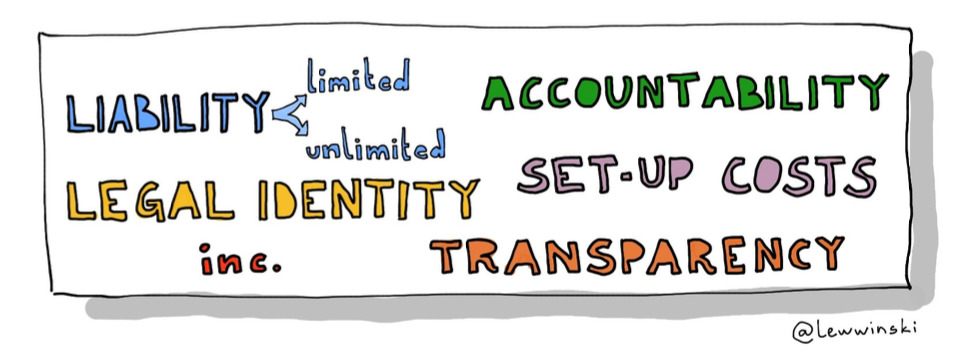
Liability is the extent to which you risk losing your personal possessions in case of the business failure, it can be limited and unlimited. Unlimited liability means that you personally are completely, 100%, totally, fully, etc responsible for all the business debts and losses. Let’s say if (God forbid) your business goes bankrupt and you are unable to pay back $1000 to the bank where you took a business development loan, then the bank will make sure someone comes to your house and takes your personal belongings (TV, couch, PlayStation, etc) to make sure there is enough to compensate for that $1000 loan. Of course, this is a simplified explanation and example, but it’s perfect to illustrate what unlimited liability is for people who have just happened to read this term. It might sound scary, but unlimited liability usually refers to smaller businesses and people rarely end up losing their personal possessions. However, if you aim at long-term growth and building a multinational corporation, unlimited liability is clearly not the best option. Limited liability means that your responsibility for business losses is restricted by your initial investment, i.e your liability is limited by initial investment. For example, you buy some shares of Amazon today and costs you $500. If tomorrow Amazon (again, God forbid) goes bankrupt, you just lose a chance to get your $500 back, but nobody’s going to come to your house and take your personal belongings. If it does go bankrupt though and if it is unable to pay for its loans, then the bank will make sure someone comes and takes Amazon company’s belongings (office chairs, computers, building, etc). In other words, company’s assets will be seized, not personal assets of people who worked for Amazon. That’s all you need to know about liability at this point.
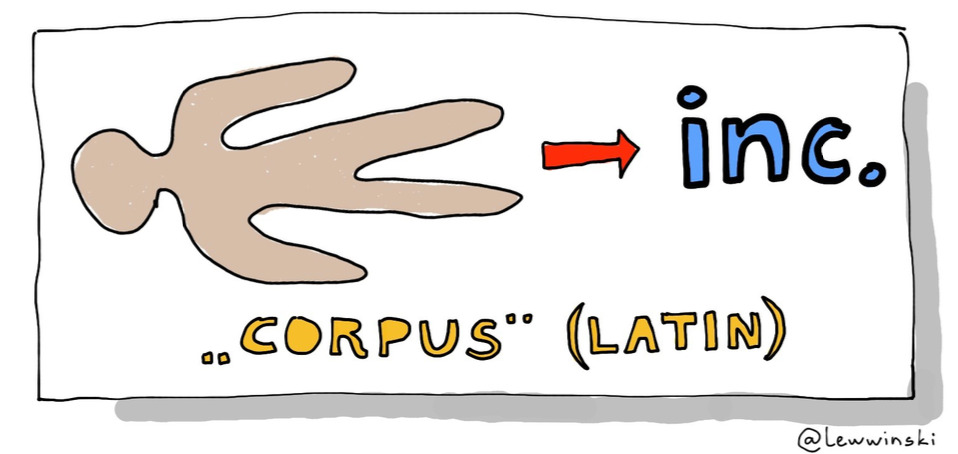
Legal identity is the formal registration of a human or non-human entity. For example, you are a real human being but unless you have a passport or another form of ID, you don’t exist from the legal perspective. So, some businesses, for example sole traders, do not have legal identity. Sole trader’s legal identity equals to the person’s legal identity. But companies, on another hand, have their own separate legal identity. Steve Jobs had his own identity, and Apple has its own. If you buy an iPhone and something doesn’t work the way it’s supposed to and you are refused a refund, then you will probably sue Apple, but not Steve Jobs, because Apple has its own legal identity. From the legal perspective, Apple is a real entity, as real as Steve Jobs. Now, if a business organisation does not have its own legal identity (just like sole traders), it means that they are unincorporated. If you buy a lemonade from a sole trader and get poisoned by it, you will sue this sole trader personally, not his business, because from legal perspective this sole trader and his/her business is one and the same entity. Companies, however, are incorporated — they do have a separate (from their owners) identity. Fun fact: “incorporated” comes from Latin word “corpus”, which means “body”. So if business and person are one and the same body — we call it “unincorporated” (no extra body). If a business has its own body that is separate from its owners’ body — we say “incorporated” (extra body created). So, if you see “inc.” after a company name, you know what it means now.
There are just three more terms before we move to sole traders, partnerships and companies. Transparency — the extent to which businesses have to disclose their financial data. Some businesses are really private and not transparent, they keep all the accounts to themselves and only share with the tax authorities. Some businesses, like publicly held companies (Apple, Amazon, Google, etc) are super transparent: they have to publish all their financial data several times a year. Want to see how much money they made? Just go onto their website and download an annual report. Accountability is the degree to which a person or business is responsible or answerable to someone. Partnerships, for example, have high degree of accountability, all the partners are accountable to each other. And finally, set-up costs refer to how much money you need to start a business in this or that form. Spoiler: setting up a business as a sole trader is usually the cheapest, but setting up a business as a company is usually the most expensive.
Now we’re ready to learn about sole traders, partnerships and companies. As you read about them, you might want to copy the table below and take notes in a systematic manner. If you were in my class, I would make you do it, haha. And by the way, I have already mentioned some of the things, so you may fill in some parts of this worksheet already.
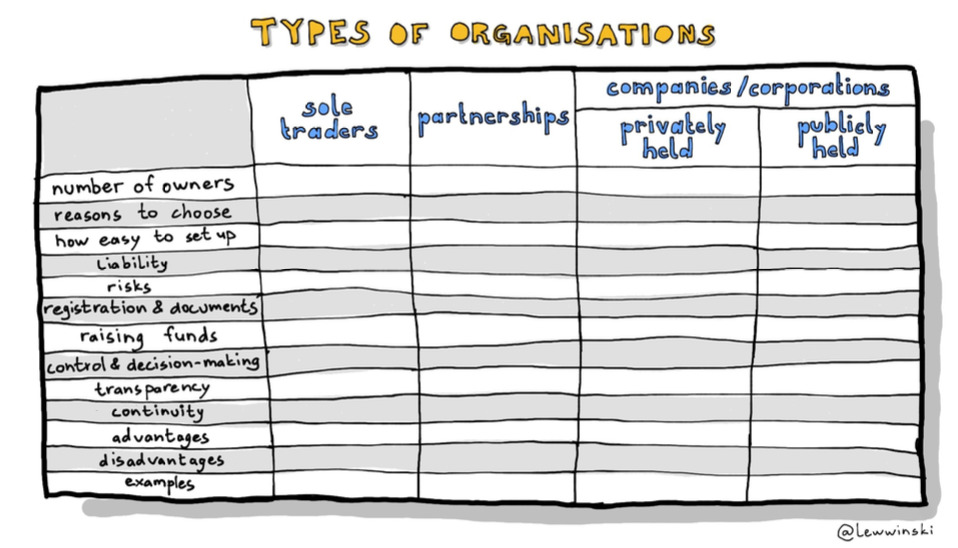
Sole traders are people who run their businesses alone. This type of business does not have a separate legal identity, the owner and the business is the same entity, which means that sole traders are unincorporated. They also have unlimited liability, so sole traders are personally liable for all business losses with their own possessions. Sole traders do not usually focus on long-term growth, very often these are just people who do not want to work for anyone and want to control their life-work balance themselves. Very often they are also quite inexperienced, so the chances of failure for sole traders are pretty high due to lack of experience. Setting a business as a sole trader is relatively easy in most countries and only requires very few documents. Owners also get to keep all the profits and the tax is usually pretty low, or in some countries sole traders who earn less than a certain amount are completely tax-free.

Raising funds for this type of business is pretty difficult. Banks are reluctant to provide loans because they know that sole traders are likely to fail due to lack of experience. Mostly, sole traders are funded by personal savings. Sole traders are quite private, they do not have to disclose how much they earn to the public, thus they are not transparent. In terms of continuity, if something happens to the owner, then the business shuts down. No owner, no business. Sole traders cannot compete with large corporations because they cannot afford that kind of competition. However, sole traders can enjoy local monopoly. For example, if there is a small store in your neighbourhood and you want a drink and some snacks, you are very much likely to go to that little store. So this store will be a monopoly, but only within your neighbourhood.
Partnership is an association of two or more (usually up to 20) people who run a business together sharing the risks, workload, and profits. The most important document for a partnership is called partnership agreement (or deed of partnership), which is like a constitution, but for a partnership: it states how workload and profits are distributed among partners, what the procedure is for entering or leaving a partnership. Deed of partnership is signed by all partners. Some partners prefer not to run a business at all, but just to invest some money in exchange for a portion of profits. This type of a partner is called a sleeping partner (or a silent partner).
There are different types of partnerships but most of them have unlimited liability, which means, as you remember, that all partners are personally liable for losses of their business. They are also unincorporated, so the business’s identity is a combination of the owners’ identities, no new entity is created. Even though workload and risks are shared among all partners, so is decision-making and profits. The degree of accountability is relatively high and for a decision to be made all partners have to agree first.

Finance is still pretty difficult to acquire and banks are still quite reluctant to loan money to partnerships, but there is more finance available to partnerships than to sole traders simply because it is a numbers game: more people, more money. The main source of finance is still personal savings. Chances of continuity for this type of business are also higher than for sole traders because, again, there are more people involved.
Very often partnerships are a group of people who share similar expertise and who see synergy in working with others. For example, some dental school graduates might form a partnership and run a small clinic together: one of them could specialise in orthodontics, another one in surgery, the third one in dental hygiene. Altogether they can offer a varied service to their patients and at the same time they can share expenses for rent, electricity and equipment.
Companies are limited liability incorporated organisations. They have their own legal identity (owner ≠ business) and are a subject of law independently from their owners and people who work for them. The number of owners is, in theory, unlimited. Technically, every single person on earth can be an owner of the same company, which has never been the case in reality. Owners of companies are called “shareholders”. From now on, when I say “owner”, it implies sole traders and partnerships, when I say “shareholders”, it implies companies. The biggest risk for shareholders is losing their initial investment (the benefit of limited liability, remember?), that is why it is so easy for companies to raise funds (attract money) and grow, compared to sole traders and partnerships. People are not afraid of becoming shareholders as much as joining a business with unlimited liability. The price that companies have to pay for it is higher transparency, more procedures in registration and strict control from the government. Otherwise, companies would easily raise money by making people believe in them and then claim bankruptcy, spreading money among majority shareholders. As I mentioned earlier, in case of bankruptcy, company’s assets are seized, but shareholders’ and workers’ personal belongings have nothing to do with it.
Speaking of registration, the two most important documents for companies are Memorandum of Association and Articles of Association. The former includes all the conditions that are needed to register a company and the latter is like a constitution of a company, it states the main rules of the company. In addition to these two documents, companies are only allowed to start trading after they are provided with the Certificate of Incorporation, which is basically a trading license that allows companies to conduct business activity. The date it is issued is the official birthday of the company.

Shareholders do not have to run a business they own. If you buy Apple’s shares tomorrow, it does not mean you have to go to their office at 8am. However, some employees might also be shareholders at the same time. People who run the business on the top strategic level are Board of Directors (BOD) and Chief Executive Officer (CEO). BOD usually includes either some of the managers selected by shareholders, or majority shareholders (i.e. those who have most of the company’s shares), or people from outside the organisation who are selected by shareholders to represent their interests. What matters is that the job of BOD is to represent shareholders’ interests. Board gets together once a year for Annual General Meeting (AGM) to determine the long-term strategic plan for company development, but they also get together for Extraordinary General Meeting (EGM) in case an emergency requires directors’ attention. The person is in charge of actually running the company on a day-to-day basis is CEO.
Shareholders are eligible to a portion of company’s profits — dividends. However, dividends do not have to be paid at all, or do not have to be paid regularly, it all depends on the legislation and the company. Since shareholders have limited liability and companies are incorporated, the chances of continuity for companies are the highest among all companies. Even though Steve Jobs passed, Apple is still working. You might be surprised to know that Steve Jobs was once kicked out from his own company, because BOD was not happy with how he ran the company. Eventually, it was not a good idea and they hired him back, but the point is, continuity of the company is really high and does not depend on the absence of shareholders.
There are two main types of companies: privately held companies and publicly held companies. The key difference between them is that the former sell shares privately, only to those businesses and/or people they want to sell to, but the latter trade their shares on the stock exchange and potentially any human being of the legal age can become a shareholder. This is how Steve Jobs lost his job, even though he created the company. Once you become a publicly held company, you risk losing control to outsiders, who can buy the majority stake and tell you what to do. Mark Zuckerberg managed to avoid that by retaining the majority stake (the largest proportion of shares). By the way, it is a common misconception that the majority stake is 51% of company shares. It is the ultimate majority stake, but it is not a majority stake in most cases. Most of the time, it is enough to have more shares than other shareholders in order to have the final say, and it does not have to be 51% as long as it is more that other shareholders have.
Privately held companies, due to lower transparency and not having to publish that much financial data to the public, usually have a relatively low number of shareholders, compared to publicly held companies. They are very often owned by families. For example, Lego has been a privately held family business since 1932. Even though Christiansen family could have gone public many times, they prefer to retain control in the family and have not changed their type of business entity since 1932. Even though the transparency is relatively low and control over privately held companies is not likely to be lost to outsiders, it is quite difficult for shareholders to “cash out” if they want to leave the company and sell their stake. For publicly held companies, you just contact your broker and sell shares, but for privately held companies it has to be a private business deal, that is more difficult to arrange. Some examples of privately held companies are Lego, IKEA, Virgin Group, Chanel, Mars.

Publicly held companies cannot just become publicly held out of nowhere. All the publicly held companies were privately held prior to “going public” — making their shares available for purchasing to anyone (the public). After making a decision to go public, privately held companies have to go through initial public offering (IPO) — the process of selling their shares to the public for the first time. After IPO there is no direct control over share price. Share price is determined by the market laws of supply and demand. This process where shares are sold freely on the stock exchange is called flotation. So, publicly held companies have the greatest access to capital among all types of business entities, but at the same time they are the most transparent type of business organisation. Examples of publicly held companies are Apple, Coca-Cola, China Mobile, HSBC, Microsoft, Nike, etc.

Watch the full video class for this topic to learn some fun facts about IPO at boosty.to/lewwinski or watch extracts from the video class about companies on my TikTok and other social media. If you know something fun and interesting about companies in your country or all over the world, please share in the comments!
iii. SOCIAL ENTERPRISES
Evaluate the main features of the following types of for-profit social enterprises: private sector companies, public sector companies, cooperatives (AO3); Evaluate the main features of the following type of non-profit social enterprise: non-governmental organisations (NGOs) (AO3)
Keep in mind that even though this part of chapter is just called “social enterprises”, there are two objectives (see above) and there are two different types of social enterprises: for-profit and non-profit. To make it clear and easy to understand, look at Figure 7.
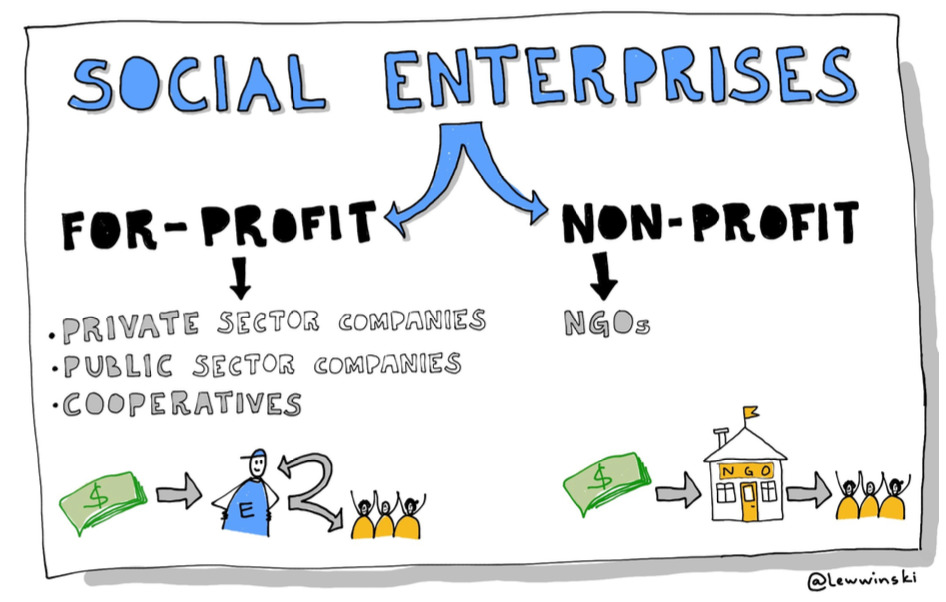
Very often students think that social enterprise and non-profit organisation is the same thing. Or, they think that there are 4 types of business entities: sole traders, partnerships, companies and social enterprises. None of these two ideas are right. Social enterprise is an organisation that has social wellbeing as its main goal, instead of making profits. That is why it is not the same as non-profit organisation. Social enterprises can make profits, or cannot, what matters is just the social wellbeing bit. Is social enterprise the fourth type of business entity in addition to sole trader, partnership or company? Wrong! Social enterprise can take any form: some social enterprises are sole traders, some are partnerships, some are companies. Cooperatives, that we’ll talk about in a moment, are social enterprises by their nature, because they are created for the benefit of certain communities. So, to recap, social enterprise is not a legal type of business entity (sole trader, partnership, company), it is a characteristic of an organisation.
Now, back to Figure 7 and the first type of social enterprise — for-profit private sector companies. By now, you should already understand what for-profit private sector company is, so I am not going to define it. If you are struggling with understanding what it is, it’s totally okay, just read the chapter again or try another way of perception and watch the video class for this topic at boosty.to/lewwinski. So, we’re not just talking about for-profit private sector companies now, we’re only talking about those of them, that are social enterprises.
These companies make profits, even though it is not their prior objective. Profits are used more as a tool to achieve socially important aims and compensate to owners at the same time. Other than that, these organisations have the same features as private sector companies.
The example of this type of social enterprise is Smenka Show and Geek Teachers that are run by two social entrepreneurs from Russia — Arina and Masha. Smenka Show is a social enterprise that raises money to renovate classrooms in schools. In the following illustration you can see the “before and after” pictures. Geek Teachers organise events for teachers to inspire positive change in education. So, what Masha and Arina do is a business, it earns profits, but community benefits from this business as much as (or even more than) Masha and Arina. I also asked the girls about the pros and cons of running a social enterprise and I will share it with you a bit later when we talk about theoretical pros and cons, so that we can compare these with what real entrepreneurs say. So keep reading.

The second type of social enterprises is for-profit public sector companies. Again, you should understand what it means by now. These organisations are the same as private sector companies that we’ve just discussed, but they operate in public sector, which means that they are created and run by government, which also means that most of them are focused on public services: medicine, infrastructure, transport, education, etc. The example of for-profit public sector companies could be waste sorting and recycling plants in Sweden. As you probably know, in Sweden they are aiming at recycling as much as possible and at having zero waste, so there are a lot of waste management companies. They:
— are trying to benefit everyone by recycling waste,
— make profits,
— are created or funded by the government,
which means that they have all the essential features of for-profit public sector companies.
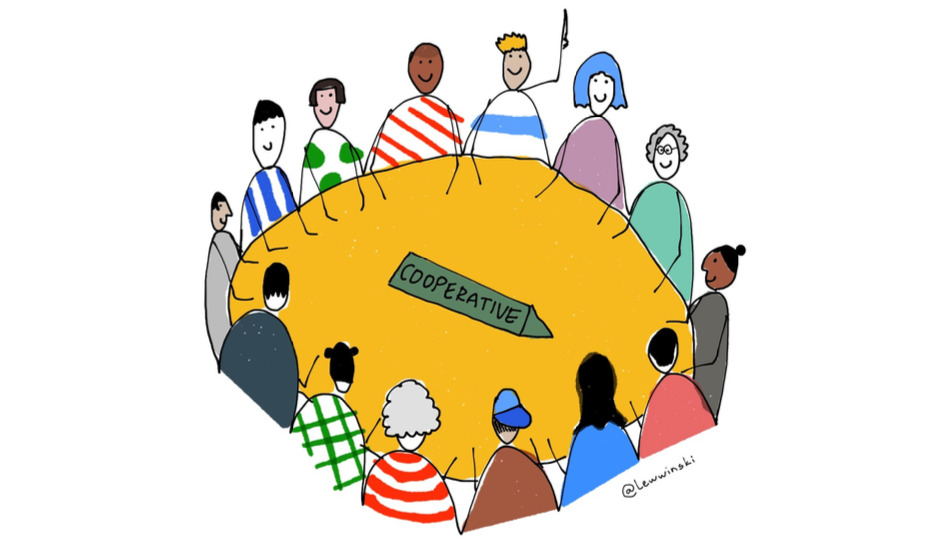
The last type of for-profit social enterprise is cooperatives — “an autonomous association of persons united voluntarily to meet their common economic, social and cultural needs and aspirations through a jointly owned and democratically controlled enterprise” (definition from International Cooperative Alliance). So, basically, a group of people decide that they need an organisation that will make their lives better. This is the key feature of a cooperative, by the way — it is created and run by its members for their benefit. For example, people in the neighbourhood decide that they need an organisation that will take care of maintenance, waste management, provision of internet and cleaning in their neighbourhood. So all the neighbours join this organisation, run this organisation, and enjoy the benefits of this organisation. That would be an example of a residential (housing) cooperative. There are also agricultural, consumer, financial and many other types of cooperatives. What all of them have in common is that they are created and run by their members for their own benefit and they are run in a democratic manner: votes for decisions are taken directly or through representatives, which is great on the one hand, but prolongs decision-making, on the other hand. I’m quite sure you heard about SWIFT (Society for Worldwide Interbank Financial Telecommunication) — it is a cooperative of banks that created a messenger to make money transfers easy and simple for their own benefit, which also benefits the clients as well.
The last type of a social enterprise is non-profit and it is NGOs (non-governmental organisations). This term first appeared shortly after the Second World War in the United Nations and there is no universal fixed definition for NGOs, so the understanding of NGOs differs from country to country. What all NGOs have in common is that they are usually non-profit, they have public trust, they usually address public well-being issues, such as health, environmental protection, human rights. NGOs can also be lobbying groups and political parties. And of course the main feature is that they are not run by the governments. Some examples of NGOs could be Greenpeace, Amnesty International and Oxfam. Check out the websites of these organisations to learn more.
So, now you know the four types of social enterprises, three of which are for-profit and one of which is non-profit. Now it’s time to look back at objective and do what it asks: evaluate. The advantages of social enterprises are:
— They result in customer loyalty, because people to buy something from “good companies” because it makes them feel good when they do so, it makes them feel they contribute to something meaningful by supporting social enterprises.
— In addition, social enterprises are by definition socially and economically sustainable which impacts communities and environment positively, or at least there is no harm.
— Lastly, social enterprises bring positive change.
On the other hand, social enterprises might experience high compliance costs (costs of being ethical). For example, you are a committed social enterprise and you have a choice of two suppliers: one is using eco-friendly materials but charges more and another uses plastic but charges less. You are very much likely to go for the expensive option because it is in line with social entrepreneurship principles, i.e the costs of being a social enterprise might be higher. In addition, very often social enterprises are not really economically sustainable and rely on donations and irregular funding. And lastly, social enterprises are usually transparent and democratic, which might result in prolonged decision-making.
The advantages and disadvantages above are too general, theoretical, and they do not necessarily apply to all social enterprises. In order to give you a more practical perspective, I asked Arina and Masha from Smenka Show and Geek Teachers what the pros and cons and opportunities and challenges for them personally as social entrepreneurs are and here’s what they said:
The benefits are opportunity to have an impact on people’s life quality and inspiring people for positive change. However, the first drawback is that traditional promotion and targeting do not work, you have to reach people. If you sell shoes, it’s pretty easy to understand who your customers are and target ads for them in social media, for example. But with renovating classrooms, you have to reach teachers, school principals and community and you start from scratch with every new school. In addition, income is hard to forecast. Also, even though you’re doing something good and you are socially focused, some people don’t need it and they say “we’re fine the way it is, we don’t care”. And lastly, people do not always understand why they should pay for some good deeds. They think that all good things should be free, for some reason.
I hope that was really helpful and I really appreciate the comment that Arina and Masha gave. Donate to Smenka (smenkashow.ru)!
That is the end of 1.2.
Look back at class objectives. Do you feel you can do these things?
— Distinguish between private and public sector (AO2)
— Evaluate the main features of the following types
of organisations: sole traders, partnerships, privately held
companies, publicly held companies (AO3)
— Evaluate the main features of the following types of for-profit
social enterprises: private sector companies, public sector
companies, cooperatives (AO3)
— Evaluate the main features of the following type of non-profit
social enterprise: non-governmental organisations (NGOs) (AO3)
Make sure you can define all of these:
1. Public sector
2. Private sector
3. Surplus
4. Profit
5. Liability
6. Limited liability
7. Unlimited liability
8. Legal identity
9. Incorporated
10. Unincorporated
11. Transparency
12. Accountability
13. Sole trader
14. Partnership
15. Deed of partnership
16. Sleeping (silent) partner
17. Privately held company
18. Publicly held company
19. Shareholders
20. CEO
21. BOD
22. AGM
23. IPO
24. Flotation
25. Stock exchange
26. Dividends
27. Memorandum of association
28. Articles of association
29. Certificate of incorporation
30. Social enterprise
31. Private sector company
32. Public sector company
33. Cooperative
34. NGO
35. Compliance costs
Check out these resources to boost your BM knowledge and skills:
— boosty.to/lewwinski
— tiktok.com/@lewwinski. business
— youtube.com/@lewwinski
Look for Lewwinski or Lewwinski Business on other social media!
1.3 Business objectives
Class objectives:
— Distinguish mission and vision statement (AO2)
— Analyse common business objectives: growth, profit,
shareholder value, ethical objectives (AO2)
— Discuss strategic and tactical objectives (AO3)
— Examine corporate social responsibility (CSR) (AO3)
The main point of this chapter is to understand the importance of business objectives — one of the main concepts in business management.
i. VISION AND MISSION
Distinguish mission and vision statement (AO2)
Vision and mission are statements that a business makes in order to prioritise objectives and let stakeholders know what business “is about”. Vision statement is a declaration of business’s aspirations, i.e. a picture of success for the business. Usually, vision statement is set only once and does not change. Mission statement is a declaration of a business’s purpose, i.e. reason for being of a business. Mission can be changed, revised and updated.
I will provide two examples of vision and mission: one will be hypothetical and not related to business, just to make it easier to understand; the other one will be Google’s vision and mission. So, if you’re a very ambitious and hardworking student, your personal vision can be “being the best student in the world” and mission might be “to study hard”. Vision is something that is quite vague and hard to quantify, and yet a good thing to work towards. It’s a good aspiration to be the best student in the world, right? Mission “to study hard” is your purpose on the way to the vision, it is not something that can be achieved, it is something that you do, it’s the reason for your existence as the best student. I hope it helps to understand the major difference between vision and mission.
The realistic business example would be Google. Vision: “To provide access to the world’s information in one click”. Mission: “Organise the world’s information and make it universally accessible and useful”. As you can see, reality is quite different from theory… More about that in the following paragraphs about pros and cons of vision and mission statements.
On the one hand, vision and mission serve as assessment criteria (just like in your IA) for the business and help to evaluate business decisions and objectives. For example, from the manager’s perspective, when he/she is uncertain about which decision to make, he/she could consider which decision is in line with vision and mission and go for this decision. At the same time, vision and mission help to motivate staff, because knowing why you work and having a meaningful work is one of the main motivators. It can also attract customers, because they like to buy from businesses that are doing something great, rather than simply sell products. Think about Nike and their ads: do they really sell shoes or do they sell values and lifestyle? And lastly, vision and mission quickly let all stakeholders (customers, employees, managers, investors, shareholders) know what the business is about.
On the other hand, both vision and mission are quite unclear and sound like “we support all good things and we don’t support all bad things”. Even though businesses are sometimes from completely different industries, their vision/mission often follow this “formula”. Sometimes, vision and mission are so vague and unclear on purpose, because the more vague they are, the more difficult it is to agree or disagree with them and the more flexible managers can be, because they have a lot of freedom in interpreting vision and mission. And lastly, very often these statements are written as a public relations (PR) trick to impress stakeholders and they are not really used to guide decisions. On top of that, in reality, many businesses do not distinguish between vision and mission and they only have one statement that is called either vision or mission.
So, overall, vision and mission are really useful statements that can guide business decision-making, but only if they are sincere and only if they are made mindfully, not just to “tick the box”.
ii. COMMON OBJECTIVES
Analyse common business objectives: growth, profit, shareholder value, ethical objectives (AO2)
For starters, we can’t just talk about objectives right away, because it is extremely important to understand the role objectives play and their place in business decision making. Actually, “common objectives” will be the last thing we’ll talk about in this part of chapter, so please be patient. For now, we’ll talk about GOST (it’s not a typo, there is no “H” in this acronym): goals, objectives, strategies and tactics.
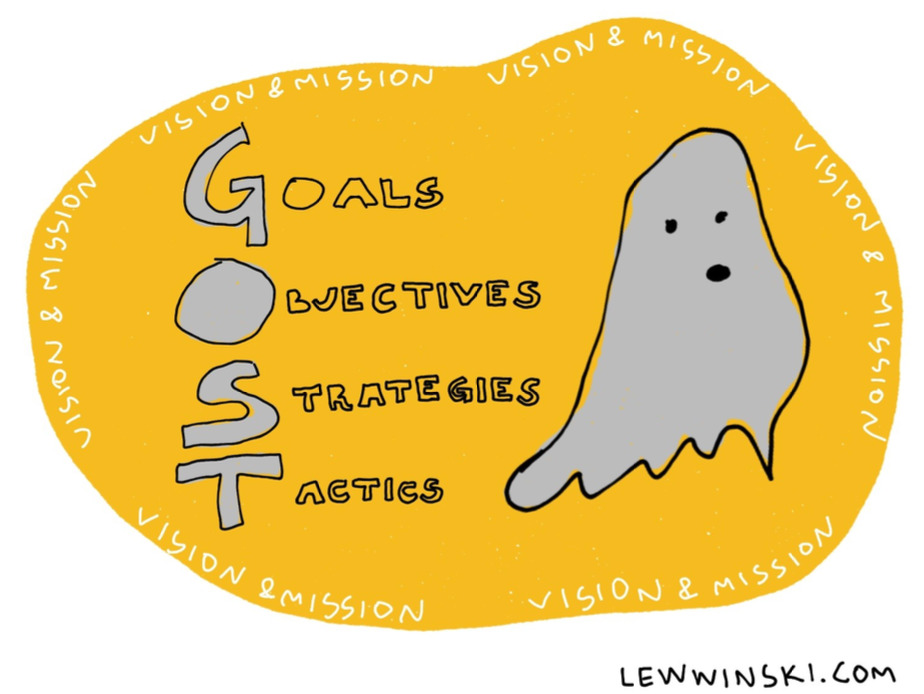
So, you already know what vision and mission are. As you can see in Figure 1, vision and mission are like a soup, where goals, objectives, strategies and tactics boil. Vision and mission underpin business and particularly decision- making at all levels. Then, inside this “soup” there are four other things (goals, objectives, strategies and tactics) that I suggest you remember in this order (GOST), because you can consider it a hierarchy. The picture in Figure 2 can help you understand it better.
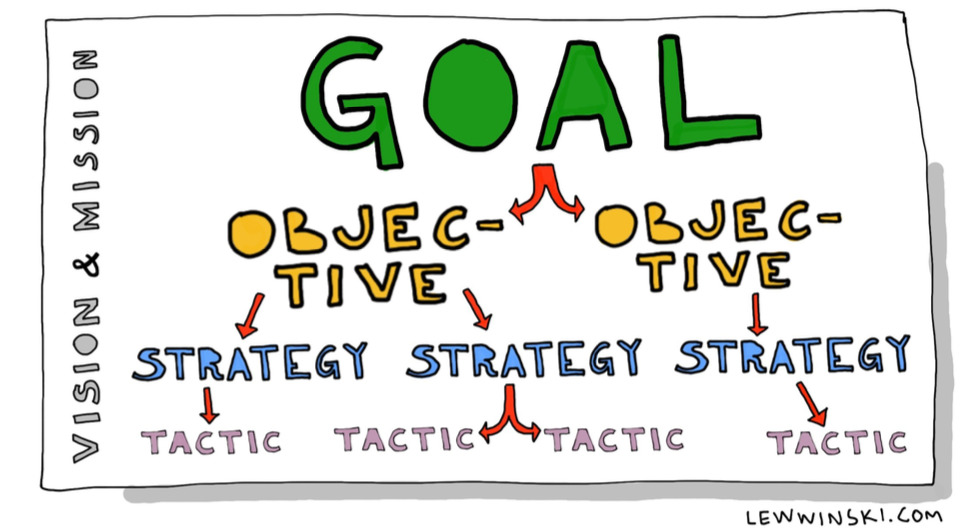
Goals — what business wants to achieve in the long-term. Objectives — clearly defined short-term or medium-term tasks that a business sets in order to achieve goals. Strategies — medium-term or long-term plans, methods, approaches, schemes that are used to achieve goals and objectives. Tactics — short-term or medium-term actions that need to be taken in order to achieve objectives.
As you can see from the definitions above, one things flows from another, hence the hierarchy: objectives are set to achieve goals, strategies are used to achieve objectives and goals, tactics are used to achieve objectives.
To deepen our understanding of goals, objectives, strategies and tactics, let’s consider an example of a hypothetical video games developer company.
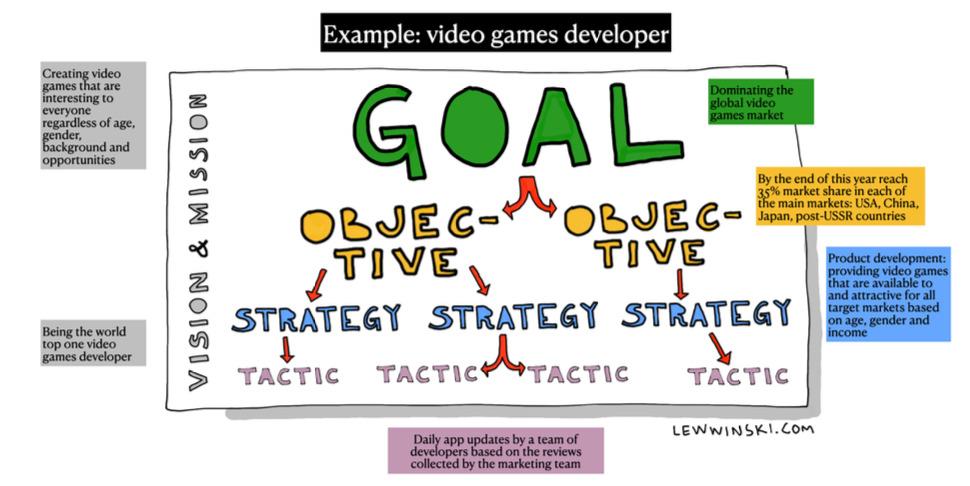
So, the first thing here is vision: “Being the world top one video games developer”. This is what drives the company at all levels. This is what helps to determine everything (goals, objectives, strategies, tactics) and this is what guides all decisions. The next thing to consider is mission: “Creating video games that are interesting to everyone regardless of age, gender, background and opportunities”. This is the reason for company’s existence, this is the “why” of their actions. Similar to vision, it guides all the decisions at all levels. Then, there is a goal that is set by senior management: “Dominating the global video games market”. It is more specific, than vision, it is realistically achievable, it is long-term, and yet it is not as specific as the objective (that is set to achieve the goal): “By the end of this year reach 35% market share in each of the main markets: USA, China, Japan, post-USSR countries”. As you can see, objective is super specific and concrete, compared to the goal. Later in this chapter we will learn a simple rule how to make a good objective (keep reading). Usually, there are several objectives that are set to achieve one goal. The next thing on the list is strategy: “Product development: providing video games that are available to and attractive for all target markets based on age, gender and income”. This is a plan on how to achieve the objective. Again, it does not have to be one objective and one strategy, there can be multiple of each. And finally, we have a tactic of “daily app updates by a team of developers based on the reviews collected by the marketing team”, which is a day-to-day routine plan on how to make objective happen.
So, by now, I hope, it is crystal clear where objectives belong to and what their role is. Objectives are the most specific of all things in GOST hierarchy, including vision and mission. Even though they are not on the top of the hierarchy, I would argue that they are the most important due to their concrete nature.
I’ve already mentioned earlier that goals are set by senior management and you might ask: “what are other types of management in an organisation?”. The brief answer to that question is in Figure 4.
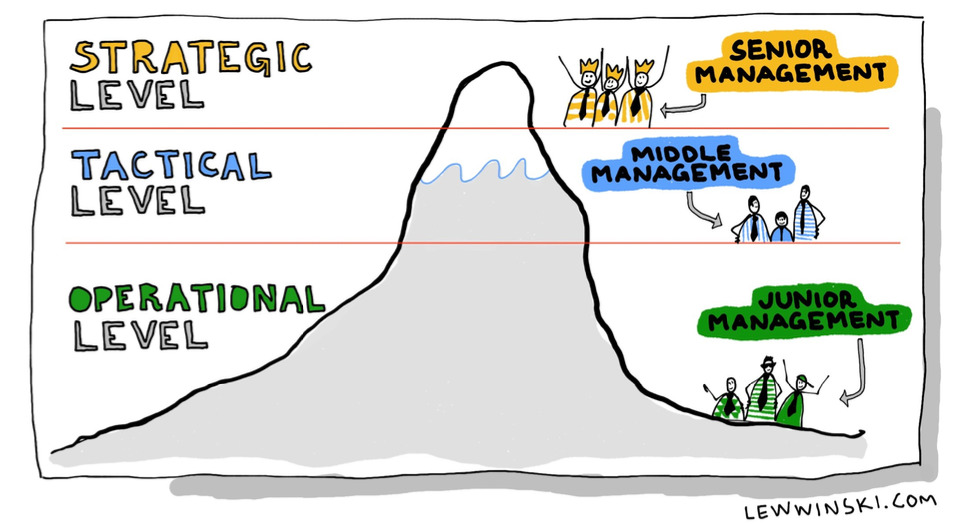
The top level of management is called strategic level. Decision-makers at this level are senior managers. They usually set the long-term goal and define corporate strategy, that determines the market in which the business operates (senior management). For example: “ten thousand students competitive one-million-RMB market of international high school education market in Beijing”. Describing a market is not an easy task, because it has a lot of characteristics (more about that in Unit 4), but once market is determined and clear, decisions and strategies are much easier to set.
The level of management in the middle of the hierarchy is called tactical level. Middle management is in charge of decision-making at that level and they usually determine generic strategy, that determines methods of achieving competitive edge. Competitive edge is “how our business is better than others”, “why would people buy from us, not from our competitors”. Middle managers are usually people who do most work in the company even though they do not get highest rewards. They are between two fires: they have a lot of subordinates on lower levels of the organisation and yet they are accountable to senior management.
The lowest level of the company is called operational level. This is a day-to-day level that is in charge of making goals, objectives, strategies and tactics happen on a daily basis. Junior management is in charge of decisions at that level and they determine operational strategy that defines what company needs to do on day-to-day routine level and how to make generic and corporate strategies happen.
As you can see, there can be overall GOST for the entire organisation, and at each level they an have their own GOST, specific to their level only. Vision and mission, however, as well as overall GOST are the same for everyone at all levels.
So, remember these sequences:
— strategic level — senior management — corporate strategy,
— tactical level — middle management — generic strategy,
— operational level — junior management — operational strategy.
Now it’s time to warn you again that all the information above is from the perfect theoretical world where everyone follows the same rules and uses the same terminology which is, of course, not the case in reality. Very often, businesses do not distinguish between the three different strategies, very often “generic” and “corporate” are used synonymously, very often “business strategy” is what businesses call any of these three. And finally, strategies are not limited to these three. There are plenty of strategies that we will learn later in the course. A lot of them will come from the business tools. Be mindful of the theory and of its real-life interpretations and you’ll be the best decision-maker ever!
Now it’s finally time to talk about the common business objectives, which are actually the title of this part of chapter. I hope you understand that all this information above is essential for understanding the common business objectives. Without this info, common objectives are quite meaningless. So, common business objectives:
— Profit — the difference between revenues and costs (more in Unit 3).
— Growth — achieving an increase in one/some of the following: market share, total revenue, profit, capital employed, size of workforce, volume of output. Ultimately, growth results in higher profits (more in 1.5).
— Shareholder value refers to what shareholders get through company’s ability to increase market capitalisation (and thus share price) and/or dividends (through increasing the profits) (more in Unit 3).
— Ethical objectives refer to the tasks/targets that go beyond profit-making and are in line with moral behaviour, sustainability and CSR (more later in this chapter).
I love it how we had to go through about 1000 words before we could read one paragraph that tells us that more information is yet to come, haha. Believe me, we needed it. If you made sense of everything you read, you learnt a lot of important stuff about business and decision-making that you can go ahead and use right now. Thanks for your efforts, appreciate that!
iii. STRATEGIC AND TACTICAL OBJECTIVES
Discuss strategic and tactical objectives (AO3)
As you already know from the previous chapter, there are three levels in an organisation: strategic, tactical and operational. There are objectives at each level. Strategic objectives apply to the entire organisation, and they determine tactical objectives and operational objectives. Have a look at the examples of all three types of objectives in Figure 5.
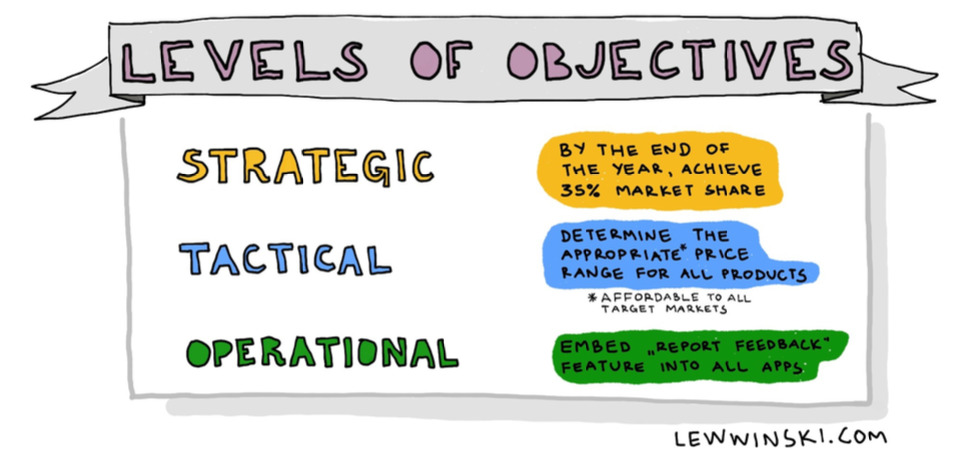
Based on the second (the most important) part of the chapter, you should have no problem understanding the levels of management and levels of objectives, but our objective for this part of chapter goes beyond understanding. Our objective here is to learn to evaluate strategic and tactical objectives. So, let’s cut to the chase.
I am going to teach you two ways to evaluate strategic and tactical (and actually any other) objectives. The first way is called SMART, the second one is called SLAP. SMART objectives is a super cool super useful rule that can apply to any objective (not only business-related). This rule was designed by Peter Drucker, whose name you have to know and whose books you are highly encouraged to read if you are interested in Business Management. The SLAP rule is what personally I use to teach my students how to answer AO3 evaluation questions. I don’t really remember how I learnt about SLAP and who invented this rule, but all of my colleagues who teach Business Management know and love this rule. I wish I knew who to give credit to.
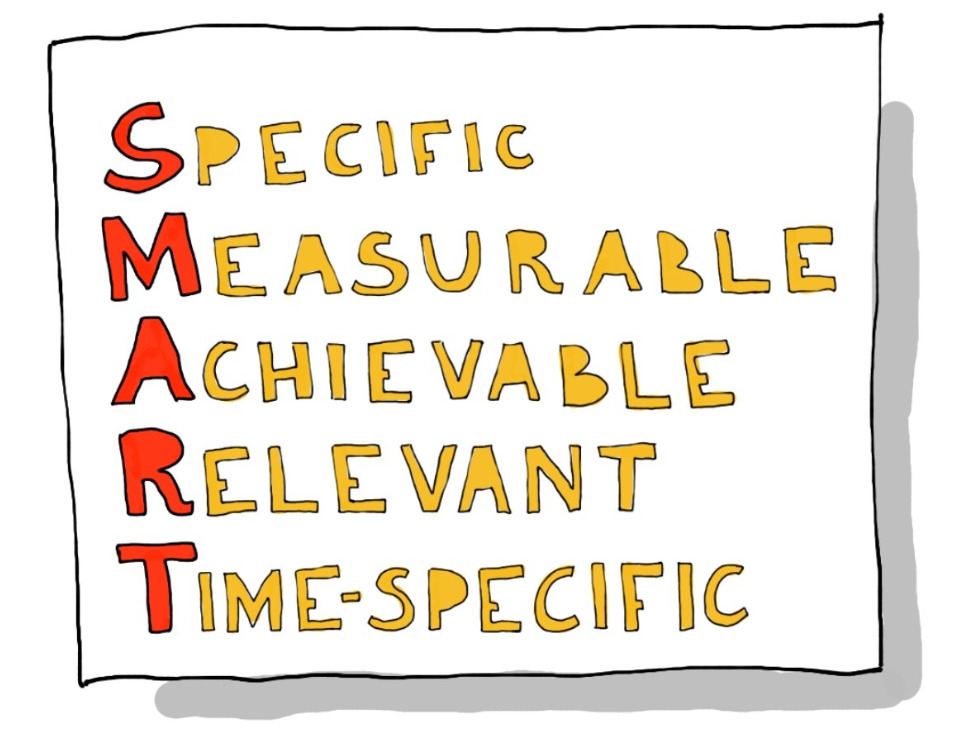
As you can see from the Figure 6, a SMART objective is the one that is specific, measurable, achievable, relevant (or realistic) and time-specific. My favourite elements are measurable and time-specific because they change objective dramatically from a vague unclear statement into a concrete target. For a video games developer company, objective “to be the best” is not SMART, but “by the end of this year reach 35% market share in each of the main markets” is SMART. I like this rule for its simplicity and significance.
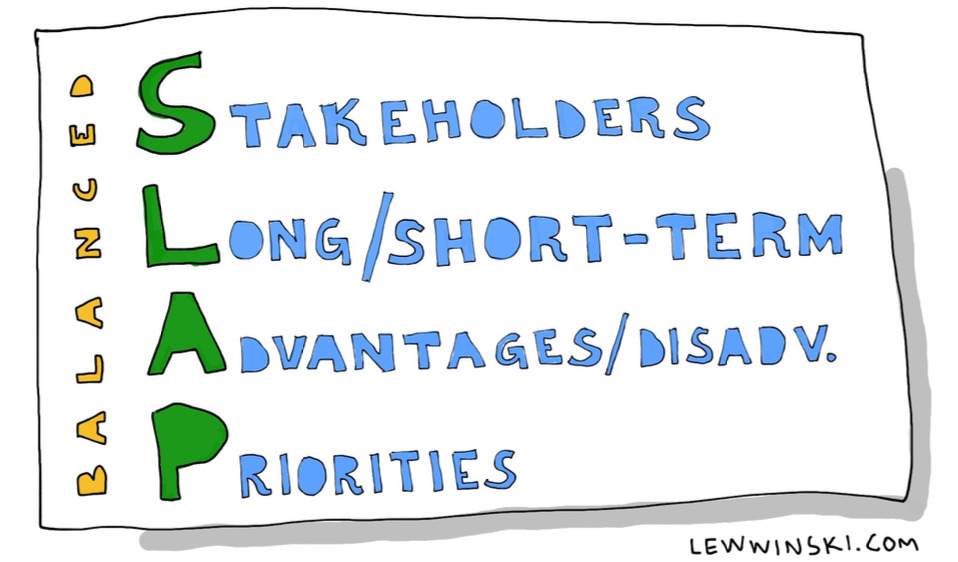
With regards to SLAP, this rule applies to any Business Management AO3 question, not just to objectives. These four letters refer to four ideas/paragraphs that you might utilise/write in your AO3 response:
1. “S” (stakeholder implications): in this paragraph you can consider implications to an internal stakeholder group and compare these implications to those of another external stakeholder group, or you can simply analyse costs and benefits to one stakeholder group. Make sure your analysis is balanced (on the one hand… on the other hand…). We’ll learn stakeholders in more detail later in 1.4, but all you need to know now is that stakeholders are people or groups of people who are interested in and affected by a certain business. Internal stakeholders are within a business (shareholders, mangers, etc), external stakeholders are outside of the business (local community, government, etc).
2. “L” (long-term and short-term implications): you can compare and contrast the short-term and long-term effects of a certain advantage or disadvantage, or of costs and benefits, or of an implication. What makes your analysis balanced is the contrast between short-term effects and long-term effects.
3. “A” (advantages and disadvantages): here you can choose any perspective and simply consider pros and cons of it.
4. “P” (priorities): in this paragraph you conclude the analysis in the paragraphs above by making a judgement against the priorities, (mission, or vision, or an assumption).
It’s okay of you feel confused now. This sort of thing is better to be explained face-to-face with step-by-step guidance, so your teacher should be of great help. One more thing I can do to help you better understand SLAP is provide an example.

Let’s say Jin is running a coffee shop in her neighbourhood and she set the following objective: “become the best coffee shop in the neighbourhood”. Our task is to evaluate this objective. We are going to use SMART and SLAP for evaluation.
SMART: If we apply SMART rule to Jin’s objective we’ll see that objective is achievable and relevant/realistic, but not specific, measurable and time-bound.
Stakeholder implications (S): If she sets this objective, Jin (an internal stakeholder) will have to focus on developing a unique selling point to compete with big coffee chains. Community (external stakeholder) might benefit from the personal touch and customisation based on their needs, that large coffee chains aren’t able to offer.
Long-term and short-term implications (L): In the short term, adopting this objective will result in investment that leads to negative net cash flow. In the long term, if the objective is reached, Jin’s coffee shop can enjoy local monopoly power (monopoly, but only within the neighbourhood).
Advantages and disadvantages (A): On the one hand, organic growth, less risk. On the other hand, “short-termism”, which means that the objective does not have long-term orientation.
Priorities (P): Since Jin just wants to keep herself busy at daytime and make some cash to support her family, objective is appropriate but it needs to be made SMART in order to make it more attainable and quantifiable. It’ll be easier to measure success with a SMART objective.
Let’s summarise this part of chapter. You know the levels of management and you know the levels of objectives in an organisation. You’re expected to learn how to assess only strategic and tactical objectives, and now you know that tools like SMART and SLAP can help you do that effectively. Well done!
iv. CORPORATE SOCIAL RESPONSIBILITY (CSR)
Examine corporate social responsibility (CSR) (AO3)
Corporate social responsibility (CSR) is a commitment to benefiting (or at least not harming) the society and environment that is achieved through setting ethical objectives. CSR is not a legal obligation, it is a positive trend that businesses set. It means that if some businesses do not commit to CSR, they are not doing anything illegal, but it’s not cool. Nowadays nearly all businesses try to adhere to CSR principles: sometimes it’s superficial, sometimes it underpins the entire organisation, but it is really a big trend nowadays.
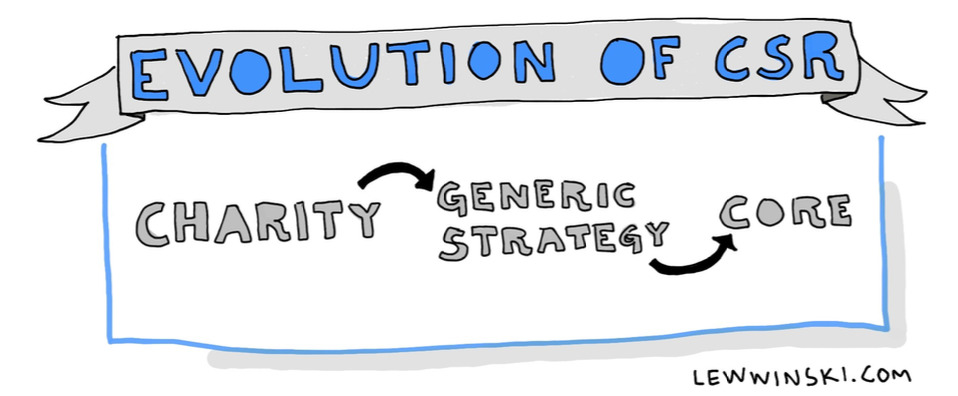
There is no agreement about when CSR started. Actually, some businesses were socially responsible even centuries ago, but it was not called “CSR” back then. CSR as a business term emerged around 1960s. Originally, CSR was similar to occasional charity (businesses just donated some money for good causes every once in a while to look good), then it turned into generic strategy (CSR was a way of gaining competitive advantage: “all businesses are just earning money, but we really care about people”), and nowadays CSR evolved into a principle that underpins all levels of the business (whenever business decisions are made, they are analysed through the prism of CSR: “what is the benefit that this decision will bring to the community? Is there any harm that comes with this decision?”).
There are several reasons why businesses commit to CSR. As I mentioned earlier, sometimes it’s just to enhance the brand image (“greenwash” the company), sometimes it’s a business strategy (criterion for decisions), sometimes it’s pure altruism (just a desire to help people), especially when it comes to social enterprises and NPOs. Regardless of the reasons, even though some businesses only do it for commercial reasons, it is a positive trend that puts extra pressure on businesses and prevents them from careless decisions that might harm the environment and local communities. This CSR trend impacts supply chain and all stakeholders and pushes all of them to be responsible “corporate citizens”. Nowadays, especially in developed economies, CSR is not an exception. An exception is its absence.
With regards to evaluation of CSR, some of the advantages of it are improved brand image, increased customer loyalty, staff retention and an extra incentive to join the business for potential job seekers. On the other hand, CSR can be just PR (public relations) trick, it is subjective and impossible to measure and it can increase costs (compliance costs — costs of being ethical, that we talked about in 1.2).
Look back at class objectives. Do you feel you can do these things?
— Distinguish mission and vision statement (AO2)
— Analyse common business objectives: growth, profit,
shareholder value, ethical objectives (AO2)
— Discuss strategic and tactical objectives (AO3)
— Examine corporate social responsibility (CSR) (AO3)
Make sure you can define all of these:
1. Vision statement
2. Mission statement
3. Goal
4. Objective
5. Strategy
6. Tactic
7. GOST
8. Strategic level
9. Tactical level
10. Operational level
11. Senior management
12. Middle management
13. Junior management
14. Generic strategy
15. Corporate strategy
16. Operational strategy
17. Profit
18. Growth
19. Shareholder value
20. Ethical objectives
21. Strategic objectives
22. Tactical objectives
23. Operational objectives
24. SMART
25. Corporate social responsibility (CSR)
Check out these resources to boost your BM knowledge and skills:
— boosty.to/lewwinski
— tiktok.com/@lewwinski. business
— youtube.com/@lewwinski
Look for Lewwinski or Lewwinski Business on other social media!
1.4 Stakeholders
Class objectives:
— Distinguish internal and external stakeholders (AO2)
— Discuss stakeholder conflicts (AO2)
The main point of this chapter is to learn a very easy and very important concept.
i. INTERNAL AND EXTERNAL STAKEHOLDERS
Distinguish internal and external stakeholders (AO2)
Stakeholders are people or organisations who affect or are affected by business decisions and/or have an interest (stake) in the operation of a particular business. “Stake” in “stakeholders” does not necessarily refer to a portion of shares in a particular company, that we learnt earlier in chapter 1.2. Here it refers to interest in operations of a particular business. If I had to coin this term, I would call stakeholders “interest-holders”.
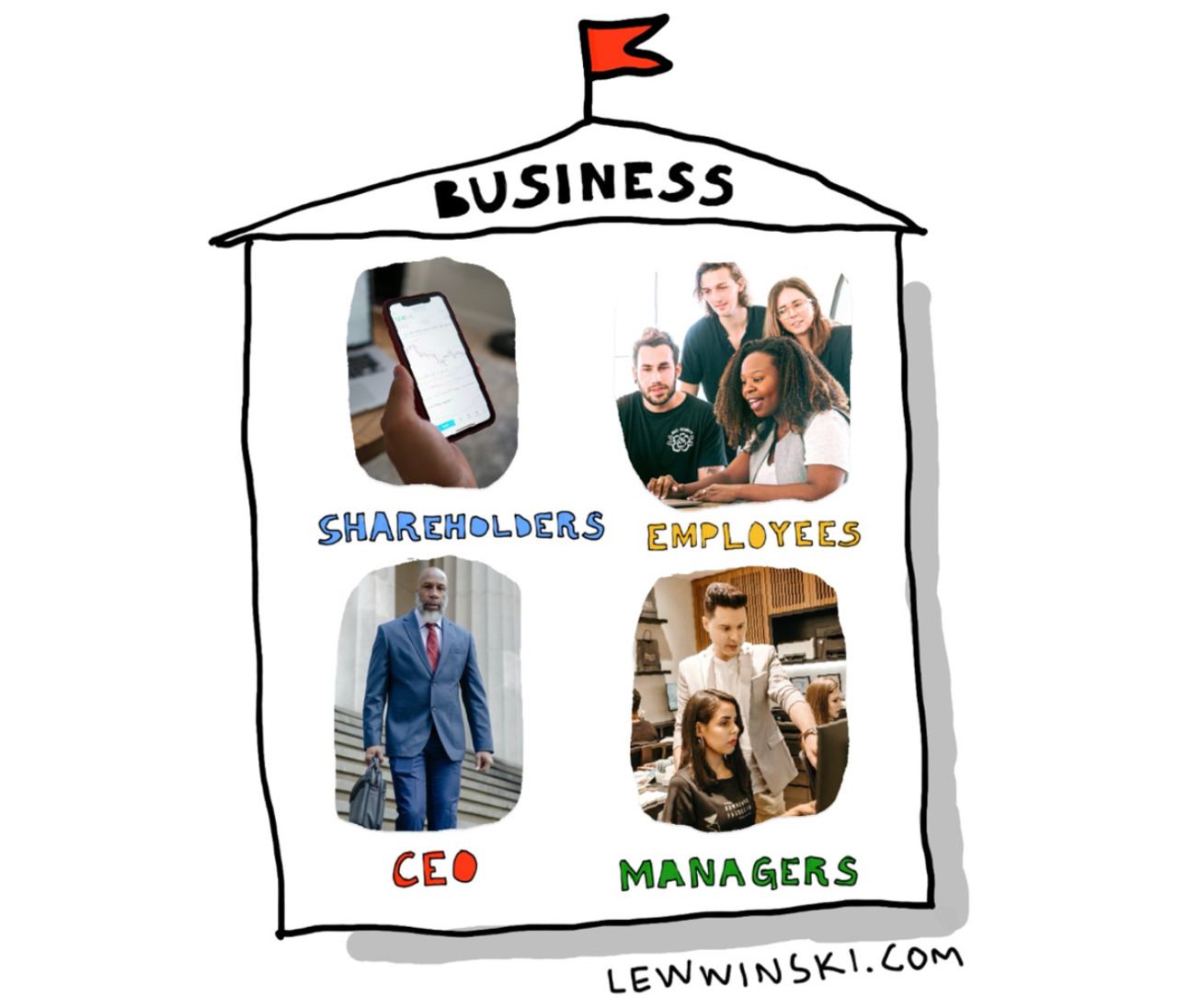
Stakeholders can be internal and external. Internal stakeholders are the ones that are inside the business. Let’s see some examples of internal stakeholders and examples of their common interests and objectives.
— Shareholders usually want to maximise shareholder value (more on that in chapter 1.3).
— Managers usually want to achieve their objectives in the shortest time and at the lowest possible costs.
— Employees usually want good working conditions, meaningful work and maximum pay for minimum effort.
— CEO usually wants to keep shareholders and board of directors (BOD) happy.
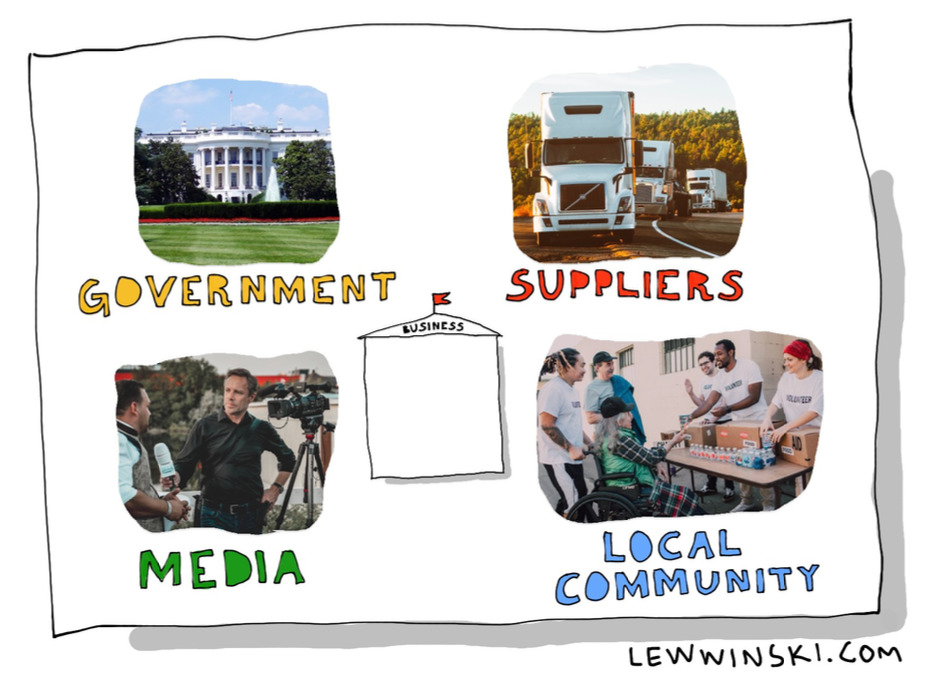
External stakeholders are the ones that are outside the business. Let’s see some examples of external stakeholders and some examples of their common interests and objectives.
— Government usually wants stable tax revenues, compliance with law and voters’ support.
— Media usually wants good stories that readers/viewers will like, regardless of whether the stories are positive or negative.
— Local community wants good employment opportunities in their area and safe environment.
— Suppliers usually want constant orders and short credit period (more about that in Unit 3).
In addition to internal and external stakeholders, there are also some groups that are hard to categorise. For example, there is no agreement whether competitors should be considered stakeholders at all… They are affected by the business, but do they really have an interest in operations of the business they compete with? In addition to that, employees who live in the local community are internal and external at the same time. So, from this perspective, stakeholder, as a business management term, is not entirely clear.
I also have to remind you that stakeholder and shareholder is not the same thing and please beware of spelling. In my experience, some students use these words interchangeably sometimes and it might result in major misunderstanding. Shareholders are stakeholders, but there are also other stakeholders, in addition to shareholders. If it doesn’t make sense, please read this chapter again or talk to your teacher.
ii. STAKEHOLDER CONFLICTS
Discuss stakeholder conflicts (AO2)
As you learnt from the previous section of this chapter, stakeholders have different interests and they might pursue different objectives. Stakeholder conflict happens when there is a clash of stakeholder interests, i.e. when different stakeholder groups want different, sometimes opposite, things. For example, employees usually demand higher wages and lower working hours, but managers demand the exact opposite: a lot of work for little payment.
It is important for businesses to keep all stakeholders satisfied and to resolve conflicts. If conflicts occur, there are two visual tools (not included into the Toolkit), that can help managers to resolve stakeholder conflicts: power-interest matrix and stakeholder analysis. Let’s discover each of them in more detail.
Power-interest matrix (or power-interest model, or stakeholder mapping) is a visual tool that helps to break down all stakeholders into 4 groups and prioritise the resolution of conflicts. There are two axes in this matrix — power and interest — hence the name.
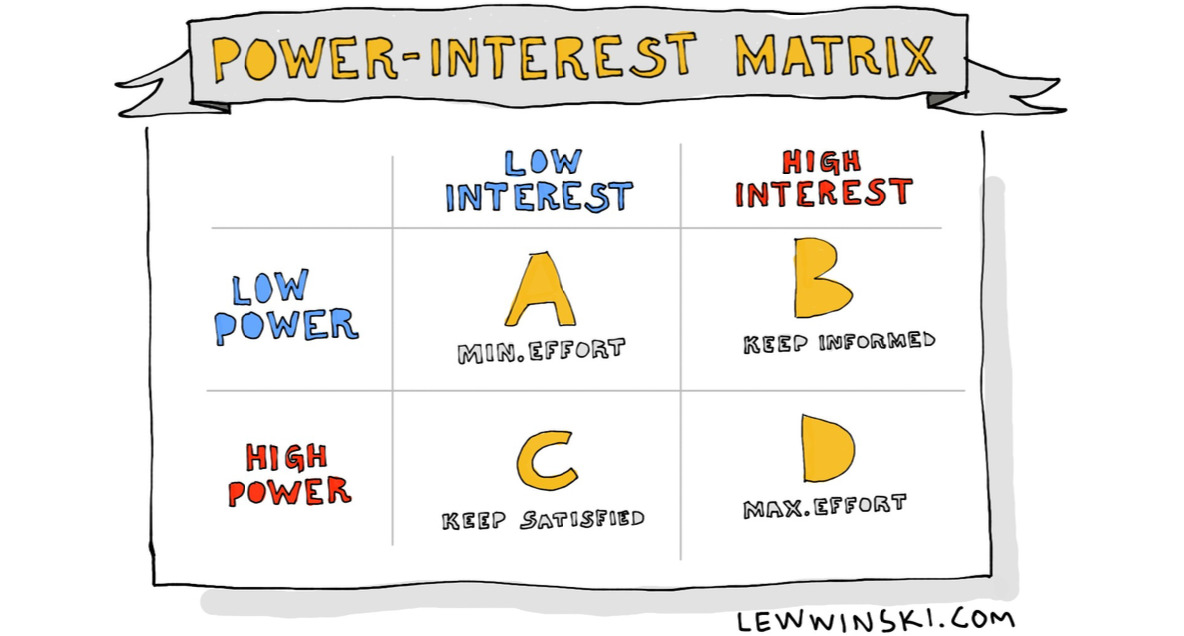
Power of decision-making and interest in business can be high and low, which gives us four stakeholder groups.
A. Low interest, low power. This group requires minimum effort. Usually local community is in this group. They don’t really care about businesses as long as there are employment opportunities and the environment is safe.
B. High interest, low power. This group should be kept informed. Usually customers are in this group. They do care a lot about the products but they don’t have much direct influence on business decision-making. Keeping them informed of the business practices and decisions usually prevents stakeholder conflicts.
C. Low interest, high power. This group should be kept satisfied. Usually government is in this group. Individual businesses are not really in their sphere of interest but they do have a lot of power that impacts business decision-making.
D. High interest, high power. This group requires maximum effort. Usually shareholders are in this group. They have direct interest in business and they are the key decision-makers on strategic level.
Please keep in mind that examples that of stakeholders in groups A, B, C, and D that I provided above are examples! It doesn’t mean that it’s always like this. It all depends on a particular conflict. In my class, I usually divide students in groups and let them role-play a stakeholder conflict using power-interest matrix and sign a binding contract by all involved parties in the end.
The second visual tool is called stakeholder analysis — a visual representation of the proximity to decision-making in a particular stakeholder conflict.
The main advantage of this tool is that it can help you (manager) see easily who the key decision-makers are. However, this analysis is usually subjective and one analysis cannot be applied to two different conflicts. Again, stakeholder groups that I mentioned in the picture above are just for reference. It doesn’t mean that it’s like this in all stakeholder conflicts.
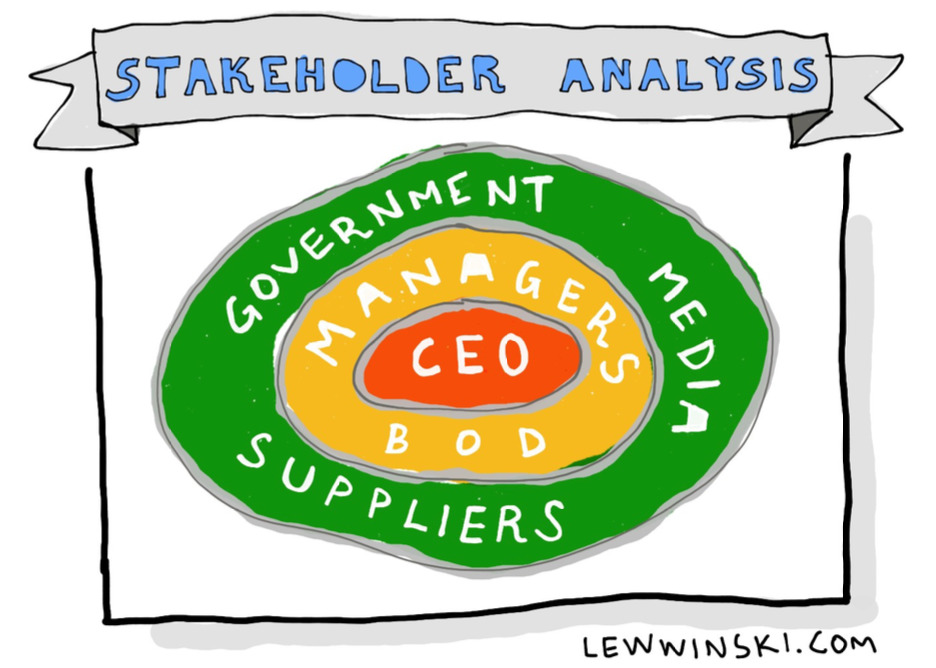
That’s it. You know who stakeholders are, you know that they can be internal and external, you know what they usually want, you know what causes conflicts between them and you know some ways that can help resolve them.
Look back at class objectives. Do you feel you can do these things?
— Distinguish internal and external stakeholders (AO2)
— Discuss stakeholder conflicts (AO2)
Make sure you can define all of these:
1. Stakeholders
2. Stake
3. Internal stakeholders
4. Shareholders
5. Managers
6. Employees
7. CEO
8. External stakeholders
9. Government
10. Local community
11. Media
12. Suppliers
13. Competitors
14. Stakeholder conflict
15. Power-interest matrix/model (stakeholder mapping)
16. Stakeholder analysis
Check out these resources to boost your BM knowledge and skills:
— boosty.to/lewwinski
— tiktok.com/@lewwinski. business
— youtube.com/@lewwinski
Look for Lewwinski or Lewwinski Business on other social media!
1.5 Growth and evolution
Class objectives:
— Distinguish internal and external economies and diseconomies
of scale (AO2)
— Distinguish internal and external growth (AO2)
— Evaluate the reasons for businesses to grow (AO3)
— Evaluate the reasons for businesses to stay small (AO3)
— Compare and contrast external growth methods (AO3)
The main point of this chapter is to understand what growth is and how businesses can grow, if they actually want to… There are certainly benefits of staying small. Success is not synonymous to growth.
i. ECONOMIES AND DISECONOMIES OF SCALE
Distinguish internal and external economies and diseconomies of scale (AO2)
As usual, before talking about the central concept of the chapter, we have to figure out the meaning of something else. This time, this “something else” is economies and diseconomies of scale and once you understand what that is, you will see how it relates to growth and why it’s important.
Economies of scale (EOS) is the decrease of the average costs of production as an organisation increases the scale of operations and improves its production efficiency. Simply put, economies of scale mean this: the larger your business gets, the cheaper it is to produce one item of your product. Diseconomies of scale (DOS) is the exact opposite of economies of scale, they happen when your average costs (costs per unit of output) increase as your company increases its scale of operations. Simply put, the larger your business gets, the more expensive it is to produce one item of your product.
For example, you squeeze oranges and sell fresh orange juice. Every day you only buy 10 kilos of oranges from local farmer and he charges you $2 per kilo. Then you create a partnership with your friends and you start selling orange juice all over town. Now you need 50 kilos of oranges a day, so you ask the farmer to give you a discount, because now you buy five times more! He agrees and now he charges you $1,5 per kilo. Now your business has grown and, at the same time, producing one litre of fresh orange juice has become cheaper than before forming a partnership with friends. Congratulations, you have just exploited economies of scale!
If you look back at the definition of economies of scale above, you will see more business terms in it:
1. costs,
2. scale,
3. efficiency.
Let’s define them too in order to understand of economies of scale like a boss.
Cost is an amount of money that needs to paid for producing the output. Costs (C) can be average (A), total (T), fixed (F) and variable (V). Fixed are the ones that remain the same regardless of how much you produce (for example, internet fee or electricity fee) while variable costs are the ones that change depending on how much you produce (for example, the costs of raw materials, such as oranges in the example above). More about costs in Unit 3. One more variable that you need to know is quantity (Q) — the amount of output that you produce. Now look at the equations below, they should make sense to you:
AC = TC ÷ Q
AC = AFX + AVC
AFC = TFC ÷ Q
AVC = TVC ÷ Q
Do they? If not, please re-read the previous paragraph.
Scale of operations refers to how much output is produced and how big the production facility is. For example, there are two factories (X and Y) and each of them produces 100 chairs a day, but factory X has 10 employees and they use 10 machines, while company Y has 8 employees that use 8 machines. Apparently, factory Y’s scale of operations is smaller, and yet their output is the same as in factory X, which means that it’s more efficient.
Efficiency in this chapter (there will be slightly different definitions in Unit 5) means the decrease of AC (average costs) that is caused by changing any of the variables above: scale, fixed costs (FC), variable costs (VC), or total costs (TC), or keeping costs the same but increasing the quantity of output produced (Q).
Now you know pretty much everything about economies and diseconomies of scale in general and, hopefully, the graph below will make perfect sense to you:
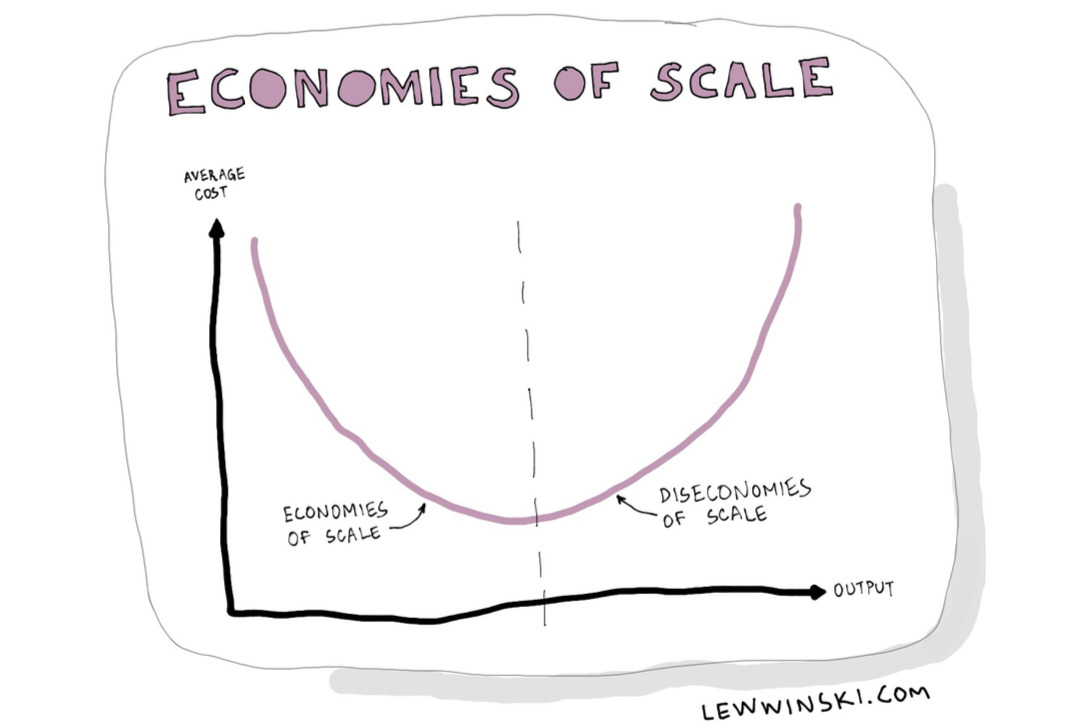
Economies and diseconomies of scale can be internal and external. Internal EOS and DOS refer to the business only, they happen within the business. External EOS and DOS refer to the entire industry, to all the businesses that produce similar products, they are outside the single business but within an industry. Let me give you four examples of each type of EOS and DOS but please keep in mind that there are more than 4, I’m just providing the most common and important (in my opinion) examples. Also, bear in mind that the ones that are in bold are also business terms, so try to use them in your business-related conversations, class discussions and exam-style answers.
Internal economies of scale:
— Purchasing EOS happen when suppliers provide a discount in exchange for buying more. The fresh orange juice example with farmer’s discount is an example of this type of EOS.
— Marketing EOS occur when a company increases marketing budgets to advertise extensively so that customers purchase more. For example, Coca-Cola spend billions of dollars on advertising and if you think about it, probably you see Coca-Cola logo at least once a day… As a result, people always remember about Coke and are constantly reminded about it, which results in higher sales, which means that average costs of production fall.
— Risk-bearing EOS happen when a firm diversifies its product portfolio, i.e. produces more things in order to have a Plan B, C, etc. In this case, if product A is not sold well, then the sales of product B or C can compensate for that and thus reduce the costs of production.
— Managerial EOS occur when a company hires a really experienced and efficient manager who saves costs and who works as efficiently as several regular managers. This, again, results in the decrease of average costs of production.
External economies of scale:
— Technological progress: new inventions that everyone benefits from. For example, a new method of chair manufacturing is invented and all the furniture companies use it and save costs.
— Educated workforce: higher education levels in the country benefit all businesses, because additional training and supervision is not required.
— Regional specialisation means a certain region focuses on producing a certain thing (for example, Suzhou for silk, Hollywood for movies, Silicon Valley for IT, Bali for surfing). It means that all businesses in that region can share infrastructure, delivery costs, can negotiate better prices with suppliers, etc. Even though these businesses are competitors, why not cooperate on certain things that benefit everyone?
— Infrastructure: roads, power supplies, transportation networks, etc. The better the infrastructure, the shorter the delivery times are and the more efficient all businesses are.
Internal diseconomies of scale:
— Bureaucracy: too many procedures and paperwork may increase
administrative costs.
— Inert (not adaptive) working culture: change does not take place and organisation stagnates, resulting in outdated processes and inefficiencies.
— Complacency (when company does not have a clear picture of reality and is overconfident in its success): for example, Kodak and Nokia thought they will remain market leaders and digital cameras and touch-screen smartphones are just a short trend in fashion. Eventually, they were too complacent and failed to succeed in competition.
— Marketing DOS: marketing failure that impacts the entire product portfolio and results in low sales. For example, there was a scandal in China when D&G created an offensive ad where a Chinese lady is eating pizza with chopsticks. That resulted in a fall in sales revenue and having to apologise to the people of China.
External diseconomies of scale:
— Infrastructure: roads, power supplies, transportation networks, etc. We’ve already talked about it, but from the positive perspective. If infrastructure leaves much to be desired, it can have the opposite effect in the entire industry and result in inefficiencies for all…
— Educated workforce: higher education levels in the country result in increased labour costs for all. We talked about this one too. On the one hand, educated people are great, but on the other hand they demand higher salaries. That is why in many developed economies most of the secondary sector activities are outsourced to developed economies (if this sentence doesn’t make sense, please review chapter 1.1).
— Increased rents: as cities and their populations grow, rent increases. Shanghai was basically a small town about 100 years ago, so imagine how cheap land in Shanghai was back then and how expensive it is now when it turned into a megapolis.
— Pollution: even though costs might not apply to businesses, employees and local community are affected negatively which will eventually have a detrimental effect on all businesses in a given industry…
Once again, there are more than 4 types in each category. Please keep in mind that my examples are not prescriptive, they are just examples that I personally think are important.
Now, before we move on, think of a question: “How to avoid diseconomies of scale as company grows? What can be a potential remedy?” There is an answer to this question in this chapter. I hope you’ll find it!
ii. GROWTH
Distinguish internal and external growth (AO2); Evaluate the reasons for businesses to grow (AO3); Evaluate the reasons for businesses to stay small (AO3)
First of all, business growth refers to the increase in size of the business. Judgements about business growth only make sense when they are relative, i.e. when you can make comparisons between similar businesses. Size of the business can be measured by several things:
— Market share — the portion of company sales in total sales in the industry (more in Unit 4).
— Revenue — price multiplied by quantity of items sold (more in Unit 3).
— Profit — the positive difference between revenue and costs (more in Unit 3).
— Workforce — the number of employees (more in Unit 2).
— Capital employed — investment that in used for operating the business (more in Unit 3).
Growth can be internal (organic) and external (inorganic). Internal (organic) growth happens when businesses grow using their own resources and capabilities. For example, you open a cafe and, after one year, you build the second floor and add 20 more tables. External (inorganic) growth happens when businesses deal with other external organisations. For example, you open a cafe and one year later you buy another cafe in another part of town from another entrepreneur.
Internal growth does not have any types, it just means that business is growing naturally. Some of the Ansoff Matrix strategies (see the Toolkit) can actually be examples of internal growth. External growth has several types/methods, that are discussed in the next part of this chapter. Some of the main characteristics and key differences between organic and inorganic growth are summarised below.
Internal (organic) growth:
— Businesses grow using their own resources and capabilities
— Low risk
— Lower potential benefits
— Slow and steady
— Relatively inexpensive
— Retention of full control
— Strengthens corporate structure
External (inorganic) growth:
— Businesses grow by dealing with other external organisations
— High risk
— Higher potential benefits
— Fast and rapid
— Requires significant finance
— Hard to control
— Challenges/weakens corporate structure
It is often assumed that all businesses want to grow and become large, and it is believed that large business is an indicator of success. In fact, this is not always true. There are certain benefits and reasons for businesses to grow as well as reasons and benefits for businesses to stay small.
Reasons to grow:
— Economies of scale: see the first part of this chapter if you forgot what it means.
— Lower prices: again, because you can lower the costs due to economies of scale you can charge lower prices and attract more customers pushing your competitors out of the market.
— Increased market share: this would be the result of lower prices and decreased competition.
— Brand recognition: the more customers you have, the more people know and recognise your brand (more about it in Unit 4)
— Higher revenues: the more people buy, the more money you make.
Reasons to stay small:
— Prestige/uniqueness: small businesses are perceived as something upscale, special, VIP, not for all, that creates a sense of uniqueness and prestige among customers.
— Adding more value (reminder: see 1.1 to review what added value is): this sense of uniqueness and prestige can allow businesses to charge higher prices, thus increasing the added value.
— Higher prices & profit margins: higher added value results in greater difference between revenues and costs of production, even though costs do not increase.
— Retaining control: smaller businesses are easier to manage and it is more likely for them to avoid internal diseconomies of scale.
— Less competition: smaller businesses usually specialise on a specific market niche and competition there is limited, as opposed to mass market where large businesses dominate.
This way or the other, large or small, all of these reasons above eventually result in higher profits. So, one way is not better than the other, these are just two different approaches to maximise profitability.
A typical example of a large business would be Coca-Cola. Their business model only makes sense when Coke is a mass market product. Without economies of scale and large scale of operations, it will not be sustainable. However, 37 Signals — the company that created, among other products, Basecamp (it’s like ManageBac, but for businesses) and Ruby on Rails (it’s a programming language) — operates using a completely different business model. They are a very small company and yet extremely successful. They actually wrote a book called ReWork about an unconventional way of running a business that I eagerly recommend to read to all of my students.
iii. EXTERNAL GROWTH
Compare and contrast external growth methods (AO3)
Since you already know what external growth is, we’ll cut to the chase right away. There are four methods of external growth: M&As, joint venture, strategic alliance and franchising. I highly recommend you to copy the table in Figure 2 and fill it in as you read.
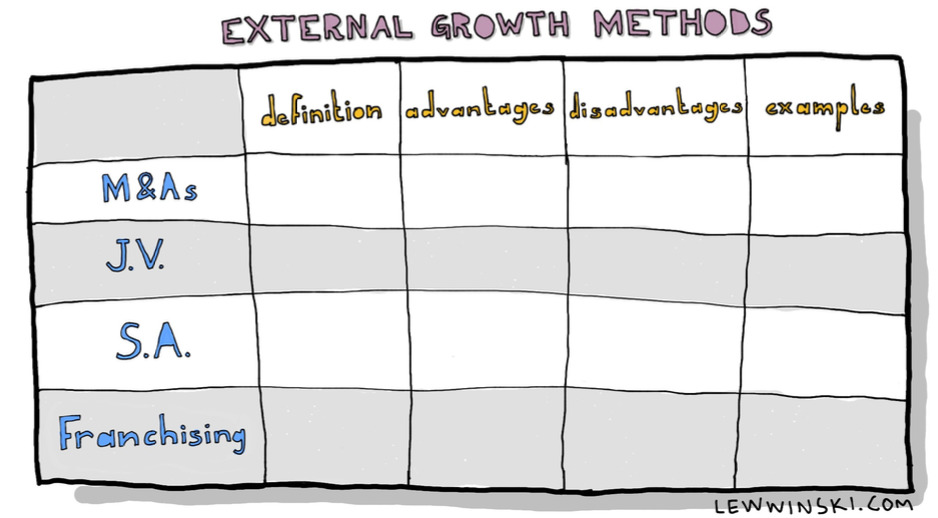
M&As refers to mergers and acquisitions. Merger means two or more companies forming one larger company (A + B = AB). An example of a merger could be ExxonMobil or Kraft Heinz. Acquisition (or takeover) happens when one company takes ownership of another company (A + B = A). An example of an acquisition could be Google taking over Android, or Disney taking over Pixar and Marvel. As you remember from chapter 1.2, privately held companies do not trade their shares on stock exchange, so it would be quite hard to take over a private company. With regards to public limited companies, their shares are traded on stock exchange and are available to everyone, which means that sometimes publicly held companies can be taken over even if they do not want that. This situation of undesired acquisition of a publicly held company is called a hostile takeover.
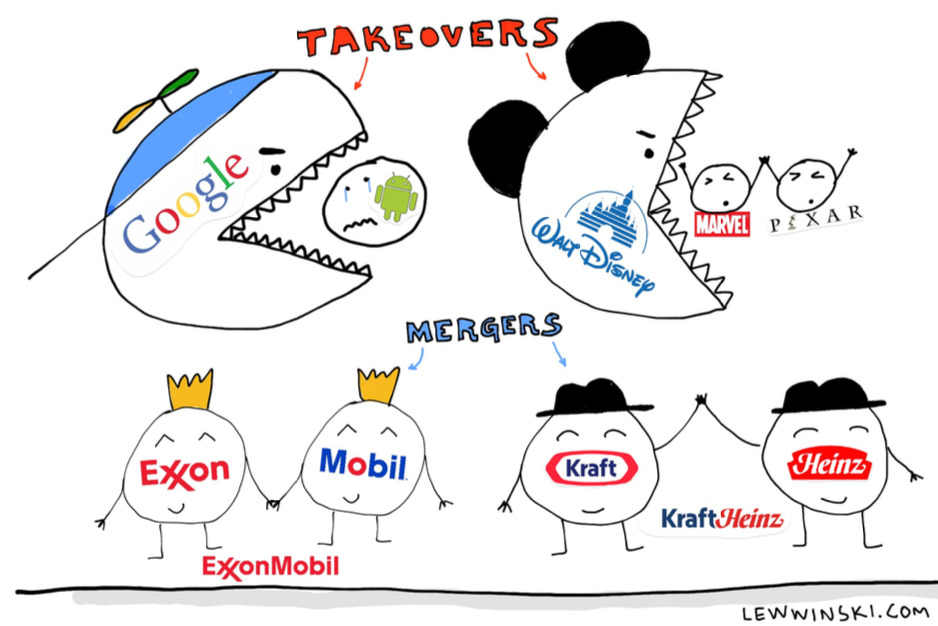
I hope you still remember what supply chain and sectors of economy are from chapter 1.2 because another way to express growth of a company through M&As is through the sectors of industry. This way of describing growth is called integration. It is not another method of external growth, we’re still talking about M&As here, but we are just adding a new perspective to M&As.
There are three types of integration:
— Horizontal integration: when M&As happen between companies in the same sector of industry. For example, a bank takes over another bank (both are in tertiary sector).
— Vertical forwards integration: when a company merges with or takes over a company from a “higher” sector of industry. For example, a car manufacturer (secondary sector) takes over a car dealership (tertiary sector).
— Vertical backwards integration: when a company merges with or takes over a company from a “lower” sector of industry. For example, a furniture shop (tertiary sector) merges with a furniture factory (secondary sector).
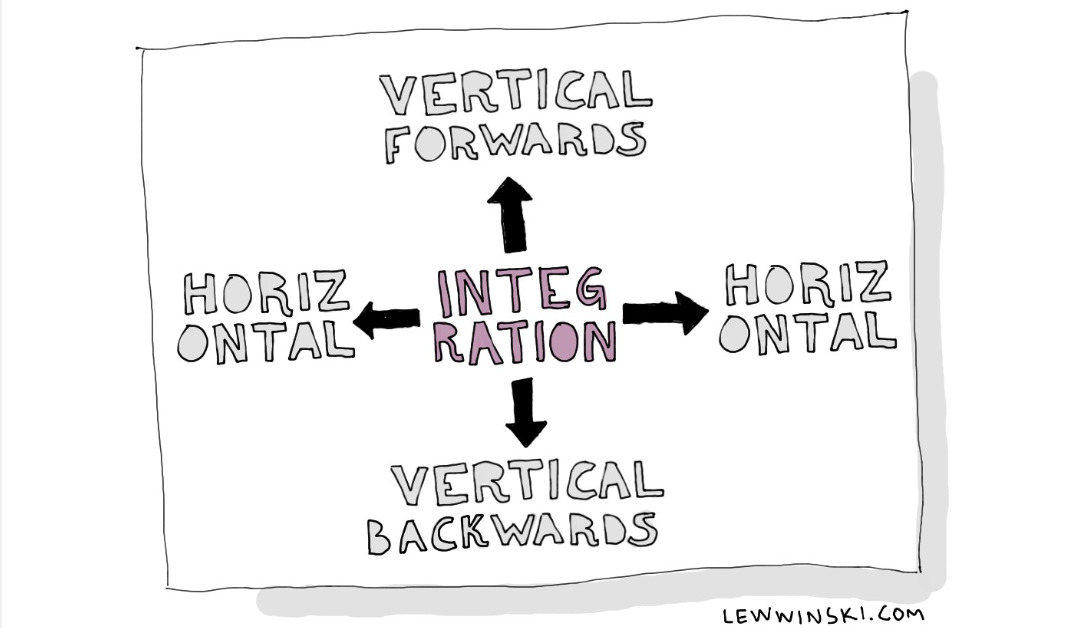
Another perspective to talk about M&As is to see whether acquisition or takeover happens between similar/related businesses or not. For example, even though a bakery that produces bread (secondary sector) merges with a bakery that sells it (tertiary sector), that would be vertical forwards integration between related businesses. Integration between unrelated businesses is called conglomerate merger (or conglomeration or diversification or conglomerate integration). An example of a conglomerate could be The Walt Disney Company that has businesses in media, entertainment, amusement parks, resorts and consumer products.
Some of the advantages of M&As include:
— Economies of scale (see part 1 of this chapter if you forgot what that is).
— Minimising risk (if one business fails, another one will back it up and act as Plan B).
— Synergy (when cooperation has more benefits than operating independently, when 2+2=5).
— Market leadership (being able to reduce competition and increase market share instantly).
Some of the disadvantages of M&As include:
— Managerial diseconomies of scale (see part 1 of this chapter if you forgot what that is).
— Cultural clash (each organisation has its own culture that might be very different from the other company involved in M&As, more about it in Unit 2).
— Increased government control and interference (large companies might face anti-monopoly issues that government has a strict control of).
— Redundancies (having to let people go (“lay off”), because two of everything might not be needed in a newly formed company. But these lay-offs are not free, people have to be paid severance pay before they leave because it is not their fault the company mo longer requires their service, more about it in Unit 2).
Joint venture is formed when two or more companies create a third company that operates for their mutual benefit (A and B create C). This newly formed company C is a real tangible business entity (unlike strategic alliances that we’ll talk about later). Sometimes joint ventures are formed even between competitors, because they might have several things that are worth cooperating on. For example, two drink manufacturers sharing a bottle factory, or two car manufacturers sharing an assembly line. Joint ventures can be temporary and only operate until the completion of the project (for example, The Channel Tunnel). Sometimes joint ventures are a government requirement and the only way to enter a foreign market. For example, in China, for a long time, that was the only way for foreign companies to enter the market — only by forming a joint venture with a Chinese counterpart (for example, BMW Brilliance). Very often, the costs and profits of a joint venture between two companies are split evenly: 50/50. In addition to examples above, Hulu is a joint venture of NBC and ABC.
Some of the advantages of joint ventures include:
— entry to foreign markets,
— synergy (same as in M&As),
— splitting the costs and risks,
— reduced competition.
Some of the disadvantages of joint ventures include:
— too much reliance on a partner,
— control and “final say” issues (having to agree on all decisions with a partner),
— having to share certain expertise (for example, some methods of production or some secret technologies).
Strategic alliance is a cooperation of two or more companies in certain aspects for their mutual benefits (A and B cooperate, C is not created). A new business entity is not created (unlike joint ventures). Similar to joint ventures, strategic alliances can happen between competitors because sometimes cooperation with competitors has benefits. Typical examples of strategic alliances could be SkyTeam and Star Alliance. Both of them are not companies, they are just systems to save miles for flying with certain airline companies that can result in discount when buying a ticket. The advantage of strategic alliances is splitting the costs only when necessary without a burden of creating a new business entity. The disadvantage is that strategic alliances are not really binding which prevents companies from serious commitments.
Franchising is a way of external growth whereby franchisor company allows other companies (franchisees) to sell their products and trade under its brand (franchise) in exchange for royalty payments (regular payments for using the franchise) and franchise fee (payment to “buy” the franchise). Examples are McDonald’s, KFC, Burger King, Subway, Cinnabon. Franchising is a great solution to avoid diseconomies of scale. Can you imagine if McDonald’s was one company and it had to manage every single restaurant in the world? That would be extremely difficult. It is much more efficient to establish the procedures and let franchisees run the business under strict guidelines.
Some of the advantages of franchising are rapid growth without jeopardising control over brand and low risk for franchisees because they only have to deal with operations. Some of the disadvantages are having to rely on franchisees and putting brand at risk (from franchisor’s perspective), as well as having to share profits with franchisors (from franchisee’s perspective).
As a brain exercise, think of several (let’s say 7) of your favourite companies and suggest an ideal “partner” for them for each of the 4 external growth methods. For example, if Muji had to merge with another company, what would be the best company to merge with and why? How about an ideal company to be taken over by Muji? An ideal company to have a joint venture and strategic alliance with? And would it be a good idea for Muji to operate as a franchise and why?
Look back at class objectives. Do you feel you can do these things?
— Distinguish internal and external economies and diseconomies
of scale (AO2)
— Distinguish internal and external growth (AO2)
— Evaluate the reasons for businesses to grow (AO3)
— Evaluate the reasons for businesses to stay small (AO3)
— Compare and contrast external growth methods (AO3)
Make sure you can define all of these:
1. Economies of scale
2. Diseconomies of scale
3. Costs
4. Fixed costs
5. Variable costs
6. Total costs
7. Quantity
8. Average costs
9. Cost per unit
10. Scale of operations
11. Efficiency
12. Internal economies of scale
13. External economies of scale
14. Internal diseconomies of scale
15. External diseconomies of scale
16. Purchasing EOS
17. Marketing EOS
18. Risk-bearing EOS
19. Managerial EOS
20. Regional specialisation
21. Inert working culture
22. Marketing DOS
23. Business growth
24. Business size
25. Market share
26. Revenue
27. Profit
28. Workforce
29. Capital employed
30. Internal (organic) growth
31. External (inorganic) growth
32. Brand recognition
33. M&As
34. Acquisition (takeover)
35. Hostile takeover
36. Integration
37. Horizontal integration
38. Vertical forwards integration
39. Vertical backwards integration
40. Conglomerate merger (conglomeration / diversification /
conglomerate integration)
41. Synergy
42. Joint venture
43. Strategic alliance
44. Franchising
45. Franchise
46. Franchisor
47. Franchisee
48. Royalty payments
Check out these resources to boost your BM knowledge and skills:
— boosty.to/lewwinski
— tiktok.com/@lewwinski. business
— youtube.com/@lewwinski
Look for Lewwinski or Lewwinski Business on other social media!
1.6 Multinational companies/MNCs
Class objective:
— Discuss the impact of MNCs on the host countries (AO3)
The main point of this chapter is to understand that MNCs and globalisation are interrelated and that both of them can be an opportunity and a threat at the same time.
i. MULTINATIONAL COMPANIES
Discuss the impact of MNCs on the host countries (AO3)
Multinational/transnational company (MNC) — is any company that operates in two or more countries. Even though usually MNCs are huge corporations, it is not required to be “huge” to be considered an MNC. What matters here is the fact that a company operates is two or more countries.
Some of the reasons why companies might prefer to enter foreign markets and become multinational are listed below:
— Increased customer base: the more countries, the more people to sell to.
— Cheaper production costs: in developing and less developing economies, labour costs are usually lower. That was one of the reasons why in the past 50 years many companies entered Chinese and Indian markets and relocated their production to these countries.
— Global economies of scale: modern economy goes beyond the country borders. Many countries and regions are interrelated. The same is true about economies of scale: some of them can only happen on a scale, larger than one country.
— Avoiding protectionism: very often, the only way to avoid protectionism (measures that the government takes to protect local economy, for example tariff and quota) in a certain country is to register an enterprise in that country, thus becoming an MNC.
— Spreading risks: if a product fails in country A, it night be successful in country B.
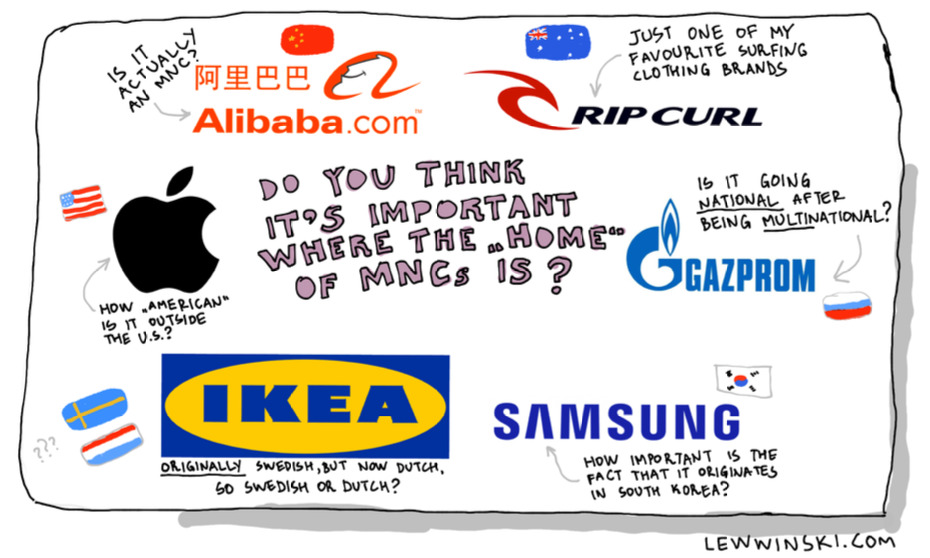
Globalisation is a trend/process of integration of local economies into one global economy, whereby companies, organisations and people think globally, but act locally. Globalisation is one of the main reasons why MNCs emerged. As you know, McDonalds operates in many countries all over the globe and even though it’s more or less the same everywhere, there are still some local features, dishes and drinks in different countries, that are unique. This is what “think globally, act locally” is.
One important thing about globalisation is that it exists outside the business. It is a trend, or a process that businesses cause and that businesses are part of, but saying that “company X decided to globalise” is not accurate. Companies can decide to operate in a foreign market but it doesn’t mean that this company is making globalisation. Please remember that globalisation is a trend in the external environment, not an internal company’s decision.
There are several impacts of globalisation on people, companies, governments, and other organisations, that cause both good and bad things, i.e can be an opportunity and a threat at the same time. Think about how the things below can be an opportunity and a threat at the same time:
— Cultural diversity: on the one hand, different cultures can blend and learn from each other, but on the other hand, it is difficult for businesses to fit in different cultures, because they have different understandings of the same thing, different tastes and traditions.
— Level of competition: on the one hand, companies can enter a foreign market with lower competition, but on the other hand, companies will also face competition and “battle” for access to foreign markets with other MNCs.
— Ability to meet customer expectations: on the one hand, people’s tastes and fashions tend to blend and become very similar, but on the other hand, people in different countries still have their own unique features, desires, needs and wants, and businesses have to adjust to them.
— Number of customers: on the one hand, the more countries, the more people to sell to, but on the other hand, it comes with a need to adjust to different customer needs.
— Economies of scale: on the one hand, businesses have great choices of location and may choose a place that allows for the highest efficiency, but on the other hand, global supply chain management is a serious and time consuming task that might result in diseconomies of scale if it’s not managed well.
— External growth opportunities: on the one hand, companies have created opportunities for M&As on a global market, but on the other hand, it means more bureaucracy and having to deal with local governments and restrictions.
— Sources of finance: similar to the previous point, greater opportunities on the one hand, accompanied by greater challenges on the other hand.
Even though a company does not have to be a huge international conglomerate to be considered an MNC, the largest companies in the world are actually multinational. Below you can see comparisons between some of the MNCs’ market capitalisations and some of the countries GDPs.
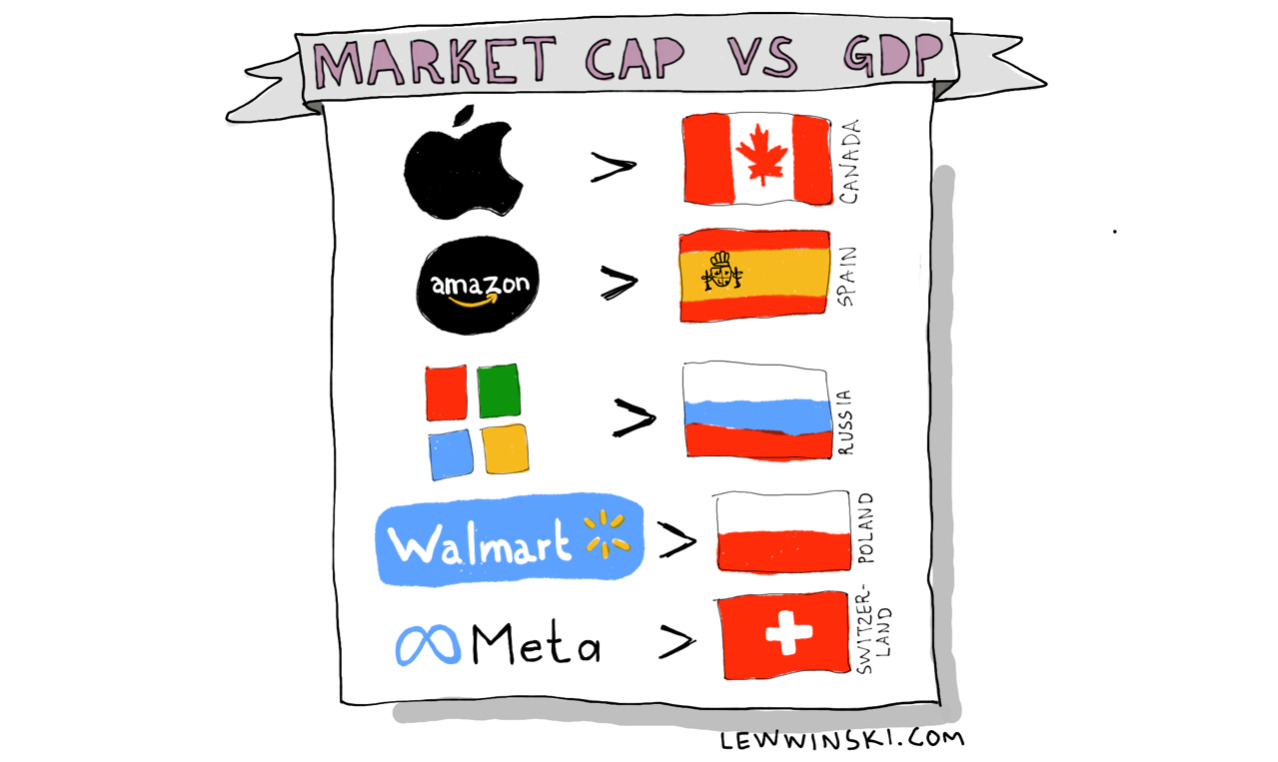
Finally, once you are familiar with what MNC is and how it’s related to globalisation, we can talk about the impact MNCs have on host countries (countries that MNCs enter).
On the one hand, MNCs bring higher tax revenues and boost host country’s GDP. Customers can benefit from increased choices of products that multinationals provide. MNCs create new employment opportunities in the host countries and usually provide secure workplaces. Once MNCs enter a certain country, this country becomes more integrated with the global economy. Thus, MNCs, in general, present an opportunity to host countries’ governments and customers.
On the other hand, companies might make profits in a host country but send them back to their “home country”, which is called repatriation of profits. It does not mean that all MNCs do that, it largely depends on the government policy, but it might happen and it is a potential drawback. In addition to that, once MNC enter a host country, they might put smaller local businesses at risk, because it will be much harder for the latter to compete with the former. As a result, some local businesses that could not withstand this competition, might have to shut down, which might result in increased unemployment. In addition to that, once MNCs enter host countries, the country becomes more integrated with the global economy, but also more reliant and dependent on global supply chains and other countries, which means that isolation from the global economy (for example, as a result of sanctions for certain political decisions) might have a detrimental effect on economy of the host country, if it is too reliant on global supply chains. Thus, MNCs, in general, present a threat to host country’s local businesses.
Look back at the class objective. Do you feel you can do this thing?
— Discuss the impact of MNCs on the host countries (AO3)
Make sure you can define all of these:
1. MNC
2. Transnational company
3. Globalisation
4. Host country
5. GDP
6. Market capitalisation
7. Repatriation of profits
Check out these resources to boost your BM knowledge and skills:
— boosty.to/lewwinski
— tiktok.com/@lewwinski. business
— youtube.com/@lewwinski
Look for Lewwinski or Lewwinski Business on other social media!
Unit 2. Human Resource Management
2.1 Introduction to human resource management
Class objectives:
— Explain the role of HR management (AO2)
— Analyse internal and external factors that influence HR
planning (AO2)
— Suggest the reasons for resistance to change (AO2)
— Discuss HR strategies for reducing the impact of change and
resistance to change (AO3)
The main point of this chapter is to see what HR means, what impacts HR and why change is so important and difficult for employees and managers.

i. ROLE OF HR MANAGEMENT
Explain the role of HR management (AO2)
Human resources (HR) are people that constitute the workforce of an organisation. Organisation can be a business of any size and type (not only companies), a country, a region, an educational institution, etc. Very often HR also refers to the department in an organisation. HR management (HRM) is one of the four business functions that corresponds to the process of organising people and maximising their efficiency. It is argued to be the most important business function and the most important type of business inputs, especially for service industries (tertiary and quaternary sector), because they rely on people more than other sectors of industry. If you forgot business functions, business inputs, and sectors of industry, please review chapter 1.1.
In order to explain the role of HRM, we should answer the question “Why is HRM important?”. There are many reasons why HRM is important. I am going to share 9 reasons that personally I find important.
1. HRM maximises staff efficiency. One of the main tasks for people who work in HR department is making sure the workplace allows employees to be as productive and efficient as possible. Without that function, workplaces would probably be monotonous and dull.
2. HRM minimises risk. One thing that HR specialists do is HR planning (more about it later in this chapter). Any planning is something that you do in order to be prepared to the future and minimise potential difficulties.
3. HRM maintains the appropriate levels of staff retention (number of employees who stayed divided by total number of employees, in a given period). Basically, it means HRM makes sure there are always enough employees hired at any time. The opposite of retention is staff turnover. More about retention and turnover later in Unit 2.
4. HRM develops and maintains organisational structure. HR department is in charge of creating organisation charts (more later in Unit 2) that help employees understand where they belong in the company, who their line manager is, who they are responsible for, etc. It creates a sense of belonging for people at work.
5. HRM develops employees via professional development (PD) workshops and training (more about it later in Unit 2). It is job of HR department to make sure all employees are adequately trained, in line with the objectives and the nature of work.
6. HRM keeps employees motivated by designing appropriate financial and non-financial rewards (again, more about it later in Unit 2).
7. HRM helps to drive change smoothly. People do not like being told that they have to do things differently. Change is scary and humans naturally try to avoid change. However, not to change means to stop developing. Change is inevitable. People who are in charge of change management usually work in HR department too.
8. HRM is in charge of recruitment and selection. This is self-explanatory, but anyway, more details will follow later in Unit 2.
9. Redundancies and dismissals. Unfortunately, organisations do not always grow in terms of the workforce size and sometimes people need to be let go. In addition, sometimes people do not perform their tasks well and they need to be let go as well. HRM is in charge of making sure redundancies and dismissals are as harmless as possible to both employees and the organisation. Learn the difference between redundancies and dismissals in the next part of this chapter.
Basically, everything we learn in Unit 2 explains the role of HRM and explains why HRM is important. I’m sure you will have no problem elaborating on the role of human resource management in the exam if you happen to have a question that asks you to do that.
ii. FACTORS THAT INFLUENCE HR PLANNING (HRP)
Analyse internal and external factors that influence HRP (AO2)
HR planning (HRP) is a systematic process of anticipating the staffing needs of an organisation. It does not necessarily imply expansion of workforce, it can also refer to downsizing (decrease in the size of the workforce), including redundancies (when employees are laid off because their service is no longer required, even though they do a good job) and dismissals (when employees are fired for not performing their tasks well). All organisations, regardless of their size, from small traders to huge MNCs, do HRP: some of them just keep it in mind, and some have a detailed document.
HRP is really important and it’s inevitable, because without it an organisation is unable to achieve its goals and objectives (chapter 1.3). All organisations rely on people, and not knowing how many and what kind of employees are required is impossible when it comes to any business-related planning. HRP, just like any business strategy, can take place on different levels of management within an organisation. Thus, HRP is a link between HRM and the strategic goal of an organisation.
HR planning, same as any other kind of planning, is not free from influences and having to be reconsidered. There are many factors that can influence HR planning: some of them come from within the organisation (internal factors) and some of them come from the external environment (external factors). Let’s see some examples of internal and external factors that influence HR planning.
With regards to internal factors, it can be (but not limited to) one or some of the following:
1. Leadership styles. The personality of senior managers and their management and leadership preferences and styles impact organisation to a very high extent. Leadership styles can vary (democratic, autocratic, laissez-faire, paternalistic, situational) and affect decision-making. More about leadership and management later in Unit 2.
2. Strategies and objectives. As you remember, HRP is a link between strategic goals and HR management. If goals, strategies and objectives (chapter 1.3) change, it means that a change in HRP will follow.
3. Finance. Resources are limited and organisations have to make decisions that are within the budgetary constraints and other financial considerations that we learn in more detail in Unit 3.
Change in any of the factors above will inevitably have an impact on HR planning.
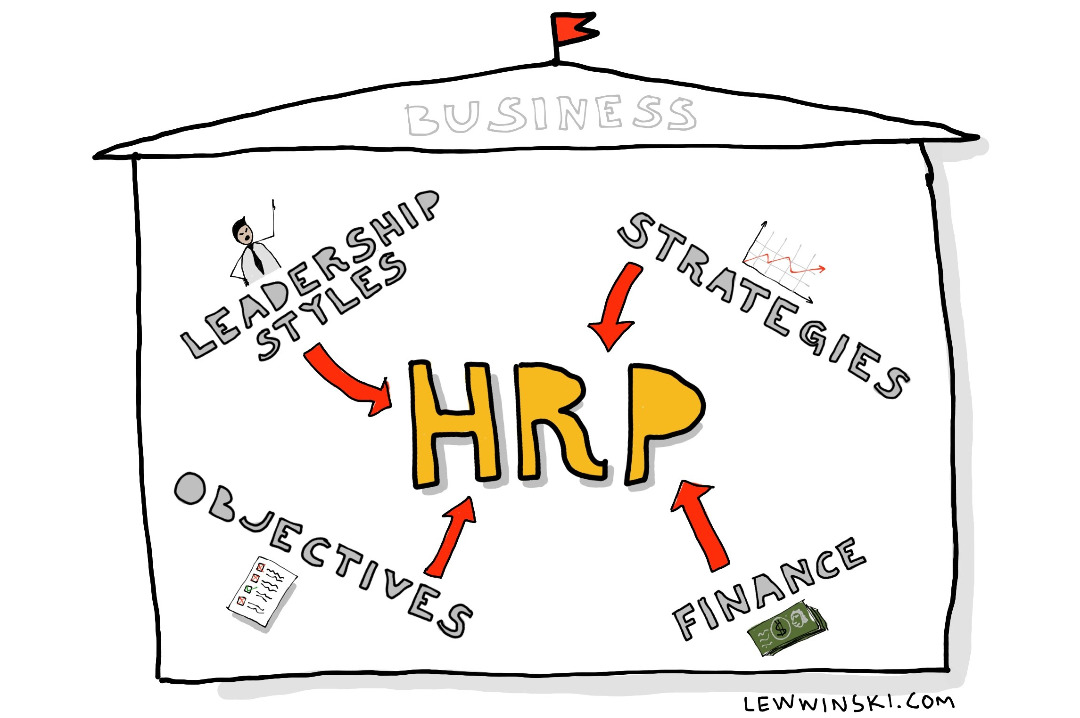
Now let’s see some examples of external factors that influence HR planning. Please keep in mind that I only discuss the ones that are included in the subject guide as examples of external factors, but it does not mean that they are the only or the most important ones. It just means that you are expected to know and be able to explain at least these:
1. Demographic change refers to any change in population dynamics and trends. For example, ageing population (the increase of the age of an average citizen), life expectancy (average life span), birth rates, etc. Check out demographic statistics of your country on worldpopulationreview.com and think how it would affect you if you were running a company.
2. Labour mobility means the extent to which the workforce is flexible in terms of acquiring new occupations (occupational mobility) and relocating to a new place (geographic mobility). For example, if people in a certain area feel completely fine about starting a career in acting after teaching for 10 years, that would be an indicator of high occupational mobility. In the US and China geographic mobility is really common: many people are born in one place, go to college in the second place, start career in the third place, and then move several times because of work.
3. Professional immigration refers to moving to a different country for work. For example, expat teachers immigrate to other countries for work, for professional reasons.
4. Flexitime refers to a trend in HR practices whereby employers provide an opportunity for flexible schedule to their employees. For example, it might not matter what time you come to the office and what time you leave, and whether you actually come to the office at all. As long as you get your job done before the deadline, you can plan your time yourself without having to comply with the office hours. This flexitime trend is on the increase, especially after the pandemic, when many companies realised that it is not necessary for the entire workforce to be in the office all the time.
5. Gig economy is a type of an economy where strong commitments are not common, and where flexible working practices (such as flexitime, short-term temporary contracts, freelance, etc.) are common.
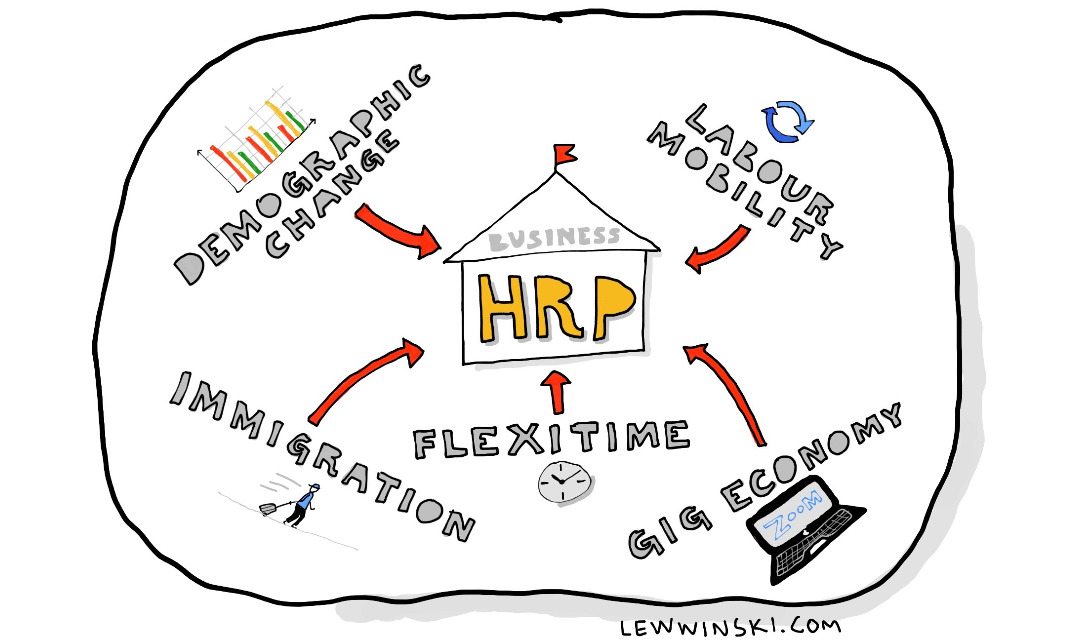
Now, the most important paragraph of this part of chapter. I have explained the factors that may influence HR planning, but they are not universal and they do not apply equally to all organisations. With the help of your BM teacher, you should choose a company and see how these factors might influence its HRP. In addition, think about other factors that HRP might be influenced by.
iii. CHANGE
Suggest the reasons for resistance to change in the workplace (AO2); Discuss HR strategies for reducing the impact of change and resistance to change (AO3)
In this part of chapter we’ll figure out what change in the workplace is, why people might not like change and what can be done in order to make change at work nice and smooth. I am going to use Kotter and Schlesinger “change theory” as a framework to discuss change, resistance and approaches to it. Actually it’s “Kotter and Schlesinger Four Causes of Resistance to Change” and “Kotter and Schlesinger Six Change Approaches”, but to keep it short, I’m going to call it “change theory”. I hope these gentlemen will forgive me for this simplification.
First of all, we are now not talking about change in general, we only discuss change at workplace. Change (at workplace) is the alteration/modification of the current work practices, or, simply put, having to do things differently. The issue with change is that human beings naturally do not like change because it’s scary and it requires significant effort. Perhaps, you saw in the movies or TV shows the so-called “5 stages of grief” that are called in academic circles “Kubler Ross change curve”. Basically, it describes 5 stages that people go through after they experience some significant and unpleasant change in their lives, such as loss of the loved ones. Luckily, change in business does not usually imply loss of the loved ones, but the stages that people go through when they deal with change are similar to that of dealing with grief: denial, anger, depression, bargaining and acceptance.
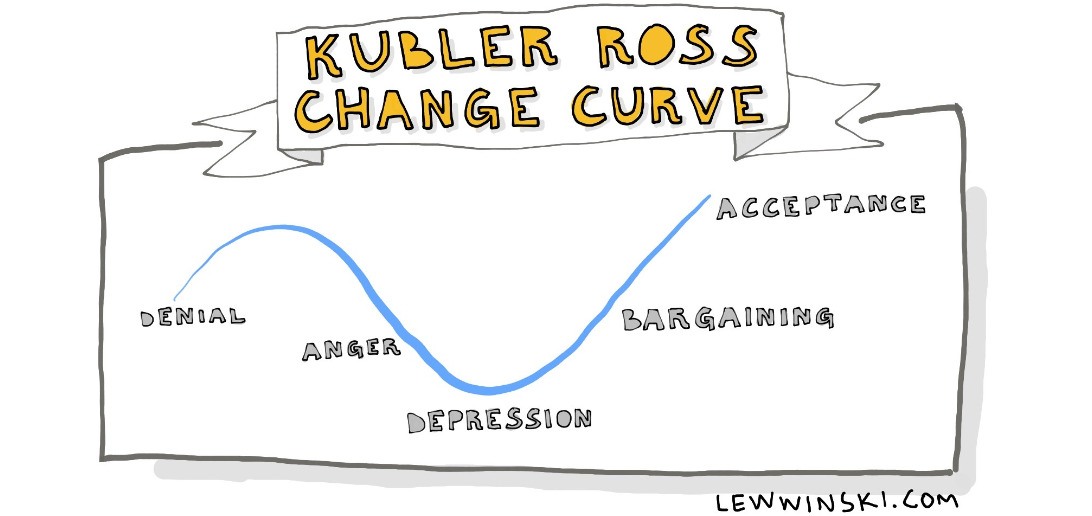
So, once we figured out what change is, why humans do not like it, and what they have to go through to accept change, we should figure out what might cause resistance to change at a workplace. First of all, for a quick intro, I suggest you look up “What is change management training video” by Gavin Wedell on YouTube. It is a weird but cute video that describes why employees don’t like change and what needs to be done to overcome it.
If you watched the video, then you have a good brief “common-sense” introduction to change and you are now ready to talk about change like a boss. We are going to explore Kotter and Schlesinger “change theory” that kills two birds with one stone and helps us to achieve both objectives for this part of chapter:
1. Suggest the reasons for resistance to change (AO2), and
2. Discuss HR strategies for reducing the impact of change and resistance to change (AO3)
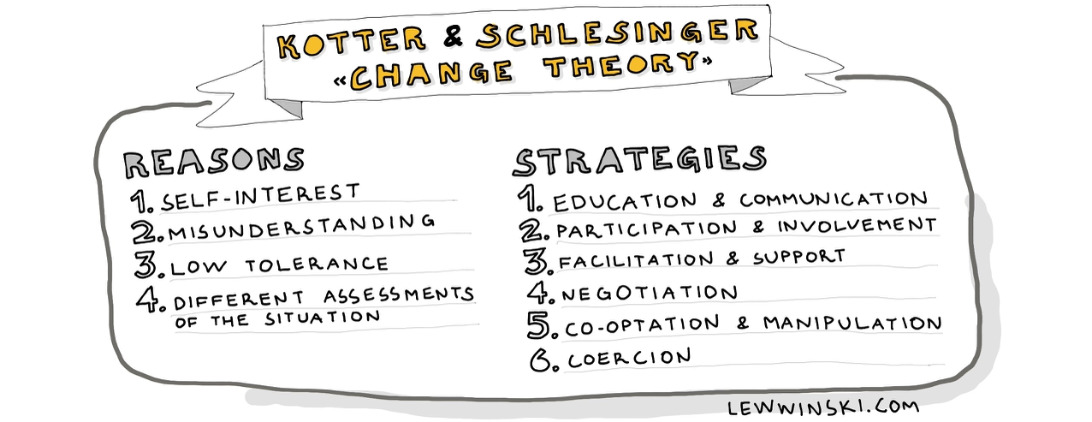
Firstly, let’s discuss the 4 reasons for resistance to change in more detail.
1. Self-interest. Employees do not understand how change benefits them personally and do not really care about distant and intangible benefits for the organisation. Thus, they are reluctant to drive change, not knowing how it benefits them personally. Quite cynical, yet true.
2. Misunderstanding. Sometimes there are actually benefits to employees but they are not explained correctly or misunderstood by them.
3. Low tolerance. Having to change means to stop doing things that are secure and safe. Some employees might not be be able to bear with it well.
4. Different assessments of the situation. Different people see the same thing from different perspectives. Very often, what the boss sees as an opportunity is perceived as a threat by employees.
Secondly, let’s discuss the 6 approaches/strategies for reducing the impact of change and resistance to change in more detail.
1. Education and communication. This is the most smooth and nice way to deal with change: prepare employees to it, train them, and let them be the drivers of change. Unfortunately, there is not always enough time for that.
2. Participation and involvement. If employees are empowered and are part of the decision-making process in an organisation, they demonstrate more loyalty and flexibility towards change because they feel that they are part of it. Thus, making employees involved and engaged reduces resistance to change.
3. Facilitation and support. This simply means being supportive and caring to employees because they might be afraid to change their working routines. Facilitation and support never hurts.
4. Negotiation. This implies reconsideration of the current incentives together with employees and trying to make mutual concessions for the benefit of implementing change. Usually it works well for highly skilled and experienced employees who cannot stand being patronised.
5. Co-optation and manipulation. If the four methods above do not work, then managers might find employees who have influence over others and try to appoint them a certain role that helps to promote and implement the desired change. The basic formula here is “if you don’t do A then B happens” where B is usually something not very nice…
6. Coercion. This is the most hardcore strategy to overcome resistance to change. It is the ultimate form of the previous strategy (co-optation and manipulation), but it implies more dramatic effects such as dismissals and loss of certain benefits. This strategy does not really overcome the resistance, it mainly pushes the change through. In the long term, this strategy will not work, especially if the change was not actually necessary.
Finally, similar to the previous part of chapter, I have to emphasise that I provided an overview of reasons for resistance to change and strategies to overcome this resistance using Kotter and Schlesinger “change theory”. It does not mean that this theory applies universally and equally to all organisations. In order to develop a proper understanding of this topic and discuss change like a boss, you have to critically apply this theory to an organisation of your choice, with the help of your teacher. This is what Business Management classes are for, right? For the rest, you can just use Lewwinski resources, haha! Good luck!
Look back at class objectives. Do you feel you can do these things?
— Explain the role of HR management (AO2)
— Analyse internal and external factors that influence HRP (AO2)
— Suggest the reasons for resistance to change (AO2)
— Discuss HR strategies for reducing the impact of change and
resistance to change (AO3)
Make sure you can define all of these:
1. Human resources (HR)
2. HR management (HRM)
3. Staff retention
4. Staff turnover
5. HR planning (HRP)
6. Downsizing
7. Redundancies
8. Dismissals
9. Demographic change
10. Labour mobility
11. Occupational labour mobility
12. Geographic labour mobility
13. Professional immigration
14. Flexitime
15. Gig economy
16. Change (at workplace)
17. Kotter and Schlesinger “change theory”
18. Kubler Ross change curve
19. Self-interest
20. Misunderstanding
21. Low tolerance
22. Different assessments of the situation
23. Education and communication
24. Participation and involvement
25. Facilitation and support
26. Negotiation
27. Co-optation and manipulation
28. Coercion
Check out these resources to boost your BM knowledge and skills:
— boosty.to/lewwinski
— tiktok.com/@lewwinski. business
— youtube.com/@lewwinski
Look for Lewwinski or Lewwinski Business on other social media!
2.2 Organisational structure
Class objectives:
— Explain 9 key terms that relate to the topic (AO2)
— Analyse and draw different types of organisation charts
(AO2, AO4)
— Discuss the appropriateness of different organisational
structures given change in external factors (AO3)
— [HL only] Discuss changes in organisational structures (AO3)
The main point of this chapter is to understand the ways to describe how human resources are organised in different organisations and to draw organisation charts.
i. KEY TERMS
Explain 9 key terms that relate to the topic (AO2)
Even though the title of the chapter is “organisational structure”, we will talk about structures in detail a bit later. For now, we’ll define some of the terms to facilitate your understanding of organisational structures and their types. If you feel a bit confused and you don’t have a clue about what organisational structure is, you can think of it as a way how things get done in a company, who gives orders, who gets things done, who’s in charge of what. But again, first of all, let’s build a foundation on which we’ll build more detailed knowledge by defining 9 key terms that relate to organisational structure.
Delegation is the passing on and entrusting of certain tasks from managers to subordinates. Simply speaking, it’s when managers give (delegate) some work to employees. Delegation is a win-win situation: managers focus more on strategic decisions by delegating tactical tasks (more about strategies and tactics in 1.3), and employees feel that they are trusted and have meaningful and interesting (hopefully) things to do. Delegation is not a reward! It’s just a natural thing in any organisation and it’s as essential to any organisation as air to our planet. You don’t reward people with air, right? It’s just an everyday normal thing that everyone has. So the same thing with delegation. If there was no delegation, then the boss would do all tasks on her/his own and there would be no organisations at all!
Span of control is the number of subordinates (employees) who are directly accountable to a manager. Simply speaking, it’s a number of employees under a manager. Span of control can be wide and narrow. One is not better than the other. Organisations with wide span of control have fewer layers, lower managerial costs, effective communication and larger teams that are harder to control directly. Organisations with narrow span of control have more layers, are more costly, have prolonged communication and “us and them” culture, but are easier to control directly. “Us and them” culture is when employees and managers do not really feel like they are one team and there’s not much unity between them, it’s when employees/managers call themselves “us” and the other group — “them”. Personally I think “us and them” culture is not cool.
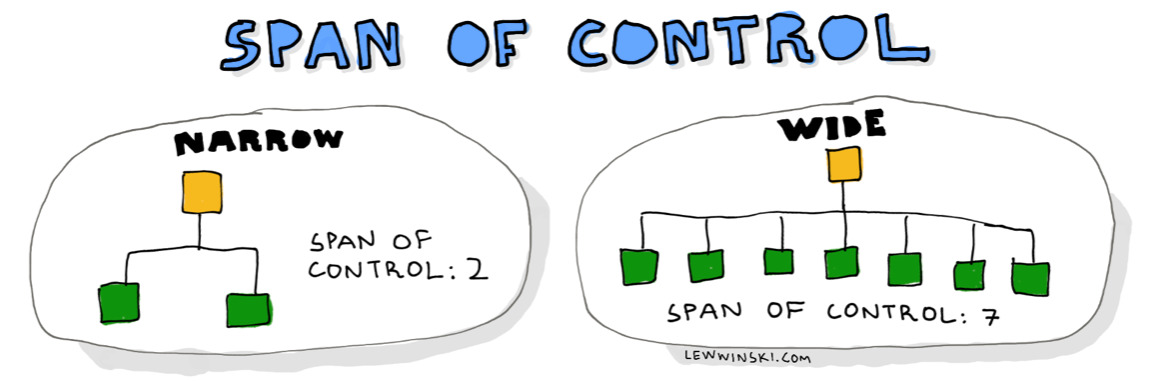
Hierarchy is an organisational system that is based on ranking. Levels of hierarchy are different layers in a hierarchical structure. Line manager is a person directly above an employee on the next hierarchical level. There can be many line managers on different levels. Line managers are essential to hierarchical structures. Hierarchical structures are clear and easy to understand and they create a sense of belonging because people easily understand their place in the hierarchy and can see who they work with, who they are accountable to and who they are responsible for. However, hierarchical structures might result in isolation between departments (and “us and them” culture, again) and they are quite inflexible because people tend to only do work that’s strictly determined by the hierarchy.
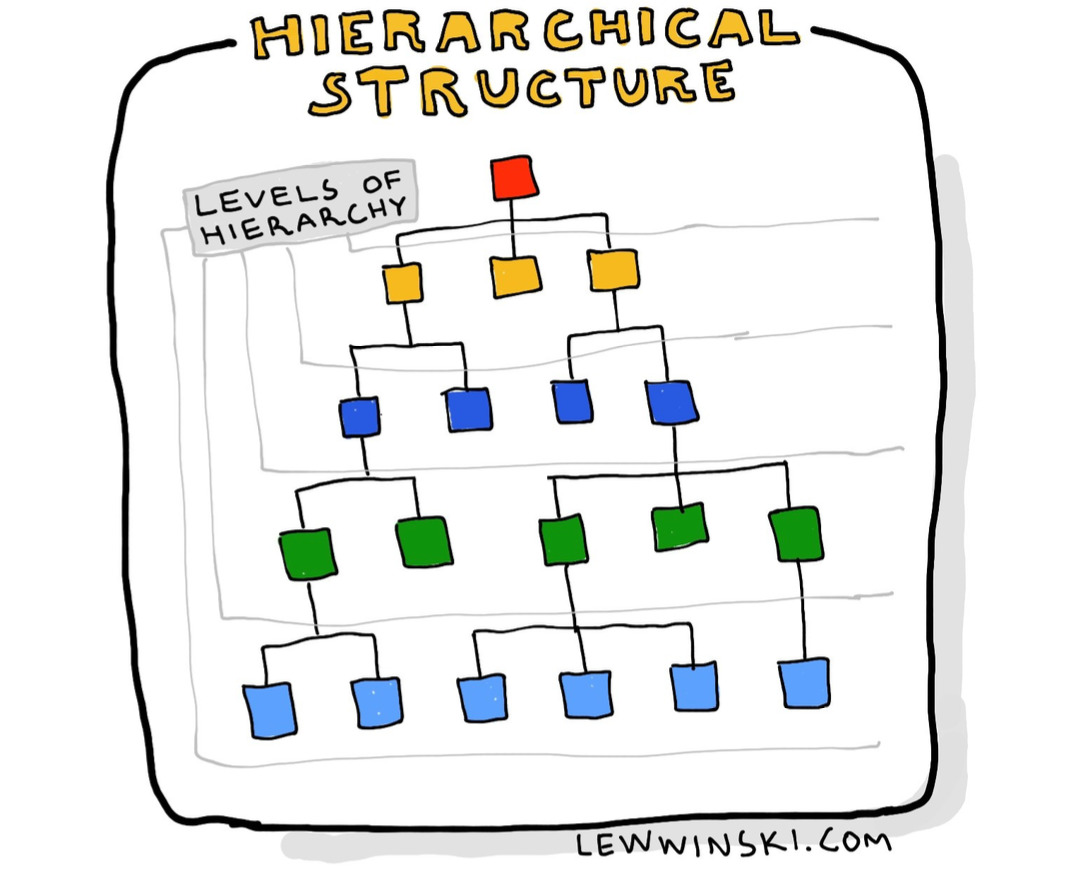
Chain of command is a system by which orders and instructions are passed down in an organisation. The more levels of hierarchy there are, the longer the chain of command is. Thus, chain of command can be long or short. Longer chains usually indicate narrow spans of control and their features (see the “span of control” paragraph), while shorter chains of command indicate wider spans of control and the corresponding features. The longer the chain of command is, the more formalistic and bureaucratic organisations tend to be, which prolongs decision-making and hinders creativity.
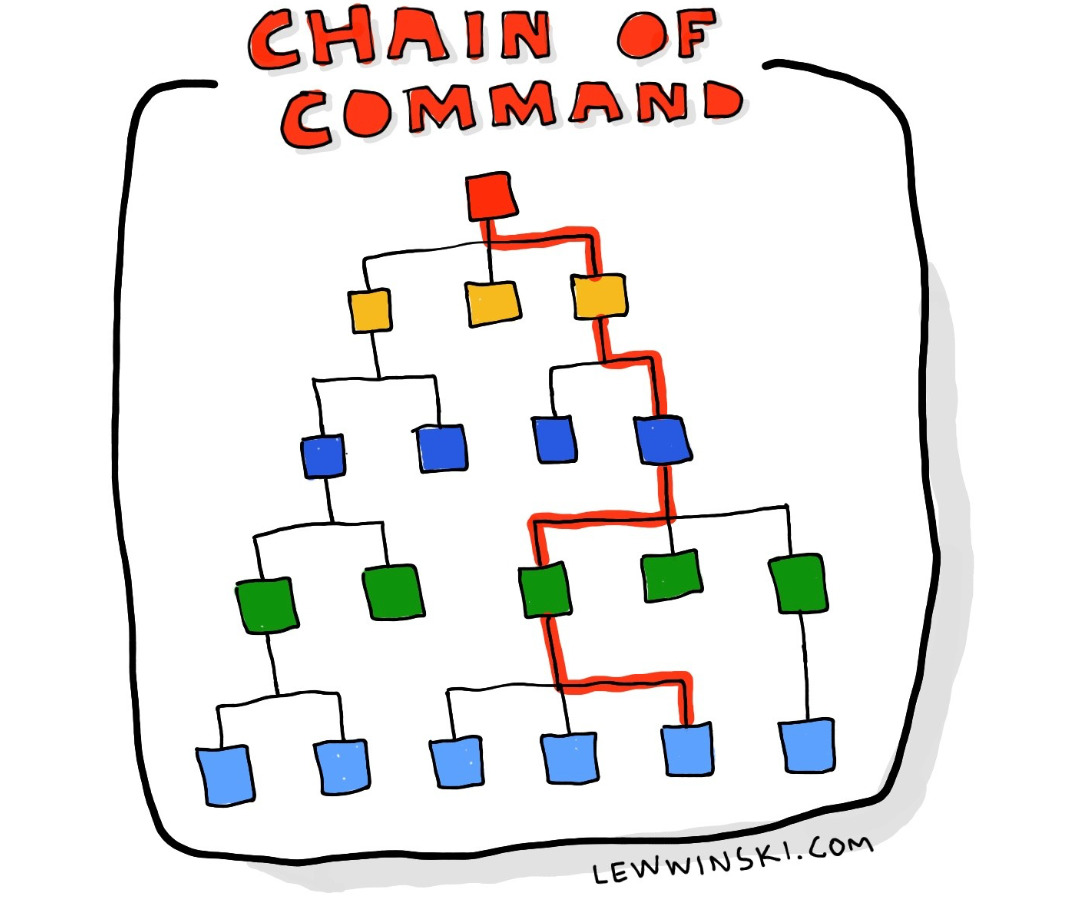
Bureaucracy is the execution of tasks that are guided by excessively complicated administrative rules and procedures. Simply speaking, it refers to too many rules and procedures and paperwork in an organisation. For example, filling in the reports, tedious paperwork, long chains of command, formality, impersonal attitudes, high degree of accountability. Bureaucratic organisations are quite inflexible and hinder creativity and risk-taking because people are reluctant to do all these things if there are too many rules and if you need a permission for everything you do. People naturally become the gears in the mechanism that support the huge bureaucratic machine. In my opinion, the most bureaucratic organisation ever was USSR. We all know how it ended, haha. Adhocracy is the opposite of bureaucracy. It does not mean that bureaucracy is bad and adhocracy is good. Balance between the two is what leads to success. Too much of anything is bad for everything.
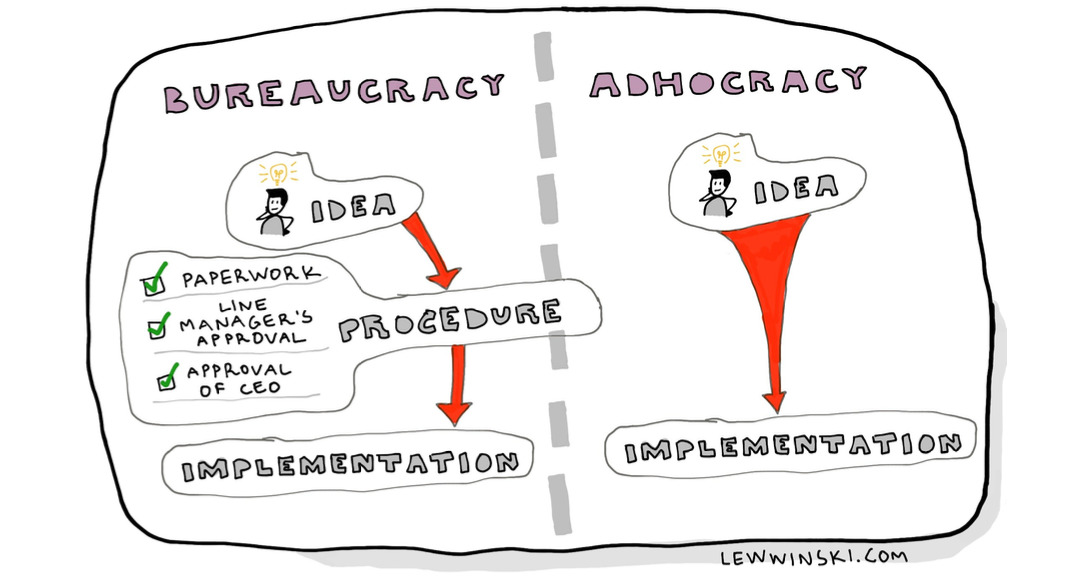
Centralisation is the concentration of power and decision-making in a single authority (one person or group of people). Simply speaking, it’s when all decisions are made by one person or a small group of people. Centralised organisations usually make quick decisions, have a good sense of direction among staff, are easier to control, and are efficient in critical situations. However, they add pressure/stress for senior management (because all decisions are on them and they are in charge of everything), they are inflexible, power plays are common (it’s a tactic to increase someone’s power, for example when the boss says “you have to do it because I’m your boss and I said so”). In addition, delays in decision-making are common for centralised organisations (waiting for the boss to okay employees before they can proceed), and it can be demotivating for some people because there is no reward for initiative, you should simply do what you’re told to do.
Decentralisation is the transfer of power and decision-making from a single authority to several people/groups. Simply speaking, it’s the opposite of centralisation. Usually, decentralised organisations have employees that are more engaged and motivated, and like working in teams. However, these organisations might experience increased admin costs (because there are more managers and decision-makers who need to be compensated for administrative work), decision-making might be more time-consuming (because agreement among many decision-makers is needed to proceed), and besides, decentralised organisation might potentially lose control over employees and not get anything done. Again, centralised doesn’t necessarily mean bad and decentralised doesn’t necessarily mean good, it’s all about finding balance.
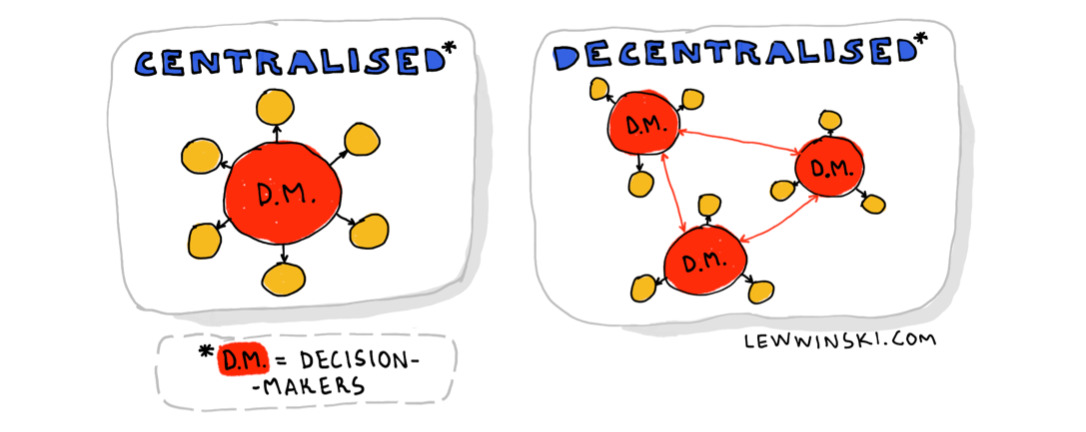
Delayering is the process of removing one or more levels in the hierarchy. It does not necessarily result in downsizing! If a management layer is removed, it doesn’t mean that these delayered managers have to leave. They will most likely be distributed among upper and lower layers of the hierarchy. Delayering implies removal of management, not necessarily removal of people (redundancies and dismissals). Some of the advantages of delayering: it reduces admin costs, improves the speed of communication, encourages delegation and empowerment. However, delayering might create anxiety and sense of insecurity, overload staff, and prolong decision-making (because there is wider span of control, and thus there are more decision-makers after delayering).
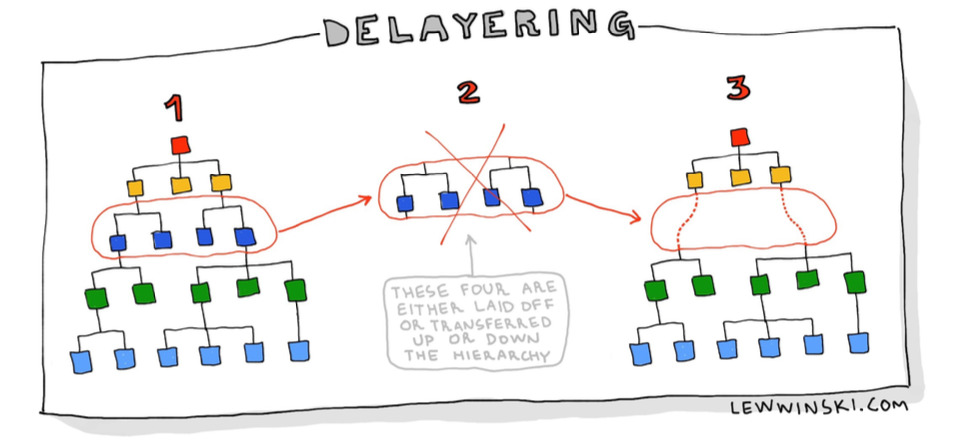
Matrix structure is a system whereby employees report to several managers and work in cross-departmental teams. Simply speaking, it’s when employees make different teams from employees in different departments and different levels of the hierarchy in order to complete different projects. The opposite of matrix structure is functional structure (traditional hierarchical structure that we talked about before). However, matrix and functional structures can coexist and overlap inside one organisation. For example, if there is an IT company with traditional hierarchy with CEO, department heads, and employees in each functional department (HR, marketing, production and finance), and the organisation has to design a new app, they might create a team for it that will include people from all functional departments and from all levels of the hierarchy. And lastly, matrix structures are very common for project-based work, where people form teams to complete a project, and then they form new teams with different people for the next project.
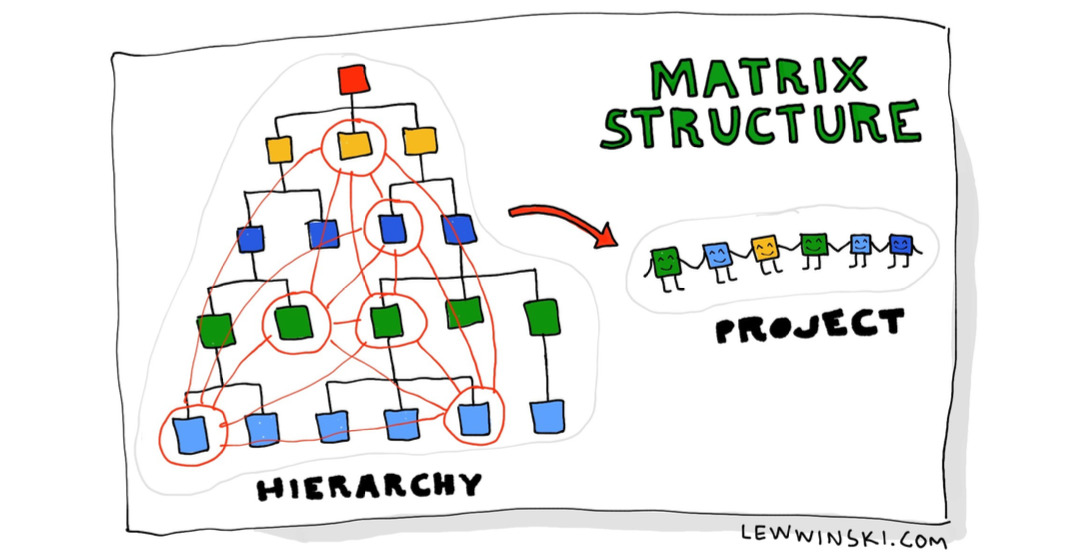
Nowadays, organisational structures (especially in creative industries) tend to get flatter and wider, with more delegation, wider spans of control, less levels of hierarchy, shorter chains of command, and tend to become less bureaucratic and more decentralised. See? 5 minutes ago you probably wouldn’t understand the previous sentence as well as you do now. Well done! You should feel good about learning so much in such a short time.
ii. ORGANISATION CHARTS
Analyse and draw different types of organisation charts (AO2, AO4)
Organisational structure is an arrangement of professional relations at work. By professional relations I mean who the boss is, who the manager is, who colleagues are, who works in one department and who works in another, how these departments and people cooperate, etc. Basically, organisational structure is “the whole thing”, the way organisation functions in terms of human resources.
Organisation chart is a graph that represents organisational structure by showing the relationships of accountability and responsibility. Simply speaking, it’s a picture that shows organisational structure. If organisation is a family, then their type of organisation chart is family tree. Accountability is a down-to-top (upwards) type of professional relationship which means being responsible to someone on the higher level of the hierarchy. For example, if you are a clerk, then you are accountable to your line manager. Responsibility is a top-down (downwards) type of professional relationship which means being in charge of someone on the lower levels of the hierarchy. For example, if you are a school principal, then you take authority over teachers. In other words, you are responsible for teachers.
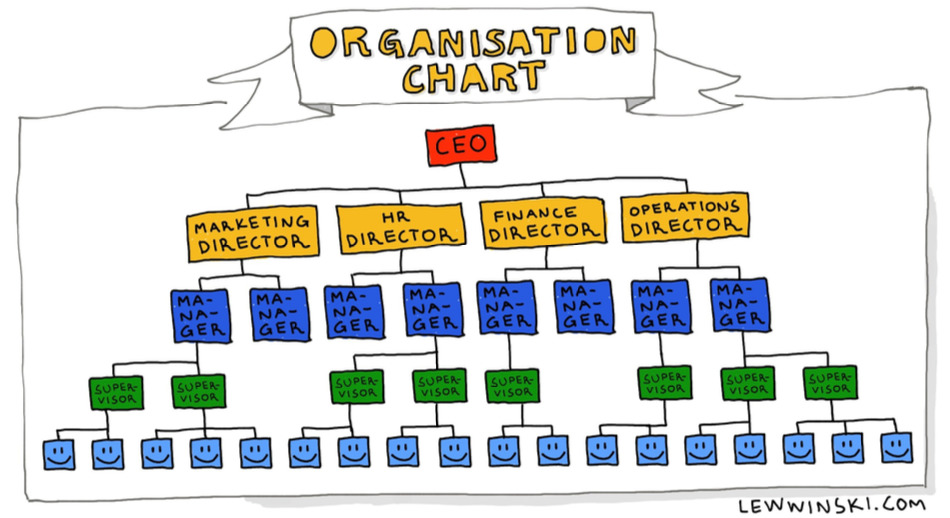
Organisation chart shows many things that we learnt in the previous part of chapter. For example, the following:
1. Functional departments
2. Chain of command
3. Span of control
4. Channels of communication
5. Levels of hierarchy
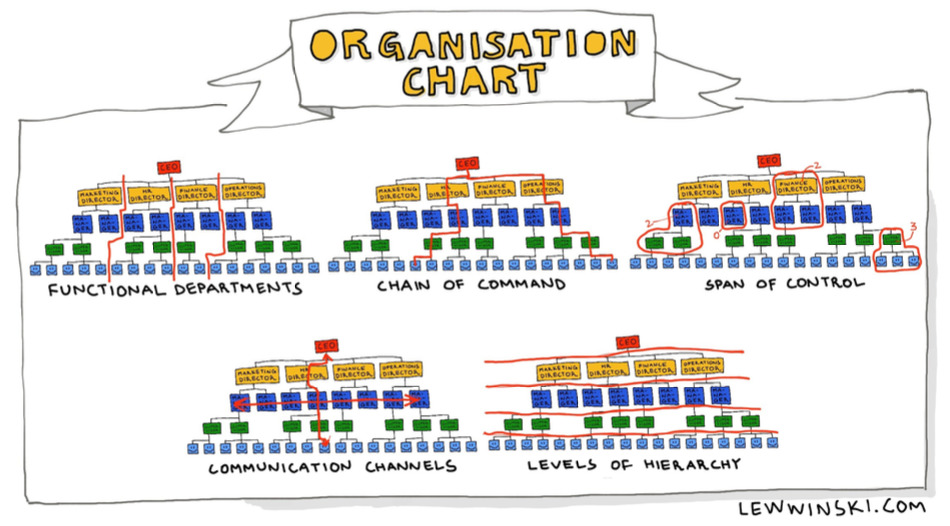
There are two categories of organisation charts. The first category refers to the “height” of charts, to how many levels they have. In this category, there are two types of charts: flat (horizontal) and tall (vertical). Flat and horizontal here are synonyms, same as tall and vertical, so you can choose the name that sounds more pleasing to your ear in each category. Another category refers to the purpose of the chart, to the main idea that it is demonstrating. In this category, there are three types of charts: by product, by function, by region. These two categories always overlap, so charts can be vertical by product or horizontal by region, etc. Let’s have a closer look at all the types of charts in both categories.
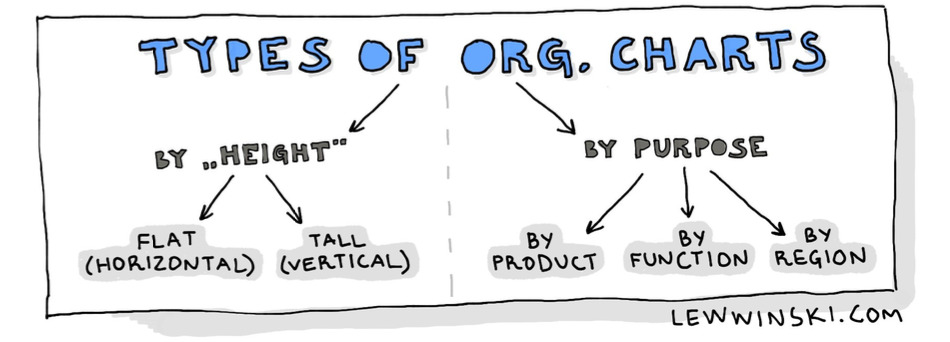
With regards to the first category (“height”), we are going to compare flat (horizontal) and tall (vertical) charts in 9 different aspects. See the table below for comparison between them.
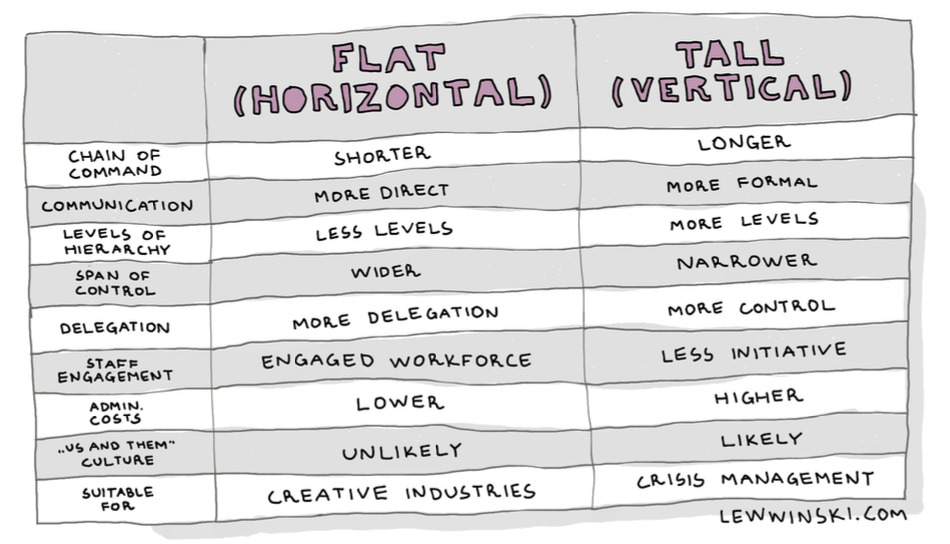
I think all the things in the chart are pretty self-explanatory and if you understood the key terms from the first part of this chapter, then you shouldn’t have problems understanding the differences between tall and flat structures.
With regards to the second category (purpose of the chart), I will give you some examples. Chart by product indicates all the products that an organisation is providing. For example, the chart for Yum! Brands Inc. might include Pizza Hut, Taco Bell and KFC, and then, under each product (brand, in this case), a traditional hierarchical chart by function. Chart by function is the most traditional kind of chart that indicates the functional departments in the organisation: marketing, HR, finance and accounts, operations (see 1.1 to review business functions). By the way, it doesn’t have to be 4 departments only, and it doesn’t have to be departments that correspond to the main 4 business functions. Organisations can structure their departments based on their needs however they want, even though they usually have departments that are in charge of the main business functions. And finally, charts by region show the regions in which organisations operate. Sometimes these regions overlap with real geographic areas and continents, but most of the time they refer to the regions that organisations define themselves. For example, for 1BO, there are 3 regions in the world: Asia-Pacific, the Americas and AEME (Africa, Europe, Middle East).
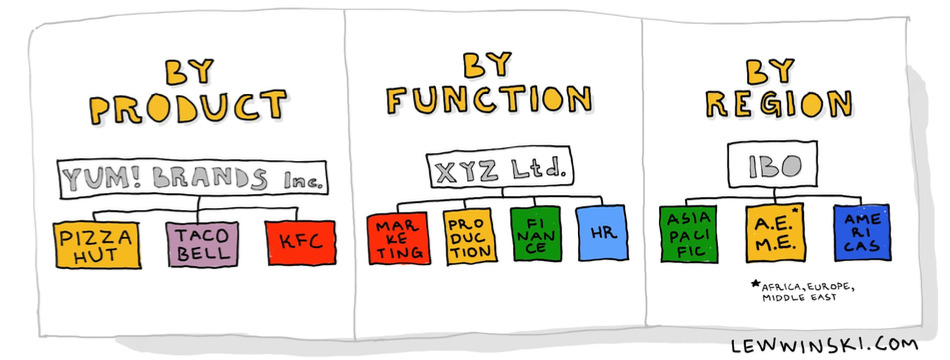
As you have probably guessed already, one type of chart doesn’t contradict the other, thus they are not mutually excluding. A chart by product can also include a chart by function within itself. Besides, all the 3 types of charts in the Purpose category can be either flat (horizontal) or tall (vertical), which means that different categories of charts aren’t mutually excluding as well. In addition, very often, organisations prepare different kinds of charts for different purposes. For example, if an organisation wants to show to people worldwide that they have branches all over the world, they’ll show the chart by region. But if the purpose is to show how only Asia Pacific branch works, who’s the big boss there and who’s accountable to her/him, then a chart by function would make more sense. And finally, if the purpose is to show what kind of services (for example, education programmes) an educational organisation offers (let’s say primary years, middle years, diploma, and career-related programmes), then a chart by product would make more sense.
Just a reminder that chart is a diagram that represents organisational structure. Thus, even though the purpose of this part of chapter was to study the charts, we have studied structures as well. Flat/horizontal, tall/vertical, by product, by region, by function — all of these characteristics apply not only to charts, but to structures that these charts represent as well.
And one more thing. In addition to traditional hierarchical charts, there are also matrix structures that we learnt in part 1 of this chapter. For them, there is no one rule or way to draw because they are super flexible and unique in each particular situation. In order to practice matrix structure charts, imagine that you are a very-very bad student (I’m just saying “imagine”, haha) and think which teachers and school administrators will be involved in the “project” of helping you study better and try to represent the team of these people in a matrix chart. That would be an example of a unique matrix chart for you only. Also, compare it to the traditional organisation chart of your school. Have fun!
iii. ORGANISATIONAL STRUCTURES VS EXTERNAL FACTORS
Discuss the appropriateness of different organisational structures given change in external factors (AO3)
The most important thing in this part of chapter is to break down the objective and understand what we are actually trying to learn here. As you can see from the subheading above, the objective of this part of chapter is to discuss the appropriateness of different organisational structures given change in external factors (AO3). The three key words in this objective are: structures, external and change. Let’s have a closer look at these key words.
Structures is what we discussed in the previous two parts of chapter. By now, you should already know what these types of organisational structures mean: hierarchical, matrix, horizontal (flat), vertical (tall), by product, by region, and by function. If you are HL student, then in the next part of chapter you will also learn about project-based and Shamrock organisations.
External factors refer to anything in the external environment that impacts businesses. If you want to have a more systematic understanding of what is going on in the external environment, you can use a tool from the Toolkit called STEEPLE analysis. I’ll just briefly say now that the tool helps managers to categorise all the factors from the external environment into 7 categories: social, technological, economic, environmental, political, legal, ethical. So, anything from the external environment (including 7 STEEPLE factors) can impact organisations and force them to reconsider their structures.
The last key word is change. Change is one of the CCES concepts of the business management course. Change is the alteration or modification of any aspect in the external environment.
By now, you should understand that organisations might have to adjust or change their structures if there is something in an external environment that forces them to do so. Your goal here is to discuss whether this or that structure is appropriate under the given circumstances from the external environment. You might ask a very good question: “I understand all the types of organisational structures. I understand that external factors can change and impact organisations. But how do I discuss the appropriateness of structures given the external change?”. Here’s how you might do it.
The “SLAP” rule applies to more or less any AO3 (evaluation) question. According to it, you can discuss organisational structures in terms of the following factors: S — stakeholder implications, L — long-term and short-term implications, A — advantages and disadvantages, P — priorities (for example, mission or objectives). In addition, you may evaluate different structures in terms of communication, sustainability, leadership, costs, and anything else that is relevant. The secret here is to keep your analysis balanced (on the one hand… on the other hand…), link your analysis to the case study, and demonstrate a well-justified judgement. Your BM teacher should know very well what AO3 is and how to answer thus type of questions.
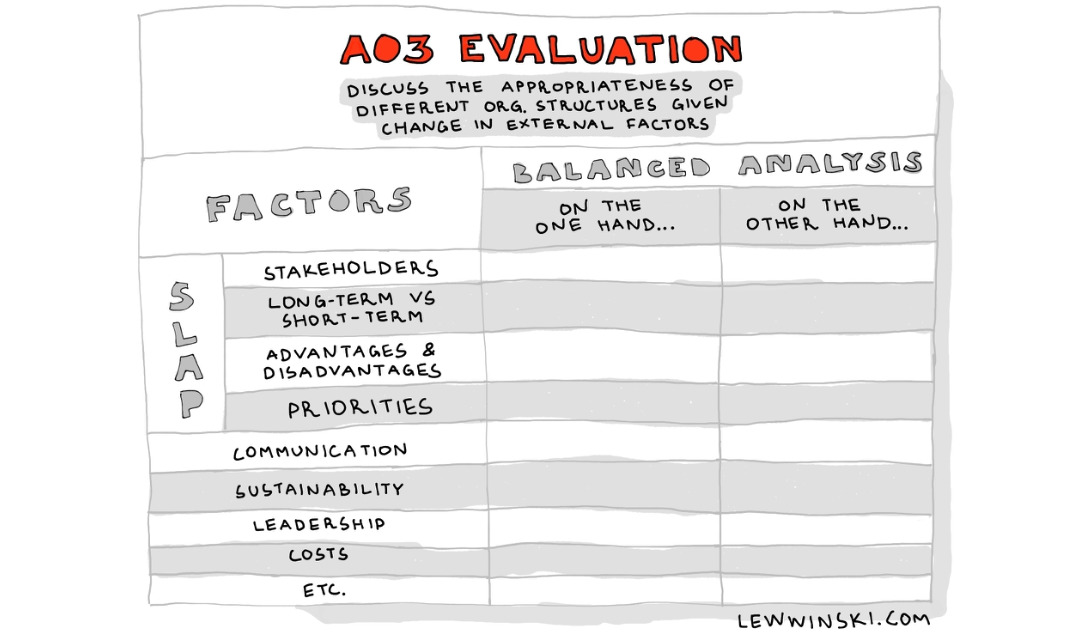
iv. CHANGE (HL ONLY)
Discuss changes in organisational structures (AO3)
In the previous part of chapter, we learnt that organisations might change their structures due to external factors. In addition to external environment, change might come from within as well. Regardless of what causes change, it is a fact that organisations have to be flexible and change their organisation structures. In addition to hierarchical, matrix, flat (horizontal), tall (vertical), by function/region/project, HL students also learn project-based and Shamrock structures, and, most importantly, learn to discuss/evaluate changes in organisation structures.
Project-based organisation is a type of organisational structure that has human resources organised around projects, as opposed to the hierarchy, or purpose, or other factors. For example, think of a construction site. The team is assembled for construction of a building and then it is dissembled upon completion. In this example, the project is construction of a building, and all the human resources are organised around that project. Another example could be any IT company that decides to create a new app and invites people from all levels of hierarchy and all departments to participate in this project. Any kind of business that is involved in “one-of-a-kind” (project) activities could be an example of a project-based organisation.
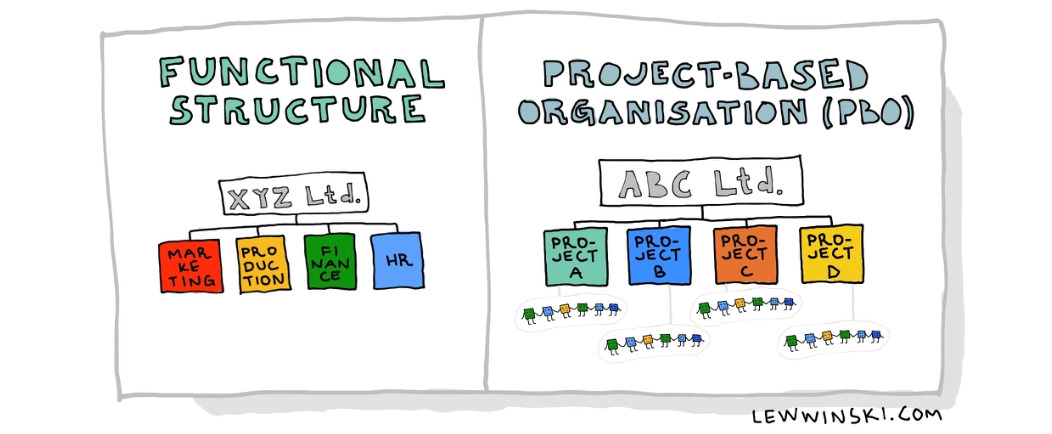
An attentive student might ask: “Haven’t we learnt that already and isn’t it called matrix structure?”. Project-based organisations and matrix structures are similar and one often implies the other. However, they are not the same. Project-based organisation is a characteristic of an organisation that works on “one-of-a-kind” activities (projects) and has a new team for each project. Matrix structure is a characteristic of an organisational structure that implies the fact that people from all departments and levels of hierarchy work together on certain tasks.
Shamrock organisation is a type of organisational structure that divides the workforce into three “leafs” depending on how essential they are to the organisation.
1. Core staff — full-time professional workers that usually work full-time and are crucial to the organisation. They are usually the key decision-makers of the organisations. CEO, engineers, directors, administrators could be some of the examples of core staff.
2. Outsourced (contractual) staff are subcontractors that perform some non-core activities for the organisation. These are usually businesses that specialise in something that is not essential to the organisation. For example, many film production companies outsource 3D visual effects to other companies. These effects are very important, but not as important as the film director, actors, and cameramen who are impossible to outsource because they are core staff members.
3. Temporary (peripheral) staff are workers that are employed only when needed on a part-time temporary basis. For example, amusement parks often hire some extra staff (usually students that are on summer vacation) for peak season.
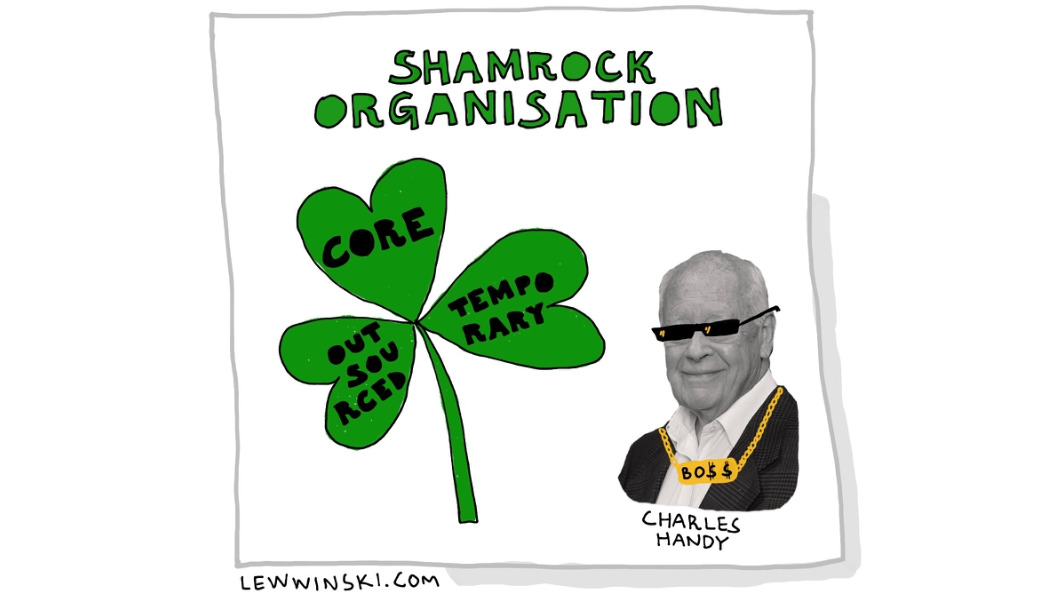
Shamrock organisation was suggested as a theory by an Irish organisational behaviour theorist and philosopher Charles Handy. Shamrock is not only a good analogy for an organisational structure, but also one of the main symbols of Ireland.
So, you know all the types of organisational structures now and it’s time to look back at the objective for this part of chapter: “Discuss changes in organisational structures (AO3)”. The relationship between change and Project-based and Shamrock organisations is that these two types of organisations is what businesses nowadays tend to become. More and more organisations, especially the ones that have creativity among their core activities, tend to become less hierarchical and vertical and more flexible and flat. This transition (from hierarchical to flexible, including Project-based and Shamrock) comes with certain implications, both positive and negative. If you review the features of flat (horizontal) structures in part 2 of this chapter, you will see what kind of advantages and disadvantages organisations that experience change in their organisational structures might have.
Look back at class objectives. Do you feel you can do these things?
— Explain 9 key terms that relate to the topic (AO2)
— Analyse and draw different types of organisation charts
(AO2, AO4)
— Discuss the appropriateness of different organisational
structures given change in external factors (AO3)
— [HL only] Discuss changes in organisational structures (AO3)
Make sure you can define all of these:
1. Delegation
2. Span of control
3. “Us and them” culture
4. Hierarchy
5. Levels of the hierarchy
6. Line manager
7. Chain of command
8. Bureaucracy
9. Adhocracy
10. Centralisation
11. Power play
12. Decentralisation
13. Delayering
14. Matrix structure
15. Functional structure
16. Organisational structure
17. Organisation chart
18. Accountability
19. Responsibility
20. Flat (horizontal) charts
21. Tall (vertical) charts
22. Chart by product
23. Chart by function
24. Chart by region
25. Project-based organisation [HL]
26. Shamrock organisation [HL]
27. Core staff [HL]
28. Outsourced (contractual) staff [HL]
29. Temporary (peripheral) staff [HL]
Check out these resources to boost your BM knowledge and skills:
— boosty.to/lewwinski
— tiktok.com/@lewwinski. business
— youtube.com/@lewwinski
Look for Lewwinski or Lewwinski Business on other social media!
2.3 Leadership and management
Class objectives:
— Distinguish leadership and management (AO2)
— Discuss leadership styles (AO3)
— [HL only] Distinguish scientific and intuitive
management/thinking (AO2)
The main point of this chapter is to understand the difference between leadership and management and learn 5 leadership styles. There’s also a surprise for Higher Level students in the end.
i. LEADERSHIP AND MANAGEMENT
Distinguish leadership and management (AO2)
Management is the process of dealing with or controlling people and making sure tasks are accomplished. “Management” can also refer to a group of people in an organisation who are in charge of the aforementioned things. Simply speaking, management means getting things done. We’ve already learnt that there are different levels of management in organisations in chapter 1.3.
There are many ways to describe functions of management and managers but I’m going to refer to the three most commonly quoted scholars to describe management functions: Henri Fayol, Charles Handy, and Peter Drucker.
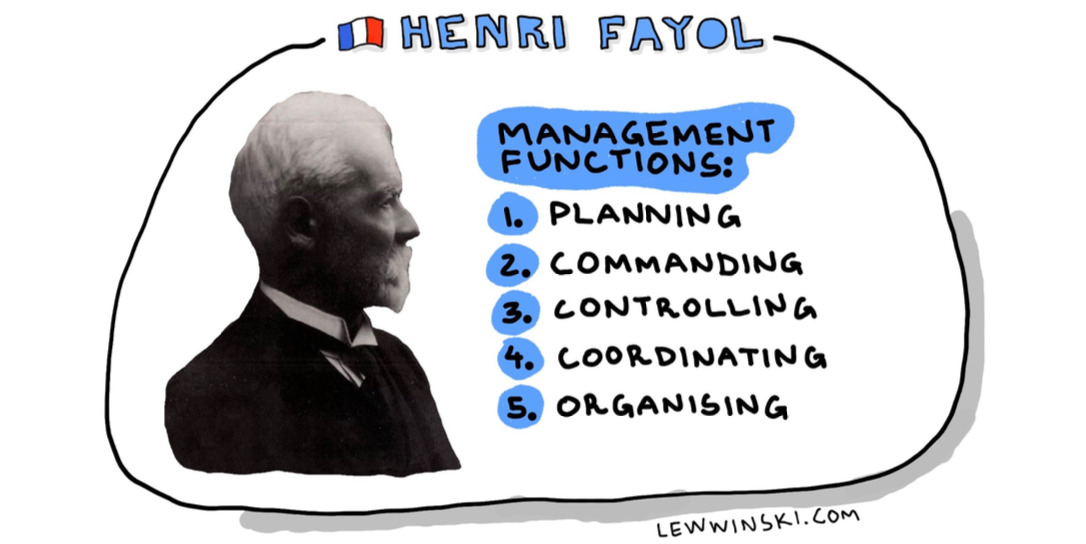
Henri Fayol was a French mining engineer who developed a theory of business administration that is used up to now. His name is pronounced as “an-ri”, not “hen-ri”. His approach to management functions is my personal favourite! So, Fayol believed that there are five management functions.
1. Planning is the process of creating arrangements and preparations for the future that might include setting objectives and allocating budgets. Without planning, management is not really management.
2. Commanding refers to giving orders. It is another essential management function that is related to delegation that we discussed in the previous chapter.
3. Controlling refers to making sure job gets done by subordinates. It does not mean standing behind the employees’ backs all day, but it means that there is a way to make sure tasks get accomplished. In most schools, one of the main ways to control teachers (and thus maintaining teaching standards) is class observations that are performed by the Head Teacher.
4. Coordinating means making sure the organisation works as one whole. From the very first chapter, you hopefully remember that there are four business functions and that organisations break down the organisation into functional departments. It is very good idea unless these functional departments become too independent from each other and do not coordinate each other’s actions. Ideally, all departments should be interdependent and it is a manager’s job to coordinate all the employees in pursue of interdependence.
5. Organising refers to allocating resources and time that are necessary to accomplish tasks. “Here’s wood, nails, tools, and wood polish. By Sunday, please make two tables” — this is a simplified example of organising in a furniture shop.
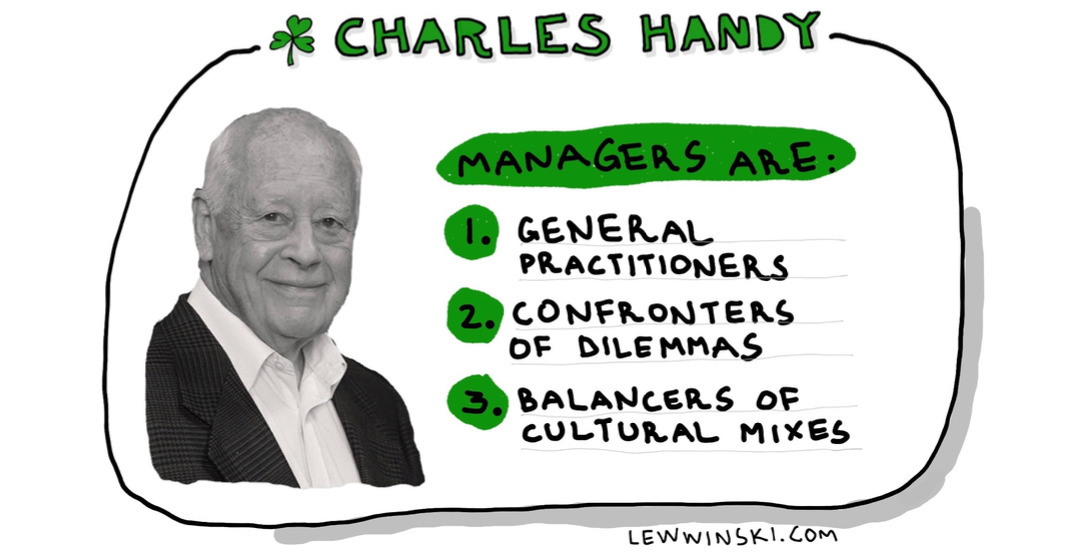
Attentive students will recall that we have already mentioned Charles Handy in 2.2, so I’ll just remind briefly that he is an Irish philosopher who specialises in organisational behaviour. From Handy’s perspective, managers perform three functions.
1. General Practitioners (GP). GP is the same as therapist or general doctor in the hospital. This is the first doctor you talk to when you are sick and don’t know the reason for your sickness. GP might not have deep specialised knowledge in certain areas of medicine but the scope of their knowledge is wide, which means they know a little bit about everything. Same thing with managers. They are not workers who actually do the work, their job is to make sure things get done, and they know enough about all the processes in the organisations, even though their knowledge might not be as specialised as that of specialised workers.
2. Confronters of dilemmas. If you know what a dilemma is (perhaps from your TOK class), you will understand that managers deal with them all the time… Very often, there is no “best” solution in all aspects, and most decisions imply certain compromises and/or sacrifices. For example, a manager might need to decide whether to save costs by ordering supplies from a cheap but non-eco-friendly supplier that might damage company’s reputation, or increase the costs by ordering supplies from an eco-friendly supplier that might have a positive impact on the company’s reputation. This kind of dilemmas is what managers constantly deal with.
3. Balancers of cultural mixes. Culture can refer to either national culture (Chinese, Indian, Asian, Western, etc.) or organisational culture (task, role, person, power — more in 2.5). Regardless of the kind of culture, there are people and groups of people who have very different cultural backgrounds. Either their national culture does not accept things that are accepted in other cultures, or the organisation where they worked before had a different way of getting things done. Thus, in any organisation there is a number of cultural mixes that might clash if they are not well-balanced and respected. Whose job is it to balance these cultural mixes and avoid cultural clash? Correct, managers’.
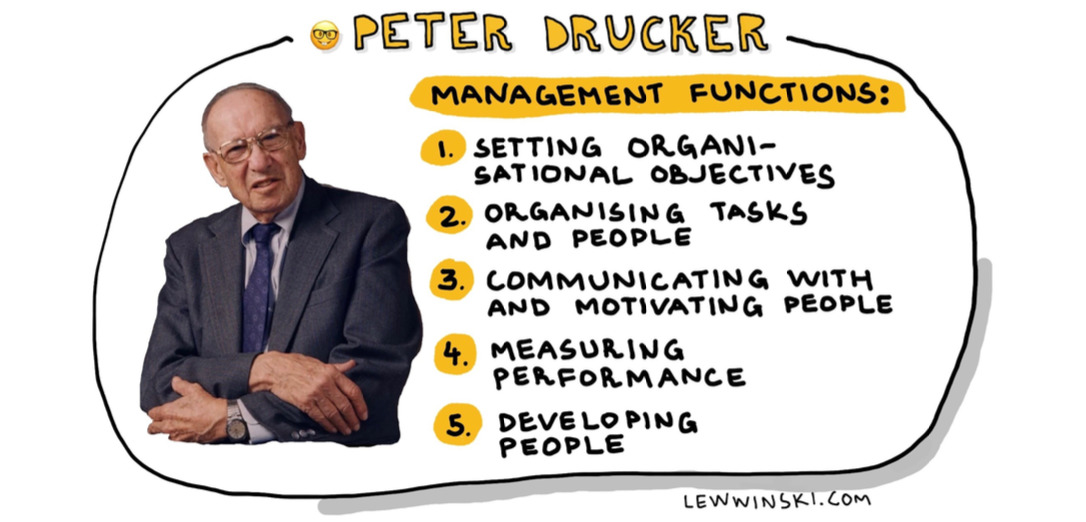
Peter Drucker is the super cool Austrian-American scholar who, among many other things, developed the SMART rule for objectives, that we have already learnt in 1.3. He believed managers do the following:
1. Setting organisational objectives.
2. Organising tasks and people.
3. Communicating with & motivating people.
4. Measuring performance.
5. Developing people.
I decided to be a General Practitioner about Peter Drucker’s theory and I have not elaborated on any of the above because they are quite self-explanatory, in my opinion. Those of you who want to dig deeper, may read Peter Drucker’s Management: Tasks, Responsibilities, Practices (1974) and become the boss of management functions.
Enough with management, let’s talk about leadership now. Leadership is the process of leading people. I really do not like definitions where the term is described using the term itself but I could not create a better definition. Anyway, leaders have followers who follow them not because they were appointed to follow them, not because it is their job to follow a leader, but because they naturally admire the leader and want to be led by him/her.
Leader is not an official position in the hierarchy, unlike manager. Very often, real leaders in organisations are not necessarily managers at all. Think about your classmates. I’m quite sure in your class there is a very cool guy who everyone wants to be friends with but who is not necessarily a good student. Very often, these cool guys are actually a bit rebellious trouble-makers, from teachers’ perspective. And yet they are considered cool and admired by peers. Same thing with leaders. They have followers, but they do not necessarily have a management role. If a manager is a leader then this is just perfect. However, this is not always the case.
Lastly, with regards to leadership, one thing I learnt in my alma mater (hi to the University of Bath!) is that in some cultures, “leader” is a word used to describe a good manager. That could be a really interesting discussion… Do you personally agree that leaders are good managers? Or do you think that a good manager is still a manager? How do you think leadership and management are related?
In the end of this part of chapter, I would like to remind everyone that Business Management is a subject in Group 3, that is called “Individuals and Societies” (Humanities, in other words). This means that there is no absolute truth and literally everything is open for doubt and discussions. That is the beauty of Humanities, isn’t it? Having said that, I would like to summarise the main differences between leadership and management in the table below and remind you that you do not have to agree with them. What matters here, is how you justify your opinion.
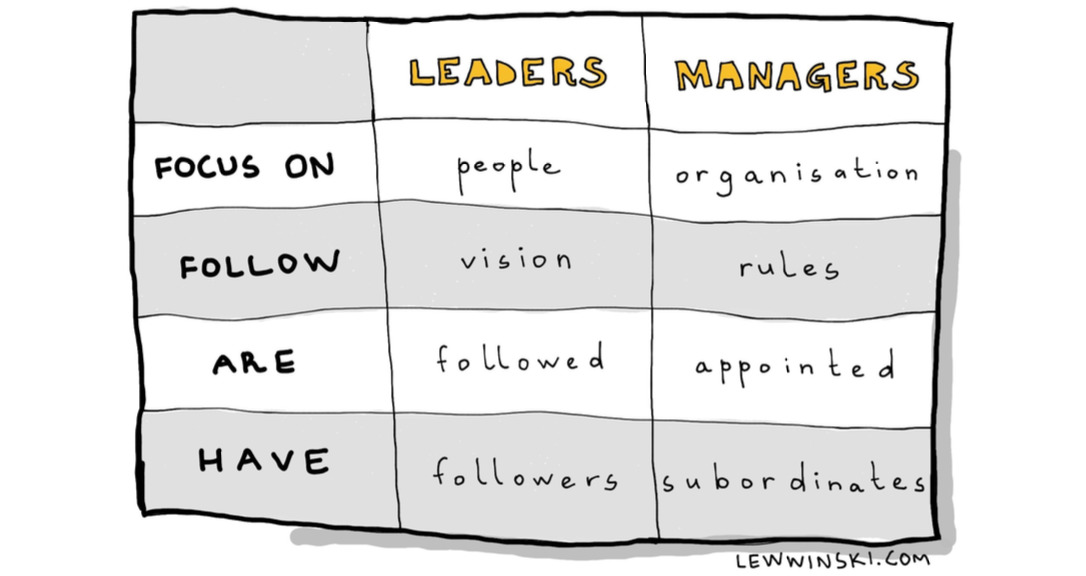
ii. LEADERSHIP STYLES
Discuss leadership styles (AO3)
You are expected to be able to evaluate 5 leadership styles: autocratic, paternalistic, democratic, laissez-faire, situational. “Evaluate” means not only to understand what these leadership styles are, but also to assess them and show some judgement with regards to them. In order to help you with that, I will explain what these 5 leadership styles are and provide some of their advantages and disadvantages. As always, these advantages and disadvantages are not prescriptive. It might be a good idea if you guys make notes using the table in Figure 6.
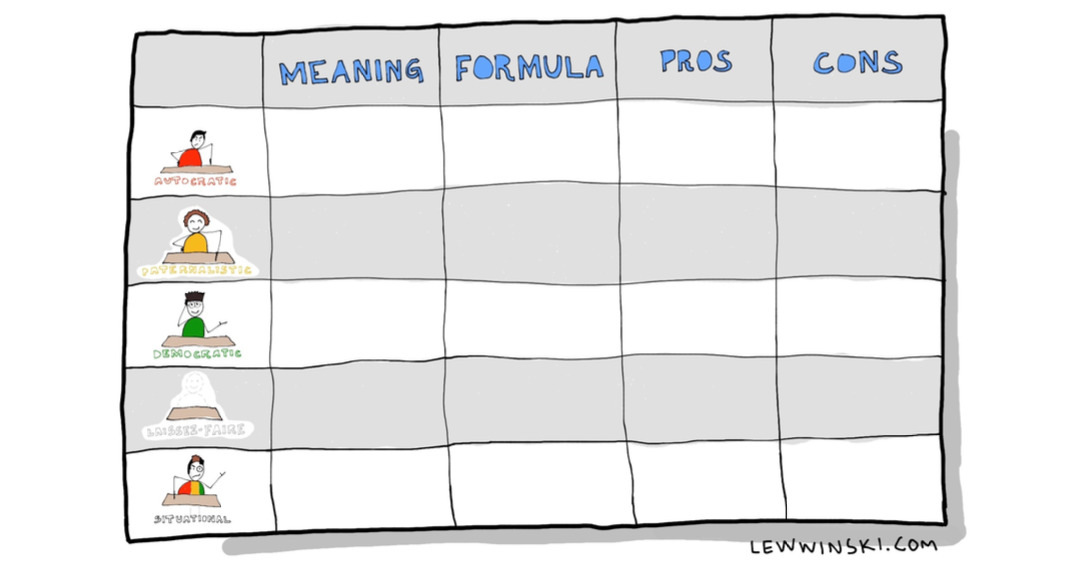
Autocratic leadership style means that the leader makes all the decisions and delegates tasks, but not responsibility. Formula of this leadership would be: “do X”. Autocratic leadership doesn’t mean that it’s bad leadership or that autocratic leader treats his/her subordinates badly. It just means that decision-making is really centralised. On the one hand, autocratic leadership implies quick decision-making and it is suitable for crisis-management. On the other hand, the stakes are really high because decision-making is not spread across the organisation, so if the decision is bad, then the entire organisation is jeopardised. In addition, autocratic leadership is quite inflexible and demotivating for employees who like showing initiative and being part of the decision-making process. Steve Jobs is argued to be an example of an autocratic leader.
Paternalistic leadership style means that the leader expresses superiority and treats subordinates as if they are family members, guiding & mentoring them in order to promote their own good. Paternalistic leaders usually “know what’s good for you”, just like parents. And of course, very often, what paternalistic leaders think is “good for you” is not necessarily what you think is good for you. Formula of this leadership is: “I know what’s good for you”. On the one hand, this leadership style is suitable for inexperienced employees who are at the start of their careers. In their case, when they really don’t know what they want, what’s good and what’s bad, it’s very nice to be paternalised by a more experienced mentor, for a while. On the other hand, employees’ interests might be neglected (as I mentioned earlier) and this leadership is not suitable for experienced employees.
Democratic leadership style means that the leader involves employees in decision-making before making the decision. In my experience, the two most common misconceptions that students have are the idea that all democratic leaders are good and the idea that democratic leaders always make decisions based on the majority of votes. In reality, democratic leader, same as any other kind of leader, can be either good or bad. The main feature of a democratic leader is that he/she makes subordinates participate in decision-making. It is up to the leader, however, whether to listen to majority or not. Once again, employees’ participation in the decision-making process is the main feature of democratic leadership. Formula is: “what do you think is best: X or Y?” On the one hand, democratic leadership is usually motivating and engaging, serves the best interests of employees. However, decision-making might be slow, might result in loss of control, and this leadership is not always applicable (for example, in some cultures it is perceived as weakness; in addition, it might not be suitable for crisis management, when quick decisions and quick implementation are important).
Laissez-faire leadership style means that the leader has minimal interference with the work of subordinates. Employees are, in a way, on their own, and are free to do work the way they want as long as it’s done, as long as it’s done before the deadline, and meets the standards. Engineers/programmers/developers in IT companies usually work under laissez-faire leadership. They usually don’t have to come to the office, there’s no clock-in/clock-out, only the final product and deadlines matter. Formula of laissez-faire leadership is: “do X or Y as you see fit”. On the one hand, this leadership style motivates employees, builds trusts among managers and subordinates, and it is completely applicable to skilful professionals. However, it is inapplicable to inexperienced employees, it might result in chaos and lack of authority if it’s “too laissez-faire”.
Situational leadership style means that leader chooses the most appropriate leadership style in the given situation. Different employees might require different approaches, or external environment might dictate the choice of leadership style, or organisational objectives might push the leaders towards different kinds of leadership. Formula is: “if X then Y, if A then B”. On the one hand, situational leadership is the most flexible of all, it is in line with employees’ interests and needs. However, it might be unstable and difficult to predict, which might confuse employees as it is difficult to plan in an environment that’s constantly changing.
In reality, most leaders are situational but one or some leadership styles usually prevail.
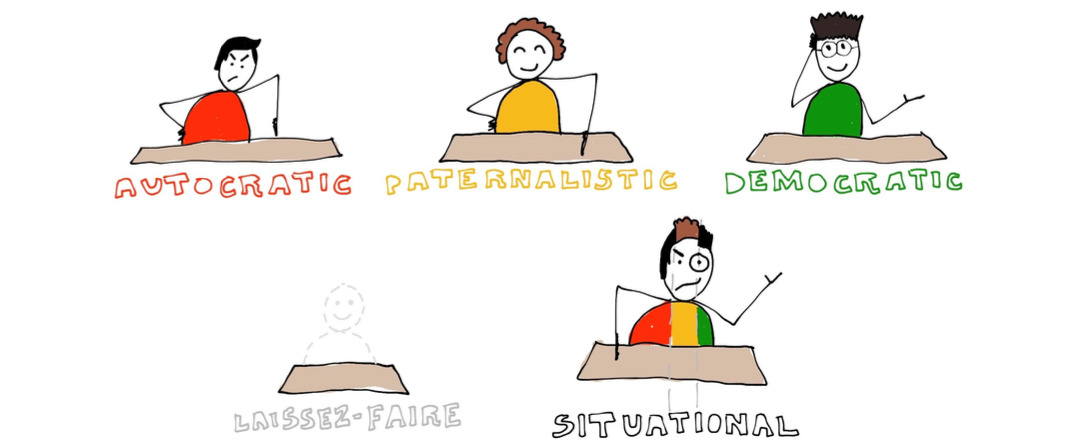
iii. SCIENTIFIC AND INTUITIVE MANAGEMENT/THINKING
(HL ONLY)
Distinguish scientific and intuitive management/thinking (AO2)
Scientific management is an approach to management that is based on the analysis of data. Scientific management is based on scientific thinking that prioritises rationality, methodical and systematic problem-solving and decision-making. This approach is more quantitative because it is based on analysing objective hard data (numbers). Scientific management may disregard people’s emotions for the sake of rationality. For example, if a company makes hiring decisions based on psychometric tests, that would be an example of scientific thinking/management. Scientific management is a theory that was originally developed by Frederick Taylor (we’ll get back to Taylor and discuss his theory in more detail in the next chapter).
Intuitive management is an approach to management that is based on instinct, intuition and gut feeling. Intuitive management is based on intuitive thinking that prioritises emotions, empathy, unsystematic and irrational problem-solving and decision-making. This approach is more qualitative because it is based on emotional and qualitative data (feelings, that are hard to turn into numbers). Intuitive management may disregard objective data for the sake of emotional happiness. For example, if an employee gets promoted based on internal politics as opposed to his/her contribution to the company, that would be an example of intuitive thinking/management. One of the advocates of intuitive thinking is Richard Branson (British billionaire, founder of Virgin Group) who once said “I can tell you that when I have to decide whether or not to go ahead with a new venture, I have often found that intuition is my best guide”. Make sure you know who Richard Branson is, look him up online. It’s an important name for the world of business.
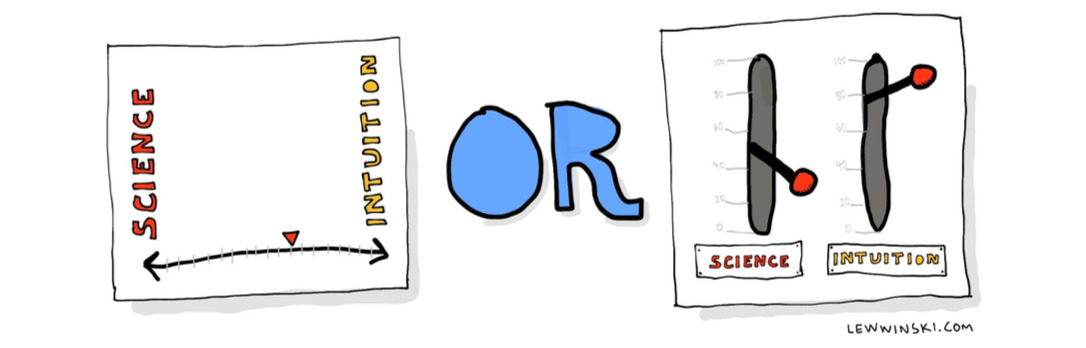
As always, one approach is not better than the other, they are just different. In reality, managers/leaders make intuitive decisions based on data, i.e. they combine scientific and intuitive management and thinking.
Even though I have explained the features of scientific and intuitive management above, it might be a good idea to fill in the table below anyway.
Look back at class objectives. Do you feel you can do these things?
— Distinguish leadership and management (AO2)
— Discuss leadership styles (AO3)
— [HL only] Distinguish scientific and intuitive
management/thinking (AO2)
Make sure you can define all of these:
1. Management
2. Charles Handy
3. General practitioners (GP)
4. Confronters of dilemmas
5. Balancers of cultural mixes
6. Henri Fayol
7. Planning
8. Commanding
9. Controlling
10. Coordinating
11. Organising
12. Peter Drucker
13. Leadership
14. Autocratic
15. Paternalistic
16. Democratic
17. Laissez-faire
18. Situational
19. Scientific management [HL]
20. Intuitive management [HL]
Check out these resources to boost your BM knowledge and skills:
— boosty.to/lewwinski
— tiktok.com/@lewwinski. business
— youtube.com/@lewwinski
Look for Lewwinski or Lewwinski Business on other social media!
2.4 Motivation and demotivation
Class objectives:
— [Some HL] Discuss motivation theories (AO3)
— Explain different types of rewards and training (AO2)
— [HL only] Explain and calculate labour turnover (AO2, AO4)
— [HL only] Explain different types of appraisal and recruitment
(AO2)
— [HL only] Compare & contrast internal and external recruitment
(AO3)
The main point of this chapter is to understand what motivates/demotivates people at work through the prism of different theories.
i. MOTIVATION THEORIES (SOME HL)
Discuss motivation theories (AO3)
Motivation refers to the reasons for behaving in a certain way, desire/effort/passion to succeed and reach certain achievements. It can be intrinsic (driven by internal factors, when you do something because you want to do it) and extrinsic (driven by external factors, when you do something because you will get a reward or will not get a punishment for doing it). Motivation is important, because if staff is motivated, it will result in job satisfaction that will lead to high productivity and high quality output, which will eventually result in higher profitability. Demotivated staff, on the contrary, will be dissatisfied with their job, will have low productivity, and produce output of low quality, which will eventually result in low profitability.
In this part of chapter we will discuss 6 motivation theories. The last 3 are HL only.
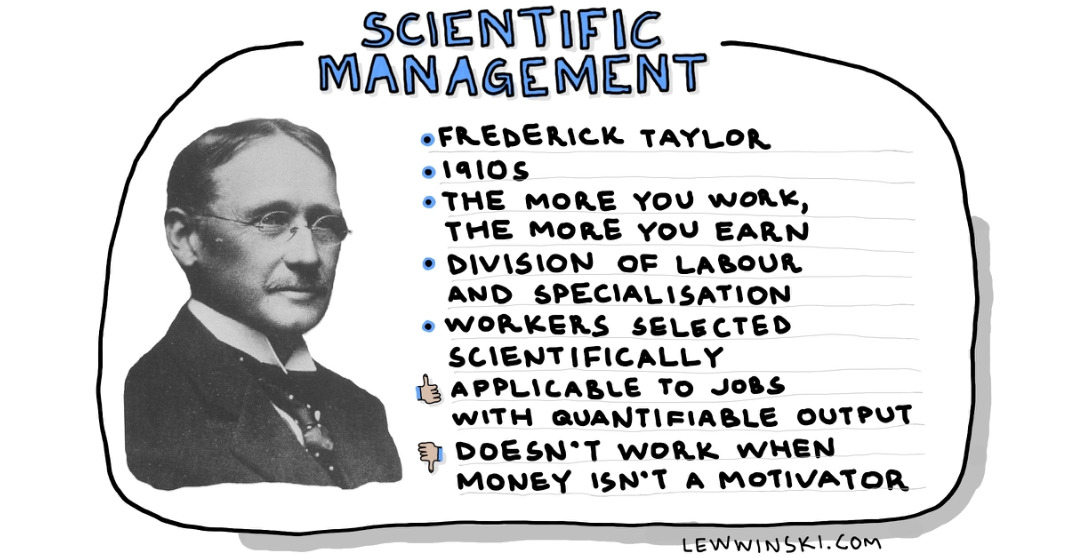
According to Taylor’s Scientific Management theory, managers are in charge of planning, direction, and control, whereas subordinates are rewarded using performance-related pay: the more they work, the more money they get. In addition, according to Taylor, there is a strict division of labour and specialisation at a workplace and all the tasks and expectations are clearly set and communicated to employees. All hiring decisions are made based on “scientific” objective parameters, not on how much a manager might potentially like the candidate emotionally.
Some of the things Frederick Taylor said: “What the workmen want from employers beyond anything else is higher wages” and “In the majority of cases, man deliberately plans to do as little as possible”. This sounds quite cynical, and yet Taylor’s theory works for some organisations up until now, even though the theory is about 100 years old.
On the one hand, Taylor’s theory works well for people who are driven by money. It also works for simple routine jobs where output can be easily quantified. In addition, the idea that “the more you work, the more you earn” is in line with certain cultures. On the other hand, mental output (such as teaching) is hard to measure, which makes the theory completely inapplicable to some professions. Besides, not all people are motivated by money. In addition, the more educated and experienced people are, the more they want to have a say in how things are done, except for merely being paid for performing certain tasks.
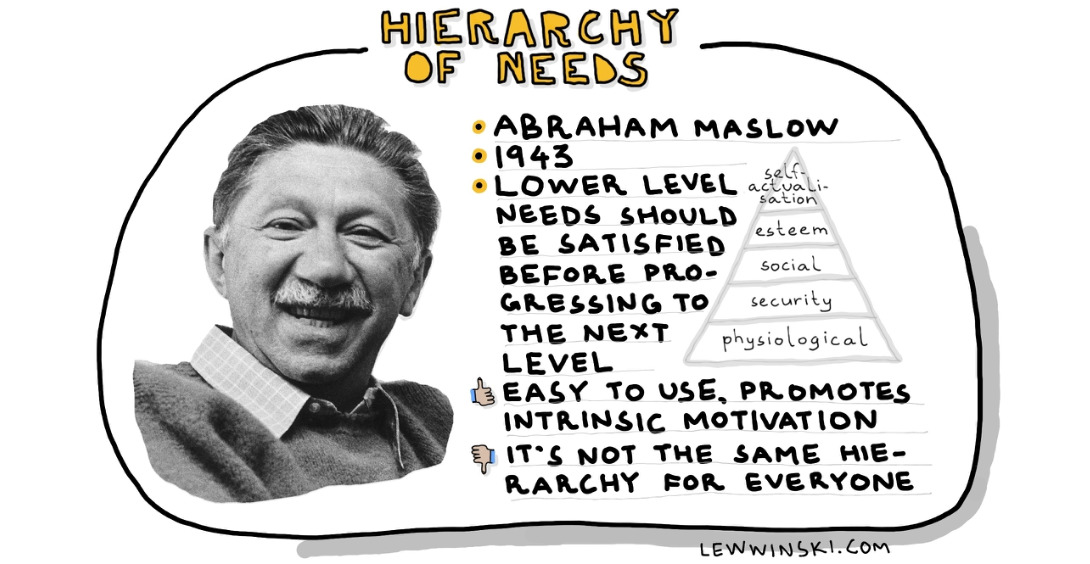
According to Maslow’s Hierarchy of Needs theory, people progress in their needs from the lower to the top level: once they are satisfied with physiological needs, they will be motivated by security; once they are satisfied with security, they will be motivated by social needs, etc. The five levels of needs (from the lowest to the highest) are:
1. Physiological (basic) needs
2. Security (safety) needs
3. Social (love & belonging) needs
4. Esteem (ego) needs
5. Self-actualisation
According to Maslow, people can’t skip any levels, and they won’t be motivated by more than one level ahead. For example, if security needs aren’t satisfied, you won’t be motivated by self-actualisation, because only social needs will motivate you.
On the one hand, the theory is really straightforward and easy to use. It can be applied across all industries. In addition, the theory suggests that true motivation is only intrinsic, thus it forces managers to think of ways how to develop employees’ intrinsic motivation. On the other hand, in reality, the hierarchy of needs is unique for all people. In addition, the levels in the hierarchy are impossible to measure and it is impossible to know whether you crossed the line between certain needs or no. And lastly, what motivates Jeff Bezos, who is definitely self-actualised? Or Elon Musk? Does it mean that they are very demotivated people now?
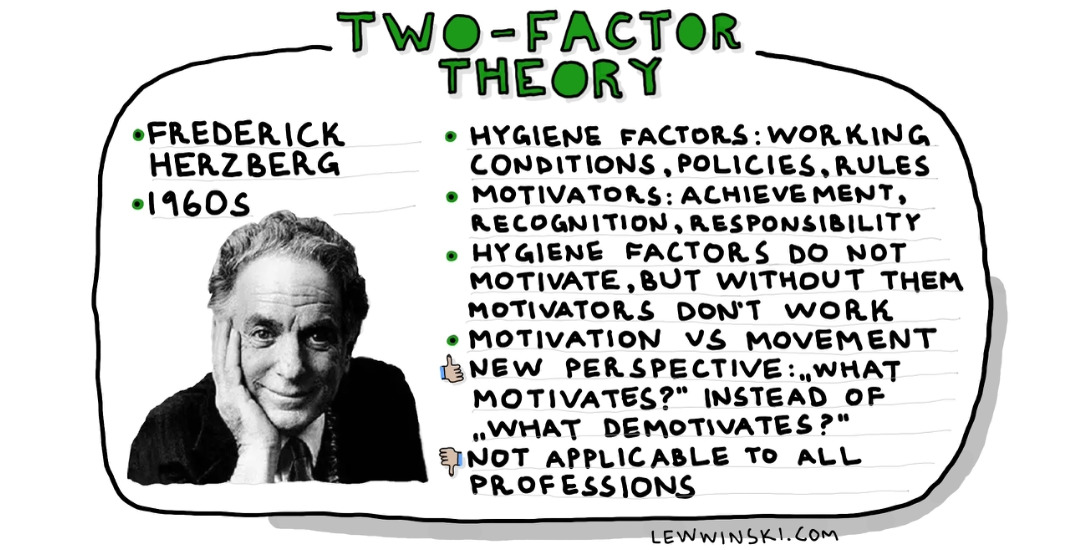
According to Herzberg’s Two-Factor theory, there are two factors (surprise-surprise!) that impact motivation at a workplace. The first one is called hygiene factors — aspects of work that do not motivate but must be met to prevent dissatisfaction: organisational rules, regulations, policies, working conditions, pay. These things don’t motivate, but their absence really demotivates. Think about school toilet: I doubt it really motivates you, but I’m sure if there was no toilet, you’d be pretty demotivated. The second kind of factors is called motivators — factors that lead to the psychological growth of workers and hence increase satisfaction and performance at work: achievement, recognition, responsibility, advancement. Motivators motivate, haha! But if hygiene factors aren’t in place, then motivators won’t work at all (think about toilet again: does achievement matter when you don’t have a chance to pee?).
In addition to that, Herzberg believed that motivation can be achieved through job enlargement (more variety in tasks, but not more challenging), job enrichment (more complex and challenging tasks to maximise potential and sense of achievement) and job empowerment (delegating decision-making power to workers). So, enlargement and enrichment refer to number of tasks and their responsibility, and job empowerment refers to decision-making. For some reason, many of my students think that enlargement + enrichment = empowerment. This is not true! I hope the picture in Figure 4 will help you understand it.
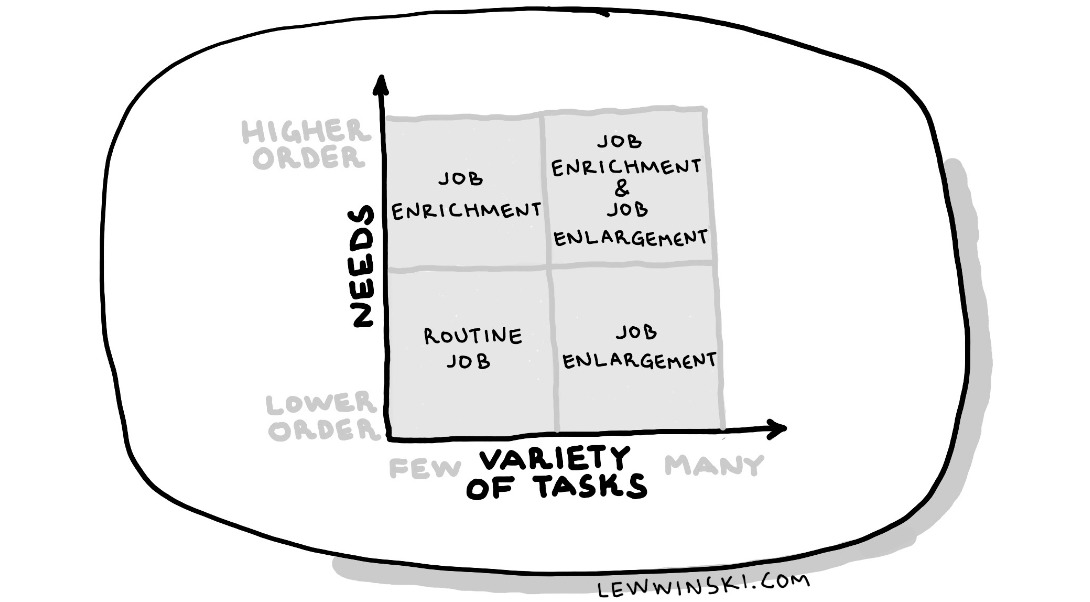
Another thing that my students usually point out and make fun of is that Herzberg only considered intrinsic motivation as a true motivation. He called extrinsic motivation “movement”, so every time I assign homework to my students, they say “movement”…
On the one hand, hygiene factors open a new perspective: “what might motivate employees?” instead of “why are they demotivated?” which makes managers think in an unconventional way and become creative in motivating their subordinates. Two-factor theory promotes the individual needs: what motivates one employee, does not motivate another employee. In addition, it considers the complex nature of motivation: what motivates today, might not motivate tomorrow, because hygiene factors and motivators are dynamic and inflexible.
On the other hand, two-factor theory can’t be applied to low-skilled low-paid labour because enrichment and empowerment will not work. Also, Herzberg’s research was based on accountants and engineers only, so there is no data that it will work across most professions. And lastly, not all employees will be motivated by enlargement/enrichment as it implies more work and responsibilities.
Standard Level students can relax now and make a cup of tea with a sandwich, but Higher Level students please stay with me for 3 more motivation theories.
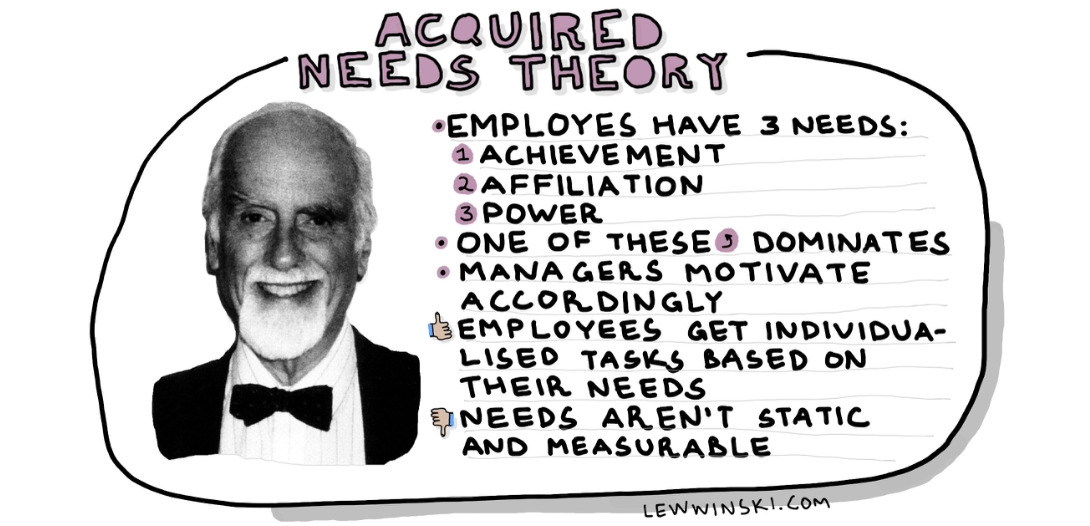
According to McClelland’s Acquired needs theory, all employees have three needs.
1. Achievement — desire to succeed, master skills and achieve goals. People who have achievement as their main need prefer to work on their own, prefer medium-risk tasks, and work best when creative and innovative solutions are required.
2. Affiliation — need to be around others and be loved/admired. People who have affiliation as their main need are excellent team players, they are usually very happy but it matters to them a lot what others think of them.
3. Power — desire to lead and inspire others. People with this type of need make good managers and prefer high-risk tasks, but are not necessarily the happiest people in an organisation.
The trick is that only one or two of these needs dominate in different people. Once managers can understand which needs prevail in an employee, they will be able to think of appropriate motivators.
On the one hand, the focus of the theory is beyond identifying needs, it’s also about developing/acquiring needs, which opens a new way of thinking and a new motivation approach to managers. In addition, if managers use this theory, employees get tasks based on their personal needs. On the other hand, most people have all three needs that take turns at different times, so it’s hard to identify what really motivates people.
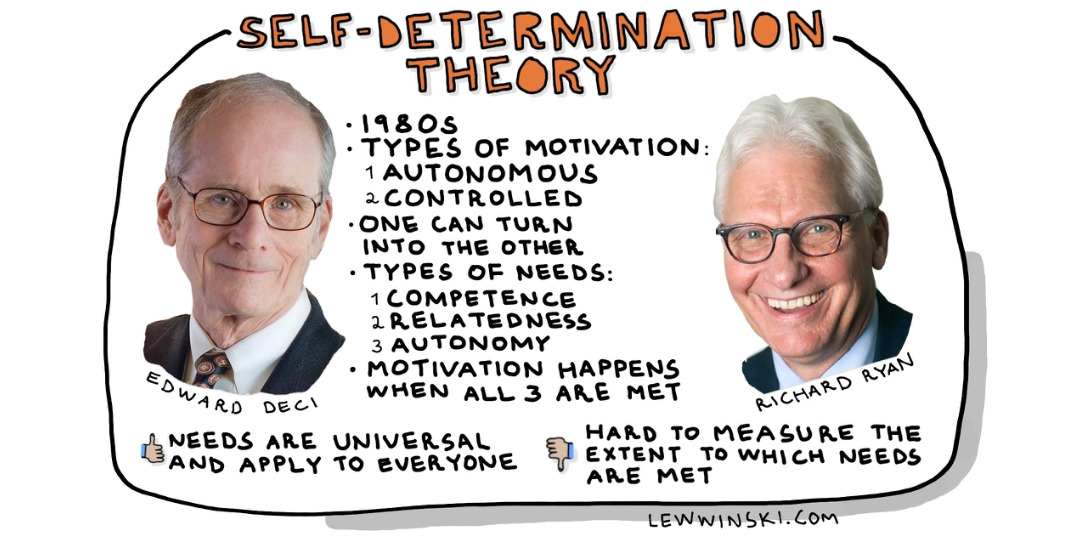
According to Deci and Ryan’s Self-determination theory, there are 2 types of motivation: autonomous (when you do something because you want to, can be either intrinsic or extrinsic) and controlled (when you do something for reward). They don’t conflict each other and one can be transformed into the other by people’s own efforts. The most productive employees internalise controlled motivation, i.e make it autonomous.
According to Deci and Ryan, all people have 3 types of universal needs:
1. Competence — need to succeed, achieve, develop.
2. Relatedness — care for and be cared by others, be part of the
group.
3. Autonomy — self-endorsed behaviour, need to be in charge
of own choices and make decisions.
Employees are motivated when all 3 needs are met. So, managers should identify which of these three is least developed and make sure it becomes satisfied so that employees could be motivated to perform their tasks well.
On the one hand, the needs are universal and apply to everyone, so theory is pretty easy to use. In addition, theory promotes self-determination of employees, thus shifting the emphasis to developing intrinsic motivation. On the other hand, it is hard to identify how much of each need different employees require. Besides, many employees are driven only by rewards and aren’t able to internalise motivators if there’s no personal benefit, which makes the theory quite inapplicable to them.
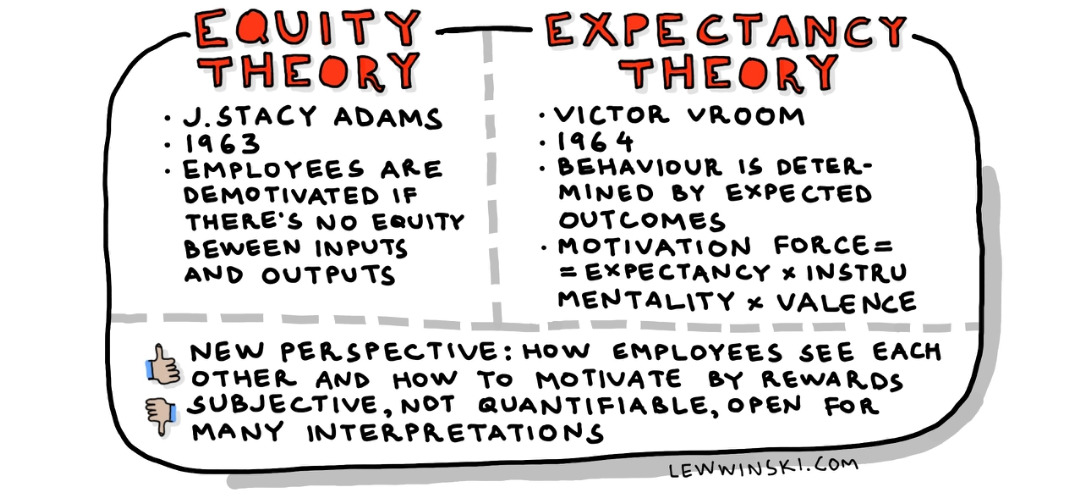
Actually, these are two different theories, but they are related and similar, and were developed at pretty much the same time. I guess that is why they are put together.
According to Adams’s Equity theory, employees compare their efforts and rewards to those of their colleagues. They become demotivated if their inputs are greater than the outputs. Inputs — contributions made by employee. Outputs — financial and non-financial rewards rewards that employees get in return for their contributions. Workers are motivated only if their input-output ratio is equitable (fair) in relation to others in the workplace. In order to understand equity theory, consider how you might feel if your teacher gave you a low predicted grade for Business Management despite the fact that you put in a lot of effort in studying BM, and yet your classmate, who put in very little effort, was rewarded with a higher predicted grade.
Keep in mind that equity is not the same as equality. And fairness is not the same as sameness. Equity theory does not say that everyone has to be equal and treated in exactly the same way. It says that there should be equity among one’s inputs and outputs.
According to Vroom’s Expectancy theory, people act in a certain way because they expect certain outcomes for their behaviour. If there are no desired outcomes, employees will not alter their behaviour. For example, employees might think “if I work hard, I will get a promotion”. According to Vroom, what drives people is motivation force, which equals to expectancy times instrumentality times valence (MF = E x I x V). Expectancy is the belief that you will achieve the goal if you work hard (“I’ll get promoted if I work hard”). Instrumentality refers to potential benefits for achieving the goal (“I’ll get a pay raise and a company car if I get promoted”). Valence is an evaluation of potential benefits that determines the behaviour (“but I will have to spend 20% more time at work, and will have to wear a tie every single day, and will spend less time with my family”). All these three things multiplied together result in motivation force, that can be weak or strong, depending on the variables.
Let’s summarise equity and expectancy theory as if they were one theory. On the one hand, it provides a new perspective to managers: how employees see each other in relation to each other or how employees perceive rewards. In addition, it provides managers a new approach: changing rewards/outputs in order to change behaviour. On the other hand, it doesn’t always work: sometimes people act against their best interests because there are other variables in place (in addition to MF, E, I and V). Inputs and outputs cannot be quantified, as well as some rewards, which makes theory hard to apply. And lastly, it is quite subjective: people have different understandings of what “fairness” and “rewards” are.
ii. REWARDS AND TRAINING
Explain different types of rewards and training (AO2)
There’s quite a lot of info in this part of chapter. In order to make it more digestible, let’s break it down into 3 parts: financial rewards, non-financial rewards, and training.
FINANCIAL REWARDS
Financial rewards are cash benefits that are given to employees in return for their efforts and achievements. There are 8 types of financial rewards that the you need to know: salary, wage (including time rate and piece rate), commission, performance-related pay (PRP), profit-related pay, employee share ownership schemes, fringe benefits. As always, it might be a good idea, to make notes using the table in Figure 8.
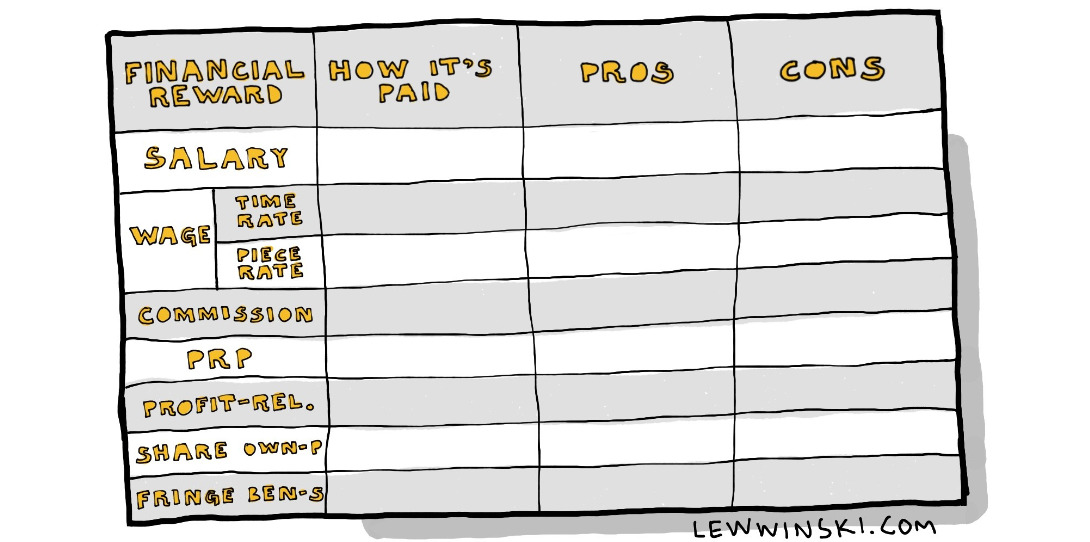
Salary is a type of financial reward that is a sum of money divided by 12 and paid in equal instalments monthly. Actually, the most important point here is not that it’s paid monthly (it doesn’t have to be like this, it can be paid twice a month too), but that it’s the same amount every time you get salary. On the one hand, salary is stable and you can easily predict your future income. On the other hand, employees are not motivated to work harder because salary is fixed and there is no need to put more effort than required by the contract.
Wage is a type of financial reward where employees are paid based on the amount of output they produce (piece rate) or the amount of time they spend at work (time rate). Piece rate, on the one hand, is fair and directly relates to output produced. It’s Taylor’s Scientific Management (see previous part of chapter) in action: the more you produce, the more you are paid. However, employees aren’t really motivated to produce high quality output, because only quantity matters, when it comes to payment. So quality standards and clear expectations have to be set with employees who are paid piece rate. With regards to time rate, it encourages employees to stay at work longer and do more work. In addition, overtime rates are usually paid for extra work and it is a great chance to earn more. However, time does not always relate to quality and efficiency, and many employees may choose to work slowly deliberately, in order to get paid more.
Important tip. Many students think that the main difference between salary and wage is that salary is paid monthly and wage is paid weekly. No no no! Even though these features of salaries and wages are true, it doesn’t necessarily have to be this way. You can pay salary weekly, and wage — monthly. What matters is that wage is directly related to the output produced (piece rate) or time spent at work (time rate), and salary is fixed regardless of the effort, time and output. In case of salary, the employer relies on professionalism of workers and dismisses workers in case they don’t meet contractual obligations. Please don’t say that the main difference is that wage is weekly and salary is monthly. Cheers!
Commission is a type of financial reward that is a percentage of the deals/sales that an employee makes. For example, real estate agent A gets 5% commission for selling a house. If he sells a house worth $100.000, he’ll get $5.000. But if he sells a house worth $1 million, then commission will be $50.000! On the one hand, it is great to be rewarded for results, and it motivates to make as many sales as possible. However, sometimes there are things in the external environment that are beyond salespeople’s control. For example, in times of recession and economic downturn, people spend less money, thus all salespeople earn lower commission, despite their skills and efforts.
Performance-related pay (PRP) is a type of financial reward that is usually a bonus that is paid in addition to salary. Simply speaking, it’s like piece rate, but for jobs that don’t involve production of tangible output (teaching, interior design, engineering, etc.), where the output may be hard to measure and thus performance targets are established based on metrics and KPIs other than the amount of output. On the one hand, it is a great way to motivate people who get salaries to work harder. On the other hard, performance targets are hard to set and may be subjective which might actually result in decreased productivity and demotivation.
Profit-related pay is a type of financial reward that is based on a portion of the profit that the organisation makes. On the one hand, it motivates people to work harder. For example, manager A receives 1% of profit in addition to salary. The higher the profit, the more money manager A makes, which is supposed to motivate manager A to work harder. On the other hand, sometimes low profit might be caused by external factors, such as recession, which results in lower profits despite the efforts of employees. In this case, staff might feel pretty demotivated.
Employee share ownership schemes is a type of a financial reward that implies giving company’s shares to employees as a bonus. Companies can either give some portion of shares to employees for free or sell shares to employees at a discounted rate or use a combination of these methods. Regardless of the method, employees are incentivised to work harder because they become shareholders (owners) of the company and understand that their contributions are directly related to the value of the company (and thus share price). However, employees who do not work hard enough (and actually devalue the company) jeopardise hardworking employees’ benefits. So, with employee share ownership scheme, everyone is tied together and someone’s shortcomings might have a negative impact on the entire staff.
Fringe benefits (perks) are a type of a financial reward that is given to employees in a non-cash form (company car, company accommodation, medical insurance, tuition for children, gym or spa membership, etc.). On the one hand, it increases the net (“take home”) salaries to employees. For example, if company pays for everything, then employees are able to save most of their earnings. However, for some employees who do not use fringe benefits much, a cash compensation might be more appropriate.
NON-FINANCIAL REWARDS
Non-financial rewards are non-cash benefits that are given to employees in return for their efforts and achievements. There are 6 types of financial rewards that you need to know: job enrichment, job rotation, job enlargement, empowerment, purpose/opportunity to make a difference, teamwork. As always, it might be a good idea to make notes using the table in Figure 9.
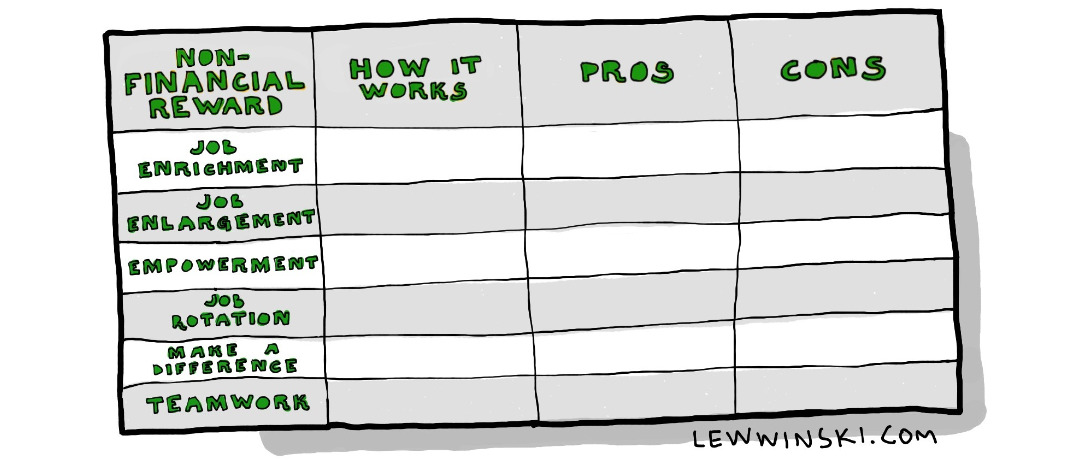
We have already briefly discussed job enrichment, job enlargement, and job empowerment in the previous part of chapter when we were learning Herzberg’s theory. Please mind the differences between these three.
Job enrichment is a type of non-financial reward that refers to an increase of challenge and responsibility, but not the increase in the number of tasks. Simply speaking, it’s a “level up” in tasks. For example, if someone’s job was to teach Business Management Standard Level course, job enrichment can be teaching Business Management Higher Level. On the one hand, it generally motivates people who like achievement and want to excel at their jobs. However, for some professions and people, job enrichment can be perceived as punishment and have a demotivating effect.
Job enlargement is a type of non-financial reward that refers to an increase in number of tasks, without increase in the challenge and responsibility levels. There is no “level up” in job enlargement. For example, if someone’s job is to teach one group of Standard Level Business Management students, job enlargement would be increasing it to two groups of SL students. On the one hand, it might work similar to job enrichment and have a motivating effect because it’s more challenging. On the other hand, if it’s simply giving more duties to someone, it will only demotivate.
Empowerment is a type of non-financial reward that refers to giving employees more decision-making opportunities and making them more in charge of their jobs. For example, empowered employees might be supervised less and provided with more freedom in how to do their jobs. On the one hand, people usually feel motivated when they feel that they are trusted with performing certain tasks without much supervision. On the other hand, empowered employees might not always manage the responsibility they were entrusted with very well and it might result in decreased productivity.
Important tip. Job enlargement and job enrichment are related and can be assigned to one category, but job empowerment and job rotation are not related to them. Very often students think that enlargement + enrichment = empowerment. This is not true. Enlargement and enrichment refer to the number of tasks and level of responsibility. Empowerment refers to decision- making. Rotation refers to switching jobs.
Job rotation is a type of non-financial reward that implies changing the working station with colleagues. For example, at a car factory, a team of 3 engineers might perform 3 tasks: painting, polishing, and assembly. In order to make the job for these 3 engineers more interesting, they might all learn to perform these 3 tasks and take turns, as opposed to one person always doing one type of job. On the one hand, it’s motivating and it makes job less tedious. In addition, it makes the workforce more flexible: if painter is sick, assembler or polisher can take over his duties in his absence. However, it takes time to learn new tasks, and productivity might decrease at the time of training. In addition, it is not applicable to all professions. For example, if I am rotated with an Mathematics teacher, I doubt I will be able to teach much…
Purpose/opportunity to make a difference is a type of non-financial reward that is providing employees with chances to be the advocate of positive social change. On the one hand, it might work very well in non-profit organisations (review NPOs in chapter 1.2) where people usually do not work for money, but for a chance to achieve social goals. On the other hand, if a for-profit organisation overemphasises social aims and opportunities to make a difference, it might cause misunderstanding and dissatisfaction among staff.
Teamwork is a type of non-financial reward that implies organisation of employees in teams inside horizontal flat structures. It implies reduction of direct strict control and supervision inside teams and laissez-fair leadership (chapter 2.3). On the one hand, it can be really motivating for teams of skilful employees who can manage themselves well. On the other hand, teamwork implies shared responsibility, thus low performance of certain team members may have a negative impact on the entire team.
TRAINING
Training is the process of providing opportunities for workers to acquire employment-related skills and knowledge. It can also be called professional development (PD). Training can be short-term and long-term. In a way, when you go to college for 4 years, it is actually a long-term training, because what you basically do there is acquiring employment-related skills… Training can be non-compulsory as well as obligatory. It is usually obligatory in professions that involve a physical risk to life. For example, miners, power supply station workers, factory workers have to have Health and Safety training before they are allowed to work. On the one hand, training develops employees and their skills, and helps them to do their jobs more efficiently and exchange their knowledge with colleagues. However, training increases chances for employees to leave their current workplace and go to a better place, especially if training results in a well-recognised certification. For example, if a school ABC provides workshops to its teachers, all teachers will get a certificate of attendance that makes them more employable and experienced. These teachers might use these certificates to apply for a job in school XYZ that pays higher salaries and provides better bonuses to teachers.
There are many types of training, but we will only focus on what you need to know for the exam: induction, on-the-job and off-the-job. As usual, I suggest you make notes using the table below.
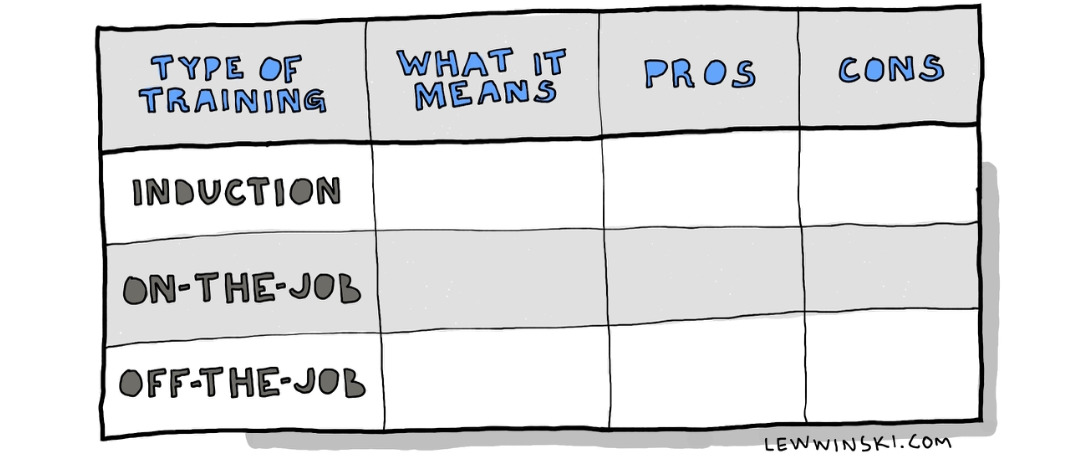
Induction training is a type of training aimed at introducing new employees to the organisation. It includes meeting key personnel, office tour, learning about the new job, company policies and practices. Induction training helps to settle in quicker, reduce potential mistakes, integrate into the corporate culture, get to know colleagues before actually starting work at a new place. However, job isn’t done during induction training.
On-the-job training is a type of training that takes place on-site. It saves costs, job gets done, output is produced, trainees get a chance to get to know colleagues, and there is no need to travel outside the workplace. However, mentor’s bad habits are passed on to the trainee, job isn’t done very well (because teaching, learning and working takes place at the same time), and mentor is not necessarily a good teacher, he/she is just a more experienced worker and there’s no guarantee that he/she knows well how to pass on knowledge effectively.
Off-the-job training is a type of training that takes place off-site. On the one hand, this kind of training is provided by professional coaches whose job is to teach. In addition, this training implies no distractions because employees are off-site and their main task is to learn. And lastly, off-the-job training usually results in certificate of attendance which is recognised outside of workplace, so employees increase their chances of employability elsewhrere. On the other hand, this type of training is usually expensive and it is not necessarily in line with company culture or objectives, because it is provided by an external organisation. Another drawback could be the fact that usually this kind of training takes place after work or on weekends, which means that employees have to sacrifice personal time for it.
iii. TURNOVER, APPRAISAL, RECRUITMENT (HL ONLY)
Explain and calculate labour turnover (AO2, AO4); Explain different types of appraisal and recruitment (AO2); Compare & contrast internal and external recruitment (AO3)
There’s quite a lot of info in this part of chapter too. In order to make it more digestible, let’s break it down into 3 parts: turnover, appraisal, recruitment.
TURNOVER
Labour turnover is the rate at which employees leave a workplace and get replaced. The formula is: labour turnover = leaving staff ÷ total staff ⨉ 100. The opposite of turnover is retention. If staff turnover is 30%, then staff retention is 70%.
Organisations usually try to maintain high levels of staff retention, however 100% retention is not always desirable, because it might lead to the so-called “dead wood” — a situation when no fresh ideas and no new people come to the organisation. The opposite of “dead wood” is “new blood”, which is generally good in moderation. Too much of anything is unhealthy for an organisation — be it high levels of staff retention, or high levels of staff turnover.
APPRAISAL
Appraisal is the formal assessment of an employee’s performance over a particular period (usually annually) that is usually conducted as an interview. On the one hand, appraisal helps employees to improve and increase productivity. At the same time, appraisal system makes sure the process is recorded which makes it more convenient to analyse data. On the other hand, it might demotivate and stress out staff if it’s too formal. In addition, it might be biased and subjective if expectations are not clearly communicated to employees. The four types of appraisal are:
1. Formative appraisal “forms” the employee. It is a developmental and learning process. The main idea is to help employees learn and improve, not to assess their results against certain criteria.
2. Summative appraisal measures performance against standards and summarises employees’ achievements over a time period. It is more “test-like” because the main idea is to assess performance, not to help learn. Usually it is the most stressful type of appraisal.
3. Self-appraisal is an opportunity for self-reflection. It helps employees to identify their own achievements and areas for improvement. The main idea of self-appraisal is to identify one’s own needs, rather then provide a second opinion. Usually it is the least stressful type of appraisal and at the same time the most motivating, because employees are given a chance to develop intrinsic motivation.
4. 360-degree feedback is a collection of feedback from all colleagues, all levels of hierarchy, sometimes even customers. It is a great opportunity to hear from people other than senior staff (boss) who are usually perceived as the main criticisers. It gives a second opinion from several different perspectives.
RECRUITMENT
Recruitment is the action of finding new people to join an organisation. For learning purposes, let’s break down the recruitment process into 8 stages and then discuss each stage in more detail:
1. Vacancy arises
2. Job analysis
3. Job description & Person specification
4. Job advertisement
5. Receiving applications
6. Short-listing
7. Interviews (& Testing)
8. Vacancy filled (& Rejecting & Contracts)
Stage 1. Vacancy arises. At this initial stage, the employer understands that a new person is needed either to replace a former employee or to take over some new duties. Basically, it is just an understanding that new person needs to be hired.

Stage 2. Job analysis is the process of identifying and recording the responsibilities for a job. It might refer to recollecting what the previous employee in that position did or it might refer to thinking about what the potential duties in the new position might be.

Stage 3. Job description (JD) and person specification (PS) are two documents that summarise the results of job analysis. Job description (JD) is a list of duties and responsibilities carried out by someone employed to do a specific job (this is a document about the job that needs to be done). Person specification (PS) is a document which outlines the requirements, qualifications, expertise, physical characteristics etc. for a specified job (this is a document about the ideal candidate for the job).

Stage 4. Job advertisement refers to letting other people know that the vacancy is open for applications. Job can be advertised either to current staff, or to anyone outside the organisation, or both. So, there are two types of recruitment:
— internal recruitment, when a vacancy is filled by one of the current employees; and
— external recruitment, when a vacancy will be filled by someone new to the business.
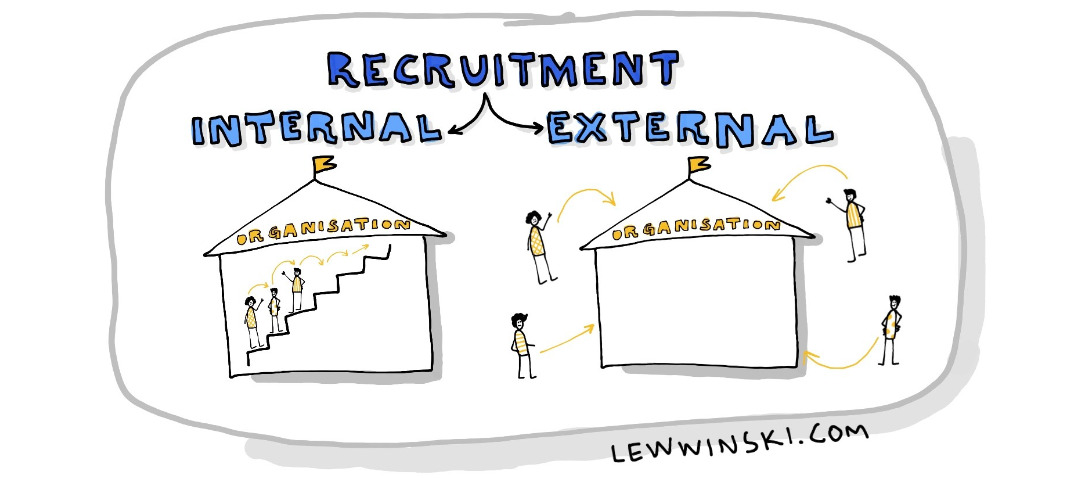
If an organisation is using internal recruitment to fill the vacancy, then it might advertise the job on a company website, or via email, or on a notice board. On the one hand, internal recruitment is cost-effective, there less down-time for new hires to settle in, there is less risk that the new hire won’t fit in, and it is motivating for all employees because they’ll know they can grow and get promoted in an organisation. On the other hand, internal recruitment implies fewer applicants (they are limited to within the organisation itself only), ‘dead wood’ (when there are no newcomers and fresh ideas), and it might cause some internal political issues, if a new hire was chosen based on favouritism or other subjective criteria, as opposed to the contributions to the organisation.
If an organisation is using external recruitment to find the best candidate, then it might advertise job in newspapers, on the internet, via recruitment agencies, in job centres, using headhunting, by university visits, or employee referrals. On the one hand, external recruitment implies “new blood” (new ideas from people with a completely different perspective), a wider range of experiences, and larger pool of applicants (not limited with organisation itself). On the other hand, with external recruitment there is a greater degree of uncertainty (because candidates are completely new to the organisation), it might be more time-consuming (because the pool of potential candidates is unlimited), and it can be expensive if a recruitment agency is involved or if HR needs to process many applications.
Important tip. Keep in mind that it doesn’t have to be “either/or”. Organisations can use internal and external recruitment at the same time.

Stage 5. Receiving applications. At this stage, candidates apply for the job that is advertised. Applications may include up to 3 documents:
1. Application form — a brief form that employers create in order to help shortlist the best applicants before inviting them for an interview. It’s created by an organisation and filled in by the applicants.
2. CV (resumé) is a summary of education, qualifications, work experience and other relevant characteristics of a candidate. Candidates prepare their own CVs themselves. Try to create one for yourself now and update it every year. It will help you to stay focused on your career.
3. Cover letter is a brief supporting letter that candidates write while applying to job where they state why they are the best match for the given vacancy.
Keep in mind that it’s not always all 3 documents. Sometimes just CV is enough, sometimes employers ask for more supporting documents.
Stage 6. Short-listing refers to creating a list of the best applicants that will be invited to the next stage — interviews. In addition, at this stage, organisations notify candidates that were not shortlisted (rejected), thank them for their applications and wish them good luck in their future applications.

Stage 7. Interviews and testing. So, shortlisted applicants are invited for an interview — a face-to-face meeting where the recruiters and applicants ask each other questions related to the potential employment. Interviews can be one-to-one, two-to-one (usually an expert in the related field of work and someone from HR), or a panel interview (more than two interviewers). If the interview went well, then the recruiters might want to contact candidate’s references (previous employers or teachers or both) and ask them for a reference letter. References are similar to college application recommendation letters. They are usually confidential (the candidate does not see them, they go directly from references to recruiters) and usually they include some sort of an evaluation form and/or a letter.
If the interview is not enough, recruiters might also arrange some tests for the candidates. It can be an aptitude test (examines professional skills), a psychometric test (assesses candidate’s personality), a group situation test (examines candidate’s behaviour in a group of people), or an intelligence test (measures IQ or other metrics of intelligence).

Stage 8. Vacancy filled (plus rejections and contracts). At the final stage, recruiters make the decision about who to offer job to (i.e. about who the best-fit candidate is), unsuccessful applicants are informed that they did not get the job and are thanked for participation. Successful candidates are offered a contract of employment.
Contract of employment is a written agreement that might include the following: job title, duties, dates of employment, hours and days of work, rates and methods of pay, holiday and sick leave, pension scheme arrangements, disciplinary procedures, termination and period of notice, names and signatures of both parties.
Employment (and thus, contract) can be part-time or full-time (depends on the hours spent at work) and permanent or temporary (depending on the period of employment).
Just to be clear, one of the assessment objectives for this part of chapter was to “compare & contrast internal and external recruitment (AO3)”. So, in case you missed it, the types of recruitment are internal and external. You are expected to be able to evaluate them. In order to do so, see the pros and cons of these types of recruitment above (stage 4: job advertisement).
Look back at class objectives. Do you feel you can do these things?
— [Some HL] Discuss motivation theories (AO3)
— Explain different types of rewards and training (AO2)
— [HL only] Explain and calculate labour turnover (AO2, AO4)
— [HL only] Explain different types of appraisal and recruitment
(AO2)
— [HL only] Compare & contrast internal and external recruitment
(AO3)
Make sure you can define all of these:
1. Motivation
2. Intrinsic motivation
3. Extrinsic motivation
4. Demotivation
5. Scientific management
6. Taylor
7. Hierarchy of needs
8. Maslow
9. Physiological needs
10. Security needs
11. Social needs
12. Esteem needs
13. Self-actualisation
14. Two-factor theory
15. Herzberg
16. Hygiene factors
17. Motivators
18. Movement
19. Job enlargement
20. Job enrichment
21. Job empowerment
22. McClelland [HL]
23. Acquired needs theory [HL]
24. Achievement [HL]
25. Affiliation [HL]
26. Power [HL]
27. Deci and Ryan [HL]
28. Self-determination theory [HL]
29. Autonomous motivation [HL]
30. Controlled motivation [HL]
31. Competence [HL]
32. Relatedness [HL]
33. Autonomy [HL]
34. Adams [HL]
35. Equity theory [HL]
36. Inputs [HL]
37. Outputs [HL]
38. Vroom [HL]
39. Expectancy theory [HL]
40. Motivation force [HL]
41. Expectancy [HL]
42. Instrumentality [HL]
43. Valence [HL]
44. Financial rewards
45. Salary
46. Wage
47. Time rate
48. Piece rate
49. Commission
50. PRP
51. Profit-related pay
52. Employee share ownership schemes
53. Fringe benefits
54. Non-financial rewards
55. Job enrichment
56. Rob rotation
57. Job enlargement
58. Empowerment
59. Opportunity to make a difference
60. Teamwork
61. Training
62. Induction training
63. On-the-job training
64. Off-the-job training
65. Professional development (PD)
66. Staff turnover [HL]
67. Staff retention [HL]
68. “Dead wood” [HL]
69. “New blood” [HL]
70. Appraisal [HL]
71. Formative appraisal [HL]
72. Summative appraisal [HL]
73. Self-appraisal [HL]
74. 360-degree feedback [HL]
75. Recruitment [HL]
76. Job analysis [HL]
77. Job description (JD) [HL]
78. Person specification (PS) [HL]
79. Job advertisement [HL]
80. Short-listing [HL]
81. Job interview [HL]
82. Internal recruitment [HL]
83. External recruitment [HL]
84. Application form [HL]
85. CV (resumé) [HL]
86. Cover letter [HL]
87. Contract of employment [HL]
Check out these resources to boost your BM knowledge and skills:
— boosty.to/lewwinski
— tiktok.com/@lewwinski. business
— youtube.com/@lewwinski
Look for Lewwinski or Lewwinski Business on other social media!
2.5 Organisational/corporate culture (HL only)
Class objectives:
— Define organisational culture (AO1)
— Explain different types of organisational culture (AO2)
— Discuss cultural clash (AO3)
The main point of this chapter is to figure out what organisational culture is and to get to know a few ways to describe it.
i. ORGANISATIONAL CULTURE
Define organisational culture (AO1)
Organisational (or corporate) culture refers to the ideas, beliefs, values and other attributes of a group of people. The “other attributes” part of this definition sounds vague and may have a lot of interpretations, based on different theories and approaches to organisational culture that will be discussed in part 2 of this chapter. For now, we’ll have to work with a definition above.
Culture is something that is formed naturally and that goes beyond managers’ control. Managers are part of organisational culture too. They can, however, influence organisational culture, but they are not able to change it at their will.
Бесплатный фрагмент закончился.
Купите книгу, чтобы продолжить чтение.