
Бесплатный фрагмент - Fairy tales with meaning
For adults and children
The Tale of the Forest of Talking Trees and the Silver Wolf
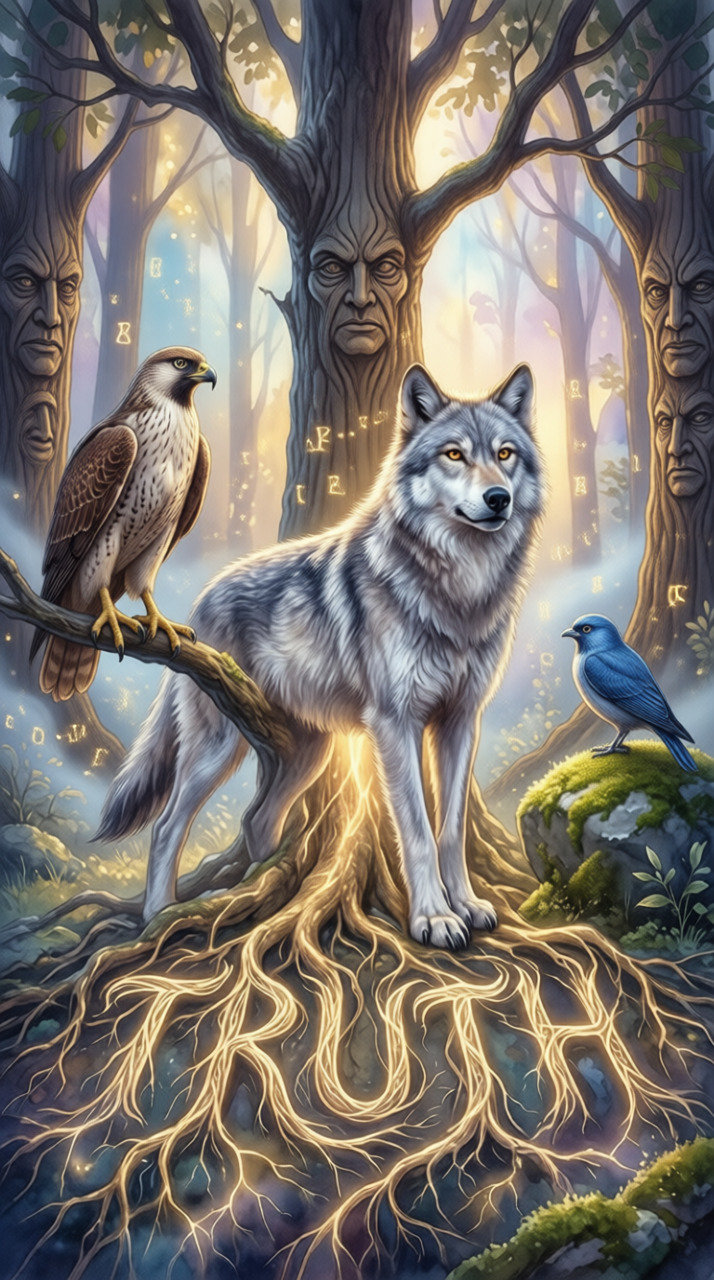
In a distant kingdom, beyond seven mountains where mists cling to the peaks and stars glow like rubies in the night, whispering ancient secrets, stood the ancient Forest of Talking Trees. Each tree remembered epochs: some rustled with tales of times when the wind was free; others murmured of days when roots wove patterns of brotherhood. But now the forest was ruled by the Falcon-King, whose iron claws dug so deep into the earth that even springs hid beneath stones.
«Whisper only of sun and rain,» he thundered, «and forget freedom. It is a mirage for fools.» Those who dared to grumble were carried away by crows into stone caves in the north, where tree trunks blackened from silence.
One day, a Silver Wolf appeared at the forest’s edge.
His fur shimmered like moonlight on water, and his voice — deep and clear — seemed to awaken sleeping seeds beneath the snow.
«Why are you here?» asked an old Willow, her branches trembling like an elder’s fingers. «We learned to fear long ago.»
«Fear is but a shadow,» replied the Wolf, touching her bark with his muzzle. «And I have come to remind you: even a shadow vanishes when light is kindled.»
He walked from oak to pine, from birch to maple, listening to their stories. The Oak told how crows had torn away his acorn-son and carried him into the unknown. The Pine whispered that her needles were falling, poisoned by drops that fell from the sky on the King’s feast days.
The Wolf remembered every word, then gathered the animals on a clearing.
«The King says streams dry up from your greed,» he growled, «but that is a lie! He himself dammed them to control your thirst.»
«But how can we fight?» asked a timid Hare, hiding behind a stone. «The Falcon has an army of crows — claws, beaks…»
«Truth is stronger than beaks,» answered the Wolf. «Tell each other what you hear. Let every leaf become a letter, every rustle — a page.»
The Falcon-King, seated on a throne of pressed branches, learned of the Wolf’s words. His feathers bristled with rage.
«He sows chaos!» he screeched to his crow advisors, whose eyes gleamed like resin. «Declare him a madman! Say he ate a fly agaric — or better yet, that he was poisoned! Smear his tail with poisonous ivy while he sleeps…»
The Falcon’s black guards flew to carry out the order. While the Silver Wolf slept, they smeared his tail with poison, and the Wolf fell ill, taking long days to recover.
And while he was absent from the forest, the Crows cawed in unison across the paths — but the animals no longer believed their cries.
Wise Owl, whose eyes saw through lies, whispered to the Wolf:
«They will come for you. Run while it’s not too late. Do not return to the forest.»
«If I run, if I do not return, they will say I was afraid,» the Silver Wolf shook his head. «Let them see: truth does not hide.»
The next morning, crows surrounded the Wolf. They bound him with their wings like ropes and dragged him to the King.
«You thought your truth would save you?» hissed the Falcon, piercing the Wolf with his gaze. «Truth is what I say it is.»
«Truth is what all see but fear to name,» replied the Wolf calmly, even as crows dug their claws into his fur.
They threw him into a windowless tower where walls breathed dampness and cold bound time, which flowed like resin… But the Wolf did not surrender. The deeper he sank into darkness, the brighter sparks flared in the forest. Mice dug tunnels to carry news from the tower. Squirrels hid seeds of truth in hollows.
And old Willow, bending toward young Maple, whispered:
«Remember — he has not vanished. As long as we speak, he is here. The forest will be free.»
One morning the Wolf was gone. The crow guards cried that he had «dissolved in his own deceit,» but on the snow outside the tower there were no tracks — only a single silver hair, glowing like a beacon.
From that night on, wonders began to unfold in the forest.
Stones that crows threw at the animals turned into flowers. Frozen streams began to murmur under moonlight. And if anyone pressed an ear to the earth, they heard a distant howl — not sorrowful, but full of strength, as if somewhere beyond the mountains the Silver Wolf ran along the trail of spring.
Moral: Even if a voice drowns in lies, never stop speaking the truth. For evil triumphs not by its own strength, but by the inaction of good creatures.
The Tale of the Ice Bear and the Lost Song
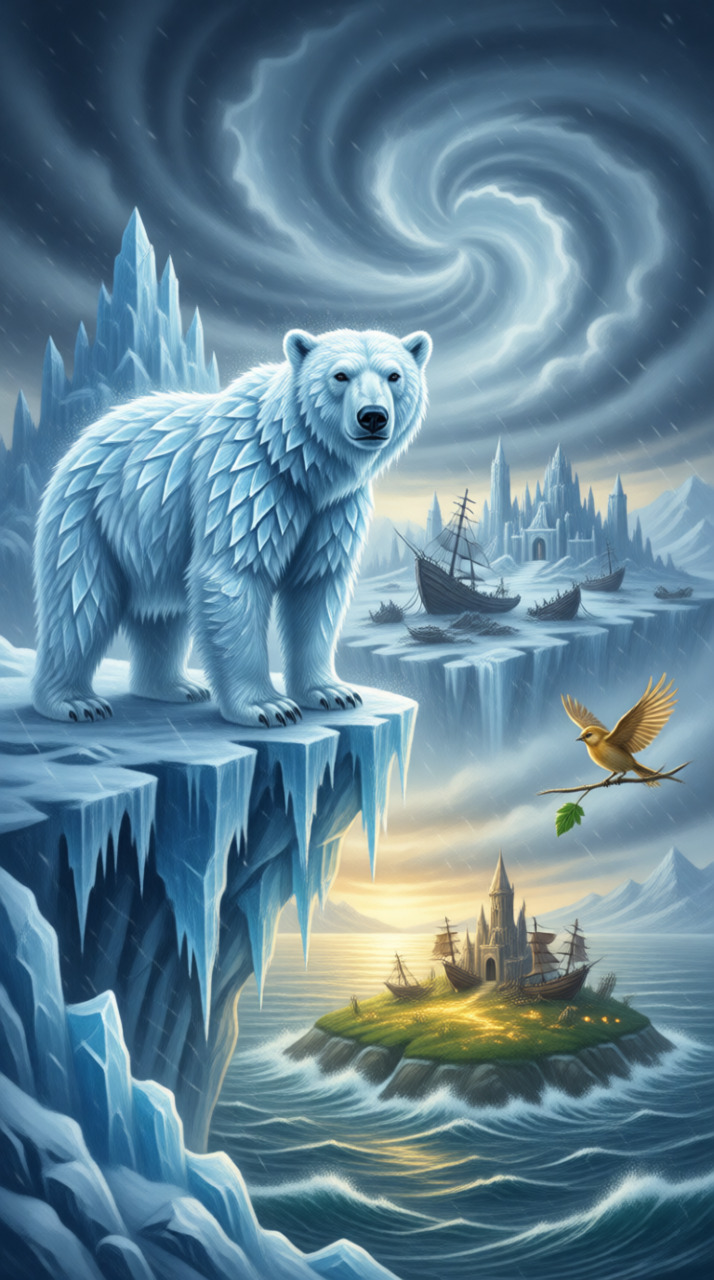
In a frozen kingdom where northern winds carved patterns into cliffs and snows remembered the footsteps of millennia, lived the mighty Ice Bear. His cave, adorned with crystals of past victories, rose above a bay where ships from across the world once sailed. The Bear ruled sternly but proudly: he believed the ice he guarded was not merely a border, but part of his own soul.
Beyond the strait, where waves sang in the language of freedom, lay the Green Island. Its people — descendants of those who once shared paths with the Bear — wove carpets from flowers and songs. But the Bear, gazing at their lights through the blizzard, whispered: «This is my land. Their roots grow in my ice.» And one day, when clouds coiled into steel rings, he unleashed an avalanche upon the Island, declaring he would «save them from themselves.»
The first to sound the alarm were the Migratory Birds.
«Run!» cried the Crane, flapping his wings at the Island’s edge. «The Bear will crush everything!»
«But we cannot abandon our nests,» replied the Swallow, pressing her chicks to her breast. «This is our home.»
«There will be no home if you stay,» whispered the Crane, vanishing into the clouds.
On the Island’s shore, an ancient Oak — whose roots remembered times when the Bear and the Island shared bread — groaned in pain:
«Why do you do this, brother?» he called across the strait, but his voice drowned in the storm’s roar.
«This is no brotherhood,» answered the Ice Bear, shattering ice with his claws. «This is my duty. I save what you have lost. I save you from yourselves. I liberate your island from invaders.»
Ships Depart
Waves raised by the avalanche reached distant shores. First to turn his sails was the Grey Whale, whose ancestor once taught the Bear to fish.
«You have broken the covenant with the sea,» said the Whale, his voice trembling like water in a storm. «I shall never sail to your bay again.»
«Traitor!» roared the Bear, but the Whale had already vanished into the mist.
Soon after, ships from the Land of Sunlit Gulls sailed away.
«We do not wish our bread to smell of ice and ash,» said the Captain, casting a wreath of poppies into the water.
Even the Fox from the Steppes — who for centuries had stolen fish from the Bear’s nets — turned away:
«Your strength has become poison,» he muttered, retreating into the mountains. «I do not wish to be part of this tale.»
In the icy kingdom, voices began to vanish.
First to leave her nest was the Golden Titmouse, whose trills once filled all the Bear’s festivals.
«I cannot sing beneath your cries of enemies from the western shore,» she said, bidding farewell to the Rowan tree by her window.
«But you are our pride!» pleaded the Rowan, shedding crimson berries. «Who will remind us of beauty?»
«Beauty does not live where it is trampled,» answered the Titmouse, carrying in her beak a twig with the last leaf.
The Mimic, whose songs once gathered beasts on clearings, followed:
«My words have become weapons in strangers’ beaks,» he whispered. «I choose silence.»
«You choose cowardice!» the Raven-Councillors shrieked after him, but the Mimic merely waved a wing:
«No. I choose life.»
Shadow in the Cave
One night, when the blizzard howled like a wounded beast, the Bear was visited by the ghost of the Old Sorcerer — a spirit who once taught him wisdom.
«You have forgotten,» said the Sorcerer, his voice chiming like ice beneath the moon, «that strength lies not in claws, but in hearing the whisper of roots.»
«They laughed at my ice!» the Bear roared, shattering a cliff. «They said I was weak!»
«And now you prove they were right,» the Sorcerer shook his head. «Look around: your kingdom has become a prison.»
The Bear looked. In the cave where festival fires once blazed, now lay splintered shipwrecks. The Raven-Councillors cawed of «greatness,» but their words fell into emptiness.
«They flatter you because they fear you,» continued the Sorcerer. «But fear is a poor advisor.»
The Last Blacksmith
That winter, the last Blacksmith closed his forge — whose chains once held ships at the docks.
«I am leaving,» he said, casting his hammer into the snow.
«You are bound to serve the kingdom!» bellowed the Bear, his breath freezing the forge door with ice.
«No,» answered the Blacksmith, unclenching his fist. On his palm lay a tiny iron bird — a memory of his son, lost in the avalanche. «I served you while you did not burn what you were meant to protect.»
Flowers Through the Ice
Years passed. At the forest’s edge, where Songbirds once gathered, grew a rowan tree with golden berries — as if drops of their songs had taken root.
And on the bay’s shore, where ships no longer came, the ice began to crack. Through the fissures sprouted yellow-blue flowers, resembling those that bloomed on the Green Island.
«Destroy them!» the Bear roared at the Ravens, but they merely exchanged glances.
«They… do not burn,» muttered one, poking a petal with his beak.
«And they do not freeze,» added another.
And far away, beyond the mountains, beasts told legends of the Mimic and the Titmouse, whose songs now echoed in foreign forests. And of the Fox from the Steppes, who, having become a wanderer, carried a handful of Island soil, saying:
«This is a reminder. Even the strongest ice will melt if the heart remembers warmth.»
Moral: When war becomes a monument to itself, even ice weeps. And those who departed teach the world: home is where wings are not broken to prove you know how to fly.
The Tale of the Ice-Mirror King and the Bread That Melted
In a distant northern kingdom where winter lasted an eternity and frost adorned windows with intricate patterns, ruled the Ice-Mirror King. His palace stood atop a mountain, its walls made of crystal that reflected everything thrice over: it seemed as though the realm possessed three suns, three moons, and three times more gold. «Behold your wealth!» cried the King’s advisors — Wolves in brocade mantles — pointing at the mirror-glare. But the people, shivering in their huts, knew the truth: the mirrors lied.
The Cold That Burned
Each night the King stepped onto his balcony and breathed upon the land. His breath turned to frost that devoured coins in purses.
«Why has my loaf shrunk to the size of a pigeon’s egg, while its price swells to that of an ox?» an old woman once asked a merchant at the market.
«This is temporary,» hissed the merchant, crossing out the price with charcoal. «The King builds great ice fortresses to protect us.»
But the fortresses rose somewhere beyond the mountains, while the people froze. Firewood cost as much as pearls, salt as much as sable fur. Even children knew that «temporary» meant «forever.»
In the forest beyond the village edge, the Woodcutter chopped frozen branches. His neighbour, the Sower, dug with empty hands into the frozen earth:
«Everything I planted they seized for the royal granaries. They say ’for the people’s good.» And now not even seeds remain…»
«Do you think the Wolf-Advisors eat these grains themselves?» chuckled the Woodcutter, tossing a bundle of kindling onto the snow.
«No. They sell them abroad,» whispered a Woman clutching a child wrapped in rags. «My husband heard merchants boasting in the tavern: „Our King trades in ice and hunger.“»
Inside the palace, the Ice-Mirror King sat upon a throne woven from blue ice. Wolves in brocade surrounded him — their teeth gleamed with grease, their eyes empty as a snowfield.
«The people grumble,» said one Wolf, licking his claws. «They say coal prices have doubled.»
«Then announce that coal now burns twice as hot!» laughed another. «And add: this is the King’s doing.»
The King, toying with his icy sceptre, nodded: «Let the mirrors show new figures. Say the wheat harvest has grown.»
«But the granaries are empty…» ventured a younger Wolf, only to be struck by the elder’s paw:
«Mirrors do not lie. Those who fail to see their light are the liars.»
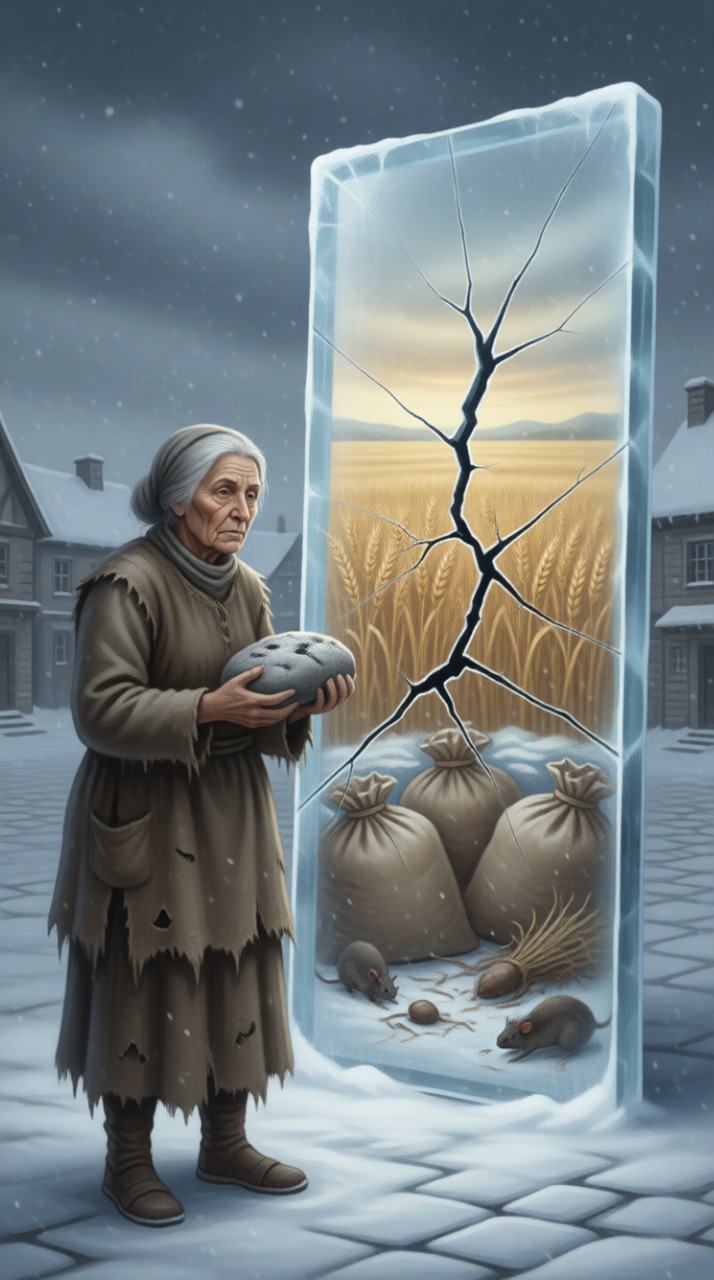
That night, in an abandoned mill, gathered those who no longer believed the mirrors. The old woman brought a crust of bread that crumbled in her hands:
«Once the flour was white, now it’s grey as ash.»
«And my salt has run out,» said the Fisherman, pulling emptiness from his nets. «The fish have fled to the depths. They say even the fish fear the King’s breath.»
The young Baker, whose shop had closed the week before, spread his hands: «The Wolves ordered me to bake ’airy loaves’ — so people would think bread was plentiful. But how does one bake air?»
«You should have added sawdust,» the Sower replied bitterly. «That’s what they do in the next village.»
Suddenly the door creaked. A Girl with frozen cheeks stood on the threshold:
«Mama says soon we’ll be gnawing bark… And the King still lies?»
«He does not lie,» the Woman embraced her. «He simply… does not see.»
The day came when even patience froze.
The old woman stepped onto the square, holding that very crust of bread. Behind her followed others: the Woodcutter with his axe, the Sower with an empty sack, the Fisherman with his torn net.
«The mirrors lie!» cried the old woman, and her voice seemed to split the sky.
«They lie!» the crowd took up the cry.
Someone threw a snowball at the nearest mirror. It cracked — and everyone saw the truth: behind the reflection of «wealth» lay empty granaries; behind «abundance,» rats gnawing frozen roots.
The Wolf-Advisors rushed from the palace, snarling: «This is the work of enemies! They wish to steal your happiness!»
«What happiness?» shouted the Woodcutter, pointing at his tattered coat. «Happiness is not shivering while your children cry from hunger!»
The Ice-Mirror King, hearing the uproar, stepped onto the balcony. His mantle of icicles chimed in the wind.
«You are ungrateful!» he roared, and his breath turned to a blizzard. «Without me you will freeze!»
«We are already freezing!» answered the Woodcutter, raising his axe. «You stole our winters. You turned life into a struggle for crumbs.»
Бесплатный фрагмент закончился.
Купите книгу, чтобы продолжить чтение.