
Бесплатный фрагмент - Effective Workplace Communication
Clear English for Daily Work
INTRODUCTION
Communication as a Work Skill
At work, communication is not “extra”. It is part of the job. You can be smart and hardworking, but if your messages are unclear, people will still make mistakes. Tasks will slow down. Meetings will become longer. Small problems will repeat.
Good communication is a practical skill. It helps you move work forward with less stress. It also helps other people work with you easily. When your message is clear, the other person knows what to do next. They do not need to guess. They do not need to ask five basic questions.
Office communication happens in small moments. A short chat message. A quick email. A two-minute meeting. These moments look simple, but they shape your whole day. If each message is unclear, your day becomes a chain of small delays.
This book focuses on daily work language. It is not about complex grammar. It is about clear actions. You will learn how to write short messages, ask precise questions, give clear instructions, set limits, and handle small conflicts in a professional way.
You do not need “perfect English” to communicate well. You need simple English with clear structure. Short sentences are often stronger than long sentences. A clear verb is better than a vague verb. A clear time is better than “later”. This is the core idea.
Why Clear English Improves Work Results
Clear English improves results because it reduces hidden work. Hidden work is the work nobody plans. It appears when messages are unclear. People rewrite tasks. They repeat conversations. They fix mistakes that should not happen. They lose time on follow-ups.
Unclear messages also create pressure. When you do not understand what is expected, you feel stress. When you do not know the deadline, you feel urgency. When you do not know who owns the task, you feel confusion. These feelings are normal, but they hurt performance.
Clear English makes work calmer. It helps people feel safe because they can see the plan. It also builds trust. When your message is clear, people believe you. They see you as reliable. They do not fear surprises.
This is especially important in international teams. People have different communication styles. Some are very direct. Some are very indirect. Some write long emails. Some write one line. Clear structure helps everyone. It reduces cultural misunderstandings and keeps the focus on work.
Clear English also protects your time. When your messages are precise, you receive better replies. You spend less time explaining. You spend less time correcting others. You can focus on real work instead of endless messaging.
The goal is simple: after a short message, the reader should know the next step. If the reader cannot answer “What do I do now?”, the message is not clear yet. This book will help you build that habit.
PART 1 — CORE OFFICE LANGUAGE
CHAPTER 1 — Direct Language for Daily Work
Vocabulary
direct — simple and honest, not hidden
collocations: direct question / direct message
clarity — being easy to understand
collocations: clarity in writing / with clarity
decode — try to understand a message that is not clear
collocations: decode a message / hard to decode
purpose — the main goal
collocations: clear purpose / with a purpose
deadline — the latest time to finish something
collocations: meet a deadline / set a deadline
misunderstanding — when people understand differently
collocations: cause misunderstanding / avoid misunderstanding
accurate — correct and exact
collocations: accurate information / be accurate
reliable — you can trust it
collocations: reliable update / reliable information
confirm — say “yes, it is correct”
collocations: confirm a time / confirm details
decline — say “no” politely
collocations: decline a meeting / decline a request
subject line — the title of an email
collocations: clear subject line / email subject line
Direct language helps you work with speed and clarity. In an office, people read fast. They open a chat or an email, scan the first lines, and move on. If the main point is hidden, they will guess, ask many questions, or do the wrong thing.
Direct language means one main idea first. Then you add the key details: what you need, when you need it, and who should do it. You do not write a long story before the task. You start with the task.
Many people avoid direct language because they fear it sounds rude. In fact, direct language is usually calmer. It removes pressure from the reader. The reader does not need to decode your message or read it twice.
Direct language is not “short for no reason”. It is “short with purpose”. You remove extra words that do not change the action. You keep the words that change the action.
Daily office work needs this style all the time. You share updates. You ask small questions. You set deadlines. You request a decision. In these moments, short messages work best in emails, chats, and meetings.
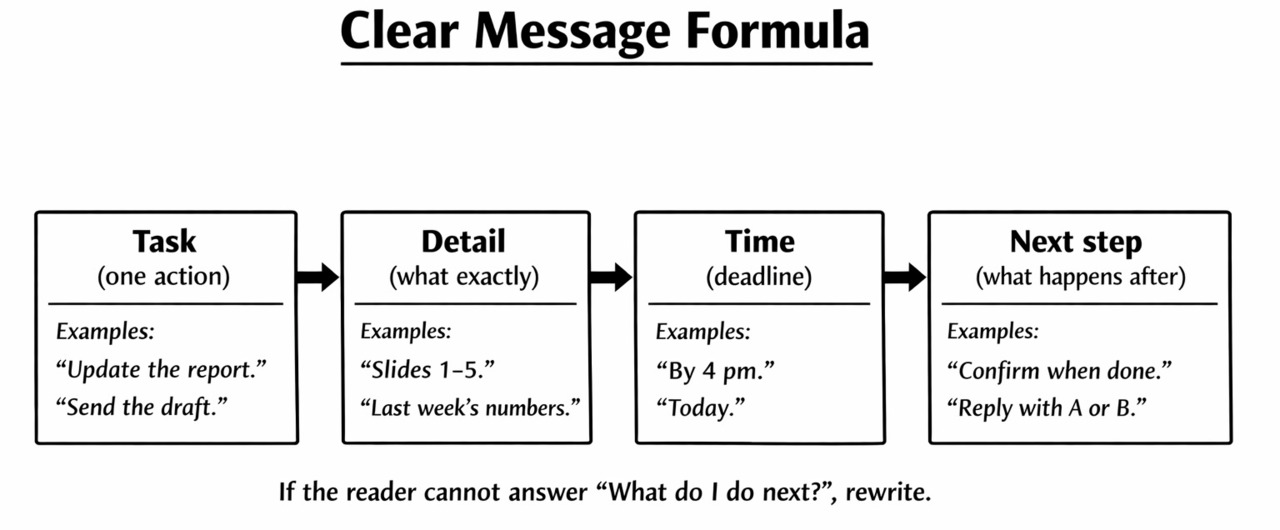
One clear message often uses a simple order. First: the task. Next: the time. After that: the important detail. If you need a reason, you can add one short line at the end. This order helps the reader act.
Compare two messages. “I just wanted to let you know that we talked about the report last week and maybe it needs some changes” sounds friendly, but it is unclear. “Please update the report today and focus on last week’s sales numbers” is direct and clear. Both can be polite. Only one saves time.
Time and numbers make messages clearer. If you can, write the exact time: 14:00, 4 pm, or “by end of day”. If you cannot give an exact time, give a simple window: “today” or “tomorrow morning”. Vague words like “soon” and “later” often create misunderstanding.
Direct language also means one idea per message. If you have three tasks, send three short lines or three short points, not one long paragraph. The reader can see the plan fast. The reader can answer fast.
Direct language helps you work with international teams. People have different styles and different levels of English. A short message with simple verbs and clear time markers is easier for everyone. It also reduces mistakes.
Another advantage is accuracy. When your message is short, you usually choose clearer verbs. You say “send”, “check”, “update”, “confirm”. These verbs show the action. They also make your communication reliable.
Direct language is useful when you receive unclear instructions too. You can ask for clarification without conflict. You can say, “This is not clear. What is the deadline?” You can say, “Which file do you mean?” These questions prevent mistakes. They show that you want to do the task correctly.
Direct language is also useful when you need to decline or set boundaries. You can be respectful and still be honest. You can say, “I cannot finish today. I can finish tomorrow.” You can say, “I cannot join this meeting, but I can send my notes.” This protects your time and keeps work moving.
Before you send a message, do one quick check. Can the reader answer three questions: What is the task? When is it due? What should happen next? If the reader cannot answer, the message is not clear yet. For emails, a short subject line also helps. “Report update — today” is better than “Question”. It shows the topic and the time at once.
Micro-scene 1: Chat (Unclear Example)
Alex: Hi, about the report
Sam: Yes?
Alex: We talked about it last week
Sam: What about it?
Alex: I think it needs some changes
Sam: Which changes?
Alex: Maybe some updates
Sam: Can you be more direct?
Micro-scene 2: Short Email (Clear Written Version)
Subject: Report update — today
Hi Sam,
Please update the report today.
Focus on last week’s sales numbers.
Send the final version by 4 pm.
Please confirm when it is done.
Thanks,
Alex
Micro-scene 3: Mini-dialogue (Bad → Better)
Bad (unclear start)
Manager: Can you finish this task today?
Employee: Which task do you mean?
Manager: The client thing.
Employee: What exactly do you need?
Better (clear start)
Manager: Can you finish the client summary today?
Employee: Yes. What exactly do you need?
Manager: A one-page summary with the main points.
Employee: Okay. When is the deadline?
Manager: By 5 pm today.
Employee: Got it. I will send it by 5 pm.
Useful Phrases
• Please update the report today.
• Focus on last week’s sales numbers.
• Send the final version by 4 pm.
• Please confirm when it is done.
• This is not clear.
• Which file do you mean?
• What is the deadline?
• Can you be more direct?
• I cannot finish today.
• I can finish tomorrow.
• I will send it by 5 pm.
• Please let me know if you have questions.
CHAPTER 2 — Starting the Workday
Vocabulary
priority — the most important thing to do first
collocations: top priority / set a priority
workload — the amount of work you have
collocations: heavy workload / manage your workload
routine — something you do the same way every day
collocations: morning routine / daily routine
interruption — when someone stops you while you work
collocations: reduce interruptions / constant interruptions
productive — doing useful work and getting results
collocations: productive morning / stay productive
discipline — the habit of doing what you planned
collocations: build discipline / self-discipline
direction — a clear plan for where you are going
collocations: clear direction / give direction
time window — a short period of time for one task
collocations: a short time window / within a time window
A clear start makes the whole day easier. Many people begin work in a hurry. They open emails, jump into tasks, and feel stress in the first ten minutes. Then they spend the next hour fixing small mistakes and answering the same questions again.
A better start is simple. It does not take a long time. You only need a short routine that gives your day a clear direction.
Start by checking your main tasks for today. Pick the work that must move forward. If everything looks important, choose one task as your priority. When your priority is clear, your workload feels smaller, even if you still have many things to do.
After you choose the main task, set a small goal. A goal is not a big dream. It is one clear result for the morning. For example: finish the first draft, send a short update, or confirm the time for a meeting. Small goals help you stay productive because you know what “done” looks like.
Then send a short morning update. This can be a message in a team chat or a short email. The message is not a life story. It is a plan. Your team can see your direction, and people can ask questions early, before the day becomes messy.
A morning update also reduces interruptions. When people know what you are doing, they stop guessing. They ask fewer “quick questions” during your focus time. They contact you when they really need you, not just because they are unsure.
It also helps to check unclear tasks at the start of the day. If something is not clear, ask one direct question. A simple question in the morning can save a lot of time later. It can also prevent a misunderstanding with a client or a teammate.
Short breaks matter too. If you plan one small break, you can reset your mind and return to the task with better focus. This keeps your work steady. It also protects your energy, especially on days with a heavy workload.
A good start helps the whole team. When everyone shares a clear plan, people see who is doing what. This builds trust and makes cooperation easier. It also creates discipline because the day begins with a clear choice, not with chaos.
Direct language is key in the morning. Use simple verbs that show action: check, send, confirm, finish, update. Put the main point first. If you need a time, write it. “By 4 pm” is clearer than “later”.
Here are strong morning lines you can copy:
— “My priority today is the client summary. Next update at 3 pm.”
— “I will finish the first draft by 12:00. I will send an update after that.”
— “I need one detail from you: the meeting time. Please confirm today.”
— “I will join the meeting at 15:00. Before that, I will update the report.”
Compare that with weak lines:
— “Update later today.”
— “I will do some tasks.”
— “Busy morning.”
These lines sound simple, but they do not help. People do not know your plan, so they will interrupt you more. A clear two-line update is short, polite, and useful.
With practice, this routine becomes natural. You start your day with a clear plan, a clear priority, and a calm mindset. This small habit improves your whole workday.
Micro-scene 1: Chat (Unclear Example)
Mila: Morning! What are you doing today?
Dan: A few things.
Mila: Which things?
Dan: Just work stuff.
Mila: What is your priority?
Dan: Not sure yet.
Mila: When will you update us?
Dan: Later.
Micro-scene 2: Mini-dialogue (Clear Spoken Version)
Manager: What is your priority this morning?
Employee: The client summary. I will finish the first draft before lunch.
Manager: Good. When will you send your update?
Employee: At 12:30.
Manager: Do you need anything from me?
Employee: Yes — please confirm the meeting time today.
Manager: Okay. I will confirm it by 10:00.
Micro-scene 3: Short Email (Clear Written Version)
Subject: Morning update — today
Hi team,
My priority today is the client summary.
I will finish the first draft by 12:00.
Next update at 3 pm.
Please confirm the meeting time by 10:00.
Thanks,
Dan
Practice Questions
1. What is your main task at the start of a normal workday?
2. How do you choose your priority in the morning?
3. What short message can you send to show your plan for today?
4. When do you usually need a break to stay focused?
5. Which task from yesterday needs a quick update today?
Work Task
Write a two-line morning update for your real workday.
Line 1: your main task today.
Line 2: the time when you will give your next update.
Send this message to your team or use it in your own work routine.
Observe if your morning becomes clearer.
Useful Phrases
• My priority today is _______________.
• I will focus on _______________.
• Next update at _______________.
• I will send an update at _______________.
• Please confirm the meeting time.
• Please confirm by _______________.
• I have a heavy workload today.
• I have a short time window for this.
• This task is not clear.
• I need one detail: _______________.
• I will finish the first draft by _______________.
• I will join the meeting at _______________.
CHAPTER 3 — Asking Precise Questions
Vocabulary
clarify — make something easier to understand
collocations: clarify a task / clarify details
specific — exact, not general
collocations: specific question / specific detail
context — the situation and important background
collocations: give context / in this context
assumption — something you believe is true, but you are not sure
collocations: make an assumption / wrong assumption
option — one possible choice
collocations: choose an option / available options
available — free to use, or free in time
collocations: available today / available time
require — need something as a rule
collocations: require approval / require information
estimate — a number that is not exact, but close
collocations: estimate the time / rough estimate
attachment — a file in an email
collocations: email attachment / attach a file
approve — say “yes” officially
collocations: approve a plan / approve a request
Many work problems do not come from bad work. They come from unclear questions. People ask “quick questions” that are not really questions. They sound polite, but they do not give the other person a clear path to answer.
A precise question is different. It is short, direct, and specific. It tells the other person exactly what information you need. It also saves time because the answer can be one message, not ten messages.
Vague questions create long conversations.
“Can you help?” is vague. “Can you check page 2 and tell me if the numbers look correct?” is precise. The second question shows the task, the place, and the expected result.
A precise question often has three parts.
First, a little context: what you are working on. Next, the exact information you need. After that, the time you need it. This order is simple, and it works well in chat, email, and meetings.
Бесплатный фрагмент закончился.
Купите книгу, чтобы продолжить чтение.