
Бесплатный фрагмент - Collective trait of humanity
DearReaders,
You are presented with a book describing the psychophysiological mold of collective interactions, based on the psychophysiological model developed by Roman Andreevich Buksaev.
Edited by:
— Igor Olegovich Panfilov, MD, PhD, Chief Neurosurgeon
— Olga Mikhailovna Kiselev, Medical Psychologist
Introduction
It is no secret that humans belong to a collective species, meaning we are inherently social beings. In this work, we aim to unveil a series of collective traits unique to our species, describing them in terms of their potential for imitation — or, in other words, mirroring.
Mirroring (or reflective imitation) is a psychological and communicative technique where a person, consciously or unconsciously, copies the verbal (words, tone) and non-verbal (facial expressions, gestures, posture) expressions of another to establish contact, demonstrate attention, and strengthen trust.
From a psychophysiological perspective, mirroring involves the imitation of cellular and muscular tension patterns associated with both primitive and complex behaviors, as well as mental processes, relative to the individual being mirrored. This opens up possibilities for replicating the reflected individual’s reactions.
In each chapter, we strive to reveal new facets of our collective nature. To do so, we examine collectivity through the lenses of psychology, physiology, psychophysiology, physics, philosophy, and electrical engineering — all in relation to the theory of mental structure developed by Roman Bukhsaev.
We wish you an engaging read.
Mental Processes and Their Hierarchy
From the chapter title, you should have gathered that this section will introduce definitions of mental processes and establish their hierarchy according to Roman Andreevich Buksaev’s theory of mental structure — the framework around which the book’s narrative unfolds. In essence, defining mental processes in terms of their hierarchy provides the foundation for understanding this theory. It also allows individuals knowledgeable in this field to compare their existing expertise with the presented model, confirming or challenging its theoretical validity.
Let us now turn our attention to Figure 1, which illustrates the hierarchy of mental processes.
Figure1.
For clarity, we will introduce definitions of mental processes while explaining their position within the mental hierarchy. We will begin with the lowest level — unconditionally conditioned reactions and their parallel branch of conditionally unconditioned reactions — and conclude with a description of the collective mental process.
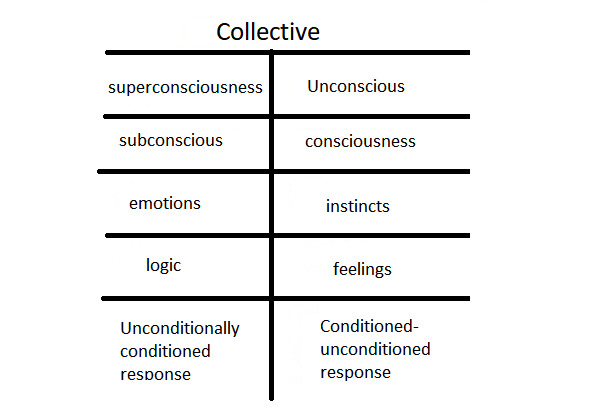
If we examine the structure of the hierarchy, it becomes evident that the hierarchical “tree” consists of two branches, both culminating in the collective mental process. The first branch begins with the unconditionally conditioned reaction, meaning an unconditional response transforms into a conditioned one — much like how an electrical signal from the nervous system, traveling to the muscles (wires made of cells), triggers their contraction. In this context, the electrical signal acts as a form of unconditional stimulus for the cell, eliciting a specific condition. This condition, or conditioned reaction, arises from the cell’s response — based on its internal “database” — to the nervous system’s electrical signal. Thus, an unconditionally conditioned reaction is formed, driving cellular behavior (e.g., muscle contraction) via nervous system electrical signals.
The second chain begins with the conditionally unconditioned reaction. To initiate the sequence of mental processes in this branch, a conditionally unconditioned reaction must first be triggered. This reaction is activated by a condition or a conditional signal. A conditional signal can be understood as electromagnetic excitation that generates electrical tension within a cell’s elements via an electric current formed in the cell’s coil through electromagnetic induction.
Electromagnetic induction is the phenomenon where an electric current (or electromotive force) is induced in a closed conducting loop when the magnetic field passing through it changes.
Thus, it turns out that an electromagnetic signal from the environment generates an electric current in the cell’s coil, and this current affects the cell’s circuit by increasing the electrical tension between its elements. Now we understand that the elements of a cell are connected not only biochemically but also through a closed electrical circuit. After the coil creates electrical tension between the cell’s elements, the cell produces an unconditionally conditioned reaction based on its internal “database.” In other words, it transforms an unconditional stimulus in the form of electrical tension from its own electrical circuit, using its database, into an unconditional electrical signal that is sent through the branches of the nervous system to the spinal cord.
From this, it follows that an unconditionally conditioned reaction is the transformation of an unconditional electrical signal from the nervous system, using the cell’s database of reactions, into its conditioned behavior. Conversely, a conditionally unconditioned reaction is the transformation of external electromagnetic excitation into electrical tension between the cell’s elements via a cellular receptor, followed by the formation — based on the cell’s reaction database — of an unconditional electrical signal directed through the branches of the nervous system to the spinal cord.
Regarding these processes, we can conclude that the stimuli for reactions in the first branch are internal processes, making the first branch considered relative to the internal environment. From this perspective, the stimuli for the second branch are electromagnetic excitations from external sources in the external environment. Therefore, if the stimuli for the second branch’s reactions are external, then this branch is considered relative to the external environment.
One can draw conclusions about the cellular reaction basis: a cell possesses two types of stimuli (unconditional and conditional) and two types of reactions to each (conditional and unconditional). This results in four types of reactions, each having two directions — one in one direction and the other in the opposite direction:
— Conversion of an electrical signal into a reaction with electromagnetic expression. (Unconditional signal into a conditional reaction)
— Conversion of an electromagnetic signal into a reaction with electrical expression. (Conditional signal into an unconditional reaction)
— Conversion of an electrical signal into a reaction with electrical expression. (Unconditional signal into an unconditional reaction)
— Conversion of an electromagnetic signal into a reaction with electromagnetic expression. (Conditional signal into a conditional reaction)
Later, you will understand that these types of reactions to stimuli are related to four psychological processes.
Since the system of directions for electrical or electromagnetic signals is bidirectional, meaning it has two directions (either receiving or expressing), therefore, thanks to the reactions from the first chain, a cell can both receive and express electrical signals. And thanks to the second chain, a cell can, with the help of a cellular receptor, express or receive electromagnetic excitation. It turns out that each cell has two types of circuits: electrical and electromagnetic. One circuit forms logical neurons in the frontal lobe, while the second circuit forms sensory neurons. It should not be forgotten that the psyche is divided into two psychological chains, one of which is responsible for the internal environment, and the other for the external environment. If we add to this the fact that different hemispheres control different halves of the body, then, consequently, one hemisphere should be responsible for the first chain, and the other for the second. Looking slightly ahead, I would like to note that the left hemisphere is responsible for the internal environment, while the right hemisphere is responsible for the external environment. As a result, the first chain pertains to the sequence of signals associated with the left hemisphere, and the right chain pertains to the sequence of signals associated with the right hemisphere. A certain picture emerges before us. Since the spinal cord processes the signals of the nervous system, it is the controller of the body’s electrical circuit (controls the body’s electrical circuit). It is the spinal cord that controls all reflex activities of the body’s elements by managing them through the branches of the nervous system, which transmit electrical signals. The division of the body into two halves creates two poles of the electromagnetic circuit. When the information flow is directed in one direction, the left amygdala has a negative charge, while the right amygdala has a positive charge. When the information flow is directed in the other direction, the charges of the amygdalae switch to the opposite. From this, it follows that when the direction of the information flow changes, the charges of the amygdalae change to opposite values, while maintaining an element of opposition. The element of opposition can be considered as the difference in the charge of one amygdala from the opposite amygdala over a unit of time. That is, at any given moment, one amygdala will have a positive charge, while the other will have a negative charge. The electromagnetic circuit forms sensory neurons depending on the direction of the flow in the frontal lobe of the left or right hemisphere. And the electrical circuit, depending on the side of origin of the electrical signal, creates a logical neuron in the opposite hemisphere from the side of excitation. Neurons are formed by the repeated repetition of excitation by the same signal. When the same electromagnetic excitation is repeated, a sensory neuron is formed; when the same electrical signal is repeated, a logical neuron is formed.
For a more precise understanding of the overall picture, let’s dissect the sequence of signal transmission from a cell to the formation of neurons in the frontal lobe, starting with the sensory neuron. When reacting to an unconditional electrical signal, a cell forms a conditional reaction based on its own database. The conditional reaction formed by the cell excites a cellular receptor, reminiscent of an electrical coil. This receptor generates electromagnetic excitation. The electromagnetic excitation from the cellular receptor is read by the amygdala. One could also say that, analogous to the electrical potential between cell elements, there exists an electromagnetic potential between the electromagnetic field of the cellular receptor and the amygdala. The amygdala can be compared to a television antenna, a radio tower, or a Wi-Fi router. Amygdalae operate on the principle of radio antennas tuned to cellular receptors. They read the electromagnetic potential of cellular receptors and transmit the formed signal, based on the read information, to the area of tactile sensations. The area of tactile sensations processes the signal relative to its emotional database and transmits it to the parietal lobe. The parietal lobe forms a representation of the received sensation for us, or one could say, for our psyche. Similarly, one could say that the parietal lobe is the center of the thinking system, forming a complete picture regarding the received signals through representations and sensations. Just as the operating system of a computer unites and coordinates all its elements, the parietal lobe unites and coordinates our psyche in relation to our body. With repeated signals received by the parietal lobe, a neuron is formed relative to the received signal. Indeed, if the signal from a cell is read by an “antenna” in the form of the amygdala and, after being processed by the area of tactile sensations, is repeatedly transmitted to the parietal lobe, then the parietal lobe, based on the repeated receipt of this signal, will form a sensory neuron or a neuron of associative sensation. This means a neuron associated with a certain sensory moment. When excited, this sensory neuron will evoke the sensory moment that created it through a reverse sequence. That is, the neuron will generate a signal in the parietal lobe. Based on this signal, the parietal lobe will send a signal to the area of tactile sensations. The area of tactile sensations will decipher this signal based on its own database and, with the help of the amygdalae, will cause the corresponding excitation of the receptor of the necessary cell or cells. The excitation of the cell receptor will create that very sensory sensation. Therefore, our sensations (feelings) are electrical potential based on electromagnetic excitations relative to the database of cell reactions, and sensory neurons are the result of the preservation of our sensations.
To understand the principle of the formation of logical neurons, let’s analyze the physiological elements from the perspectives of electrical engineering, physics, and psychophysiology.
The signal from a cell, formed by muscle movements (shaped by conditioned behavior), enters the branches of the nervous system, which resemble electrical wires, and is transmitted to the spinal cord. The spinal cord, being the center for processing signals of the nervous system, compares the signal with its immune database. If the signal does not pertain to the immune system, it is further transmitted to the cerebellum. It’s worth emphasizing that the spinal cord is not only the reflex center of the body but also processes all electrical signals of the body. Additionally, it serves as an immune database through which it controls the immune system and manages all life activities of the body’s elements.
If the spinal cord receives a signal from a cell that does not pertain to the immune system, it is sent to the cerebellum. The cerebellum is the database for muscular reactions. Therefore, if the signal does not pertain to the immune system, it means it pertains to the muscular system, as cells connected in sequence form muscles.
Let’s step aside a bit and note that from electrical engineering, we know two elementary methods of connecting elements in a circuit: series connection, where elements are connected one after another, and parallel connection, where elements form nodes of connections among themselves, meaning they are connected in parallel within the circuit. In the body, all cells are connected both in parallel and in series. In parallel connection, cells are connected by the power of the cellular receptor. The cellular receptor of each cell forms the cell’s electromagnetic field. The nodes of their connection in this scheme are the amygdalae, which, through their own electromagnetic field (electromagnetic circuit), unite all cells into electromagnetic circuits.
When a signal is transmitted in reverse, with the power of an unconditionally conditioned reaction, an electrical signal is formed from the cell directed to the spinal cord through the branches of the nervous system. This signal should form a logical neuron. The logical neuron is formed as a result of the spinal cord processing the signal and transmitting it to the cerebellum if it does not pertain to the immune system. The cerebellum, having a database of muscular reactions, processes the signal and, through repeated transmission of similar signals, forms a logical neuron. This logical neuron, when excited, will generate a signal that follows the reverse path, leading to a logical response or action.
In summary, the formation of logical neurons is a complex process involving the transmission and processing of signals through the nervous system, spinal cord, and cerebellum, with cells being interconnected both in parallel and in series, and the amygdalae playing a crucial role in uniting cells into electromagnetic circuits.
Roughly speaking, such a parallel connection scheme is formed by an electromagnetic circuit. When cells are connected in series, they form muscles, the coordination of tension in which is managed by the cerebellum. Due to its functions, the cerebellum has developed its own database relative to which it reshapes the signal from the spinal cord and transmits it to the occipital lobe.
In addition to this, I would like to note something else. Please remember or recall that due to interhemispheric asymmetry, the right hemisphere controls the left half of the body, and the left hemisphere controls the right half of the body. For this reason, the electrical signal from the cells of the left half of the body forms logical neurons on the right, and the electrical signal from the cells of the right half of the body forms logical neurons on the left. It is also worth noting that the cerebellum processes signals from cells united into muscles. Therefore, if we combine these two observations, we can conclude that logical neurons are formed in the hemispheres from the repetition of muscle contractions in the halves of the body opposite to the hemispheres.
Continuing, the signal has now arrived from the cerebellum to the occipital lobe. The direct task of the occipital lobe is to process signals from the eyes, forming the volume of the image. The indirect task of the occipital lobe, however, is to process the signal from the cerebellum, reshaping it into a volumetric signal, and forwarding it to the parietal lobe. The parietal lobe forms our sensations and perceptions regarding the signal received from the occipital lobe, and upon repeatedly receiving identical signals from the occipital lobe, it forms a logical neuron. When excited, the logical neuron invokes the reverse sequence that created it, as a result of which a change is called forth corresponding to the cellular tension that created the neuron, or in simpler terms, a muscular reaction.
It turns out that logical neurons cause muscular reactions, while sensory neurons cause sensory sensations that create electromagnetic tension between cells, and as a result of this tension, an electrical potential is created between cellular elements. This intricate interplay between different parts of the brain and the nervous system highlights the complexity of how our body processes information and generates responses, whether they be sensory perceptions or muscular actions.
I would indeed like to emphasize once again that cells, through the reverse unconditionally conditioned reaction, form logical neurons in the hemispheres opposite to the half of the body. Additionally, cells, through the reverse conditionally unconditioned reaction, form sensory neurons relative to the direction of the information flow. We will discuss information flows a bit later, but let’s clarify now that when consciously controlling the psyche, sensory neurons are formed in the right hemisphere, whereas when controlling the psyche at a superconscious level, sensory neurons are formed in the left hemisphere.
Consequently, reactions from cells form chains through the physiological sequences of the body’s elements. These chains participate in the processing of electrical and electromagnetic signals. In the basic model of simple behavior, these chains form experience neurons that store the sequences of cellular reactions that created them. When cells are connected in parallel through the body’s electromagnetic circuit, based on the amygdalae and the zone of tactile sensations, sensory chains are formed. And when cells are connected in series into muscles, whose signals are processed by the cerebellum, logical chains are formed.
Thus, cells form neurons through physiological chains. The creation and excitation of neurons form the model of simple behavior. The reaction of cells is primitive behavior. The preservation of primitive behavior reactions in the form of neurons, with the ability to invoke primitive behavior upon excitation of these neurons, forms simple behavior. I believe this is now clear.
This explanation provides a fascinating insight into how cellular reactions and neural processes are interconnected to form the basis of our behavior, both primitive and more complex. It highlights the intricate balance and coordination required within our physiological systems to produce coherent and purposeful actions. Now, let’s indeed transition to discussing complex behavior, although before that, let’s draw a conclusion regarding the hierarchy of mental processes and the material we’ve covered concerning simple and primitive behavior. We can conclude that reactions from the mental hierarchy, forming the first level of the hierarchy, can be considered primitive behavior of cells. The second level in the mental hierarchy is simple behavior, which is formed by the preservation of primitive cellular reactions in the form of logical and sensory neurons through physiological chains.
It’s important not to confuse physiological chains with mental chains. Physiological chains are sequences of signal processing relative to physiological elements. Mental chains, on the other hand, are sequences of mental processes interacting with each other through physiological chains. Here’s a simple example to illustrate the difference: consider a calculator. The calculator itself represents the psyche, consisting of a display program and a calculation program. These programs are mental processes, and the sequential connection between these programs is a mental chain. The microchips of the calculator can be compared to the physiological elements of an organism. In the informational environment of the calculator, the programs (mental processes) perform their assigned tasks, forming mental thinking (the operation of the calculator). In this environment, the connection between the display and calculation programs occurs based on a mental chain, for the execution of whose functions electrical circuits of sequential and parallel signal processing are used (physiological chains).
This analogy helps clarify the distinction between physiological and mental chains and how they interact to form the basis of behavior, both simple and complex. It underscores the intricate relationship between the physical components of a system and the mental processes they support, highlighting the complexity of understanding behavior at both the physiological and psychological levels.
Now, let’s indeed move on to discussing complex behavior. We have neurons in the left and right halves of the brain, and the relationship between these neurons is defined by complex behavior. Complex behavior is formed by physiological elements such as the reptilian brain and the zone of tactile sensations. While in simple behavior, it’s clear that the excitation of a neuron invokes the primitive behavior that created it, complex behavior supplements the chain triggered by neuron excitation by branching the signal towards physiological elements that form complex behavior.
Based on this, complex behavior is formed by the branching of signals from the excitation of neurons in the zone of tactile sensations into a database of complex behavior. This database creates complex cellular behavior, or in other words, complex reactions, based on its own database of reactions. Let’s delve into how this happens.
Take sensory neurons, for example. If a sensory neuron in the right hemisphere is excited, it invokes a corresponding signal in the right parietal lobe. The right parietal lobe then divides the signal into two branches:
1. The First Branch of the Signal and the Formation of Logical and Sensory Correlation
— Initiation of the Process: A sensory neuron in the right hemisphere of the brain is stimulated, sending a signal to the tactile sensation zone. This zone, with the help of the right amygdala, invokes a corresponding excitation of cellular receptors, creating an electrical potential between cell elements.
— Reverse Signal Formation: The cell, using its reaction base, forms a reverse signal of an unconditional conditioned response, creating an electrical signal that spreads through the branches of the nervous system.
— Processing in the Spinal Cord and Cerebellum: The spinal cord processes this electrical signal and, seeing that it does not pertain to the immune system, transmits it to the cerebellum. The cerebellum reshapes the signal from the cells according to its muscular database and sends it to the occipital lobe of the left hemisphere.
— Formation of Logical Sensation: The occipital lobe of the left hemisphere creates the dimensionality of the signal received from the cerebellum and transfers it to the parietal lobe of the left hemisphere, which forms a logical type of sensation.
— Correlation Formation: In this way, a correlation is formed between the logical signal sensation of the left hemisphere and the sensory signal of the right hemisphere. Thus, we correlate the sensory sensation relative to an external stimulus (sensory signal from the right parietal lobe based on cellular electromagnetic potential) with a logical signal relative to the internal environment (with a signal in the left parietal lobe created by a muscular reaction on the right).
— Simplification for Understanding: For simplicity in understanding the example, correlate muscular reactions with logical signals, and sensory signals with reactions caused by electromagnetic excitations. And remember, the interaction system has two directions. The logical signal on the left, relative to this example, will in reverse sequence form a sensory signal on the right.
— Signal Reshaping: Due to the structure of cells and their ability to use the first two levels in the psychological hierarchy, it becomes possible to reshape the signal from one chain to another and vice versa through cellular reactions. This signal reshaping is possible thanks to the first database of complex behavior in the form of a tactile sensation zone. The tactile sensation zone forms electrical potential of cellular elements during signal transformation by controlling the electromagnetic circuit.
— Emotional Background: This electrical potential of cellular elements can be denoted as an emotional background. And the emotional background of the parietal lobe sensations is felt as an emotion. Thus, the parietal lobe with amygdalae in pairs forms signals in the parietal lobe based on its database. By reading the electrical potential of each cell through the expression of cellular receptors forming an electromagnetic field, and as a result, forming emotions.
— Logical Neuron Excitation: Based on this, if a logical neuron is excited, it will inevitably create an emotion and a corresponding sensory signal related to the emotion. And if a sensory neuron is excited, it will inevitably create a sensation and a corresponding logical signal related to this sensation. And all this is thanks to the database of complex behavior in the form of a tactile sensation zone.
2. The Second Branch of the Signal and Instinctive Behavior Formation
— Parallel Processing: In parallel with the first branch, the sensory signal from the parietal lobe is also sent to the reptilian brain. The reptilian brain, based on its database, invokes a logical signal in the left hemisphere relative to the sensory signal of the right hemisphere.
— Instinctive Behavior Formation: This logical signal invokes simple behavior. It first goes to the left occipital lobe, then is processed by the cerebellum, which transfers it to the spinal cord. The spinal cord, using the branches of the nervous system, sends signals to corresponding cells, invoking an unconditional conditioned reaction in the form of muscle contraction. Thus, instinctive behavior is formed, invoked by the reptilian brain.
— Instinctive Behavior Definition: Instinctive behavior is a muscular reaction to a sensory signal in the parietal lobe, provided that the sensation is in the database of the reptilian brain. Then, a conditionally unconditional reaction is created, and based on it, with the help of amygdalae and the tactile sensation zone, a sensory signal is formed in the right hemisphere.
— Correlation of Muscular and Sensory Reactions: So, what happens is that a sensory signal, invoked by the excitation of a sensory neuron on the right, is processed by the reptilian brain. The reptilian brain invokes a corresponding logical signal on the left. Correspondingly, to the logical signal on the left, muscular reactions occur on the right. As a result of muscular reactions on the right, cellular potential is created, relative to which a sensory signal is created on the right with the help of an emotional database and amygdalae. Thus, our muscular (instinctive) behavior is correlated with our sensations.
— Different Bases for Signal Formation: Consequently, the first branch of the signal is formed based on the emotional database, and the second branch of the signal is formed based on the instinctive database. Thus, instincts (muscular behavior) and emotions (electrical potential) are formed. And immediately note that if a sensation does not find an association in the database of the reptilian brain, then instinctive behavior, which underlies mimicry, postures, and gestures (non-verbal interaction), is not created. Simply put, if there is no association in the instinctive base, then there is no instinctive behavior.
Understanding the Third Level of the Hierarchy and the Role of the Spine in the Subconscious
Now that we understand how the third level of the hierarchy is formed, and that logical signals shape emotions while sensory signals shape instincts, both contributing to a complex behavioral model, we can explore how organisms are managed through these complex behavioral models via psychological processes. These processes form our psyche. We’ll start with simple psychological processes like consciousness and the subconscious, then move on to higher psychological processes such as super-consciousness and the unconscious, and conclude with a description of the collective psychological process.
The Hypothesis: The Spine and the Subconscious
Let’s hypothesize that the spine is responsible for the subconscious. Many might find this idea vague, as numerous psychological and psychophysiological theories offer different interpretations of the subconscious. However, I ask you not to jump to conclusions and to consider this hypothesis as a possible fact — or perhaps not.
What We Know About the Spine and the Subconscious
Let’s begin with what we know about the spine. Here are some definitions from a search engine:
The spine is a long, tubular structure made of nervous tissue, part of the central nervous system. It runs inside the vertebral column, connecting the brain to the rest of the body and transmitting signals in both directions. The spine also controls simple reflexes and is responsible for coordinating movements such as walking and urination.
From this definition, we understand that the spine is nervous tissue, part of the CNS, connects the brain and body, transmits signals in both directions, controls simple or, according to our theoretical model, primitive reflexes, and is responsible for coordinating movements. Let’s supplement this understanding with information about the immune system’s connection to the spine from a search engine:
The spine and the immune system are closely interconnected: the spine transmits nerve signals that regulate immune function, and spinal injuries disrupt this connection, leading to decreased immunity. At the same time, immune cells in the central nervous system (CNS) and its membranes play a role in protecting against infections, but in diseases like multiple sclerosis, they can begin attacking the brain and spinal cord’s own tissues.
Possible Pathways to Autoimmunity
If we think about it, there are likely two pathways that could lead to this:
— Cellular Revolt: Cells are alive, and as a result of their exploitation, they might revolt against the exploiters. But I’m just joking to distract you a bit. In reality, it’s quite simple.
— Gene Mutation: More likely, due to a gene mutation in cells, the immune system becomes foreign to them, or more precisely, the elements involved in its management and regulation, namely the spine and brain. As a result of a mutation, presumably linked to the modification of an immune cell gene responsible for proving the belonging of a certain type of cell to a certain immune system, the fact of relationship is not confirmed (it differs). Consequently, the immune cells that the spine and brain try to control see them as foreign manipulators and attack them. This could be the influence of viruses or other factors causing changes in cell genes, affecting immune cells. But the fact that this can be cured by genetic modification of immune cells using a specially developed drug to restore the immune cell gene sounds like an axiom. As a result, it is possible to restore the confirming gene of relationship to the immune system in immune cells, and immune cells will stop attacking their manipulators in the form of the spine and brain. So to speak, reconcile them.
The Spine’s Role in the Subconscious
Now, let’s return to our hypothesis that the spine is responsible for the subconscious. The spine, as part of the CNS, plays a crucial role in transmitting signals between the brain and the body. It controls simple reflexes and coordinates movements, which are fundamental aspects of our behavior. If we consider the subconscious as the part of the mind that operates below the level of conscious awareness, controlling automatic and instinctive behaviors, then it’s plausible to hypothesize that the spine, with its ability to transmit and regulate nerve signals, could be the physical basis for the subconscious.
— Automatic Reflexes and Instincts: The spine controls simple reflexes, which are automatic responses to stimuli. These reflexes are similar to instinctive behaviors, which are innate and do not require conscious thought. The subconscious mind is often associated with these automatic, instinctive behaviors.
— Signal Transmission and Regulation: The spine transmits signals between the brain and the body, regulating various functions. This transmission and regulation could be seen as the subconscious mind’s way of managing the body’s responses to internal and external stimuli without conscious awareness.
— Immune System Connection: The close interconnection between the spine and the immune system suggests that the spine might also play a role in regulating immune responses, which are often automatic and occur without conscious thought. This further supports the idea that the spine could be the physical basis for the subconscious.
Conclusion
While this hypothesis is speculative and requires further research and evidence to support it, it offers an interesting perspective on the relationship between the spine and the subconscious. By considering the spine’s role in transmitting and regulating nerve signals, controlling automatic reflexes and instincts, and its close connection to the immune system, we can begin to see how it might be responsible for the subconscious aspects of our behavior. Further exploration of this hypothesis could lead to a deeper understanding of the mind-body connection and the role of the subconscious in shaping our behavior and experiences.
Connection Between the Spinal Cord, Immune System, and Subconscious: Synthesis of Information
Connection Between the Spinal Cord and the Immune System
From the description, we understand that the spinal cord regulates the body’s immune function by transmitting electrical signals. Injuries to the spinal cord disrupt this connection, leading to a decrease in immunity. Since the spinal cord controls reflexes (conditioned and unconditioned behaviors of cells) through electrical signals, it also manages immune cells that play a role in protecting against infections. However, in diseases like multiple sclerosis, immune cells may begin to attack the body’s own brain and spinal cord tissues, likely due to damage to the gene responsible for confirming the relationship of immune cells to the immune system controlled by the spinal and cerebral cortex.
Synthesis of Observations on the Spinal Cord
The spinal cord:
— Is nervous tissue that controls cells and their reactions (primitive reflexes) through electrical signals.
— Is responsible for the vital functions (immune system) of the body’s structures or elements.
— Together with the cerebellum, is responsible for coordinating movements by controlling muscles, as muscles are conductors made of cells.
— Connects the brain and the body (the structure of the organism).
From this, we can form a brief definition within our theoretical model: The spinal cord is nervous tissue that connects the brain to the body, transmitting signals to and from the body to the brain. As part of the nervous system, it manages the body’s vital functions (immune system, “cells” as elements of the organism) and controls primitive reflexes (reactions) of cells.
Definition of the Subconscious from Search Engines
The subconscious is a hidden level of the mind that controls automatic processes such as breathing and walking, stores experiences, habits, and emotions, and influences our thoughts and behaviors even when we are not aware of it.
Understanding the Hierarchy of Levels
Now that we know what the spinal cord is and understand the formation of the first three levels of the hierarchy — from primitive reflexes to simple behavior, and from simple behavior to complex behavior — the next level is simple mental processes that manage the levels below them. Consequently, let’s correlate the obtained information about the levels with information about the spinal cord and the definition of the subconscious from open sources.
Simplified Understanding: Comparing the Definition of the Subconscious with the Functions of the Spinal Cord and Our Theoretical Model
The subconscious is:
Starting with this excerpt from the definition: “A hidden level of the mind that controls automatic processes such as breathing and walking.” The spinal cord, as an organ composed of nervous tissue with processes hidden from the conscious mind, is responsible for the vital functions of the organism. Therefore, it can be assumed that it is responsible for breathing because, without the respiratory process, the vital functions of the organism are impossible, and the respiratory process is automatic for the conscious mind. Additionally, the definition states that the subconscious is involved in walking. Since the spinal cord, in conjunction with the cerebellum, manages movement coordination, and the cerebellum is the database of muscular reactions, and the spinal cord controls electrical signals managing simple reflexes (primitive reactions), it follows that the spinal cord controls walking by managing reactions coordinated through the cerebellum. So far, everything aligns; let’s move to the next part of the definition.
The definition states that the subconscious stores experiences, emotions, and habits. We already know that experience consists of neurons in the frontal lobe of the brain, the formation of which is governed by the second level of the hierarchy, i.e., simple behavior. The spinal cord is involved in the formation of logical neurons. Therefore, if the definition is accurate and our hypothesis is correct, then the spinal cord or subconscious not only participates in the formation of logical neurons but also controls the logical neurons in the frontal lobe, manipulating them as necessary. If we consider that the subconscious also controls emotions, and from the perspective of the psychophysiological model, emotions are a reaction of complex behavior to logical signals or the excitation of logical neurons, it follows that the subconscious controls the model of simple behavior. Thus, the subconscious is responsible for the formation of experience and hidden processes related to the mind. Habits are reactions to frequently repeated stimuli in the form of neuronal excitations that occur due to the frequent repetition of associative moments related to them. This again brings us to the conclusion that neuronal excitation pertains to simple behavior, except for the location of the association in the reptilian brain’s database. Since this would form a model of complex behavior and transmit a signal to another mental process, the subconscious manages simple behavior, which is responsible for storing experience, invoking emotions, and habits. We hypothesize that the spinal cord’s involvement in the formation of logical neurons and its control over the entire electrical structure of the organism makes it the hidden worker of our organization called the organism, whose work can be compared to a subconscious mental process. Indeed, the subconscious is not only the spinal cord, but the spinal cord is the foundation of the subconscious. The work of the spinal cord can be compared to the work of a process in a computer.
The definition concludes with: “also influences our thoughts and behavior, even when we are not aware of it.” The subconscious and the spinal cord control the vital functions of the organism; without their hidden management, it is impossible to imagine how overwhelmed the mind would be with tasks related to maintaining the organism’s operation. Since the spinal cord is presumably the subconscious or its main part and controls the vital functions of cells, it can be hypothesized that any signal transmitted to the brain from cells and back, processed by the spinal cord, is compared with an immune database regarding its relation to it. That is, every signal is compared with the immune database and modified if necessary to avoid harming the organism. Consequently, the reaction of cells and conditioned behavior may change, thereby influencing our thoughts, since thoughts are chains of sequential signals processed by mental processes. And the reactions of cells are a direct part of the chains of any process in the organism. Next, we will describe this hypothesis in more detail.
Summary: Formulating a Definition of the Subconscious Based on Our Theory
Бесплатный фрагмент закончился.
Купите книгу, чтобы продолжить чтение.