
Бесплатный фрагмент - Ayurveda – God’s manual for healing
Author: Dr. Vikram Chauhan
Copyright © 2025 Dr. Vikram Chauhan
All rights reserved.
No part of this book may be reproduced or distributed without permission.
Medical Disclaimer
This book is intended for informational and educational purposes only.
It is not a medical guide and must not be used for diagnosis, treatment, or prevention of any disease.
Always consult a qualified healthcare professional before applying any recommendations.
The author and publisher disclaim responsibility for any consequences resulting from use of information in this book.
Veda literally means knowledge in Sanskrit language. Vedic literature is the ancient treasure of knowledge which originated from God himself. God created this world and has given us manuals in the form of Vedas explaining how this world works. Ayurveda is a health manual gifted to us by God explaining how to lead a healthy, peaceful and happy life.
The principles of Ayurvedic healing are based on laws of nature which are ageless and eternal.
Ayurveda is on its comeback trail. The reason being holistic approach towards health, strong emphasis on diet, preventive medicine, exercise, nutrition, regulated life style.
This book is written in a very comprehensive style for Ayurveda students, health conscious people and common man who is interested to maintain his health and prevent diseases. This book explains basic principles of Ayurveda, the importance of diet and lifestyle in prevention of many dreadful diseases. The book also covers uses of common herbs/spices for prevention and treatment of various diseases.
ATTRIBUTES OF TRI- ENERGIES
Dr. Vikram Chauhan, M.D. (Ayurveda), is a well known Ayurvedic consultant physician in Chandigarh, India. He is running his Herbal/Ayurvedic treatment centre in Chandigarh. He is one of those rare “Vaidyas’ who practice Ayurveda in its original form with profound dedication. He regularly writes articles for various health magazines, news papers, provides consultancy for product development to various herbal/Ayurvedic manufacturing units. He is also providing online Ayurvedic consultations at www.planetayurveda.com. Besides this he developed a range of products for his own enterprise Krishna Herbal (www.krishnaherbals.com) with an intention to promote Ayurveda in true sense and provide best quality Ayurvedic products to relieve the patients from their diseases and preserve health of healthy individuals.
Disclaimer: This book is designed to provide information in regard to the subject matter covered. The author and the publisher shall have neither liability nor responsibility to any person or entity with respect to any loss, damage or injury caused or alleged to caused directly or indirectly by the information contained in this book. The information presented herein is in no way intended as a substitute for medical counseling.
Foreword
Having practiced as a vaidya for over thirty years, I often look back at my personal experiences with this science and I wonder whether it is adequate to call Ayurveda, “Indian System of Medicine”. Surely it is “Indian’, but is it merely a “system of medicine’? As years have passed, I have become fairly convinced that it is rather myopic to simply think of Ayurveda as just another “system of medicine’. Ayurveda, as the name suggests, is a body of knowledge about life itself. In my opinion, no other contemporary system of health amelioration manages to deliver the world health organization definition of health which is:
“Health is a state of complete physical, mental and social well-being and not merely the absence of disease or infirmit”
Ayurveda not only delivers this promise of health, it does more. It expands it further and promises an even more extensive state of good health where besides the physical, social and mental, a human being finds spiritual health as well. A student of Ayurveda can, at best, only be modest about the limits of one’s knowledge of this great science and philosophy which has evolved through thousands of years of experimentation and deliberation by great ancient Indian rishis (or seers). He can only marvel at the scope of this vast body of knowledge and humbly attend to those who seek alleviation of their physical, mental, spiritual and social pains. After thirty years of devoted effort in this field, I am overcome with a somewhat Newtonian modesty and feel as if I am just a mere child collecting pebbles near an ocean of knowledge and occasionally finding smoother pebbles compared to others and feeling delighted about it. In fact, I would say I haven’t even managed to reach out to pick these pebbles up and have simply felt gratified by being associated with this ocean and having spotted the pebbles. Hence, when Dr. Vikram Chauhan asked me to write the foreword for his book, I was overwhelmed by the honor as well as humbled by my own inadequacies in doing justice to such a great science.
I laud Dr. Vikram Chauhan for making an effort to bring this knowledge — albeit a very small portion of it — to the common man. The intention of this book is certainly not to bring out every aspect of Ayurveda and I am sure Dr. Vikram would agree with me. That would certainly be a Herculean task. In fact, the modest aim of this book is to provide glimpses of the brilliance of this science to the common man so that he becomes interested in this ocean of knowledge and discovers true good health. The book is simple, easy to read and concise. It introduces the
reader to the basics of Ayurveda. It gives some insights into an Ayurvedic perspective of how certain ailments may be cured. It pays a fair bit of attention to an Ayurvedic response to the prevalent life-style diseases like hypertension, rheumatoid arthritis, diabetes mellitus etc.
I congratulate Dr. Vikram Chauhan for taking the initiative to write this book. I am very sure that this is just the beginning of a long journey. As a life-time student of Ayurveda, I wish my fellow student all the best in his learning.
— Vaidya Madan Gulati
By Dr. Madan Gulati
MD (Ayurveda)
Deputy Director,
Department of AYUSH, Chandigarh, India
PREFACE
Stress is the root cause of most of the ailments. The world is changing at it’s fastest pace. Everyone seems to be in hurry and newer things are being discovered everyday. Every new discovery is to make life more comfortable. How far is it true? We are becoming accustomed to live and work with so called comforts to such an extent that it seems impossible to live without them. No doubt that the new discoveries and devices are for our comfort, but our dependency upon them and the desire to acquire them has given rise to many health problems. The stress of day to day life is at its peak.
According to Ayurveda-Our intelligence is called “Pragya” in Sanskrit. The reason for all the diseases and problems is misdoings by our Pragya.
Our Pragya (Intelligence) is befooled by our false ego and logics given by the mind. Our mind has become slave of our senses and we behave just like a puppet in the hands of our senses. People suffering from Diabetes know that sugar is not right for them, but still they eat sweets, as they can not control their sense of taste. People suffering from obesity know eating fast food is not good for them but still they eat it. People know alcohol damages their liver and heart but still they can’t control their desire.
The obsession to posses materialistic things has created chaos everywhere. Everyone is running for materialistic gains and all the hard earned money is spent on sensual gratification rather than self realization. People are working day and night to satisfy false ego by maintaining financial status, buying new machines rather than maintaining their health.
Sound, Touch, Sight, Taste and Smell are five senses which spoil the mind’s decisive power and befool the intelligence by exploiting false ego of the intelligence.
Many industries are running just to fulfill the demands of the senses which are never under the control of our mind. People are working hard under so much stressful conditions just to feed their senses.
Fast food industry, five star hotels, restaurants are all growing because we do not have control on our tongue.
Everyone wants to buy television, mobile phones, DVD players, see movies or music concerts because it gives pleasure to their ears and eyes.
The pornography industry is running because we don’t have control over sensation of sight and touch.
Fashion industry is in full bloom because we want to look good to exhibit our physical body. We express desire to buy expensive clothes and jewelry to satisfy our false ego. So we buy costly clothes, cosmetics and jewelry to feel more confident in society and that depicts how much empty our society is at the mental level.
Deodorants, perfume industries are also flourishing because we want to feed our sense of smell.
Cause of all Imbalance
Intelligence
False Ego Mind Senses
Excessive indulgence in providing material pleasure to senses and misuse of our resources by our Intelligence (“Pragya”) is the root cause of all Diseases. Our mind gives excuses to do wrong with the help of false ego and acts like a puppet in the hands of senses to cause disease.
Although the earning capacity of everyone is increasing day by day, we still have to work more and more to over feed our senses. Just to buy bigger houses, expensive cars and other expensive useless items, but in this whole process we ignore our health altogether.
My above statements do not mean we should not strive for the best things in the world, neither do I mean that we should avoid hard work. What I intend to say is that we should try to adopt a positive attitude towards life rather than leading a stressful life and should live in harmony with nature. The feelings of jealousy, anger, wrong desires, excessive indulgence in sexual activities, extremism leads to a catastrophe inside the mind and body. All these thoughts and emotions lead to release of the hormones by the hypothalamus which create indiscipline within body’s biochemistry. These feelings generate harmful chemicals inside the body which eat up the vital force or “the Prana’ according to Ayurveda.
This indiscipline within the body’s biochemistry produces diseases like Diabetes, blood pressure, cancers and many other diseases.
Another concept in Ayurvedic healing is its approach to fortify the immune system rather than
fighting the germs. With the advent of microscope and antibiotics the world’s intellectual thoughts tilted over killing the germs and treat the diseases. That started a chain reaction to discover more and more anti-biotics to kills germs. It started an endless war between the germs and the humans. With the passage of time, humans became habitual to fight with the germs only with the help of antibiotics. The human resistance to infections lowered. As more time elapsed, the germs adapted to most of the antibiotic arsenal developed by humans. There was not much effort to improve human resistance to germs. It is not foolish to kill the enemy by extraordinary weapons, but it is foolish when you are killing yourself along with the enemy.
Our ancient sages (Sushruta 1000 BC-an ancient Ayurveda surgery scholar and still known as father of modern plastic surgery) had deep knowledge about the existence of germs, even then they emphasize the importance of balance within the internal energies i.e. vata, pitta and kapha. Germs can harm and produce infection only if the inner balance is disturbed. A seed can not grow into a tree unless all supportive factors are there. It can’t grow unless the soil is fertile and other conditions are favorable.
Similarly germs can not infect our bodies unless our immune system is weak enough. This weakness or imbalance is all due to imbalance in these tri energies of Vata, Pitta and Kapha. The imbalance in trienergies is due to many reasons which include sedentary life style, lack of nutrition, high consumption of packaged or processed food, stressful lifestyle. We know all this but still we are very much ignorant about these things.
“Ignorance is the cause of all disease, knowledge is the way to live at ease”
Even the renowned microbiologist, Louis Pasteur who discovered germs, said before his death “Microbes are nothing, everything is soil”.
Ayurveda lays more stress on fortifying the vital force “The Prana’. It can only be done if we change our lifestyle, our dietary habits and our attitude towards various life events.
Nature has offered us the treasure of herbs and minerals, which nature’s very own weapons. They attack the disease at the root and helps the body to regain it’s lost strength. Herbs and other natural methods improve our body’s defense or “Ojus-The Vital Energy’. Natural sources of vitamins and minerals are much more effective than synthetic vitamin pills. An Amla berry or 3 tablespoonfuls of Ama berry juice is much better than chewing a vitamin C tablet. 1 tablespoonful of natural amla juice contains 50 to 90 mg of Vitamin C.
There may be thousands of other vitamins, micronutrients which may be there in the herbs and required by the body, but still yet to be discovered by modern science.
Not only herbs and minerals increase body’s vital force but thoughts have a very positive influence on it. Laughter, love, peace, sharing, happiness, forgiveness, charity leads to release of positive and anti-stress hormones within our body, which restores the disturbed chemicals within the body, whereas anger, jealousy, hatred, revenge, greed, grudges release gush of stress promoting hormones within the body.
So this book is intended to bring awareness about nature’s power to heal. This is for intellectuals and laymen as well. It emphasizes the role of diet, nutrition, herbs and healthy life style in the prevention and treatment of diseases.
Lord Dhanvantari
Lord Dhanvantari is the primal deity, the God of Ayurveda and of natural healing. He is credited with propagating the surgical aspect of Ayurveda as well as its philosophical aspects. He is an incarnation of Lord Vishnu, the preserver who has come to earth in his many forms to help humanity
CHAPTER 1 — Ayurveda — A Way of Living
An introduction to Ayurveda
• Ayurveda is one of the traditional ways of
healing various ailments, naturally, being
practiced in India since time immemorial.
• It is a gift by God for the well being
of humanity.
Veda — Vedic literature is the ancient treasure of knowledge which originated from God himself. God has created this world and has given us a manual in the form of Vedas explaining how this world works. Ayurveda is a manual of life management given by God explaining how to lead a healthy and happy life in every aspect.
Ayur– literally means life span and Ayurveda is knowledge of life. It’s God’s manual to tell us how to lead a happy, healthy, peaceful, prosperous lifestyle, preventing diseases and leading a respectful social life.
Ayurveda is in existence since the existence of life and the universe, as the principles of healing are based on laws of nature which are ageless and eternal. According to Ayurveda all physical matter as well as our body is made up of five elements-Earth, Water, Ether, Air, Fire. The only difference is that our body has a sixth element called Soul and non-living things have only five elements in different ratio and proportion. The working components of these five elements are represented by the three basic physiological humors or the biological “Tri-energies’ doing all the movement, metabolic reactions, providing support and nutrition. These biological tri-energies are called — Vata (Kinetic Energy), Pitta (Thermal Energy) and Kapha (Potential Energy).
Ancient Ayurveda scholar Charaka explains
Dharmartha- kama- moksanam arogyam uttamam rogastasyapahartarah sreyaso jivitasya ca
Goals of religion or Karma, material world, sensual pleasure or liberation can be achieved only if one is healthy. The disease destroys health, well being and whole life. (Charka Sutra Sthana 1- 15)
This ancient verse clearly indicates the importance of health to lead a happy, prosperous, and peaceful life.
“Hitahitam Sukham Dukham Aayustsya hitahitam
Maanam Ch tachh yatroktam Ayurved S Ucchayate”
This ancient verse defines Ayurveda as the science of life management in which are explained what principles, diet, lifestyles are good and bad for life, what leads to a happy or unhappy life, and what is the exact span of life, that is known as Ayurveda.
“Samdosha samagnisch samdhatu malkriya
Prassnatma indriya man swasth ityabhidhiyate”
Health according to Ayurveda is balance of these tri energies. Their imbalance is the cause of diseases or ill health.
Health is defined in Ayurveda in the following verse as
Perfect balance between physical and mental bio energies, digestive and physiological fires, balanced anabolism, proper excretory functions, blissful soul, senses and mind is health and their imbalance is disease.
Ayurvedic techniques focus on achieving that balance
The balance of these “Tri-energies’ can be maintained by our diet, lifestyle, different Ayurvedic herbs, minerals and purification procedures.
Their balance is disturbed by irregular life style, prolonged physical and mental stress, wrong dietary habits, incompatible foods, misuse of senses.
Ayurveda is a way of living in harmony with nature and guides us how to maintain a steady healthy state. It explains details about body care, daily routine, diet and various foods to promote health and maintain the balance of the “Tri-energies’
If we do not sleep early in the night, the vata (Air element) increases leading to painful bones, cramps in the muscles, dark circles around eyes or sleep bags, constipation, dry mouth and hastens ageing process. Stale and kept overnight food also causes increased Vata. Excessive work, long traveling leads to fatigue, which is a symptom of increased Vata. This all leads to diseases like joint pains, cervical pain, backache, nervousness, confusion, insomnia, constipation etc.
Similarly Pitta (Fire) is excessive heat. Consuming food, herbs and our behavior similar to properties of Pitta leads to increase in pitta. Excessive consumption of hot potency food, spices, alcohol, disturbs Pitta. The seat of Pitta is liver and stomach. Excessive aggression, anger, jealousy, hatred etc. leads to increased Pitta. This leads to diseases like peptic ulcers, liver diseases, blood pressure etc.
Excessive consumption of fat rich food, sedentary life style leads to vitiation of Kapha. Excessive Kapha blocks all the nutrition and elimination channels leading to obesity, diabetes. Diet and behaviour opposite to the nature of Kapha leads to cleaning up the system and balancing the kapha. (Earth + Water)
There are other concepts like Ojus, Aama, and Dhatus which need clarification here. According to Ayurveda- The “Ojus’ is the vital energy present in our body that is responsible
for our healthy physical and mental outlook. It gives glow to our skin, strength to our heart and body. The toxins or free radicals deplete the “Ojus’ within our body and there is a feeling of fatigue and depression. The toxins create imbalance of the tri-energies which also has a great negative impact on “Ojus’. In Ayurveda, a lot of emphasis is laid on improving the vital energy or the resistance of the person called “Ojus”.
Aama — It is a kind of sticky substance that forms within the body due to excessive consumption of heavy, greasy food on regular basis. Aama can be understood as disturbed form of “kapha’ which coats the tongue, the entire length of intestines, blocks entry and exit through micro channels of the cells, clogging of arteries. This leads to congestion within the system, leading to fermentation of the stale, undigested food lying in the intestines. This leads to formation of endotoxins, which disturb the immunological system leading to all auto-immune diseases. Herbal remedies like Sanjeevani Vati, Arogyavardhni Vati etc. clear this “Aama” and offer an effective solution to such problems.
Similarly there are great chances of females getting ovarian cysts, breast cancer or uterine fibroids due to abortion or a miscarriage. Abortion or miscarriage leads to accumulation of left over hormones/chemicals which are released from the hypothalamus and pituitary to help maintain a pregnancy. After abortion, those hormones which brought changes in female reproductive organs, within the breasts are no longer useful. The changes which they did are not completely undone. God decided for a woman to be pregnant and give life to someone and that woman decided to abort it. She suffers ultimately with problems caused by “Aama”.
These leftover hormones can also be understood as “Aama”. Other things which can be correlated with “Aama” are Rheumatoid factor, HLA B 27 and other immunological factors responsible for autoimmune diseases. The digestive fire and individual tissues fire burns these factors and mediators, if treated properly.
Dhatus (Tissues) — There are seven Dhatus which support our body. They are
Rasa (Plasma)
Rakta (Blood)
Mamsa (Muscles)
Meda (Fatty tissue)
Asthi (Bones)
Majja (Bone Marrow)
Shukra (Semen & Reproductive tissue)
The “Dhatus”described in Ayurveda are the various organs and parts of our body. Origin of Ayurveda
Vedas are the most ancient literature available in the history of human civilization. These ancient Indian texts were written in Sanskrit language. These texts explain the fundamentals of geometry, astronomy, astrology, life style, behavior sciences, metaphysics, economics and life sciences. There are four Vedas in all. Lord Brahma, when he created life also created a big compendium containing 100,000 verses about life and other principles which sustain it. This
whole knowledge was bestowed upon ancient sages by Lord Brahma himself. The sages blessed with the divine wisdom created these 4 Vedas. These are
Rig Veda
Sam Veda
Yajur Veda
Atharveda
All Vedas have separate appendices which are Ayurveda (health, medicine and life stlyle), Arthshastra (political science and economics), Dhanurveda (martial arts) and Gandharva veda (music). Ayurveda is an appendix of “Atharveda’
Ayurveda has eight branches
1. Internal medicine (Kaya Chikitsa)
2. Ear, nose, throat, eye (salakya tantra)
3. Toxicology (Agad tantra)
4. General surgery (Shalya tantra)
5. Pediatrics (Kumarbhritya)
6. Mental Health or Psychiatry (Bhut Vidya)
7. Geriatrics and Rejuvenative therapies (Rasayana)
8. Reproduction and Procreation therapy (Vajikarna)
Ayurveda is not only a medical system but also an art and philosophy of life. It was created by Lord “Brahma –the creator’ to sustain life in the universe. That’s why the book’s name is “God’s manual for healing”. The ancient Vedic literature explains that Lord Brahma imparted the knowledge of Ayurveda to Daksh Prajapati, who in turn forwarded his knowledge to twin brothers-Ashwanikumara. Ashwanikumara were bestowed with exceptional understanding of healing sciences. They are also known as the “magical’ physicians of the Gods in heaven. They cured many incurable diseases and performed remarkable surgeries.
Lord Indra- The king of all angels in heaven, gained the knowledge from Ashwanikumara and propagated this science to Lord Dhanwantri and Maharishi Bhardwaj to spread the knowledge of Ayurveda among humans on earth.
Maharishi Atreya who learned Ayurveda from Maharishi Bhardwaj tought Ayurveda to his six disciples namely –Agnivesh, Bhela, Jatukarna, Prashar, Harit, and kshaarpani. Agnivesh, being most intelligent among other students created a treatise on Ayurvedic medicine-“The Agnivesh Samhita”, which was later on republished as “The Charka Samhita” (1500 BC). This was an excellent book explaining every basic principle of Ayurveda in detail and it helped a lot of scholars to write down their own books and learn Ayurveda more clearly.
Sushruta- a brilliant student of Lord Dhanwantri learned the art of surgery and created a treatise on Surgery. It is known as “Sushrut samhita” (1200 BC). It was a unique manuscript. The art and methods of Surgery were so technically perfect that they are still performed in many modern day surgeries and “Sushrut is still considered as the father of plastic surgery. He was the first to do many cosmetic surgeries including first Rhinoplasty in the history of mankind.
These are the two main treatises on which basics of Ayurveda are clearly explained and still
read by Ayurveda scholars worldwide. Vagbhatta- another Ayurveda scholar compiled “Ashtang Sangreh” and “Ashtang Hridya”. These two texts by “Vagbhatta” are basically an overview of Charak and Sushrut Samhita
Basic Principles of Ayurveda
Concept of 5 Elements
All matter in this universe is composed of 5
basic elements, except living things, who are
blessed with an eternal soul also.
ELEMENTS WHICH COMPOSE THE UNIVERSE
Earth (Prithvi)
Water (Jal)
Fire (Agni)
Air (Vayu)
Ether (Aakash)
Concept of 5 Elements
According to Ayurveda, every thing in this universe is made up of five basic elements in different proportions. These five elements or panch bhutas are Earth (Prithvi), Water (Jal), Air (Vayu), Fire (Agni), Ether (Aakash). The food, the planets and every living and non-living thing are made up of these 5 elements. There is a fundamental harmony at the macrocosm level and microcosm level and our body is a very minute image of the universe. The only thing which differentiates living and non-living things is the Soul.
Characteristics of 5 Elements —
1. Space- Present in hollow cavities within body and empty areas of cosmos, transmits sound, non-resistant to anything, frictionless or smooth, subtle, Soft, abundant. Any diet, food or herbs with similar properties will increase Space element within the body.
2. Air- Light, Dry, Subtle, Mobile, Transparent, Rough are the properties of Air. It is responsible for movement, dryness in the body. Any diet, exercise, medicine which has such properties will increase “Vata” or Air element in the body.
3. Fire- It is hot, sharp, intense, dry, light. It emits light and heat. Any food, diet, exercise, herbs which has similar properties will increase this element in our body. For example Chillies, Ginger, Garlic, Peppers, will increase “Pitta” or Fire element” in the body.
4. Water — Water is moist, cohesive or sticky, cool, soft and oily (unctuous). Water is present in many foods, milk and herbs as well as in our body. Excess of water increases the above mentioned characteristics in our body and decreases the opposite. Water intake is useful in diseases caused by fire or “pitta and air or “vata’. For example, acidity, skin problems, constipation, dryness, excessive breakdown or accumulation of metabolites/endotoxins. In other words it acts as detoxifying agent.
5. Earth- It is solid, dense, stable, heavy, hard, dull and slow. It constitutes the solid structures in the universe and our body. Any food, exercise, herbs which have similar properties will provide nutrition, support and cause heaviness in the body. It will also improve strength and stability.
These are the characteristics of the 5 elements, out of which this whole universe is made up of. Using these attributes, everything in this world can be classified to be made up of combination of these 5 elements in different ratios and proportions. Even all the natural elements in the modern periodic table in chemistry can be classified under these 5 elements. For example, a steel rod has more earth than wood. Wood has earth and water. Our body has all 5 i.e. Space and Air (Hollow organs and body cavities), Fire (Chemicals), Earth (Bony structures) and Water (Saliva, Digestive Juices and intracellular or extra cellular fluids).
An atom also depicts the combination of 5 elements. The electric charge depicts the fire energy within an atom. The nuclear reaction is also an example of fire energy contained within an atom.
The Earth element is represented by the mass of the electron, proton and neutrons as well as subatomic particles within an atom.
The Water is responsible for the cohesion between the subatomic particles. They are bound in an atom because of the cohesive nature of the water element.
The empty Air element is represented by the force which is causing the movements of the electrons around the nucleus.
The Ether is the empty space between or the empty space in and around an atom. The balance of these Energies, particularly Vata (Air), Pitta (Fire) and Kapha (Water) keeps the atom an atom and prevents it from becoming an atomic bomb. Similarly these energies are moving this whole universe.
The example of planets and galaxies moving around in space also fit into the example of tri-energy module.
Similarly this analogy is also useful in case of cellular function and structure. The metabolism occurring in mitochondria within the cells and also other intracellular organelles is an example of fire energy. The oxygen represents the air and the water represents the water. The structure of plasma membrane and other solid things within the cells represent the earth element. The empty space in vacuoles is presented by the space element.
The balance of these elements fluctuates in different environments and one element can transform into another. For example, the water element can change into the earth element if it is stored in a very low temperature. Similarly, Same water if heated turns into steam and evaporates and becomes space.
Similarly if we burn something, it changes its form. Suppose we burn a piece of paper, parts of it evaporate by becoming space and air and it changes from earth to Air and Space.
The Human body Vs the Universe
All the energies in the human body are a true incarnation of the energies working in the universe i.e. whatsoever we see in this universe at macrocosm level is present in the human body at microcosm level and performs the same functions
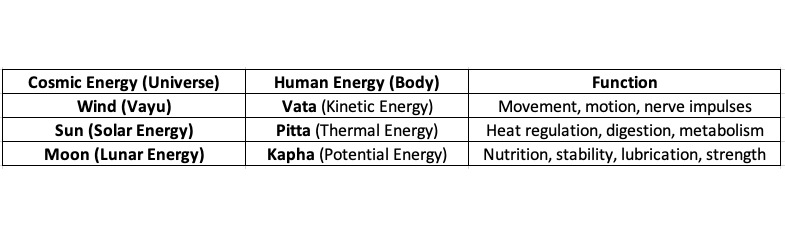
Representation of Elements in human beings
The five elements are present in various living and non-living things in various ratios and proportions. Living things have five elements and a soul whereas non-living have only 5 elements in their composition.
These 5 elements represent themselves in the form of 3 energies in humans called “Dosha’ or Tri-Dosha. These dosha can also be called Tri-Energies.
The “Tridosh” Principle or Tri — energies
Another fundamental theory of Ayurveda is the “Tridosh” principle or the tri-energies theory. This can also be understood as combination of panchbhutas (Five Elements) into 3 the 3 biological or physiological and physical forces that cater to the metabolic functions and structural composition of our body. The balance of these tri-energies is known as a state of health and their imbalance is disease. Anything which restores this balance is good for health. So any diet, exercise, behavior or medicine can be recommended to restore this balance and provide health. The tri-energies are
Tridosha Energy Counterpart — Elementary Composition
Vata — Kinetic Energy — composed of Air + Ether
Pitta — Thermal Energy — composed of Fire
Kapha — Potential Energy — composed of Earth + Water
This is the physical elementary composition of 3 basic energies that act in synergy to maintain the health of the body. Their balance is responsible for health maintenance at the physical level. However there are many more principles of Ayurveda in further chapters of this book which lay strong emphasis on balance and coordination between senses-body-mind-soul axis for complete physical, mental, social and spiritual well being.
Ayu (Life) is not merely life span measured in chronological years but it is union of mind-body-senses and soul. So there is a great importance of mind and soul in Ayurveda.
CHAPTER — 2 CONCEPT OF 25 ELEMENTS
In the previous chapter, we learned the concept of 5 elements and 3 energies i.e. Vata, Pitta and Kapha. Now we will go into deeper details of 5 elements and other fundamentals of Ayurveda. We will learn how this world originated, what are the various components, which a human being is made of.
The 25 elements are —
1 Soul — Atma
1 Nature — Prakriti
1 Ego — Ahankaar
1 Intelligence — Budhi
1 Mind — Manas
5 Knowledge acquiring senses- Tongue, Eyes, Ears, Nose, Skin
5 Working Senses — Hands, Feet, Speech, Reproductive organs, Anus
5 Subtle forms of physical elements (5 Tanmatras) — Hearing, Touch, Sight, Taste, Smell 5 Physical elements- Earth, Water, Fire, Air, Ether
25 Elements in total
— — — — — — — — — — — — — — — — — — — — — — — — — — — — — — — — — — — — — — — — — — — — — — — — — — — — — — How this world originated —
Ayurveda firmly believes in the presence of God and Soul. According to Ayurveda, the world originated initially by union of the soul with the cosmic matter or nature (Prakriti).
It first involved the Soul (Purusa) and Cosmic Matter (Prakriti) which combined to form intelligence (Buddhi).
Cosmic matter is lying in nature in inert form initially and is in 3 unmanifested qualities Goodness, Passion, Ignorance. Goodness is Sattva Guna, Passion is Rajas Guna and Ignorance is Tamas Guna according to Ayurveda. Guna means quality in Sanskrit.
These qualities are present in nature or cosmic matter in inert form.
Once these properties (Gunas) of Prakriti (nature) combine with Soul, they give rise to intelligence and ego, which are the active forms of nature.
Intelligence and Ego are products of combination of Nature with soul.
Nature (Sattva, Rajas, Tamas) gives rise to ego (Ahankaar) after combining with soul. The ego gives rise to mind (Manas). So 3 types of mental properties arise. People with Sattva, Rajas and Tamas mind arise.
The 3 types of egos combine to form mind, 10 senses and 5 subtle and 5 physical elements.
CHAPTER — 3 Place and Actions of Vata-Pitta-Kapha
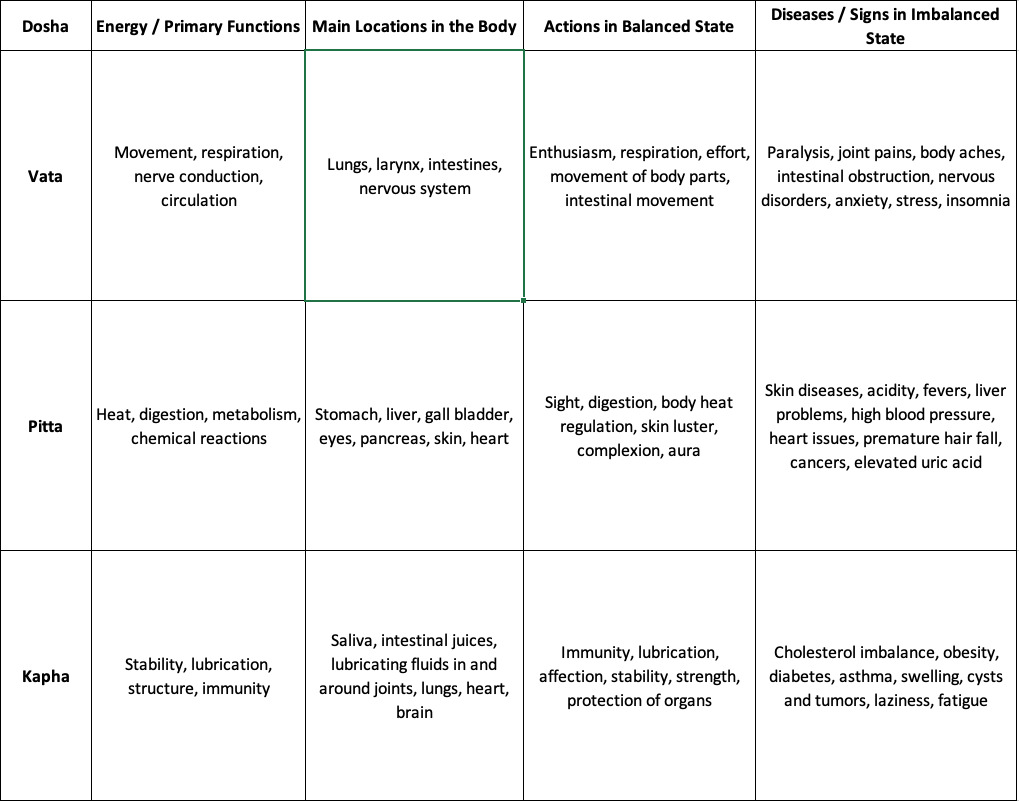
ATTRIBUTES OF TRI- ENERGIES
The tri-energies in humans are responsible for physical, biological and mental attributes of a person. All three of them have different characteristics and express their attributes in the individual. For understanding it in a very easy way, we can simply say that “Vata” or Kinetic energy is just like air in the universe, Pitta or Thermal energy is just like Fire and Kapha or Potential energy is just like Earth.
These Vata, Pitta and Kapha provide basic characters of Air, Fire and Earth in the body. Some of the typical attributes of Vata, Pitta and Kapha people are explained in the tables.
Physical and functional attributes of the tri-energies Vata — (AIR + ETHER) — Nervous System, Movements
Vata: Vata or Vayu is compared with Kinetic energy within the body. All the movements in the universe and inside the body are considered to be because of “Vata”. All the planetary movements, revolving of electrons around the nucleus, anything which moves has Vata
component in it. There are 5 types of Vata in our body.
1. Prana (Vata controlling respiratory function)
2. Udana (Vata controlling speech function)
3. Samana (Vata aiding digestive process, intestinal movements)
4. Vyana (Vata responsible for body movements, movement of blood) 5. Apana (Vata controlling evacuation of stool, urine)
Location of Vata in our body: According to Ayurveda, the location of Vata in our body is — large intestine (Colon, rectum), urinary bladder, urinary tract, spine, thighs and legs.
Functions of Vata in our body: It governs the physical movement of the body, circulates the body fluids, controls respiration, stimulates excretion of digestive juices, regulates peristaltic movements of intestines. In other words, it can be said that it controls neuro-hormonal system. The neurotransmitters, hormones can be considered as moving from one organ to the other because of Vata.
Emotions controlled by Vata: Fear, stress, anxiety, impatience are all aggravated and generally elevated in Vata type personalities and in case of increased Vata.
Physical attributes of Vata: Vata is rough, dry, light, mobile, cool and subtle.
Vata type personalities: Ayurveda has explained physical and mental characteristics of people having high Vata constitution. These can be read in the table provided.
Remedies for Vata disorders- Massage with hot Oils, Internal consumption of Ghee, Regular Sleep, Herbs like Ashwagandha, Ginger, Cumin, Turmeric, Guggul, Garlic, Asa foetida, Hot fomentation, Prayers and Meditation regulates Vata.
Pitta — (Fire) — Metabolism & other Chemical Reactions
Pitta: Pittta is compared with Thermal energy within the body. It is responsible for all the metabolic and chemical reactions occurring in our body. The heat energy or “the fire” required for a chemical reaction is “Pitta”.
There are five types of Pitta in our body.
1. Pachak — (Pachak Pitta) aids digestion and is located in stomach, small intestines) 2. Ranjak — (Ranjan” means to color something. Ranjak Pitta colors the blood red i.e. responsible for blood formation in our body.
3. Bhrajak — (Bhrajak Pitta) is present in skin and reflects skin luster and texture) 4. Sadhak — (Sadhak Pitta is present in heart. Any abnormality in Sadhak Pitta causes hypertension, palpitations and heart problems.
5. Aalochak — (Aalochak Pitta) is present in eyes and is responsible for vision.
Location of Pitta in our body: According to Ayurveda, the location of Pitta in our body is middle portion of our body. i.e. stomach, liver, spleen, duodenum, gall bladder, bile, small intestine, pancreas, heart, retina, skin and blood.
Functions of Pitta in our body: It governs the digestive process, metabolic and enzymatic activity within our body.
Emotions controlled by Pitta: Fear, stress, anxiety, impatience are all aggravated and in Pitta type personalities and also in case of increased Pitta.
Physical attributes of Pitta: Pitta is hot, sharp, acrid, oily and acidic.
Remedies for Pitta disorders- Fresh Green coconut water, All foods which are bitter especially pumpkin family fruits and vegetables like bottle gourd, long gourd, round gourd etc. All green leafy vegetables, Apples, Papaya, Melons, Dragon fruit, Herbs like Neem, Amla, Katuki, Aloe vera juice, Brahmi. Ghee should be used. Yoga and meditation also help in Pitta disorders.
Kapha — (Earth + Water) — Nutrition & Support
Kapha: Kapha is compared with Potential energy within the body. It has Earth and Water as its elemental constituents. So the attributes are just like earth and water. It provides stability to our body and cells. It is responsible for the structures to stick together, like bones joining with ligaments and muscles with tendons. It provides stability to the body and also to the mind. It is responsible for lubrication within the joints. In general, the fluid and solid structures constitute “Kapha” within the body. It is nutritive and supportive to the body. The adipose tissue is also a form of “Kapha” within our bodies.
There are five types of Kapha in our body.
1. Bodhak — “Bodhan” means to let you know. This Kapha is present in the salivary glands of the tongue and informs you about the taste of the food.
2. Kledak — “Kledak Kapha” aids digestion and is located in stomach, can be correlated with digestive juices. It moistens and softens food.
3. Tarpak- “Tarpan” means to provide nutrition and Support. It has nutritive functions. Cerebrospinal fluid can be correlated with “Tarpak Kapha”. Sense organs are also getting nutrition and support from “Tarpak Kapha.
4. Avlambak — Avlamban means to cover. It covers vital organs like heart, and lungs. It can be understood as shock absorbing fluid layers in and around vital organs. 5. Shleshak — “Shleshak” means lubricant. It is present in between the joints. It can be correlated with synovial fluid present within the joints.
Location of Kapha in our body: According to Ayurveda, the location of Kapha in our body is Upper portion of our body. i.e. Lungs, Throat, Larynx, Nose, Brain, Eyes.
Functions of Kapha in our body: It is responsible for nutrition and support within our body. It keeps the structures bound to each other. It acts as a cohesion agent.
Emotions controlled by Kapha: Patience, Mental Stability, Slowness, More retaining abilities.
Physical attributes of Kapha: Kapha is cool, sticky, dull, oily and sweet
Remedies for Kapha disorders- Since Kapha is heavy, cool dull, sticky, immobile in order to burn Kapha we will need diet/herbs which are rich in subtle, hot, mobile properties. The herbs useful for Kapha are all spices like turmeric, cinnamon, clove, ginger, garlic, holy basil, are all good for Kapha.
CHAPTER — 4 The Human Constitition — Body types or Prakriti
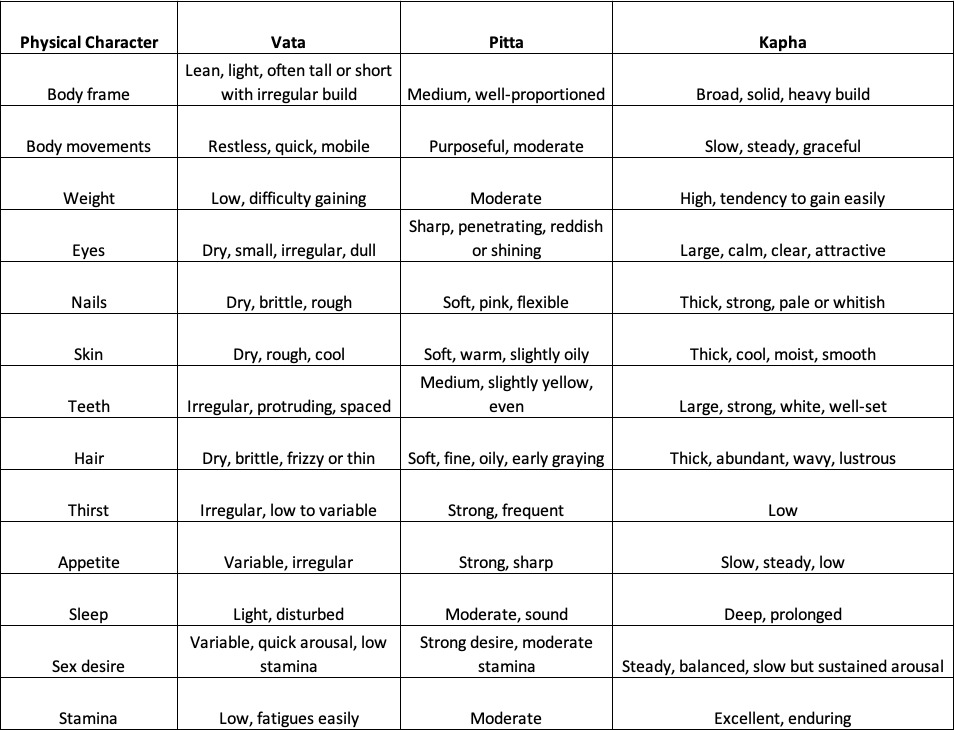
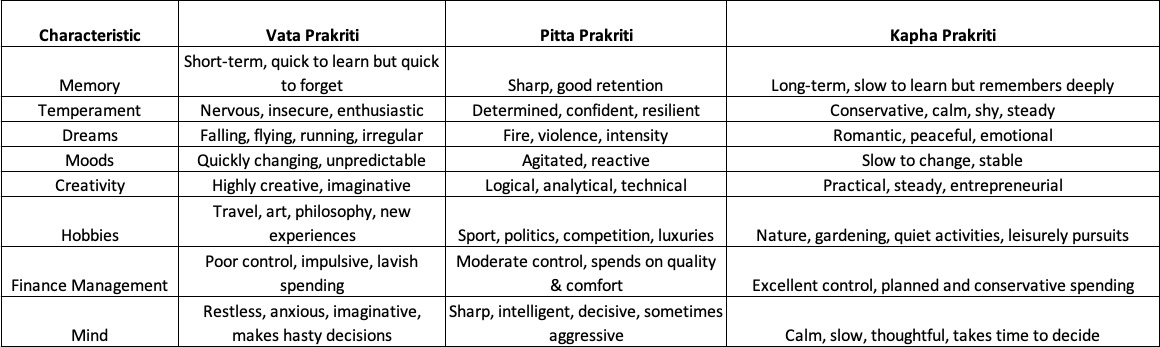
Another concept that is unique to Ayurveda is Prakriti (The Constitution). The physical, mental and personality characteristics of a person are known as “Prakriti” or Constitution of the person. The Prakriti is further classified into two types — physical and mental. The Prakriti of a person is determined at the time of conception and depends upon the state of doshas at that time. The people are classified into Vata, Pitta and Kapha types. It is also common for a person to have traits of one or more doshas in his personality and that makes it twin dosha or tri dosha personalities. The seven combinations of Doshas, which lead to the following body types of humans, are classified as —
1) Vata type 2) Pitta Type 3) Kapha Type 4) Vata-Pitta Type 5) Pitta-Kapha Type 6) Vata-Kapha Type 7) Vata-Pitta-Kapha Type.
Physical appearance of people according to Prakriti (Dosha Predominance) :
Psychological/Mental characteristics of people with various Prakritis (Dosha dominance)
Psychological/Mental characteristics of people with various Prakritis (Dosha dominance)
CHAPTER- 5 Concept of Tissues, Channels & Ojas Dhatus — The Seven Tissues
Tissues are important indicators of various symptoms and manifestation of diseases. So their knowledge is important. According to Ayurveda there are seven layers of tissues or “Dhatus” in our body. These are the constructing, supporting elements. The health of these tissues is directly affected in case of imbalance in “Vata, Pitta and Kapha”. The health of these tissues can be maintained by keeping the balance of doshas through proper diet, exercise, nutrition and rejuvenation programs. These are the following “Dhatus’ which can be corresponded with —
Rasa — Plasma
Rakta- Blood
Mamsa- Muscle tissue
Meda- Adipose tissue
Asthi- Bone
Majja- Bone marrow and nerve tissue
Shukra and Artav- Semen and female reproductive/menstrual discharge
All the tissues get nutrition through the food we eat. These tissues provide support, nutrition to the body and sustain it. The tissues mentioned above are formed in the body in the same sequence from the food we eat.
The seven tissues are also formed of five elements as every other thing in this universe is made up of. During digestion, the food is converted into nutritive juice (Aahar Rasa) and waste material (Malas). All the tissues are formed from this nutritive juice called Aahar Rasa.
Srotas — The Channels in the body
Бесплатный фрагмент закончился.
Купите книгу, чтобы продолжить чтение.